Although digital technology is playing an increasingly significant role in education and students are using digital technology in their everyday lives, the use of digital technology in their academic learning is still very limited. The literature indicates that the individual factors, such as computer self-efficacy and attitude, are significant predictors of whether or not individuals intend to use technology. In this context, a research conducted to investigate the effect of undergraduate students’ computer self-efficacy and attitude toward digital technology on their intention to use digital technology in their academic learning. The objective of this research was to examine the effect of individual factors on undergraduate students’ intentions to use innovative digital technology in their academic learning. A survey was conducted on undergraduate students in spring, summer, and fall semesters at a regional campus of a large public university. The research findings support the literature that computer self-efficacy and attitude have significant effects on undergraduate students’ intention to use digital technology in their academic learning. Therefore, both factors should be considered important in the process of implementation of digital technology in undergraduate learning environment. The results from this study will provide educators and administrators in higher educational institutions a better understanding about the undergraduate students’ adoption of digital technology in their learning process.
Integration of emerging digital technology in academic learning is becoming prevalent in educational institutions. The fast changing digital technology is highly influencing the higher education by enhancing effective learning and providing students unprecedented immediate access to up-to-date course content 1. The advancement in digital technology, along with lowering costs, has increased the adoption of such technology for learning in academic institutions. Today, without incorporating the advance digital technology no educational institution can expect to excel in their students’ learning experience 2, 3. Research shows that the advent of digital technology to educational institutions has improved the learning process because students learning skills can be improved using digital technology 4. As a result, increasing numbers of higher education institutions are integrating innovative digital technologies such as Learning Management Systems, digital apps, Web 2.0, social media, and other digital media as instructional tools to enhance implementation of learning objectives 5, 6. In fact, to remain competitive, higher education institutions are emphasizing on greater use of digital technology for effective learning.
However, students can be benefitted from using digital technology in their academic learning only if they actively and effectively integrate this technology in their learning method 7. Today’s undergraduate students are using innovative digital technology extensively in their everyday lives primarily for socializing and entertainment. They are spending much of their time using interactive multimedia, social media, online games, etc. 8. They are the generation with extensive experience in using digital technology such as Web 2.0, social media, etc. 6. But, students’ use of digital technology in their academic learning is still relatively low 9. As digital technology becomes ever-present in students daily life, it is important for instructors to use those technologies to enhance their students’ participation in interactive learning to improve learning outcomes 10. In this context, understanding the factors that affect undergraduate students’ intentions to use digital technology in their academic learning is an important research issue 8. Identifying those factors can help educators and academic administrators understanding of undergraduate students’ use of digital technology in their academic learning method.
Unfortunately, the understanding of how emerging digital technology is used for academic learning from the students’ perspective is still quite limited 11. Acceptance of emerging digital technology has been studied in great detail by researchers in the field of Information Technology. Even, the acceptance of digital technology in education is a dominant concern of research and practice. However, compared to studies on other areas, undergraduate students’ intentions to use digital technology in their academic learning has not been assessed and thoroughly understood. Thus, a better understanding of digital technology use in academic learning from the undergraduate students’ perspective is crucial 7, 11, 12. What is also missing in current literature on undergraduate students’ adoption of digital technology for academic learning is a conceptualization of individual factors. Most literature on digital technology in education has a specific focus on the characteristics of the technology itself 13, but to gain a full understanding of why a particular technology is or is not used, careful attention need to be paid on individual factors. Individual factors are the psychological characteristics of the individual making the decision about acceptance of technology 14. In this context, this study intended better understanding of the issue by focusing on the individual factors that may have effect on undergraduate students’ intention to use digital technology in their academic learning method.
A variety of theoretical models have been developed, with varying levels of theoretical and empirical support, to explain the factors that contribute to acceptance of technology. This effort to find the determinants of technology acceptance has been supported by cognitive behavioral models. Primarily developed from theories in psychology and sociology, these theoretical models have explained contribution of individual factors on people’s acceptance of technology 15. The Theory of Reasoned Action 16, Theory of Planned Behavior 17, Social Cognitive Theory 18, Diffusion of Innovation Theory 19, and Technology Acceptance Model (TAM) 20 focused on the influence of individual factors on people’s acceptance of technology. Those cognitive theoretical models are useful to explain people’s acceptance of technology from individual perspective 21 because all of them emphasize on individual factors to explain people’s technology acceptance. Many studies focused on the contribution of individual factors on individuals’ acceptance of technology based on those models 15. Especially, the Technology Acceptance Model (TAM) has supported by extensive empirical research 9.
According to TAM, people’s decision to accept new technology is the product of their rational analysis of its desirable perceived outcome, namely Perceived Usefulness and Perceived Ease of Use 20. Thus, Perceived Usefulness and Perceived Ease of Use are the determinants of intention to use the technology, which in turn determines actual use of technology 22. Davis 20 defined Perceived Usefulness as “the degree to which a person believes that using a particular system would enhance his or her job performance” (p. 320). He defined Perceived Ease of Use as “the degree to which a person believes that using a particular system would be free of effort” 20.
2.1. Computer Self-EfficacyCompeau and Higgins 23 introduced Computer Self-Efficacy (CSE) as an important construct to explain people’s acceptance of computer technology. The CSE derived from self-efficacy construct, which is the key element of Social Cognitive Theory developed by Bandura, refers to people’s beliefs in their ability to use computer 24, 25. Self-efficacy is not about the assessments of the actual skills that a person may possess, but it is instead about the level of confidence the person has in his or her ability to perform the task successfully. Bandura 18 identified self-efficacy as “people’s judgment of their capabilities to organize and execute a course of action required to attain designated types of performance. It is not with the skills one has but with judgments of what one can do with whatever skills one possesses.” (p. 391)
Compau and Higgins 23 stated that CSE is a specific type of self-efficacy, which is people’s believe in their capability to use computer. They argued that people’s use of computer largely influenced by their CSE 23.
Literature shows that CSE has a significant positive influence on people’s acceptance of learning technology and performance 25. The research findings suggest that CSE is a strong predictor of a variety of computing attitudes, beliefs, behaviors, and performance. People with higher CSE are less anxious about computer, use computers more, and perform better in different computer tasks 26.
2.2. Attitude toward Digital TechnologyAccording to Ajzen and Fishbein 16, “Several meta-analyses of the empirical literature have provided evidence to show that intentions can be predicted with considerable accuracy from measures of attitudes toward the behavior, subjective norms, and perceived control or self-efficacy” (p. 196). Attitude is defined by Ajzen 27 as “a disposition to respond favorably or unfavorably to an object, person, institution, or event” (p. 3). According to Allport 28, “An attitude is a mental and neural state of readiness, organized through experience, exerting a directive or dynamic influence upon the individual’s response to all objects and situations with which it is related” (p. 810). In his theory of planned behavior, Ajzen 17, 27 linked attitude and behavior through the description of three types of belief systems that guide individual behavior; namely, behavioral beliefs, normative beliefs, and control beliefs. A combination of these three belief systems produces a behavioral intention, which is assumed as an immediate antecedent of actual behavior. Therefore, attitude can influence actual behavior 29.
Davis, Bagozzi, and Warshaw 30 stated that attitude is the degree to which the individual is interested in specific technology, which has a direct effect on the intention to use as well as actual use of those technology. The extent to which technology are actually used over a certain period of time is influenced by the intention to use 30. Since intention can be predicted by attitude towards a behavior, it is reasonable to predict that students’ favorable attitudes will lead to their favorable behavior 29. Research findings revealed that students’ attitudes toward digital technology are influential in determining their technology-based learning experiences. In this context, it is important to consider undergraduate students’ attitude regarding their intention to use digital technology in their academic learning 4, 29.
2.3. Intention to Use of Digital TechnologyIn research on acceptance of technology, actual use of technology is a key dependent variable and intention to use is a valid predictor of actual use of technology 31. The actual use of a technology has been long hypothesized to be dependent on behavioral intention to use technology 21. Davis et al. stated that individuals’ actual use of technology can be predicted reasonably well from their intention to use technology. A stream of theoretical models such as Technology Acceptance Model (TAM), Theory of Planned Behavior, and Diffusion of Innovation Theory have focused on individuals’ attitude and behaviors toward new technology, explaining intention to use technology models. TAM especially has been the focus of numerous studies that examined individuals’ beliefs, intention to use, and actual use of technology 22. In TAM, the intention to use variable has more variation in measurement where participants are usually asked about their use or future use of a technology, typically in terms of: (1) likely frequency of use, (2) likelihood of use, and/or (3) likely amount of use time 32.
In Theory of Planned Behavior, the best way to predict behavior is to measure behavioral intention. According to Ajzen 33, intention plays an important role in guiding individual behavior, and relatively stable intentions are a better predictor of subsequent behavior. Individuals’ intentions capture the motivational factors that influence their behavior, and thus, indicate how hard individuals are willing to try or to what extent they are planning to make an effort, in order to perform the behavior. Thus, the intention to use is the primary antecedent of actual use 33. According to Fishbein and Azen 34, behavior is the direct positive function of behavioral intention; therefore, intention is the best single predictor of behavior. Consequently, intention to use technology has a direct effect on the actual use of technology.
The aforementioned theoretical models explain that individual factors influence individuals’ intention concerning a particular behavior, which in turn led to their actual behavior. Correspondingly, individuals’ individual factors such as computer self-efficacy and attitude may contribute to their intention to use technology that in turn influence their actual use of technology.
2.4. Digital Technology as Learning ToolEmerging digital technology, as an effective critical tool in learning experience, is changing the instructional and learning process 13. With advanced digital technology, the opportunities for more flexible technology-supported learning environment emerges for undergraduate students. The integration of digital technology play important role in moving students’ learning process from instructor-centered to student-centered 35, 36. The role of digital technology in delivering course learning objectives continues to grow with achievement of effective learning outcomes 4. Those innovative digital technology also has been increasingly support instructors by providing instructional tools that help them to transform their instructional method efficiently. As a result, in recent years, more and more instructors are interested in integrating digital technology as instructional tools in their classes. They are using digital technology as a cost-effective instructional tool to improve and enhance their students’ learning outcomes 7, 37.
According to Süleyman and Özlem 38, the world is becoming a mobigital virtual space where learning and teaching digitally is possible from anywhere and anytime. Today, when timely access to information is vital, mobile devices such as laptop, tablet, iPads, Smart phone, mp3 and mp4 players, iPods, digital cameras, Personal Digital Assistance (PDA), netbook, e-Reader such as the Kindle, Nook, etc. have become common devices used by younger generation, especially undergraduate college students. Social media and other digital tools that promote collaboration and information sharing, can be used in academic settings to enhance undergraduate student engagement and facilitate better learning process. Digital communication in social media such as texting, Twitting, Instagramming, etc. can strengthen undergraduate students’ learning skills. Therefore, social media can be used to create high level of students’ engagement, promote collaborative learning environments with positive effects on the teaching and learning process 6, 39. Academic professionals and scientific community see a large potential in integrating social media technology in higher education. Research shows that the use of social media in learning can impact students’ academic achievement in significant level. Social media that includes a variety of web-based tools and services such as blogs, wikis, multi-media (audio, photo, video, text, etc.), sharing tools, and other platforms i.e., Facebook, Twitter, Instagram, YouTube etc. can be used as learning tools to increase students engagement for effective learning 40.

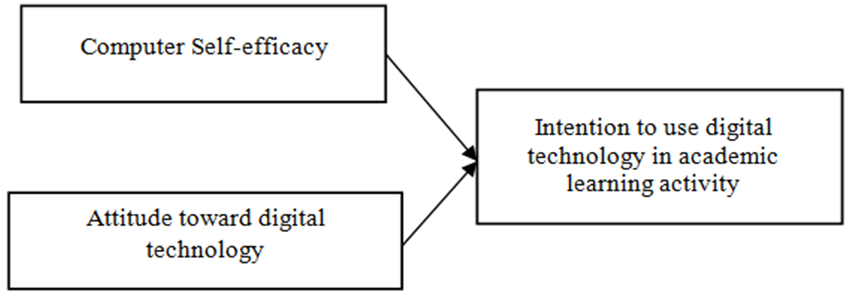
The purpose of this study was to assess how individual factors affect undergraduate students’ intention to use digital technology in their academic learning process. The literature review outlines the key individual factors related to individuals’ intention to use digital technology. Based on the research findings and theoretical models in existing literature, this study investigated the contribution of two specific individual factors on the undergraduate students’ intention to use digital technology in their academic learning. Consequently, the study specifically addressed the following questions:
1) What effect undergraduate students’ computer self-efficacy has on their intention to use digital technology in academic learning?
2) What effect undergraduate students’ attitude toward digital technology has on their intention to use digital technology in academic learning?
The target population of this study was undergraduate students of public or private academic institutions. The sample for this study was full-time and part-time undergraduate students enrolled in different online or on-campus classes in Business, Law, and Technology department at a regional campus of a large public university. Any student aged under 18 was excluded from the study. Total 94 students participated in the survey with response rate of about 35%.
3.2. Data Collection Procedure and MeasuresIn this study, an electronic survey instrument was used as a multi-item, Likert-type scale for empirical investigation. After receiving IRB approval, the electronic survey including instructions, study information, and the survey link, was sent to students via e-mail. It was clear to students that their participation in the survey is completely voluntary and anonymous. In addition, students were requested to read the study information before participating in the web survey. The study information informed students of their rights as research participants. The survey was conducted throughout three semesters in the spring, summer, and fall.
3.3. Participants’ Demographic InformationThe demographic part of the questionnaire was administered to have general assessment of participants’ gender, age, and program of study. The Table 1 shows the demographic information of the undergraduate students participated in the survey. Out of 94 students, 69 were male and 25 were female students.
3.4. Statistical AnalysisThe survey data was analyzed using the statistical software SPSS 22. The quantitative analysis of collected data explained if aforementioned individual factors computer self-efficacy and attitude toward digital technology have effect on students’ intention to use digital technology in their academic learning. After pre-analysis data screening procedure, reliability and validity tests, the final screened dataset retained for further statistical analyses. Multiple Linear Regression (MLR) Analysis was used to study the effect of independent variables computer self-efficacy and attitude toward digital technology on dependent variable students’ intention to use digital technology in their academic learning. MLR model was used to test linear relationship between independent variables and dependent variable.
In order to perform Multiple Linear Regression (MLR) Analysis, each construct’s items were aggregated. For each construct’s item aggregation, the average of items was measured in five response levels. Using those aggregated measures created for computer self-efficacy (CSE), attitude toward digital technology (ATT), and intention to use digital technology (IU), the MLR model was performed. Table 2 and Table 3 show the results of MLR analysis.
The MLR results, as shown in Table 2 and Table 3, for predicting IU from four predictors CSE and ATT, indicate that both predictors are strongly significant with an overall prediction model: R2 = .857, Adjusted R2 = .854, F(df = 2, n = 91) = 272.859, p < .001. The finding value of adjusted R2 in this study indicated that the independent variables account for 85% of the accumulated variance.
That is, the aforementioned predictive constructs CSE and ATT in combination have significant effects on dependent variable IU. In particular, as shown in Table 3, weight-wise the impact of CSE on dependent variable IU was greater (β = .758, p < .001) than ATT (β = .519, p < .001). These weights represent the strength of independent variables in their effect on dependent variable. The β = .758 for CSE represents that for one unit increase in CSE, IU would increase by .758 units. The β = .519 for ATT represents that for one unit increase in ATT, IU would increase by .519 units. It is important to note that the relationship between a particular independent variable and dependent variable is valid only when holding the other independent variables constant.
The purpose of this study was to empirically assess the individual factors such as computer self-efficacy, and attitude toward digital technology on undergraduate students’ intention to use digital technology in their academic learning. The population in this empirical study was undergraduate students in Business, Law, and Technology department in a regional campus of a large public university. Total 94 students participated in the survey yielding a response rate of about 35%. The MLR analysis of collected data from the survey address the research questions. The results indicated that both aforementioned individual factors computer self-efficacy, and attitude toward digital technology have significant effect on undergraduate students’ intention to use digital technology in their academic learning. The MLR analysis showed that both predictive variables computer self-efficacy and attitude toward digital technology in combination have significant effect on dependent variable undergraduate students’ intention to use digital technology in their academic learning. MLR analysis indicated that the aforementioned independent variables account for 85% of the variation of dependent variable. The MLR model analysis also showed that weight-wise, the impact of predictive variable computer self-efficacy was greater on dependent variable undergraduate students’ intention to use digital technology in their academic learning than the attitude. These results addressed the research questions of this empirical study.
The study made theoretical and practical contributions to the literature on integration of digital technology by undergraduate students in their academic learning. The empirical findings showed that computer self-efficacy has significant effect on students’ intention to use digital technology in their learning. This finding supports previous findings by Campeau and Higgins 23 that computer self-efficacy is an important factor that affects individual’s intention to use technology. The empirical results also showed that attitude toward digital technology has significant effect on students’ intention to use digital technology in their academic learning. This finding supports previous findings by other researchers that attitude towards technology is a critical factor that affect individual’s intention to use technology. Davis, Bagozzi, and Warshaw 30 stated that attitude is the degree to which the individual is interested in specific technology, which has a direct effect on the intention to use as well as actual use of those technologies. More specifically, both individual factors found consistent and statistically significant predictors that have practical importance in undergraduate students’ acceptance of digital technology in their academic learning processes. Consequently, these factors should be considered essential in the process of implementation of digital technology in undergraduate learning environment.
5.1. ImplicationsThis study could have practical importance for any educators and administrators in higher academic institutions as they plan to implement digital technology in the undergraduate program. The implication of this study is to understand the individual factors that affect undergraduate students’ intention to use digital technology in their academic learning. This understanding expects to help academic administrators and educators to make better decisions when integrating digital technology in learning environment in their institutions. To ensure technology acceptance among undergraduate students in classroom learning, those individual factors need to be taken into serious consideration by the digital technology practitioners also. The findings implied that digital technology practitioners in education should not only concern with basic software design and development, but they also need to address individual factors of the users.
5.2. Study Limitations and Suggestions for Future ResearchThe study has some limitations that suggest caution in interpreting the findings, but at the same time, offer possibilities for future research. Thus, those limitations also present an opportunity for future researchers to investigate. First, the study findings are based on a limited sample; consequently, the findings and conclusions cannot be used to generalize too broadly. The reduced size of the sample employed in drawing the results of this small-scale study makes it a difficult proposition to generalize its findings to larger populations. Therefore, further studies are needed to investigate the effect of individual factors on undergraduate students’ intention to use digital technology in their academic learning process. The study has the potential to be replicated in a number of different sized educational institutions to see if similar findings occur. Second, about 86% of the participants in this study were from Information Technology- and Information Systems-related undergraduate programs of study. Further research could examine responses from undergraduate students who are enrolled in different academic programs. Third, the results of the study rely on participants’ self-reported data on usage of and experience with digital technology, which may not always provide the most accurate information, because individual factors are a subjective state of mind that can be influenced by different social or environmental factors. Future research can be conducted to collect data with additional factors minimizing aforementioned limitations.
| [1] | Abuzir, Y., “The development of virtual laboratory using SEMMLABs in Al-Quds Open University,” The International Journal of E-Learning and Educational Technologies in the Digital Media (IJEETDM), 1(2), 133-141. (2015). | ||
| In article | View Article | ||
| [2] | Omar, A., Kalulu, D., & Alijani, S. G., “Management of innovative e-learning environments,” Academy of Educational Leadership Journal, 15(3). (2011). | ||
| In article | |||
| [3] | Agbatogun, A. O., “Exploring the Efficacy of Student Response System in a Sub-Saharan African Country: A Sociocultural Perspective,” Journal of Information Technology Education: Research, 11, 249-267. (2012). | ||
| In article | View Article | ||
| [4] | Wong, L., & Fong, M., “Student attitudes to traditional and online methods of delivery,” Journal of Information Technology Education: Research, 13, 1-13. (2014). | ||
| In article | View Article | ||
| [5] | Abrantes, L. S., & Gouveia, B. L., “Learning Environments,” Proceedings of Informing Science & IT Education Conference (InSITE) 2010. | ||
| In article | |||
| [6] | Dron, J., & Anderson, T., “On the design of social media for learning,” Social Sciences, 3, 378-393. (2014). | ||
| In article | View Article | ||
| [7] | Shroff, H. R., Deneen, C. C., & Ng, E. M. W., “Analysis of the technology acceptance model in examining students’ behavioural intention to use an eportfolio system,” Australasian Journal of Educational Technology, 27(4), 600-618. (2011). | ||
| In article | View Article | ||
| [8] | Rodriguez, E. T., & Lozano, M. P., “The acceptance of Moodle technology by business administration students,” Computers & Education, 58, 1085-1093. (2012). | ||
| In article | View Article | ||
| [9] | Padilla-Meléndez, A., Aguila-Obra, A., R., & Garrido-Moreno, A., “Perceived playfulness, gender differences and technology acceptance model in a blended learning scenario,” Computers & Education, 63, 306-317. (2013). | ||
| In article | View Article | ||
| [10] | Chuang, Y-T., “A teaching philosophy that utilizes instructional technologies to improve learning motivation,” The International Journal of E-Learning and Educational Technologies in the Digital Media (IJEETDM), 1(2), 121-132. (2015). | ||
| In article | View Article | ||
| [11] | Lai, C., Qiu, W., & Lei, J., “What factors predict undergraduate students’ use of technology for learning? A case from Hong Kong,” Computers & Education 59, 569-579. (2012). | ||
| In article | View Article | ||
| [12] | Shih, H., “Using a cognitive-motivation-control view to assess the adoption intention for Web-based learning,” Computer & Education, 50, 327-337. (2008). | ||
| In article | View Article | ||
| [13] | Musawi, A. S. A., “Redefining technology role in education,” Creative Education – Scientific Research, 2(2), 130-135. (2011). | ||
| In article | View Article | ||
| [14] | Mathieson, K., & Chin, W. W., “Extending the technology acceptance model: The influence of perceived user resources,” The DATA BASE for Advances in Information Systems, 32(3), 86-112. (2001). | ||
| In article | View Article | ||
| [15] | Venkatesh, V., Thong, J. Y. L., & Xu, X., “Consumer acceptance and use of information technology: Extending the unified theory of acceptance and use of technology,” MIS Quarterly, 36(1), 157-178. (2012). | ||
| In article | View Article | ||
| [16] | Ajzen, I., & Fishbein, M., Understanding attitudes and predicting social behavior. Englewood Cliffs, NJ: Prentice-Hall, 1980. | ||
| In article | |||
| [17] | Ajzen, I. From intentions to actions: A theory of planned behavior. In J. Kuhl & J. Beckmann (Eds.), Action control: From cognition to behavior, New York: Springer, 1985, 11-39. | ||
| In article | View Article | ||
| [18] | Bandura, A., Social foundations of thought and action: A social cognitive theory. Englewood Cliffs, NJ: Prentice Hall, 1986. | ||
| In article | |||
| [19] | Rogers, E. M., Diffusion of innovations (4th ed.). New York: The Free Press, 1995. | ||
| In article | |||
| [20] | Davis, F. D., “Perceived usefulness, perceived ease of use, and user acceptance of information technology,” MIS Quarterly, 13(3), 319-340. (1989). | ||
| In article | View Article | ||
| [21] | Ferdousi, B., & Levy, Y., “Development and Validation of a Model to Investigate the Impact of Individual Factors on Instructors’ Intention to Use E-learning Systems,” Interdisciplinary Journal of E-Learning and Learning Objects, 6, 1-21. (2010). | ||
| In article | View Article | ||
| [22] | Brown, A.S., Venkatesh, V., & Goyal, S., “Expectation confirmation in technology use,” Information Systems Research 23(2), 474-487. (2012). | ||
| In article | View Article | ||
| [23] | Compeau, D. R., & Higgins, C. A., “Computer self-efficacy: Development of a measure and initial test,” MIS Quarterly, 19(2), 189-211. (1995). | ||
| In article | View Article | ||
| [24] | He, J., & Freeman, A. L., “Are Men More Technology-Oriented Than Women? The Role of Gender on the Development of General Computer Self-Efficacy of College Students,” Journal of Information Systems Education, 21(2). (2010). | ||
| In article | View Article | ||
| [25] | Hauser, R., Paul, R., & Bradley, J., “Computer Self-Efficacy, Anxiety, and Learning in Online Versus Face to Face Medium,” Journal of Information Technology Education: Research, 11. (2012). | ||
| In article | View Article | ||
| [26] | Downey, J. P., & Kher, H. V., “A longitudinal examination of the effects of computer self-efficacy growth on performance during technology training,” Journal of Information Technology Education: Research, 14, 91-111. (2015). | ||
| In article | View Article | ||
| [27] | Ajzen, I., Attitudes, personality, and behavior, McGraw-Hill Education (UK), 2005. | ||
| In article | |||
| [28] | Allport, G. W., Attitudes. In C. M. Murchison (Ed.), Handbook of Social Psychology, Worcester, MA: Clark University Press, 1935, 796-834. | ||
| In article | |||
| [29] | Larbi-Apau, A. J., & Moseley, L. J., “Computer Attitude of Teaching Faculty: Implications for Technology-Based Performance in Higher Education,” Journal of Information Technology Education: Research, 11. (2012). | ||
| In article | View Article | ||
| [30] | Davis, F. D., Bagozzi, R. P., & Warshaw, P. R., “User acceptance of computer technology: A comparison of two theoretical models,” Management Science, 35(8), 982-1003. (1989). | ||
| In article | View Article | ||
| [31] | Premkumar, G., & Bhattacherjee, A., “Explaining information technology usages: A test of competing models,” Omega – The International Journal of Management Science, 36, 64-75. (2006). | ||
| In article | View Article | ||
| [32] | Chan, H. C., & Teo, H., “Evaluating the boundary conditions of the technology acceptance model: An exploratory investigation,” ACM Transactions on Computer-Individual Interaction, 14(2), 1-22. (2007). | ||
| In article | View Article | ||
| [33] | Ajzen, I., “Nature and operation of attitudes,” Annual Review of Psychology, 52, 27-58. (2001). | ||
| In article | View Article PubMed | ||
| [34] | Fishbein, M., & Ajzen, I., Belief, attitude, intention, and behavior: An introduction to theory and research, Reading, MA: Addison-Wesley, 1975. | ||
| In article | |||
| [35] | Male, G., “Enhancing the quality of e-learning through mobile technology. A socio-cultural and technology perspective towards quality e-learning applications,” Campus-Wide Information Systems, 28(5), 331-344. (2011). | ||
| In article | View Article | ||
| [36] | Efe, R., “Science Student Teachers and Educational Technology: Experience, Intentions, and Value,” Educational Technology & Society, 14(1), 228-240. (2011). | ||
| In article | |||
| [37] | Ngafeeson, M. N., & Sun, J., “The effects of technology innovativeness and system exposure on student acceptance of e-textbooks,” Journal of Information Technology Education: Research, 14, 55-71. (2015). | ||
| In article | View Article | ||
| [38] | Süleyman, N. S. & Özlem, G., “Preservice teachers’ perceptions about using mobile phones and laptops in education as mobile learning tools,” British Journal of Educational Technology, 45(4), 606-618. (2014). | ||
| In article | View Article | ||
| [39] | Gonzalez, L., & Young, C., (2015). Can Social media impact learning? Retrieved from www.techlearning.com. | ||
| In article | |||
| [40] | Tarantino, K., McDonough, J., & Hua, M., “Effects of student engagement with social media on student learning: A review of literature,” The Journal of Technology in Student Affairs. (2013). | ||
| In article | |||
Published with license by Science and Education Publishing, Copyright © 2019 Bilquis Ferdousi
 This work is licensed under a Creative Commons Attribution 4.0 International License. To view a copy of this license, visit
http://creativecommons.org/licenses/by/4.0/
This work is licensed under a Creative Commons Attribution 4.0 International License. To view a copy of this license, visit
http://creativecommons.org/licenses/by/4.0/
| [1] | Abuzir, Y., “The development of virtual laboratory using SEMMLABs in Al-Quds Open University,” The International Journal of E-Learning and Educational Technologies in the Digital Media (IJEETDM), 1(2), 133-141. (2015). | ||
| In article | View Article | ||
| [2] | Omar, A., Kalulu, D., & Alijani, S. G., “Management of innovative e-learning environments,” Academy of Educational Leadership Journal, 15(3). (2011). | ||
| In article | |||
| [3] | Agbatogun, A. O., “Exploring the Efficacy of Student Response System in a Sub-Saharan African Country: A Sociocultural Perspective,” Journal of Information Technology Education: Research, 11, 249-267. (2012). | ||
| In article | View Article | ||
| [4] | Wong, L., & Fong, M., “Student attitudes to traditional and online methods of delivery,” Journal of Information Technology Education: Research, 13, 1-13. (2014). | ||
| In article | View Article | ||
| [5] | Abrantes, L. S., & Gouveia, B. L., “Learning Environments,” Proceedings of Informing Science & IT Education Conference (InSITE) 2010. | ||
| In article | |||
| [6] | Dron, J., & Anderson, T., “On the design of social media for learning,” Social Sciences, 3, 378-393. (2014). | ||
| In article | View Article | ||
| [7] | Shroff, H. R., Deneen, C. C., & Ng, E. M. W., “Analysis of the technology acceptance model in examining students’ behavioural intention to use an eportfolio system,” Australasian Journal of Educational Technology, 27(4), 600-618. (2011). | ||
| In article | View Article | ||
| [8] | Rodriguez, E. T., & Lozano, M. P., “The acceptance of Moodle technology by business administration students,” Computers & Education, 58, 1085-1093. (2012). | ||
| In article | View Article | ||
| [9] | Padilla-Meléndez, A., Aguila-Obra, A., R., & Garrido-Moreno, A., “Perceived playfulness, gender differences and technology acceptance model in a blended learning scenario,” Computers & Education, 63, 306-317. (2013). | ||
| In article | View Article | ||
| [10] | Chuang, Y-T., “A teaching philosophy that utilizes instructional technologies to improve learning motivation,” The International Journal of E-Learning and Educational Technologies in the Digital Media (IJEETDM), 1(2), 121-132. (2015). | ||
| In article | View Article | ||
| [11] | Lai, C., Qiu, W., & Lei, J., “What factors predict undergraduate students’ use of technology for learning? A case from Hong Kong,” Computers & Education 59, 569-579. (2012). | ||
| In article | View Article | ||
| [12] | Shih, H., “Using a cognitive-motivation-control view to assess the adoption intention for Web-based learning,” Computer & Education, 50, 327-337. (2008). | ||
| In article | View Article | ||
| [13] | Musawi, A. S. A., “Redefining technology role in education,” Creative Education – Scientific Research, 2(2), 130-135. (2011). | ||
| In article | View Article | ||
| [14] | Mathieson, K., & Chin, W. W., “Extending the technology acceptance model: The influence of perceived user resources,” The DATA BASE for Advances in Information Systems, 32(3), 86-112. (2001). | ||
| In article | View Article | ||
| [15] | Venkatesh, V., Thong, J. Y. L., & Xu, X., “Consumer acceptance and use of information technology: Extending the unified theory of acceptance and use of technology,” MIS Quarterly, 36(1), 157-178. (2012). | ||
| In article | View Article | ||
| [16] | Ajzen, I., & Fishbein, M., Understanding attitudes and predicting social behavior. Englewood Cliffs, NJ: Prentice-Hall, 1980. | ||
| In article | |||
| [17] | Ajzen, I. From intentions to actions: A theory of planned behavior. In J. Kuhl & J. Beckmann (Eds.), Action control: From cognition to behavior, New York: Springer, 1985, 11-39. | ||
| In article | View Article | ||
| [18] | Bandura, A., Social foundations of thought and action: A social cognitive theory. Englewood Cliffs, NJ: Prentice Hall, 1986. | ||
| In article | |||
| [19] | Rogers, E. M., Diffusion of innovations (4th ed.). New York: The Free Press, 1995. | ||
| In article | |||
| [20] | Davis, F. D., “Perceived usefulness, perceived ease of use, and user acceptance of information technology,” MIS Quarterly, 13(3), 319-340. (1989). | ||
| In article | View Article | ||
| [21] | Ferdousi, B., & Levy, Y., “Development and Validation of a Model to Investigate the Impact of Individual Factors on Instructors’ Intention to Use E-learning Systems,” Interdisciplinary Journal of E-Learning and Learning Objects, 6, 1-21. (2010). | ||
| In article | View Article | ||
| [22] | Brown, A.S., Venkatesh, V., & Goyal, S., “Expectation confirmation in technology use,” Information Systems Research 23(2), 474-487. (2012). | ||
| In article | View Article | ||
| [23] | Compeau, D. R., & Higgins, C. A., “Computer self-efficacy: Development of a measure and initial test,” MIS Quarterly, 19(2), 189-211. (1995). | ||
| In article | View Article | ||
| [24] | He, J., & Freeman, A. L., “Are Men More Technology-Oriented Than Women? The Role of Gender on the Development of General Computer Self-Efficacy of College Students,” Journal of Information Systems Education, 21(2). (2010). | ||
| In article | View Article | ||
| [25] | Hauser, R., Paul, R., & Bradley, J., “Computer Self-Efficacy, Anxiety, and Learning in Online Versus Face to Face Medium,” Journal of Information Technology Education: Research, 11. (2012). | ||
| In article | View Article | ||
| [26] | Downey, J. P., & Kher, H. V., “A longitudinal examination of the effects of computer self-efficacy growth on performance during technology training,” Journal of Information Technology Education: Research, 14, 91-111. (2015). | ||
| In article | View Article | ||
| [27] | Ajzen, I., Attitudes, personality, and behavior, McGraw-Hill Education (UK), 2005. | ||
| In article | |||
| [28] | Allport, G. W., Attitudes. In C. M. Murchison (Ed.), Handbook of Social Psychology, Worcester, MA: Clark University Press, 1935, 796-834. | ||
| In article | |||
| [29] | Larbi-Apau, A. J., & Moseley, L. J., “Computer Attitude of Teaching Faculty: Implications for Technology-Based Performance in Higher Education,” Journal of Information Technology Education: Research, 11. (2012). | ||
| In article | View Article | ||
| [30] | Davis, F. D., Bagozzi, R. P., & Warshaw, P. R., “User acceptance of computer technology: A comparison of two theoretical models,” Management Science, 35(8), 982-1003. (1989). | ||
| In article | View Article | ||
| [31] | Premkumar, G., & Bhattacherjee, A., “Explaining information technology usages: A test of competing models,” Omega – The International Journal of Management Science, 36, 64-75. (2006). | ||
| In article | View Article | ||
| [32] | Chan, H. C., & Teo, H., “Evaluating the boundary conditions of the technology acceptance model: An exploratory investigation,” ACM Transactions on Computer-Individual Interaction, 14(2), 1-22. (2007). | ||
| In article | View Article | ||
| [33] | Ajzen, I., “Nature and operation of attitudes,” Annual Review of Psychology, 52, 27-58. (2001). | ||
| In article | View Article PubMed | ||
| [34] | Fishbein, M., & Ajzen, I., Belief, attitude, intention, and behavior: An introduction to theory and research, Reading, MA: Addison-Wesley, 1975. | ||
| In article | |||
| [35] | Male, G., “Enhancing the quality of e-learning through mobile technology. A socio-cultural and technology perspective towards quality e-learning applications,” Campus-Wide Information Systems, 28(5), 331-344. (2011). | ||
| In article | View Article | ||
| [36] | Efe, R., “Science Student Teachers and Educational Technology: Experience, Intentions, and Value,” Educational Technology & Society, 14(1), 228-240. (2011). | ||
| In article | |||
| [37] | Ngafeeson, M. N., & Sun, J., “The effects of technology innovativeness and system exposure on student acceptance of e-textbooks,” Journal of Information Technology Education: Research, 14, 55-71. (2015). | ||
| In article | View Article | ||
| [38] | Süleyman, N. S. & Özlem, G., “Preservice teachers’ perceptions about using mobile phones and laptops in education as mobile learning tools,” British Journal of Educational Technology, 45(4), 606-618. (2014). | ||
| In article | View Article | ||
| [39] | Gonzalez, L., & Young, C., (2015). Can Social media impact learning? Retrieved from www.techlearning.com. | ||
| In article | |||
| [40] | Tarantino, K., McDonough, J., & Hua, M., “Effects of student engagement with social media on student learning: A review of literature,” The Journal of Technology in Student Affairs. (2013). | ||
| In article | |||



)
)