Urbanization is integrally connected to three pillars of sustainable development, economic development, social development and environment protection. Haphazard urban expansion leads to rapid sprawl, pollution and environmental degradation together with unsustainable production and consumption pattern. A comprehensive assessment and proper methodology are inevitable for urban planning. This study is to identify spatiotemporal trends of urban expansion and intensity in two Metropolitan cities: Thiruvananthapuram and Cochin city region (Kerala), To measure the magnitude and pace of urban growth and Urban proportional Index (UPI)and Urban Intensity Index (UII) were developed. GIS based buffer analysis was adopted in this study. Each buffer zone was employed as a basic spatial unit to characterize distance dependent urban growth behaviour with their UPI and UII values for a given time period. The results indicates that two distinct phases of urbanization are discernible in these. The trends in Urban behaviour of Thiruvananthapuram and Cochin are to be given grave concern and study being the administrative as well as commercial capital of Kerala state respectively.
Urbanisation in a demographic sense is defined as a process of growing population concentration whereby the proportion of the total population which is classified as urban is increasing. As far as urban growth is concerned there are three components; natural increase, net in-migration and changes in city boundaries which result in incorporation of previously rural places 1, 2. Urban areas are characterized by a central feature: they concentrate population, energy and materials, industrial and commercial activities, and buildings and infrastructure. It is not any single one of these factors, but the confluence of them that defines urban area. Indeed, although there is no uniform or globally consistent definition of “urban”, most countries define urban according to a criterion pertaining to some aspect of a region's population, economy, or built infrastructure 3. The only consistent thing about cities is that they are always changing cities since their inception have always demonstrated gradual, piecemeal change through processes of accretion, addition or demolition. This type of change can be regarded as largely cosmetic and the underlying processes of urbanisation and the overall structure of the city remained largely unchanged 4. To understand the mechanism of urbanisation of a particular region, it is necessary to understand the growth of its satellite towns and the trend of its urbanisation and its role in the growth of regional economy and how they contribute to development of city centre. 5
The basic premise in using remote sensing data for change detection is that the process can identify change between two or more dates that is uncharacteristic of normal variation. 6, 7, 8. Remote sensing allows retrospective viewing of earth’s surface, and time–series of remote sensor data can be used to develop a historical perspective of an urban attribute or process which can help examine significant human or natural processes that act over a long time period 9.
The urban population was estimated to be 2.96 billion in 2000 and 3.77 in 2010 10. It was estimated that nearly 50 million people are added to the world's urban population each year. The urbanization level has almost stabilized in developed countries. Africa and Asian countries are in the process of urbanization. The expansion of cities in the 20th century has been phenomenal, and now a majority of the world’s 7 billion people are living in urban areas 11.
In general Asia's urbanization closely linked with economic development. High Income countries are more urbanized with high economic growth and Populous countries witnessed regional variation in urbanization. Asia is highly populous and has experienced sustained growth for the last 3 decades, its urbanization gave birth to some of the largest and densest cities in the world, supported by massive investments in infrastructure. Within these cities the growth is not uniform it is often periphery, spreading in to neighbouring areas and or in spontaneous and unintended squatter settlements. As of 2010, Asia had 12 out of 22 mega cities in the world and the number of megacities is expected to rise considerably by 2025, to 20 in Asia.
India shares most characteristic features of urbanisation in the developing countries. It reflects a gradual increasing trend of urbanization. Urbanization in India is as pseudo urbanization were in people arrive to cities not due to urban pull but due to rural push 12. Indian urbanization, as a whole is dominated by large cities and metropolitan towns and itis not mainly "migration lead" but a product of demographic explosion due to natural increase in nature. Traditionally, India’s urbanization pattern is an illustration of highly polarised and spatially unbalanced urban system with sharp core-periphery differences. However, recent trends show that urban industrial interaction fields are spreading through linking rural areas and also small towns around the mega cities and urban corridors are emerging along the transport routes 13.
Kerala urbanisation is unique in its spatial structure and organisation. Kerala shows a distinctive pattern of rural-urban continuum throughout the state where it is difficult to demarcate urban and rural area, it presents a different picture in the matter of urbanisation from the rest of India due to dispersed nature of settlements, growth of tertiary sector and unique rural-urban continuum manifested throughout the state. In Kerala, the main reason for urban population growth is the increase in the number of urban areas and also urbanization of the peripheral areas of the existing major urban centres. Kerala has had a relatively slow but consistent growth in its urban population and the major urbanized population is concentrated on the coastal plain. The process of urbanization in kerala is distinctly differ from other parts of India. The major differences are 1. The lesser degree of fluctuation in urban growth 2. very high spatial dispersion of towns 3. Insignificant role of Rural to Urban migration 14.
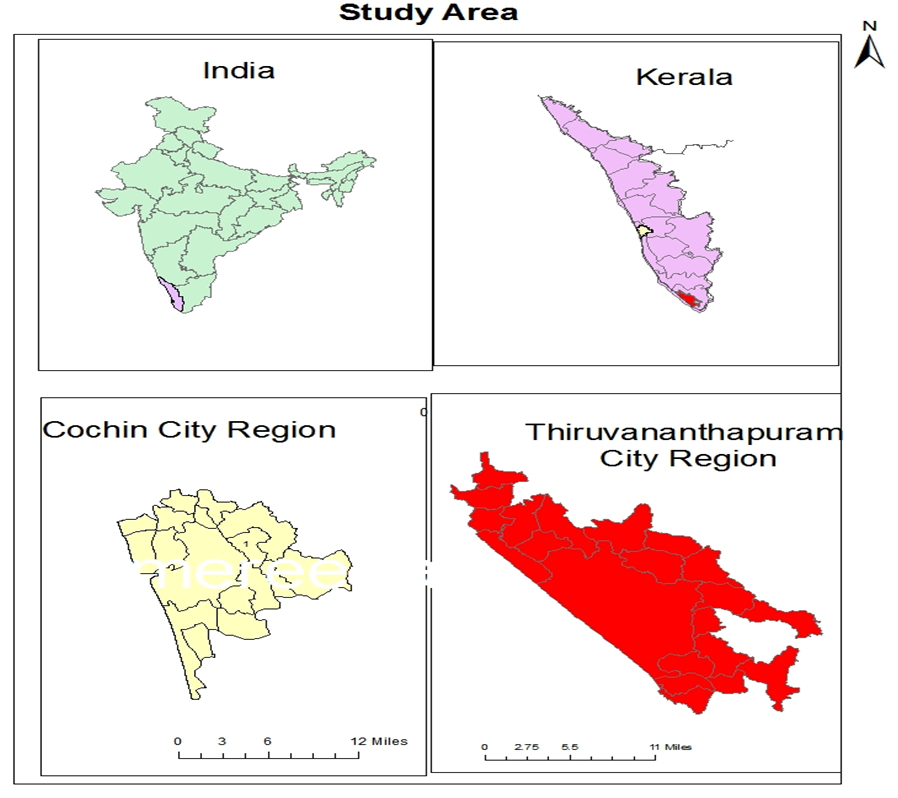
Ernakulum is the most urbanised district in the state in terms of absolute number of urban population (2234363 population as per 2011 census). After independence the political participation with people, conscious development efforts of missionaries, organizations and grassroots level planning strategies with people’s participation brings Ernakulum as a miniature of Kerala model of development. Cochin city region encompasses most of urban centres in the Ernakulum district; economically active region in the state.
Thiruvananthapuram back in the time of the formation of the state was the best and foremost developed district in Kerala. The district is developed in the base of Tourism, leisure, IT, Agriculture and Educational sector investment. Now the city region of the district is growing through more foreign and private investment. The district needed a sector wise planning approach for the holistic development.
The present study addresses urbanisation in both spatial and temporal contexts and explores urban expansion of the Cochin and Thiruvananthapuram city region as well as their interaction in the regional urbanisation. Three sets of LANDSAT images were used and GIS based buffer system was established covering these two-metropolitan regions.
Urban sprawl in two fast growing urban centres in Kerala, Cochin and Thiruvananthapuram are taken as the core of present study. Former is considered to the Commercial capital of the state, where as the latter is administrative capital.
Cochin is one of the largest and most important commercial and industrial centres of Kerala. Its strategic importance over the centuries is underlined by the Arabian Sea. Cochin city region is situated on the south-west coast of Indian peninsula with an administrative area of 369.72 sq. km which fall within the geographical co-ordinates 9° 47’ 14”N to 10o 5’38” N and 76° 12’22”E to 76° 25’ 50”E. The Cochin Corporation, five municipalities and nine panchayats fall in the present Cochin City Region. It is located on the south-western coastal strip of India. Cochin is inseparably linked with the wetlands of Vembanad estuary. Cochin, is a region interspersed with tidal water bodies and all developmental initiatives have to be streamlined giving due respect to the geological and ecological fingerprints of the region. Large scale projects especially in construction sector, Information Technology, transport, existence of Vallarpadam container shipment contributed to the urbanisation of Cochin city.
Thiruvananthapuram is the capital city located in the south western part of Keralahaving a historical legacy of administration since 1700 AD. It was the foremost developed city in Kerala having a full-fledged infrastructure setting for the administration of the kingdom.The city situated in between north latitudes 8° 17' and 8° 54' and east longitudes 76° 4' and 77° 17'. Thiruvananthapuram corporation. Three municipalities and 26 panchayaths falls under this area. The city was built on hills by the seashore comprised of three geographical divisions. The low land is a narrow stretch comprising of shorelines, rivers and deltas. The mid land region comprise low hills and valleys adjoining Ghats and the highlands forms the eastern suburbs of the city and is called as the "city of seven hills".It was the first city to have a full-fledged draining and pipeline system from the colonial period .The city covers a population of 9,57730 persons (2011 census). The city is mainly based on tertiary sector now it is growing as one of the major IT hubs of the state.
Two sets of LANDSAT TM images (1995/2005, resolution 30 m, seven bands) and one LANDSAT ETM+ (2015, resolution 15m, seven band) were used in the study. These images were processed with ERDAS IMAGINE software, which involves geometric correction, unsupervised classification and GIS reclassification. The different bands of imageries were stacked to produce a False Colour Composite (FCC). The Panchromatic data were merged with multispectral FCC. The base map (Cochin City Region Development Plan, 2031, Thiruvananthapuram Development Authority) of the study area was imported in computer environment and georeferenced in GIS environment. By using this shape files were generated. The sub-setting of satellite images was performed for extracting study area by taking geo-referenced outline Cochin City Region Development Plan boundary of 2031 map and the outline boundary of Trivandrum Development Authority. The subset image was then re-projected. All three images were then classified using ISODATA unsupervised classification algorithm. Thirty classifications. Through visual examination of satellite imageries, and by using toposheets and Google earth images, digitally classified images were interpreted and reclassified. Through the use of spectral classification, the urban area was extracted, which include high density residential areas and newly developed zone.
To measure and quantify the magnitude and pace of urban growth and Urbanisation Proportional Index (UPI) and Urbanisation Intensity Index were developed and employed 15 which expressed as
 |
 |
The variables UPIi,t~t+n, UIIi,t~t+n, ULAi,t+n and ULAi,t are indices of the proportion of urbanization and the intensity of urbanization within a spatial unit i during a time period t~t+n, and the areas of urban land-use for years t+n and t, respectively. TLAi is the total area of the spatial unit i. The UPI expresses the percentage of the total area occupied by urban expansion for a given spatial unit over the entire course of the study from 1995to 2015, and it reveals the total magnitude and spatial distribution patterns of urban expansion throughout this period. The UII is used to compare the pace and intensity of urban expansion over various periods.
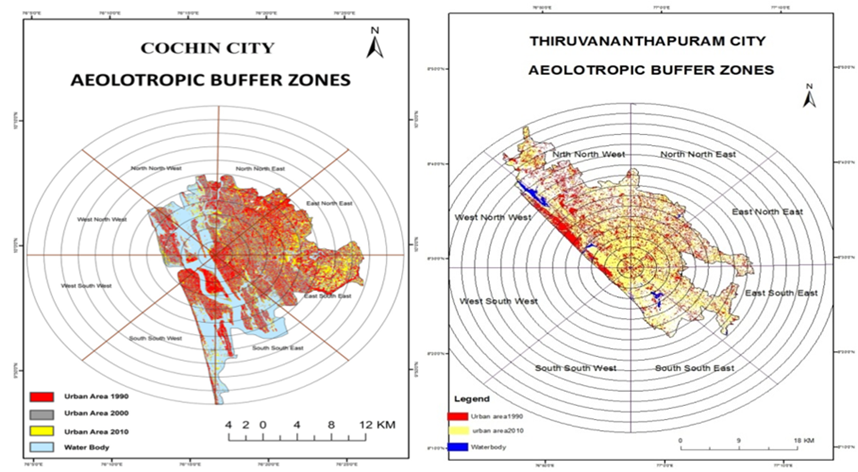
GIS-based buffer analysis was adopted in this study. ArcGIS software was used for buffer analysis. Each buffer zone was employed as a basic spatial unit to characterize distance-dependent urban growth behaviour with their UPI and UII values for a given time period. For the purpose of the study, three different buffer systems were established. The first was a circular buffer zone system with a buffer width of 2 km covering the entire region. This was designed to explore the overall urbanisation process over the two metropolitan regions comprising the Cochin city and Thiruvananthapuram city. The second system consists of aeolotropicbuffer analysis of entire city regions. For this, the entire region was divided into eight parts based on direction. Calculations of the UPI and UII were made separately for each part toexplore the directional trends in urbanisation process. The division was (in clockwise order): north-northeast (0º to 45º), east-northeast (45º to 90º), east-southeast (90º to 135º), south-southeast (135º to 180º), South-southwest (180o to 225o), West-southwest (225o to 270o), West-northwest (270o to 315o) and North-northwest (315o to 360o). The third buffer system was established by creating separate buffer zones around Cochin and Thiruvananthapuram city centre. In all buffer analysis urban areas of Cochin and Thiruvananthapuram city region indicated by LANDSAT data from 1995, 2005 and 2015 were extracted and used to represent the urban centre as a baseline for creating buffer zones. Because the urban centre of each satellite city was generally not obvious, the CBD of each satellite city during the first-time phase (1995) was used as the origin in creating the buffer zones.
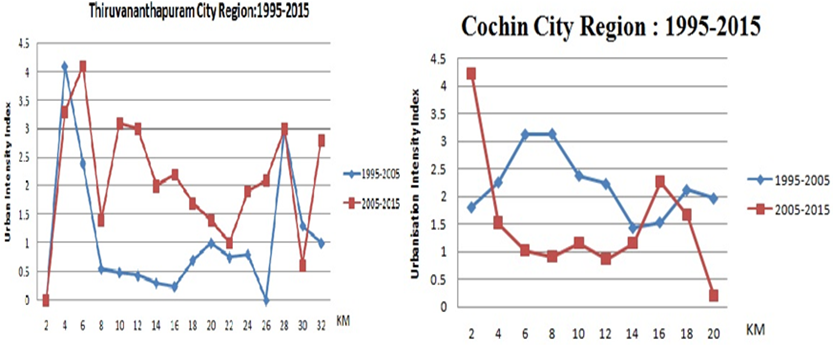
Figure 2 illustrate the changes in UII with distance from urban centre while analysing the graphs its evident that Cochin city region is already developed during 1995-2015 period but Thiruvananthapuram achieved its urban standard very recently (during 2005-2015). The Cochin city region core area well developed from the earlier days and has developed as a CBD. Well-connected transportation network added more advantage to the urbanization of this region. Between 2 to 6 km UII is increasing in this area this is because the earlier settlement of Cochin was developed at Mattanchery. This area grew in to a market town with cosmopolitan character attracting foreign traders and its commercial activities distributed along the waterfronts. In Thiruvananthapuram the city core already marked its legacy in the colonial period. The heart core of the city East fort used to be the centre of administration, art and literature from the Travancore dynasty period. In this zone the main business centre, Chalai market is located to supply commodities to Travancore state. During 1995-2005 the well-connected road railway network accelerated the urbanization process, thus the whole sale and retailing market of the centre developed as a CBD. In Cochin city region between 4 to 8 Km UII is increasing but in Thiruvananthapuram UII is decreasing. The port-based developments in Elamkunnapuzha accelerated the urban growth. Edappaly, Vytilla and Kudannur along NH 47 developed as a active node of the city. Maradu, Thripunithura, Thrikkakara, Kakkanad, Fort cochin etc are developed in this zone and marked its high UII. In Thiruvananthapuram the UII is declining because in these zones the administrative, educational and medical servicing centres are located and the depended population is more and more commuters. Comparing with Cochin the diversified economic activities are less in Thiruvananthapuram city region it is mainly acted as a centre of administrative activity of the state while international and foreign investments are more in Cochin. The coastal belt population is also included in this region which is denselypopulated. A discernable UII increase recorded between 12 to 16 km the development of small marginal towns and its diversified economic activity is the main reason for this change.Balaramapuram Handloom industry, IT parks in the Kazhakootam, Kulathoor region, Development of tourist spots like Kovalam, Veli etc. added its advantages for the UII change. In Cochin city region the UII is decreasing in peripheral areas while in Thiruvananthapuram newly developing marginal towns attracts population in and surrounding areas of the city. Kattakada, Neyyatinkara and Nedumangadu are some of them developed as a marginal-towns. This region comprises of more vacant spaces with a mix of rural and urban economic activity. In Cochin the urban intensification is high in between 12km to 18 km. This zone has developed due to its geographical location and the physical development activities implemented by the government. The UII between 18-22 km shows a gradual decline as the land area is limited.

Compared to 1995-2005 period, in 2005-2015 the UII shows an increasing trend in Thiruvananthapuram but in Cochin it is decreasing. In between 2-4 km the UII is at its peak due to high intensification of Urbanization in both these cities. In between 4-8 km Cochin shows a steady declining trend from the city centre because the zone is already well developed and the vacant space for further expansion is negligible. In Thiruvananthapuram residential population increased and service-oriented activities are prominent, in between 4 to 6 km recorded sharply high UII in this zone Govt Medical College and its associated institutions located which cater a mass population not only within the district but throughout the state. The SH and MC road passing through the city enhance the developmental activities. During this period in Cochin the high UII is recorded in between 12 to 16 Km due to major investments like Brahmapuram power plant, Smart city, IT parks and related developments. In Thiruvananthapuram also a same trend of growth is evident because of IT corridor developing along the bypass Kazhakootam to Thiruvallom which is in between 10 to 14 Km. Afterwards a gradual declining trend is visible up to 14Km. In these areas some panchayaths are also included having both urban and rural characteristics and have a potential to develop as a satellite town such as Nemom, Sreekaryam, Peroorkada etc. Cochin also shows a same trend of decline in UII is recorded while the zone is mixed-up with rural economic activities.
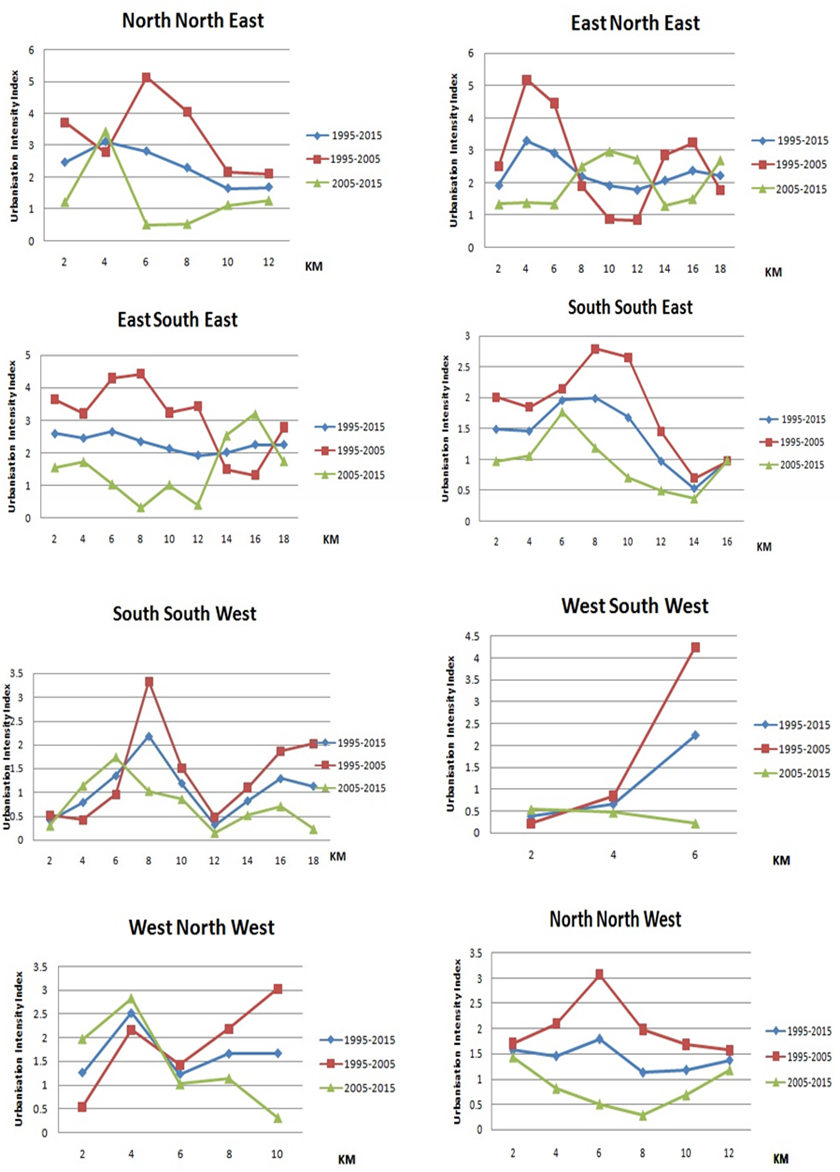
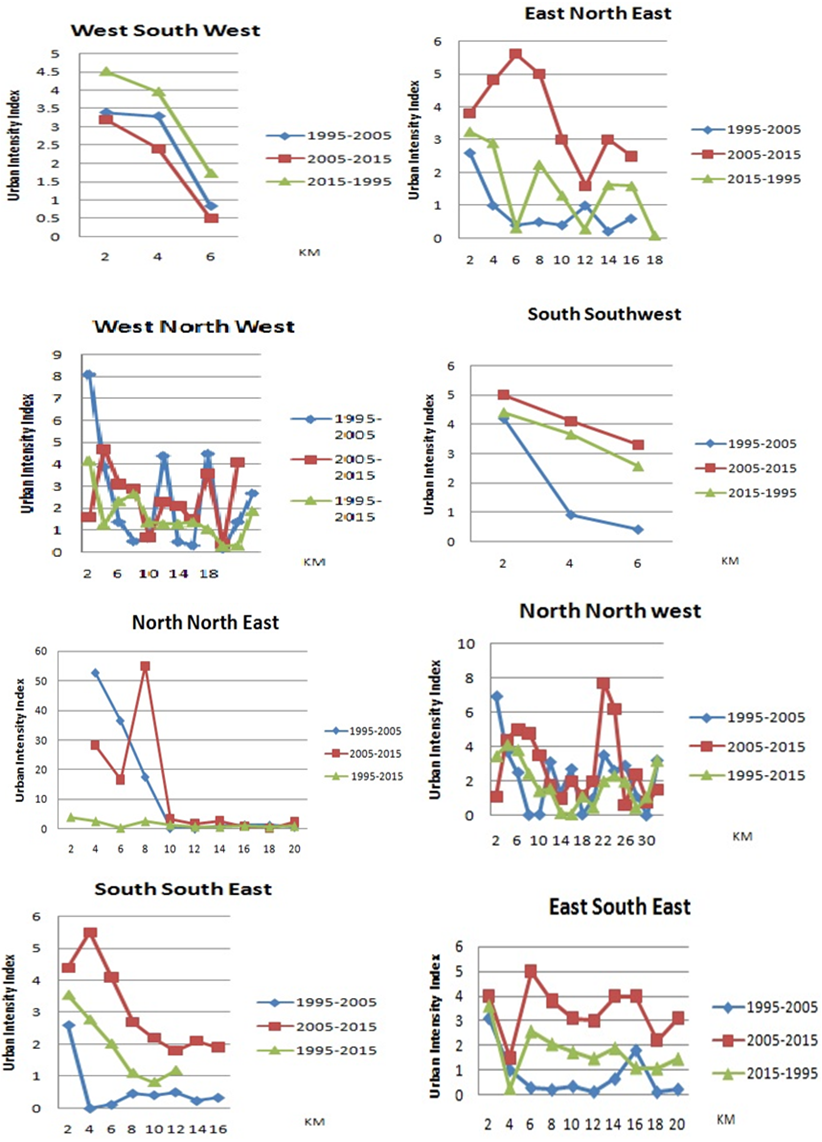
4.2. Spatial Aeolotropy of UII Based on Buffer Analysis during 1995-2015Figure 3, Figure 4 and Figure 5 displays the results of the spatial aeolotropy analysis of the UII for Cochin and Thiruvananthapuram city region. During 1995-2005 Cochin city up to 2 Km NNE, SSE, ESE slices shows a similar trend of high urban growth as the city core comes under this slice. ENE, SSW, shows a steady growth in UII. WSW, WNW and NNW slices shows a gradual increase in urbanization compared to other slice as the portion largely covered by water bodies. The ENE slices which cover Ernakulum town and Edapally reaches its peak value in this buffer zone as the residential population is more concentrated in this zone. In Thiruvananthapuram NNE, WSW and WNW slices shows a similar trend of high urban growth rather than economic activities, administrative activities are predominant. Most of department headquarters of the state located in this region. ESE, SSW, WNW&NNW shows a sharp decline in between 4 to 6 KM. WSW &SSW UII decreasing and further expansion hindered by seacoast.
During 1995-2005 Thiruvananthapuram recorded comparatively low rate of urban growth. Moving apart from the city centre the UII is decreasing and in between rural and urban functions mutually coexisting. ESE and SSE slices up to 12Km shows a decreasing trend, agricultural fields are seen in this direction but these areas recorded high UII up to 16 Km. Balaramapuram (Handloom small scale industry) Neyyatinkara and Kattakada are located in this zone. These small marginal towns acted as a collection centres for the agriculture and related Products from the nearby Panchayath. In Cochin NNE, ESE and SSE demonstrates a narrow increase in UII between 4-6Km. WSW slice including Mattanchery, Bolgatty displays a high peak of UII.Similar to Thiruvananthapuram due to physiographic constraints further urban expansion is hindered in WSW direction. In between 6 to 8 km NNE, ENE and NNW slices show a dramatic reduction in UII due to the predominance of primary activities. A rapid tapering off to relatively low levels in the range 8-12 km is seen in NNE, ENE, SSE and NNW slices and further declining trend is visible on ESE and SSE direction. Contrary to this WNW slices including Vallarpadom, Njarakkal and Elamkunnappuzha UII shows an increasing trend up to 10Km. After 12 km ENE, SSE, ESE and SSW slices shows uniform growth.


For the period of 2005-2015 Thiruvananthapuram recorded high UII which is closely interacted with the CBD through various economic activity. NNW, ESE, ENE & NNE spotted its highest UII in between 4 to 6 Km. These zones are serving the city by providing medical educational and administrative services. Pattom, Medical college, Ulloor, Nemometc are covered by this zone. Between 6 to 10 km NNW, NNE, ESE, ENE and NNE direction UII is decreasing. Mannanthala, Sreekaryam, peyadetc. Residential population are more concentrated in these zones. The development of IT sector brings more and more investment to the NNE and NNW direction of the city which leads to the further urbanexpansion. The newly developed bypass and well connected road railway network accelerated its expansion. Segmented urbanization is visible in Neyattinkara and Kattakada region, these towns act as a complimentary poles for the cities development and satisfy various functions provided by the city centre. In the NNW slices recorded high UII at Attingal municipality region.
In Cochin UII curves shows similar increasing trend up to 4km for NNE, ESE, and WNW slices, upto 6 km for SSE and SSW slices, andupto 12 k in ENE slice. Almost all slices reaches its peak value at 6 km as new developmental activities such as IT parks, industries etc. are concentrated in this zone. ENE zone demonstrate a declining trend between 12-6km and after 16 km it shows a rise. ESE slice shows rapid fluctuations in UII SSW WNW slices shows a similar trend of steady growth and further declining trend, while moving away from the city centre its intensity is declining.
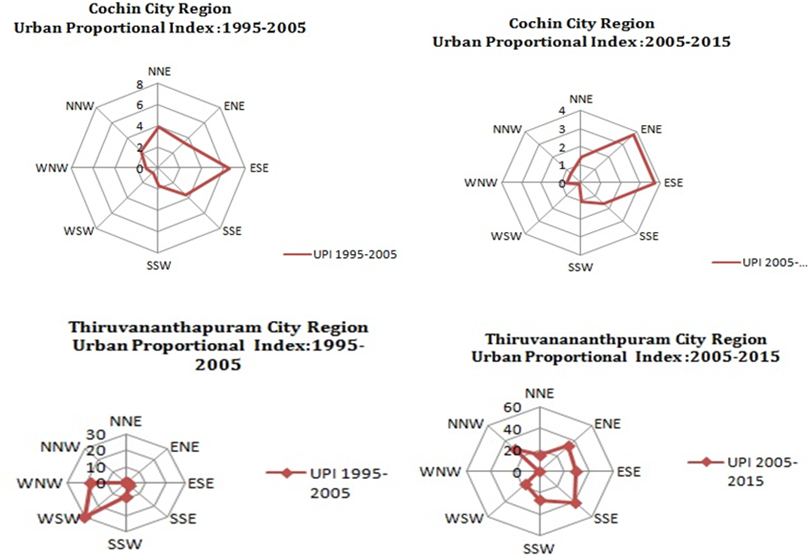
4.3. Spatial Aeolotrophy of UPI Based on Buffer Analysis during 1995-2015Based on the results of buffer zone analysis, the spatial aeolotrophic characteristics of Cochin and Thiruvananthapuram city region displayed in Figure 6 is summarized as follows. During 1995-2005 urban expansion in Cochin city region concentrated mainly to four directions NNE, ENE, ESE and SSE.
The Urban Expansion is limited in other directions due to the physical constraints (water bodies). Aluva industrial belt is located on the North north eastern direction which accelerates the urban growth to that direction. In ENE direction the developmental activities in Edapally, Thekkumpaddy, Thrikkakara and Kalamassery boosted urban expansion. The well-developed road and rail network as well as the industrial activities in Ambalamugal region hasten the spread of urban area in ESE direction. The apartment villa projects in Maradu and further expansion activities speed up the urbanisation process in SSE directionFor the period of 2005-2015 urban area is spread over ENE and ESE direction. The development of IT parks, industries and commercial activities, institutions and transport development in Kalamassery, Eloor and Thrikkakara led to the spread of urban area in ENE direction. While in ESE direction the urban spread is due to launch of residential buildings in Thripunithura and heritage tourism in Thripunithura and Thiruvankulam, Smart city, Brahmapuram Power Plant, Solid Waste treatment plant in Vavucode-Puthencruz.

In 1995-2005 the urban expansion of Thiruvananthapuram is less compared to Cochin WNW and WSW direction. The international airport and CBD of the City is in this direction and the city core is much developed in this period compared to other direction. Coastal stretch of the city is located in this direction due to limited area the available peoples densely settled in this region. Manacaud. Chala old market zone, Beemapally, KovalamVeli tourist centres are located in this zone. During 2005-2015 decade the Thiruvananthapuram city expanded much more towards NNW, ENE, ESE, SSW, SSE and NNW. The development in medical, educational and administrative service boosts up this urban growth. Spreading of new IT based industries and more investment in the infrastructural development make the city much more attractive to the migrant population. While analysing the UPI it is clearly evident the city is growing and its spreading toward the outskirt areas.
• Historical legacy played a major role in the growth of these two metropolitan cities of Kerala. Kochi was the princely state came in to existence in 1102 and was under the foreign rule since 18th century. Thiruvananthapuram was under the rule of venad kingdom till 10 century AD. In 1729 Marthandavarma found the princely state of Thiruvithamcore and made Thiruvananthapuram as the capital in 1745. Both these towns cities have trade relation with Indoneasian, French Dutch and Portuguese from the 18th century as famous are the centre spice trade and after the destruction of kodungloor port cochin came into flourished as major trading Hub.
• Post-independence era the economic reforms introduced by central govt of India boosted up the growth of Cochin city region as a financial hub of the state. Thiruvananthapuram retained its position as an administrative centre with an efficient govt machinery in place to conduct the administration of the entire state.
• Geographical position of these two towns influenced its urban growth of these two cities Cochin city geographically located in the central part of Kerala so the accumulation of wealth flowing from central Kerala districts. The Cochin city is well connected with district like Kottayam, Idukki, Alapuzha and Thrissur. Comparing with Cochin Thiruvananthapuram is geographically located in the southwest corner of India having less connectivity to the neighbouring district.
• Kochi metropolitan region having a sustainable economic base through the Private and foreign investment. The service sector flourished after the introduction new economic policy which leads to the rapid commercialization of the city and developed as a financial capital of the state. While comparing with Cochin Thiruvananthapuram city is sustained through Public investment, the city centre is occupied through administrative centres and allied govt headquarters which hindered the private investment. Since 2005 the city gathered its momentum through service sector development, and now the city is growing as a major IT hub having a share of 80% of software export.
• With economic development and population growth, the process of Urbanization of Cochin city had accelerated and the area of urban land increased quickly.
1. Two distinct phases of urbanisation are discernible
a) Phase of Rapid Urbanisation (1995-2005)
This phase is characterised by large scale urban expansion and the urbanisation intensity increases as a whole. There is a rapid expansion in the urban expansion zone. This is because the city centre, Mattancherry, Fort Cochin, Ernakulum regions immediately surrounding the city centre has already developed and urbanised and the areas surrounding it like Maradu, Edapally, Eloor, Kalamassery, Thrikkakara, Thripunithura partly transformed into new urban centres, the urban expansion zone rapidly moves outward with a drastic increase in area. On the outer side of urban expansion zone, the urban expansion intensity decreases.
b) Phase of diffusive urbanisation (2005-2015)
Urban expansion has already caused considerable growth of urban area, as well as outward expansion of the urban-suburban transition zone. The extent of urban expansion zone also continues to increase and the top values of UII are at points further from the original urban centres but with lower values. The urbanization is characterized by a transformation from being localized, high intensity and uniform to diffusive, regionalised and complementary. Therefore, UII peak values are lower than those in earlier phase.
• While analysing the process of Urbanization of Thiruvananthapuram city region it can be categorised into two
1. The phase of steady urban growth (1995-2005)
This phase was characterised in to urban growth is mainly concentrated in the CBD and the area of influence of the main city centre and a leapfrog urban growth is visible in the municipality areas. The core area is concentrated with administrative activity moving away from the city centre the UII is decreasing because the residential population is also less compared to cochin during this period. Thiruvananthapuram city region is well connected with the suburb so the commuter’s population is more within the city. The city growth is mainly based on development tertiary sector
2. The phase of Uniform urbanization (2005-2015)
In this phase the whole urban intensity of the city is increased compared to the previous decade. Service sector is development and the growth of the city as a major IT hub of the state accelerated the urban growth. More private investments in Tourism, Medical, Educational and research sector leads to the uniform urban growth. The residential population of the also increase in this phase.
• In cochin the major directional growth was observed to be in the ENE and ESE slice as new developmental activities and projects are undertaking in this zone. Earlier it was also observed in- NNE because of the IT industries and Special Economic Zone in Kalamassery. In Thiruvananthapuram directional growth is towards NNW,ENE,ESEandSSE.The city is growing towards the suburb panchayaths which lies in between municipalities. The palces such as Nemom, Attingal, Sreekaryam etc having high potential to develop as a satellite town.
• In cochin the urban expansion was observed active for Maradu, Kalamassery and Thripunithura. Residential apartments in Maradu, IT parks at Kalamassery, Heritage tourism and residential buildings in Thripunithura accelerated the urban growth.
• The developmental activities such as Cochin metro rail, Port related activities in Wellington Island, Elamkunnappuzha, Mulavukadu, Njaraikkal, Kadamankkudy, Heritage and tourism activities in Fort Cochin and Mattancherry, Fishing and tourism in Chellanam and Kumbalangy, industrial activities in Vadavucodu-Puthenkurisu, Kalamassery and Thrikkakara, Residential activities in Maradu, Kumbalam, Thripunithura and Thiruvankulam accelerates future trend of urban expansion. While comparing with Cochin Thiruvananthapuram not much explored as an urban centre Kazhakootam, Nedumangad, Neyyatinkara, Varkala and Attingal regions developed as a urban growth poles and has a high potential to develop as a satellite towns. The proposed Vizhinjam Harbour project, Monorail and the new smart city initiatives will boost up the urban growth of the city in future.
The Spatio temporal analysis of urban expansion reveals the intensity of urbanization of a particular area and how it influencing landscape of region. This study analyze the directional growth of urban expansion in accordance with its intensity. Through the analysis it reveals that the urban expansion is the product of socio economic and demographic factors individually and sometimes with its association. In the Case of Cochin, the economic demographic& social parameters are going hand in hand. It records a rapid urbanization during 1995-2005 period. Major directional growth of cochin city is mainly towards ENE & ESE direction, which is economically vibrant region. Thiruvanthapuram is developed as an administrative centre and its urbanization rate is increased during 2005-2015. In both the cities the urbanization is spreading towards the rural stretches were the urban and rural activities mutually correlated..The expansion is towards panchayaths area and which is mainly to meet the residential demand of the city population.
| [1] | Lipton, Michael. (1977). Why Poor People Stay Poor: Urban Bias in World Development. Temple Smith, London. | ||
| In article | View Article | ||
| [2] | Pacione, M. (2009). Urban Geography: A Global Perspective. Routledge, London. | ||
| In article | View Article | ||
| [3] | United Nations, (2007). Principles and Recommendations for Population and Housing Census, Newyork. Volume 2, 2010, Pages 1139-1156. | ||
| In article | |||
| [4] | Peter A. Hall, Rosemary C. R. Taylor. (1998). The Potential of Historical Institutionalism: A Response to Hay and Wincott, Political Studies, vol. 46, 5: pp. 958-962. | ||
| In article | View Article | ||
| [5] | Xiaowen Li, (2010). A GIS-based buffer gradient analysis on spatiotemporal dynamics of urban expansion in Shanghai and its major satellite cities. Procedia Environmental Sciences. | ||
| In article | View Article | ||
| [6] | Muchoney, D.M. and Haack, B.N. (1994). Change Detection for Monitoring Forest Defoliation. Photogrammetric Engineering and Remote Sensing, 60, 1243-1251. | ||
| In article | |||
| [7] | Singh, A. (1989). Digital Change Detection Techniques Using Remotely-Sensed Data. International Journal of Remote Sensing, 10, 989-1003. | ||
| In article | View Article | ||
| [8] | A. Shalaby, R. Tateishi. (2007). Remote sensing and GIS for mapping andmonitoring land cover and land-use changes in the Northwestern coastal zone of Egypt, Elsevier, Applied Geography, 28-41. | ||
| In article | View Article | ||
| [9] | Xiaojun Yang, (2011). Urban Remote Sensing: Monitoring, Synthesis and Modeling in the Urban, Wiley Blaackwell. | ||
| In article | View Article | ||
| [10] | United Nations. (1993). World Urbanisation Prospects Report, NewYork | ||
| In article | |||
| [11] | United Nations Environment Programme. (2013). Annual Report. | ||
| In article | |||
| [12] | Breese G. (1969). The city in the newly delveloped countries, Prentice-Hall | ||
| In article | |||
| [13] | Chattopadhyay S. (2006). Striving for Sustainability: Environmental Stress and Democratic Initiatives ,Concept Publishing Company, New Delhi. | ||
| In article | |||
| [14] | T T Sreekumar. (1990). Neither Rural nor Urban: Spatial Formation and Development Process, Economic and Political Weelky Vol 25,1981-1990 | ||
| In article | |||
| [15] | Liu, S., Wu, C., & Shen, H., (2000). A GIS-based model of urban landuse growth in Beijing. Acta Geogr. Sin. 55, 407-416 [in Chinese: English abstract]. | ||
| In article | |||
Published with license by Science and Education Publishing, Copyright © 2021 Jayalakshmy S.S, Dr T.K Prasad and Mereena C.S
 This work is licensed under a Creative Commons Attribution 4.0 International License. To view a copy of this license, visit
http://creativecommons.org/licenses/by/4.0/
This work is licensed under a Creative Commons Attribution 4.0 International License. To view a copy of this license, visit
http://creativecommons.org/licenses/by/4.0/
| [1] | Lipton, Michael. (1977). Why Poor People Stay Poor: Urban Bias in World Development. Temple Smith, London. | ||
| In article | View Article | ||
| [2] | Pacione, M. (2009). Urban Geography: A Global Perspective. Routledge, London. | ||
| In article | View Article | ||
| [3] | United Nations, (2007). Principles and Recommendations for Population and Housing Census, Newyork. Volume 2, 2010, Pages 1139-1156. | ||
| In article | |||
| [4] | Peter A. Hall, Rosemary C. R. Taylor. (1998). The Potential of Historical Institutionalism: A Response to Hay and Wincott, Political Studies, vol. 46, 5: pp. 958-962. | ||
| In article | View Article | ||
| [5] | Xiaowen Li, (2010). A GIS-based buffer gradient analysis on spatiotemporal dynamics of urban expansion in Shanghai and its major satellite cities. Procedia Environmental Sciences. | ||
| In article | View Article | ||
| [6] | Muchoney, D.M. and Haack, B.N. (1994). Change Detection for Monitoring Forest Defoliation. Photogrammetric Engineering and Remote Sensing, 60, 1243-1251. | ||
| In article | |||
| [7] | Singh, A. (1989). Digital Change Detection Techniques Using Remotely-Sensed Data. International Journal of Remote Sensing, 10, 989-1003. | ||
| In article | View Article | ||
| [8] | A. Shalaby, R. Tateishi. (2007). Remote sensing and GIS for mapping andmonitoring land cover and land-use changes in the Northwestern coastal zone of Egypt, Elsevier, Applied Geography, 28-41. | ||
| In article | View Article | ||
| [9] | Xiaojun Yang, (2011). Urban Remote Sensing: Monitoring, Synthesis and Modeling in the Urban, Wiley Blaackwell. | ||
| In article | View Article | ||
| [10] | United Nations. (1993). World Urbanisation Prospects Report, NewYork | ||
| In article | |||
| [11] | United Nations Environment Programme. (2013). Annual Report. | ||
| In article | |||
| [12] | Breese G. (1969). The city in the newly delveloped countries, Prentice-Hall | ||
| In article | |||
| [13] | Chattopadhyay S. (2006). Striving for Sustainability: Environmental Stress and Democratic Initiatives ,Concept Publishing Company, New Delhi. | ||
| In article | |||
| [14] | T T Sreekumar. (1990). Neither Rural nor Urban: Spatial Formation and Development Process, Economic and Political Weelky Vol 25,1981-1990 | ||
| In article | |||
| [15] | Liu, S., Wu, C., & Shen, H., (2000). A GIS-based model of urban landuse growth in Beijing. Acta Geogr. Sin. 55, 407-416 [in Chinese: English abstract]. | ||
| In article | |||