Carbon tax scheme is one main low-carbon policy to curb carbon emission. This paper develops an optimal production policy model with defective items in a single production period under carbon tax scheme. We assume that the demand for perfect items is price-sensitive and environment-sensitive and the defective items can always be sold. Firstly, we get the optimal production policy and the maximum expected profit. Secondly, we analyze the effect of some parameters emphatically and the results show that when the tax rate is low, firm can’t utilize the optimal production policy unless the rate of perfect product is high. We also find that the optimal production lots may increases when the rate of perfect product increases and the profit may decreases in the same situation, which is inconsistent with intuition.
Carbon emission have directly led to global warming, which is noted all over the world. Therefore, Many countries and regions have started to implement low-carbon policies to prevent the process of global warming and protect environment 1. Carbon tax policy and carbon cap-and-trade policy are the two main policies among them and widely used. Under carbon cap-and-trade scheme, firm is given a maximal emission allowance, which called emission cap. Moreover, this allowance can be traded on the carbon trading market. Carbon cap-and-trade policy can directly reduce the carbon emission of firm while carbon tax policy is an indirect way to reduce the carbon emission. Under carbon tax scheme, firm is charged for each unit of carbon emission at a fixed carbon tax rate. Carl and Fedor 2 investigate the current use of public revenues generated through both carbon tax and cap-and-trade system, cap-and-trade system generated $6.57 billion in total public revenues while carbon tax system generated $21.7 billion. This result proved the economic effectiveness of carbon tax policy and confirmed the widely usage of carbon tax policy emphatically. When firm under carbon tax policy make production decision, carbon tax rate should also be considered besides some traditional factors like cost and price. Previous literature has studied a lot on this topic. Meng et al. 3 develop the optimal strategies for product of two competitive firms with Nash and Stackelberg game structures in the presence of carbon tax. Wu et al. 4 analyze how to determine the production mode under carbon tax with the objective of profit optimization. While He et al. 5 examine the production lot-sizing issues of a firm under carbon tax scheme.
Traditional newsvendor model or economic order model always considers the situation that all products are of perfect quality. However, in the actual process of production, because of the existing of equipment fault, deficiency of quality supervision, limitation of production technology and some other man-made or random factors, defective items are unavoidable. Some literature also take this condition into consideration. Shih 6 considers a model within a production context and assumes that the proportion of defective items is random with a known probability distribution and defective items are returned to the manufacturer at no cost. Papacristos and Konstantaras 7 establish an EOQ model under the items of imperfect quality based on the research of Salamah and Jaber 8, they assume that the shortage of perfect products are not allowed and defective products will be sold at a low price. Yadav et al. 9 develop a supply chain model with defective items while the demand is price-sensitive. A typical assumption in literature is that defective items are reworked or removed from inventory. However, in some situations, defective items cannot be reworked or returned to the supplier. It may then be possible to sell items of imperfect quality at a low price 10. The latter condition is what we consider in this paper. What’s more, the perfect rate of product is considered as a known probability distribution, which is same as Shih 6.
The above two topics are widely researched, but the literature on the combination of them is relatively limited. This paper considers a one period optimal production policy model with both defective item and tax carbon scheme. Moreover, the demand of perfect item is price-sensitive and environment-sensitive. The rest of the paper is organized as follows: in section 2, we develop the optimal production policy model and get the result of the model. In section 3, we analyze the result and some managerial insights are given. In section 4, we provide concluding comments.
In this section, we describe the condition of our model in reality firstly, then some main assumptions and parameters are given. Finally, we develop the optimal production model and get the optimal production policy.
2.1. Model Description and AssumptionsWe consider a setting where a firm makes production decision in a single production period. The items of defective quality will present randomly and defective items will be sold out at a low price  , the proportion of perfect item is
  , where
  is a random variable among
  called the rate of perfect product, we use beta distribution to represents the distribution of
  cause it is highly suited for practical purposes especially in the absence of complete data 6. The firm charged for a tax rate of
  for per unit of carbon emission. The demand of perfect item is sensitive to the price
  and the consumer’s environmental awareness
  , which can be represented as
  where
where  is the maximum market demand for perfect product, and
  is the sensitivities of price and consumer’s environmental awareness respectively,
  is the carbon emission per product. The firm’s objective is to determine the optimal production quantity
  to maximize the expected profit
  in one production period. Other notations and assumption are shown as follow:
1) The cost of per unit is  and
and  .
.
2) The quantity of perfect product and defective product are  and
and  respectively.
3) The beta distribution is shown as  , which implies that the firm can predicts the expected by the history production performance data.
4) All the parameters mentioned above are larger than zero.
5)  and
and  are the destiny function and distribution function of
  respectively.
Let  and
and  denote the expected amount of perfect item and defective item respectively, we can obtain that
  and
and  , what’s more, the price of perfect product can be represented as
  . Hence, the maximum expected profit equation can be given as:
 | (1) |
The first derivatives of Eq. (1) is  and the second derivatives of Eq. (1) is
  , which imply that the maximum expected profit equation is a convex function of
  and the optimal production policy can be driven by
 |
So the optimal production policy is:
 | (2) |
Then we can obtain the total carbon emission  by
by  , which is obtained as:
 | (3) |
The price of perfect product is:
 | (4) |
Finally, the maximum expected profit is obtained as:
 | (5) |
In this section, we analyze the results of the theoretical models in Section 2 and discuss their managerial implications.
Proposition 1. There are two conditions when the optimal production policy is available. That is  when
when  or
or  when
when  where
where
 |
and  . which means that when the carbon tax rate is low, the optimal production policy is more possible to be unavailable unless the rate of perfect product is high. Firm can use the history production performance data to make adjustment.
Proof: The optimal production lots and the price of perfect product should larger than zero when the optimal production policy is efficient. So the numerator of Eq. (2) and Eq. (4) should larger than zero, that is  and
and  , then we can obtain the range of
  is
is
 |
Let  and
and
 |
when  ,
,  , so
, so  ; when
  ,
,  , so
, so  .
.
The result of proposition 1 is consistent with intuition. When the history performance of production is good, the firm can realize the optimal production policy under a wider range of carbon tax rate, which implies that high rate of perfect product can provide a higher possibility for firm to achieves the optimal production policy.
Proposition 2. Optimal production lots  is increases with
 and decreases with
 and
and  optimal production lots
  is increases with the expected rate of perfect product when
  and
and
 |
 is decreases with the expected rate of perfect product when
  or
or  and
and  , where
  .
.
Proof: The first theorem in proposition 2 can be verified directly. Now we demonstrate the second one. The derivative of  with respect to
  is:
is:
 | (6) |
When  , Eq. (6)
 ,
,  is decreases with
  when
when  if
if  , Eq. (6)
 ,
,  is decreases with
  ; if
; if  , Eq. (6)
  ,
,  is increases with
  .
.
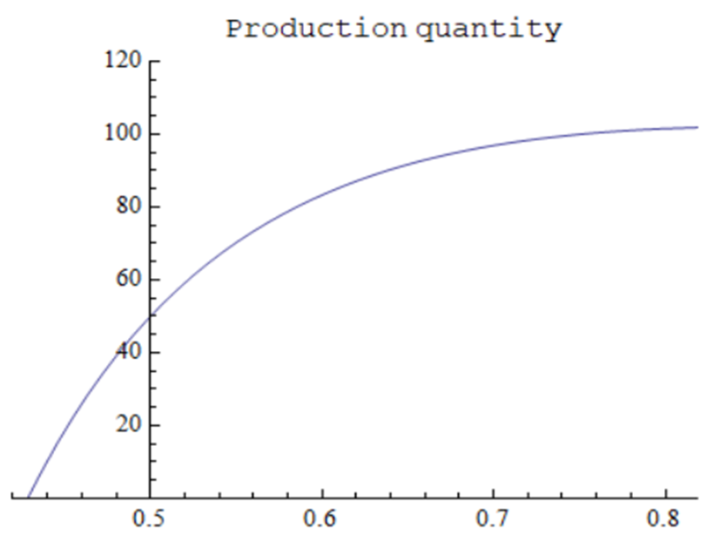
The result of proposition 2 is inconsistent with intuition. We always believe that when the rate of perfect product is high, the optimal production lots will be low. But in some conditions, for example, when the carbon tax is low, the optimal production lots will increases with the expected perfect rate of product. Figure 1 illustrates the phenomenon with numerical results. Another main found is that the optimal production lots will decreases with the consumer environmental awareness.

 with respect to
  with a low tax rate
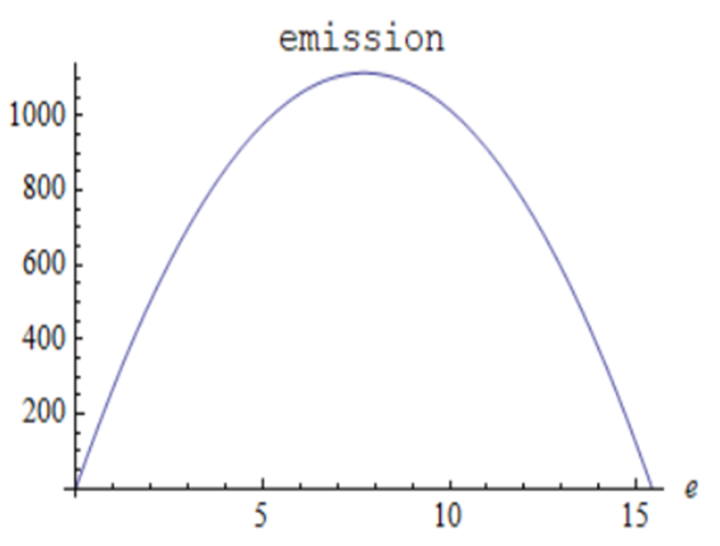
Proposition 3. The change in the total carbon emission  with
with ,
,  ,
,  ,
,  and
and  is same as the optimal production lots
  . When
  and
and  satisfy the conditions in proposition 1, if
 |
 is increases with
  ; if
; if
 |
 is decreases with
  .
.
Proof: The first theorem in proposition 3 can be verified directly. Now we demonstrate the second one. Eq. (3) can be rewritten as:
 | (7) |
The increase or decrease of Eq. (7) is determined by the numerator. Let
 |
cause  always larger than 0, so
  is increases with
  when
when
 |
and decreases with  when
when
 |
The result of proposition 2 is inconsistent with intuition. Most of us believe that the total carbon emission will always increases with the carbon emission per unit of product. However, when the carbon emission per unit of product is high, the total carbon emission will decreases with carbon emission per unit of product. Figure 2 illustrates the phenomenon with numerical results.

Proposition 4. The price of perfect product  is increases with
  and decreases with
  ,
,  and
and  . The price of perfect product
  is increases with
  if the price-sensitive is predominant and is decreases with
  if the environment-sensitive is predominant.
Proof: The first theorem in proposition 4 can be verified directly. The change of  in
in  is determined by the plus or minus of
  , where
  and
and  satisfy the conditions in proposition 1. Therefore, when the environment-sensitive is predominant in demand function,
  is negative and
  is decreases with
  ; when the price-sensitive is predominant position in the demand function,
  is positive,
  is increases with
  .
.
The result of proposition 2 is consistent with intuition. When the consumer environment awareness is high, products with high per unit emission will be unpopular unless the price is low.
Proposition 5. When  ,
,  ,
,  ,
,  and
and  respectively satisfy the condition that
 or
or  and
and  , the expected profit
  is increases with
  and decreases with
  ,
,  ,
,  and
and  .; When
  ,
,  ,
,  ,
,  and
and  respectively satisfy the condition that
  and
and  , the expected profit
  is decreases with
  and increases with
  ,
,  ,
,  and
and  , where
  ,
,  and
and  .
.
Proof: The derivative of  with respect to
  ,
,  ,
,  and
and  are:
are:
 | (8) |
 | (9) |
 | (10) |
 | (11) |
 | (12) |
For Eq. (8), when  satisfy the condition that
  or
or  and
and
 |
Eq. (8) is larger than zero,  is increases with
  ; when
  satisfy the condition that
  and
and  , Eq.(8) is less than zero,
  is decreases with
  . For Eq. (9), when
  satisfy the condition that
  or
or  and
and  , Eq. (8) is less than zero,
  is decreases with
  ; when
  satisfy the condition that
  and
and  , Eq.(8) is larger than zero ,
  is increases with
  . The proof of
  ,
,  and
and  is same as
  .
.
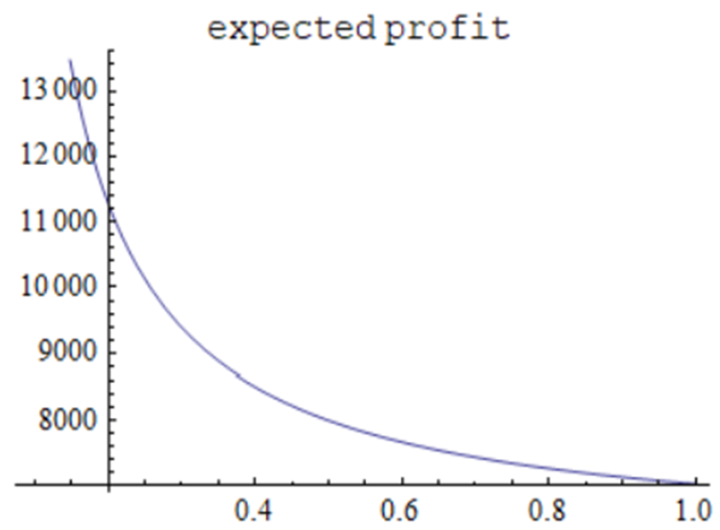
The result of proposition 5 is inconsistent with intuition. When the carbon tax rate is low, higher rate of perfect product is bad for profit, firm will choose to increases the price of defective product to increases profit. Figure 3 illustrates the phenomenon with numerical results. Moreover, the profit may increases with cost-related parameters like the carbon tax rate, which implies that the high carbon tax rate may harms the interests of consumers.
This paper analyze an optimal production policy model in one single production period considering carbon tax scheme, defective items and consumer environmental awareness. We obtain the optimal production lots with the objective of profit maximization, the total carbon emission, the price of the perfect product and the maximum profit. Then we discuss the relationship of these results with different parameters. Our main finding conclude that when the tax rate is low, firm can’t utilize the optimal production policy unless the rate of perfect product is high, which implies that high rate of perfect product can provide a higher possibility for firm to achieves the optimal production policy. The optimal production lots may increases with the expected perfect rate of product while the maximum profit may decreases with the expected rate of product, firm will improve the price of defective product to get more profit. The total carbon emission will decreases with thee carbon emission per product when the carbon emission per product is high, the main reason is the production lots will be constrained in this situation. What’s more, the price of defective product has opposite affect on the price of perfect product and when the consumer environment awareness is high, firm should utilizes low-price strategy if the carbon emission per unit of product is high.
This paper has provided useful managerial insight for the production and pricing of the firm. However, there are some limitations that points to the necessity of future research to be performed. The employed model only considers a single production period and ignores the production competition, apparently there is spacious room for model extension. Future research may further consider the issue of multiple period and competition between other manufacturers, moreover, comparison with other low-carbon policy like carbon cap-and-trade policy is also available.
| [1] | X.Y. Xu, X. Xu, P. He, Joint production and pricing decisions for multiple products with cap-and-trade and carbon tax regulations, Journal of Cleaner Production., 20 (2016) 4093-4106. | ||
| In article | View Article | ||
| [2] | D. Fedor, Tracking global carbon revenues: A survey of carbon taxes versus cap-and-trade in the real world, Energy Policy., 96 (2016) 50-77. | ||
| In article | View Article | ||
| [3] | X.G. Meng, Z.Yao, J.J. Nie, Y.X. Zhang, Z.L. Li, Low-carbon product selection with carbon tax and competition: Effects of the power structure, International Journal of Production Economics., 200 (2018) 22-230. | ||
| In article | View Article | ||
| [4] | P. Wu, Q.Q. Wang, R.N. Wang, Production mode choice under carbon tax, International Conference on Service Systems and Service Management IEEE., (2017). | ||
| In article | |||
| [5] | P. He, W. Zhang, X. Xu, Y. Bian, Production lot-sizing and carbon emissions under cap-and-trade and carbon tax regulations, Journal of Cleaner Production., 103 (2015) 241-248. | ||
| In article | View Article | ||
| [6] | W. Shih, Optimal inventory policies when stockouts result from defective products, Int. J. Prod. Res., 18 (1980) 677-685. | ||
| In article | View Article | ||
| [7] | S. Papachristos, I. Konstantaras, Economic ordering quantity models for items with imperfect quality, International Journal of Production Economics., 100 (2006) 148-154. | ||
| In article | View Article | ||
| [8] | M.K. Salameh, M.Y. Jaber. Economic production quantity model for items with imperfect quality, International journal of production economics, 64 (2000) 59-64. | ||
| In article | View Article | ||
| [9] | R. Yadav, S. Pareek, M. Mittal, Supply chain models with imperfect quality items when end demand is sensitive to price and marketing expenditure, RAIRO - Operations Research., (2018). | ||
| In article | View Article | ||
| [10] | B. Maddah, M.K. Salameh, G.M. Karame, Lot sizing with random yield and different qualities, Applied Mathematical Modelling., 33.4(2009) 1997-2009. | ||
| In article | View Article | ||
Published with license by Science and Education Publishing, Copyright © 2020 Xinyuan Cui, Duanshu Peng and Yulong Huang
 This work is licensed under a Creative Commons Attribution 4.0 International License. To view a copy of this license, visit
http://creativecommons.org/licenses/by/4.0/
This work is licensed under a Creative Commons Attribution 4.0 International License. To view a copy of this license, visit
http://creativecommons.org/licenses/by/4.0/
| [1] | X.Y. Xu, X. Xu, P. He, Joint production and pricing decisions for multiple products with cap-and-trade and carbon tax regulations, Journal of Cleaner Production., 20 (2016) 4093-4106. | ||
| In article | View Article | ||
| [2] | D. Fedor, Tracking global carbon revenues: A survey of carbon taxes versus cap-and-trade in the real world, Energy Policy., 96 (2016) 50-77. | ||
| In article | View Article | ||
| [3] | X.G. Meng, Z.Yao, J.J. Nie, Y.X. Zhang, Z.L. Li, Low-carbon product selection with carbon tax and competition: Effects of the power structure, International Journal of Production Economics., 200 (2018) 22-230. | ||
| In article | View Article | ||
| [4] | P. Wu, Q.Q. Wang, R.N. Wang, Production mode choice under carbon tax, International Conference on Service Systems and Service Management IEEE., (2017). | ||
| In article | |||
| [5] | P. He, W. Zhang, X. Xu, Y. Bian, Production lot-sizing and carbon emissions under cap-and-trade and carbon tax regulations, Journal of Cleaner Production., 103 (2015) 241-248. | ||
| In article | View Article | ||
| [6] | W. Shih, Optimal inventory policies when stockouts result from defective products, Int. J. Prod. Res., 18 (1980) 677-685. | ||
| In article | View Article | ||
| [7] | S. Papachristos, I. Konstantaras, Economic ordering quantity models for items with imperfect quality, International Journal of Production Economics., 100 (2006) 148-154. | ||
| In article | View Article | ||
| [8] | M.K. Salameh, M.Y. Jaber. Economic production quantity model for items with imperfect quality, International journal of production economics, 64 (2000) 59-64. | ||
| In article | View Article | ||
| [9] | R. Yadav, S. Pareek, M. Mittal, Supply chain models with imperfect quality items when end demand is sensitive to price and marketing expenditure, RAIRO - Operations Research., (2018). | ||
| In article | View Article | ||
| [10] | B. Maddah, M.K. Salameh, G.M. Karame, Lot sizing with random yield and different qualities, Applied Mathematical Modelling., 33.4(2009) 1997-2009. | ||
| In article | View Article | ||


 with respect to
  with a low carbon tax