This study was conducted to test the mediating role of perceived training quality in the relationship between the factors of Supportive service, Organizing and managing, Teacher, Infrastructure, Image, Tuition fee, Offical Staff, Training program, and Satisfaction of car driving learners at driving training schools in Vietnam based on learners' perceptions and expectations about the quality of service they receive. This study helps managers at car driving training schools better understand the impact of service quality on learner satisfaction, thereby taking measures to improve the quality of car driving training for society. Through a survey of 821 students studying at car driving training schools in Vietnam, the author collected and analyzed data using SmartPLS 4.0 software. Research results show that Supportive service, Organizing and managing, Teachers, Infrastructure, Image, Tuition fees, Training programs, and official staff directly affect perceived training quality and indirectly affect learner satisfaction through perceived training quality
During the international economic integration associated with the 4.0 industrial revolution, training quality (skill quality) has been given top priority. Many driving training establishments have recently established and implemented advanced, diverse, and large-scale vocational training programs. To improve competitiveness, affirm its position, and survive and develop both in breadth and depth, car driving training schools constantly innovate to enhance training quality and meet learners' increasing needs. However, with the current situation and trend of chasing quantity and profit, forgetting quality is one of the alarming risks to traffic order and safety and traffic accidents, causing significant losses to the lives and property of people and society. There are many causes of traffic accidents, such as infrastructure not keeping up with social development, technical characteristics of vehicles are not synchronized, the management of training and driving tests is poor, the quality of training is not guaranteed, the level of skills is not high, especially the moral awareness of drivers is still limited. Therefore, to survive and develop, driving training schools are required to constantly improve the quality of training, ensuring that learners have good skills with high quality after graduation, which is the basis for developing their careers. Although the Vietnamese government has conducted many studies and proposed many solutions to improve the training quality of driver training schools, the quality of training still has many limitations. Therefore, researching factors that affect training quality and providing solutions to improve the training quality of driving training schools is extremely meaningful.
According to the Vocational Education Law (2014) 1, vocational training is the teaching of practical skills, occupations, or knowledge related to a specific field so that learners can acquire and master knowledge, skills, and occupations systematically to prepare the person to adapt to life and be able to undertake a specific job. According to ISO 9000: 2005 (2005) 2, quality is defined as the degree to which a set of inherent characteristics meets requirements. According to Nguyen Tien Hung (2014) 3, training quality is the comparison between input and output of the training process. Nguyen Ngoc Quan and Nguyen Tan Thinh (2009) 4 believe that the quality of training is reflected in the quality, personality value, and labor value or practice capacity of the respective graduates corresponding to goals and training programs for specific occupations. From there, it can be seen that the quality of driving training includes two aspects: 1) Achieving goals (by standards) set by the school; in this aspect, quality is considered " internal quality"; 2) The quality of driver training is considered the best satisfaction of the driver's requirements. In this aspect, quality is considered "external quality." Therefore, if driver training activities want to achieve high quality, they must first achieve internal quality, which will be the foundation for achieving external quality. Thus, the quality of driving training is understood as the training process for driving learners who have learning needs so that after being trained, individuals will have enough capabilities (knowledge, skills, attitude, and problem-solving ability) with content and training organization methods designed according to requirements to meet output standards corresponding to each level of driver training level.
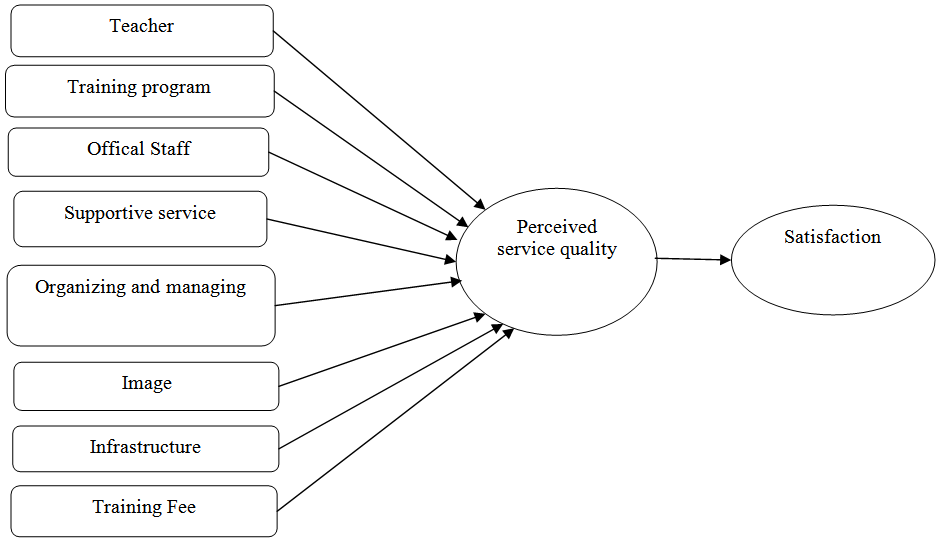
2.2. Research ModelsIn the context of the car driving training environment in Vietnam, along with an overview of models measuring training service quality and learner satisfaction, in this study, the author uses standard variables to measure the quality of training services that affect the satisfaction of car driving learners: Teacher quality, training program quality, Facilities, quality of administrative staff, support services, training organization and management, facilities, reputation of the training unit and training costs [5-7] 5.
Below is the author's proposed model:

Teachers
In the study of Firdaus (2005) 8, the responsibility of teaching staff is demonstrated with characteristics such as having a positive attitude, good communication skills, allowing full consultation, and providing regular feedback to learners. According to Silva et al. (2017) 10, the quality of training services is greatly influenced by the team of teachers responsible for teaching. Teachers are the ones who directly provide training services to learners, so the teacher's capacity and qualifications are among the factors that determine the quality of services that the teacher provides. Ha (2021) 11 believes that competent and qualified teachers will create an effective learning environment, helping learners learn and exploit the teacher's knowledge. Through modern teaching methods, teachers will provide learners with opportunities and experiences and create interactive classroom activities, allowing learners to explore and test their learning abilities. Navarro et al. (2005) 12 demonstrated that teachers' teaching methods are often considered indicators of training quality and are one of the prerequisites for creating learner satisfaction. Teachers with suitable expertise and effective communication methods will help learners gain full knowledge. In addition, teachers often regularly and directly interact with learners, share, understand, and encourage learners. Hence, learners often think that the image of teachers is one of service quality that the school offers. Learners who appreciate the quality of teachers will be satisfied with the assessment of learning outcomes, which leads to overall satisfaction. The qualitative research process also shows the critical role of teachers in evaluating the quality of training services. Therefore, the research hypothesis is proposed as follows:
H1: Teacher quality has a positive impact on perceived training quality.
Training program
Silva et al. (2017) 10 argue that curriculum quality emphasizes the importance of offering a range of reputable programs with flexible learning plans and structures. Gamage et al. (2008) 6 believe that learners' awareness of the training program is reflected in the subject content of the curriculum and the ability to apply knowledge. Training program quality has been considered in many studies on training service quality and is an essential factor in evaluating training service quality 13. The learning program includes the content structure of subjects, training time, time allocation ratio between subjects, between theory and practice, and internships to help learners master educational knowledge. A good quality training program will meet the training program's general goals, specific goals, and output standards, assisting learners in acquiring the necessary knowledge and skills for particular jobs in the future. Research results by Ling et al. (2010) 14 show that the "training program" is the most critical antecedent that affects learners' perception of training quality. Therefore, the author proposes the hypothesis:
H2: Training program has a positive impact on perceived training quality.
Administrative Staff
According to the definition by Firdaus (2006) 15, administrative staff in training units often include staff from departments such as the executive department, training department, learner management department, finance department... This employee does not directly participate in teaching but is responsible for administrative procedures, records, and paperwork tasks. According to Nasser et al. (2008) 16, the support of the school’s administrative staff is one of the important factors for students to evaluate the quality of training because this support creates favorable conditions for students to be convenient in the learning process. The enthusiasm and support of the administrative staff build confidence in learning and trust in the training program, encouraging and motivating students to study when necessary. Qualitative research also shows the importance of non-academic staff in departments, faculty assistants, and clerical teams in supporting students' learning process. When students are satisfied with the quality of administrative staff, it will lead to overall satisfaction. Therefore, the hypothesis is:
H3: The quality of administrative staff positively impacts the perceived quality of training.
Supportive services
Gamage et al.'s (2008) 6 support services are essential to learners' overall satisfaction in the training environment. Learners come to training school not simply to enjoy services provided directly by teachers, but they also need to complete many different procedures and documents. In addition, for learning with teachers to be effective, there are many support activities. All of these support activities are provided by other training facility staff. Gamage et al.'s (2008) 6 study presents aspects of training activities related to consulting and support services and complaint procedures, answering learners' questions about the school. Therefore, the better the support services, the more the quality of training will increase, and the satisfaction of learners will also increase. From such facts, the study proposes the following hypothesis:
H4: Supportive services have a positive impact on perceived training quality.
Organization and management
Classroom organization, according to Gamage et al. (2008) 6, is the implementation of diversifying training organization methods to meet the learning needs of learners and employers. Have a training plan, closely monitor, and ensure the implementation of the training plan on schedule. Implement teaching methods in the direction of active learners; Critically evaluate learning outcomes to ensure appropriate objective fairness 7. Therefore, the research hypothesis is set:
H5: Training organization and management positively impact perceived training quality.
Infrastructure
Facilities and equipment are all physical means mobilized for teaching, learning, and training activities. Jain et al. (2013) 7 summarized previous studies and proposed that facility variables include the adequacy of classrooms and equipment for practice and internships. According to Schneider (2002) 17, environmental factors (light, air, ventilation, temperature) and facilities (age and quality of buildings, teaching aids) affect the quality of training. These factors create a quiet, comfortable, and safe learning environment, affecting the quality of teaching and learning. With a good training program and good teachers but needing more equipment for learning and practice, the knowledge learners acquire is only theoretical, not practical. If the training school does not have enough room for studying and research, it will also significantly affect learning, negatively impacting the learner's perception of the training schools. Therefore, the research hypothesis is:
H6: Facilities have a positive impact on perceived training quality.
Image
In training activities, the reputation of the training unit is becoming increasingly important, and training units have developed distinct images to maintain competitiveness in the market. Firdaus's (2005) [ 8] study also mentioned the reputation of the training unit as part of the academic aspect and argued that this is an essential element. It is the ability to offer wide-ranging and prestigious training programs with a flexible structure. Gamage et al. (2008) 6 also describe the reputation of the training unit through the image and reputation mentioned by society (family, friends, media). The importance of institutional reputation has been identified by Nguyen and LeBlanc (2001) 18 and Kazoleas et al. (2001) 19. Firdaus (2005) 8 also believes that the reputation of the training unit dramatically affects the perception of service quality of learners. This element represents the professional image of the training unit in terms of facilities and instructors. When learners highly appreciate the reputation of the training unit, they also understand the quality of the training service of the whole training school, leading to satisfaction. Therefore, the hypothesis is proposed:
H7: Image of the training school positively impacts the quality of training.
Training fee
Tuition fees are one of the factors that receive attention from learners. For driving training schools, tuition fees lead to different levels of learner satisfaction with learning outcomes and the quality of training services. Usually, in the goods and services market, the higher the quality, the higher the price. However, the educational environment has differences that sometimes make this relationship different. Customers in the education sector are all people who need education and have different income levels but still want to enjoy high-quality service. LeBlanc and Nguyen (1999) 5 proposed a factor affecting learner satisfaction between price and quality when considering value. Therefore, this study suggests the hypothesis:
H8: Appropriate training fee has a positive impact on perceived training quality.
Perceived Service Quality
Silva et al. (2017) 10 argue that Quality of Education emphasizes providing a range of reputable and well-planned programs. Gamage et al. (2008) 6 believe that learners will have an awareness of the curriculum, the ability to apply knowledge into practice, and effectiveness in work after graduation. Training quality has been considered in many studies on the quality of training services. It is reflected through the content structure of subjects, training time, between theory and practice, and internships. Students master the basic knowledge and skills of the industry and interdisciplinary. A good quality training program will meet the training program's general goals, specific goals, and output standards at a particular level. The quality of training will help connect subjects so that students can easily acquire knowledge supplement and support between subjects to achieve high results in exams. Therefore, the author proposes the hypothesis:
H9: Training quality has a positive impact on learner satisfaction.
Learner satisfaction:
According to Oliver (1981) 19, satisfaction is "a user's response to having his or her desires met." This is considered a general definition when evaluating the level of satisfaction. With this definition, users do not necessarily have to have standards before using services or have to use them to be able to evaluate.
According to Kotler & Keller (2006) 20, satisfaction is the consumer's evaluation of the overall service experience (process and outcome). It is an emotional state in which a consumer's needs, wants, and expectations are met or exceeded during a service experience. On that basis, learner satisfaction is the level of satisfaction with the school's services and training quality 9.
The study used a convenience sampling method with a sample size based on Hair et al. (2009) 21; for exploratory factor analysis (EFA), the minimum sample size N ≥ 5*x (x: Total number of observed variables). As for Tabachnick & Fidell (2007) 22, to best conduct regression analysis, the minimum sample size that needs to be achieved is calculated according to the formula N ≥ 8m +50 (in which N is the sample size, m is total number of independent variables of the model). To test the scale, researchers do not give a specific number on the required sample size but provide a ratio between the size of the sample needed and the number of parameters to be estimated. For factor analysis (EFA), the sample size will depend on the number of variables introduced in the factor analysis. Hair et al. (2009) 21 suggested that the sample size should be five times the number of variables.
In this study, 54 observed variables require factor analysis, so the minimum sample size needed is 54 x 5 = 270 observations. To ensure the investigation's reliability and the scale of the number of driving training schools in Vietnam, even though the sample size requirement is only 270 observations, the author decided to build the initial sample to 1000 observations. The study collected primary data from interviews with 1000 students learning to drive cars at training schools in Vietnam from July to September /2023.
This study used the SEM model to identify factors affecting training quality and learner satisfaction at driving training centers in Vietnam. This is a type of statistical model that explains the relationship between factor variables (constructs) and the dependent variable. Questions using a Likert scale receive values from 1 to 5, in which (1) "Strongly disagree” to (5) “Strongly agree”. Data collected after cleaning was analyzed using Smart PLS-SEM 4.0 software.
The research was conducted with survey subjects who were students learning to drive cars at schools in Vietnam. The author surveyed 1000 questionnaires, resulting in 905 surveys, reaching a rate of 90.5%.
The collected survey questionnaires were checked and filtered by the author, with the criteria of a valid questionnaire being that the questionnaire has all the customers' response items, and the response items must be objective (do not answer the same item for each person). The results of checking and filtering ballots included 84 invalid ballots. After eliminating invalid questionnaires, 821 valid survey questionnaires are remaining. The author will enter data into Excel software and analyze it using SmartPLS4 software.
Research results show that the subjects participating in driving lessons are mainly men (accounting for 69.55%), while the remaining subjects are only 30.45% women. This indicates that although the number of women driving cars has increased dramatically, men still make up the majority. In addition, because the driving profession is characterized by having to travel long distances, both night and day, most people working in this profession are men. At the same time, most women only learn to drive for personal transportation purposes. Those participating in driving lessons are mainly between the ages of 30 and 40 (accounting for 40.9%), followed by the age group 40 to 50 (accounting for 30.57%).
Regarding the occupation of those learning to drive, most participants are civil servants, office staff, general laborers, and business people. Groups of officials, civil servants, and business people learn to serve themselves and their families, but unskilled workers learn to prepare for their careers. This is also similar to the learner's learning purpose ratio. Most learners take driving lessons to prepare for their careers, for themselves and their families, while a part learns to follow the trend and a small part (11.69%) learns for other reasons (for example, learning to drive due to the force from family, etc.).
4.2. Factors Affecting Training QualityAssessing the quality of observed variables: The Outer loading factor of observed variables is an index showing the degree of association between the observed variable and the parent latent variable. In essence, Outer loading in SMART PLS is the absolute square root of the value 𝑅2 of the linear regression from the parent latent variable to the child observed variable. After running the SEM model with SmartPLS4 software, the results showed that all the Outer loading coefficients of the measured variables were significant at 0.7 and suitable for inclusion in the model.
Assessing the scale's reliability: The scale's reliability is evaluated through two leading indicators: Cronbach's Alpha and Composite Reliability. Cronbach's Alpha is a traditional reliability index; The Composite Reliability index is more commonly used in analysis using the PLS-SEM method. In this study, data ensures reliability when Cronbach's Alpha and Composite Reliability indexes are greater than or equal to 0.7. According to the research results, these indexes of the component scales are all greater than 0.7 and within the range of 0.8-1, which shows that the study's scales are perfect (Table 3).
Evaluating convergence: To evaluate convergence on SmartPLS, we must rely on the extracted average variance index AVE. Hock and Ringle (2010) 23 state that a scale achieves convergent validity if the AVE is 0.5 or higher. The level of 0.5 (50%) means that the average parent latent variable will explain at least 50% of the variation of each child's observed variable. The results obtained about AVE in Table 3 show that the scale in the study met the convergence requirements.
Evaluate the discrimination of the scale: Discriminant value shows the distinctiveness of a construct when compared to other constructs in the model. To evaluate the discrimination of the scale, the study used the Heterotrait-monotrait (HTMT) index. With the HTMT index, SmartPLS prioritizes the threshold of 0.85 in evaluation. Table 4 results show that almost all HTMT values are much smaller than the threshold of 0.85. Thus, all factors meet the requirements of discriminant value.
Evaluate the degree of reflection of the independent variables with the dependent variables of the model: Table 5 shows that the adjusted R2 of the Perceived service quality variable is 0.517, so the influencing factors in the model have been explained 51.7% of the variation in the Perceived service quality variable, while 48.3% comes from systematic errors and other factors outside the model; For the adjusted R2 of the satisfaction variable is 0.309, so the influencing factors in the model explain 30.9% of the variation in the learner satisfaction variable, while 69.1% comes from systematic error and other factors outside the model.
Testing the assumption of multicollinearity violation (Multicollinearity): To test multicollinearity violation, we use the Inner VIF Values index, an index used to evaluate the multicollinearity phenomenon between latent variables. According to Hair et al. (2019) 24, if the VIF is five or more, the model has a high possibility of multicollinearity. The VIF results of this study show that the association between predictor factors does not violate the multicollinearity assumption because all coefficients are in the range of 1.546-2.422, lower than three, and within the acceptable range. Yes, so the model does not violate multicollinearity.
Bootstrapping Test: Since the data analyzed in PLS are assumed to be non-normally distributed, the significance of coefficients such as path coefficients cannot be tested using a parametric significance test in the regression accumulation. Instead, PLS relies on nonparametric Bootstrap analysis to test coefficient significance 25. To test whether the path coefficient was significantly different from zero, t values were calculated via Bootstrapping.
Test the hypotheses:
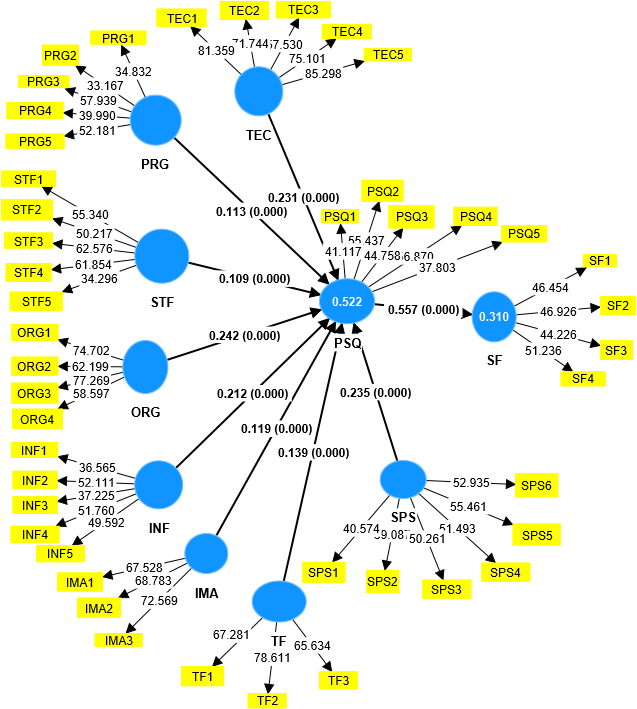
Thus, after testing with the SEM model, all 17 hypotheses are accepted and have 5% and 1% statistical significance, respectively. Comparing the level of impact of variables on perceived training quality, we have the following descending order of impact: Supportive service, Organizing and managing, Teacher, Infrastructure, Image, Tuition fee, official staff, and Training program.
The research results also show that Perceived service quality mediates all eight relationships between independent variables and satisfaction.
Through testing the theoretical model, we have an official model of factors affecting perceived training service quality, as shown in Figure 2.
Regarding student support activities, they have the most significant impact on perceived training quality. Learners who come to study at training facilities learn directly with instructors and need many support activities to serve better training quality. Student support activities include tuition payment instructions, advice on choosing class time frames, and guidance on administrative procedures for course registration and exam registration. Therefore, schools need to do an excellent job of supporting learners to improve the perceived quality of training and enhance learner satisfaction. Specifically, schools can establish a learner support center to resolve difficulties and problems promptly, sympathize with learners, and simultaneously introduce learners to job opportunities if they want to apply for a driving-related job. Strengthen the organization of dialogue activities with students to grasp students' thoughts and opinions promptly.
Organization and management factors are the second important factor affecting training quality. When the organization and management of training increases by one unit, the quality of training will increase by 0.242 units. This also shows that this work of schools is still not done well and is not methodical, forcing students to travel many times and wasting time, thus affecting their studies and work. Therefore, it negatively affects the quality of training. Management and training support staff are the bridge between students and lecturers. The training management and support process must be built and implemented systematically to help the classroom operate according to the plan, schedule, and training content. Therefore, when the organization and management of training are improved, the quality of training will improve very quickly.
The teacher factor also plays a vital role in improving training quality. This factor has the third level of importance in the regression results. Each unit increase in the number of teachers improves the quality of training by 0.231 units. Teacher quality is also a big problem in schools today. Teachers are sometimes recruited based solely on relationships. Many become teachers, rarely researching and updating new knowledge, so their professional level could be higher. Therefore, when the quality of teachers is improved, it will significantly impact the school's training quality. To enhance the quality of education and training, educational institutions must focus on building a team of teaching staff with sufficient quantity and good professional expertise.
The regression results show that the facility factor plays the fourth most crucial role in training quality. When facilities are improved by 1 unit, training quality increases by 0.212 units. This reflects the fact that current schools' facilities are not good and cannot meet the needs of learners. Most schools need to be equipped with air conditioning, and classrooms are overcrowded and need more air and light. This causes the quality of training to be significantly affected. Therefore, when facilities are improved, it will dramatically impact the quality of training.
Regarding the image, the fifth influence on the perceived quality of learners is that when a driving training school has a good image and brand, the perceived quality of training will be higher, promoting learner satisfaction. The driving training school must provide reasonable, high-quality services for many years to have a good image in customers' hearts. The image of an ambitious training school needs to be formed over a long period, so training schools need to make continuous efforts to provide good services, thereby enhancing image awareness.
Tuition has the sixth influence on perceived quality. Learners participating in the course often have to pay a fixed tuition fee and some additional expenses such as overtime car rental, practice field rental, and materials. Therefore, schools need to set tuition and other fees consistent with the quality of provision. Learners always compare the cost they have to spend and the value they receive, and the cost is the easiest thing to compare between training schools. If tuition fees are high, students will not attend, but if tuition fees are low, there will not be enough funds to cover the school's operations. It will take time to achieve profit goals. Therefore, it is necessary to set tuition and other fees based on considering the current state of facilities and service quality of the school along with the fees of other driving training schools in the area.
Unlike the author's expectations, the training program has a negligible impact on the quality of training. When the training program is improved by one unit, the quality of training only improves by 0.113 units. The reason is probably because the Ministry of Education and Transport regulates the framework program too rigidly, making it difficult for schools to change, so the impact on training quality could be better. Driver training schools need to rebuild the training program system according to the Ministry of Education and Training, the Ministry of Transport, and school regulations to improve the quality of training services. The training program needs to be redesigned according to application orientation, an appropriate assessment of the training process, and the distribution ratio between theory and practice in the training program.
The support staff has the 8th influence on perceived training quality. Management and training support staff must be more professional in resolving student questions. The homeroom teacher is the focal point to assist in resolving issues related to administrative procedures between students and the school. The attitude of support staff also dramatically affects the quality and satisfaction of learners. Support staff (including managers and administrative staff) must show enthusiasm and friendliness towards learners, helping them solve all problems related to managerial procedures while learning to drive at the school.
Improving training quality and learner satisfaction is always the top concern of training schools, particularly driver training schools. By using a structured questionnaire to survey 750 students studying at driving training schools in Vietnam and analyzing data with SmartPLS 4.0 software, it has been shown that there are eight factors affecting Perceived service quality in decreasing order as follows: Supportive service, Organizing and managing, Teacher, Infrastructure, Image, Tuition fee, Official Staff, Training program; At the same time, the research results also show that Perceived service quality mediates all eight relationships between independent variables and satisfaction. The results of this research are the foundation for driving training schools to devise appropriate strategies to improve training quality and learner satisfaction, thereby enhancing the competitiveness of training schools.
| [1] | Congress (2014), Vocational education law, Law No.: 74/2014/QH13. | ||
| In article | |||
| [2] | ISO 9000:2005 (2005) Quality management system - Basics and vocabulary, Hanoi. | ||
| In article | |||
| [3] | Nguyen Tien Hung (2014), Quality management in Education, Hanoi National University Publishing House. | ||
| In article | |||
| [4] | Nguyen Ngoc Quan and Nguyen Tan Thinh (2009), Human Resource Management in Organizations, Education Publishing House. | ||
| In article | |||
| [5] | Leblanc, G. and Nguyen, N. (1999). "Listening to the customer's voice: Examining perceived service value among business college students." The International Journal of Educational Management, 13 (4), 187-198. | ||
| In article | View Article | ||
| [6] | Gamage, D.T., Suwanabroma, J., Ueyama, T., Hada, S., Sekikawa, E. (2008), "The impact of quality assurance measures on student services at the Japanese and Thai private universities." Quality Assurance in Education, 16 (2), 181198. | ||
| In article | View Article | ||
| [7] | Jain, R., Sahney, S. and Sinha, G., (2013). "Developing a scale to measure students' perception of service quality in the Indian context." The TQM Journal, 25 (3), pp.276-94. | ||
| In article | View Article | ||
| [8] | Firdaus, F. (2005), “HEdPERF versus SERVPERF: "The quest for an ideal measuring instrument of service quality in the higher education sector," Quality Assurance in Education, Vol. 13, No. 4, pp. 305-328. | ||
| In article | View Article | ||
| [9] | Ali, F.; Zhou, Y.; Hussain, K.; Nair, P.K.; Ragavan, N.A. (2016), "Does higher education service quality affect student satisfaction, image, and loyalty?: A study of international students in Malaysian public universities", Quality Assurance in Education, Vol. 24, Iss 1, pp. 70-94. | ||
| In article | View Article | ||
| [10] | Silva, D., Moraes, G., Makiya, I. and Cesar, F. (2017), "Measurement of perceived service quality in higher education institutions," Quality Assurance in Education, Vol. 25 No. 4, pp. 415-439. | ||
| In article | View Article | ||
| [11] | Ha, N. Van. (2021). Improving the Quality of Teachers and educational administrators in the current period. Communist Magazine, ISSN 2734-9071. | ||
| In article | |||
| [12] | Navarro, M. M., Iglesias, M. P., & Torres, P. R. (2005). A new management element for universities: Satisfaction with the offered courses. International Journal of Educational Management, 19 (6), 505–526. | ||
| In article | View Article | ||
| [13] | Sportillo, D., Paljic, A., & Ojeda, L. (2019). On-Road Evaluation of Autonomous Driving Training. ACM/IEEE International Conference on Human-Robot Interaction, 2019-March, 182–190. | ||
| In article | View Article | ||
| [14] | Ling, Kwek Choon, Chai, Lau Teck, & Piew, Tan Hoi. (2010). The “Inside-out” and “Outside-in” Approaches on Students’ Perceived Service Quality: An Empirical Evaluation. Management Science and Engineering, 4 (2), 1-26. | ||
| In article | |||
| [15] | Firdaus, F. (2006), "The development of HEdPERF: a new measuring instrument of service quality for the higher education sector," International Journal of Consumer Studies, Vol. 30, pp. 569-581. | ||
| In article | View Article | ||
| [16] | Nasser, R. N., Khoury, B., & Abouchedid, K. (2008). University students' knowledge of services and programs about satisfaction. A case study of a private university in Lebanon. Quality Assurance in Education, 16 (1), 80–97. | ||
| In article | View Article | ||
| [17] | Schneider, F., 2002. Size and measurement of the informal economy in 110 countries around the world. In: Paper presented at the Workshop of Austrian National Tax Centre, Australian National University, Canberra, Australia, 17 July 2002. www .amnet.co.il/attachments/informal_economy110. Pdf. (Accessed 26 April 2009). | ||
| In article | |||
| [18] | Nguyen, N. and Leblanc, G. (2001) Corporate Image and Corporate Reputation in Customers’ Retention Decisions in Services. Journal of Retailing & Consumer Services, 8, 227- 236. | ||
| In article | View Article | ||
| [19] | Kazoleas, D., Kim, Y., & Moffitt, M. A. (2001). Institutional image: A case study. Corporate Communications: An International Journal, 6, (4). | ||
| In article | View Article | ||
| [20] | Oliver, R.L. (1981), "Measurement and evaluation of satisfaction process in retail setting," Journal of Retailing, Vol. 57, pp. 25-48. | ||
| In article | |||
| [21] | Kotler, P. and Keller, K. (2006), Marketing Management. 12th Edition, Prentice Hall, Upper Saddle River. | ||
| In article | |||
| [22] | Hair J. F., Black W. C., Babin B.J., Anderson R. E., (2009). Multivariate data analysis, 7th edition, Prentice Hall. | ||
| In article | |||
| [23] | Tabachnick, B. G., & Fidell, L. S. (2007). Using Multivariate Statistics (5th ed.). New York: Allyn and Bacon. | ||
| In article | |||
| [24] | Hair, J.F., Risher, J.J., Sarstedt, M. and Ringle, C.M. (2019), "When to use and how to report the results of PLS-SEM," European Business Review, Vol. 31 No. 1, pp. 2-24. | ||
| In article | View Article | ||
| [25] | Hair, J., Jr, Sarstedt, M., Hopkins, L., and G. Kuppelwieser, V. (2014), "Partial least squares structural equation modeling (PLS-SEM) an emerging tool in business research," European Business Review, Vol. 26 No. 2, pp. 106-121. | ||
| In article | View Article | ||
Published with license by Science and Education Publishing, Copyright © 2023 Nguyen Van Thang
 This work is licensed under a Creative Commons Attribution 4.0 International License. To view a copy of this license, visit
http://creativecommons.org/licenses/by/4.0/
This work is licensed under a Creative Commons Attribution 4.0 International License. To view a copy of this license, visit
http://creativecommons.org/licenses/by/4.0/
| [1] | Congress (2014), Vocational education law, Law No.: 74/2014/QH13. | ||
| In article | |||
| [2] | ISO 9000:2005 (2005) Quality management system - Basics and vocabulary, Hanoi. | ||
| In article | |||
| [3] | Nguyen Tien Hung (2014), Quality management in Education, Hanoi National University Publishing House. | ||
| In article | |||
| [4] | Nguyen Ngoc Quan and Nguyen Tan Thinh (2009), Human Resource Management in Organizations, Education Publishing House. | ||
| In article | |||
| [5] | Leblanc, G. and Nguyen, N. (1999). "Listening to the customer's voice: Examining perceived service value among business college students." The International Journal of Educational Management, 13 (4), 187-198. | ||
| In article | View Article | ||
| [6] | Gamage, D.T., Suwanabroma, J., Ueyama, T., Hada, S., Sekikawa, E. (2008), "The impact of quality assurance measures on student services at the Japanese and Thai private universities." Quality Assurance in Education, 16 (2), 181198. | ||
| In article | View Article | ||
| [7] | Jain, R., Sahney, S. and Sinha, G., (2013). "Developing a scale to measure students' perception of service quality in the Indian context." The TQM Journal, 25 (3), pp.276-94. | ||
| In article | View Article | ||
| [8] | Firdaus, F. (2005), “HEdPERF versus SERVPERF: "The quest for an ideal measuring instrument of service quality in the higher education sector," Quality Assurance in Education, Vol. 13, No. 4, pp. 305-328. | ||
| In article | View Article | ||
| [9] | Ali, F.; Zhou, Y.; Hussain, K.; Nair, P.K.; Ragavan, N.A. (2016), "Does higher education service quality affect student satisfaction, image, and loyalty?: A study of international students in Malaysian public universities", Quality Assurance in Education, Vol. 24, Iss 1, pp. 70-94. | ||
| In article | View Article | ||
| [10] | Silva, D., Moraes, G., Makiya, I. and Cesar, F. (2017), "Measurement of perceived service quality in higher education institutions," Quality Assurance in Education, Vol. 25 No. 4, pp. 415-439. | ||
| In article | View Article | ||
| [11] | Ha, N. Van. (2021). Improving the Quality of Teachers and educational administrators in the current period. Communist Magazine, ISSN 2734-9071. | ||
| In article | |||
| [12] | Navarro, M. M., Iglesias, M. P., & Torres, P. R. (2005). A new management element for universities: Satisfaction with the offered courses. International Journal of Educational Management, 19 (6), 505–526. | ||
| In article | View Article | ||
| [13] | Sportillo, D., Paljic, A., & Ojeda, L. (2019). On-Road Evaluation of Autonomous Driving Training. ACM/IEEE International Conference on Human-Robot Interaction, 2019-March, 182–190. | ||
| In article | View Article | ||
| [14] | Ling, Kwek Choon, Chai, Lau Teck, & Piew, Tan Hoi. (2010). The “Inside-out” and “Outside-in” Approaches on Students’ Perceived Service Quality: An Empirical Evaluation. Management Science and Engineering, 4 (2), 1-26. | ||
| In article | |||
| [15] | Firdaus, F. (2006), "The development of HEdPERF: a new measuring instrument of service quality for the higher education sector," International Journal of Consumer Studies, Vol. 30, pp. 569-581. | ||
| In article | View Article | ||
| [16] | Nasser, R. N., Khoury, B., & Abouchedid, K. (2008). University students' knowledge of services and programs about satisfaction. A case study of a private university in Lebanon. Quality Assurance in Education, 16 (1), 80–97. | ||
| In article | View Article | ||
| [17] | Schneider, F., 2002. Size and measurement of the informal economy in 110 countries around the world. In: Paper presented at the Workshop of Austrian National Tax Centre, Australian National University, Canberra, Australia, 17 July 2002. www .amnet.co.il/attachments/informal_economy110. Pdf. (Accessed 26 April 2009). | ||
| In article | |||
| [18] | Nguyen, N. and Leblanc, G. (2001) Corporate Image and Corporate Reputation in Customers’ Retention Decisions in Services. Journal of Retailing & Consumer Services, 8, 227- 236. | ||
| In article | View Article | ||
| [19] | Kazoleas, D., Kim, Y., & Moffitt, M. A. (2001). Institutional image: A case study. Corporate Communications: An International Journal, 6, (4). | ||
| In article | View Article | ||
| [20] | Oliver, R.L. (1981), "Measurement and evaluation of satisfaction process in retail setting," Journal of Retailing, Vol. 57, pp. 25-48. | ||
| In article | |||
| [21] | Kotler, P. and Keller, K. (2006), Marketing Management. 12th Edition, Prentice Hall, Upper Saddle River. | ||
| In article | |||
| [22] | Hair J. F., Black W. C., Babin B.J., Anderson R. E., (2009). Multivariate data analysis, 7th edition, Prentice Hall. | ||
| In article | |||
| [23] | Tabachnick, B. G., & Fidell, L. S. (2007). Using Multivariate Statistics (5th ed.). New York: Allyn and Bacon. | ||
| In article | |||
| [24] | Hair, J.F., Risher, J.J., Sarstedt, M. and Ringle, C.M. (2019), "When to use and how to report the results of PLS-SEM," European Business Review, Vol. 31 No. 1, pp. 2-24. | ||
| In article | View Article | ||
| [25] | Hair, J., Jr, Sarstedt, M., Hopkins, L., and G. Kuppelwieser, V. (2014), "Partial least squares structural equation modeling (PLS-SEM) an emerging tool in business research," European Business Review, Vol. 26 No. 2, pp. 106-121. | ||
| In article | View Article | ||