Education is the social pillar of the vision 2030 hence education gets the highest budget. The education sector got 32.6% of the Kenyan national budget of the financial year 2022/23 to finance its activities, which was the largest share, yet performance of public schools has not been impressive. The schools have implemented strategic plans, they have service charter delivery and have set targets geared towards performance but it is still unrewarding. This study objectives were to established how strategic leadership, strategic resource allocation and strategic incentives affected performance of public secondary schools in Bungoma County, Kenya. This research utilized the resource based and the capability theory, behavioral leadership theory, expectancy variables were anchored by the balance score card model, Resource Based View, Dynamic Capability Theory, Leadership Behavioural Theory and Expectancy Value Theory. The researcher used descriptive survey design; the sample size was 101 respondents. Data was collected using a structured questionnaire and analyzed using descriptive statistics and multiple regression analysis models. The results indicated that strategic leadership had significant effect on performance in public schools in Bungoma County. Strategic resource allocation had a significant and positive effect on performance of public schools in Bungoma County and the strategy of incentive had a significant effect on the performance of public schools in Bungoma County. The researchers recommends that school managers should provide strategic leadership and ensure that strategic plans are executed within the allocated resources, school managers disseminate messages on the strategic plans effectively to the staff and ensure incentives are provided to those who meet the set targets so that there is successful implementation of strategic plans which can translate to greater productivity among teachers and students.
Strategic planning is significant in any administrative work performance since it’s a way that makes an organization to succeed or fail. A strategy is a proposal that is projected to help attain specific goals 1. It aids companies to know its programs and how they carry them out with the future in mind.
Nowadays there is a mounting need for development of strategic plans by secondary schools. The aim of introducing action plans has been to acquire excellent education and boost performance and make schools self-regulated.
Strategic implementation is understood as the workforce knowing the “what”, “why’ and “how” of the strategy after the strategy gets conveyed to the organization 2. Strategic implementation has a gigantic influence on performance in any organization.
There are dissimilar factors that affect strategic implementation and its success including strategic leadership, strategic resource allocation and strategy of incentives. Strategic implementation is a characteristic that has been overlooked in University courses and even in manuscript literature 3.
Due consideration is given to formulation of strategies coupled with faultless strategy yet with wrong implementation which leads to unrealized goals (Pederson, 2008). Most textbooks have depicted the strategic process as consisting of a series of steps which are mainly the formulation stage, analysis and implementation stage 2.
For years, strategic implementation has received little exploration in literature. Hrebiniak 4 stipulates that administrative writings have often given much attention to planning and formulation while giving little attention to the paradigm of strategic implementation 3.
A study done by Wanjala 5 indicated that Kenyan secondary schools have a long way as regards the full integration of all-encompassing strategies. Majority of the strategies are essentially in the thoughts of managers with the most important hierarchical and inflexible leadership which negatively influences the forecasting process in schools.
Many governments have made arrangements that state organizations with public schools included have to create strategic plans as a way of promoting management with a clear focus on results and effectiveness in most transactions.
The directives to schools by the National Policy on Education guides all educational establishments to be engrossed in strategic forecasting to encourage service delivery and educational preparedness 6. According to the state of Victoria 7 Australia went a step ahead by making commendations of what educational institutions should address in their strategic plan.
Bell 8 correspondingly recounted that the United Kingdom derived a strategy where general targets for different schools are used to create specific targets for schools.
According to Richard 9 organization performance entails three distinct areas of organization outcomes: shareholders return, financial performance and product market performance.
Organizations measure performance in terms of its profitability but public schools being non- profit organizations measure performance in terms of number of employees, enrolment rates, conflict management, teachers and learners complaints, financial stability, technology and availability of resources.
The efficiency of public schools is determined by how well it carries out its functions in relation to achievement of set goals 9. Strategic implementation is the summation of all the programs and selections needed for the enforcement of strategies 10.
Implementation is the situation of translating plans into actions so as to realize strategic objectives. Executing strategic plan takes supremacy than the reputation of strategy itself.
Strategic implementation encompasses activities on how institutions instruments (individuals, procedures and technical systems) will be associated with the objectives. Numerous scholars have scrutinized the influence of strategic leadership on implementation.
Kalali, Akhavan and Pourezzat 11 explained that since the leadership role is significant in strategic implementation, where a leader is not concerned with strategic implementation then leadership will not be able to generate a vibrant vision for any strategic program.
Matapere and Mavhiki 12 supports the claim by asserting that besides vision generation, leadership identifies resources like appropriate workforce for the strategy growth and execution, cultivate communication and invest in evolving the desired organizational culture
1.1. Statement of the problemEducation is the social pillar of the vision 2030 hence education gets the highest budget. Data from the Ministry of education (M.O.E) 2022 show that the education sector got a lion’s share, that is, 32.6 % of the Kenya’s national budget of the financial year 2022/23, to finance its activities.
Nevertheless, performance of secondary schools presents mixed results, more so in Bungoma County. According to the KNEC report of 2019, 2020 and 2021, the performance of 5 top schools in the County was as follows: Friends school Kamusinga scored a mean of 9.16, 9.62 and 9.6 in 2020.
Lugulu Girls high school scored the means of 8.3, 9.3 and 9.4 respectively. Cardinal Otunga Girls scored 7.2, 7.0 and 7.35 respectively. St Luke’s high school scored 6.88 in 2019 and 7.22 in 2020 and Kibabii boy’s high school scored 6.88, 8.57 and 7.68 respectively.
Many public schools in Bungoma County set targets at the beginning of the year, yet most of them do not attain the planned or predicted targets. Most of the public schools have service charter delivery as a strategy and are keen in meeting deadlines, yet performance is still unrewarding 13.
The policy of the Ministry of Education to secondary schools to guide them to generate and execute strategies and the provision of public resources for the same has been effective in enhancing performance in secondary schools 14.
Secondary schools in Kenya are charged with the responsibility of providing excellency in education 13. This calls for formulation and implementation of strategic plans that stir the schools to their anticipated future.
This generates a knowledge gap between what school managers and the executing agents are supposed to do in order for them to realize the anticipated performance. Schools have enforced strategic plans yet performance has not improved. Most of the strategies are in the minds of school managers or just sit on shelves.
The students, parents and Board of Management in Bungoma North sub- county claim that limited strategic leadership, insufficient strategic resource allocation and lack strategic incentives to teachers are prevalently liable for the unrewarding performance in the sub- County.
According to Nderitu 15 similar claims were observed in Kenya. However, from similar literature examined, little studies has been undertaken in Bungoma North to invalidate or back the claim, hence the need to carry out this study.
1.2. Objectives of the StudyI. To establish how strategic leadership affect performance of public secondary schools in Bungoma County, Kenya.
II. To examine how strategic resources allocation affect performance of public secondary schools in Bungoma County, Kenya.
III. To assess how strategic of incentives affect performance of public secondary schools in Bungoma County, Kenya.
This section dealt with the theoretical review and the empirical review of literature in relation to specific objectives.
2.1. Theoretical ReviewThe following theories guided this study, that is, the leadership behavioural theory, the resource-based view, goal setting theory and the balance score card model.
Balanced score card was coined by Kaplan and Norton 16. It is composed of diverse ways of assessing performance for the different units of learning and growth, financial performance, internal processes and customer relationships 17
Firms come up with objectives that have fixed deadlines and translate them into measures 16. The balanced score card is precisely predominant in inspiring execution of strategy Langfield 18. Kaplan and Norton assert that it delivers a technique for executing strategy and alterations outstanding to the dynamic nature of the feasible market of the company and the digital environment.
Balanced score card in companies leads to preparation of strategies and execution of strategies in the whole organization 19. It illustrates the financial indicators of performance in the past that are reinforced by original indicators that express performance of the future.
Goals and pointers of balanced score card depend on the plan and strategy of the organization and the following are the performance pointers of the organization that create the four standpoints financial aspect, internal perspective, the customer aspect and the Learning and growth perspective 20.
The balance score card in this study was used to help administrators to formulate strategies of boosting student’s performance in national examinations. It also helps stakeholders (teachers and support staff) be gratified of the success in academics and other co- curricular activities and helps managers execute the strategy in schools leading to superior performance.
The Resource Based View was coined by Penrose 21 and her contributions were: Firstly, the firm’s economic value is created by innovative and effective management of resources and not just possession of resources. Secondly, there is a causal link between making of viable opportunities for growth and innovation and resources.
To her, the image of unique productive opportunities for the firm is affected by the experience that managers have with each other and other resources in the organization. Thirdly, the existence of technical and top managerial talent hinders the growth of a firm for a period of time. To her, firms who ignore these limiting factors experience loss of competitive advantage and inefficiencies.
Resource Based View has received improvements from different authors. For example, some resources that institutions own and control have the capability to create competitive edge and improve performance 22
According to Hoopes 23 institutions’ resources can maintain superior monetary performance with the certainty that they cannot be imitated. The core competence of an institution comes from resources that are outstanding and valuable 24.
The salient features of a valuable resource are that; they are exceptional, they add value, they carry the ability to be taken advantage of if carefully exploited and they are hard to reproduce.
The resource-based view recognizes factors that make it difficult to imitate as dependability, physical uniqueness, resilience, indistinctness, economic dissuasion and appropriateness 24.
Whelan and Hunger 10 assert that to measure whether a resource has competitive edge, you liken it to formerly existing resources and the resources that belong to a major competitor.
The resource-based view has been used in this study to show that school’s resources should be superior to competitors, possessed by a school and superior than the existing resources.
The resource base view was supported by the dynamic capability theory which came into existence both as a reaction against RBV and an extension of the theory. The dynamic capability theory was proposed by 25.
It addresses the redevelopment and growth of capabilities and resources to address the dynamic environments. It will be used in this study to marshal, integrate and reconfigure the organizations resources and capabilities to adapt to the dynamic environments.
It will help education institutions to achieve sustainable competitive advantage and superior performance by configuring their strategies in the dynamic environment 26, 27.
According to (Likert) 1950, the leadership behavioural theory evolved from the trait theory. The founders and pioneers of the behavioural theory were Mary Parker Follet, Hugo Munsterberg and Elton Mayo.
It states that leaders to a large extent are made rather than born and that particular traits are learnt to ensure effective leadership. It puts great emphasis on the actions of a leader and not the intellectual abilities and characteristics of a leader.
People learn to become leaders through observation and training 28. The leadership behavioural theory ignores the environment and situation of a leader.
The behavioural theory has been used in this study because it helps leaders acquire leadership skills and behaviour through observation and training which enables them to achieve organization performance in schools.
It was coined by Victor Vroom in 1964 29. According to the theory, a combination of subjective task value and people’s expectation for success in a specific domain leads to attainment of choices that are related. Task values are more strongly tied to achievement related choices.
There is high motivation when value and expectancy are high but motivation disappears when expectancy and value equals zero. The expectancy value theory has been used in this study to help employees work hard so that they receive better remunerations.
2.2. Empirical ReviewRelated literature was discussed in relation with studies done globally, regionally and locally in Kenya.
The prominence of strategic leadership in the performance of schools has been distinguished by academicians.
This is due to the fact that leadership is concerned with stakeholder administration, resources deployment and utilization, incentive of teachers and policy origination. The role of strategic leadership inside the secondary schools’ structure is responsible for the realization and maintenance of viable organization performance.
A study was done by Absah, Rini and Sembiring 30 on Quality Management Practices and organization performance in tertiary institutions in Indonesia. They concluded that sound practices in management practices produced a positive impact on organization performance in tertiary institutions.
Cross-sectional research design was employed and the researcher gathered data using questionnaires. Krejcie and Morgan 31 instruction were applied for sample size extraction using cluster sampling.
Data was analyzed by statistical software known as Partial Least Square (PLS) and Confirmatory Factor Analysis (CFA). The target population was 400 respondents and a sample size of 212 participants.
A study by Matepere, Mavhiki, Nyamwanza, Sikomwe and Mhonde 12 in Zimbabwe on leadership role in strategic implementation in government owned enterprises. The study had 188 participants randomly sampled.
The exploration used open ended questionnaire. The study discovered a comparatively little leadership participation in strategic implementation leading to incomplete success in strategy execution.
They further asserted that leadership has been unsuccessful to mold the desired behaviour essential for fruitful execution of strategies. The study used open ended questionnaires.
They recommend that leadership should craft a vision for any strategic program and come up with operational communication strategies as well as mold behavior changes that align with new strategies. This study will employ both open ended and closed questionnaires.
A study was done by Njukunye and Waithaka 32 on strategic leadership and performance of high schools in Samburu central, Kenya. They asserted that was an existence of a strong relationship between the student performance and the leadership style of a principal.
The study employed descriptive survey design and gathered data by use of questionnaires. The study utilized inferential and descriptive statistics, SPSS and multiple regression to analyze the data.
The target population was 27 public secondary schools and a sample size of 20 % of the population using simple random sampling. This study dealt with organization performance while Njukunje and Waithaka’s study dealt with academic performance in public schools.
A study done by Wang’ang’a and Awour 33 in Nakuru County on the leadership role on academic performance of secondary schools. Descriptive research design was employed. The study applied a universe populace of 338 schools and 8400 teachers with a sample size of 99 participants.
Questionnaires were applied to gather data. The researcher employed multiple regression models to analyze data. They concluded that performance in Nakuru County was predicted by discipline level, resource mobilization, stakeholder administration and strategy execution. It focused on only one variable while this study focused on three variables.
Educational resources help schools to realize their intentions and goals. Quite a lot of studies have observed that there are inadequate economic, physical and financial resources in schools which might be perpetuating student’s low academic performance.
Some studies show that resources in schools do not produce a substantial increase on performance of schoolchildren 34. According to Nambuya 35 physical and economic resources exert a substantial increase on performance of students. Physical resources are divisible into persons, equipment, touchable and economic resources.
A study was done by Sebile and Tomul 36 in Turkey on the effect of educational resources and performance of students. The universe was pre- primary schools in the 2007-2008 academic years. Two cluster sampling was employed. The study found out that resources did not have the ability to affect academic performance.
According to them there are great negative relationships between the examination results of students and the normal stay of the teachers, inadequate competent teachers in sciences, inadequate experienced teachers to teach Turkish language and inadequate laboratory technicians.
Pre- primary pupils were used while the study used secondary students and focus on organization performance.
A study was done by Agbonghale and Adavbiele 37 on resources and student’s performance in woodwork in Vocational institutions in Nigeria’s Delta State. The research employed Correlation survey research design. A sample of 20 apprentices was determined in colleges at dissimilar occasions with an interval of two weeks.
The study used the Pearson’s product moment correlation used to analyze results. The researcher found out that various technical colleges experienced insufficient workshop, insufficient assistant workforce, insufficient competent teachers and the equipment in workshops were grossly insufficient.
The study recommended sufficient delivery of resources. Performance was a dependent variable while this present study has organization performance as the dependent variable.
A study was done by Wanjiku 38, in Mbeere South in Embu County on the utilization and accessibility of school resources and strategic plans in secondary schools. The universe population was 34 secondary schools with a sample of 34 principals and 68 H.O.DS (sciences and languages) out of a population of 6403 students.
Stratified sampling was used to pick 3 boys from 8 mixed day schools and 4 girls from girls boarding school. The researcher gathered data using lesson observation, questionnaires and checklists. The study established out that textbooks and laboratories were insufficient in different categories of schools.
The study had strategic plans as an independent variable and both studies considered organization performance as a dependent variable. Stratified sampling was used while this study used simple random sampling.
A study was done by Imende, Atieno and Olel 13 in Kakamega County on resources and execution of strategic plans in high schools. The research applied the descriptive survey research. The population’s universe was 645 participants with a sample size of 173 subjects using multiple stage sampling methods.
The study established that the implementation of school strategic plans was greatly impacted by resources. This study dealt with strategic plans implementation and performance while their study dealt with the effect of resources on execution of strategic plans in high schools.
A study done by Gunn 39 explains that an efficient incentive package relies on the capacity to set achievable goals. The author expounds on setting goals that are irrationally high which leave the workforce feeling exasperated. She asserts that leaders should avoid an incentive package that is too intricate to be understood by the workforce.
According to Plecki, Alejano, Knapp and LochMiller 40, while many kinds of incentive can be imaginary, educational leaders wishing to pursue a learning improvement agenda regards fairness as an essential objective addressing questions of encouragements. - as well as deterrents- that affect who does what in relation to the schedule.
They contend that school administrators should create incentives that inspire skilled teachers to work hard, teach subject areas that are challenging and provide rewards for improvement.
A study was done in North Carolina’s ABC program with the purpose of qualifying the danger to collegiality hypothetically brought about by specific incentive system. However, the judgements about recompense were based on subjective factors that are far from the jurisdiction of teachers 41.
Other types of incentives attract teachers to work in hardship regions, high poverty and less performing schools. Strategies such as loan forgiveness plans and housing assistance have a capability to making students have access to high quality teachers and teaching.
According to Ozoemena 42 in contemporary Nigeria undertook a study on improved incentive system in the profession of teaching in order to offer quality service in delivery and improve production. The study recommends different incentives such as monetary, non-monetary, promotion scheme, physical working condition, worker pleasure and recreation and job enhancement.
According to her these incentives increases productivity. However, teachers are likely to rate school founded factors such as well-mannered schoolchildren, co-operative working environment and compassionate administrators just as important as better compensation 43.
They argue that whether or not these non-financial incentives and provisions are existent, the inside of schools is principally a task of the excellence of a district or school level leadership arrangements that bring non- financial resources (like re- organized time and knowhow) to bear on school environment.
A study carried out by Saad 44 on Incentives and the Performance level of Nursing Staff in the Public Health Sector of Libya. The researcher used SSPS to analyze descriptive data. Data was gathered by use of questionnaires from a populace of 643 male and female nurses. Incentive system was found to cause a significant effect on the performance level of nurses.
A study by Gbollie and Keamu 45 in Liberia on how the role of motivation strategies and perceived factors in senior and junior secondary schools hinder academic performance. The researcher employed cross- sectional quantitative research design with 323 subjects from two counties. Questionnaires were used to gather data. They analyzed the data using statistical package for social sciences (SPSS).
They found out that there is a positive relationship between incentive learning strategies and academic performance. They recommended that teacher’s need to concentrate keenly on encouraging student’s enthusiasm in order to promote self- efficacy, make learners to have confidence in themselves and also teachers should trust their students.
A study was carried out by Barasa 46 on teacher incentives and academic performance of students. Descriptive survey design employed in the study which had a target populace of 30 secondary schools and a sample of 20 secondary schools in Trans- Nzoia West County.
The study employed questionnaires to gather data. The researcher discovered that most teachers lack inspiration in their work and this is the justification for the low performance in these schools. The study was carried out in Trans- Nzoia County hence a conceptual gap in Bungoma County.
A study was carried by Al-Nsour 47 on moral and financial incentives and employee performance in Jordanian’s Universities. The researcher found out that financial incentives had greater impact on performance level than the moral incentives. Statistical package for Social Science was used to analyze data. The researcher used a sample of five universities while this study used twenty seven secondary schools.
In this study, descriptive survey research design was utilized. The method sought to offer particular and systematic data about the population under inspection Muathe 2, McCombe 48. McCombe emphasized that descriptive survey research plan was best suited when the researcher does not need to control the research variables. This method was chosen because the study’s main objective was to recognize the characteristics, frequencies and categories of the population according to Garl and Borg 49, Muathe, 2.
In this study, the researcher used 27 public secondary schools in Bungoma County. The target population in this study involved Principals, Deputy Principals, Senior teachers and heads of support staff selected from 27 secondary schools in Bungoma North Sub- County making a sample of 101 respondents. The study used primary data which was gathered using structured questionnaires since they are easy to administer and the data gathered is easy to be examined 32. The collected data was analyzed using descriptive statistics and multiple regression models.
This section dealt with analysis, presentation and discussion. The study illustrated implementation of strategic plans on organization performance in Bungoma County. The researcher analyzed the data using multiple regression models and presented the results using charts, percentages, means, standard deviations and frequency tables.
4.2. Questionnaire Response RateA total of 101 questionnaires were distributed to 27 schools in Bungoma County. In each school, the principal, the deputy principal and the senior teacher were given the questionnaires to fill. There was a total of 101 completed questionnaires that were collected making a response rate observed was at 100%.
According to Mugenda and Mugenda 50, a response rate of above 50% is sufficient to establish the research objectives and research questions. This response rate was achieved as all the respondents were readily available and within the school institution. A descriptive statistical analysis was performed on the responses especially on the demographic features of the responses and the following are the results:
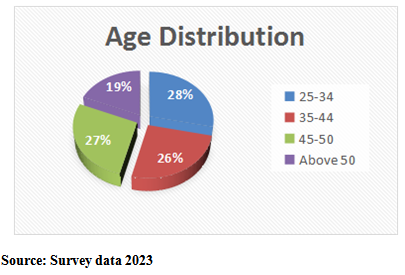
General information was sought to understand the respondent’s age, gender and level of education. These attributes were pertinent to the study since they enabled the researcher to comprehend the characteristics of the respondents.
The respondents' age was sought among the choices of age classes given. The responses were shown in the figure above:

The findings indicated that 19% of the respondents were above 50 years, 26% were between 35-44 years. 27% were between 45-50 years and 28% of the respondents were between 25-34 years. This shows that most of the respondents are young and experienced in their career fields.
The respondents (101) were asked to indicate their gender in order to establish their representation of either gender in the study in public schools in Bungoma County. The responses were shown in the table below;
From the findings, male respondents were represented by 64.4% while female respondents were represented by 35.6%. This indicates that male respondents preferred technical subjects in comparison to females.

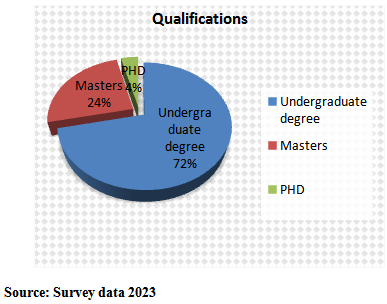
The respondents (101) were asked to indicate their qualification in their field of study. The responses are shown in the figure below;
From the findings above it is observed that 71.6% of the respondent’s had undergraduate degrees, 24.5% had masters and 3.9% had PhD. This implies that most of the respondents were skilled with an undergraduate degree and had not advanced their career.
4.4. Descriptive analysisDetermination of strategic leadership on organization performance among public schools in Bungoma County was the prime aim of this study. The respondents were asked questions on a Likert scale of 1-5, denoted as Strongly Disagree=1, Disagree=2, Neutral=3, Agree=5, strongly Agree=5. The results were depicted as shown below:
The investigation realized that to a moderate extent the public schools embraced efficiency in marking and release of exams, efficiency in performing duties, involvement in decision making, and absorption of graduates in tertiary institutions as shown by the means of 4.26, 4.00, 3.85 and 3.74 respectively. This demonstrates that the public schools embraced employee involvement and efficiency in marking and release of exams that was employee centered.
This had a positive contribution to organization performance. This finding concurs with Knies; Jacobson and Tummers, 51, study in strategic leadership and performance that showed that strategic leadership had a positive effect on performance.
Respondents were asked to identify how beneficial the implementation of strategic resource allocation has impacted on organization performance in public schools in Bungoma County, Kenya on a Likert scale of 1-5. The scale was denoted as Strongly Disagree=1, Disagree=2, Neutral=3, Agree=4, strongly Agree=5. The results were depicted as shown below:
The study depicted that, to a great extent, that public schools had adequate resources, appropriately allocated financial resources, had skilled teachers, adequate staff to carry out duties, laboratories were available as shown by a mean of 3.35, 3.43, 2.95, 3.10 and 2.90 respectively.
This demonstrates that the public schools in Bungoma County, Kenya have improved their organization performance through appropriately allocating the resources and ensuring that the resources are enough. The study concurs with Ongeti and Machuki 52. who determined the effect of organizational resources on performance in Kenyan State Corporations and deduced that resources had a positive effect on performance.
The study lastly strived to determine how the strategy of incentive affected organization performance in public schools in Bungoma County on a Likert scale of 1-5. The scale was denoted as Strongly Disagree=1, Disagree=2, Neutral=3, Agree=4, strongly Agree=5. The results were depicted as shown below:
The study established that public schools in Bungoma County had minimal improvement in financial incentives given to teachers, incentives given to students and minimal leave paid to support staff as demonstrated by the mean of 3.24, 2.94, 3.27, 3.33 and 3.19 respectively.
This indicated that there was minimal effort as regards to motivation to students and staff while aiming at improving organization performance. These findings are similar to the study of Al-Nsour 33 on incentives and organization performances who noted that financial incentives had little effect on learning and growth in Jordanian universities.
Strategic plans implementation among public schools in Bungoma County, Kenya was investigated to establish the effectiveness of its implementation. The respondents were asked questions using a Likert scale of 1-5. The scale was denoted as Strongly Disagree=1, Disagree=2, Neutral=3, Agree=4, strongly Agree=5. The results were depicted as shown below:
The research showed that, to a positively moderate extent, the public schools in Bungoma County, Kenya had improved organization performance through participation in formulation of plans, implementation of the plans and transition to university as highlighted by a mean of 3.33, 3.72 and 2.76 respectively. This shows that organization performance was moderate among public schools.
These study’s findings are similar to the study of Mathore 53 on strategy implementation and performance who established a significant relationship between strategy execution and performance in Diamond Trust Bank (DTB) in Kenya.
These results also concur with the study of Keya 54 on strategy implementation practices and performance of Kenya’s non-governmental organizations. He deduced that organization performance was affected by strategic implementation practices based on schedule compliance, standards and deliverables compliance and budget compliance.
4.5. Inferential StatisticsThe implementation of strategic plans on organization performance in Bungoma County, Kenya was employed by using a multiple linear regression model. The results of the model summary of both coefficient of regression and ANOVA are shown below:
The results of the correlation coefficient and the determination coefficient are shown table below:
A Predictors: Strategic leadership, strategic resource allocation and the strategy of incentive.
B Dependent variable: Organization performance
According to the study, a coefficient of correlation (R) of 0.646 showed that there was a strong correlation among variables. The modified R2 coefficient was 41.8% which implied that strategic leadership, strategic resource allocation and the strategy of incentive moderately contribute to the changes in organization performance.
The residual implies that there are factors outside the scope of this study that account for 58.2% changes in organization performance.
The next output on the multiple analysis performed is the ANOVA (Analysis of variance) that was conducted at the level of 95% confidence level. The results of Fcalculated and FCritical are shown in Table 4.Table 5. :
A Dependable Variable: Organization performance
b. Predictors: Constant, Strategic Leadership, Strategic Resource Allocation, Strategy of Incentive
The study established that an F Calculated value of 22.709 and the F Critical was 2.901. This indicates that the total regression model was significant for the investigation because F calculated > F Critical. It was noted that at least one explanatory variable had significant effect as demonstrated by the p value 0.00<0.05, on how public schools in Bungoma County performed.
4.6. Regression CoefficientRegression coefficient was employed to determine the impact of each variable of strategic plans implantation on organization performance among public schools in Bungoma County, Kenya. The results are shown in the table below:
A Dependent Variable: Organization Performance
Where Y= 2.039 + 0.016 X1 + 0.443X2 +0.022X3
X1 = Strategic Leadership
X2 = Strategic Resource
X3 = Strategy of Incentive
Table 9 shows that with all variables kept constant organizational performance in public secondary schools in Bungoma County would be 2.039. When strategic leadership is increased by one unit and other factors held constant, organizational performance raises by 0.016 units. These findings are in line with Quigley and Graffin, 2017 that articulated that strategic leadership positive effect on organization performance. Also Knies et al., 55 is in line with this study where they concluded that strategic leadership had minimal effect on organization performance due to the moderating effect of the external environment.
Intensifying strategic resources allocation when implementing strategic plans while holding other factors constant organization performance would attain 0.446. Nafari and Rezaer 56 research findings are in line with this study that asserted that human resources strategy had a positive effect on organization performance.
In addition, Ongeti and Machuki 52 also asserted that organizational resources had a positive effect on the performance of Kenyan state corporations. Lastly increasing the strategy of incentive by one unit would lead to an increase of 0.022 in organization performance.
These findings are in line with the study of Lagat 57 that explained that vacations, promotions, food, coupons and on-call payments had effect on happiness and the overall organization performance. Furthermore, Al-Nsour 47 asserted that financial incentives had a positive effect on learning and growth in Jordanian Universities.
The variables of implementation of strategic plans had varying p values, that is, strategic leadership had a p value of 0.00 which is less than 0.05, indicating that strategic leadership had effect on organization performance in public schools in Bungoma County.
Strategic incentives had p value of 0.001 which is less than 0.05 implying that the strategy of incentive had significant effect on organization performance. Nevertheless, strategic resource allocation had a p value of 0.00 which is lower than 0.05 indicating that strategic resource allocation had a positive impact on organization performance.
These findings are also similar to the study of Maroa 58 on influence of strategic management and performance of Kenya’s floriculture firms. The author concluded that strategy formulation, control and implementation had a positive effect on the performance of Kenya/s flower firms.
The study sought to examine the effect of strategic plans implementation on organization performance in public schools in Bungoma County, Kenya. According to the study's findings the researcher deduced that, Strategic leadership, Strategic resource allocation and the Strategy of incentive all had a positive effect on the organization performance of public schools in Bungoma County, Kenya. Hence the schools which will implement the formation strategic plan issues are likely to do better than those which don’t implement.
5.1. Policy RecommendationsThe researcher recommends that school managers ensure that strategic plans are executed within the stipulated resources. The researcher also recommends that Heads of Departments ensure that strategic plans are implemented successfully and in the postulated time when executing the strategic plans.
This study will be advantageous to the ministry of education to help derive guidelines to ensure that school managers and the senior management of the school have the essential skills for successful implementation of strategic plans. The researchers recommends that resources should be appropriately allocated and in adequate amounts to achieve organization performance.
The school administration should further ensure that the school staff is provided with adequate resources to carry out their duties with regard to effective organization performance within public schools in Bungoma County, Kenya. The study also deduced that the strategy of incentive is significant in achieving organization performance in public schools in Bungoma County, Kenya.
The study proposes that school staff is given both financial and non-financial incentives as motivation towards improved performance.
5.2. Limitations and Future Research DirectionThe researchers encountered the problem of some principals being suspicious of the intention of the study. However, they were informed about the reason for the survey and reassured of the confidentiality of the information they were going to provide. The researcher was also inhibited by the COVID pandemic which limited movement of the researcher and the assistants from one school to another.
To overcome the problem, the researcher and research assistants wore face masks to protect themselves and the respondents. Though this study provides insights into performance of public secondary schools in Kenya, the findings cannot be generalized to the rest of the country and therefore further study involving more counties should be contacted to validate these findings.
| [1] | Bryson, J. M (2011). Strategic planning for public and nonprofit organizations: A guide to strengthening and sustaining organizational achievement. (4th edition) San Francisco CA:-Bass | ||
| In article | |||
| [2] | Muathe, S. M. A. (2010). The Determinants of Adoption of Information and Communication Technology by Small and Medium Enterprises within the Health Sector in Nairobi, Kenya. Unpublished PhD Thesis, Kenyatta University. | ||
| In article | |||
| [3] | Kioko, M; Wasike, S; & Ndiao, D. (2013). Growth strategies and product performance: A Case of M-pesa. Strategic Journal of Business & Change Management 6(3). | ||
| In article | |||
| [4] | Hrebiniak, L. G. (2005). Making Strategy work: Overcoming the obstacles to effective execution. Strategic Management Journal, Western University Canada. | ||
| In article | |||
| [5] | Wanjala, C. N & Rarieya, F. A. (2014). Strategic planning in schools in Kenya: Possibilities and challenges. ISEA, 42 (1). | ||
| In article | |||
| [6] | Federal Government of Nigeria (NERDC) Press; Yaba, Lagos, Nigeria. | ||
| In article | |||
| [7] | State of Victoria. (2010). Strategic plan 2010-2013. | ||
| In article | |||
| [8] | Bell, L. (2002). Strategic planning and school management: Full of sound and fury, signifying nothing? Strategic planning and management 40 (5): 407-424. | ||
| In article | View Article | ||
| [9] | Richard, P. J; Devinney, T. M; Yip, G. S; & Johnson, G. (2009). Measuring organizational performance: Towards methodological best practice. Journal of Management, 35(3): 718-804. | ||
| In article | View Article | ||
| [10] | Wheelan, P. N & Hunger, J. D. (2008). The Resource Based Theory of Competitive Advantage: Implication for strategy formulation, California Management Review Vol 3, 33. | ||
| In article | |||
| [11] | Kalali, N. S; Akhavan, M. R; Pourezzal, A. A & Dastjerdi, D. K (2011). What does strategic plans implementation fail. A Study in the Health Sector of Iran Operations research, Faculty of management, University of Teran, Iran. | ||
| In article | |||
| [12] | Matepere, D; Mavhiki, S; Nyamwanza, T; Sikomwe, S; & Mhonde, C. (2012). Strategic Role in strategic Implementation in Zimbabwe’s State owned enterprises, International Journal of Business and social sciences 3 (16). | ||
| In article | |||
| [13] | Imende, M. T; Atieno, M; & Olel; M. A. (2020). The Effect of Resources on Implementation of Strategic Plans in Public Secondary Schools in Kakamega County, Kenya. | ||
| In article | |||
| [14] | Abdikadir, A, K. (2015). Challenges in Implementation of Strategic Plans by Secondary Schools in Mandera County; University of Nairobi, Kenya. | ||
| In article | |||
| [15] | Nderitu, M. W. (2020). Challenges in the Implementation of strategic plans by secondary schools in Mandera County. University of Nairobi, Kenya. | ||
| In article | |||
| [16] | Kaplan, R. S; & Norton, D. P. (2005). The Balance Score Card: Measures that drive performance, Havard Business Press. | ||
| In article | |||
| [17] | Lipe, M & Salterio, S. (2000). Balanced Scorecard judgemental effects of common and unique performance measures. The Accounting Review 75 (3): 283-298. polteksby, ac.id/ebook/files/Ebook/Accounting/Controlling. | ||
| In article | View Article | ||
| [18] | Langfield, K. S. (2005). What do we know about management control systems? In Controlling Strategy: Management accounting and Performance Measurements. New York: Oxford University Press pgs 65-85. ISBN 0199283230.Https://www.researchate.net/publication/285320720-what-do-we-know-about-management-control-systems-strategy. | ||
| In article | |||
| [19] | Kaplan, S. R & Norton, P. D. (1997). The Balanced Scorecard: Measures that drive performance. Harvard Business Review, January-February]: 71-79.Https://hbr.or/1992/01/the-balanced-scorecard-measures-that-drive-performance-2. | ||
| In article | |||
| [20] | Marinic, P. (2008). Strategic Planning in Non-Profit Organization. Grada Publishing. | ||
| In article | |||
| [21] | Penrose, E .T. (1959). The Theory of the Growth of the Firm. Oxford: Oxford University Press. John Wiley & Sons, New York. . | ||
| In article | |||
| [22] | Edwards, J; Ketchen, D & Short, J. (2014). Mastering strategic management, 1st Canadian edition. Bc Campus Open Education. | ||
| In article | |||
| [23] | Hoopes, D, G; Madsen, L. T & Walker, G. (2003). Effect of Resources and Performance. Strategic management journal, 24 (10): 889-902. Wiley InterScience (www.interscience wiley,com) DOI:10.1002/smj.356. | ||
| In article | |||
| [24] | Hill, C & Jones, G. (2001) Strategic Management Theory: An integrated approach. Houghton Miffin Company. Boston, New York. | ||
| In article | |||
| [25] | Teece, P. D & Pisano, P. G. (1994). The Dynamic Capability of the Firms: An introduction. Industrial and Corporate Chan 3(3) 537-556.Doi:10,1093/icc/3.3.537-a.Https://www.researchgate.net/publication/235362985-the-dynamic-capabilities-of-firms. | ||
| In article | |||
| [26] | Bleady, A & Hafiez, A. (2018). Dynamic Capability Theory: Pinning down a shifting concept; University of science & Technology, Sudan; Accounting & Financial Studies Journal Vol 22 (2). | ||
| In article | |||
| [27] | Muithya, V & Muathe, S. (2020). Dynamic Capability and Performance in the Context of Microfinance Institutions in Kenya: An Exploratory study. International Journal of Business, Economics and Management Works; 7 (08). 15_ 20 | ||
| In article | |||
| [28] | Rose, N; Jones, S & Nwachukukwu, P. O. A Review of Leadership Theories, Principles and Styles and their Revelence to Eduational Management. Scientific and Academic Journal 591) 6-14. Doi:10.5923/j.mm.20150501.02. | ||
| In article | |||
| [29] | Montana, P. J & Charnov, B. H. (2008). Management (4thed); Barron’s Educational Series, Inc. ISBN 978-0-7641-3931-4. | ||
| In article | |||
| [30] | Absah, Y; Rini, E. S; & Sembiring, B. F. (2019) Impact of quality management practices in organization performance in tertiary institutions in Indonesia; Faculty of Economics and Business, University of Sumatera Utara, Medan, Indonesia. | ||
| In article | |||
| [31] | Krejcie, P. V & Morgan, D. W. (1970). Determining Sample Size for Research Activities. Educational and Psychological Measurement. The NEA Research Bulletin, Vol38. Https://home.kku.ac.tb/sompong/guest-speaker/krejcieandmorgan-article.pdf. | ||
| In article | |||
| [32] | Njukunye, P. L; & Waithaka, P. (2020). Strategic leadership and performance of secondary schools in Samburu Central Sub- County, International Journal of human resource and business administration 3 (9):104-128. Kenyatta University, Kenya. | ||
| In article | |||
| [33] | Wang’ang’a, J. M; & Awour, E. (2019). The role of leadership in academic performance of secondary schools in Kenya: A case Study of Nakuru County. Journal of Human Resource and Leadership 3 (2): 94-110. | ||
| In article | |||
| [34] | Hanushek, E. A; & Luque, J. A (2003). Efficiency and equity in schools: Economics of Education Review. | ||
| In article | |||
| [35] | Nambuya, O, B. (2013). School based factors influencing students’ academic performance. Masters of education in educational administration, University of Nairobi. Https://eap.uonbi.ac.ke/sites/default/files/cees/edn/cap. | ||
| In article | |||
| [36] | Sebile, H & Tomul; E. (2016). The Relationship between Educational Resources and Academic Performance of the Elementary Schools in Burdur.Iosrjournal.com. | ||
| In article | |||
| [37] | Agbonghale, G. O & Adavbiele, J. A. (2018). Relationship between Availability of Resources and Performance of Students in Vocational Institutions in Nigeria. International journal of new technology and research (JNTR) ISSN: 2454-4116 4(1) 08-12. | ||
| In article | |||
| [38] | Wanjiku, M. E. (2013). Availability and Utilization of Educational Resources in Influencing Strategic Plans in Secondary Schools in Mbeere South, Embu County, Kenya. | ||
| In article | |||
| [39] | Gunn, N. (2017). Incentive in Diabetic Eye Assessment by Screening Trial: a three- armed randomized controlled trial of financial incentives. National Center for Biotechnology Information. Pub Med.gov. | ||
| In article | |||
| [40] | Plecki, M. L; Alejano, C. R; Knaap, M. S; & Lochmiller, C. R. (2006). Allocating Resources and creating incentives to improve teaching, The Wallace Foundation, New York, NY. Washington Seattle. | ||
| In article | |||
| [41] | Mang’era, L. K. (2020). Influence of teacher motivation on students academic performance. Gretsa University. Https://ir.gretsauniversity.ac.ke/bitstream/handle/20.500.12736/1959. | ||
| In article | |||
| [42] | Ozoemena, P. O. (2013). Improved incentive system in teaching profession as strategy for quality delivery and enhanced productivity in contemporary Nigeria, International education and research 1 (7). | ||
| In article | |||
| [43] | Farkas, M. & Robinson, M. (2021). Effect of Monetary Incentives on Attractiveness, Effort and Performance. Journal of Applied Accounting Research. DOI: 10.1108/JAAR-01-2021-0018. | ||
| In article | |||
| [44] | Saad, A. M. A. (2021). The Impact of Incentives on the Performance level of Nursing Staff in the Lybian public Universities: Faculty of economics, University of Benghazi. | ||
| In article | |||
| [45] | Gbollie, C. & Keamu, H.P. (2017). Education research international (1): 1-11. DOI:10.11155/2017/1789084. | ||
| In article | |||
| [46] | Barasa, C. (2015). Influence of Teacher Motivational Strategies on Students. Masters of Arts in Project Planning and Management University of Nairobi. | ||
| In article | |||
| [47] | Al-Nsour, M. M. (2012). Impact of financial and moral incentives on organization performance for employees in Jordanian Universities: Faculty of planning and management, International Journal of Business Management Vol 7 (1) 78-89. | ||
| In article | |||
| [48] | Mc Combe, S. (2019). Introduction to research methods. (6 th edition). Chicago, Google Scholar. | ||
| In article | |||
| [49] | Garl, M. D & Borg, R. W. (2007) Educational Research: An introduction. (8th edition) New York, NY: British journal of education (2013). | ||
| In article | |||
| [50] | Mugenda, O. M & Mugenda, A. G. (2003). Research Methods; Quantitative &Qualitative Approaches. Nairobi: Act Press. . | ||
| In article | |||
| [51] | Knies, E; Jacobsen, C & Tummers, L. G. (2016). Leadership and Organizational Performance: State of the Art and Research Agenda. Hartley, J & Hart, P. (9th ed). Routledge companion to leadership (pp404-4180, London: Routledge. | ||
| In article | |||
| [52] | Ongeti, J. W & Machuki, V. N. (2018). Organizational Resources and Performance of Kenyan state corporations. European Scientific Journal vol14n34 p34. Doi: 10.19044.esj.2018.v14n34pg34. | ||
| In article | |||
| [53] | Mathore. J. (2016). Effect of strategic Implementation on organization performance. UON Digital Repository. Http://e repository.Uonbi.ac.ke. | ||
| In article | |||
| [54] | Keya, L.W. (2019).Strategy implementation practices and performances in interaction Non-governmental organizations in Kenya.International journal of innovation and Research in educational sciences vol 6(5)ISSN (online): 2349-5219. | ||
| In article | |||
| [55] | Quigley, T. J & Graffin, S. D. (2017). Reaffirming the CEO’s effect is needed and much longer than chance: A comment on Fitza. Strategic Management Journal 38 (3): 793-801. | ||
| In article | |||
| [56] | Nafari, E & Rezaer, B. (2022). Relationship between Human Resources strategies and organization performance based on the balance score card in a public hospital in Iran: A cross-sectional study.PubMed Central, 2022, 22: 363. Doi:10.1186.s/29/3-022. | ||
| In article | |||
| [57] | Lagat, I. C. (2021). The Influence of Reward System on employee performance in the public sector. A case of Nairobi Metropolitan. Master of Arts in Public Policy and Adminstration of Kenyatta University.Https://ir.libraruy.ku.ac.ke/bitstream/handle/123456789/23639. | ||
| In article | |||
| [58] | Maroa, J. G. (2015). Effect of strategic management practices of performance of floriculture firms in Kenya. International Journal of Economics, Commerce and Management,vol3(7)2015.ISSN2348 0386.Https://ijecm.couk/wp.content/uploads/41.8 2015/07/3732.pdf. | ||
| In article | |||
Published with license by Science and Education Publishing, Copyright © 2023 Carolyne Wamalwa Nang’ole and Stephen Makau Muathe
 This work is licensed under a Creative Commons Attribution 4.0 International License. To view a copy of this license, visit
http://creativecommons.org/licenses/by/4.0/
This work is licensed under a Creative Commons Attribution 4.0 International License. To view a copy of this license, visit
http://creativecommons.org/licenses/by/4.0/

| [1] | Bryson, J. M (2011). Strategic planning for public and nonprofit organizations: A guide to strengthening and sustaining organizational achievement. (4th edition) San Francisco CA:-Bass | ||
| In article | |||
| [2] | Muathe, S. M. A. (2010). The Determinants of Adoption of Information and Communication Technology by Small and Medium Enterprises within the Health Sector in Nairobi, Kenya. Unpublished PhD Thesis, Kenyatta University. | ||
| In article | |||
| [3] | Kioko, M; Wasike, S; & Ndiao, D. (2013). Growth strategies and product performance: A Case of M-pesa. Strategic Journal of Business & Change Management 6(3). | ||
| In article | |||
| [4] | Hrebiniak, L. G. (2005). Making Strategy work: Overcoming the obstacles to effective execution. Strategic Management Journal, Western University Canada. | ||
| In article | |||
| [5] | Wanjala, C. N & Rarieya, F. A. (2014). Strategic planning in schools in Kenya: Possibilities and challenges. ISEA, 42 (1). | ||
| In article | |||
| [6] | Federal Government of Nigeria (NERDC) Press; Yaba, Lagos, Nigeria. | ||
| In article | |||
| [7] | State of Victoria. (2010). Strategic plan 2010-2013. | ||
| In article | |||
| [8] | Bell, L. (2002). Strategic planning and school management: Full of sound and fury, signifying nothing? Strategic planning and management 40 (5): 407-424. | ||
| In article | View Article | ||
| [9] | Richard, P. J; Devinney, T. M; Yip, G. S; & Johnson, G. (2009). Measuring organizational performance: Towards methodological best practice. Journal of Management, 35(3): 718-804. | ||
| In article | View Article | ||
| [10] | Wheelan, P. N & Hunger, J. D. (2008). The Resource Based Theory of Competitive Advantage: Implication for strategy formulation, California Management Review Vol 3, 33. | ||
| In article | |||
| [11] | Kalali, N. S; Akhavan, M. R; Pourezzal, A. A & Dastjerdi, D. K (2011). What does strategic plans implementation fail. A Study in the Health Sector of Iran Operations research, Faculty of management, University of Teran, Iran. | ||
| In article | |||
| [12] | Matepere, D; Mavhiki, S; Nyamwanza, T; Sikomwe, S; & Mhonde, C. (2012). Strategic Role in strategic Implementation in Zimbabwe’s State owned enterprises, International Journal of Business and social sciences 3 (16). | ||
| In article | |||
| [13] | Imende, M. T; Atieno, M; & Olel; M. A. (2020). The Effect of Resources on Implementation of Strategic Plans in Public Secondary Schools in Kakamega County, Kenya. | ||
| In article | |||
| [14] | Abdikadir, A, K. (2015). Challenges in Implementation of Strategic Plans by Secondary Schools in Mandera County; University of Nairobi, Kenya. | ||
| In article | |||
| [15] | Nderitu, M. W. (2020). Challenges in the Implementation of strategic plans by secondary schools in Mandera County. University of Nairobi, Kenya. | ||
| In article | |||
| [16] | Kaplan, R. S; & Norton, D. P. (2005). The Balance Score Card: Measures that drive performance, Havard Business Press. | ||
| In article | |||
| [17] | Lipe, M & Salterio, S. (2000). Balanced Scorecard judgemental effects of common and unique performance measures. The Accounting Review 75 (3): 283-298. polteksby, ac.id/ebook/files/Ebook/Accounting/Controlling. | ||
| In article | View Article | ||
| [18] | Langfield, K. S. (2005). What do we know about management control systems? In Controlling Strategy: Management accounting and Performance Measurements. New York: Oxford University Press pgs 65-85. ISBN 0199283230.Https://www.researchate.net/publication/285320720-what-do-we-know-about-management-control-systems-strategy. | ||
| In article | |||
| [19] | Kaplan, S. R & Norton, P. D. (1997). The Balanced Scorecard: Measures that drive performance. Harvard Business Review, January-February]: 71-79.Https://hbr.or/1992/01/the-balanced-scorecard-measures-that-drive-performance-2. | ||
| In article | |||
| [20] | Marinic, P. (2008). Strategic Planning in Non-Profit Organization. Grada Publishing. | ||
| In article | |||
| [21] | Penrose, E .T. (1959). The Theory of the Growth of the Firm. Oxford: Oxford University Press. John Wiley & Sons, New York. . | ||
| In article | |||
| [22] | Edwards, J; Ketchen, D & Short, J. (2014). Mastering strategic management, 1st Canadian edition. Bc Campus Open Education. | ||
| In article | |||
| [23] | Hoopes, D, G; Madsen, L. T & Walker, G. (2003). Effect of Resources and Performance. Strategic management journal, 24 (10): 889-902. Wiley InterScience (www.interscience wiley,com) DOI:10.1002/smj.356. | ||
| In article | |||
| [24] | Hill, C & Jones, G. (2001) Strategic Management Theory: An integrated approach. Houghton Miffin Company. Boston, New York. | ||
| In article | |||
| [25] | Teece, P. D & Pisano, P. G. (1994). The Dynamic Capability of the Firms: An introduction. Industrial and Corporate Chan 3(3) 537-556.Doi:10,1093/icc/3.3.537-a.Https://www.researchgate.net/publication/235362985-the-dynamic-capabilities-of-firms. | ||
| In article | |||
| [26] | Bleady, A & Hafiez, A. (2018). Dynamic Capability Theory: Pinning down a shifting concept; University of science & Technology, Sudan; Accounting & Financial Studies Journal Vol 22 (2). | ||
| In article | |||
| [27] | Muithya, V & Muathe, S. (2020). Dynamic Capability and Performance in the Context of Microfinance Institutions in Kenya: An Exploratory study. International Journal of Business, Economics and Management Works; 7 (08). 15_ 20 | ||
| In article | |||
| [28] | Rose, N; Jones, S & Nwachukukwu, P. O. A Review of Leadership Theories, Principles and Styles and their Revelence to Eduational Management. Scientific and Academic Journal 591) 6-14. Doi:10.5923/j.mm.20150501.02. | ||
| In article | |||
| [29] | Montana, P. J & Charnov, B. H. (2008). Management (4thed); Barron’s Educational Series, Inc. ISBN 978-0-7641-3931-4. | ||
| In article | |||
| [30] | Absah, Y; Rini, E. S; & Sembiring, B. F. (2019) Impact of quality management practices in organization performance in tertiary institutions in Indonesia; Faculty of Economics and Business, University of Sumatera Utara, Medan, Indonesia. | ||
| In article | |||
| [31] | Krejcie, P. V & Morgan, D. W. (1970). Determining Sample Size for Research Activities. Educational and Psychological Measurement. The NEA Research Bulletin, Vol38. Https://home.kku.ac.tb/sompong/guest-speaker/krejcieandmorgan-article.pdf. | ||
| In article | |||
| [32] | Njukunye, P. L; & Waithaka, P. (2020). Strategic leadership and performance of secondary schools in Samburu Central Sub- County, International Journal of human resource and business administration 3 (9):104-128. Kenyatta University, Kenya. | ||
| In article | |||
| [33] | Wang’ang’a, J. M; & Awour, E. (2019). The role of leadership in academic performance of secondary schools in Kenya: A case Study of Nakuru County. Journal of Human Resource and Leadership 3 (2): 94-110. | ||
| In article | |||
| [34] | Hanushek, E. A; & Luque, J. A (2003). Efficiency and equity in schools: Economics of Education Review. | ||
| In article | |||
| [35] | Nambuya, O, B. (2013). School based factors influencing students’ academic performance. Masters of education in educational administration, University of Nairobi. Https://eap.uonbi.ac.ke/sites/default/files/cees/edn/cap. | ||
| In article | |||
| [36] | Sebile, H & Tomul; E. (2016). The Relationship between Educational Resources and Academic Performance of the Elementary Schools in Burdur.Iosrjournal.com. | ||
| In article | |||
| [37] | Agbonghale, G. O & Adavbiele, J. A. (2018). Relationship between Availability of Resources and Performance of Students in Vocational Institutions in Nigeria. International journal of new technology and research (JNTR) ISSN: 2454-4116 4(1) 08-12. | ||
| In article | |||
| [38] | Wanjiku, M. E. (2013). Availability and Utilization of Educational Resources in Influencing Strategic Plans in Secondary Schools in Mbeere South, Embu County, Kenya. | ||
| In article | |||
| [39] | Gunn, N. (2017). Incentive in Diabetic Eye Assessment by Screening Trial: a three- armed randomized controlled trial of financial incentives. National Center for Biotechnology Information. Pub Med.gov. | ||
| In article | |||
| [40] | Plecki, M. L; Alejano, C. R; Knaap, M. S; & Lochmiller, C. R. (2006). Allocating Resources and creating incentives to improve teaching, The Wallace Foundation, New York, NY. Washington Seattle. | ||
| In article | |||
| [41] | Mang’era, L. K. (2020). Influence of teacher motivation on students academic performance. Gretsa University. Https://ir.gretsauniversity.ac.ke/bitstream/handle/20.500.12736/1959. | ||
| In article | |||
| [42] | Ozoemena, P. O. (2013). Improved incentive system in teaching profession as strategy for quality delivery and enhanced productivity in contemporary Nigeria, International education and research 1 (7). | ||
| In article | |||
| [43] | Farkas, M. & Robinson, M. (2021). Effect of Monetary Incentives on Attractiveness, Effort and Performance. Journal of Applied Accounting Research. DOI: 10.1108/JAAR-01-2021-0018. | ||
| In article | |||
| [44] | Saad, A. M. A. (2021). The Impact of Incentives on the Performance level of Nursing Staff in the Lybian public Universities: Faculty of economics, University of Benghazi. | ||
| In article | |||
| [45] | Gbollie, C. & Keamu, H.P. (2017). Education research international (1): 1-11. DOI:10.11155/2017/1789084. | ||
| In article | |||
| [46] | Barasa, C. (2015). Influence of Teacher Motivational Strategies on Students. Masters of Arts in Project Planning and Management University of Nairobi. | ||
| In article | |||
| [47] | Al-Nsour, M. M. (2012). Impact of financial and moral incentives on organization performance for employees in Jordanian Universities: Faculty of planning and management, International Journal of Business Management Vol 7 (1) 78-89. | ||
| In article | |||
| [48] | Mc Combe, S. (2019). Introduction to research methods. (6 th edition). Chicago, Google Scholar. | ||
| In article | |||
| [49] | Garl, M. D & Borg, R. W. (2007) Educational Research: An introduction. (8th edition) New York, NY: British journal of education (2013). | ||
| In article | |||
| [50] | Mugenda, O. M & Mugenda, A. G. (2003). Research Methods; Quantitative &Qualitative Approaches. Nairobi: Act Press. . | ||
| In article | |||
| [51] | Knies, E; Jacobsen, C & Tummers, L. G. (2016). Leadership and Organizational Performance: State of the Art and Research Agenda. Hartley, J & Hart, P. (9th ed). Routledge companion to leadership (pp404-4180, London: Routledge. | ||
| In article | |||
| [52] | Ongeti, J. W & Machuki, V. N. (2018). Organizational Resources and Performance of Kenyan state corporations. European Scientific Journal vol14n34 p34. Doi: 10.19044.esj.2018.v14n34pg34. | ||
| In article | |||
| [53] | Mathore. J. (2016). Effect of strategic Implementation on organization performance. UON Digital Repository. Http://e repository.Uonbi.ac.ke. | ||
| In article | |||
| [54] | Keya, L.W. (2019).Strategy implementation practices and performances in interaction Non-governmental organizations in Kenya.International journal of innovation and Research in educational sciences vol 6(5)ISSN (online): 2349-5219. | ||
| In article | |||
| [55] | Quigley, T. J & Graffin, S. D. (2017). Reaffirming the CEO’s effect is needed and much longer than chance: A comment on Fitza. Strategic Management Journal 38 (3): 793-801. | ||
| In article | |||
| [56] | Nafari, E & Rezaer, B. (2022). Relationship between Human Resources strategies and organization performance based on the balance score card in a public hospital in Iran: A cross-sectional study.PubMed Central, 2022, 22: 363. Doi:10.1186.s/29/3-022. | ||
| In article | |||
| [57] | Lagat, I. C. (2021). The Influence of Reward System on employee performance in the public sector. A case of Nairobi Metropolitan. Master of Arts in Public Policy and Adminstration of Kenyatta University.Https://ir.libraruy.ku.ac.ke/bitstream/handle/123456789/23639. | ||
| In article | |||
| [58] | Maroa, J. G. (2015). Effect of strategic management practices of performance of floriculture firms in Kenya. International Journal of Economics, Commerce and Management,vol3(7)2015.ISSN2348 0386.Https://ijecm.couk/wp.content/uploads/41.8 2015/07/3732.pdf. | ||
| In article | |||