Purpose: As digital transformation/ E-HRM has become a new trend and continues to affect corporate organizations, it has been crucial and advantageous for all organizations. Thus, the purpose of this research is to investigate the positive and negative consequences of digital transformation in HRM in Egypt that cause Talent Development Effectiveness (TDE). Also, to test if the top Management support and the Human Resources staff competencies impact the strength of the relation between the e-HRM and each of TDE. Aim and objective: The aim of this study is to assess the advantages and repercussions that digital transformation has had on HR practices as well as the strategic effects that e-HRM has had on the development of talent. Design/methodology/ approach: An inclusion criterion was developed to identify who qualifies to be included in the research sample; chosen individuals must work in an Egyptian organization that employs an E-HRM system and have an HR managerial position. Only 331 out of 400 respondents satisfied these requirements, which assisted the researcher in completing the questionnaire. The study used a descriptive and inferential quantitative research approach. Consequently, Statistical Packages for the Social Sciences SPSS was the appropriate software for data analysis. Main results: The study found a positive relationship between digital transformation/e-HRM and TDE. However, the study found that HR staff competencies have no significant impact on the strength of the effect of digital transformation/e-HRM on TDE. The top management support has no significant impact on the strength of digital transformation/e-HRM on TDE. Recommendation: The study recommends that organizations should consider using digital technologies to improve their HR practices and that they should invest in training and development for their HR staff to ensure they can effectively use new digital technologies. Also, organizations must ensure that their top management is on board with the digital transformation process and is committed to its success.
Digital transformation/electronic human resources (e-HRM) have grown tremendously in recent decades. Digitalization has become an essential part of the modern corporate world, and it is gaining immense ground. Ziebell et al. 1 claim that companies are now trying to digitalize human resource (HR) practices in diverse spheres, including working planning, recruitment, talent management, and operational processes. As the digitalization of HR practices in organizations continues to evolve, the underlying technical processes also augment rapidly. Saini 2 argues that HR managers are currently using e-HRM solutions to map diverse HR processes, reduce costs, and address core business issues. However, the introduction of digital transformations has various consequences that have implications for corporate strategy, HR strategies, and the HR department as a strategic partner.
1.2. Research MotivationThe goal of this research is to help HR managers, and other management professionals in Egypt's various enterprises adopt the essential e-HRM practices and strategies for providing high-quality services. As a result, knowledge and awareness about how the new digital platforms might strategically affect or influence their business will grow among the 21st century HR employees, stakeholders, HR professionals, entrepreneurs, and other interested stakeholders.
1.3. Research ProblemA recent study conducted by Attaran, 3 reported that there had been an explosion in the use of digital devices in the workplace in recent years. Hitlin 4 also noted that digital devices, such as laptops and smartphones, have evolved the current, with nearly 67% of users owning laptops and desktop computers. These devices have made communication easier and enhanced HR practices, including talent development. Andrus, Kejriwal, and Wadhwani 5 claim that about 76% of employees consider it vital to work with a digitally enabled organization. Such digital transformation poses technical issues and infers organizational and functional changes 1. Besides, inadequate knowledge among HR staff to operate sophisticated technology and how to get the benefits of e-HRM and utilize its full potential are among the diverse issues that result from digital transformation.
In the midst of digital transformation, HR professionals seek a strategic role in providing their organizations with strategic enablers, such as talent development and aligning employee performance with strategy. This is an enormous challenge for HR professionals and staff in Egypt.
1.4. Research GapFew researchers have focused on the impact of e-HRM on HR practices, particularly the TDE, despite most previous studies focusing on the effects of digital transformation on business and corporate performance 1, 2. Considering the key elements affecting e-HRM and its impact on the HR functions under consideration, there is also a dearth of research on the strategic impact of digital transformation on TDE. Stewart and Brown 6 tried to link strategic implementation and integrate HRM practices as fundamental HR management practices and effectively improve organizational success, but they could not identify how e-HRM affects TDE. Even though numerous studies examined the effect of e-HRM on HR practices, most of these studies failed to demonstrate how digital transformation affects TDE, which is the primary objective of this research 7, 8, 9, 10. Even though Bondarouk and Brewster 11 claimed that advances in digital technology provide HR management practices with a new digital environment, the study failed to identify the connection between e-HRM and HR practices.
1.5. Research QuestionsThis study seeks to answer the subsequent questions to attain the intended study aim and objectives above.
1. Is there any association between digital transformation/e-HRM and Talent Development Effectiveness?
2. How do the competencies of HR staff impact the effect of digital transformation/e-HRM on Talent Development Effectiveness?
3. Is the top management support impacting the effect of digital transformation/e-HRM on Talent Development Effectiveness?
1.6. Research ObjectivesTo ensure that the study topics are adequately addressed, certain research objectives have been established:
To explore the way digital transformation/e-HRM influences Talent Development Effectiveness.
To determine how the competencies of HR staff moderate the effect of digital transformation/e-HRM on Talent Development Effectiveness.
To identify how the top management support moderates the effect of digital transformation/e-HRM on Talent Development Effectiveness.
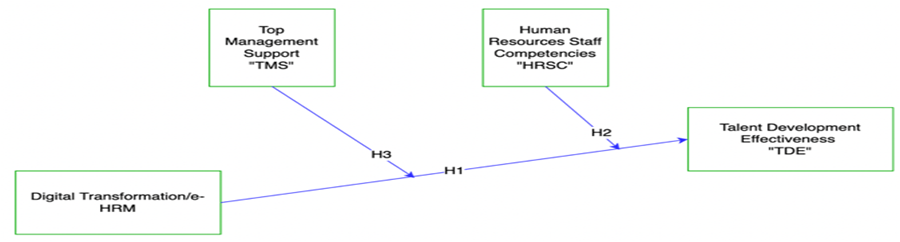
1.7. Research HypothesisThe following hypothesis illustrates the relationship between digital transformation/ e-HRM and TDE. Also, the moderating effect of the HR staff competencies and top management support.
H1: There is a positive relationship between digital transformation/ e-HRM and TDE.
H2: HR staff competencies have a moderate impact on the strength of the relationship of digital transformation/e-HRM on TDE.
H3: Top management support has a moderate impact on the strength of the relationship of digital transformation /e-HRM on TDE.
1.8. Research Conceptual FrameworkDigital transformation/e-HRM positively affects HR practices, such as TDE. Testing H1, H2, and H3 will help determine a correlation relationship, as reflected in below conceptual framework in Figure 1.
E-HRM refers to the use of digital technologies in human resource management. Ideally, e-HRM includes the strategy, implementation, and use of technology in human resource practice 1. Utilizing information technology to network and assist persons and actors engaged in common human resource management operations. Consequently, a company may adopt e-HRM by implementing e-hiring, e-selection, e-training and development, e-evaluation, and e-payments.
E-HRM is based on three main viewpoints and theories. The first theory is relational e-HRM, in which firms employ contemporary technology to assist human resource processes such as recruiting, selection, training and development, evaluation, and payments 12. Thus, relational HRM intends to turn e-hiring, e-selection, e-training and development, e-evaluation, and e-payments into e-practices 13. Transformational e-HRM focuses on strategic components of human resource practices, such as knowledge management and strategic orientation. This approach guarantees that all data is collected and used strategically to the workers' and organizations' advantage. An operational e-HRM focuses on administrative tasks such as handling payroll and personnel information. Among other administrative responsibilities, this approach employs information technology to produce payrolls and handle personal data.
Sousa and Rocha 14 observed intensive innovation in organizations to develop ways that digital technology can be embedded in daily processes. Various authors have attempted to define digital transformation as applied in a business environment. Ziyadin et al. 15 conclude that such integration should consider the organization's corporate strategy, the importance of the functional strategy proposed, and the expected competitive advantage. Digital transformation refers to using new technologies to improve various business activities like employee management and customer service. A literature review by Gebayew et al 16 notes that digital transformation streamlines operations and creates new organizational models.
Such an application would enable engagement with various stakeholders using digital applications at every touch point. Magalhães et al., 17 observe that human resource departments in healthcare have benefited immensely from employing digital technologies. Strohmeier 18 defined e-HRM as an application of modern technology to support and network with individuals and actors performing human resource practices. Here, the study finds technology to perform two functions. First, technology is key in connecting individuals and facilitating digital interaction. Second, technology plays a key role by fully or partially substituting the role played by human resource managers. e-HRM refers to modifying and facilitating several human resource management processes using digital technology. Such activities include recruitment, selection, training, payments, and planning. Based on this definition, a strong emphasis is placed on the implementation process. The study by Ellmer and Reichel 19 only focuses on the theoretical part of e- HRM.
A study by Oswal and Narayanappa 13 found that information and communication technology has been used to transform human resource management. Sivathanu and Pillai 20 made a similar study focusing on how Industry 4.0 has revolutionized human resource practices. Wege et al. 21 studied e-HRM applications in 21 firms listed on the Nigerian Stock Exchange and found that digital technology had a significant impact on organizational performance.
2.2. Talent Development Effectiveness TDETalent development aims to create organizations that are high-performing and sustainable 22, 23. Organizations should ensure that talent development practices are effective in achieving high employee retention rates. Organizations focusing on talent development will have skilled, knowledgeable, and performing employees. These employees will provide better service to customers and improve their experience 24.
An organization that practices talent development exhibit various characteristics. Talent development characteristics include talent recognition, attraction, acquisition, training, and development 25. Other characteristics include retention and management of succession plans and hierarchy. Organizations whose human resource practices and talent development programs have the mentioned characteristics can achieve talent development effectiveness.
There are three Dimensions of TDE first one is appraisal which is a common method in the employees' performance management and hiring process. Through the appraisal system, the organization can better identify its employees' strengths and weaknesses and determine the best allocation of resources to improve the organization's performance 26. The Second Dimension of TDE is Training and career development which enable us to develop talent in new ways, and new skills are becoming critical for success 27. This shift is forcing us to rethink how we train our future talent, significantly affecting how we design, deliver, and evaluate our training programs. The last dimension of TDE is Compensation and retention, which are two of the most commonly discussed topics related to the Dimensions of Talent Development Effectiveness (TDE). They are important because they help an organization determine the talent development effectiveness of its programs and services. Retention is the process of keeping employees in the organization 28.
Talent development can be explained in three basic theories: the social capital theory, where resources can develop and accumulate human capital; Based on social capital theory, organizations with a talent development culture through programs and resources can help employees develop skills and talent and be rewarded for such development 29. Organizations with a talent development culture through programs and resources can help employees develop skills and talent. The second theory, self-interest, refers to actions that lead to personal benefits 30. The third theory is the organizational support theory, where employees believe organizations are obligated to care about them. Talent development and management programs are established to ensure that employees and the firm benefit from talent development.
Garavan et al. 31 interpret talent development as programs implemented by firms to attract, recruit, develop, and manage their workforce. For the technical aspect, talent development focus on developing technical competencies within individuals. However, such an approach leads to falling short of performance expectations. Such competencies can be developed through traditional processes. Talent development has been used to improve the performance of organizations 32.
Russian firms preferred internal talent development to recruiting new ones and had pre-defined employee skills required for talent development. Tlaiss et al. 33 note that talent development programs are rampant in French firms and are motivated by the fear of losing talent and the cost of hiring recruits. Akunda et al. 34 find that HRM plays a key role in retaining talent in an organization, with talent development and talent management among the ways the goal can be achieved. The study used a case study approach, where a reflective account of an employee at a major firm in Uganda was taken. Pandita and Ray's 35 study focused on how talent development and employee engagement led to higher retention. Results show that organizations view talent management as a key way of reducing turnovers.
2.3. Top Management Support TMSManagement of an organization is key to achieving various goals, including digital transformation. Top management support is defined as devoting time to information systems and technology-related programs. It includes aspects of cost and potential, reviewing integration plans, following up on progress, providing solutions, and allowing integration of modern technology in business activities and processes 36.
Top management support has several characteristics. They include goal-oriented, pervasiveness, multidimensional, process continuity, and dynamism 37. Organizations implementing digital transformation would need continuous support from management, especially in decision-making, goal-setting, planning, funding, staffing, and resetting, among other activities. The five characteristics are key for top management support to achieve digital transformation in human resource practices.
Vukšić et al. 38 reviewed past studies on digital transformation to establish how organizations perceived digital transformation. Findings show that digital transformation involves using information technology to support business processes. Manfreda and Štemberger 39 observe that top management support can be offered in continuous funding, decision-making, equipment supply, and other non-technical support. Such support should be extended to support efforts in achieving the digital transformation of various business activities.
2.4. Human Resource Staff Competencies- HRSCAchieving efficient management of human resources depends on staff and processes, systems, and activities employed. Human resource staff competencies are important and refer to skills, knowledge, attributes, and abilities that improve staff performance 40. Organizations must ensure that human resource staff possesses key competencies required to achieve the digital transformation of various business processes and activities.
Companies should ensure that human resource staff possesses the necessary competencies when recruiting, training, developing, evaluating, and compensating other employees. Human resource staff competencies are characterized by leadership, ethical conduct, relationship management, and consultation. Other characteristics include cultural effectiveness and sensitivity, evaluation, and communication 41. These characteristics are key for a competent human resource manager or staff and are essential in achieving digital transformation and staff retention.
There is a need to ensure that human resource staff and professionals in an organization meet the growing needs of digital transformation. Smirnova et al. 42 find that competencies among human resource practitioners are key to achieving the digital transformation of various business activities and processes. Vardarlier 26 notes that traditional managed methods are no longer sufficient in the digital era, requiring human resource managers and staff to possess certain competencies. Competency among human resource staff is key to achieving efficient human resource management and other organizational goals like digital integration of activities and processes. A study by Otoo (2018) administered questionnaires to 600 employees of sampled hotels. The authors find attributes of a competent human resource professional or practitioner in selection and recruitment, training programs, evaluation, appraisal, and rewards and planning for employee careers.
The research is intended to aid HR managers and those in management positions in various Egyptian organizations. These individuals who will profit from the research are, thus, the major components of this research project. This indicates that the target demographic of the research is formed of human resource managers, human resource professionals, and senior human resource employees who would assist with survey questionnaire responses. This population might be calculated based on the number of government and commercial firms in the nation. Therefore, the population of interest for this research will consist of HR managers, HR professionals, and senior HR personnel employed by Egyptian organizations that use an E-HRM system.
Drawing a sample from the target population is based on various factors considered in the research. The primary factors are time and finances. An inclusion criteria was designed to determine who qualifies for being included in the sample. First, selected members should be working in a company in Egypt and applying the E-HRM system, whether private or government company. Secondly, they must be working in an HR management position. Those who met these criteria were to be included in the sample and help the researchers in answering the questionnaires. Through this technique, 400 respondents were willing to help with answering the questionnaires. However, only 331of the responses were valid, and these made up the final sample size.
3.2. Sampling Procedure/TechniqueAccording to Etikan & Babtope 43, probability sampling is a method of selecting samples from a target population where every element in the target population is accorded an equal chance of being chosen for the sample. A probability sampling method was selected for this research. The options for selecting individuals for the sample were based on the set objectives and the desirable characteristics that could lead to conclusive results. The eligible elements are those that meet the inclusion criteria and were picked, eliminating the rest.
The sample size is determined using the following formula: the sample size assuming an infinite population, is determined according to the following formula:
 |
Where Zα is the critical value of the normal distribution at α (e.g., for a confidence level of 95%, α is 0.05, and the critical value is 1.96), and p is the percentage of specific phenomena, and it is set to be 0.5 as it gives the highest value for sample size, e is the margin error, and set to be 0.055. According to this formula, the sample size is at least 320. However, to avoid the non-response rate and the problems of missing data, a sample of 400 respondents were surveyed, and the valid responses were 331.
3.3. Research PhilosophiesAccording to Saunders, Thornhill, & Lewis 44, a research philosophy is a set or a system of beliefs and assumptions concerning knowledge development. With a research philosophy, a researcher can project the type of data required for their research, conduct their study swiftly, and determine the most appropriate way of collecting and interpreting the collected data.
While conducting this research, the fundamental understanding of the application of e-HRM in the business world and the results it is supposed to bring is crucial in developing the findings. According to Park et al. 45, the positivism paradigm is aligned with hypothetical-deductive models of science, which are based on verifying prior hypotheses and experimentation through operationalizing variables and measures. These understandings enlightened the focus of this research through ample control of the process and interpretation of the results. It is for these reasons that the positivism research philosophy was employed.
3.4. Research ApproachBased on the research objectives, this research is a descriptive and inferential study. The research approach chosen is a quasi-approach with a cross-sectional design utilized through the survey data collection methodology. While there are many types of this research methodology, they all fall under two main categories, which are experimental and non-experimental research designs. The rationale for choosing descriptive and inferential study design and quantitative approach is that the research entails examining and discussing relationships between different variables, including how their parameters or sub-dimensions interact for extensive data.
3.5. Data Collection MethodsFor this research, the HR employees from companies in Egypt were considered and engaged in the research process. As a result, the information was received first-hand from the selected employees. Therefore, the research utilizes questionnaires to collect primary data from the sample of employees. The data is collected using the Survey Monkey platform. This method was chosen for this research for several reasons. First, it is a cost-saving method of collecting data. This method requires no extensive labor to execute. Secondly, the strategy helped reach the participants quickly and effortlessly 46. As the questionnaire development started, the primary consideration when developing the question was to focus on the variables of interest during the research.
Another step was taken to modify the questionnaire by making relevant changes to the questionnaire developed. This step included internal and external players for assured success in review and modification. The supervisor is primary, and a sample size of 30 participants was required to run parametric tests, particularly in the multivariate study; the participants act as external reviewers of the documents and enact any noted changes or modifications 47. After the supervisor, external referees are involved when they go through the document, suggesting any necessary modifications or making comments on the documents. These act as a study strategy, which is a pilot strategy for ensuring that the questionnaire is complete and eligible to answer the research questions
3.6. Research VariablesThe dependent variables are based on the objectives and goals of the research. TDE here is the element in research that is under investigation and is influenced by the actions of the researcher. As with technology, companies are expected to assemble superior teams effectively. Talent development effectiveness “TDE” refers to the efficiency of human resource practices that attract, develop, motivate, and retain employees 48. Organizations employ different means to ensure that talent development approaches are effective. The main dimensions of the TDE are Appraisal System, Training and Career Development, and Compensation & Retention.
In research, an independent variable is an entity or a component in research that the researcher manipulates to understand or explore its effects. This research’s independent variable is electronic human resource management implementation (E-HRM). The main dimensions of the E-HRM are; Operational e-HRM, Transformational e-HRM, and Relational e-HRM.
The primary independent variable, its relationship with the dependent variable, was motivated or shaped by two different moderators. A moderator is a research entity that determines or shapes the relationship between the dependent and independent variables in research.
The role of top management support (TMS) in an organization or entity is integral to the company's overall management. TMS understands and is aware of an organization's capabilities to engage in any improvement, such as e-business. The top management also coordinates resources for vital organizational projects, thus capacitating performance and implementation of different-level projects. According to research, implementing the e-HRM strategy will cause significant mobilization and influence on any company. Other than communication, there are other dimensions for top management support; such as Provide Resources, Structural Arrangement, Expertise, and Power
Competencies are the characteristics that staff in the human resource management team express in their line of duty. These competencies are valid depending on different individuals' qualifications and skills. It is the dream of every organization to assemble the most qualified and competent teams. However, when implementing an electronic or digital strategy in a company, the available competencies possessed by current employees are invariant. This implies that these competencies cannot be altered during the implementation strategy. However, their stature and the accommodation of the implemented technology will indicate the strategy’s success and impact on overall human resource practices. The main dimensions for the Human Resources staff competencies are; Strategic Positioner, Credible Activist, Capability Builder, Change Champion, HR Innovator, Integrator, and Technology Proponent.
As a first step, we have to measure reliability using Cronbach’s Alpha measure. As shown in Table 1.
Table 1 presents the results of Cronbach’s Alpha. It is the measure of reliability to determine the item that, when deleted, would enhance the overall reliability of the measuring instrument. It is essential to know whether all statements are effectively measuring a factor or not.
It is clear that the questionnaire’s variables are reliable as Cronbach’s Alpha for all items is greater than 0.6.
4.2. Descriptive StatisticsIn this section, we are going to describe the creating variables by comprising their mean and standard deviation, as follows in Table 2.
The average of all the variables is close to 4, meaning that respondents tend to agree with the statements that measure these variables.
4.3. Correlation AnalysisFrom Table 3 and with a 5% confidence level, it’s clear that:
1. There is a positive significant correlation between e-HMR and each of: (TDE, Top Management Support, and HR Staff Competencies), as the p-value associated with them is less than 0.05.
2. There is a positive significant correlation between TDE and each of: (Top Management Support and HR Staff Competencies), as the p-value associated with them is less than 0.05.
3. There is a positive significant correlation between Top Management Support and HR Staff Competencies, as the p-value associated with them is less than 0.05.
4.4. Answering HypothesesTo answer the previously mentioned hypotheses, we will treat the variables: (Top Management Support and HR Staff Competencies) as moderators using dummies and interaction terms and then run a regression model for the dependent variable.
Equation Form:
 |
The previous table shows that the value of the determination coefficient equals 0.585, which means that the differences in the explanatory variables explain about 59% of the differences in the TDE variable.
The significance of the previous test is less than the level of significance (α=0.05), which indicates the significance of the estimated model (at least one of the regression coefficients is significant).
• There is a significant effect of EHRM on TDE with a confidence of 95% as the p-value associated with the test is less than 5%. The value of the TDE will increase by about 0.694 as the value of the e-HRM increases by one unit for the companies with low Top Management Support and low HR Staff Competencies, holding the other variables constant.
• There’s an insignificant difference in the mean of the TDE for the companies with high Top Management Support and those with low Top Management Support, holding the other variables constant, this with confidence 95% as the p-value associated with it, larger than 5%.
• There’s an insignificant difference in the mean of the TDE for the companies with high HR Staff Competencies and those with low HR Staff Competencies, holding the other variables constant; this with confidence 95% as the p-value associated with it larger than 5%.
• The value of the TDE increases by about 0.694 as the value of the e-HRM increases by one unit whether the Top Management Support of the company is low or high, holding the other variables constant; this with confidence 95% As the p-value associated with the interaction term larger than 5%.
• The value of the TDE increases by about 0.694 as the value of the e-HRM increases by one unit whether the HR Staff Competencies of the company is low or high, holding the other variables constant, as the p-value associated with the interaction term larger than 5%.
Estimated Model:
 |
Summary:
• There is a significant effect of EHRM on TDE
• Top management support does not moderate the relationship between Digital transformation/e-HRM and TDE.
• HR Staff Competencies do not moderate the relationship between Digital transformation/e-HRM and TDE.

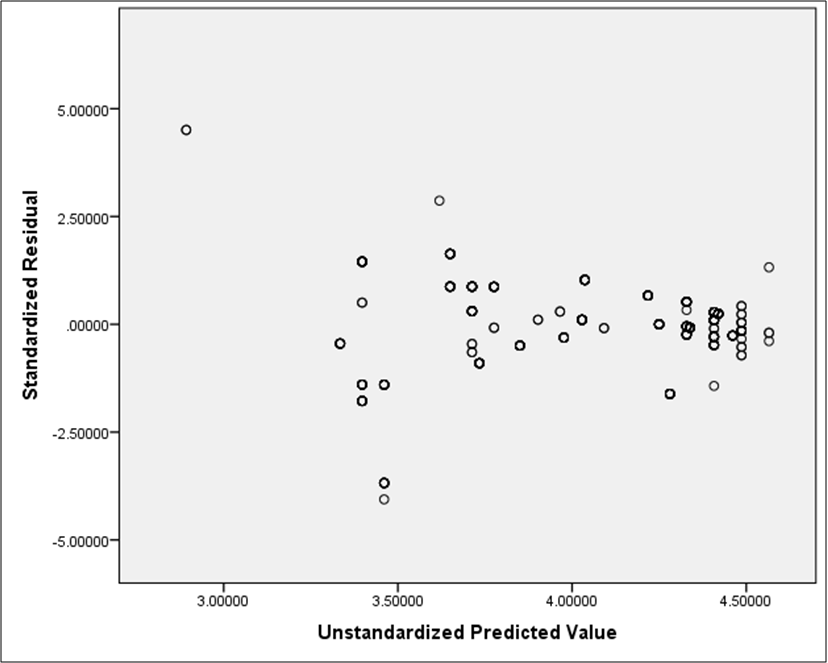
The points on the previous plot show no pattern or trend, which indicates the linearity of the estimated mode.
By comparing the literature to the findings that there is a positive relationship between digital transformation/ e-HRM and talent development effectiveness (TDE). It is observed that this is consistent with previous research as relational E-HRM focus on how technology is affecting the way organizations and individuals relate to one another, which agrees with Osborne & Hammoud 49; Islam & Tari 50, that talent development promotes employee engagement and motivation, and a study by Rezaei & Beyerlein, 25 made similar findings on the significance of talent development in accrediting organizations. Also, Wege et al. 21 discovered that digital technology has a major influence on organizational performance via e-training and development. Consequently, digital technology has played a significant role in transforming organizational functions such as human resource management. This has increased efficiency and sustainability, resulting in increased output. In addition, workers favor companies whose human resource strategies prioritize talent development, career advancement, and training. Consequently, talent development fosters employee engagement and motivation, boosting productivity, reducing staff turnover, and enhancing performance 51, 52. Therefore, when the organizations implement digital talent development programs, this will insure foster the employee engagement, motivation, and career path. Also, will enable the employees to fulfil their full potential while simultaneously contributing to the achievement of their company's mission-critical goals.
Prior research contradicts with the findings that Top management support moderate the strength of the relationship between digital transformation/e-HRM and talent development effectiveness (TDE), as the study found that top management support has no moderating effect on TDE, as Findings from research by Nwankpa and Roumani 53 that established the function of top management in digital transformation. According to the authors, management support is essential for attaining organizational success and should be extended to initiatives to change different business activities into digital ones. As a consequence, while reforming activities and processes, implementing departments like human resource management would profit from such management assistance. Also, According to Vukšić 38, top management support is essential for implementing the digital transformation of organizational processes. Here, the backing of top management was essential for creating a transformation plan and putting measures into place that would reflect the digital approach.
Also, the study found that the HR staff competencies don’t have a moderate impact on the strength of the relationship of digital transformation/e-HRM on TDE, which contradicts all the previous research.
Despite the research limitations, this research provides important practical insights and recommendations to the HR professional and the stakeholders about the role of digital transformation/e-HRM and how it impacts talent development effectiveness and employee performance management effectiveness.
The study found that there is a positive relationship between digital transformation/e-HRM and TDE. The study found that HR staff competencies have no moderate impact on the strength of the effect of e-HRM on TDE. Additionally, the top management support has no moderate impact on the strength of the effect of e-HRM on TDE.
The researcher recommends exploring the strategic usefulness of digital transformation/e-HRM and calls for more empirical research to duplicate this work and expand upon the results.
The study recommends that organizations consider how digital technologies can improve their HR practices and consider how innovative tools can be utilized to enhance their HR practices.
Furthermore, HR staff need to be competent in new digital technologies to realize the full benefits of digital transformation. As a result, organizations should invest in training and development for their HR staff.
Additionally, top management support is essential for successfully implementing digital transformation in human resources. Thus, Organizations must ensure that their top management is on board with the digital transformation process and is committed to its success.
Some of the literature reviews does not include empirical data. This means that the findings are based on the opinions of the authors of the reviewed studies and may not be representative of the general population.
7.2. Language and Time LimitThe study only includes studies published in Europe and America. This means that the findings may be biased towards the European and western world and may not represent the global population. Also, this study was cross-sectional in nature and assessed the respondent perception at a specific time
7.3. Research MethodologyThe study is based on a survey of human resources professionals in Egypt and may not be representative of the views of professionals in other countries. Also, the survey reflects the views of human resources professionals and not representing the views of top management or other department heads.
7.4. Research ObjectivesFurther, the study only looked at the impact of digital transformation on Talent development effectiveness and did not examine the impact of digital transformation on other areas of Human resources practices like talent acquisition, compensation and benefits ..etc..
| [1] | Ziebell, R. C., Albors-Garrigos, J., Schoeneberg, K. P., & Marin, M. R. P. (2019). Adoption and success of e-HRM in a cloud computing environment: A field study. International Journal of Cloud Applications and Computing (IJCAC), 9(2), 1-27. | ||
| In article | View Article | ||
| [2] | Saini, S. (2018). Digital HRM and its Effective Implementation: An Empirical Study. International Journal of Management Studies, 2(7), 62-66. | ||
| In article | View Article | ||
| [3] | Attaran, M., Attaran, S., & Kirkland, D. (2019). The need for digital workplace: increasing workforce productivity in the information age. International Journal of Enterprise Information Systems (IJEIS), 15(1), 1-23. | ||
| In article | View Article | ||
| [4] | Hitlin, P. (2018). Use of internet, social media, digital devices plateau in US. Pew Research Center. | ||
| In article | |||
| [5] | Andrus, G., Kejriwal, S., & Wadhwani, R. (2016). Digital transformation in financial services: The need to rewire organizational DNA. Dostupno na poveznici: https://www2.deloitte.com/insights/us/en/industry/financial-services/digital-transformation-in-financialservices.html (18.12. 2017. | ||
| In article | |||
| [6] | Stewart, G. L., & Brown, K. G. (2019). Human resource management. John Wiley & Sons. | ||
| In article | |||
| [7] | Borgmann, L., Rowold, J., & Bormann, K. (2016). Integrating leadership research: a meta analytical test of Yukl’s meta-categories of leadership. Personnel Review, 45(6), 1340-1366. | ||
| In article | View Article | ||
| [8] | Oskam, J. (2016). “Airbnb: the future of networked hospitality businesses”. Journal of Tourism Futures. 2, 22-42. | ||
| In article | View Article | ||
| [9] | Osmundsen, K., Iden, J., & Bygstad, B. (2018). Digital transformation: Drivers, success factors, and implications. MCIS 2018 Proceedings. 37. https://aisel.aisnet.org/mcis2018/37 | ||
| In article | |||
| [10] | Terra, L. A., & Passador, J. L. (2016). Symbiotic dynamic: The strategic problem from the perspective of complexity. Systems Research and Behavioral Science, 33(2), 235-248. | ||
| In article | View Article | ||
| [11] | Bondarouk, T., & Brewster, C. (2016). Conceptualizing the future of HRM and technology research. The International Journal of Human Resource Management, 27(21), 2652-2671. | ||
| In article | View Article | ||
| [12] | Purohit, M. (2018). A study on relational E-HRM and its outcomes in I.T. sector (with special reference to Pune Region). IOSR Journal of Business and Management (IOSR-JBM), 20(7), 1-3. | ||
| In article | |||
| [13] | Oswal, N., & Narayanappa, G. L. (2014). Evolution of HRM to e-HRM towards organizational effectiveness and sustainability. International Journal of Recent Development in Engineering and Technology, 2(4), 7-14. | ||
| In article | View Article | ||
| [14] | Sousa, M. J., & Rocha, Á. (2019). Digital learning: Developing skills for digital transformation of organizations. Future Generation Computer Systems, 91, 327-334. | ||
| In article | View Article | ||
| [15] | Ziyadin, S., Suieubayeva, S., & Utegenova, A. (2019, April). Digital transformation in business. In International Scientific Conference “Digital Transformation of the Economy: Challenges, Trends, New Opportunitie. | ||
| In article | View Article | ||
| [16] | Gebayew, C., Hardini, I. R., Panjaitan, G. H. A., & Kurniawan, N. B. (2018, October). A systematic literature review on digital transformation. In 2018 International Conference on Information Technology Systems and Innovation (ICITSI) (pp. 260-265). IEEE. | ||
| In article | View Article | ||
| [17] | Magalhães, D., Martins, J., Branco, F., Au‐Yong‐Oliveira, M., Gonçalves, R., & Moreira, F. (2020). A proposal for a 360° information system model for private health care organizations. Expert Systems, 37(5), e12420. | ||
| In article | View Article | ||
| [18] | Strohmeier, S. (2017). Research in e-HRM: Review and implications. Human Resource Management Review, 17(1), 19-37. | ||
| In article | View Article | ||
| [19] | Ellmer, M., & Reichel, A. (2018). Unpacking the "e" of e-HRM. The Brave New World of E-HRM, 2(0), 247. | ||
| In article | |||
| [20] | Sivathanu, B., & Pillai, R. (2018). Smart HR 4.0–how industry 4.0 is disrupting H.R. Human Resource Management International Digest, 26(4), 7-11. | ||
| In article | View Article | ||
| [21] | Wege, L. G., Ngige, C. D., & Dieli, O. J. (2019). Electronic human resource management (E-HRM) and organizational performance in Nigeria. International Journal of Management and Entrepreneurship, 1(1), 53-69. | ||
| In article | |||
| [22] | Boštjančič, E., & Slana, Z. (2018). The role of talent management in comparing medium-sized and large companies is major challenge in attracting and retaining talented employees. Frontiers in Psychology, 9, 1750. | ||
| In article | View Article PubMed | ||
| [23] | Di Fabio, A., & Peiró, J. M. (2018). Human capital sustainability leadership to promote sustainable development and healthy organizations: A new scale. Sustainability, 10(7), 2413. | ||
| In article | View Article | ||
| [24] | Geng, Z., Li, C., Bi, K., Zheng, H., & Yang, X. (2018). Motivating service employee creativity: regulatory focus and emotional labor. Journal of Service Theory and Practice, 28(2), 228-249. | ||
| In article | View Article | ||
| [25] | Rezaei, F., & Beyerlein, M. (2018). Talent development: A systematic literature review of empirical studies. European Journal of Training and Development, 2(1), 21-34. | ||
| In article | View Article | ||
| [26] | Vardarlier, P. (2020). Digital transformation of human resource management: digital applications and strategic tools in HRM. In Hacioglu, U. (Ed.), Digital business strategies in blockchain ecosystems (pp. 239-264). Springer, Cham. | ||
| In article | View Article | ||
| [27] | Macke, J., & Genari, D. (2019). Systematic literature review on sustainable human resource management. Journal of cleaner production, 208, 806-815. | ||
| In article | View Article | ||
| [28] | Schwertner, K. (2017). Digital transformation of business. Trakia Journal of Sciences, 15(1), 388-393. | ||
| In article | View Article | ||
| [29] | Machalek, R., & Martin, M. W. (2015). Socio-biology and Sociology: A new synthesis. Research Gate. https://www.researchgate.net/publication/304193830_Sociobiology_and_Sociology_A_New_Synthesis. | ||
| In article | View Article | ||
| [30] | Bosse, D. A., & Phillips, R. A. (2016). Agency theory and bounded self-interest. Academy of Management Review, 41(2), 276-297. | ||
| In article | View Article | ||
| [31] | Garavan, T. N., Carbery, R., & Rock, A. (2012). Mapping talent development: Definition, scope and architecture. European Journal of Training and Development, 36(1), 5-24. | ||
| In article | View Article | ||
| [32] | Latukha, M. O. (2018). Talent development and a firm's performance: Evidence from Russian companies. Journal of General Management, 43(2), 51-62. | ||
| In article | View Article | ||
| [33] | Tlaiss, H. A., Martin, P., & Hofaidhllaoui, M. (2017). Talent retention: Evidence from a multinational firm in France. ESSCA. https://www.essca.fr/talent-retention-evidence-from-a-multinational-firm-in-france-by-pascal-martin-and-mahrane-hofaidhllaoui. | ||
| In article | View Article | ||
| [34] | Akunda, D., Chen, Z., & Gikiri, S. N. (2018). Role of HRM in talent retention with evidence. Journal of Management and Strategy, 9(2), 8-19. | ||
| In article | View Article | ||
| [35] | Pandita, D., & Ray, S. (2018). Talent management and employee engagement–a meta-analysis of their impact on talent retention. Industrial and Commercial Training, 50(1). | ||
| In article | View Article | ||
| [36] | Young, R., & Jordan, E. (2018). Top management support: Mantra or necessity? International Journal of Project Management, 26(7), 713-725. | ||
| In article | View Article | ||
| [37] | Veth, K. N., Korzilius, H. P., Van der Heijden, B. I., Emans, B. J., & De Lange, A. H. (2019). Which HRM practices enhance employee outcomes at work across the life-span? The International Journal of Human Resource Management, 30(19), 2777-2808. | ||
| In article | View Article | ||
| [38] | Vukšić, V. B., Ivančić, L., & Vugec, D. S. (2018). A preliminary literature review of digital transformation case studies. International Journal of Computer and Information Engineering, 12(9), 737-742. | ||
| In article | |||
| [39] | Manfreda, A., & Štemberger, M. I. (2019). Establishing a partnership between top and IT managers: A necessity in an era of digital transformation. Semantic Scholar. https://www.semanticscholar.org/paper/Establishing-a-partnership-between-top-and-IT-Manfreda-Stemberger/d8cd690cfb7b5bada4251f02610ad5e6b270ef7a. | ||
| In article | |||
| [40] | Gunawan, J., Aungsuroch, Y., & Fisher, M. L. (2019, January). Competence-based human resource management in nursing: A literature review. Nursing Forum, 54(1), 91-101. | ||
| In article | View Article PubMed | ||
| [41] | Fuller, M., Heijne-Penninga, M., Kamans, E., van Vuuren, M., de Jong, M., & Wolfensberger, M. (2018). Identifying competence characteristics for excellent communication professionals: A work field perspective. Journal of Communication Management, 22(2), 233-252. | ||
| In article | View Article | ||
| [42] | Smirnova, A., Zaychenko, I., & Bagaeva, I. (2019, September). Formation of requirements for human resources in the conditions of digital transformation of business. Atlantis Press. https://www.atlantis-press.com/proceedings/icdtli-19/125918521. | ||
| In article | View Article | ||
| [43] | Etikan, I., & Babtope, O. (2019). A basic approach in sampling methodology and sample size calculation. Med Life Clin, 1(2), 1006. | ||
| In article | |||
| [44] | Saunders, M., Thornhill, A., & Lewis, P. (2016). Research Methods for Business Students (7th ed). England: Pearson Education. | ||
| In article | |||
| [45] | Park, Yoon Soo; Konge, Lars; Artino, Anthony R. (2019). The Positivism Paradigm of Research. Academic Medicine, 1-. | ||
| In article | |||
| [46] | Cote, C. (2021). 7 Data Collection Methods in Business Analytics. Business Insights Blog. Retrieved 2 July 2022, from https://online.hbs.edu/blog/post/data-collection-methods. | ||
| In article | |||
| [47] | Bos-Nehles, A. C., & Meijerink, J. G. (2018). HRM implementation by multiple HRM actors: A social exchange perspective. International Journal of Human Resource Management, 29(22), 3068-3092. | ||
| In article | View Article | ||
| [48] | Michael, A. (2019). A handbook of human resource management practice. Kogan Page Publishers. | ||
| In article | |||
| [49] | Osborne, S., & Hammoud, M. S. (2017). Effective employee engagement in the workplace. International Journal of Applied Management and Technology, 16(1), 4. | ||
| In article | View Article | ||
| [50] | Islam, T., & Tariq, J. (2018). Learning organizational environment and extra-role behaviors: the mediating role of employee engagement. Journal of Management Development, 37(14). | ||
| In article | View Article | ||
| [51] | Antony, M. R. (2018). Paradigm shift in employee engagement–A critical analysis on the drivers of employee engagement. International Journal of Information, Business and Management, 10(2), 32-46. | ||
| In article | |||
| [52] | Sergio, R. P., & Rylova, M. (2018). Employee engagement and empowerment as gateway towards retention: The case of Volkswagen group. Journal of Eastern European and Central Asian Research, 5(2). | ||
| In article | View Article | ||
| [53] | Nwankpa, J. K., & Roumani, Y. (2016). IT capability and digital transformation: A firm performance perspective. CORE. https://core.ac.uk/download/pdf/301370499.pdf. | ||
| In article | |||
Published with license by Science and Education Publishing, Copyright © 2022 Nashwa Samih Mohamed Nageeb and Mohamed Saad
 This work is licensed under a Creative Commons Attribution 4.0 International License. To view a copy of this license, visit
http://creativecommons.org/licenses/by/4.0/
This work is licensed under a Creative Commons Attribution 4.0 International License. To view a copy of this license, visit
http://creativecommons.org/licenses/by/4.0/
| [1] | Ziebell, R. C., Albors-Garrigos, J., Schoeneberg, K. P., & Marin, M. R. P. (2019). Adoption and success of e-HRM in a cloud computing environment: A field study. International Journal of Cloud Applications and Computing (IJCAC), 9(2), 1-27. | ||
| In article | View Article | ||
| [2] | Saini, S. (2018). Digital HRM and its Effective Implementation: An Empirical Study. International Journal of Management Studies, 2(7), 62-66. | ||
| In article | View Article | ||
| [3] | Attaran, M., Attaran, S., & Kirkland, D. (2019). The need for digital workplace: increasing workforce productivity in the information age. International Journal of Enterprise Information Systems (IJEIS), 15(1), 1-23. | ||
| In article | View Article | ||
| [4] | Hitlin, P. (2018). Use of internet, social media, digital devices plateau in US. Pew Research Center. | ||
| In article | |||
| [5] | Andrus, G., Kejriwal, S., & Wadhwani, R. (2016). Digital transformation in financial services: The need to rewire organizational DNA. Dostupno na poveznici: https://www2.deloitte.com/insights/us/en/industry/financial-services/digital-transformation-in-financialservices.html (18.12. 2017. | ||
| In article | |||
| [6] | Stewart, G. L., & Brown, K. G. (2019). Human resource management. John Wiley & Sons. | ||
| In article | |||
| [7] | Borgmann, L., Rowold, J., & Bormann, K. (2016). Integrating leadership research: a meta analytical test of Yukl’s meta-categories of leadership. Personnel Review, 45(6), 1340-1366. | ||
| In article | View Article | ||
| [8] | Oskam, J. (2016). “Airbnb: the future of networked hospitality businesses”. Journal of Tourism Futures. 2, 22-42. | ||
| In article | View Article | ||
| [9] | Osmundsen, K., Iden, J., & Bygstad, B. (2018). Digital transformation: Drivers, success factors, and implications. MCIS 2018 Proceedings. 37. https://aisel.aisnet.org/mcis2018/37 | ||
| In article | |||
| [10] | Terra, L. A., & Passador, J. L. (2016). Symbiotic dynamic: The strategic problem from the perspective of complexity. Systems Research and Behavioral Science, 33(2), 235-248. | ||
| In article | View Article | ||
| [11] | Bondarouk, T., & Brewster, C. (2016). Conceptualizing the future of HRM and technology research. The International Journal of Human Resource Management, 27(21), 2652-2671. | ||
| In article | View Article | ||
| [12] | Purohit, M. (2018). A study on relational E-HRM and its outcomes in I.T. sector (with special reference to Pune Region). IOSR Journal of Business and Management (IOSR-JBM), 20(7), 1-3. | ||
| In article | |||
| [13] | Oswal, N., & Narayanappa, G. L. (2014). Evolution of HRM to e-HRM towards organizational effectiveness and sustainability. International Journal of Recent Development in Engineering and Technology, 2(4), 7-14. | ||
| In article | View Article | ||
| [14] | Sousa, M. J., & Rocha, Á. (2019). Digital learning: Developing skills for digital transformation of organizations. Future Generation Computer Systems, 91, 327-334. | ||
| In article | View Article | ||
| [15] | Ziyadin, S., Suieubayeva, S., & Utegenova, A. (2019, April). Digital transformation in business. In International Scientific Conference “Digital Transformation of the Economy: Challenges, Trends, New Opportunitie. | ||
| In article | View Article | ||
| [16] | Gebayew, C., Hardini, I. R., Panjaitan, G. H. A., & Kurniawan, N. B. (2018, October). A systematic literature review on digital transformation. In 2018 International Conference on Information Technology Systems and Innovation (ICITSI) (pp. 260-265). IEEE. | ||
| In article | View Article | ||
| [17] | Magalhães, D., Martins, J., Branco, F., Au‐Yong‐Oliveira, M., Gonçalves, R., & Moreira, F. (2020). A proposal for a 360° information system model for private health care organizations. Expert Systems, 37(5), e12420. | ||
| In article | View Article | ||
| [18] | Strohmeier, S. (2017). Research in e-HRM: Review and implications. Human Resource Management Review, 17(1), 19-37. | ||
| In article | View Article | ||
| [19] | Ellmer, M., & Reichel, A. (2018). Unpacking the "e" of e-HRM. The Brave New World of E-HRM, 2(0), 247. | ||
| In article | |||
| [20] | Sivathanu, B., & Pillai, R. (2018). Smart HR 4.0–how industry 4.0 is disrupting H.R. Human Resource Management International Digest, 26(4), 7-11. | ||
| In article | View Article | ||
| [21] | Wege, L. G., Ngige, C. D., & Dieli, O. J. (2019). Electronic human resource management (E-HRM) and organizational performance in Nigeria. International Journal of Management and Entrepreneurship, 1(1), 53-69. | ||
| In article | |||
| [22] | Boštjančič, E., & Slana, Z. (2018). The role of talent management in comparing medium-sized and large companies is major challenge in attracting and retaining talented employees. Frontiers in Psychology, 9, 1750. | ||
| In article | View Article PubMed | ||
| [23] | Di Fabio, A., & Peiró, J. M. (2018). Human capital sustainability leadership to promote sustainable development and healthy organizations: A new scale. Sustainability, 10(7), 2413. | ||
| In article | View Article | ||
| [24] | Geng, Z., Li, C., Bi, K., Zheng, H., & Yang, X. (2018). Motivating service employee creativity: regulatory focus and emotional labor. Journal of Service Theory and Practice, 28(2), 228-249. | ||
| In article | View Article | ||
| [25] | Rezaei, F., & Beyerlein, M. (2018). Talent development: A systematic literature review of empirical studies. European Journal of Training and Development, 2(1), 21-34. | ||
| In article | View Article | ||
| [26] | Vardarlier, P. (2020). Digital transformation of human resource management: digital applications and strategic tools in HRM. In Hacioglu, U. (Ed.), Digital business strategies in blockchain ecosystems (pp. 239-264). Springer, Cham. | ||
| In article | View Article | ||
| [27] | Macke, J., & Genari, D. (2019). Systematic literature review on sustainable human resource management. Journal of cleaner production, 208, 806-815. | ||
| In article | View Article | ||
| [28] | Schwertner, K. (2017). Digital transformation of business. Trakia Journal of Sciences, 15(1), 388-393. | ||
| In article | View Article | ||
| [29] | Machalek, R., & Martin, M. W. (2015). Socio-biology and Sociology: A new synthesis. Research Gate. https://www.researchgate.net/publication/304193830_Sociobiology_and_Sociology_A_New_Synthesis. | ||
| In article | View Article | ||
| [30] | Bosse, D. A., & Phillips, R. A. (2016). Agency theory and bounded self-interest. Academy of Management Review, 41(2), 276-297. | ||
| In article | View Article | ||
| [31] | Garavan, T. N., Carbery, R., & Rock, A. (2012). Mapping talent development: Definition, scope and architecture. European Journal of Training and Development, 36(1), 5-24. | ||
| In article | View Article | ||
| [32] | Latukha, M. O. (2018). Talent development and a firm's performance: Evidence from Russian companies. Journal of General Management, 43(2), 51-62. | ||
| In article | View Article | ||
| [33] | Tlaiss, H. A., Martin, P., & Hofaidhllaoui, M. (2017). Talent retention: Evidence from a multinational firm in France. ESSCA. https://www.essca.fr/talent-retention-evidence-from-a-multinational-firm-in-france-by-pascal-martin-and-mahrane-hofaidhllaoui. | ||
| In article | View Article | ||
| [34] | Akunda, D., Chen, Z., & Gikiri, S. N. (2018). Role of HRM in talent retention with evidence. Journal of Management and Strategy, 9(2), 8-19. | ||
| In article | View Article | ||
| [35] | Pandita, D., & Ray, S. (2018). Talent management and employee engagement–a meta-analysis of their impact on talent retention. Industrial and Commercial Training, 50(1). | ||
| In article | View Article | ||
| [36] | Young, R., & Jordan, E. (2018). Top management support: Mantra or necessity? International Journal of Project Management, 26(7), 713-725. | ||
| In article | View Article | ||
| [37] | Veth, K. N., Korzilius, H. P., Van der Heijden, B. I., Emans, B. J., & De Lange, A. H. (2019). Which HRM practices enhance employee outcomes at work across the life-span? The International Journal of Human Resource Management, 30(19), 2777-2808. | ||
| In article | View Article | ||
| [38] | Vukšić, V. B., Ivančić, L., & Vugec, D. S. (2018). A preliminary literature review of digital transformation case studies. International Journal of Computer and Information Engineering, 12(9), 737-742. | ||
| In article | |||
| [39] | Manfreda, A., & Štemberger, M. I. (2019). Establishing a partnership between top and IT managers: A necessity in an era of digital transformation. Semantic Scholar. https://www.semanticscholar.org/paper/Establishing-a-partnership-between-top-and-IT-Manfreda-Stemberger/d8cd690cfb7b5bada4251f02610ad5e6b270ef7a. | ||
| In article | |||
| [40] | Gunawan, J., Aungsuroch, Y., & Fisher, M. L. (2019, January). Competence-based human resource management in nursing: A literature review. Nursing Forum, 54(1), 91-101. | ||
| In article | View Article PubMed | ||
| [41] | Fuller, M., Heijne-Penninga, M., Kamans, E., van Vuuren, M., de Jong, M., & Wolfensberger, M. (2018). Identifying competence characteristics for excellent communication professionals: A work field perspective. Journal of Communication Management, 22(2), 233-252. | ||
| In article | View Article | ||
| [42] | Smirnova, A., Zaychenko, I., & Bagaeva, I. (2019, September). Formation of requirements for human resources in the conditions of digital transformation of business. Atlantis Press. https://www.atlantis-press.com/proceedings/icdtli-19/125918521. | ||
| In article | View Article | ||
| [43] | Etikan, I., & Babtope, O. (2019). A basic approach in sampling methodology and sample size calculation. Med Life Clin, 1(2), 1006. | ||
| In article | |||
| [44] | Saunders, M., Thornhill, A., & Lewis, P. (2016). Research Methods for Business Students (7th ed). England: Pearson Education. | ||
| In article | |||
| [45] | Park, Yoon Soo; Konge, Lars; Artino, Anthony R. (2019). The Positivism Paradigm of Research. Academic Medicine, 1-. | ||
| In article | |||
| [46] | Cote, C. (2021). 7 Data Collection Methods in Business Analytics. Business Insights Blog. Retrieved 2 July 2022, from https://online.hbs.edu/blog/post/data-collection-methods. | ||
| In article | |||
| [47] | Bos-Nehles, A. C., & Meijerink, J. G. (2018). HRM implementation by multiple HRM actors: A social exchange perspective. International Journal of Human Resource Management, 29(22), 3068-3092. | ||
| In article | View Article | ||
| [48] | Michael, A. (2019). A handbook of human resource management practice. Kogan Page Publishers. | ||
| In article | |||
| [49] | Osborne, S., & Hammoud, M. S. (2017). Effective employee engagement in the workplace. International Journal of Applied Management and Technology, 16(1), 4. | ||
| In article | View Article | ||
| [50] | Islam, T., & Tariq, J. (2018). Learning organizational environment and extra-role behaviors: the mediating role of employee engagement. Journal of Management Development, 37(14). | ||
| In article | View Article | ||
| [51] | Antony, M. R. (2018). Paradigm shift in employee engagement–A critical analysis on the drivers of employee engagement. International Journal of Information, Business and Management, 10(2), 32-46. | ||
| In article | |||
| [52] | Sergio, R. P., & Rylova, M. (2018). Employee engagement and empowerment as gateway towards retention: The case of Volkswagen group. Journal of Eastern European and Central Asian Research, 5(2). | ||
| In article | View Article | ||
| [53] | Nwankpa, J. K., & Roumani, Y. (2016). IT capability and digital transformation: A firm performance perspective. CORE. https://core.ac.uk/download/pdf/301370499.pdf. | ||
| In article | |||