We considered if temperature effects the growth of microcracks in a casted bro- ken femur, locally at three particularly points. We used theory of adaptive elasticity neglecting and accounting temperature and energy density theory. We showed for both cases after the removal of the cast, femur locally at points of our interest i) will be weaken (the mean length of their microcracks will be increased) or ii) will be under osteoporosis (the mean length of their microcracks will be dramatically increased). The results coincide with those of corresponding problem at macroscopic area. We resulted that temperature plays no role to growth of microcracks for our case.
The purpose of this paper is to study if temperature effects the growth of microcracks in a broken castedfemur. For that reason we will use the theory of internal bone remodeling 1, 2 at microscopic area neglecting and accounting temperature and the energy density theory 3, 4, 5.
Macroscopically the bone has a volume V and a surface S. The volume V microscopically consists of microvolumes  which generally are not homogenous 3. Expanding the theory of adaptive elasticity [ 1, p. 322] at microscopic area we assume:
i) Every micro volume  of bone consists of a elastic microvolume
  (micromatrix bone) and of microporous (microcracks) that is:
 | (1) |
where  is the volume of microcracks.
From the other hand Sih [ 5, p.179] showed that every microvolume  contains an homogenous microvolume. Thus we suppose that an elastic microvolume
  given by (1) is homogenous microvolume.
ii) The mechanical properties of microvolume of bone  coincides with the mechanical properties of homogenous microvolume
  of micromatrix bone.
iii)The fraction of microvolume of the micromatrix bone  is defined as [ 1, p. 322]:
 | (2) |
where  is the density of microvolume
  , while
  is the density of material (bone) and assume to be cons- tant. From the above it follows
  .
.
v) The porosity that is the mean length of microcraks of microvolume  alters with mass added /removal to /from micro matrix bone and linearly depends from the history of microstrain [ 1, p. 322]. The above is characterized by a parameter
  2:
2:
 | (3) |
where  is the initial fraction of the microvolume of of micromatrix bone. With other words parameter
  is the change of the mean value of microcracks.
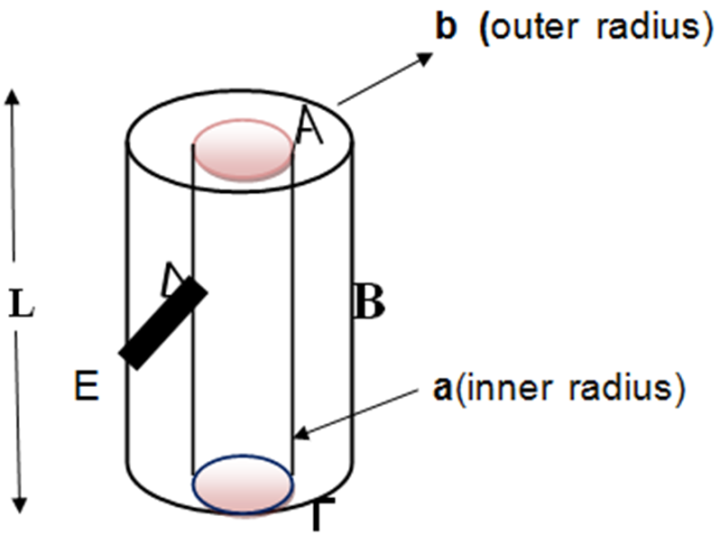
Assume that someone with bones that are not un- der osteoporosis 2 breaks his /her femur. We cast bone for a period 6-8 weeks. In earliest paper we studied same problem at macroscopic area 6. In present paper we want to predict the situation of healing bone after the removal of cast, locally to three points indicated in Figure 1:
A: at the top of inner rad of femur’s diaphysis
B: at the middle of outer rad of femur’s diaphysis and
Γ: at the bottom of middle distance between inner and outer rad of femur’s diaphysis.
Αssume that at t= 0 broken femur at macroscopic area was under a constant tensile load Τo, due to the total weight of the leg (femur + tibia). Consequently its points Α, Β and Γ were respectively under constant tensile loads Go, Fo and Ρο. The lasts due respectively to the total weights: i) of leg (femur + tibia), ii)of half fe- mur +tibia and iii) of tibia. All loads are in units of B.W. Finally Α, Β and  had the same
  and
and  2.
2.

At t >0 we cast broken femur for a period of 6-8 weeks. Then the femur locally at points Α, Β and  continues to be under the same tensile loads Go, Fo and Ρο respectively since patient can not walk and uses crosiers. In addition points Β and
  are under a con- stant external pressure P1 due to cast. We want to predict
  , where to is time moment of removal of cast.
Femur is modeled as a hollow circular cylinder with length L, inner and outer radii a and b respectively indicated in Figure 1. These radii correspond to endosteal and periosteal surface of bone and are constant, due to internal remodeling 7. Since we deal with microscopic area, we base upon density energy theory 3, 4, 5.
The equations of above theory in cylindrical coordinates are the followings:
i) the stress relations between macroscopic and microscopic area [ 3, p.182]
 |
where 
 ,
,  and (dV/dA) are respectively: the macroscopic displacement, the stress on microvolume, the stress at macrovolume and the change of volume with surface 3.
ii) the macrostress - equations [ 5, p.182]:
 |
iii) the microstress equations [ 5, p.182]: :
 |
where ú denotes microdisplacement.
iv) the microstrain-microdisplacement relations [ 5, p.179]:
 |
v) the microstress - microstrain relations
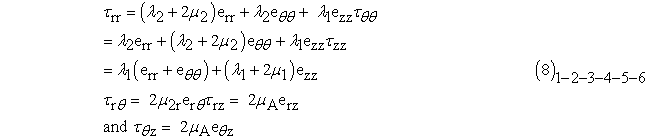 |
where: 
 |
In the above ΕΑ, ΕΤ and vA,, vΤ are Young’s modulus and Poisson ratio in transverse and axial direction in macroscopic area.
Finally rate remodeling equation 2 microscopic area without /and accounting temperature are respectively:
 |
where  ,
,  are rate remodeling coefficients in transverse and axial direction respectively, while
  is rate remodeling coefficient depends from temperature.
The boundary conditions of our problem are:
i) at point A:
 |
ii) at point B:
 |
iii) at point  :
:
 |
where B is the body weight of the pattient and suppose to be constant during casting.
Our problem has a unique solution [ 5, p.186] and assume that microdisplacements are of the form:
 |
where A(t), B(t) and C(t) are unknowns. Then (7) are written as:
 |
Therefore (8) because of (15) take the forms:
 |
Applying the boundary conditions (11)–(12)−(13) into (16) it is possible to obtain A(t), B(t), C(t) at points Α, Β and Γ respectively. Thus:
i) at point Α:
 |
ii) at point Β:
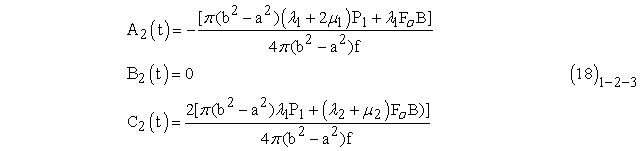 |
iii) at point  :
:
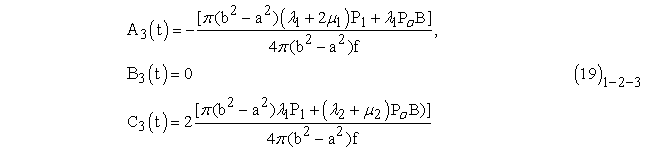 |
where:
 | (20) |
Employing (17), (18) and (19) into (14), it possible to obtain the microdisplacements at points Α, Β and Γ respectively. Also employing (17),(18) and (19) into (15), it is possible to obtain microstrains. Thus:
i) at point Α:
 |
ii) at point Β:
 |
iii) at point  :
:
 |
At continuity we distinguish the following cases:
i) The internal remodeling of femur does not depends upon temperature:
Then substituting (21), (22), (23) into (10)1 it is possible to obtain:
i) at point Α:
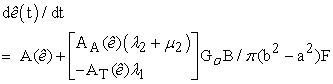 | (24) |
ii) at point Β:
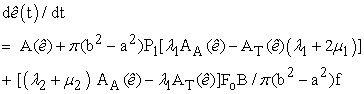 | (25) |
iii) at point  :
:
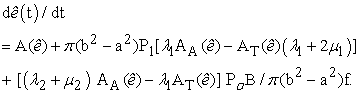 | (26) |
Since living bone is continually remodeling obeying to Wollf’s law 8, 9 we assume Young’s modulus and Poisson’s ratio depends upon το  6, 10, 11, 12. Then from (6) it results that
  ,
, 
 ,
,  depend also
  . At continuity we impose:
 |
Therefore(24)-(25)-(26) conclude to the following form
 | (28) |
where:
i) at point Α:
 |
ii) at point Β:
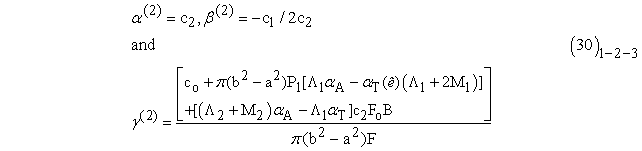 |
iii) at point  :
:
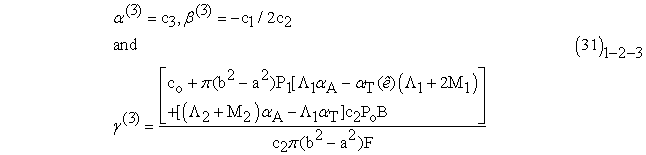 |
where:
 | (32) |
As we stated earlier initially femur was in a state at which no remodeling occured. Therefore 2:
 | (33) |
The solutions of (28) satisfying (33) are:
 |
The acceptable solutions are given in Table 1. 6. Αccordingly to results of this Table there are two possible cases: After the removal of cast the femur at points A, B, Γ: i) will be weaken, that is the mean length of microcraks will be increased or ii) will be under osteoporosis, that is the mean length of microcraks will be dramatically increased.
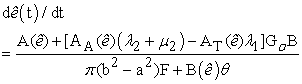
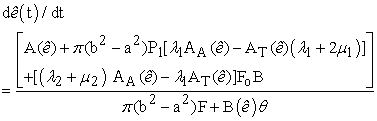
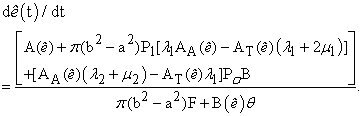
ii) The internal remodeling of femur does depends upon temperature:
Then substituting (21),(22),(23) into (10)2 it is possible to obtain:
i) at point Α:
 | (35) |
ii) at point Β:
 | (36) |
iii) at point  :
:
 | (37) |
At continuity substituting (27) into (35), (36), (37) and imposing:
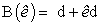 | (38) |
we again conclude to (28) where:
i) at point Α:
 |
ii) at point Β:
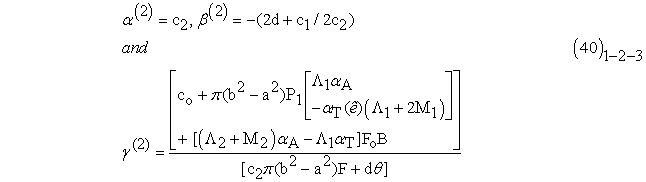 |
iii) at point  :
:
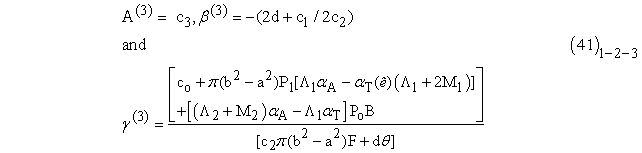 |
The solutions of (28) satisfying (33) are (34)1-2 and all that we stated at previous case are valid.
Our results coincides with the corresponding problem at macroscopic area 6, 13, 14. Therefore both accounting and neglecting temperature after the removal of cast the femur locally at points of our interest: will be weaken or osteoporotic, that is an increase or a dramatically increase of its microcracks will be arised. From the above we conclude that temperature does not effect the growth of micro- cracks in a broken casted femur.
| [1] | Cowin S. and Hegedus D. (1976). Bone remode-ling I: Theory of adaptive elasticity”. J. Elastic. 6, pp. 313-326. | ||
| In article | View Article | ||
| [2] | Hegedus D. και Cowin S. (1976). Bone remodeling II: Theory of adaptive elasticity”. J. Elastic. 6, pp. 337-352. | ||
| In article | View Article | ||
| [3] | Sih G.C. (1985). “Mechanics and Physics of energy density theory”, Theoret., Appl., Fract. , Mech., 44, pp. 157-173. | ||
| In article | View Article | ||
| [4] | Sih G.C (1972 -1982). “Mechanics of fracture, Introductory chapters”, Vol. I- VII, edited by G.C. Sih, Marti-nus Nijhoff, The Hague. | ||
| In article | |||
| [5] | Sih GC (1988). “Thermomechanics of solids: none-quilibrium and irreversibility”, Theoretical and Applied Fracture Mechanics, 9, pp. 175-198. | ||
| In article | View Article | ||
| [6] | Tsili M. (2000). “Theoretical solutions for internal bone remodeling of diaphyseal shafts using adaptive elasticity theory” J. Biomech., 33 pp. 235-239. | ||
| In article | View Article | ||
| [7] | Frost H. M. (1964). “Dynamics of bone remodeling in bone bio dynamics” (edited by Frost H.M) Little and Brown 316, Boston. | ||
| In article | PubMed | ||
| [8] | Wolff. J. (1884). Das gesetz der transformation der inneren architecture knocken bei pathologism veran-derungen der aussen knochenform. Sitz Ber. Preuss Acad. d. Wiss 22, Sitz Physik- Math. K1. | ||
| In article | |||
| [9] | Wolff J. (1892). “Das gesetz der transformation knocken hirschald”, Berlin | ||
| In article | |||
| [10] | Cowin S. and Van-Burskirk W. (1978). “Internal bone remodeling induced by a medullary pin.” J. Biomech. 11, pp. 269-275. | ||
| In article | View Article | ||
| [11] | Τsili M. (2008b). “Internal bone remodeling induced by the distance - running and the unkown remodeling coefficients” in: www.ispub.com/journal- of- internet journal of bioengineering, Volume 4. number 2, | ||
| In article | |||
| [12] | Τsili M. (2008c). “Internal bone remodeling induced by volleyball in: www.ispub.com/journal-of-internet journal of bioengineering, Volume. 4. number 1. | ||
| In article | |||
| [13] | Dietrick J., Whedon, Shore E. (1948) American Journal of Medicine 4, pp. 3-36. | ||
| In article | View Article | ||
| [14] | Fung Y. (1981). Biomechanics. Mechanical proper- ties of living tissues, springer, New York. | ||
| In article | View Article | ||
Published with license by Science and Education Publishing, Copyright © 2017 Mary Tsili and D. Zacharopoulos
 This work is licensed under a Creative Commons Attribution 4.0 International License. To view a copy of this license, visit
http://creativecommons.org/licenses/by/4.0/
This work is licensed under a Creative Commons Attribution 4.0 International License. To view a copy of this license, visit
http://creativecommons.org/licenses/by/4.0/
| [1] | Cowin S. and Hegedus D. (1976). Bone remode-ling I: Theory of adaptive elasticity”. J. Elastic. 6, pp. 313-326. | ||
| In article | View Article | ||
| [2] | Hegedus D. και Cowin S. (1976). Bone remodeling II: Theory of adaptive elasticity”. J. Elastic. 6, pp. 337-352. | ||
| In article | View Article | ||
| [3] | Sih G.C. (1985). “Mechanics and Physics of energy density theory”, Theoret., Appl., Fract. , Mech., 44, pp. 157-173. | ||
| In article | View Article | ||
| [4] | Sih G.C (1972 -1982). “Mechanics of fracture, Introductory chapters”, Vol. I- VII, edited by G.C. Sih, Marti-nus Nijhoff, The Hague. | ||
| In article | |||
| [5] | Sih GC (1988). “Thermomechanics of solids: none-quilibrium and irreversibility”, Theoretical and Applied Fracture Mechanics, 9, pp. 175-198. | ||
| In article | View Article | ||
| [6] | Tsili M. (2000). “Theoretical solutions for internal bone remodeling of diaphyseal shafts using adaptive elasticity theory” J. Biomech., 33 pp. 235-239. | ||
| In article | View Article | ||
| [7] | Frost H. M. (1964). “Dynamics of bone remodeling in bone bio dynamics” (edited by Frost H.M) Little and Brown 316, Boston. | ||
| In article | PubMed | ||
| [8] | Wolff. J. (1884). Das gesetz der transformation der inneren architecture knocken bei pathologism veran-derungen der aussen knochenform. Sitz Ber. Preuss Acad. d. Wiss 22, Sitz Physik- Math. K1. | ||
| In article | |||
| [9] | Wolff J. (1892). “Das gesetz der transformation knocken hirschald”, Berlin | ||
| In article | |||
| [10] | Cowin S. and Van-Burskirk W. (1978). “Internal bone remodeling induced by a medullary pin.” J. Biomech. 11, pp. 269-275. | ||
| In article | View Article | ||
| [11] | Τsili M. (2008b). “Internal bone remodeling induced by the distance - running and the unkown remodeling coefficients” in: www.ispub.com/journal- of- internet journal of bioengineering, Volume 4. number 2, | ||
| In article | |||
| [12] | Τsili M. (2008c). “Internal bone remodeling induced by volleyball in: www.ispub.com/journal-of-internet journal of bioengineering, Volume. 4. number 1. | ||
| In article | |||
| [13] | Dietrick J., Whedon, Shore E. (1948) American Journal of Medicine 4, pp. 3-36. | ||
| In article | View Article | ||
| [14] | Fung Y. (1981). Biomechanics. Mechanical proper- ties of living tissues, springer, New York. | ||
| In article | View Article | ||