Transport is the cornerstone of civilization, an essential part of human activity. Road transportation in particular plays a significant role in the economic development of any nation, for high proportion of economic activities are dependent on an efficient network of roads. The Nigerian Coastal zone sprawls over a total of nine coastal states and stretch inland for a distance of 15km in Lagos in the West to about 150km in the Niger Delta and about 25km east of the Niger Delta. Coastal Roads constitute a major segment of national road network in countries with vast shorelines like Nigeria. The East-West Road undergoing reconstruction and upgrading is currently the most southern road running through the Region. It is about 40km from the coastline on the average, leaving a vast section of the coastal communities inaccessible by road transport and has naturally slowed down development and business expansion. The conception and proposal to construct an East-West Coastal Highway is thus a welcome development. The 704km highway with about 106km of spurs connects over 1,000 communities and serves as a strong east-west spine from Calabar towards Lagos, with several north-south ‘ribs’ connecting growth poles. The paper contributes to an understanding of the human environment of proposed project from a specialist perspective on impacts’ assessment study. Beneficiaries, prevailing baseline conditions and recognition of associated positive benefits including regional-national integration if implemented are discussed. High expectations await the coastal road execution and Government and her agencies should not tarry too long in doing the needful.
The total road network in Nigeria is estimated at 200,000km and this represents the principal means for freight and passenger movements across the country. The Road transport assumed a more significant role and most utilized mode of freight movement since the collapse of the rail system in the 1970s/80s. Today, road transportation accounts for nearly 95% of all modes of transport and estimated N200b growing at 10% per annum compared with other developed economies such as South Africa, UK and US 1.
Transport is the cornerstone of civilization as it is an essential part of human activity. As society and economic organizations become more complex, the relevance of transport grows. Road transportation in particular plays a significant role in the economic development of any nation, for a large proportion of its economic activities are dependent on an efficient network of roads. Indeed, no two locations will interact effectively without a viable means of movement from one point to another.
The correlation between transport and economic development has long been established. Several studies advocate that socioeconomic development can be catalyzed by the presence of transport infrastructure. If these facilities and services are absent, development will be very difficult and in fact can be likened to a very scarce commodity that can only be secured at a very high price and cost 2, 3, 4.
Additionally, according to study by 4, road infrastructure has been identified to form a major factor for economic growth and development of any country. In this study, an empirical approach was employed to explore the association between road infrastructure and economic development. The study revealed that there are consistent and significant associations between economic development, in terms of per capita gross national product (GNP), and road infrastructure, in terms of per capita length of paved road network. Furthermore, the study also showed that road condition seems to be associated with economic development. Indeed, good infrastructure raises productivity and lowers production costs. Thus, it is clear that infrastructural development is a function of economic development.
An Africa Competitiveness Report 5, also affirmed that Africa suffers from a pronounced infrastructure deficit. Compared with countries in other regions, African countries have a low stock of infrastructure, particularly in energy and transportation, and the potential for information and communication technologies (ICTs) has not been fully harnessed. Coupled with burdensome trade regulations, these deficiencies have constrained gains in domestic productivity and present a critical bottleneck to more regional integration.
Infrastructure that is sufficient and works properly is crucial for Africa’s economic integration. African economies can begin the process of deep integration if their infrastructure networks are designed in such a way as to link production centers and distribution hubs across the continent, as the networks of developed economies do. Such infrastructure will enable Africa to compete effectively, tap into regional markets, and benefit from globalization through investment and trade. To achieve this calls for the construction of an efficient and secure national and cross-border physical infrastructure as well as a coherent system of regulation for business transactions.
Infrastructure is also critical for the promotion of inclusive and sustainable growth. Rural infrastructure—notably feeder roads and transmission lines that connect rural communities to national grids—enable individuals, households, communities, and small businesses to embark on income-generating activities thanks to improved access to electricity and links to markets. The use of renewable energy or environment-friendly sources of energy—including solar, wind, geothermal, and hydropower, with all of which Africa is well endowed—would contribute to making growth sustainable.
The Federal Government of Nigeria (FGN) realises the importance of improved transportation infrastructure particularly to the effect of economic development and national integration. To this end, it has embarked on bold steps in the rehabilitation, re-construction, construction and expansion of major arterial highways in the country. Against this backdrop, there have been a number of challenges confronting efforts of the government in the delivery of improved road infrastructure. One of the major challenges is attributable to the funding gap in road infrastructure delivery.
Coastal Roads constitute a major segment of national road network in countries with vast shorelines like Nigeria. This is so not only because they provide access to fishery, residential and tourism resources but also because of the difficult coastal terrain which is a major challenge to all other productive sectors and social activities on a daily basis 6. However, in Nigeria it is a different “kettle of Fish”. The many years of marginalization, neglect and betrayal by the successive governments at the centre have led to the total absence of infrastructures such as road networks, railroads and general paucity of communication networks in the Nigerian coastal communities (especially in the Niger Delta Region) which provides over 95% of the economic life support for the Nigerian nation.
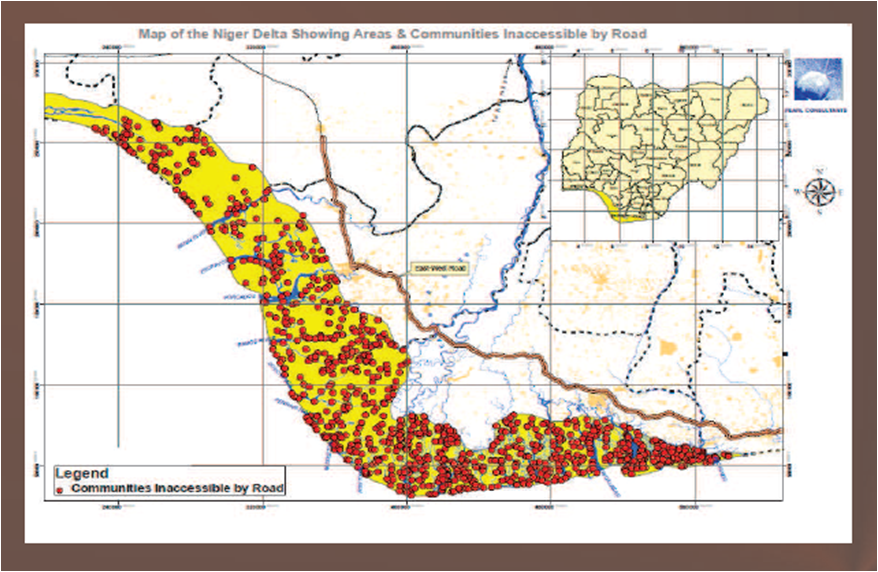
The East-West Road presently undergoing reconstruction and upgrading is currently the most southern road running through the Niger Delta Region. This road is about 40km from the coastline on the average, leaving a vast section of the coastal communities inaccessible by road transport. Towns and communities such as Ilaje, Awoye, Escravos, Oporosa and Okerenkoko in Gbaramatu Kingdom, Forcados, Burutu, Agge, Tebidaba, Igbomotoru, Peremabiri, Apoi, Brass, Kula, Soku, Bonny, Opobo just to mention a few cannot be reached by road even through their respective state capitals. Effective transportation and communication is limited to water and air, both of which are comparatively more expensive than land transport and therefore outside the range of majority of the inhabitants. This has naturally slowed down development and business expansion. Besides communication, roads provide the platform for evacuating electricity, telephony and other services that stimulate development.

The Niger Delta sub-region of Nigeria is generally an inaccessible region due to its anastomosing network of creeks, rivulets, streams, rivers and extremely dense vegetation. There is an existing East-West Road passing through the northern segment of the delta thus leaving the largely uninhabited and petroleum-prolific southern segment of the Niger Delta devoid of roads and highways (Figure 1). It is in order to solve this intractable and perennial problem of lack of all forms of transportation in this south-central segment, it became imperative to plan for an East – West Coastal Road from Calabar to Lagos (terminating at Lekki Lagos). This proposed Highway has been divided into ten (10) Segments, for ease of implementation of its studies and constructions 2.
This paper deals primarily with the East-West Coastal Road infrastructure Development and impacts on the socioeconomic (human) environment, particularly how it affects both regional and national integration. Investigations to characterize the project’s baseline environment at two axes of the coastal highway project (Cross River to Akwa Ibom and Ondo to Lekki in Lagos States) were undertaken. The paper presents the field experience of a practitioner. In the subsequent sections, the Nigeria road infrastructure and the East-West Coastal Highway Road Project are briefly explored, the impact assessment process, including presentation of study approaches for socioeconomic data collection is discussed, then a summary of project impacts detailing both the beneficial expected from road development are explored. The paper concludes with recommendations for a speedy execution of the highway road project for its beneficial results to be experienced.
The Nigerian road network from the colonial days to the present day, have been classified into three, namely Trunk A, B & C.
A: These roads forms the skeleton of the national road grid. They cut across regional boundaries in the country and even extend to the international borders of neighbouring West African countries. These categories of roads are under Federal Government’s ownership. They are designed, constructed, maintained and financed by the Federal government through the Federal Ministry of Works. The Federal Road Maintenance Agency (FERMA) is in charge of carrying out maintenance of this class of roads.
B: These roads are the second category of main roads in Nigeria. They link the major cities within States with the State capitals. These roads are designed, developed, financed and maintained by the State governments through their Ministries of Works, Transport or Infrastructure. The primary objectives of Trunk B roads are to enhance the socio-economic development of the various States in the country.
C: These roads are local feeder roads constructed and maintained by the Works Department of Local Government Authorities in Nigeria. This class of roads are primarily not concrete asphalted and are affected by seasonal weather changes. The roads link villages and communities in the remote parts of each local government region.
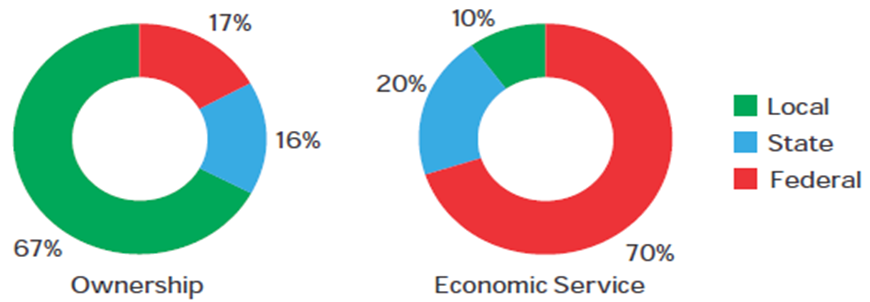
The total national road network in Nigeria is approximately 200,000km made up of 33,000km, 50,000km and 117,000km for Federal, State and Local Government respectively depicted by the chart below. Only about 65,000km of the 200,000km are paved mostly in bituminous layers others are earth roads. Out of this, the Federal Government owns about 35,000km representing 54% of the entire bituminous road network in Nigeria. The balance is shared between the 36 States and the 774 Local Government Areas 1.
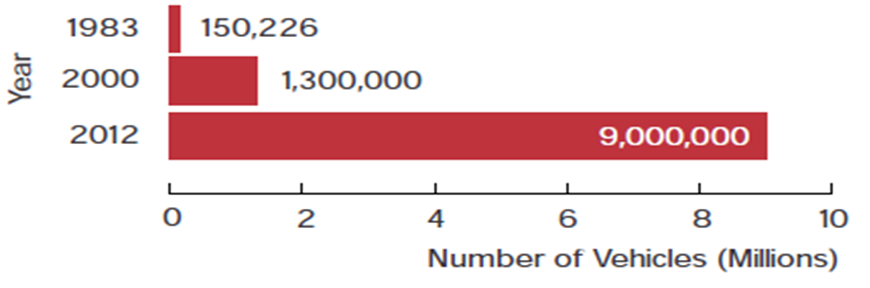
According to the Constitution of the Federal Republic of Nigeria, the different tiers of government have independent responsibilities for the planning, financing, constructing and maintenance of the roads under its respective jurisdictions. Most of the freight and passenger movement in the country are conveyed by road. The diagram below provides a comparative analysis of the number of vehicles over three decades.
Even though Federal roads constitute only 17% of the total national stock, they carry more than 80% of the National vehicular traffic, thus underscoring their crucial importance to the economy of the country. The Federal roads have been subjected to severe pressure as a result of increased vehicular traffic as well as freight especially given the near absence of rail, marine and other forms of transport to convey heavy goods.


The Nigerian Coastal zone sprawls over a total of nine coastal states (out of the thirty-six States of the Federation) namely Akwa Ibom, Bayelsa, Cross River, Delta, Edo, Lagos, Ogun, Ondo and Rivers. The coastal states are estimated to account for 25% of the national population. The coastal areas stretch inland for a distance of 15km in Lagos in the West to about 150km in the Niger Delta and about 25km east of the Niger Delta.
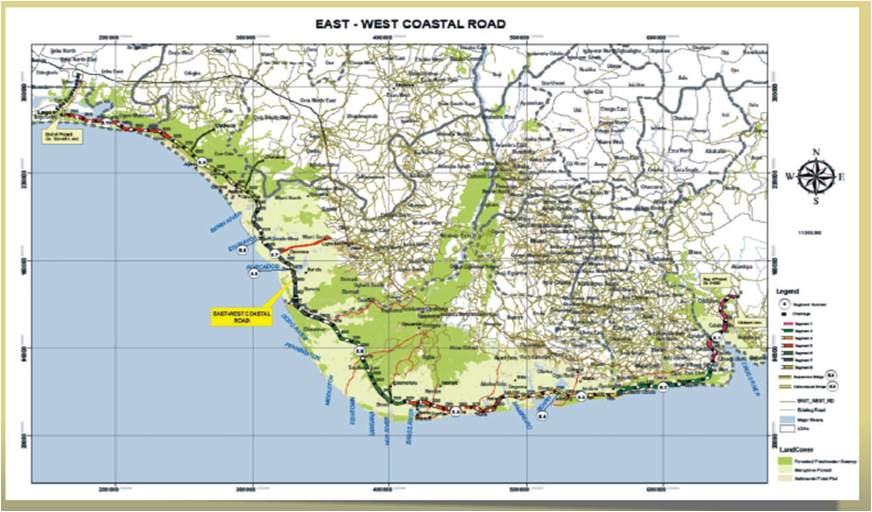
The alignment commences from Calabar, the old nexus of national administration and the former Colonial Capital of Nigeria on the Calabar Ogoja Road. From this starting point, the alignment takes a southerly direction, finding its way to the coastal area through the hilly terrain of Cross River. At Ibeno in Akwa Ibom State, the alignment moves westwards connecting the Coastal areas of Rivers, Bayelsa, Delta and Ondo States. From Ondo State, the East-West Coastal Highway stretches through Ogun State before terminating at Ibeju on the Lagos Epe Expressway. The highway connects over 1,000 communities. From the detour on Route 90, the East-West Coastal Highway is linked to the Trans West African (Coastal) Highway (Lagos Benin Enugu Abakiliki Ikom Cameroon Mombassa on the East African Coast. (See Figure 4)
The Coastal Road travels over 704km on the main alignment and with about 106km of spurs, straddling over barrier Island forests, fresh water swamps, mangrove swamps and waterways. Spurs are provided to connect the East-West Coastal Highway to centres of economic activities in the northern and central regions of the country, and also to create access to the coastline for maritime industries, tourism and recreational activities.
The road is designed to a 2-lane dual carriageway standard with raised median, kerbs and chutes at the outer edges. Each carriageway has a travel way width of 7.3m, flanked with an inner shoulder of 1.2m width and outer shoulder of 3.65mm width with a 900mm wide paved section provided for future expansion. The road has 18nos. bridges which include 3no. Iconic bridges – Suspension Bridge at the Bonny River Crossing (‘WATER DIAMOND’), a Cable-Stayed Bridge at Escravos River Crossing (‘ESCRAVOS MARVEL’) and Forcados River Crossing (‘WONDROUS FORCADOS’) 7.
Nigeria is a maritime state and lies between latitude 4°10’N to 6°20’N and longitude 2°45’ to 8°35’E. It has a coastline of approximately 853km that stretches from the western border with the Republic of Benin to the eastern border with the Cameroun Republic. Much of Nigeria’s population and economic activities are located along the coast with over 25% of the population inhabiting the coastal areas. Eight (8) out of the 36 states that make up Nigeria (Lagos, Ogun, Ondo, Delta, Bayelsa, Rivers, Akwa Ibom and Cross River) are located in the coastal zone.
Like elsewhere around the world, several human settlements long drawn to coastal areas, because of the many resources and trading opportunities which the coast confers are located along the Nigerian coastline. The proposed road, measuring about 704km in length (plus another 106 km of spurs), is expectedly cutting through the states and several human habitations located along and within the proposed right-of-way/route and corridors. Should the road be implemented as planned, it shall certainly ease communication and transportation, boosting the economic activities of the entire coastline communities since many shall be linked up to their neighbours, including the hinterlands.
Good as the project is, it is a well-known fact there always exists a conflict between environment and development. Environmental management process must therefore, be carried out to ensure sustainable development. The tool for achieving this goal is the Environmental Impact Assessment (EIA) tool. It is to this end and in compliance with the national environmental and social regulatory requirements 11, 12, 13, corporate best practice (NDDC’s HSE Policies) and international best practice/requirements 14, 15, that an environmental assessment (EIA) for the proposed road project was commissioned. This is to aid project implementation, incorporating effective environmental management and monitoring plan for the road construction activities. The study provided information on the quality of the project environment, the interaction of the project with the natural and human environments, potential impacts (positive and negative) and mitigation to minimise significant negative (adverse) impact and/or enhance beneficial impact.
3.1. The East-West Coastal Road Socioeconomic (Human) EnvironmentAcquisition of baseline socioeconomic characteristics of a project area is an important phase of any integrated Environmental Impact Assessment (EIA) process. Baseline data provides vital information on the existing human environmental quality in which a development is planned. It is also useful for delineating sensitive socioeconomic areas for avoidance and/or preparing of mitigation measures for potential adverse impacts. In this study, the socioeconomic characteristics of the project area were established through extensive literature search, field surveys, stakeholder consultation and data interpretation.
The proposed East-West Coastal Highway project originates from Odukpani in Cross River State and traverses through environmentally sensitive areas/ecosystems and human habitations across the Niger Delta Region before its terminal point in Lekki, Lagos State. As a linear project, the activities associated with the coastal highway road project’s construction and operation’ and “area of influence” was determined as constituting all the settlements/communities located within a certain distance on either side of the road’s right-of-way (ROW)/route.
Over 1000 communities are expected to benefit from the road project directly and indirectly. For project’s right-of-way however, several hundreds of settlements and human habitations are also located within and around the project’s precinct (ROW). Many are considered to be host communities, “land-holding communities” and primary impact communities. Many of these communities are remotely located, many are inaccessible, located inside the freshwater and mangrove swamp and thick tropical rainforests of the region, harvesting both the fisheries and agricultural produce of the area. For detailed socioeconomic impact assessment (SEIA/SIA) of project environment including characterization of project’s environment involved the use of both qualitative and quantitative methodologies. With the help of base maps, reconnaissance visits were first undertaken to identify would-be project affected communities (PACs), then a selection of representative communities were carried out and then visited. Participatory methodologies that employed a mix of techniques, including community-wide meetings (town hall meetings), focus group discussions, key-informant interviews and semi-structured interviews were used for socioeconomic baseline data collection 16, 17. At the Cross River to Akwa Ibom States axis of highway route, the road cuts through 8 Local Government Council Areas (LGAs) and over 30 settlements/communities were identified to be traversed. Sixteen (16) of the communities were visited for detailed socioeconomic study and eight (8) were sampled with close to 250 copies of the structured questionnaire.
Also, the proposed coastal highway road from the Ondo State to Lagos axis commences from Eketie, which shares boundary with Oghoye, the last of Ijaw settlements in Delta State. From Eketie, down to Araromi-Seaside, also the terminal settlement of Ilaje extraction located in Ondo State, there are over 100 human habitations, some evidently small and subsumed under more popular permanent and parent settlements, and some also found deserted and desolate because of the communal crises that rocked the area some years back. The settlements/communities are located on both sides of first a natural waterway, long turned into a canal by the Government since the 1970s and through a variety of vegetation; tall mangroves to a swampy marshy grassland/savannah through shorter mangrove and transition vegetation that terminates in more tropical rainforest at Araromi axis.
At the Ilaje axis, 10 settlements/communities were surveyed and structured copies of the questionnaire administered in 4 of the surveyed habitations. The road is proposed to run parallel with the coast and at the Ogun State axis, very close to the ocean. Accessibility was a major challenge, thus the consultant relied on an earlier socioeconomic study and literature on the area 18, 19. At the Lekki axis, Folu is the most proximate of the communities to the terminal point of the road and was considered for assessment. Because of the length and remote nature of the some of the affected settlements/communities, retrieval of administered instruments was a big challenge. A total of one hundred and forty (140) sets of the questionnaire were administered, out of which seventy-six (76) or 54.3% were retrieved for analysis.
Summary of Socio-demographic characteristics of Project Environment
A summary socioeconomic statistics of the human environment of the East-West Coastal road project from the sample survey of the Cross River-Akwa Ibom and Ondo (Ilaje) through to Ogun Waterside and Lagos (Lekki) axes include the following:
Impacts caused by new road projects are sometimes very complex in pattern with regard to the immediate surroundings. These complex impacts could be well assessed only when considered from local or regional socioeconomic viewpoint 12 This involves taking into consideration the characteristics of the project area and of the project. The environmental damages which may be temporary, long-term or permanent, created by road projects include deforestation, destruction of natural habitats, air and noise pollution, population migration, communal conflict, etc. The ultimate impact of these damages to the environment is on human health.
• This road is crucial not only because of the vital communication links that it would provide, but the wider benefits of acting as a catalyst in the development of the region and unlocking the vast tourism potentials and opportunities in the region.
• The planned 704km East-West Coastal Road will help immeasurably in opening up of the Niger Delta region's economic potentials, assist in relieving the difficulties which for long encumber the movement of goods and enable the people to improve their living standards.
• The East-West Coastal Road holds much prospects for the Coastal Region as well as for the Nigerian economy at large; studies revealed the road project will create employment for over 11,000 people in the region during the construction period 7. Already, the nation has started appropriating some of the prospects of the East-West Coastal Road project. For instance, for the first time in the country's history, local experts are given a chance to contribute to national development and this has created jobs, built local capacities and enhanced technology transfer.
• 180 No. bridges which includes 3 No. Iconic bridge structures are expected to be constructed along with the road to ease the movement of goods in and out of the region. These are lasting legacies and assets that are expected to give the people of the region a deep sense of belonging.
• Moreover, the road when finally completed will connect over 1,000 communities; improve fishing and trading activities in the region by at least 27.5% and 24.4% respectively. The economic contributions of these hidden communities are, hitherto disconnected from the mainstream centres of economic activities; the road will certainly assist in absorbing their contribution to national growth and facilitate the movement of raw materials from the rural end of the market to the high end urban centres where their produce is transformed into final outputs.
• There will be a reduction in the average transport time on between the two ends of proposed project route. The traveling distance between two ends Calabar and Lagos on the existing East-West Road currently takes between 10 to 12 hours; and on completion of the East-West Coastal Road, this travelling time will be about half.
• Improved access to production/marketing centers for nearly 30 million inhabitants;
• Improved access and connection to isolated villages, following construction and linkage with feeder rural roads (spurs); and
• Positive impact on daily living, following the facilitation of access to areas of production.
Other benefits of the East-West Coastal Road, when completed, are as follows:
• to give direct access to waterways that are currently not utilized and encourage the establishment and growth of maritime industries such as ocean terminals for deep anchorage, ship repair/maintenance and engineering facilities to handle large ocean-going vessels, boat building facilities, passenger cruise terminals, fishing terminals etc.
• to encourage establishment of export processing zones in the individual coastal states.
• to enhance the exploitation of the natural resources of the Niger Delta oil and gas, salt, sand for glass-making, timber etc.
• the proposed road will enhance the security of the region and nation at large.
• the East-West Coastal Road will serve as the shortest route linking Lagos to the coastal areas of Ondo, Edo, Delta, Bayelsa, Rivers, Akwa Ibom and Cross River States and also connects the North-South vertical routes.
• the construction of the coastal road from Calabar - Lagos will engender a genuine feeling of national integration in the people of the Niger Delta Region who have always felt marginalized in national developmental programmes.
• It will encourage the creation of eco-sanctuaries where people will experience natural encounter with wild life in a regenerating ecosystem. This will bring about tremendous development in the area and engender employment opportunities in tourism.
• it will display the first set of Nigeria's monumental bridge structures. This will automatically give a permanent seat to Nigeria in the elite club of nations with iconic structures which will give massive added flavor to tourism.
3.2. Negative/adverse Social ImpactsThe significant adverse impacts envisage from the East-West Coastal Road project implementation and operation and suggested mitigation are summarized in Table 2 below.
Nigeria is a country blessed with the perfect combination of abundant human and natural resources and should earn its rightful position among the top 20 economies of the world in less than seven years, the time lag for the vision 20:20:2020 agenda. One way to achieving such vision is through improved infrastructural development. Well-developed energy, transportation, and communication infrastructure networks are a prerequisite for linking less-developed communities to markets in a sustainable way. Effective modes of transport—including quality roads, railroads, air transport, and ports—enable inhabitants and entrepreneurs to get their goods and services to markets in a secure and timely manner, facilitate the movement of workers to the workplace, and encourage foreign direct investment.
Empirical research has shown that there is a positive relationship between infrastructure investment and economic growth. Several researchers demonstrate the beneficial impact of infrastructure investments on growth in African economies; this occurs because solid infrastructure accelerates annual growth convergence rates by as much as 13 percent and also increases per capita annual growth by almost 1 percent 20, 21, 22, 23, 24. In fact, some have argued that the strongest impact comes from telecommunications, followed by roads and electricity 2.
Reliable transport infrastructure, in all of its four subsectors—roads, railways, air transport, and ports—is an essential component of all countries’ competitiveness. Road infrastructure, particularly facilitates economic development. The connection between good roads and economic development has been established, it is clear that infrastructure development plays a vital role in the economic well-being of any nation. Putting the statistics under perspective, it has been shown that Nigeria still has a huge task ahead. The total road network in Nigeria currently estimated at 200,000km remains to be improved in order to bring them to sync with road infrastructure development in other thriving economies such as USA, China, Brazil, Turkey, India and South-Africa. A comparative analysis provides a clearer view of enormity of the challenge facing economic development of the nation.
According to 7, “The planned East-West Coastal Highway Road shall open, and connect over 1,000 communities to assess the economic opportunities and attract investment in abundant natural resources. It will promote direct access to water ways that are under-utilised at the moment and to encourage the establishment and growth of maritime industries; promote the exploitation of natural resources of the Niger Delta” among other benefits. The road will definitely facilitate regional integration and linkage of coastal economies to the national economy in Nigeria.
The author acknowledges there have been a number of challenges confronting efforts of the government in the delivery of improved road infrastructure, including the funding gap in road infrastructure delivery attributable to the lean financial resources of the times. To this end, it has become imperative for the Federal Government to source for alternative means of funding in order to achieve its objective of keeping roads in good condition and plan for future growth. The Federal Government through the Ministry of works is working to reduce dependence on Public finance by facilitating private sector participation as well as encouraging funding by multi-lateral Agencies on road development.
While it is a welcome development for the Federal Government to seek external sources for raising the required fund, it is important that the government also device some internal mechanisms that could further assist in raising substantial finance to fund the project. This could come in the form of deductions from oil revenues which are predominantly generated from the coastal states. This suggestion borders on the awareness that the East-West Coastal Road is a necessity of life in the Coastal Area, knowing fully well that these States need this infrastructural development to enhance the economic base of the region.
In conclusion, it is pertinent to think of the immense opportunities the implementation of the East-West Coastal road project holds for the country, it will be in the interest of the Federal Government and the Nigerian State at large to support the East-West Coastal Road Project which holds great prospects for the country in the area of revenue that could be generated from tourism, expanded agricultural activities and job creation. Government should therefore, not tarry in going through with the project.
| [1] | Federal Ministry of Works, (2013). Compendium Report on ROAD INFRASTRUCTURE & RELATED DEVELOPMENT IN NIGERIA - AN INVESTOR’S MANUAL, published by Pison Real Estate and Infrastructure Professional Practice & Services: PISON-REIPPS (an associate Company of Pison Housing) for the Federal Ministry of Works, Abuja, Nigeria. | ||
| In article | |||
| [2] | Ondiege, P., Mbabazi Moyo, J. and Verdier-Chouchane, A. (2013). Developing Africa’s Infrastructure for Enhanced Competitiveness, In: African Development Bank. | ||
| In article | |||
| [3] | Willoughby, C. (2004), “Infrastructure and the MDGs”, sponsored by DFID. | ||
| In article | |||
| [4] | World Bank (2005) Meeting the Challenge of Africa’s Development: A World Bank Group Action Plan. World Bank, Africa Region, Washington, DC. http://go.worldbank.org/1AWD265Q20. | ||
| In article | |||
| [5] | Cesar Queiroz and Surhid Gautam (1992). Road Infrastructure and Economic Development: Some Diagnostic Indicators. Working Papers Series (WPS) 921, Infrastructure Operations Division, Western Africa Department, and the Transport Division, Infrastructure and Urban Development Department. The World Bank, 1818H Street NW, Washington, DC 20433. | ||
| In article | |||
| [6] | Africa Competitiveness Report [2013]. World Economic Forum, Geneva. ISBN-10: 92-95044-44-4; ISBN-13: 978-92-95044-44-9. | ||
| In article | |||
| [7] | (David-West, 2011). ‘’East-West Coastal Road: Challenges and Prospects’’. Lecture delivered at 6th Prof. Y.O. Beredugo Annual Lecture on Thursday 27th October, 2011 at Hotel Presidential, Port Harcourt, Nigeria. | ||
| In article | |||
| [8] | Teme, So-ngo Clifford; David-West, Mayne; and Iboroma, Nathan, "Alignment and Design of a 73-Km Long Coastal Road in the South-Central Segment of the Niger Delta, Nigeria" (2013). International Conference on Case Histories in Geotechnical Engineering. 9. https://scholarsmine.mst.edu/icchge/7icchge/session_07/9. | ||
| In article | |||
| [9] | Pearl Consultants (2014). East-West Coastal Road Project: Mileage and Way Forward. Updated version, Port Harcourt. | ||
| In article | |||
| [10] | Pison Housing Company/US-Africa Infrastructure Conference Presentation, June 2012. | ||
| In article | |||
| [11] | (FEPA) (1995), now Federal Ministry of Environment (FMENV) EIA Decree/Act No. 86 of 1992 | ||
| In article | |||
| [12] | Federal Environmental Protection Agency (FEPA, 1995) Sectoral Guidelines for Infrastructures, FEPA, Lagos. | ||
| In article | |||
| [13] | Federal Environmental Protection Agency (1995). Environmental Impact Assessment Procedural Guidelines, FEPA, Lagos. | ||
| In article | |||
| [14] | World Bank (1991). Environmental assessment sourcebook. Washington DC., World Bank, 3 vols. | ||
| In article | |||
| [15] | International Finance Corporation (IFC) (2006). Performance Standards (PS) on Social and Environmental Sustainability. International Finance Corporation, Washington, USA 34pp. | ||
| In article | |||
| [16] | Ojile, M.O., Bodude, D., & Okhade, R. (2016). Community-based GIS Approach to Natural Resource Mapping and Socioeconomic Considerations in Impact Assessment: Case Study of Bayelsa Greenfield Airport Development in Niger Delta, Nigeria. Modern Environmental Science and Engineering (MESE). Vol. 2, No. 6, pp.427-433. Academic Star Publishing Company, ISSN 2333-2581, New York, USA. | ||
| In article | |||
| [17] | Akpofure, E.A. & Ojile, M.O. (1999). “Social Impact Assessment: an interactive & Participatory Approach – Case Study Example from the Niger Delta, Nigeria in UNEP EIA Training Resource Manual, pp211-222, UNEP, Kenya. | ||
| In article | |||
| [18] | Ojile, Meshach (2006). Draft Report of the Baseline Socioeconomic Characteristics of OKLNG Project Affected Communities for the Preparation of the Resettlement Action Plan (RAP) October 15, 2006, 20pp. | ||
| In article | |||
| [19] | Plan (2007). Draft Resettlement Action Plan Report, V. 3 for the OKLNG Project submitted to OKLNG Nigeria, May 2007. | ||
| In article | |||
| [20] | Boopen, S. (2006). “Transport Infrastructure and Economic Growth: Evidence from Africa Using Dynamic Panel Estimates.” The Empirical Economics Letters 5 (1): 37-52. | ||
| In article | |||
| [21] | Briceño-Garmendia, C. and C. Domínguez-Torres. (2011). “Burkina Faso’s Infrastructure: A Continental Perspective.” Policy Research Working Paper No. 5818. Washington, DC: World Bank. | ||
| In article | View Article | ||
| [22] | Calderón, C. (2008). “Infrastructure and Growth in Africa.” Africa Infrastructure Country Diagnostic (AICD) Working Paper No. 3. Africa’s Infrastructure: A Time for Transformation. World Bank: Washington DC. Available at http://www.infrastructureafrica.org/system/files/library/2009/10/WP03_Infra_growth.pdf. | ||
| In article | View Article | ||
| [23] | Estache, A. and A. Goicoechea. (2005). “How Widespread Were Private Investment and Regulatory Reform in Infrastructure Utilities during the 1990s?” Policy Research Working Paper No. 3595. Washington, DC: World Bank. | ||
| In article | View Article | ||
| [24] | Estache, A. and Q. Wodon (2011). Infrastructure and the Poor in Sub-Saharan Africa, draft manuscript. European Center for Advanced Research in Economics and Statistics (ECARES) at Université Libre de Bruxelles (ULB), Brussels. | ||
| In article | |||
Published with license by Science and Education Publishing, Copyright © 2021 Meshach Owho Ojile
 This work is licensed under a Creative Commons Attribution 4.0 International License. To view a copy of this license, visit
http://creativecommons.org/licenses/by/4.0/
This work is licensed under a Creative Commons Attribution 4.0 International License. To view a copy of this license, visit
http://creativecommons.org/licenses/by/4.0/
| [1] | Federal Ministry of Works, (2013). Compendium Report on ROAD INFRASTRUCTURE & RELATED DEVELOPMENT IN NIGERIA - AN INVESTOR’S MANUAL, published by Pison Real Estate and Infrastructure Professional Practice & Services: PISON-REIPPS (an associate Company of Pison Housing) for the Federal Ministry of Works, Abuja, Nigeria. | ||
| In article | |||
| [2] | Ondiege, P., Mbabazi Moyo, J. and Verdier-Chouchane, A. (2013). Developing Africa’s Infrastructure for Enhanced Competitiveness, In: African Development Bank. | ||
| In article | |||
| [3] | Willoughby, C. (2004), “Infrastructure and the MDGs”, sponsored by DFID. | ||
| In article | |||
| [4] | World Bank (2005) Meeting the Challenge of Africa’s Development: A World Bank Group Action Plan. World Bank, Africa Region, Washington, DC. http://go.worldbank.org/1AWD265Q20. | ||
| In article | |||
| [5] | Cesar Queiroz and Surhid Gautam (1992). Road Infrastructure and Economic Development: Some Diagnostic Indicators. Working Papers Series (WPS) 921, Infrastructure Operations Division, Western Africa Department, and the Transport Division, Infrastructure and Urban Development Department. The World Bank, 1818H Street NW, Washington, DC 20433. | ||
| In article | |||
| [6] | Africa Competitiveness Report [2013]. World Economic Forum, Geneva. ISBN-10: 92-95044-44-4; ISBN-13: 978-92-95044-44-9. | ||
| In article | |||
| [7] | (David-West, 2011). ‘’East-West Coastal Road: Challenges and Prospects’’. Lecture delivered at 6th Prof. Y.O. Beredugo Annual Lecture on Thursday 27th October, 2011 at Hotel Presidential, Port Harcourt, Nigeria. | ||
| In article | |||
| [8] | Teme, So-ngo Clifford; David-West, Mayne; and Iboroma, Nathan, "Alignment and Design of a 73-Km Long Coastal Road in the South-Central Segment of the Niger Delta, Nigeria" (2013). International Conference on Case Histories in Geotechnical Engineering. 9. https://scholarsmine.mst.edu/icchge/7icchge/session_07/9. | ||
| In article | |||
| [9] | Pearl Consultants (2014). East-West Coastal Road Project: Mileage and Way Forward. Updated version, Port Harcourt. | ||
| In article | |||
| [10] | Pison Housing Company/US-Africa Infrastructure Conference Presentation, June 2012. | ||
| In article | |||
| [11] | (FEPA) (1995), now Federal Ministry of Environment (FMENV) EIA Decree/Act No. 86 of 1992 | ||
| In article | |||
| [12] | Federal Environmental Protection Agency (FEPA, 1995) Sectoral Guidelines for Infrastructures, FEPA, Lagos. | ||
| In article | |||
| [13] | Federal Environmental Protection Agency (1995). Environmental Impact Assessment Procedural Guidelines, FEPA, Lagos. | ||
| In article | |||
| [14] | World Bank (1991). Environmental assessment sourcebook. Washington DC., World Bank, 3 vols. | ||
| In article | |||
| [15] | International Finance Corporation (IFC) (2006). Performance Standards (PS) on Social and Environmental Sustainability. International Finance Corporation, Washington, USA 34pp. | ||
| In article | |||
| [16] | Ojile, M.O., Bodude, D., & Okhade, R. (2016). Community-based GIS Approach to Natural Resource Mapping and Socioeconomic Considerations in Impact Assessment: Case Study of Bayelsa Greenfield Airport Development in Niger Delta, Nigeria. Modern Environmental Science and Engineering (MESE). Vol. 2, No. 6, pp.427-433. Academic Star Publishing Company, ISSN 2333-2581, New York, USA. | ||
| In article | |||
| [17] | Akpofure, E.A. & Ojile, M.O. (1999). “Social Impact Assessment: an interactive & Participatory Approach – Case Study Example from the Niger Delta, Nigeria in UNEP EIA Training Resource Manual, pp211-222, UNEP, Kenya. | ||
| In article | |||
| [18] | Ojile, Meshach (2006). Draft Report of the Baseline Socioeconomic Characteristics of OKLNG Project Affected Communities for the Preparation of the Resettlement Action Plan (RAP) October 15, 2006, 20pp. | ||
| In article | |||
| [19] | Plan (2007). Draft Resettlement Action Plan Report, V. 3 for the OKLNG Project submitted to OKLNG Nigeria, May 2007. | ||
| In article | |||
| [20] | Boopen, S. (2006). “Transport Infrastructure and Economic Growth: Evidence from Africa Using Dynamic Panel Estimates.” The Empirical Economics Letters 5 (1): 37-52. | ||
| In article | |||
| [21] | Briceño-Garmendia, C. and C. Domínguez-Torres. (2011). “Burkina Faso’s Infrastructure: A Continental Perspective.” Policy Research Working Paper No. 5818. Washington, DC: World Bank. | ||
| In article | View Article | ||
| [22] | Calderón, C. (2008). “Infrastructure and Growth in Africa.” Africa Infrastructure Country Diagnostic (AICD) Working Paper No. 3. Africa’s Infrastructure: A Time for Transformation. World Bank: Washington DC. Available at http://www.infrastructureafrica.org/system/files/library/2009/10/WP03_Infra_growth.pdf. | ||
| In article | View Article | ||
| [23] | Estache, A. and A. Goicoechea. (2005). “How Widespread Were Private Investment and Regulatory Reform in Infrastructure Utilities during the 1990s?” Policy Research Working Paper No. 3595. Washington, DC: World Bank. | ||
| In article | View Article | ||
| [24] | Estache, A. and Q. Wodon (2011). Infrastructure and the Poor in Sub-Saharan Africa, draft manuscript. European Center for Advanced Research in Economics and Statistics (ECARES) at Université Libre de Bruxelles (ULB), Brussels. | ||
| In article | |||