Tilapia aquaculture (Oreochromis niloticus) is an important sector for food security in Côte d’Ivoire, but faces increasing sanitary risks from bacterial infections. This study aimed to characterize cultivable opportunistic bacteria isolated from rearing water and fish organs (skin, intestine, liver, and kidney) in semi-intensive aquaculture systems in Anyama and Aboisso, and to examine seasonal patterns in their abundance and distribution. Water and fish samples were collected during the dry and rainy seasons. Bacterial isolation was performed using conventional culture-based methods on selective and differential media, followed by identification using MALDI-TOF mass spectrometry. The diversity of cultivable isolates was assessed using the Shannon index (H′), and non-parametric statistical tests were applied to evaluate seasonal variation. Three cultivable opportunistic bacterial species were identified: Pseudomonas aeruginosa, Staphylococcus aureus, and Macrococcus caseolyticus. No significant seasonal difference was observed in the diversity index across the studied matrices. These results indicate relative temporal stability in the distribution of the recovered cultivable bacterial isolates under the present study conditions. However, because the study relied on targeted fish sampling and culture-dependent methods, the findings should be interpreted with caution and limited to the cultivable fraction of opportunistic bacteria, which may not reflect the full microbial diversity of aquaculture systems. To cultivable opportunistic bacteria. This work provides baseline data for microbiological monitoring of tilapia aquaculture systems in southern Côte d’Ivoire.
Tilapia aquaculture (Oreochromis niloticus) is one of the fastest-growing sectors in Africa, contributing to food security and rural development while providing an important source of animal protein and income 1. However, the intensification of aquaculture systems has led to increasing health challenges, particularly bacterial infections, which represent a major cause of mortality and economic losses 2 3.
Bacteria associated with aquaculture systems originate from both the aquatic environment and the fish microbiota. Rearing water plays a central role as a reservoir and vector of microorganisms, directly influencing the colonisation of the skin, gastrointestinal tract, and, to a lesser extent, internal organs 4. In tilapia, several opportunistic and pathogenic bacteria, including Staphylococcus aureus, Pseudomonas aeruginosa, Aeromonas spp., and Flavobacterium spp., have been frequently associated with infections 3 5.
Culture-based methods remain widely used to isolate and characterize bacteria in aquaculture systems. However, these approaches detect only cultivable microorganisms and may underestimate the true microbial diversity in the environment. The use of MALDI-TOF mass spectrometry has improved bacterial identification by enabling rapid, reliable species-level characterization of cultured isolates 6 7. In this context, ecological indices such as the Shannon index (H′) can be used to describe the diversity of recovered cultivable bacterial isolates. However, they do not reflect the full microbial community 8 9.
In tropical regions, seasonal variations between dry and rainy periods can influence physicochemical properties of water and potentially affect the distribution of microorganisms 10. Nevertheless, data on seasonal patterns of cultivable bacteria in tilapia aquaculture systems in Côte d’Ivoire remain scarce.
Therefore, this study aimed to characterize cultivable opportunistic bacteria isol
ated from tilapia and rearing water, to describe their distribution across compartments and sampling sites, and to assess seasonal variation in the diversity of recovered isolates in semi-intensive aquaculture systems in Anyama and Aboisso.
This cross-sectional and prospective study was conducted from January to December 2020.
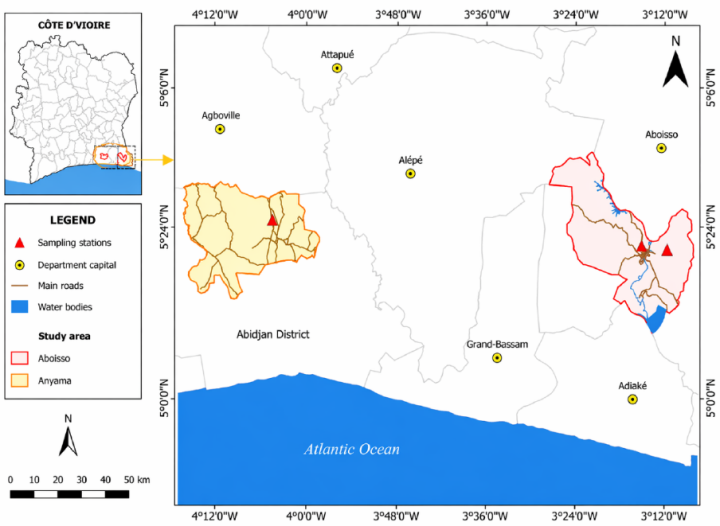
2.2. Study AreaThe study was conducted in southern Côte d’Ivoire at three sampling stations located in Anyama and Aboisso (Figure 1). Station 1 is located in Anyama (5.53293° N; −4.06262° W), whereas stations 2 (5.47800° N; −3.14900° W) and 3 (5.486743° N; −3.214537° W) are situated in Aboisso.

These localities are in the southern part of the country and are characterised by a subequatorial climate with four distinct seasons. The long rainy season generally extends from April to mid-July and corresponds to the period of maximum rainfall. It is followed by a short, dry season from mid-July to September, characterised by a slight decrease in precipitation. A short rainy season then occurs from September to November, marked by moderate rainfall. Finally, a long dry season extends from December to March under the influence of the Harmattan, a dry wind originating from the Sahara 2 11.
Annual rainfall exceeds 1.500 mm, and mean temperatures range from 25 to 30°C 11, creating favourable conditions for the development of aquatic ecosystems, aquaculture activities, and microorganisms, particularly pathogenic bacteria 2 12. The areas of Anyama and Aboisso are characterised by dense hydrographic networks, respectively connected to the Ébrié Lagoon and the Bia River basin 13, which supply fish ponds and may facilitate the dispersion of bacteria, especially during the rainy season 14. The vegetation, originally part of the Guinean forest domain but heavily modified by human activities, influences water quality by supplying organic matter and nutrients, thereby affecting physicochemical parameters and microbial diversity 15. Furthermore, the relatively flat topography and predominantly ferralitic and hydromorphic soils contribute to the biogeochemical dynamics of aquatic environments, the development of aquaculture infrastructures, and microbial load 11 16.
Microbiological analyses were carried out at the Antibiotics, Natural Substances and Antimicrobial Resistance Surveillance Unit of the Institut Pasteur of Côte d’Ivoire. This laboratory is equipped with advanced platforms in microbiology, molecular biology, and biochemistry, enabling diagnosis, epidemiological surveillance, and antimicrobial resistance research.
2.3. Measurement of Physicochemical ParametersWater physicochemical parameters, including temperature (°C), pH, dissolved oxygen (mg/L), and conductivity (µS/cm), were measured in situ at each sampling station (S1, S2, and S3) during each sampling campaign. Measurements were performed using a portable multiparameter device previously calibrated according to the manufacturer’s recommendations. These variables were considered to assess their potential influence on the dynamics of bacterial communities in aquaculture systems.
2.4. Water and Fish SamplingWater samples were collected from fish farms located in Anyama and Aboisso. Sampling was carried out in the same ponds containing diseased fish throughout the study period.
The sampling campaign was conducted over a period of twelve (12) months, from January to December 2020. Two (2) sampling campaigns were performed per month. During each campaign, three (3) water samples were collected, totalling six (6) per month.
Samples were collected using sterile 500 mL bottles. The bottles were immersed at a depth of approximately 20 cm below the water surface to avoid surface contamination.
Fish sampling was conducted in aquaculture ponds located in Anyama and Aboisso over a twelve (12)-month period, from January to December 2020.
During this period, two (2) sampling campaigns were carried out per month. In each campaign, fish exhibiting clinical signs of disease were preferentially selected, including red spots on the back and head, skin ulcers, and other visible pathological signs. Therefore, a targeted (non-random) sampling strategy was adopted, focusing on symptomatic individuals.
As a result, the number of sampled fish was not strictly consistent across sites and sampling campaigns. Fish were captured using fishing nets and subsequently processed for bacterial isolation and identification. Fish sampling was performed in parallel with water sampling from the same ponds to ensure consistency between environmental and host-associated samples.
All collected water and fish samples were placed in insulated coolers containing ice packs to maintain the cold chain. They were transported to the Antibiotics, Natural Substances, and Antimicrobial Resistance Surveillance Unit of the Institut Pasteur of Côte d’Ivoire, where microbiological analyses were conducted.
This symptom-oriented sampling approach facilitates the detection of bacteria associated with clinical infections. However, it may introduce selection bias and limit the representativeness of the results, particularly with respect to the overall diversity of cultivable bacteria within the entire fish population.
2.5. Enumeration of Pathogenic BacteriaThe assessment of bacterial loads of major pathogenic agents present in rearing water and fish organs was performed using standard microbiological methods based on culture on selective media.
For water samples, 500 mL was filtered through sterile cellulose ester membranes (0.45 µm, Whatman®, type WCN) using a vacuum filtration system. The membranes were then aseptically placed on appropriate selective and differential culture media (Table 1).
For fish samples, aseptic sampling of liver, intestine, and kidney was performed. One gram of each organ was homogenized in 10 mL of Tryptic Soy Broth (TSB), followed by serial decimal dilutions (10⁻¹ to 10⁻⁸). 0.1 mL of the appropriate dilutions was spread onto the same selective media.
The plates were incubated at 37°C for 24 to 48 hours. After incubation, only colonies exhibiting characteristic morphology were counted.
Bacterial loads were expressed as colony-forming units (CFU) according to the general formula:
 |
where N represents the number of colonies counted, F is the dilution (or conversion) factor, and Q is the quantity of the analyzed sample (volume in mL for water or mass in g for organs). The results were expressed as colony-forming units (CFU) per 100 mL for water and CFU per gram (CFU/g) for organ samples.
2.6. Identification of Isolates by MALDI-TOF Mass SpectrometryBacterial isolates were identified using MALDI-TOF mass spectrometry. Fresh colonies grown on Tryptic Soy Agar (TSA) were deposited onto a stainless steel target plate and overlaid with a matrix solution of α-cyano-4-hydroxycinnamic acid (HCCA). Spectra were acquired in positive linear mode and compared with the manufacturer's reference database. Identification scores ≥ 2.0 were considered reliable for species-level identification 6 7.
The analysis focused on cultivable isolates recovered from selective and differential culture media. The main bacterial taxa targeted through the culture conditions included Aeromonas hydrophila, Edwardsiella tarda, Flavobacterium columnare, Francisella spp., Streptococcus agalactiae, Pseudomonas aeruginosa, Staphylococcus aureus, Vibrio cholerae, and Macrococcus caseolyticus.
However, only isolates that successfully grew under the applied culture conditions and yielded reliable MALDI-TOF identification scores were retained for analysis. Consequently, the results presented in this study reflect only the cultivable fraction of opportunistic bacteria and may underestimate the true microbial diversity in aquaculture systems.
2.7. Diversity analysis of Cultivable Bacterial IsolatesThe Shannon diversity index (H′) was used to describe the diversity of cultivable bacterial isolates by integrating species richness and relative abundance among recovered taxa. Higher H′ values indicate greater diversity and a more even distribution of the detected isolates, whereas lower values reflect the dominance of one or a few taxa.
Given the culture-based approach used in this study, the calculated diversity index reflects only the diversity of cultivable opportunistic bacteria recovered under the applied experimental conditions. Therefore, it does not represent the full microbial diversity or the overall structure of the microbial community in the aquaculture systems.
2.8. Statistical AnalysisComparisons between the dry and rainy seasons were performed using the non-parametric Mann–Whitney test due to the non-normal distribution of the data. The level of statistical significance was set at p < 0.05. All statistical analyses were carried out using R software (version 4.3.1).
The results are presented according to three main aspects: (i) physicochemical parameters, (ii) bacterial loads and species distribution, and (iii) bacterial diversity and seasonal variations.
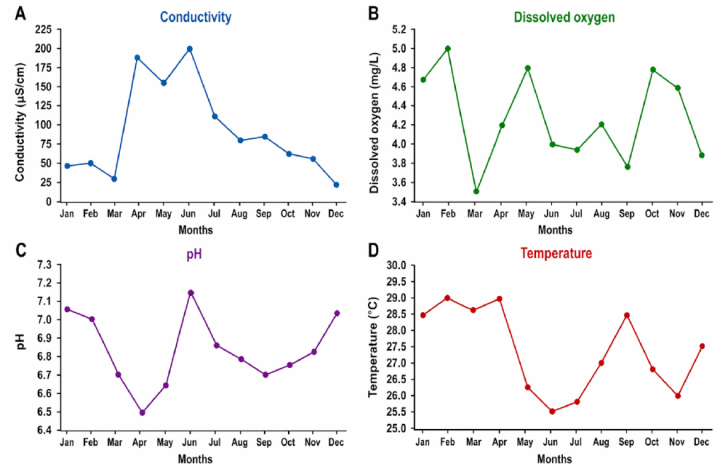
3.1. Physicochemical Parameters of WaterFigure 2 shows the monthly variation of water physicochemical parameters throughout the study period.
Conductivity exhibited marked variability, with low values at the beginning of the year (January–March: 27.1–44.9 µS/cm), followed by a sharp increase from April, reaching a peak in June (202.63 µS/cm), and then gradually decreasing until December (20.7 µS/cm).

Dissolved oxygen concentrations showed moderate variability (3.52–4.97 mg/L), with the lowest values recorded in March and September, and the highest values in February and October.
The pH remained relatively stable throughout the year (6.49–7.05), indicating neutral to slightly acidic conditions. A slight decrease was observed between March and May, followed by a stabilization.
Water temperature ranged from 25.5 °C to 29 °C, with higher values between February and April, a noticeable decrease in June, and a gradual increase until September.
Overall, the results indicate relative stability of physicochemical conditions despite temporal fluctuations, particularly in conductivity and dissolved oxygen.
3.2. Bacterial LoadsBacterial loads varied significantly across compartments and sampling sites (Table 2).
In water, the highest values were observed at site 2 (23,792 ± 26,398 CFU/100 mL), followed by site 3 (18,633 ± 24,190 CFU/100 mL) and site 1 (15,925 ± 22,390 CFU/100 mL), indicating the highest contamination at site 2.
At the intestinal level, a progressive decrease in bacterial load was observed from site 1 (375 ± 918 CFU/g) to site 3 (131 ± 189 CFU/g), with an intermediate value at site 2 (282 ± 347 CFU/g). The high variability observed at site 1 (SD = 918) suggests substantial interindividual variation.
Hepatic bacterial loads remained generally low across the three sites, with a maximum value recorded at site 2 (29.9 ± 17.7 CFU/g). Renal bacterial loads were very low at all sites (4.4–9.6 CFU/g), indicating limited kidney colonisation.
Overall, a decreasing gradient in bacterial load was observed across compartments (water > intestine > liver > kidney), regardless of the site.
Analysis of variance (ANOVA) followed by Tukey’s post hoc test revealed:
• a significant difference between sites for water samples (p < 0.05),
• a significant difference at the intestinal level (p < 0.05),
• no significant difference for liver and kidney samples (p > 0.05).
3.3. Distribution of Bacterial SpeciesTable 3 shows that three main cultivable bacterial species were identified: Pseudomonas aeruginosa, Staphylococcus aureus, and Macrococcus caseolyticus.
P. aeruginosa and S. aureus were detected at all sampling sites, indicating a widespread occurrence among the recovered cultivable isolates. In contrast, M. caseolyticus was not detected at site 3, indicating that fewer cultivable taxa were recovered at this site under the present study conditions.
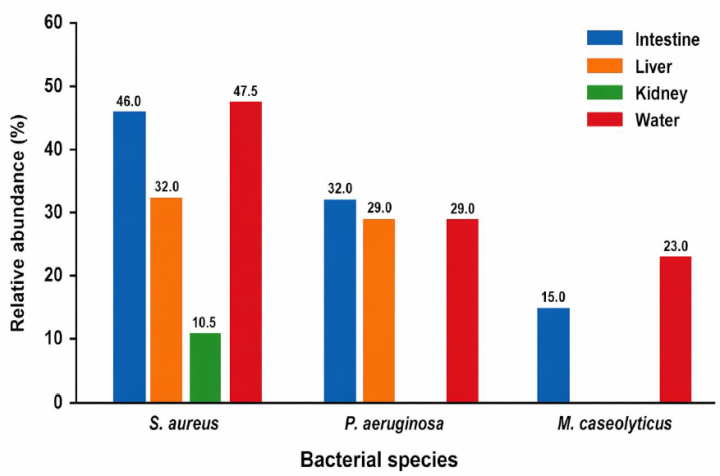
3.4. Diversity of Cultivable Bacterial Isolates across CompartmentsFigure 3 shows the relative abundance (%) of the main cultivable bacterial species identified, namely Staphylococcus aureus, Pseudomonas aeruginosa, and Macrococcus caseolyticus, across different sample types (intestine, liver, kidney, and water).

The results indicate an overall predominance of Staphylococcus aureus among the recovered isolates across all studied compartments. This species exhibited its highest relative abundance in water (47.89%), followed by the intestine (46.33%) and the liver (32.33%). In contrast, its proportion was markedly lower in the kidney (10.67%), indicating a heterogeneous distribution of the detected isolates across compartments.
Pseudomonas aeruginosa showed a relatively homogeneous distribution across the intestine (32.2%), liver (29.33%), and water (29%), but was not detected in the kidney. This pattern may reflect a greater occurrence in external environments and in certain tissues than in deeper internal organs under the present study conditions.
In contrast, Macrococcus caseolyticus exhibited a more restricted distribution. This species was mainly detected in the intestine (15.47%) and water (22.78%), but was not recovered from the liver or kidney. This limited distribution may indicate an association with the rearing environment and the digestive compartment among the cultivable isolates.
Overall, the diversity of recovered cultivable isolates was higher in water and intestinal samples, where multiple taxa were detected. In contrast, internal organs, particularly the liver and kidney, showed lower diversity, with dominance of Staphylococcus aureus and limited representation of other isolates.
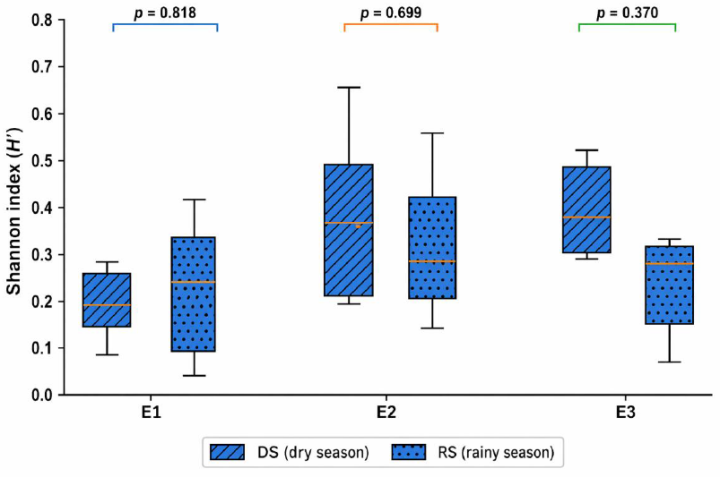
3.5. Seasonal Variation in the Diversity of Cultivable Bacterial IsolatesShannon diversity index (H′) values indicated low to moderate diversity of cultivable bacterial isolates across all studied matrices (Figure 4).

For matrix E1, diversity values were relatively low in both seasons. During the dry season, the median H′ was approximately 0.19, with values ranging from 0.08 to 0.28. In the rainy season, the median slightly increased to approximately 0.24, with greater dispersion (0.05–0.41). However, this difference was not statistically significant (p = 0.818).
Matrix E2 showed the highest diversity values. In the dry season, the median H′ was approximately 0.37 (0.19–0.65), whereas in the rainy season it slightly decreased to approximately 0.28 (0.14–0.55). This variation was not statistically significant (p = 0.699).
For matrix E3, diversity values were intermediate. In the dry season, the median was approximately 0.38 (0.29–0.52), while in the rainy season it decreased to approximately 0.29 (0.08–0.33). This difference was not statistically significant (p = 0.37).
Overall, no significant difference was observed between the dry and rainy seasons across the three matrices (p > 0.05). Although descriptive variations were noted, particularly a decreasing trend in diversity during the rainy season for E2 and E3, these differences were not statistically significant.
These results indicate that no marked seasonal effect was detected on the diversity of recovered cultivable bacterial isolates under the present study conditions. However, this finding should be interpreted with caution, as it reflects only the cultivable fraction of the bacterial assemblage and does not represent the full microbial diversity of the aquaculture systems.
This study identified three cultivable opportunistic bacterial species, namely Pseudomonas aeruginosa, Staphylococcus aureus, and Macrococcus caseolyticus, in water and tilapia samples from semi-intensive aquaculture systems in southern Côte d’Ivoire. The recovery of only three taxa should be interpreted with caution, as the study relied on culture-based methods and symptom-oriented fish sampling, both of which may substantially underestimate the actual bacterial diversity present in aquaculture environments 17 18.
The frequent detection of P. aeruginosa and S. aureus across all sampling sites suggests that these bacteria are common cultivable opportunists under the studied conditions. Their occurrence in both water and fish organs supports the role of rearing water as an important reservoir of bacteria and a potential source of host exposure 3 5.
The distribution of bacterial loads revealed a decreasing gradient across compartments (water > intestine > liver > kidney), indicating higher bacterial abundance in compartments directly exposed to the environment. In contrast, the low bacterial loads observed in internal organs may reflect either limited systemic dissemination or reduced recovery of bacteria under the applied culture conditions 4 19.
The Shannon index values obtained in this study indicate low to moderate diversity among the recovered cultivable isolates, with dominance of a limited number of opportunistic taxa. This pattern is consistent with previous studies based on culture-dependent approaches in aquaculture systems 20 21.
Measured physicochemical parameters were relatively stable throughout the study period, particularly pH and temperature, while conductivity and dissolved oxygen exhibited moderate variation. Under these conditions, no significant seasonal difference was detected in the diversity of cultivable bacterial isolates. However, this finding should not be interpreted as evidence of the absence of seasonal effects on the overall microbial community, as only the cultivable fraction of bacteria was assessed 10.
Under the present study conditions, the observed patterns in bacterial distribution may be influenced by local environmental and management factors, including feeding practices, stocking density, and water renewal. These factors could contribute to relatively stable conditions within ponds and may reduce detectable temporal variation among the recovered cultivable isolates 4.
In addition, anthropogenic activities in the studied areas may contribute to continuous nutrient and microorganism inputs, potentially limiting seasonal contrasts in the detected bacterial profiles 13.
Finally, several limitations should be acknowledged. The use of a symptom-oriented, non-random fish sampling strategy may introduce selection bias and limit the representativeness of the results. Moreover, reliance on culture-based methods restricts the analysis to cultivable bacteria, thereby underestimating total microbial diversity. The relatively small sample size may also reduce the analyses' statistical power. These limitations should be considered when interpreting the findings of this study.
This study documented the occurrence of three cultivable opportunistic bacterial species—Pseudomonas aeruginosa, Staphylococcus aureus, and Macrococcus caseolyticus—in rearing water and tilapia organs from semi-intensive aquaculture systems in Anyama and Aboisso. The results also showed differences in bacterial loads among compartments, with higher values in water and intestine than in internal organs. No significant seasonal difference was detected in the diversity of the recovered cultivable isolates. However, because the study used culture-dependent methods and symptom-oriented fish sampling, these findings should be interpreted as applying only to the detected cultivable bacterial fraction. The study nevertheless provides useful baseline data for microbiological monitoring of tilapia farming systems in southern Côte d’Ivoire.
Perspectives
Future studies should combine culture-based methods with high-throughput molecular approaches, such as 16S rRNA metabarcoding or metagenomics, to capture both cultivable and non-cultivable bacterial taxa. Randomized fish sampling, including both healthy and diseased individuals, would also improve the representativeness of microbiological profiles. In addition, investigating antimicrobial resistance patterns among isolated bacteria would strengthen the epidemiological value of such studies within a One Health framework.
The authors sincerely thank the managers and staff of aquaculture farms in Anyama and Aboisso for their collaboration and availability throughout this study. They also express their deep gratitude to the management of the Institut Pasteur of Côte d’Ivoire (IPCI) and to the technicians of the Antibiotics, Natural Substances and Antimicrobial Resistance Surveillance Unit (ASSURMI) for their technical support and contribution to microbiological analyses.
The authors declare no conflict of interest.
| [1] | El-Sayed, A. M. and Fitzsimmons, K., "From Africa to the world—The journey of Nile tilapia," Reviews in Aquaculture, 15 (S1). 6-21. Feb. 2023. | ||
| In article | View Article | ||
| [2] | FAO, The State of World Fisheries and Aquaculture 2020: Sustainability in Action, FAO, Rome, 2020. | ||
| In article | |||
| [3] | Samsing, F. and Barnes, A. C., "The rise of the opportunists: What are the drivers of the increase in infectious diseases caused by environmental and commensal bacteria?" Reviews in Aquaculture, 16 (4). 1787-1797. Sep. 2024. | ||
| In article | View Article | ||
| [4] | Egerton, S., Culloty, S., Whooley, J., Stanton, C. and Ross, R. P., "The gut microbiota of marine fish," Frontiers in Microbiology, 9. 873. May 2018. | ||
| In article | View Article PubMed | ||
| [5] | Austin, B. and Austin, D. A., Bacterial Fish Pathogens, Springer International Publishing, Cham, 2016. | ||
| In article | View Article | ||
| [6] | Clark, A. E., Kaleta, E. J., Arora, A. and Wolk, D. M., "Matrix-assisted laser desorption ionization–time of flight mass spectrometry: A fundamental shift in the routine practice of clinical microbiology," Clinical Microbiology Reviews, 26 (3). 547-603. Jul. 2013. | ||
| In article | View Article PubMed | ||
| [7] | Singhal, N., Kumar, M., Kanaujia, P. K. and Virdi, J. S., "MALDI-TOF mass spectrometry: An emerging technology for microbial identification and diagnosis," Frontiers in Microbiology, 6. Aug. 2015. | ||
| In article | View Article | ||
| [8] | Hill, T. C. J., Walsh, K. A., Harris, J. A. and Moffett, B. F., "Using ecological diversity measures with bacterial communities," FEMS Microbiology Ecology, 43 (1). 1-11. Feb. 2003. | ||
| In article | View Article PubMed | ||
| [9] | Magurran, A. E., Measuring Biological Diversity, Blackwell Publishing, Malden, 2004. | ||
| In article | |||
| [10] | Dang, H. and Lovell, C. R., "Microbial surface colonization and biofilm development in marine environments," Microbiology and Molecular Biology Reviews, 80 (1). 91-138. Mar. 2016. | ||
| In article | View Article PubMed | ||
| [11] | Konate, D. et al., "Observed changes in rainfall and characteristics of extreme events in Côte d’Ivoire (West Africa)," Hydrology, 10 (5). 104. Apr. 2023. | ||
| In article | View Article | ||
| [12] | Abdallah, E. S. H., Metwally, W. G. M., Abdel-Rahman, M. A. M., Albano, M. and Mahmoud, M. M., "Streptococcus agalactiae infection in Nile tilapia (Oreochromis niloticus): A review," Biology, 13 (11). 914. Nov. 2024. | ||
| In article | View Article PubMed | ||
| [13] | Kouassi, J.-L., Gyau, A., Diby, L., Bene, Y. and Kouamé, C., "Assessing land use and land cover change and farmers’ perceptions of deforestation and land degradation in South-West Côte d’Ivoire, West Africa," Land, 10 (4). 429. Apr. 2021. | ||
| In article | View Article | ||
| [14] | Luthman, O., Robb, D. H. F., Henriksson, P. J. G., Jørgensen, P. S. and Troell, M., "Global overview of national regulations for antibiotic use in aquaculture production," Aquaculture International, 32 (7). 9253-9270. Dec. 2024. | ||
| In article | View Article | ||
| [15] | Huavas, J., Heyse, J., Props, R., Delamare-Deboutteville, C. and Shelley, C., "Microbiomes of tilapia culture systems: Composition, affecting factors, and future perspectives," Aquaculture Research, 2024 (1). 5511461. Jan. 2024. | ||
| In article | View Article | ||
| [16] | Yao, K. L., Kouakou, K. E., Kouassi, A. M., Deguy, A. J. P. and Camara, M., "Analysis of land use change in the N’ZI watershed of Côte d’Ivoire using Landsat satellite images," Earth and Space Science, 10 (3). e2022EA002744. Mar. 2023. | ||
| In article | View Article | ||
| [17] | Amann, R. I., Ludwig, W. and Schleifer, K. H., "Phylogenetic identification and in situ detection of individual microbial cells without cultivation," Microbiological Reviews, 59 (1). 143-169. Mar. 1995. | ||
| In article | View Article PubMed | ||
| [18] | Lagier, J.-C. et al., "Microbial culturomics: Paradigm shift in the human gut microbiome study," Clinical Microbiology and Infection, 18 (12). 1185-1193. Dec. 2012. | ||
| In article | View Article PubMed | ||
| [19] | Ringø, E. et al., "Effect of dietary components on the gut microbiota of aquatic animals: A never-ending story?" Aquaculture Nutrition, 22 (2). 219-282. Apr. 2016. | ||
| In article | View Article | ||
| [20] | Resende, J. A., Silva, V. L., Cesar, D. E., Del’Duca, A., Fontes, C. O. and Diniz, C. G., "Seasonal dynamics of microbial community in an aquaculture system for Nile tilapia (Oreochromis niloticus)," Aquaculture Research, 46 (5). 1233-1240. May 2015. | ||
| In article | View Article | ||
| [21] | Wang, K. et al., "Community assembly of bacteria and archaea in coastal waters governed by contrasting mechanisms: A seasonal perspective," Molecular Ecology, 29 (19). 3762-3776. Oct. 2020. | ||
| In article | View Article PubMed | ||
Published with license by Science and Education Publishing, Copyright © 2026 Oswald Kouassi KRA, Fernique Kouadio KONAN, Maxime Kouao DIANE, Moussa CISSE, Allassane OUATTARA and Guessennd Kouadio Nathalie
 This work is licensed under a Creative Commons Attribution 4.0 International License. To view a copy of this license, visit
http://creativecommons.org/licenses/by/4.0/
This work is licensed under a Creative Commons Attribution 4.0 International License. To view a copy of this license, visit
http://creativecommons.org/licenses/by/4.0/
| [1] | El-Sayed, A. M. and Fitzsimmons, K., "From Africa to the world—The journey of Nile tilapia," Reviews in Aquaculture, 15 (S1). 6-21. Feb. 2023. | ||
| In article | View Article | ||
| [2] | FAO, The State of World Fisheries and Aquaculture 2020: Sustainability in Action, FAO, Rome, 2020. | ||
| In article | |||
| [3] | Samsing, F. and Barnes, A. C., "The rise of the opportunists: What are the drivers of the increase in infectious diseases caused by environmental and commensal bacteria?" Reviews in Aquaculture, 16 (4). 1787-1797. Sep. 2024. | ||
| In article | View Article | ||
| [4] | Egerton, S., Culloty, S., Whooley, J., Stanton, C. and Ross, R. P., "The gut microbiota of marine fish," Frontiers in Microbiology, 9. 873. May 2018. | ||
| In article | View Article PubMed | ||
| [5] | Austin, B. and Austin, D. A., Bacterial Fish Pathogens, Springer International Publishing, Cham, 2016. | ||
| In article | View Article | ||
| [6] | Clark, A. E., Kaleta, E. J., Arora, A. and Wolk, D. M., "Matrix-assisted laser desorption ionization–time of flight mass spectrometry: A fundamental shift in the routine practice of clinical microbiology," Clinical Microbiology Reviews, 26 (3). 547-603. Jul. 2013. | ||
| In article | View Article PubMed | ||
| [7] | Singhal, N., Kumar, M., Kanaujia, P. K. and Virdi, J. S., "MALDI-TOF mass spectrometry: An emerging technology for microbial identification and diagnosis," Frontiers in Microbiology, 6. Aug. 2015. | ||
| In article | View Article | ||
| [8] | Hill, T. C. J., Walsh, K. A., Harris, J. A. and Moffett, B. F., "Using ecological diversity measures with bacterial communities," FEMS Microbiology Ecology, 43 (1). 1-11. Feb. 2003. | ||
| In article | View Article PubMed | ||
| [9] | Magurran, A. E., Measuring Biological Diversity, Blackwell Publishing, Malden, 2004. | ||
| In article | |||
| [10] | Dang, H. and Lovell, C. R., "Microbial surface colonization and biofilm development in marine environments," Microbiology and Molecular Biology Reviews, 80 (1). 91-138. Mar. 2016. | ||
| In article | View Article PubMed | ||
| [11] | Konate, D. et al., "Observed changes in rainfall and characteristics of extreme events in Côte d’Ivoire (West Africa)," Hydrology, 10 (5). 104. Apr. 2023. | ||
| In article | View Article | ||
| [12] | Abdallah, E. S. H., Metwally, W. G. M., Abdel-Rahman, M. A. M., Albano, M. and Mahmoud, M. M., "Streptococcus agalactiae infection in Nile tilapia (Oreochromis niloticus): A review," Biology, 13 (11). 914. Nov. 2024. | ||
| In article | View Article PubMed | ||
| [13] | Kouassi, J.-L., Gyau, A., Diby, L., Bene, Y. and Kouamé, C., "Assessing land use and land cover change and farmers’ perceptions of deforestation and land degradation in South-West Côte d’Ivoire, West Africa," Land, 10 (4). 429. Apr. 2021. | ||
| In article | View Article | ||
| [14] | Luthman, O., Robb, D. H. F., Henriksson, P. J. G., Jørgensen, P. S. and Troell, M., "Global overview of national regulations for antibiotic use in aquaculture production," Aquaculture International, 32 (7). 9253-9270. Dec. 2024. | ||
| In article | View Article | ||
| [15] | Huavas, J., Heyse, J., Props, R., Delamare-Deboutteville, C. and Shelley, C., "Microbiomes of tilapia culture systems: Composition, affecting factors, and future perspectives," Aquaculture Research, 2024 (1). 5511461. Jan. 2024. | ||
| In article | View Article | ||
| [16] | Yao, K. L., Kouakou, K. E., Kouassi, A. M., Deguy, A. J. P. and Camara, M., "Analysis of land use change in the N’ZI watershed of Côte d’Ivoire using Landsat satellite images," Earth and Space Science, 10 (3). e2022EA002744. Mar. 2023. | ||
| In article | View Article | ||
| [17] | Amann, R. I., Ludwig, W. and Schleifer, K. H., "Phylogenetic identification and in situ detection of individual microbial cells without cultivation," Microbiological Reviews, 59 (1). 143-169. Mar. 1995. | ||
| In article | View Article PubMed | ||
| [18] | Lagier, J.-C. et al., "Microbial culturomics: Paradigm shift in the human gut microbiome study," Clinical Microbiology and Infection, 18 (12). 1185-1193. Dec. 2012. | ||
| In article | View Article PubMed | ||
| [19] | Ringø, E. et al., "Effect of dietary components on the gut microbiota of aquatic animals: A never-ending story?" Aquaculture Nutrition, 22 (2). 219-282. Apr. 2016. | ||
| In article | View Article | ||
| [20] | Resende, J. A., Silva, V. L., Cesar, D. E., Del’Duca, A., Fontes, C. O. and Diniz, C. G., "Seasonal dynamics of microbial community in an aquaculture system for Nile tilapia (Oreochromis niloticus)," Aquaculture Research, 46 (5). 1233-1240. May 2015. | ||
| In article | View Article | ||
| [21] | Wang, K. et al., "Community assembly of bacteria and archaea in coastal waters governed by contrasting mechanisms: A seasonal perspective," Molecular Ecology, 29 (19). 3762-3776. Oct. 2020. | ||
| In article | View Article PubMed | ||