We reexamined the Copenhagen interpretations of quantum mechanics from the perspectives of mathematical deduction, logic reasoning process and intrinsic physical nature of wave function. We conclude that all the Heisenberg’s uncertainty principle, Born rule, and Bohr’s complimentary principle were not correct. Even for a quantum particle, at specific time, it must be classically localized but not non-local. Based on our analysis and deduction, the right interpretations to quantum mechanics were also developed.
An interpretation 1 of quantum mechanics is an attempt to explain how the mathematical theory of quantum mechanics “corresponds” to reality. Although quantum mechanics has held up to rigorous and extremely precise tests in an extraordinarily broad range of experiments (not one prediction from quantum mechanics has been found to be contradicted by experiments), there exist a number of contending schools of thought over their interpretation. These views on interpretation differ on such fundamental questions as whether quantum mechanics is deterministic or stochastic, which elements of quantum mechanics can be considered real, and what the nature of measurement is, among other matters.
Despite nearly a century of debate and experiment, no consensus has been reached among physicists and philosophers of physics concerning which interpretation best “represents” reality 2.
The views of several early pioneers of quantum mechanics, such as Bohr, Born and Heisenberg, are often grouped together as the “Copenhagen interpretation”, though physicists and historians of physics have argued that this terminology obscures differences between the views so designated 3 Copenhagen-type ideas were never universally embraced, and challenges to a perceived Copenhagen orthodoxy gained increasing attention. Although the quantum mechanics has worked astonishingly well in modern physics, the unquestionable meaning or undisputable interpretation of intrinsic duality has not been satisfactorily resolved yet. Here we try to re-analyze the deduction process of the principles of Quantum Mechanics and try to illustrate the intrinsic physical nature of any particle in wave motion.
1) Heisenberg’s Uncertainty Principle
In quantum mechanics, the Heisenberg's uncertainty principle is any of a variety of mathematical inequalities 4 asserting a fundamental limit to the accuracy with which the values for certain pairs of physical quantities of a particle, such as position,  and momentum,
  can be predicted from initial conditions.
Introduced first in 1927 by Heisenberg, the uncertainty principle states that the more precisely the position of some particle is determined, the less precisely its momentum can be predicted from initial conditions, and vice versa 5. The formal inequality relating the standard deviation of position  and the standard deviation of momentum
  was represented as Equation 1.
 | (1) |
In statistics, the standard deviation is a measure of the amount of variation or dispersion of a set of values, In the case where X takes random values from a finite data set 
 …,
…,  with each value having the same probability, the standard deviation is
 |
Where  is either the actual value or the average of the data set. When N=1,
 |
 or
or  represents the x’s deviation to the actual value from mathematic perspective, but from physical point of view as a moving particle, it presents a position change of new position relative to its last position. If
  or
or  always take absolute value, then
  equals to
  or
or  Same is true for
  and
and  or
or  And then the Equation 1 will be described as Equation 2.
 | (2) |
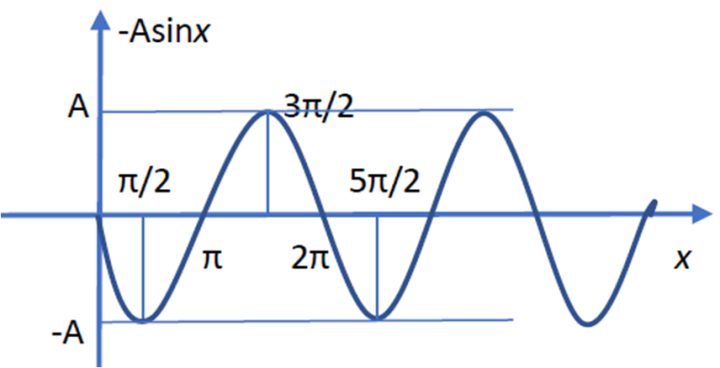
Before we explore the physical meaning of this inequality, let’s check a classical wave motion first, the simplest wave function as Equation 3. We all know that a wave motion is a combination of uniform linear motion and an oscillation, y represents the displacement of an oscillator deviating from its oscillating balance position, A as the amplitude of the oscillation, u as the wave speed, m as the mass of the particle in oscillation. The derivative of  is represented as Equation 4 and the figure of function -Asinx is illustrated as Figure 1
 |
 |
 |
 |
 |
 |
 |
if we always take absolute value for  and
and  then
then
 |
 | (5) |
because any oscillation is a periodic motion, in the whole periodic interval [0, 2π], the oscillation in interval [π/2, 2π], is just the same oscillation in interval [0, π/2], but with different oscillation directions, then
 |
 |
 |
 |
 | (6) |
Therefore the equation 6, or the inequality is always correct in the whole periodic interval as long as  and
and  always take absolute value.

While for function -Asinx in x interval [π/2, 3π/2],  always, function -Asinx is monotonic increasing, so according to Equation 4,
  is monotonic increasing with
  ; In x interval [3π/2, 5π/2],
  >0 always, -Asinx is monotonic decreasing, therefore
  is monotonic decreasing with
  ; If we take the oscillation position change from -A to A as
  as one of the oscillation directions, and the oscillation position change from A to -A as
  <0 as the opposite oscillation direction, and if we always take absolute value for
  then in x interval [3π/2, 5π/2],
  is also monotonic increasing with
In another words, in the whole period [π/2, 5π/2],  is monotonic increasing with
  as long as
  always takes absolute value. We can conclude that for any wave function, no matter how complex the form is, as long as it is a cosine function, in any interval (2kπ+π/2, 2kπ+5π/2), k∈Z or (-∞, +∞) x∈R,
  is monotonic increasing with
  , if
, if  always takes absolute value.
Now we have a much clearer and complete relation for  ,
,  and
and  , the higher
  , the higher
  , the lower
  and vice versa.
Based on the inequality Equation 5 and 6, for a classical wave motion, can we also conclude that the more precisely the oscillation displacement of some particle is determined, the less precisely its momentum can be predicted from initial conditions, and vice versa? Apparently, we can’t, it is absolutely wrong, and the conclusion is against physical laws. If we can’t deduce such a conclusion for a classical wave motion based on an inequality, why shall we conclude such a counter intuition uncertainty for quantum wave motion based on another inequality?
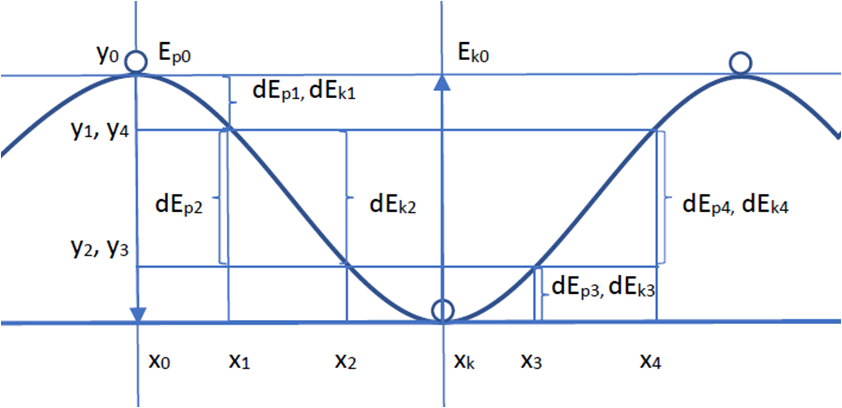
2.2. Physical AnalysisIn order to illustrate the relation of potential energy change and kinetic energy change during wave motion, let’s take a small ball rolling form ramp top to bottom and then to ramp top as an example (equivalent to wave motion), represented as Figure 2.
We suppose when the ball at initial point (x0, y0), it has the highest potential energy, with zero kinetic energy; When the ball rolling at the bottom (xk, 0), it has the highest kinetic energy, but with zero potential energy. During the rolling motion, it is an energy conversion process from potential energy(Ep) to kinetic energy(Ek), the total energy(Etotal) is conserved.

Let’s Analyze the energy change for the ball rolling motion.
 |
 |
 means energy gain;
  means energy loss. When the ball rolls from point (x0, y0) to (x1, y1),
 |
When the ball rolls from point (x1, y1) to (x2, y2),
 |
During this period of motion,
 |
The physical meaning is: the higher  , the lower
  , the more loss of Ep, the more gain of Ek.
If we took absolute values for all 
 and
and  the physical meaning would be: the higher
  the higher
  the more gain of Ep, the more gain of Ek. Apparently, this approach is against energy conservation, and is absolutely wrong; The correct physical meaning shall be the higher
  the higher
  the less gain of Ep, the more gain of Ek, “the more loss of Ep” corresponding to “the less gain of Ep”.
When the ball in the period of motion from (xk, 0) to (x3, y3) to (x4, y4),
 |
The physical meaning is: the higher  , the higher
  , the more gain of Ep, the more loss of Ek.
Again, if we took absolute values for all  ,
,  the physical meaning would be: the higher
  , the higher
  , the more gain of Ep, the more gain of Ek. Apparently, this approach is absolutely wrong too; The right physical meaning shall be the higher
  , the higher
  , the more gain of Ep, the less gain of Ek, “the more loss of Ek” equivalent to “the less gain of Ek”.
Therefore, if we always take absolute value for dEp and dEk, which will cover the physical meaning of energy gain or loss during the ball motion, because the potential energy change and kinetic energy change always take opposite directions even the absolute value of quantity change is same. In another word, we can describe energy change in ball motion as, the more potential energy gain, the more kinetic loss; or the more potential energy gain, the less kinetic energy gain. But we can never describe the energy change as, the more potential energy gain, the more kinetic energy gain in ball motion, which is against the physical meaning, energy conservation.
2.3. The Assumptions of Schrodinger Wave EquationSchrodinger wave equation 6 is one of the most fundamental equations of quantum physics. It is basically a differential equation and widely used in Physics and Chemistry to solve problems based on the atomic structure of matter. It is a mathematical expression describing the energy and position of the electron in space and time, taking into account the matter wave nature of the electron inside an atom. But the equation was based on three assumptions as below:
1. A classical plane wave equation,
2. de Broglie’s hypothesis of matter wave,
3. Energy conservation,
Based on assumption 1, a cosine function was used to represent a matter wave, where λ is the matter wave length, v is the frequency,  is the angular frequency, u is the wave speed:
 |
Based on assumption 2, was applied to state that the energy of waves are quantized, where h is Plank constant, ħ is the reduced Plank constant:
 |
then
 |
Based on assumption 3, total energy is the sum of the kinetic and potential energy of the particle, the final quantum wave equation was deduced as, where V is the potential energy,  is the Hamiltonian operator:
 |
then
 |
Apparently, all the three assumptions are very important. Schrodinger wave equation, the base of quantum mechanics, couldn’t be deduced without these assumptions. Based on the assumption 1 and 3, we can easily obtain the same relation of 
 and
and  from the quantum wave motion as from classical mechanical wave motion, the higher
  the higher
  the lower
  and vice versa, and can obtain similar inequality for
Now let’s check the Heisenberg’s inequality again, because  is corresponding to potential energy change (gain), while
  represents the kinetic energy change (gain). Therefore, the physical meaning of Heisenberg’s inequality shall be, the higher
  the higher
  the lower
  shall lead to the conclusion, the more gain of potential energy, the less gain of kinetic energy, and vice versa.
For quantum wave motion, Heisenberg’s mathematical deduction only selectively described the relation of position and momentum, without considering the relation of kinetic energy and potential energy, and without differentiating the energy gain or loss either. And at last the assumption of always taking absolute value of energy change without consideration of gain and loss, resulted in the confusion and uncertainty interpretation.
Based on both mathematical and physical analysis, we conclude that Heisenberg's inequality is nothing to do with the measure accuracy of position and momentum at same time, but to ensure the energy conservation during the quantum wave motion. It is in alignment with the intrinsic assumption of the wave function as introduced by Schrodinger to quantum mechanics, energy conservation.
2) Born Rule
The Born rule is a key postulate of quantum mechanics which gives the probability that a measurement of a quantum system will yield a given result 7. In its simplest form, it states that the probability density of finding a particle at a given point, when measured, is proportional to the square of the magnitude of the particle's wave function at that point. It was formulated by Born in 1926.
Before the exploration of Born Rule, let’s share a scenario of final examination of Math 236 for a differential equations course.
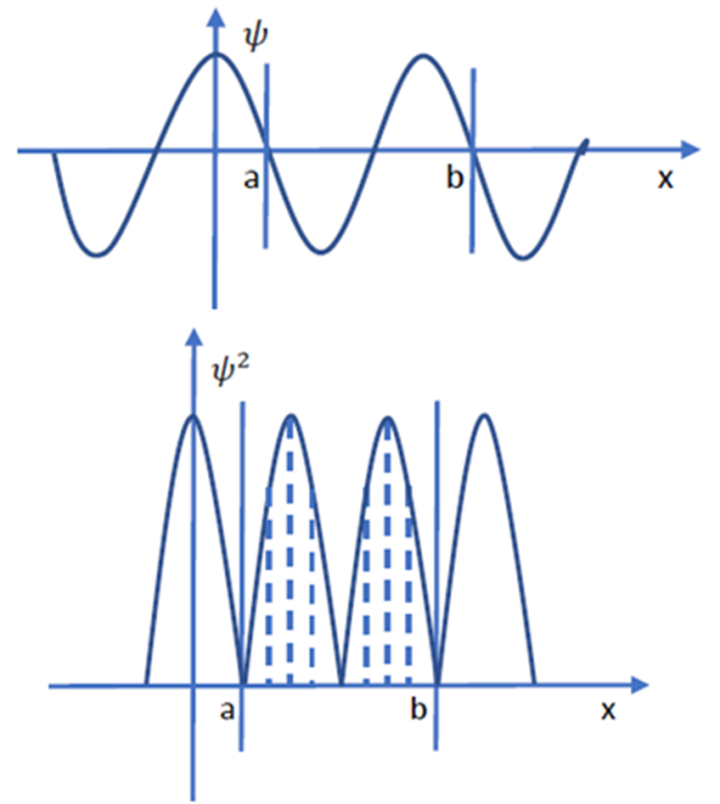
Problem: Articulate the physical meaning of wave function  in x interval [a, b]
Three students submitted a solution as the  wave curve defined by
  in x interval [a, b] as illustrated by Figure 3;
While four students submitted another solution as  in x interval [a, b], corresponding to probability of the particle’s presence in the area highlighted in Figure 3.

Up to now we haven’t got the right answer yet for this final examination. Let’s analyze the Born’s logic reasoning process before we get the right answer.
Born’s premise: A particle’s motion was defined as wave function 
Born’s deduction: Given a wave function  for a single structureless particle in position space, implied that the probability density function
  for a measurement of the position at time
  was
was  =
= 
Born’s conclusion: The particle was not moving as wave function, it could present anywhere in the area corresponding to the 
Apparently, Born’s conclusion denied his own premise. His premise and conclusion were in self-conflict. From logic reasoning perspective, either his premise, or deduction process, or his conclusion was false.
Since the premise was the fact that a particle behaved as a wave, that was why we used wave function to describe the particle’s motion. It must be right.
Then either Born’s deduction or his conclusion was false, or both were false. Because his conclusion was against his premise, while his premise was true(fact), therefore Born’s conclusion must be wrong, no matter his deduction was true or false.
From physics point of view, the wave function’s intrinsic nature is energy conservation. If we accept Born’s probability conclusion, then we have to deny energy conservation; if we accept energy conservation, then we have to deny Born’s probability conclusion, unless we introduce different theory to describe the particle’s motion.
The correct interpretation of Born rule shall be like this: We can use Born’s normalization to estimate the quantum particle’s presence as probability in the area defined by  in an interval; but at any specific time, the quantum particle must be precisely at a position on wave curve defined by wave function
  Or the particle must be localized at specific time instead of non-local.
3) Bohr’s Complimentary Principle
In physics, complementarity is a conceptual aspect of quantum mechanics that Niels Bohr regarded as an essential feature of the theory 8, 9. The complementarity principle holds that objects have certain pairs of complementary properties which cannot all be observed or measured simultaneously.
An example of such a pair is position and momentum. Bohr considered one of the foundational truths of quantum mechanics to be the fact that setting up an experiment to measure one quantity of a pair, for instance the position of an electron, excludes the possibility of measuring the other, yet understanding both experiments is necessary to characterize the object under study.
In Bohr's view, the behavior of atomic and subatomic objects cannot be separated from the measuring instruments that create the context in which the measured objects behave. Consequently, there is no “single picture” that unifies the results obtained in these different experimental contexts, and only the “totality of the phenomena” together can provide a completely informative description.
Bohr’s complimentary principle was deduced from both Heisenberg’s uncertainty principle and Born rule. Apparently, his principle can’t be right without these fundamental bases.
Feynman 10 once said about quantum mechanics, “We choose to examine a phenomenon which is impossible, absolutely impossible, to explain in any classical way, and which has it in the heart of quantum mechanics. In reality, it contains the only mystery. We cannot explain the mystery in the sense of “explaining” how it works”. We strongly believe that the mystery was introduced by Heisenberg’s Uncertainty Principle, Born Rule, and Bohr’s Complimentary Principle to quantum mechanics as the fundamental principles which covered the intrinsic nature of the real physical meaning of quantum particle’s motion. As to the particle-wave duality, our right interpretation will be: At any specific time, any quantum particle must be a classic particle, but in some time interval, it must behave as both wave and particle.
In quantum mechanics, there are no interference impacts existing on a quantum particle when the particle is under measure or observation as long as the scientific techniques of measure or observation are available. Both Heisenberg’s Uncertainty Principle and Born Rule were the mathematical interpretation, but not physical interpretation. Even for a quantum particle, it is still as a localized, classic, and mechanical particle but not non-local. Just as Einstein said, no matter we see the moon or not, it is always there.
Any similar interpretations introduced with measure or observation, wave function collapse, quantum particle probability, wave function superposition, are all counter intuitional and not physical interpretations. They must be wrong from physics point of view. Human’s understanding and cognition of nature needs patience. It will take time for us to discover the intrinsic nature of the atomic, subatomic world and universe.
| [1] | Albert, D.Z. Quantum Mechanics and Experience. Harvard Univ. Press, ISBN 0-674-74112-9, 1992. | ||
| In article | |||
| [2] | Bell, J.S. Speakable and Unspeakable in Quantum Mechanics, Cambridge Univ. Press, ISBN 0-521-36869-3, 1987. | ||
| In article | |||
| [3] | Jammer, M. Philosophy of Quantum Mechanics: The Interpretations of Quantum Mechanics in Historical Perspective, Wiley-Interscience, c1974. | ||
| In article | |||
| [4] | Sen, D. “The Uncertainty Relations in Quantum Mechanics”, Current Science. 107 (2): 203-218(2014). | ||
| In article | |||
| [5] | Heisenberg, W. “Über den anschaulichen Inhalt der quantentheoretischen Kinematik und Mechanik”, Zeitschrift für Physik(in German), 43 (3-4): 172-198(1927). | ||
| In article | View Article | ||
| [6] | Schrodinger, E. “An Undulatory Theory of the Mechanics of Atoms and Molecules”. Physical Review. 28(6) 1049-1070. | ||
| In article | View Article | ||
| [7] | Wikipedia, “Born rule”, https://en.wikipedia.org/wiki/Born_rule. | ||
| In article | |||
| [8] | Wheeler, J.A. “‘No Fugitive and Cloistered Virtue’—A tribute to Niels Bohr”. Physics Today. Vol.16 No.1, p30(1963). | ||
| In article | View Article | ||
| [9] | Wikipedia, “Complementarity(physics)”, https://en.wikipedia.org/wiki/Complementarity_(physics). | ||
| In article | |||
| [10] | Feynman, R.P. Leighton, R.B. Sands, M. The Feynman Lectures on Physics, Addison-Wesley Publishing Company, ISBN 0-201-02010-6-H, Vol 3, 1977, 1-1. | ||
| In article | |||
Published with license by Science and Education Publishing, Copyright © 2021 Zhonglin BO
 This work is licensed under a Creative Commons Attribution 4.0 International License. To view a copy of this license, visit
http://creativecommons.org/licenses/by/4.0/
This work is licensed under a Creative Commons Attribution 4.0 International License. To view a copy of this license, visit
http://creativecommons.org/licenses/by/4.0/
| [1] | Albert, D.Z. Quantum Mechanics and Experience. Harvard Univ. Press, ISBN 0-674-74112-9, 1992. | ||
| In article | |||
| [2] | Bell, J.S. Speakable and Unspeakable in Quantum Mechanics, Cambridge Univ. Press, ISBN 0-521-36869-3, 1987. | ||
| In article | |||
| [3] | Jammer, M. Philosophy of Quantum Mechanics: The Interpretations of Quantum Mechanics in Historical Perspective, Wiley-Interscience, c1974. | ||
| In article | |||
| [4] | Sen, D. “The Uncertainty Relations in Quantum Mechanics”, Current Science. 107 (2): 203-218(2014). | ||
| In article | |||
| [5] | Heisenberg, W. “Über den anschaulichen Inhalt der quantentheoretischen Kinematik und Mechanik”, Zeitschrift für Physik(in German), 43 (3-4): 172-198(1927). | ||
| In article | View Article | ||
| [6] | Schrodinger, E. “An Undulatory Theory of the Mechanics of Atoms and Molecules”. Physical Review. 28(6) 1049-1070. | ||
| In article | View Article | ||
| [7] | Wikipedia, “Born rule”, https://en.wikipedia.org/wiki/Born_rule. | ||
| In article | |||
| [8] | Wheeler, J.A. “‘No Fugitive and Cloistered Virtue’—A tribute to Niels Bohr”. Physics Today. Vol.16 No.1, p30(1963). | ||
| In article | View Article | ||
| [9] | Wikipedia, “Complementarity(physics)”, https://en.wikipedia.org/wiki/Complementarity_(physics). | ||
| In article | |||
| [10] | Feynman, R.P. Leighton, R.B. Sands, M. The Feynman Lectures on Physics, Addison-Wesley Publishing Company, ISBN 0-201-02010-6-H, Vol 3, 1977, 1-1. | ||
| In article | |||