A new atom configuration was developed, based on proton and electron as electric monopole pairs deducted from “the theory of spin vector in motion” developed by us recently, and symmetry of group theory. New proton and neutron structures were proposed based on quarks’ mass and spin properties. According to proton and neutron’s configuration proposed, we concluded that the radioactivity of nucleus shall result directly from the electric repulsive force induced by symmetry breaking resulted from extra neutron(s) of an isotope. Based on inner structures of proton and neutron, we concluded that there is no “strong” force required to bond quarks in proton and neutron, the fused proton or neutron’s empty carriers or containers is the Higgs particle.
An atom is the smallest unit of ordinary matter which forms a chemical element. Every atom is composed of a nucleus and one or more electrons bound to the nucleus. The nucleus is made of one or more protons and a number of neutrons.
Thomson 1 proposed a plum pudding model, based on his cathode rays experiment results. He thought that the negatively-charged electrons were distributed throughout the atom. Rutherford and his colleagues performed a series of experiments in which they bombarded thin foils of metal with alpha particles. They spotted alpha particles being deflected by angles greater than 90°. Rutherford proposed that the positive charge of the atom is not distributed throughout the atom's volume as Thomson believed, but is concentrated in a tiny nucleus at the center. The Bohr model of the atom was the first complete physical model of the atom. It described the overall structure of the atom, how atoms bond to each other, and predicted the spectral lines of hydrogen. Bohr's model was not perfect and was soon superseded by the more accurate Schrodinger model 2, the Quantum Mechanics.
With the great success and further development of Quantum Mechanics, the more accurate structures of proton and neutron are required to modify, based on the development of quark’s mass, spin and electric properties derived from Standard Model 3.
We know that wave motion is a combination of an oscillation and a uniform linear motion perpendicular to the oscillation. The wave equation can be expressed as Equation 1,  as the wave function,
  as the amplitude of the oscillation,
  as the angular frequency of the oscillator,
  as the wave traveling time,
  as the position on the wave motion direction,
  as the speed of the wave motion, and
  as the initial phase angle.
 | (1) |
Its derivative forms will be expressed as Equation 2.
 | (2) |
In order to illustrate that a wave is generated by a moving oscillator, we would prefer to describe the equation in form of Equation 3, λ as the wave length.
 | (3) |
Since an oscillation is equivalent to the rotation or spin of a vector field in some dimension, So a spin vector field in motion perpendicular to its oscillation can also be expressed as a wave equation. The wave equation will be represented as Equation 4,  as the Laplace operator. The spin vector in motion must behave with particle-wave duality. In another word, if a particle demonstrates particle-wave duality, it must be an moving oscillator with its direction perpendicular to its oscillation, or it must be a spin vector in motion.
 (4)
(4)
Atomic-scale particles such as photon, electron, proton, neutron and even big molecules can demonstrate particle-wave duality 4, 5. Based on the above theory, we shall deduce that proton and electron must be electric monopoles. Considering their spin quantum number ms = ½, they must be electric monopole pairs, proton as a positive electric monopole pair while electron as a negative electric monopole pair.
With this new deduction, we need to reconfigure a new structure of an atom based on monopole pair feature of proton and electron. In order to make it simple, we ignore the mass difference between proton and neutron intentionally, and divide the configuration process in three steps: 1. Basic particle structure proposal; 2. configuration; 3. Atom configuration
First step: Basic particle structure proposal is described as follows:
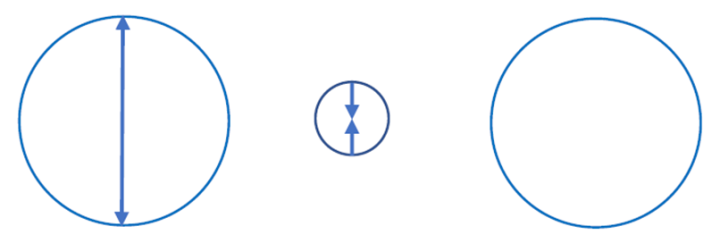
A proton is proposed as a big ball with two diametrical open pinholes through its diameter and with a positive point-charge located and fixed at its ball center, while an electron is proposed as a small ball with two diametrical open pinholes through its diameter too and with a negative point-charge located and fixed at its ball center. A neutron is just a same big empty ball with same mass and size as proton but without any electric charge inside the ball. All the balls no matter for proton, neutron and for electron are made of same material with very good electric insulation and special mechanical property. The basic particle structures proposed are represented as Figure 1. In order to simplify the nucleus configuration, the quark structures are not taken into consideration for both proton and neutron intentionally.

Second step: Nucleus configuration is described as follow:
Since the protons are positive-charge monopole pairs, their vector directions shall be orientated furthest with least electric repulsive forces one another and without unbalanced electric repulsive forces on the surface of a nucleus. Every neutron shall be orientated at right back of a proton as a pair to ensure only one vector direction of any proton in function. For the convenience of configuration, we just put isotope aside and take the non-isotope nucleus into consideration only, and assume the nucleus at static state. The nucleus configurations with number of protons up to 10 are represented in Table 1, sphere as the nucleus, vector arrow as proton’s one vector orientation with one neutron at right back of a proton in nucleus.
The configurations of rest nucleus of elements on the periodic table shall follow same principle to ensure its vector directions oriented furthest with least electric repulsive forces one another and without unbalanced electric repulsive forces on the surface of a nucleus.
In non-isotope nucleus, there are same number of proton(s) and neutron(s) inside. The total number of them is an even number, it is easy for the nucleus to get both symmetry for protons’ vector orientation, and symmetry of proton and neutron space allocation within nucleus.
Third step: Atom configuration is described as follows:
Based on the proton’s vector vertex configuration, it is logic to assume each electron shall rotate to a corresponding proton as a rotation pair. But according to Quantum Mechanics, we have to meet the principles of the lowest energy, Pauli exclusion principle and Hund’s rule 2. This rotation pair concept shall be ignored. For the convenience of atom configuration, we shall need to select a plane with the most electric vector vertexes of protons as the rotating plane. The S electron orbit shall be either on the rotation plane or parallel to the rotation plane, the P electron orbit shall be either on the rotation plane, or parallel to the rotation plane, or perpendicular to the rotation plane.
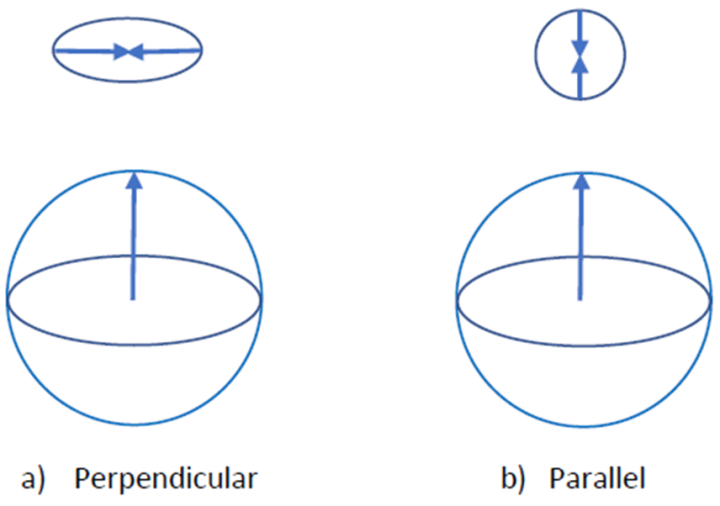
Let’s start the configuration of hydrogen atom first, we know that both electron and proton are spinning while electron is rotating to proton in its orbit outside of the proton. In order to make it simple, we assume a proton always spins in clockwise direction. The electron can take either its spin plane perpendicular to proton’s electric vector, or its spin plane parallel to proton’s electric vector described as Figure 2.

In perpendicular mode, no matter electron’s spin direction in clockwise or counter clockwise, its magnetic pole orientation induced by its spin will be always perpendicular to proton’s induced magnetic pole orientation, the interaction of induced magnetic forces between electron and proton will turn electron’s orientation from perpendicular to parallel orientation due to their mass difference. Therefore, it is rational for an electron to always take parallel mode, because its induced magnetic orientation, no matter clockwise or counter clockwise, is always parallel to proton’s magnetic orientation. The induced magnetic forces between electron and proton will be either attractive or repulsive if the electron spins in different direction. Let’s assume an electron takes both spin and rotation to a proton in clockwise direction. Then there is always constant attractive magnetic force between proton and electron, but the attractive electric force between them is variable because the distance of their electric vectors is changing under orbit motion mode.
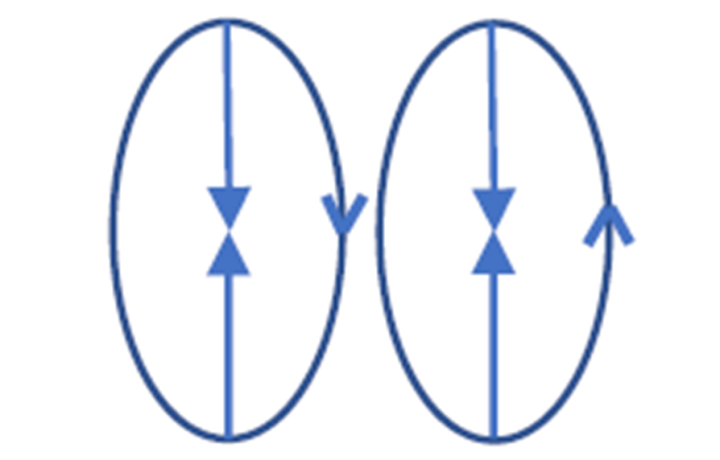
In Helium nucleus, a plane with two positive electric vectors is the clockwise rotating plane, the second electron shall be filled into its 1S orbit too. Apparently, the two electrons must have different spin direction, with variable electric repulsive force but with constant attractive magnetic force between them, even though the second electron’s induced magnetic force is repulsive with proton’s induced magnetic force. Because the attractive magnetic force induced between two electrons is very strong due to very short distance, while the repulsive magnetic force between the proton and the second electron is much weaker due to the big distance between them. Therefore, the two electrons will be stable in the same orbit rotating to the proton, the spin feature of the tow electrons in same orbit is illustrated as Figure 3.

For lithium atom, the 2S orbit is an outer orbit of 1S, the 2S1 electron shall be filled in the same way as 1S1 of hydrogen electron; For Beryllium atom, the 2S2 electron shall be filled in the same way as 1S2 of Helium’s electron; For Boron atom, the 2P orbit is an outer orbit of 2S. The 2P1 electron shall be filled same way as 1S1 of hydrogen electron; For Carbon atom, the second 2P electron shall be filled in another 2P orbit according to Hund’s rule. For Nitrogen atom, the third 2P electron shall be filled in another 2P orbit too. From Boron, Carbon Nitrogen, Oxygen, Fluorine to Neon atoms, one P orbit is on the same rotating plane, while the other two P orbits are perpendicular to the rotating plane. The configuration of atom from H to Ne are presented in Table 2.
The configurations of rest atoms of elements in the periodic table shall follow the same principles. A plane with most electric vector vertexes is selected as the clockwise rotating plane. Electrons shall be filled into their orbits, according to their quantum numbers exactly defined by Quantum Mechanics, Pauli exclusion principle and Hund’s rule to keep the atom at lowest energy and most stable status as the principle of electron filling into orbits.
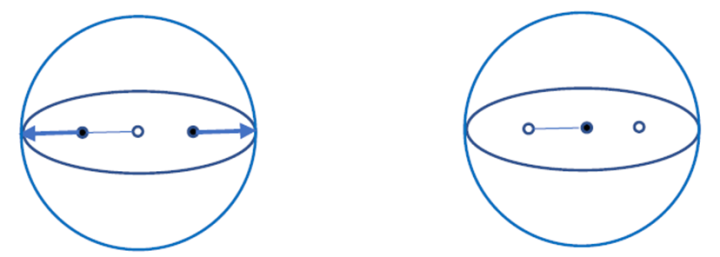
In Step one, during basic particle structure proposal, we only proposed for proton and electron. Now we can also configure the new structure for anti-proton and positron according to their electric properties. The anti-proton, positron and neutron, another set of basic particles for anti-atoms are represented as Figure 4.

If there are magneton or anti-magnetron available, we can also configure another 2 new sets of basic particles for magnetron atoms and anti-magnetron atoms. In our universe, we all know that matter is made of atoms, life form is carbon based; It is logical to deduce that there are other three type of matters existing, and other three life forms existing too based on anti-carbon, magnetic carbon and anti-magnetic carbon.
Since we have concluded that photons are either electric dipoles or magnetic dipoles 4, based on electromagnetic theory, there must be four types of light sources, positive electric pole as spin center, negative electric pole as spin center, magnetic pole as spin center and anti-magnetic pole as spin center; Or the electric photon spins with its middle as center with clockwise and counter clockwise direction, or the magnetic photon spins with its meddle as center with clockwise and counter clockwise direction.
These assumptions may explain the dark matter and dark energy in universe. Because our universal matter is only one of the four type of matters, and our universal is with only one of the four type of lights.
3.2. Exploration of Quark StructureIn Step one: Basic particle structure proposal, we didn’t take the quark’s structure into consideration intentionally. Now let’s re-configure the inner structures of new proton and neutron with considering of quark’s mass and spin property. This time we propose the 2 big balls for proton and neutron each with open diametrical pinholes. A big ball is inserted a dipole with negative point-charge located and fixed at ball center, then a positive point-charge is inserted and balanced with open pinholes at each side. Another big ball is inserted a dipole with positive point-charge located and fixed at ball center, a negative point-charge is inserted and balanced, and finally the big ball’s open pinholes are sealed. The new proton and neutron with quark’s structures taken into consideration are represented as Figure 5, sphere as the proton and neutron’s carrier or container, small black dots as positive point-charge, and small circles as negative point-charge.

The reason why we don’t accept the quarks’ electric charges as ±1/3 and ±2/3 is just because these concepts are not simple, not symmetrical and counter intuition. The fact of one positive charge in proton and neutral neutron instead of three point-charges inside proton and neutron results in quarks’ charges as ±1/3 and ±2/3; The neutron’s electric neutrality is not because of its electric charge, but because of its electric property sealed in an electrically insulated container. Apparently in Large Hadron Collider, there are both fission and fusion of the carrier(container) material. If our proton’s central negative point-charge and bottom positive point-change are bombed away, or the dipole is bombed away, the residual parts with diametrical pinholes and with different masses, will form quarks (up, antidown, antistrange) and positron; If our neutron’s central positive point-charge and bottom negative point-change are bombed away, or the dipole is bombed away, the residual parts with diametrical pinholes and with different masses, will form quarks (antiup, down, strange) and electron.
If a neutron’s side negative point-charge is bombed away with diametrical pinholes and fused with empty carriers, it will form quarks (charm, antibottom, top); if a proton’s side positive point-charge is bombed away with diametrical pinholes and fused with empty carriers, it will form quarks (anticharm, bottom, antitop).
If our neutron’s pinholes changes from close radius to open diametrical and with some ball material bombed away or fused with some empty carrier, it will form muon and tau based on decay results of muon and tau; while if our proton’s ball material is bombed away or fused with some empty carrier, it will form antimuon and antitau based on decay results of antimuon and antitau.
If either a proton or a neutron’s side point-charge is bombed away and with corresponding mass of each neutrino in the standard model, the residual part with diametrical pinholes will form different six neutrinos respectively. The reason why they all have spin=1/2, is just because after 180◦ self-rotation, each neutrino will become its anti-neutrino. If there are no anti-neutrinos existing, each neutrino shall have spin=1.
The photon and gluon will be the dipoles bombed out either from proton or neutron without masses, maybe the only difference is that gluon is with different pole as spin center or with different spin direction, or it is just an anti-photon.
If a proton and a neutron are fused with empty ball material and with only one open diametrical pinhole, then W+ and W- boson will be formed. If a proton and a neutron’s side point-charges are bombed away, fused with some ball material and with two open diametrical pinholes, the Z bosons will be formed accordingly.
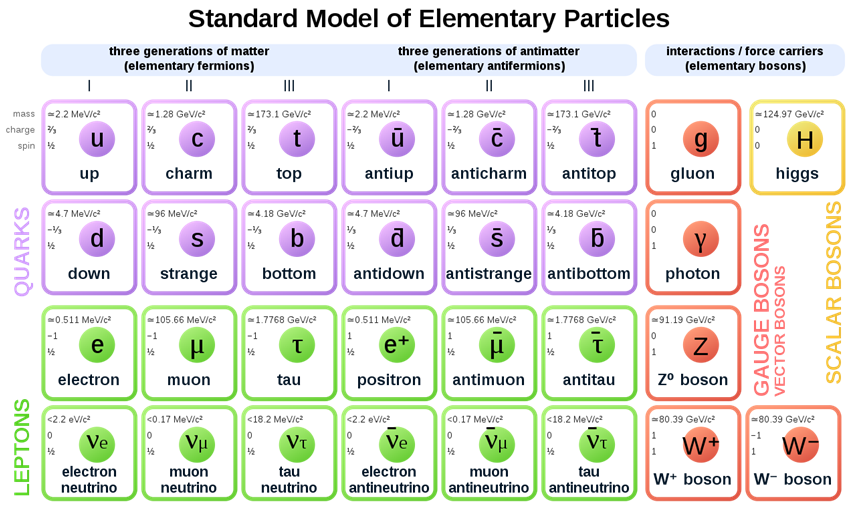
All the above deduction results are completely aligned with the description of “Elementary Particles” by Standard Model, except their electric charge features for “quarks”. The Standard model particles are illustrated as Figure 6 3.

Besides these results, all the other debris particles discovered in Large Hadron colliding can also be verified by the scientists at research center of Large Hadron Collider.
As to the Higgs particle, it seems we will never find it, or we have already found it. Because there is no natural Higgs particle existing at all. Actually, we can deduce that the fused debris of empty protons or neutrons without any point-charge inside, but with same mass as Higgs’ is the Higgs particle. Inside proton or neutron there is electromagnetic force only according to our structure proposed for proton and neutron, there is no other “strong force” required to hold the balanced point-charges inside proton or neutron at all. The only energy required from collider is to smash the carrier or container, but it is nothing to do with the “strong force” required to hold the “quarks” together. It seems even the huge energy was applied to protons and neutrons in Large Hadron Collider, such huge energy just resulted in the fission and fusion of the insulation material (the carrier or container), but couldn’t destroy it completely. It is the material properties but not the mass, insulation and mechanical strength, that determine the proton, electron and neutron’s sub-atomic particle properties in the Large Hadron Collision.
3.3. Exploration of RadioactivityAs to the configuration of isotope nucleuses, the number of protons and neutrons are not equal. With the extra number of neutron(s) increasing, especially with odd number, the symmetry of proton and/or neutron space allocation will break first, which will induce the symmetry breaking of proton vectors orientation, and then will induce the unbalanced electric repulsive forces in nucleus. The symmetry and stability of nucleus structure will be harder to maintain with the neutron number increasing.
The radioactivity of nucleus shall result directly from the unbalanced electric repulsive force induced by symmetry breaking from isotope neutron(s).
For alpha decay 2, a nucleus emitting an alpha particle, loses two protons and two neutrons. Since there is no fission of proton or neutron in the decay, there are no impacts on decay results from our new proton and neutron configuration compared to the current proton and neutron configuration.
For beta-plus decay, when a proton emits a positron and a neutrino, according to our proton configuration, an empty proton without electric charge inside, with about 99% of the original proton mass is left behind. A counterfeit neutron compared to our new neutron is formed.
For beta-minus decay, when a neutron emits an electron and an antineutrino, according to our neutron configuration, an empty neutron without electric charge inside, with about 99% of the original neutron mass is left behind. A counterfeit neutron compared to our new neutron is formed too, but not a proton. Only when a neutron emits two electrons then a counterfeit proton will be formed. Further exploration and verification are required to confirm the current beta-minus decay theory based on current configuration of neutral neutron.
For gamma decay, when a proton emits a photon (a dipole), according to our proton configuration, a counterfeit proton compared to our new proton, with 100% mass of original proton is left behind.
Our configuration of proton and neutron can explain almost all the alpha, beta and gamma decay results except the “proton” of beta-minus decay result due to the current electric configuration of neutral neutron without point-charge inside.
Based on our theory of spin vector in motion, we concluded that both proton and electron are monopole pairs. With monopole pair features, a new atom configuration was developed accordingly. Based on the quark mass and spin properties, new proton and neutron structures were re-configured. Based on the configuration of proton, we conclude that the radioactivity of an isotope results from extra neutron(s), its intrinsic nature is the electric repulsive force induced by the symmetry breaking with extra neutron introduced. According to the new inner structures of proton and neutron, we concluded that there is no “strong force” required to hold the “quarks” together to form proton and neutron. Inside proton and neutron, in fact the “strong force” is electric force itself. The fused empty carriers or containers without any electric charge of the protons and neutrons is the actual Higgs particle. The electric charge features of all the “Elementary Particles” shall be verified by the scientists in research facility of in Large Hadron Collider. What matter the electric insulation material is made of and why the material has special mechanical properties, easy to break but never to be destroyed is still a mystery. It is critical for us to explore further to understand the intrinsic nature of the subatomic world.
| [1] | Wikipedia, “Atom”, https://en.wikipedia.org/wiki/Atom. | ||
| In article | |||
| [2] | Serway, R.A. Jewett, J.W. Physics for Scientists and Engineers with Modern Physics, Philadelphia: Saunders College Pub., P1267-1326, c1983. | ||
| In article | |||
| [3] | Wikipedia, “Standard Model”, https://en.wikipedia.org/wiki/Standard_Model. | ||
| In article | |||
| [4] | Merli, P.G. Missiroli, G.F. and Pozzi, G. “On the statistical aspect of electron interference phenomena”. Am. J. Phys. 44 306-7 (1976). | ||
| In article | View Article | ||
| [5] | Nairz, O. Arndt, M. and Zeilinger, A. “Quantum interference experiments with large molecules”. Am. J. Phys. 71(4) 319-325 (2003). | ||
| In article | View Article | ||
Published with license by Science and Education Publishing, Copyright © 2021 Zhonglin BO
 This work is licensed under a Creative Commons Attribution 4.0 International License. To view a copy of this license, visit
http://creativecommons.org/licenses/by/4.0/
This work is licensed under a Creative Commons Attribution 4.0 International License. To view a copy of this license, visit
http://creativecommons.org/licenses/by/4.0/
| [1] | Wikipedia, “Atom”, https://en.wikipedia.org/wiki/Atom. | ||
| In article | |||
| [2] | Serway, R.A. Jewett, J.W. Physics for Scientists and Engineers with Modern Physics, Philadelphia: Saunders College Pub., P1267-1326, c1983. | ||
| In article | |||
| [3] | Wikipedia, “Standard Model”, https://en.wikipedia.org/wiki/Standard_Model. | ||
| In article | |||
| [4] | Merli, P.G. Missiroli, G.F. and Pozzi, G. “On the statistical aspect of electron interference phenomena”. Am. J. Phys. 44 306-7 (1976). | ||
| In article | View Article | ||
| [5] | Nairz, O. Arndt, M. and Zeilinger, A. “Quantum interference experiments with large molecules”. Am. J. Phys. 71(4) 319-325 (2003). | ||
| In article | View Article | ||