Magnetic field is one of the most used sciences in today's industry, which is applied in many cases such as electromagnets, electric motors, and generators, electric transformers, electromagnetic wave propagation in antennas, magnetic levitation, etc. that has led to many types of research in this field. Therefore, correct calculation of magnetic force is one of effective and important discussions in this field. One of the subsets of the force calculation is between two coils. The purpose of this research is to implement and simulate two cylindrical coaxial coils with uniform current. We calculate the axial magnetic force of the cylindrical coil by simulating and implementing two coils and applying numerical integration methods, parametric integration, and finite element method in MATLAB software. The results show that the implemented codes are able to calculate the force between two coils quickly, with small error, and with high accuracy. These results will help to implement a proper system with real term and very high accuracy by choosing the best method that fits your system's constraints, conditions, and type.
The magnetic field is used in a wide variety of scientific and industrial fields such as astronomy, biomedical, positioning systems, etc. 1, 2, 3. The coils carrying the current, according to Maxwell's equations, create a magnetic field and they are influenced by the surrounding magnetic field 4. For this reason, coils have many applications in power industry, including motors, generators, etc. 5, 6. Pancrak has developed an algorithm for calculating mutual inductance between two coils with general shape and parallel axes by integrating the magnetic moment element between 2 coils of thin walls with axes and parallel walls 7. This algorithm is based on an equation that has three main parts. The first part is a function to determine the shape of the first coil. The second part is the function to determine the shape of the second coil and radial distance between coils and the third part is to determine the axial distance between the coils. Suresh et al. 8 provided an analysis of the magnetic field induced by the coil with a core and bobbin using the elliptical function. They then calculated and plotted the magnetic field distribution caused by the coil. The calculations are simulated in MATLAB software. The magnet with its magnetic field along the cylindrical axis is equivalent to a thin-walled coil in terms of Coulomb's law and Biot–Savart law 9. Lemarquand et al. showed that the force between two magnets is equal to the mutual inductance between two thin-walled coils. Braneshi et al. use the calculating functions contains elliptic integrals and kernel functions for computing the force between two disk coils 10. Ravaud et al. provided analytical expressions for the force relationship between 2 thin-walled coils and two cylindrical magnets 11. They showed that the mathematical model of the thin-walled coil coincides with the cylindrical iron by calculating the field, force, and inductance between the coils and the cylindrical magnet analytically. Then, they compared their analysis calculations with finite element methods to show the optimality of their method 11. In this research, the axial force between two coaxial coils was calculated by applying Maxwell and Lawrence equations in three ways. In the first method, the axial force analysis of two coaxial coils was calculated using the elliptic functions and the derivative of Maxwell's mutual inductance equation. Then, in the second method, the force between the two coils was calculated numerically using the fractional method and the force equation between the two coils. Finally, the force integral equation between two coils was calculated using a trapezoidal law numerically.
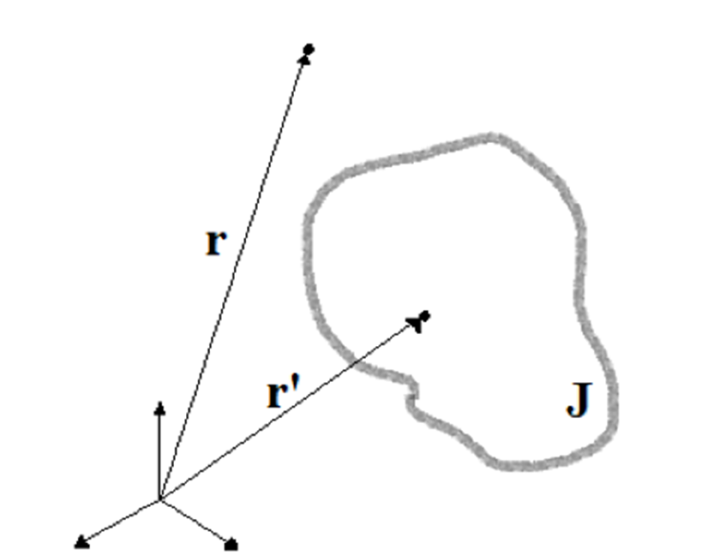
Biot-Savart law helps to obtain the magnetic field caused by an electric current. The law is as follows 12:
 | (1) |

 and the point at which the magnetic field is calculated
μ0 is the vacuum permittivity coefficient as much as 4π*10-7. The coordinate machine is cylindrical.  is the volume current density of the source of the magnetic field. r is the position vector of the desired point to calculate the field.
  is the position vector of the current element in the source.
  is the distance of the flow element from the calculated point. This element is obtained by the law of cosines:
 | (2) |
 | (3) |
If the current density of J is uniform:
 | (4) |
The field resulting from a current distribution can be obtained by integrating this element. The direction of each field element is perpendicular to the direction of current and the distance vector between the source element and the point being investigated.
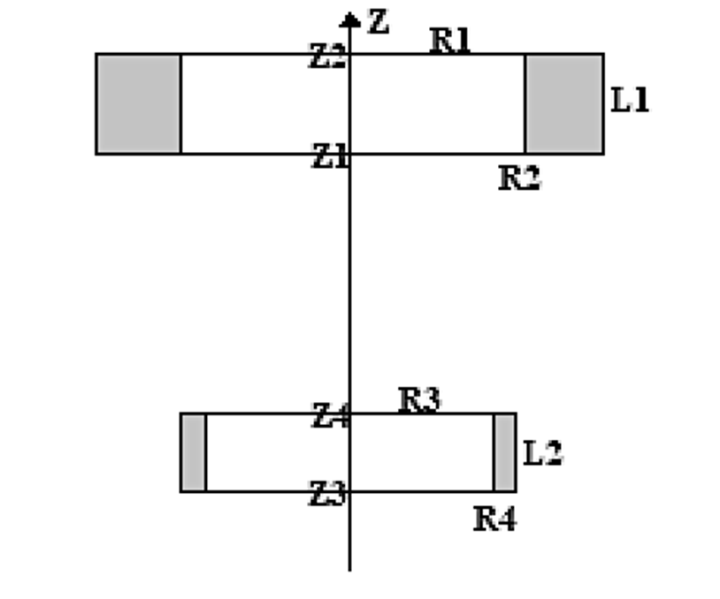
The inner and the outer radius of the coil are considered as R1 and R2 for a coil with N loops and L length (The loops are attached to each other and there is no space between them) with constant current I pass through them. The direction of the axes of solenoid is the z-axis. The direction of current is φ. The field element is defined as follows.
 | (5) |
The magnetic field induced by the coil can be obtained anywhere by integrating this element 13.
In a coil, the integral of zero to π is equal to the integral of π to 2π. Therefore, instead of the integral of zero to 2π, the integral of zero to π is assumed and a factor as much as 2 is multiplied by the integral.
2.2. Lorentz ForceThe force is applied to an electric charge in the presence of an electric or magnetic field known as the Lorentz force 14.
 | (6) |
E= Electrical Field, B= Magnetic Flux Density, V=Velocity, q= Electric charge.
Since the electric current is related to the moving charges, the magnetic force applied to the object by the volume current density J in the presence of field B is:
 | (7) |
J=Current Density, B= Magnetic Flux Density, V=Volume.
2.3. Force between Two Coils Carrying CurrentBy combining the Biot–Savart and Lorentz laws, the following equation (8) is obtained. There are two coaxial coils that the first coil with height L1, number of loops N1, inner and outer radius R1, R2 and Current density J’. It is assumed that first coil makes magnetic field and the force enters the second coil, and the second coil have inner and outer radius R3, R4 and height L2 and number of loops N2 and current density J. distance between the center of the coils is (z-z’).
 | (8) |
 | (9) |
Since there is no dependence on φ, the integral on φ gives a constant value of 2π.
 | (10) |
This integral can be solved numerically and parametrically.
The force equation between the two coils by integrating the Lorentz equation parametrically is as follows:

 | (11) |
 | (12) |
where
 | (13) |
 | (14) |
 | (15) |
 | (16) |
 | (17) |
 | (18) |
 | (19) |
 | (20) |
 | (21) |
 | (22) |
 | (23) |
 | (24) |
 | (25) |
 | (26) |
 | (27) |
 | (28) |
 | (29) |
 | (30) |
 | (31) |
 | (32) |
Where R1 and R2 are the inner and outer radius of the first coil, and R3 and R4 are the inner and outer radius of the second coil. z1, z2, z3 and z4 are the top and bottom of the coils. N1 is the number of loops of the first coil and N2 is the number of loops of the second coil. K(k) and E(k) are the Complete Elliptical integral of first and second kind.  is the Heuman Lambda function 15.
 | (33) |
 | (34) |
 | (35) |
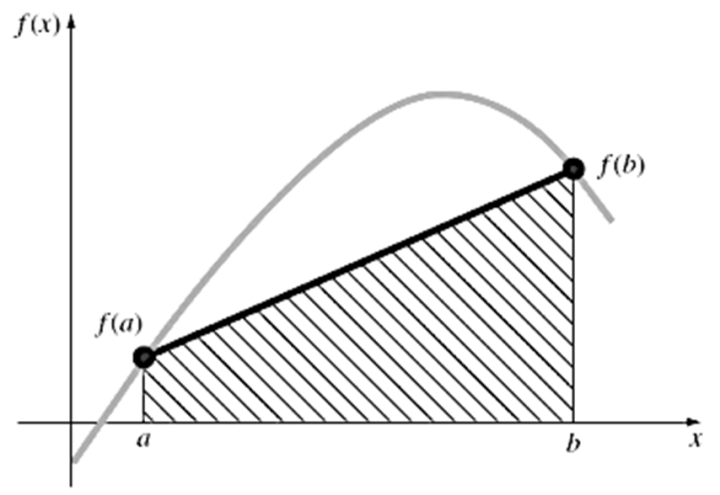
The trapezoidal rule is the simplest form of numerical integration. The integration interval is divided into several segments, which is calculated for each trapezoidal area.
 | (36) |
Where I= Trapezoidal Area
Since the force is calculated from multiple independent integrals, the trapezoidal rule is applied to each individual variable.

The finite element method can be used instead of integrating to obtain the force between two coils. To this end, the coils are divided into a number of loops carrying the current by dividing the length and thickness of each coil. The final force is obtained between two coils by sum the force between each pair of loops from two coils.
The coil force is obtained from the mutual inductance of the two coils depending on the distance between them.
 | (37) |
Mutual inductance between the two current-carrying loops provided by Maxwell is provided in the following figure 16.

 | (38) |
 | (39) |
The force between the two loops carrying the current can be obtained by deriving M from the distance of two loops.
 | (40) |
Then the total force can be obtained by summing the elements of the two coils.
The length and thickness of the first coil are divided into 2A+1 and 2B+1, respectively. The length and thickness of the second coil are divided into 2C+1 and 2D+1, respectively. The current density of each element in the first coil is equal to  and the current density of each element in the second coil is equal to
 | (41) |
Where F (a, b, c, d) is the force between two Maxwell current loops:
 | (42) |
 | (43) |
 | (44) |
 | (45) |
 | (46) |
 | (47) |
 | (48) |
 | (49) |
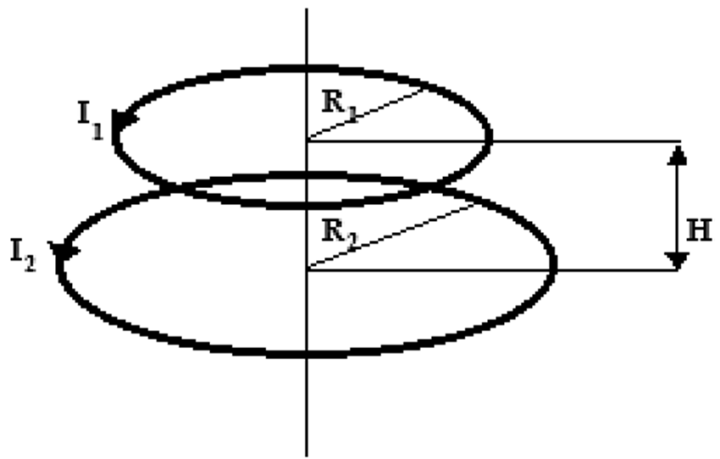
Where R1 and R2 is the radius of elements (loops) and z(a,c) is the distance between elements. H is the distance between the center of coils.  and
and  is the inner and outer radius of first coil.
  and
and  is the inner and outer radius of second coil.
Sometimes, the thickness or length of the coils are considered thin to calculate integrals easier by calculate a triple integral instead of a quintuple integral. Another application of suppose the wall be thin is to simulate the magnets to a thin coil to calculate the magnetic field and force applied to them. To reduce the size of the coil, either a thin wall coil (low thickness) or a disk (low length) is considered. There were three situations for the coils. The first is the force between the two thin-walled coils, the second the force between the two disk coils and the third the force between the thin-walled coils and the disk coils.
3.1. Two Thin Wall CoilsThis mode is also used to simulate magnets with a coil 9. For this case, the integral equation is as follows:
 | (50) |
The parametric solution of this integral is as follows:
 | (51) |
 | (52) |
 | (53) |
 | (54) |
 | (55) |
 | (56) |
 | (57) |
 | (58) |
Where R and R’ are the radius of first and second coil. z1, z2, z3 and z4 are the top and bottom of the coils. N1 is the number of loops of the first coil and N2 is the number of loops of the second coil. K(k) and E(k) are the Complete Elliptical integral of first and second kind.  is the Heuman Lambda function.
For this case, the integral equation comes in the following format:
 | (59) |
The parametric solution of this integral is as follows:
 | (60) |
 | (61) |
where
 | (62) |
 | (63) |
 | (64) |
 | (65) |
 | (66) |
 | (67) |
 | (68) |
 | (69) |
 | (70) |
 | (71) |
 | (72) |
 | (73) |
 | (74) |
 | (75) |
 | (76) |
 | (77) |
 | (78) |
 | (79) |
 | (80) |
 | (81) |
Where R1 and R2 are the inner and outer radius of the first coil, and R3 and R4 are the inner and outer radius of the second coil. H is the distance between coils. N1 is the number of loops of the first coil and N2 is the number of loops of the second coil. K(k) and E(k) are the Complete Elliptical integral of first and second kind.  is the Heuman Lambda function.
For this case, the integral equation is as follows:
 | (82) |
The parametric solution of this integral is as follows:
 | (83) |
 | (84) |
 | (85) |
 | (86) |
 | (87) |
 | (88) |
 | (89) |
 | (90) |
 | (91) |
 | (92) |
 | (93) |
 | (94) |
 | (95) |
 | (96) |
 | (97) |
 | (98) |
 | (99) |
 | (100) |
Where R1 and R2 are the inner and outer radius of the first coil, and R is the radius of the second coil. z1 and z2 are the top and bottom of the second coil. H is the distance between the center of coils. N1 is the number of loops of the first coil and N2 is the number of loops of the second coil. K(k) and E(k) are the Complete Elliptical integral of first and second kind.  is the Heuman Lambda function.
In this paper, the axial force between two coaxial coils is investigated and calculated. The calculations have three modes. Initially, the force integral was calculated by parametric method. Then, in the second mode, the integral was calculated numerically and in the third mode, the finite element method was used to calculate the force.
4.1. Two Thin Wall CoilsIn this test, there are two thin-walled coils with an inner radius of 2cm, height of 5cm. The distance between the centers of two coils is 15cm. The number of loops of each coil is 100 and the current of each coil is 1A. The force between the coils is equal to:
- The force is obtained as much as 2.052*10-5N through parametric method.
- The force is obtained as much as 2.052*10-5N through the finite element method.
- The force is obtained as much as 2.125*10-5N through numerical solution method (trapezoidal integration).
In this test, there are two thin-walled coils with an inner radius of 1cm and a height of 5cm. the distance between the centers of the coils is 15cm. The number of loops of each coil is 100 and the current of each coil is 1A. The force between the coils is equal to:
- The force is obtained as much as 1.387*10-6N through parametric method.
- The force is obtained as much as 1.508*10-6N through the finite element method.
- The force is obtained as much as 1.387*10-6N through numerical solution method (trapezoidal integration).
In this test, there are two thin-walled coils with an inner radius of 2cm and a height of 6cm. the distance between the centers of the coils is 15cm. The number of loops of each coil is 100 and the current of each coil is 1A. The force between the coils is equal to:
- The force is obtained as much as 2.234*10-5N through parametric method.
- The force is obtained as much as 2.233*10-5N through the finite element method.
- The force is obtained as much as 2.306*10-5N through numerical solution method (trapezoidal integration).
In this test, there are two thin-walled coils with an inner radius of 2cm and a height of 5cm. the distance between the centers of the coils is 12cm. The number of loops of each coil is 100 and the current of each coil is 1A. The force between the coils is equal to:
- The force is obtained as much as 5.251e-05N through parametric method.
- The force is obtained as much as 5.250e-05N through the finite element method.
- The force is obtained as much as 5.433e-05N through numerical solution method (trapezoidal integration).
In this test, the number of loops of each coil is 100 and the current of each coil is 1A. The radius of the first coil is 2cm and the radius of the second coil is 3cm. The height of the first coil is 5cm, the height of the second coil is 7cm, and the distance between the coils is 12cm. The force is obtained as much as 1.416*10-4N through parametric method. The force is obtained as much as 1.211*10-4N through the finite element method. The force is obtained as much as 1.245*10-4N through numerical solution method (trapezoidal integration).
4.2. Two Disc CoilsIn this test, the number of loops of each coil is 100. The current of each coil is 1A. The inner radius of the coils is 15cm and the outer radius of the coils is 20cm. The distance between the coils is 15cm. The force is obtained as much as 0.037N through parametric method. The force is obtained as much as 0.034N through the finite element method. The force is obtained as much as 0.036N through the trapezoidal integration method.
In this test, the number of loops of each coil is 100. The current of each coil is 1A. The inner radius of the coils is 10cm and the outer radius of the coils is 20cm. The distance between the coils is 5cm. The force is obtained as much as 0.021N through parametric method. The force is obtained as much as 0.022N through the finite element method. The force is obtained as much as 0.023N through the trapezoidal integration method.
In this test, the number of loops of each coil is 100. The current of each coil is 1A. The inner radius of the coils is 15cm and the outer radius of the coils is 25cm. The distance between the coils is 5cm. The force is obtained as much as 0.026N through parametric method. The force is obtained as much 0.031N through the finite element method. The force is obtained as much as 0.032N through the trapezoidal integration method.
In this test, the number of loops of each coil is 100. The current of each coil is 1A. The inner radius of the coils is 15cm and the outer radius of the coils is 20cm. the radius of the thin wall coil is 5cm. The height of the thin wall coil is 5cm. The distance of the center of the coils is 10cm. The force is obtained as much as 1.49*10-3N through parametric method. The force is obtained as much as 1.25*10-3N through the finite element method. The force is obtained as much as 1.44*10-3N through the trapezoidal integration method.
The number of loops of each coil is 100. The current of each coil is 1A. The inner radius of the coils is 15cm and the outer radius of the coils is 20cm. the radius of the thin wall coil is 15cm. The height of the thin wall coil is 5cm. The distance of the center of the coils is 10cm. The force is obtained as much as 1.51*10-2N through parametric method. The force is obtained as much as 1.07*10-2N through the finite element method. The force is obtained as much as 1.46*10-2N through the trapezoidal integration method.
The number of loops of each coil is 100. The current of each coil is 1A. The inner radius of the coils is 15cm and the outer radius of the coils is 20cm. The height of the thin wall coil is 5cm. The distance between the center of the coils is 10cm. The force is obtained as much as 0.053N through parametric method. The force is obtained as much as 0.048N through the finite element method. The force is obtained as much as 0.049N through the trapezoidal integration method.
The number of loops of each coil is 100. The current of each coil is 1A. The inner radius of the first coil is 15cm and the outer radius of the first coil is 20cm. The inner radius of the second coil is 10cm and the outer radius of the second coil is 17cm.The height of the thin wall coil is 5cm. The distance between the center of the coils is 10cm. The force is obtained as much as 0.027N through parametric method. The force is obtained as much as 0.025N through the finite element method. The force is obtained as much as 0.026N through the trapezoidal integration method.
The number of loops of each coil is 100. The current of each coil is 1A. The inner radius of the first coil is 15cm and the outer radius of the first coil is 20cm. The inner radius of the second coil is 10cm and the outer radius of the second coil is 20cm.The height of the thin wall coil is 5cm. The distance between the center of the coils is 10cm. The force is obtained as much as 0.034N through parametric method. The force is obtained as much as 0.033N through the finite element method. The force is obtained as much as 0.033N through the trapezoidal integration method.
The number of loops of each coil is 100. The current of each coil is 1A. The inner radius of the coils is 10cm and the outer radius of the coils is 25cm. The distance between the center of the coils is 10cm. The force is obtained as much as 0.028N through parametric method. The force is obtained as much as 0.027N through the finite element method. The force is obtained as much as 0.026N through the trapezoidal integration method.
4.5. ResultAs shown in the tests, the force of the coil decreases with decreasing the radius. On the other hand, the force between the coils increases with decreasing the coil height. This means that the more the coils become like a disk coil, the more force is between them. The current and number of loops in the force equation linearly affect. For this reason, they have fixed value in the tests not to affect the changes. The distance between the coils also has a severe effect on the force between the coils and the force between them decreases with increasing the distance between the coils.
In this paper, two coaxial cylindrical coils carrying a uniform current were implemented and simulated. The general equation of the axial force integral was obtained between two coaxial coils by applying the Maxwell and Lorentz equations. Then, the force equation was obtained by applying two methods of numerical integration and parametric integration. Then, the force was obtained by the element method using the finite element method and the derivation of the Maxwell current loop formula (mutual inductance between two coaxial current loops). The obtained equation in MATLAB was tested under real terms and the axial force was shown between two coaxial coils. The results showed that the three calculation methods yield the same results under the same conditions. Depending on the conditions, constraints, and type of system, the best way to calculate the force is selectable, which will help increasing computational speed and reduce error.
| [1] | Zakharchenko, A., Guz, N., Laradji, A.M. et al. “Magnetic field remotely controlled selective biocatalysis.” Nature Catalysis, Vol. 1, 73-81, 2018. | ||
| In article | View Article | ||
| [2] | Valter Pasku, , , et al. “Magnetic field-based positioning systems.” IEEE Communications Surveys & Tutorials, 19(3), pp. 2003-2017, thirdquarter 2017. | ||
| In article | View Article | ||
| [3] | McMichael, K. D., Karak, B. B., Upton, L., Miesch, M. S., and Vierkens, O., “The Evolution of the Solar Magnetic Field: A Comparative Analysis of Two Models”, American Geophysical Union Fall Meeting, vol. 2017, 2017. | ||
| In article | |||
| [4] | Kirsch, Andreas, and Frank Hettlich. The Mathematical Theory of Time-harmonic Maxwell's Equations. Springer International Pu, 2016. | ||
| In article | |||
| [5] | K Sondhi, N Garraud, D Alabi, D P Arnold et al. “Flexible screen-printed coils for wireless power transfer using low-frequency magnetic fields.” Journal of Micromechanics and Microengineering, 29(9), 2019. | ||
| In article | View Article | ||
| [6] | Xiaoyong Xu, , , et al. “Study on Reducing the Maximum Perpendicular Magnetic Field of HTS Coils Used on Synchronous Generator Armatures.” IEEE Transactions on Applied Superconductivity, 29(5), pp. 1-5, Aug. 2019. | ||
| In article | View Article | ||
| [7] | Pankrac, Vitezslav. “The algorithm for calculation of the self and mutual inductance of thin-walled air coils of general shape with parallel axes.” IEEE transactions on magnetics, Vol. 48, No. 5, 1875-1889, 2012. | ||
| In article | View Article | ||
| [8] | V, Suresh, V.K.Gopperundevi,Abudhahir, A., R.Antonysamy, and K.Muthukkutti,. “Simple Algorithm for the Magnetic Field Computation in Bobbin Coil Arrangement.” International Journal of Innovative Research in Computer and Communication Engineering, Vol. 2, No. 1, 2014. | ||
| In article | |||
| [9] | Lemarquand, Guy, Lemarquand, V., Babic, S., and Akyel, C. “Magnetic field created by thin wall solenoids and axially magnetized cylindrical permanent magnets”, In Progress In Electromagnetics Research Symposium, Progress In Electromagnetics Research. 614-618. 2009. | ||
| In article | |||
| [10] | Braneshi, Myrteza., Zavalani, Orion., and Pijetri, Alfred. “The use of calculating function for the evaluation of axial force between two coaxial disk coils.” 3rd Int. PhD Seminar Computational Electromagn. Tech. Applicat, 2006. | ||
| In article | |||
| [11] | R. Ravaud, G. Lemarquand, S. Babic, V. Lemarquand and C. Akyel, “Cylindrical Magnets and Coils: Fields, Forces, and Inductances,” in IEEE Transactions on Magnetics, vol. 46, no. 9, pp. 3585-3590, Sept. 2010. | ||
| In article | View Article | ||
| [12] | Ferreira, J. M., and Joaquim Anacleto. “The magnetic field circulation counterpart to Biot-Savart’s law.” The European Physical Journal Plus, Vol.133, No. 6, 2018. | ||
| In article | View Article | ||
| [13] | Munir H. Nayfeh, Mortton K. Brussel, Electricity and magnetism, Retrieved Dover Publications, , 2015. | ||
| In article | |||
| [14] | Ali Jebelli, Arezoo Mahabadi, Mustapha C. E. Yagoub, Hicham Chaoui. Magnetic Force Calculation between Magnets and Coils. International Journal of Physics. Vol. 8, No. 2, 2020, pp 71-80. | ||
| In article | View Article | ||
| [15] | Abramowitz, Milton, and Irene A. Stegun, eds. Handbook of mathematical functions with formulas, graphs, and mathematical tables. Dover Publications, 1 edition, 1965. | ||
| In article | |||
| [16] | Conway, John T. “Inductance calculations for noncoaxial coils using Bessel functions.” IEEE Transactions on Magnetics, Vol. 43, No. 3, 2007. | ||
| In article | View Article | ||
Published with license by Science and Education Publishing, Copyright © 2021 Ali Jebelli, Arezoo Mahabadi, Hicham Chaoui and Mustapha C. E. Yagoub
 This work is licensed under a Creative Commons Attribution 4.0 International License. To view a copy of this license, visit
http://creativecommons.org/licenses/by/4.0/
This work is licensed under a Creative Commons Attribution 4.0 International License. To view a copy of this license, visit
http://creativecommons.org/licenses/by/4.0/
| [1] | Zakharchenko, A., Guz, N., Laradji, A.M. et al. “Magnetic field remotely controlled selective biocatalysis.” Nature Catalysis, Vol. 1, 73-81, 2018. | ||
| In article | View Article | ||
| [2] | Valter Pasku, , , et al. “Magnetic field-based positioning systems.” IEEE Communications Surveys & Tutorials, 19(3), pp. 2003-2017, thirdquarter 2017. | ||
| In article | View Article | ||
| [3] | McMichael, K. D., Karak, B. B., Upton, L., Miesch, M. S., and Vierkens, O., “The Evolution of the Solar Magnetic Field: A Comparative Analysis of Two Models”, American Geophysical Union Fall Meeting, vol. 2017, 2017. | ||
| In article | |||
| [4] | Kirsch, Andreas, and Frank Hettlich. The Mathematical Theory of Time-harmonic Maxwell's Equations. Springer International Pu, 2016. | ||
| In article | |||
| [5] | K Sondhi, N Garraud, D Alabi, D P Arnold et al. “Flexible screen-printed coils for wireless power transfer using low-frequency magnetic fields.” Journal of Micromechanics and Microengineering, 29(9), 2019. | ||
| In article | View Article | ||
| [6] | Xiaoyong Xu, , , et al. “Study on Reducing the Maximum Perpendicular Magnetic Field of HTS Coils Used on Synchronous Generator Armatures.” IEEE Transactions on Applied Superconductivity, 29(5), pp. 1-5, Aug. 2019. | ||
| In article | View Article | ||
| [7] | Pankrac, Vitezslav. “The algorithm for calculation of the self and mutual inductance of thin-walled air coils of general shape with parallel axes.” IEEE transactions on magnetics, Vol. 48, No. 5, 1875-1889, 2012. | ||
| In article | View Article | ||
| [8] | V, Suresh, V.K.Gopperundevi,Abudhahir, A., R.Antonysamy, and K.Muthukkutti,. “Simple Algorithm for the Magnetic Field Computation in Bobbin Coil Arrangement.” International Journal of Innovative Research in Computer and Communication Engineering, Vol. 2, No. 1, 2014. | ||
| In article | |||
| [9] | Lemarquand, Guy, Lemarquand, V., Babic, S., and Akyel, C. “Magnetic field created by thin wall solenoids and axially magnetized cylindrical permanent magnets”, In Progress In Electromagnetics Research Symposium, Progress In Electromagnetics Research. 614-618. 2009. | ||
| In article | |||
| [10] | Braneshi, Myrteza., Zavalani, Orion., and Pijetri, Alfred. “The use of calculating function for the evaluation of axial force between two coaxial disk coils.” 3rd Int. PhD Seminar Computational Electromagn. Tech. Applicat, 2006. | ||
| In article | |||
| [11] | R. Ravaud, G. Lemarquand, S. Babic, V. Lemarquand and C. Akyel, “Cylindrical Magnets and Coils: Fields, Forces, and Inductances,” in IEEE Transactions on Magnetics, vol. 46, no. 9, pp. 3585-3590, Sept. 2010. | ||
| In article | View Article | ||
| [12] | Ferreira, J. M., and Joaquim Anacleto. “The magnetic field circulation counterpart to Biot-Savart’s law.” The European Physical Journal Plus, Vol.133, No. 6, 2018. | ||
| In article | View Article | ||
| [13] | Munir H. Nayfeh, Mortton K. Brussel, Electricity and magnetism, Retrieved Dover Publications, , 2015. | ||
| In article | |||
| [14] | Ali Jebelli, Arezoo Mahabadi, Mustapha C. E. Yagoub, Hicham Chaoui. Magnetic Force Calculation between Magnets and Coils. International Journal of Physics. Vol. 8, No. 2, 2020, pp 71-80. | ||
| In article | View Article | ||
| [15] | Abramowitz, Milton, and Irene A. Stegun, eds. Handbook of mathematical functions with formulas, graphs, and mathematical tables. Dover Publications, 1 edition, 1965. | ||
| In article | |||
| [16] | Conway, John T. “Inductance calculations for noncoaxial coils using Bessel functions.” IEEE Transactions on Magnetics, Vol. 43, No. 3, 2007. | ||
| In article | View Article | ||