Concentration levels of PM2.5, PM10 and Black Carbon were assessed in the industrial zone of Yopougon, Abidjan, Côte d'Ivoire over twelve months. The particle mass for the two fractions was carried out by the gravimetric method. The sampled filters were also analyzed to determine the levels of Black Carbon concentration using the black smoke method. The fine and coarse particles black carbon fractions, as well as the PM2.5/PM10 ratio were determined. The mass concentrations determined for these fractions were respectively between [40.50; 158.17] µg/m3 with an average of 77.34 µg/m3 for PM10 and [17.25; 161.00] µg/m3 with an average of 48.83 µg/m3 for PM2.5. Compared to the Ivorian standards and the WHO guidelines, these results indicate that there is a strong need for mitigation actions on atmospheric emissions in order to protect the population living in this area against the harmful effects of air pollution.
Air pollution has become a major problem faced by all big cities in the world. According to Cristina et al. 1, expanding industrialization and increasing traffic volumes will drastically increase total emissions of many air pollutants in the developing countries. Particulate matter (PM) is a major component of this pollution and is one of the most concern pollutant because of its strong impact on human health 2, 3, 4, 5, 6.
Black Carbon is also of particular interest because it is one of the most important components in atmospheric aerosols. Indeed, there is suggestive evidence of a BC concentration link to health effects 7 and it contributes widely to global warming 8, 9.
Very few data on particulate matter monitoring exist in the African region. In order to fill this lack, the IAEA (International Atomic Energy Agency) initiated the RAF 4019 project entitled "Developing Air Pollution Monitoring in Urbain Zone". This project aimed to provide developing countries in Africa with a minimum capacity to conduct air quality monitoring.
In Côte d'Ivoire, the monitoring of PM2.5 and certain gases concentrations and their impact on human health have been carried out through the Working Package 2 (WP2) of the Dynamics-Aerosol-Chemistry-Cloud Interactions in West Africa (DACCIWA) project for traffic and landfill sources. The results of this study have shown that the air quality situation in Abidjan is worrying, as it is in the major megacities in West Africa 10.
In addition to this project, various initiatives on air quality monitoring are under way, such as the acquisition of a mobile laboratory by the Ivorian Antipollution Center (CIAPOL), the installation of an air quality monitoring network by the District of Abidjan in partnership with the city of Nice (France).
The present work is part of the IAEA RAF7016 project entitled "Establishing and Improving Air Pollution Monitoring" which aims to enhance the capacity of monitoring and increase the production of air quality data in the Africa region. This project focuses on air particulate matter monitoring, mainly for PM2.5 and PM10.
In this study, we assessed the level of air pollution by particles matters and black carbon measurements in the industrial area of the municipality of Yopougon, in Abidjan.
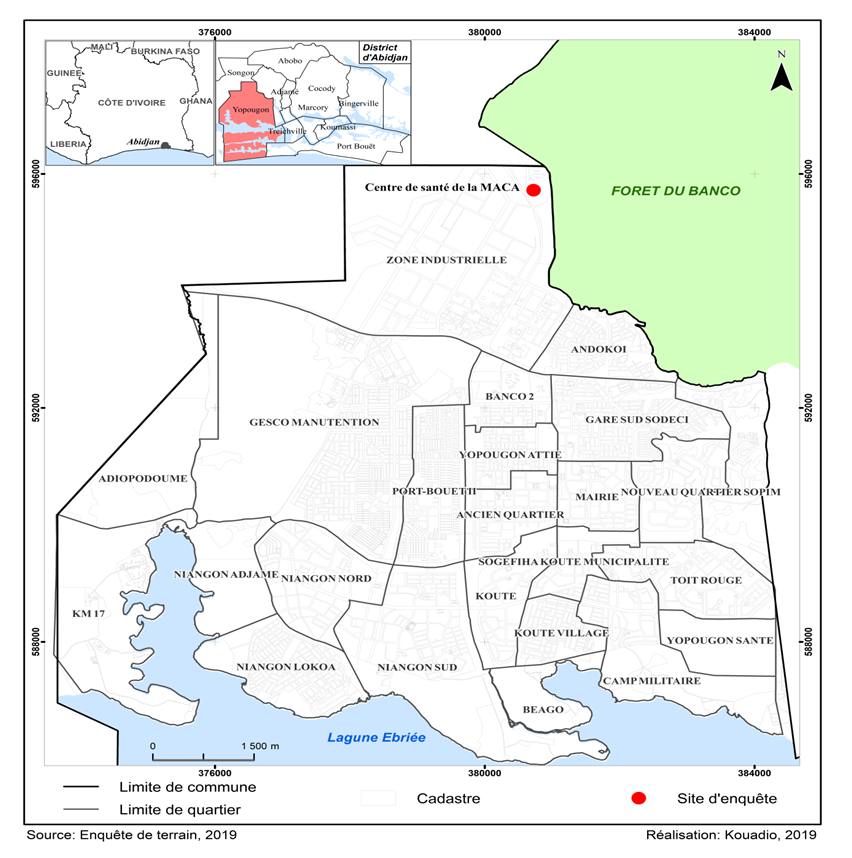
Particle samples were taken from a site near the industrial area of Yopougon (Figure 1). Located in the northwestern part of the city of Abidjan, at coordinates 5°20’56’’ North and 4°00’56’’ West, the town of Yopougon covers an area of 153 km2 11. It is the largest of the thirteen municipalities in the District of Abidjan. With a population around 1071500 inhabitants 12, Yopougon is the most populated commune of Abidjan and Côte d'Ivoire. Moroever, this municipality has the highest concentration of factories with more than four hundred (400) companies grouped within the industrial zone. The industrial activities include sheet metal and rebar manufacturing, cement, food and several chemical factories. The sampling site lies around 200 meters from a busy road and a parking for heavy-duty trucks transporting various goods in and out of the area.
Particles collection was carried out using a low-volume sampler (LVS / LVS6-RV, Sven Leckel) placed on the roof of the city health centre near the prison of Abidjan, at about three meters from the ground. The PM2.5 and PM10 samples were collected on high retention borosilicate glass microfiber filters (Grade GF/A 1820-47, diameter 47 mm, porosity 1.6 µm). The samples were contained in Petri dishes, previously cleaned with ethanol to avoid contamination, and stored in a desiccator.
Three (03) samples were collected per week (two working days and one the week-end), from April 2018 to July 2019. The sampling was performed for 24 hours with an average flow rate of 38.33 l/min.
For the study period, a total of 133 filters were collected, including 64 for PM10 and 69 PM2.5 corresponding to 12-14 individual samples per month. Particular care was taken to transport the samples from the sampling site to the packaging room, in order to avoid any loss of particles.

The filters were weighed before and after sampling five times with a Sartorius microbalance Quintix 65-1S with a sensitivity of 1 µg at a relatively controlled temperature and humidity.
Gravimetric analysis was performed to determine the mass concentration of the aerosol sampled. PM2.5 and PM10 concentrations in ambient air were calculated as the total mass of particles collected divided by the volume of air sampled under real conditions. The concentrations were expressed in micrograms per cubic meter (µg/m3).
Several studies have reported that black smoke, derived from absorbance coefficients, is well correlated with the concentration of elemental carbon and may be recommended as a valid and inexpensive indicator for air pollution studies related to combustion and health 13, 14, 15, 16. There are several methods for estimating the concentration of black carbon. One of them is the one using a darkness reflectometer.
In the present work, the sampled filters in PM2.5 and PM10 were examined for black smoke to measure the reflectance using an EEL Smoke Stain reflectometer (Model 43M, Diffusion Systems Ltd 43). A light source shines its light on the filter, and the reflected light is measured by photocells located in a black housing. The reflector reading is obtained directly from the universal digital readout., and converted to output voltage. The output voltage is then converted to a measure of blackness, which is uniquely determined from the three output obtained, i.e. from the aerosol filter to be evaluated, the totally black filter and the totally black filter. The blackness is essentially determined by the use of Lambert-Beer’s (Gagel, 1996) 17. Each filter was examined by the five-points method of measuring reflectance and the average value was used in the calculations.
The concentration of black carbon in the air particles collected on the filters was estimated using the Maenhaut method 18.
2.3. Weather SituationCôte d'Ivoire has an equatorial climate characterized by high temperatures and average humidity of 90% during most of the year and by seasonal variations marked by precipitations. Depending on weather conditions 19, the year can be divided into four seasons: a long and a short rainy seasons alternating with a short and a long dry seasons. These seasons are distributed over the year as follows:
• December to March: the long dry season interspersed with some rain. It’s the hottest time of the year, especially during February and March. January is marked by the influence of the harmattan over the whole Ivorian Coast.
• From April to July, the longest rainy season takes place during which two thirds of the total annual precipitation were recorded.
• From August to September, the rains stop but the sky remains cloudy. The small dry season sets in.
• From October to November, it is the small rainy season which takes place with some small precipitations.
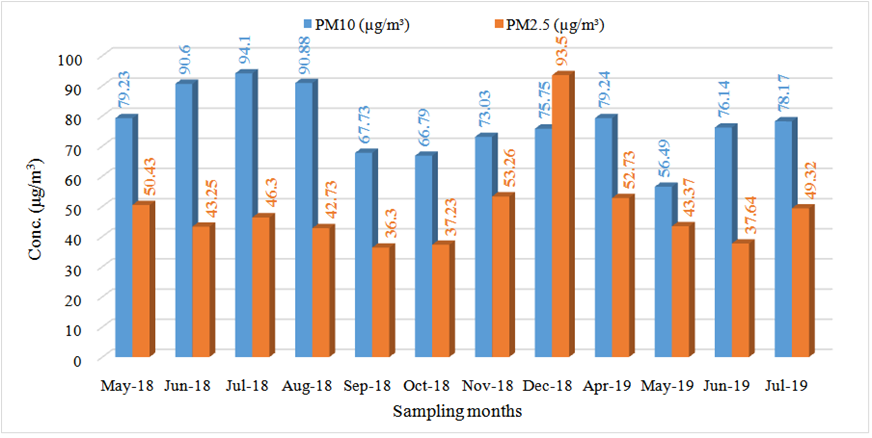
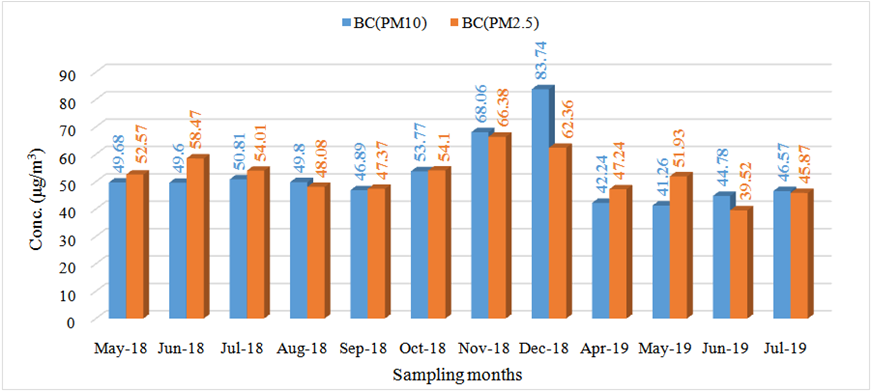
The variations of PM2.5 and PM10 and their respective variations in BC concentration are presented in Figure 2 and Figure 3.


Table 1 gives the average of the mass concentrations of PM2.5 and PM10, the black carbon and the percentage of black carbon in the two fractions. The Minimum and maximum of these parameters are also provided.
A high variability in day-to-day and from one month to another was observed in mass concentrations of PM10 and PM2.5 with a maximum 94.1 µg/m3 and 93.5 µg/m3 respectively in July 2018 and December 2018. The lowest mass concentration average values 36.30 µg/m3 and 56.49 µg/m3 for the fine and the coarse fractions were experienced in September 2018 and May 2019 (Figure 2). The whole period was characterized by very high PM10 concentrations.
The obtained values were compared to the Ivorian standards 20 and those of the World Health Organization (WHO) 21.
For PM10, the 24h-average value of 77.34 ±10.91 µg/m3 exceeded the Ivorian standard and the WHO guideline which is 50 µg/m3. This is supported by the monthly average values which were higher than the mentioned reference value for the overall months covered.
During this period, one can also note that the WHO 24h-average guideline of 25 µg/m3 was widely exceeded for PM2.5 (48.83 ± 15.24 µg/m3).
As it can be seen, the mass concentrations of PM10 were much higher compared to PM2.5. These results showed that the PM atmospheric emissions in the study site was mainly due to incomplete combustion sources 22.
The mass concentration of BC in the fine (PM2.5) and coarse (PM10) fractions were determined. It also varied from month to month and was dominant in PM2.5, except in August 2018, November 2018, December 2018, June 2019 and July 2019. A peak of BC in the coarse fraction (83.74 µg/m3) was recorded in December 2018. This corresponds to the highest manufactoring period of the year during which many industrial chimney exhausts were released into the ambient air. Moreover, also more traffic was observed in this zone, at this period. For PM2.5, the BC concentration level proportion varied from 40.01 % to 59.23 % with an average of 52.31 %. The percentage of black carbon concentration in PM10 averaged at 40.16 % with a variation from 34.77 % to 52.50 %.
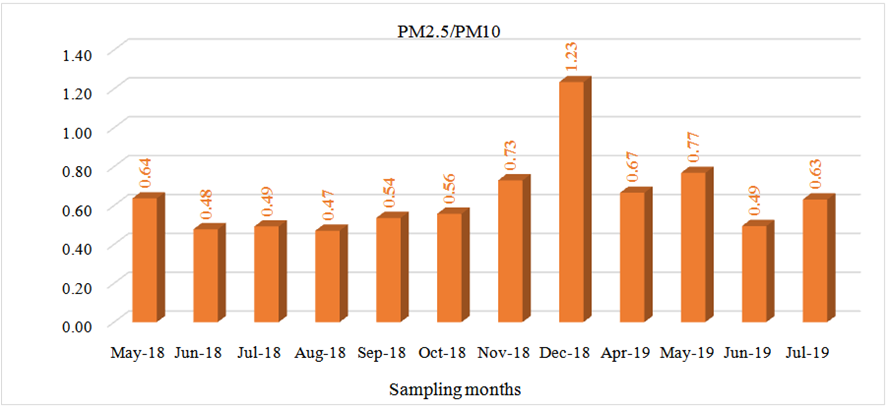
Table 2 shows the average ratios of PM2.5 and PM10 mass concentration. The lowest value (0.47) was recorded in August 2018 (Figure 4) during which there is a significant decrease of the companies activities because it is the holiday period.
The highest average ratio (1.23) was obtained in December 2018. December 2018, in relation to the weather conditions 22, had the lowest rainfall and was among the coldest over the investigated period. Such meteorological conditions, could originate an accumulation of suspended fines particles in the air while coarse particles were deposited on the ground very close to their sources area.
The monthly ratio trend presented in Figure 4 showed that instead of December 2018, all the other months gave a ratio below 1.0. The obtained mean value of 0.64 suggested that most of the data collected were dominated by coarse particles. Hence, PM pollution was associated to sources of incomplete combustion 23 which were consistent with heavy industrial activities and vehicular traffics that characterize the study area.
PM and BC mass concentrations were studied for 12 months. A high variability was observed in mass concentrations. The results showed that during the study period:
• Both PM10 and PM2.5 mass concentrations were much higher than the guide values recommended by WHO.
• Coarse particles made up a large portion of the collected aerosols, indicating that sources of incomplete combustion and natural activities were the mayor sources of particulate matter pollution in the industrial zone of Yopougon.
• Black Carbon was found to be dominant in the fine fraction.
According to the results recorded from this study, the ambient air of the industrial area of Yopougon is highly polluted by particulate matters, not only the breathable fine particles but particles from natural activities that resulted in high PM10 values. Hence more studies were needed to be carried out in order to identify the sources and quantify the contribution of each source. The authorities should take some mitigation actions to improve the air quality in this area to prevent inhabitants from the harmful effects of these fine particles emissions sources.
This work was carried out with the support of the International Atomic Energy Agency (IAEA, Vienna-Austria) through the framework of the RAF7016 project.
All our gratitude to the East-Yopougon Departmental Direction of Health and also to the Direction of the Health Centre near the Abidjan Prison (MACA), where the sampler was located during the sampling campaign.
| [1] | Cristina, G., Frank, D.L., Valentin, F., “Air Quality in Europe”, European Environment Agency., 2013. | ||
| In article | |||
| [2] | Laden, F.; Neas, L. M.; Dockery, D. W.; Schwartz, J.,. “Association of fine particulate matter from different sources with daily mortality in six U.S. cities”. Environment Health Perspectives, 108, 941-947, 2000. | ||
| In article | View Article PubMed | ||
| [3] | Michael, F. W.; Daniel, L. C. “Air pollutants and the respiratory tract”, Taylor and Francis Group, 204 (2), May 2005. | ||
| In article | |||
| [4] | Ruzer, L. S.; Harley, N. H. “measurement dosimetry and health effects”. Aerosols handbook [S.l.]: CRC Press, 2004. | ||
| In article | View Article | ||
| [5] | Moreno, T., Jones, T.P., Richards, R.J., “Characterisation of aerosol particulate matter from urban and industrial environments examples from Cardiff and Port Talbot, South Wales, UK”, Science of the Total Environment, 334(335), 337-346, 2004. | ||
| In article | View Article PubMed | ||
| [6] | Pöschl, U., “Atmospheric aerosols composition, transformation, climate and health effects”, Angewandte Chemie International, 44 (46), 7520-7540, November 2005. | ||
| In article | View Article PubMed | ||
| [7] | Sandro, F., Stefania, G., Consiglio, N.D.R.B.; “Research Findings in support of the EU Air Quality Review Chapter 2: Particulate Matter”, European Commission., 2013. | ||
| In article | |||
| [8] | Menson S., Hansen J., Nazarenko L., Luo Y., “Climate Effects of Black Carbon Aerosols in China and India”, SCIENCE , 297 (5590), 2250-2253, September 2002. | ||
| In article | View Article PubMed | ||
| [9] | Florie, C., “Mesures de Black Carbon : bilan 2016”, Air paca Qualité de l’air ,2-13, mai 2017. Available : http:// www.airpaca.org [Accessed August, 2020]. | ||
| In article | |||
| [10] | Djossou, J., Léon, J.F., Barthélemy, A.A., “Mass concentration, optical depth and carbon composition of particulate matter in the major southern West African cities of Cotonou (Benin) and Abidjan (Côte d’Ivoire)”, Atmospheric Chemistry. Physics, 18(9), 6275-6291, May 2018. | ||
| In article | View Article | ||
| [11] | Madina D., N’Datchoh E. Toure, S.S., Véronique, Y., Arona, D. and Célestin H., “Emissions from the Road Traffic of West African Cities: Assessment of Vehicle Fleet and Fuel Consumption”. Energies, 11(9), 2300, September 2018. | ||
| In article | View Article | ||
| [12] | Institut National de la Statistique Côte d’Ivoire, “Résultats Globaux-INS”, pages 14-15, 2014. | ||
| In article | |||
| [13] | Cyrys, J., Heinrich, J., G., Hoek, K. Meliefste, H. E.,Wichman and Brunekreef, B., “Comparison Between different traffic-related particle indicators Elemental Carbon (EC), PM2.5 mass and Absorbance”. Journal of Exposure Analysis and Environmental Epidemiology, 13 (2): 134-143, April 2003. | ||
| In article | View Article PubMed | ||
| [14] | Etyemezian, V., Kuhns, H., Gillies, J., Green, M, Pitchford, M. and Watson, J., “Vehicle,. Based road dust emission measurement I: Methods and calibration”. Atmospheric Environment., 37 (32), 4559-4571, March 2003. | ||
| In article | View Article | ||
| [15] | Thomas, G., Lucy, O., Patrick, M., Christian, M., Nikos, M., Otto, H., Liba, P. and Nino, K., “Comparison of black smoke and PM2.5 levels in Indoor and outdoor environments of Four European Cities”. Environmental Science Technology., 36 (6), 1191-1197, March 2002. | ||
| In article | View Article PubMed | ||
| [16] | Janssen, N.A.H., Van Vliet, P.H.N., Aarts, F., Harssema, H. and B. Brunekreef, “Assessment of exposure to traffic related air pollution of children attending schools near motorways”, Atmospheric Environment, 35 (22). 3875-3884, August 2001. | ||
| In article | View Article | ||
| [17] | Gagel, A., “Simultaneous black smoke and airborne particulate immission measurement by means of an automated combined instrument”. VDI-Report 1257, 631-645, 1996 | ||
| In article | |||
| [18] | Willy, M., “Long‐term atmospheric aerosol study at urban and rural sites in Belgium using multi‐elemental analysis by particle‐induced x‐ray emission spectrometry and short‐irradiation instrumental neutron activation analysis”, x-ray-spectrometry, 27(4), 236-246, July/August 1998. | ||
| In article | View Article | ||
| [19] | Salam, A., Bauer, H., Kassin, K., Ullah, S.M and Puxbaum, H. “Aerosol chemical characteristics of a mega-city in Southeast Asia (Dhaka, Bangladesh}”, Atomspheric Environment, 37(18) 2517-2528, june 2003. | ||
| In article | View Article | ||
| [20] | Republic of Côte d’Ivoire, Social security code, Ministry of Environment and Sustainable Development, September 14, 2017. Available: Official Journal N°74 of the Republic of Côte d’Ivoire. | ||
| In article | |||
| [21] | WHO, “WHO Air Quality Guidelines for Particulate Matter Ozone, Nitrogen Dioxide and Sulfur Dioxide”, Genèse, 2006. | ||
| In article | |||
| [22] | Marcazzan, G.M., Valli, G. and Vecchi, R., “Factors Influencing mass concentration and Chemical Composition of fine aerosols during a PM high pollution episode”, Science of Total Environment, 298(1-3), 65-79, October 2002. | ||
| In article | View Article | ||
| [23] | Marcazzan, G.M., Valli, G. and Vecchi, R., “Characterisation of PM10 and PM2.5 particulate matter in the ambient air of Milan (Italy)”, Atmospheric Environment, 35(27), 4639-4650, September 2001. | ||
| In article | View Article | ||
Published with license by Science and Education Publishing, Copyright © 2021 Alloman Joseph Popouen, Koudou Djagouri, Djama Djoman Alfred AGBO, Aka Antonin Koua and Alain Georges Monnehan
 This work is licensed under a Creative Commons Attribution 4.0 International License. To view a copy of this license, visit
http://creativecommons.org/licenses/by/4.0/
This work is licensed under a Creative Commons Attribution 4.0 International License. To view a copy of this license, visit
http://creativecommons.org/licenses/by/4.0/
| [1] | Cristina, G., Frank, D.L., Valentin, F., “Air Quality in Europe”, European Environment Agency., 2013. | ||
| In article | |||
| [2] | Laden, F.; Neas, L. M.; Dockery, D. W.; Schwartz, J.,. “Association of fine particulate matter from different sources with daily mortality in six U.S. cities”. Environment Health Perspectives, 108, 941-947, 2000. | ||
| In article | View Article PubMed | ||
| [3] | Michael, F. W.; Daniel, L. C. “Air pollutants and the respiratory tract”, Taylor and Francis Group, 204 (2), May 2005. | ||
| In article | |||
| [4] | Ruzer, L. S.; Harley, N. H. “measurement dosimetry and health effects”. Aerosols handbook [S.l.]: CRC Press, 2004. | ||
| In article | View Article | ||
| [5] | Moreno, T., Jones, T.P., Richards, R.J., “Characterisation of aerosol particulate matter from urban and industrial environments examples from Cardiff and Port Talbot, South Wales, UK”, Science of the Total Environment, 334(335), 337-346, 2004. | ||
| In article | View Article PubMed | ||
| [6] | Pöschl, U., “Atmospheric aerosols composition, transformation, climate and health effects”, Angewandte Chemie International, 44 (46), 7520-7540, November 2005. | ||
| In article | View Article PubMed | ||
| [7] | Sandro, F., Stefania, G., Consiglio, N.D.R.B.; “Research Findings in support of the EU Air Quality Review Chapter 2: Particulate Matter”, European Commission., 2013. | ||
| In article | |||
| [8] | Menson S., Hansen J., Nazarenko L., Luo Y., “Climate Effects of Black Carbon Aerosols in China and India”, SCIENCE , 297 (5590), 2250-2253, September 2002. | ||
| In article | View Article PubMed | ||
| [9] | Florie, C., “Mesures de Black Carbon : bilan 2016”, Air paca Qualité de l’air ,2-13, mai 2017. Available : http:// www.airpaca.org [Accessed August, 2020]. | ||
| In article | |||
| [10] | Djossou, J., Léon, J.F., Barthélemy, A.A., “Mass concentration, optical depth and carbon composition of particulate matter in the major southern West African cities of Cotonou (Benin) and Abidjan (Côte d’Ivoire)”, Atmospheric Chemistry. Physics, 18(9), 6275-6291, May 2018. | ||
| In article | View Article | ||
| [11] | Madina D., N’Datchoh E. Toure, S.S., Véronique, Y., Arona, D. and Célestin H., “Emissions from the Road Traffic of West African Cities: Assessment of Vehicle Fleet and Fuel Consumption”. Energies, 11(9), 2300, September 2018. | ||
| In article | View Article | ||
| [12] | Institut National de la Statistique Côte d’Ivoire, “Résultats Globaux-INS”, pages 14-15, 2014. | ||
| In article | |||
| [13] | Cyrys, J., Heinrich, J., G., Hoek, K. Meliefste, H. E.,Wichman and Brunekreef, B., “Comparison Between different traffic-related particle indicators Elemental Carbon (EC), PM2.5 mass and Absorbance”. Journal of Exposure Analysis and Environmental Epidemiology, 13 (2): 134-143, April 2003. | ||
| In article | View Article PubMed | ||
| [14] | Etyemezian, V., Kuhns, H., Gillies, J., Green, M, Pitchford, M. and Watson, J., “Vehicle,. Based road dust emission measurement I: Methods and calibration”. Atmospheric Environment., 37 (32), 4559-4571, March 2003. | ||
| In article | View Article | ||
| [15] | Thomas, G., Lucy, O., Patrick, M., Christian, M., Nikos, M., Otto, H., Liba, P. and Nino, K., “Comparison of black smoke and PM2.5 levels in Indoor and outdoor environments of Four European Cities”. Environmental Science Technology., 36 (6), 1191-1197, March 2002. | ||
| In article | View Article PubMed | ||
| [16] | Janssen, N.A.H., Van Vliet, P.H.N., Aarts, F., Harssema, H. and B. Brunekreef, “Assessment of exposure to traffic related air pollution of children attending schools near motorways”, Atmospheric Environment, 35 (22). 3875-3884, August 2001. | ||
| In article | View Article | ||
| [17] | Gagel, A., “Simultaneous black smoke and airborne particulate immission measurement by means of an automated combined instrument”. VDI-Report 1257, 631-645, 1996 | ||
| In article | |||
| [18] | Willy, M., “Long‐term atmospheric aerosol study at urban and rural sites in Belgium using multi‐elemental analysis by particle‐induced x‐ray emission spectrometry and short‐irradiation instrumental neutron activation analysis”, x-ray-spectrometry, 27(4), 236-246, July/August 1998. | ||
| In article | View Article | ||
| [19] | Salam, A., Bauer, H., Kassin, K., Ullah, S.M and Puxbaum, H. “Aerosol chemical characteristics of a mega-city in Southeast Asia (Dhaka, Bangladesh}”, Atomspheric Environment, 37(18) 2517-2528, june 2003. | ||
| In article | View Article | ||
| [20] | Republic of Côte d’Ivoire, Social security code, Ministry of Environment and Sustainable Development, September 14, 2017. Available: Official Journal N°74 of the Republic of Côte d’Ivoire. | ||
| In article | |||
| [21] | WHO, “WHO Air Quality Guidelines for Particulate Matter Ozone, Nitrogen Dioxide and Sulfur Dioxide”, Genèse, 2006. | ||
| In article | |||
| [22] | Marcazzan, G.M., Valli, G. and Vecchi, R., “Factors Influencing mass concentration and Chemical Composition of fine aerosols during a PM high pollution episode”, Science of Total Environment, 298(1-3), 65-79, October 2002. | ||
| In article | View Article | ||
| [23] | Marcazzan, G.M., Valli, G. and Vecchi, R., “Characterisation of PM10 and PM2.5 particulate matter in the ambient air of Milan (Italy)”, Atmospheric Environment, 35(27), 4639-4650, September 2001. | ||
| In article | View Article | ||