This paper demonstrates that the pitch angle of a spiral galaxy can be calculated from the spiral arm simulation based on the new ROTASE model for the formation of spiral arms of galaxies, the new spiral equations from the model are more universal than other spiral formulas. A spiral arm length weighted average method is proposed to more fairly calculate the average pitch angle for the entire galaxy. The spiral patterns of the galaxy J101652.52, the galaxy NGC 4314 and NGC 210 are nicely simulated by the ROTASE model and their average pitch angles are calculated. The spiral patterns of the galaxy J101652.52 is a Sbc type galaxy with well-defined short arms; the spiral pattern of NGC 4314 is made of two identical rings, each ring is made of a half small inner ring and a half large outer ring, each ring crosses other ring twice with chain-link style, the quality of the spiral arm decreases along the spiral arm line due to aging of X-matter stream. The NGC 210 shows a nice spiral-ring pattern. The special spiral patterns of galaxies NGC 4314 and NGC 210 fully match the ROTASE model. Total of 15 pitch angles of galaxies are calculated and listed in this paper. The size of the spiral arms may not be limited by 4/1 Lindblad resonance due to the possible non-gravitational/anti-gravitational property of the X-matter. The results show that the average pitch angle of the galaxy heavily depends on the length of the spiral arms and decreases quickly within the one loop of spiral arm winding range, the age of the spiral arms and the quality of the galactic disc have strong impact on the length of the spiral arms and on the value of the average pitch angle of the galaxies. If the spiral pattern of a galaxy can be well simulated by a formula, then the pitch angle obtained from the simulation will be more accurate than other methods with automated computer signal picking from images which have substantial interarm signals and strong background and foreground signals. The new findings in this study indicates that the correlation between the average pitch angle of the spiral arms and the mass of central supermassive black hole may be unreliable due to the heavy dependence of pitch angle on the length of the spiral arm. Spiral patterns with central symmetry can only be initiated/started at the galactic centers, any non-central spiral arm initiators cannot produce such patterns. The density waves proposed for the spiral arm formation do not exist in the disc galaxies. A completely new mechanism has to be adopted to describe the formation of the spiral arms. The ROTASE model is just the first attempt in this direction, but certainly not the last, other different models may come up in the future.
Pitch angle (PA) of spiral arms is one of the key parameters to characterize the structural morphology of the spiral galaxies. It is defined as the angle between the tangent of the spiral arm and the tangent of the circle at the same spiral arm location with its center located the galactic center. The PA measures the tightness of the spiral arms, such tightness is believed to be possibly related to mass of the supermassive black hole (SMBH) at the galactic center 1, 2, small PAs (more tightness) may reflect larger SMBH mass. Such PA-SMBH relationship is one of the current hot researches in astronomy. There are many ways to extract the PAs from galactic images, such as the manual arm fitting 3, a window method to determine the PA as a function of scale and position 4, one-dimensional Fourier decomposition 5, two-dimensional fast Fourier transform 2DFFT 6 and its parallelized descendent P2DFFT 7, they all have pros and cons. For the manual fitting, a suitable spiral mathematical function has to be used, the common formulas are the logarithmic, Archimedean or hyperbolic spirals, however, most of the galactic spirals do not fit those formulas well. For computer automated methods (one or two-dimensional Fourier transform), it may be difficult to distinguish arm signal from inter arm noise; the starting and ending points of the spirals have to be recognized and the galactic bars have to be excluded 8. Hewitt and Treuthardt recently proposed improved version of P2DFFT called P2DFFT:TRACED to input the arms which are visually traced from images rather than the directly input of the galaxy images 9. The author recently proposed a new hypothesis called Rotating Two Arm Sprinkler Emission model (for short, ROTASE model) to explain the formation of the spiral arms of galaxies 10, 11, a set of mathematical spiral formulas was derived from this model, 15 spiral galaxies with substantially different/unusual patterns have been precisely simulated, galaxies with spiral arms broken connection with galactic bars are nicely explained; for the first time, it also clearly reveals that the double ring (a small inner ring and a large outer ring) spiral structure of NGC 7098 and UGC 12646 is actually made of two identical rings, each ring is made of a half inner ring and a half outer ring, the two rings cross each other twice with the chain-link style; the NGC 1079 has two identical rings and each ring cross other ring twice and cross itself once. It was also shown that the PA of whole spiral arm can be calculated after good simulation for spiral patterns of the galaxies is achieved 11. Each spiral galaxy has its unique spiral pattern just like human’s finger print, even the different sections of the same spiral arm have different characteristics such as luminosity, curvature, pitch angle, matter density, etc. A more universal spiral arm simulation method will be beneficial because when the spiral pattern of a galaxy can be well simulated, then more accurate pitch angle can be calculated than results by other automated methods such as one dimension and two-dimension Fourier transform methods because some of interarm signals and uneven distributed noises will be counted as valid signals in those automated methods. The successful simulation of 15 galactic spiral patterns demonstrates that the new spiral formulas are more universal than other spiral formulas, they can be used to find the actual spiral arm structures from images which may be difficult to be recognized with visual inspections and their PAs cannot be accurately extracted. This paper will demonstrate that the new spiral formulas can be applied to calculate PAs for those galaxies with special patterns by manual fitting method. The new spiral formulas will be the new addition to the current family of mathematical spiral formulas.
The proposed new model for the spiral arm formation was originally named as Rotating Double-side Sprinkle Emission model (for short, RDSSE model), and the mysterious matter emitted by the central supermassive black hole was named as “Imaginary Matter” in the first publication of the model 10, it was re-named as Rotating Two Arm Sprinkler Emission model (for short, ROTASE model) in second publication based on the readers’ comments, and the “Imaginary Matter” was re-named as “X-matter” for more properly reflecting the nature of the current knowledge about the mysterious unknown matter 11. The “X” means “unknown” similar to “X-ray” which was given for unknown radiation when it was discovered by the German scientist Wilhelm Conrad Röntgen in 1895. Since the ROTASE model is a new model to describe the formation of the spiral patterns of the galaxies, it is necessary to very briefly describe the ROTASE model here. Readers may refer the references for the detail of the model and derivation of the new spiral formulas 10, 11. In this model, the flat disc of the galaxy can be treated as an ideal rotating fluid system with flat rotation velocity, when the central super massive black hole evolves to a particular state, it will emit totally unknown matter called X-matter through its two opposite direction in the galactic plane, just like light beams emitted from a lighthouse, the X-matter will move for certain distance in a confined straight route, then, X matter will move freely with its initial emission velocity and will be dragged by the galactic rotation fluid, a spiral line is formed by the X-matter due to continuous emission of the black hole during its rotation; the X-matter has non-gravitational or antigravitational property, it is unknown if the X-matter has mass or is massless, it will gradually convert to hydrogens on the way of its motion, the extra hydrogens converted from X-matter temporarily increase the local hydrogen density and refuel the local stars and promote new start formation, the local luminosity is enhanced which is the observed spiral patterns and galactic bars. However, it has to be understood that the extra amount of hydrogens converted from X-matter does not significantly increase local gas density, but is high enough to refuel the existing local stars to be optically brighter and promote new star formation. The X-matter emission behavior of the black hole decides the spiral patterns. In previous reference papers 10, 11, the author used the new spiral formulas derived from the ROTASE model to simulate the spiral patterns of galaxies with various different morphology. In this paper, it will be demonstrated that the spiral pattern of the galaxies can be calculated by differential equations which are much simpler and more convenient for the computer programming. The original differential equations to derive the spiral formulas for the ROTASE model can be written as:
 | (1) |
Where
 | (2) |
The initial values of x and y are set as:
 | (3) |
 | (4) |
 | (5) |
Where, x and y are the coordinates of spiral arm point in the calculation, Rb is the half length of galactic bar, θ is the rotation angle galactic bar from the reference axis from which the X-matter is emitted, the rotation angle θ of the galactic bar can be used as time counting t as defined by:
 | (6) |
Vr is the rotation velocity of the end of the galactic bar, which is also the flat rotation velocity of the galactic disc. M is the total number of increments in the loop calculation for a given θ. The ρ is defined as the ratio of the X-matter emission velocity Ve(θ) over the flat rotation velocity Vr of the galactic disc,
 | (7) |
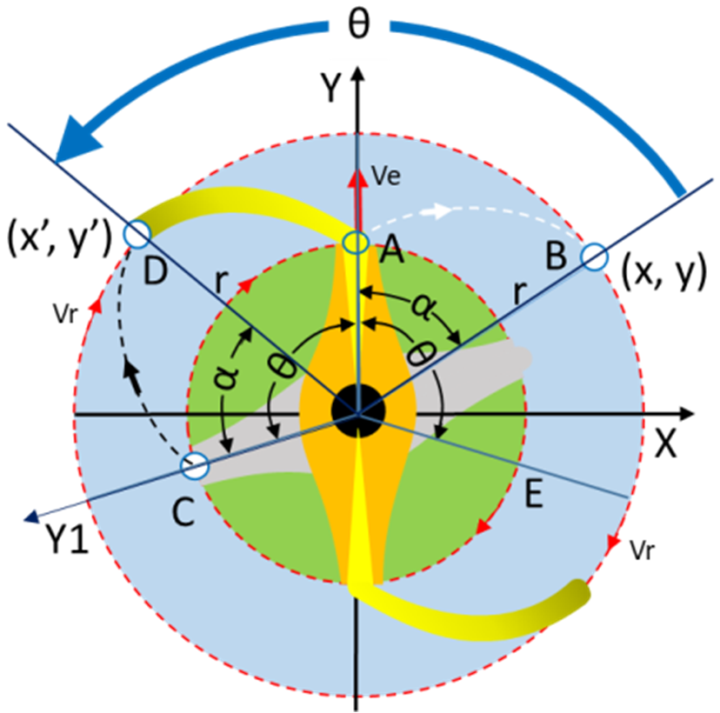
The parameter ρ is a pure number without any physical unit. The θ in equation (7) represents time. The emission velocity Ve of X-matter can change with time in any format, so does the ρ(θ), therefore, the parameter ρ will be the function of θ with assumption that the flat rotation velocity Vr is constant. It has to clearly explain how to calculate the spiral arms with the above equations. Assume that the parameter ρ changes with time (here the time is θ), say to calculate the spiral arm every degree up to total 100 degrees of galactic bar rotation angle in digital calculation by a computer program. As an example, let’s calculate the x and y coordinates for rotation angle 20° and set the dθ = 0.1 (the increment of θ is 0.1°). First, use equation (5) to calculate ρ(20) with defined function f(θ) such as a linear, or exponential, or Gaussian or any other suitable function, f(θ) can be a constant as a special case; then, put the value of ρ(20) into equations (1) with initial x0 and y0 values to calculate the first dx and dy, then use the calculated dx and dy to calculate x and y by equations (2); then, use the calculated x and y values to calculate next dx and dy, continue the loop calculation until sum of all dθ equals 20 (i.e., the equation (4) is met), the final x and y values (i. e., x(20) and y(20)) are the coordinates of X-matter during the 20° of galactic bar rotation angle time after the X-matter is emitted at A on Y axis as shown in Figure 1. The total number of the loop calculation M is 200; carry such calculation from 0° to 100°. The computer codes for this calculation is very simple. Each x(θ) and y(θ) will be rotated backward for the galactic bar rotation angle θ by following equations for the coordinates (x’ and y’) of the real spiral arm point:
 | (8) |
Rotating backward by equation (8) is critical as illustrated in Figure 1. The bar rotation angle θ is defined as positive angle in clockwise rotation, then, the rotation angle in counterclockwise will be negative.

In Figure 1, the Y axis of the reference frame for the calculation of the spiral arm is set at vertical position, the calculation of x and y coordinates for all bar rotation angle θ is based on the assumption that the X-matter exits the end of the galactic bar at the location A on the Y axis and the galactic disc rotates clockwise with constant rotation speed, the current galactic bar is set along the Y axis as current time “now”, i.e. the time is zero, the rotation angle θ of the galactic bar is zero. Therefore, the real observed spiral arm A-D is generated in the past. However, the calculation based on the ROTASE model is to calculate x and y coordinates at the location B of the X-matter exited at location A and moved to B during the time period that the galactic bar rotates θ angle clockwise from A to the location E, the r is the distance of B to the galactic center and α is the angle between r and the reference axis Y of X-matter exiting the end of the galactic bar. The actual spiral arm located at D is from the X-matter exited the end of galactic bar (gray) when it is at the location C in the past with the same length of the time (the same rotation angle θ) from current Y axis, the reference axis of D is Y1, the Y1 axis is the backward (counterclockwise) rotation of Y axis by (-θ) angle. Therefore, the motion (black dash line) of X-matter from C to D is exactly the same as the motion (white dash line) from A to B, the coordinates of D (x’ and y’) can be calculated by just backward rotation (-θ) of the coordinates (x and y) of B with the equation (8).
In general, spiral galaxies have two central symmetric spiral arms, use the steps above to calculate one spiral arm line, the other spiral line can be generated through symmetry. In case that the two arms of the galaxy do not have central symmetry, then, the two arm spiral lines have to be calculated separately. The above calculation also assumes the current galactic bar is along the Y axis and rotates clockwise, however, in real galaxies, the galactic bars may be along X axis and rotates counterclockwise, so it may have to exchange x to -x, or x to y, or x to -y to match the images of the galaxies.
Plotting x’(θ) and y’(θ) will produce the calculated spiral pattern. Further Euler rotation may be performed to match the orientation of line of sight respect to the galactic plane axis. In the calculation, the Rb can be set to 1, and the simulation plot will be scaled up or down to match spiral pattern of the image of the galaxy. The equations (1) can be viewed as parent spiral equations and the 4 formulas derived from the equations (1) as solutions can be viewed as child spiral equations (please refer the references for the detail of the ROTASE model and derivation of the differential equations and their solutions 10, 11), they both are equivalent and give the same results, but the differential equations (1) can be used for all ρ values. However, one has to choose a right spiral formula based on the ρ value (ρ > 1, or ρ =1, or ρ < 1) when using spiral formulas (the child spiral equations) to calculate the spirals, if ρ changes from less than 1 to greater than 1, three formulas have to be used.
For ρ < 1, the distance of X-matter to the galactic center is limited, which will produce a beautiful spiral-ring pattern, the maximum distance r is also the radius of the ring defined by the following equation:
 | (9) |
No other currently available models can give such equivalent result. The spiral ring patterns were addressed in detail in the references 10, 11.
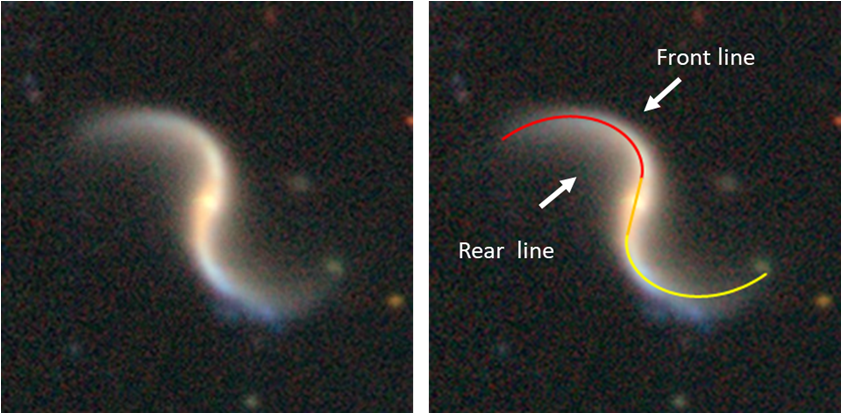
2.1. The Pitch Angle of the Galaxy J101652.52-004630.0The spiral galaxy J101652.52-004630.0 is a well-defined spiral galaxy with two short and very clean spiral arms shown in Figure 2 left without spurs and branches and random noisy spots. It will be a good model for the pitch angle calculation.
The two spiral arms have perfect symmetry with respect to the galactic center, it should be a Sbc type galaxy with open spiral arms. It can be precisely simulated with equations (1) with constant ρ = 2.5 and 95° of galactic bar rotation angle, the simulation is shown in Figure 2 right, the galactic bar is clearly displayed and excluded during pitch angle calculation. As demonstrated in reference 11 that the pitch angle along the entire spiral arms of the galaxy can be easily calculated after good simulation is achieved. Figure 3 shows the pitch angle of the galaxy J101652.52-004630.0 changes with length of the arm from the galactic bar end.


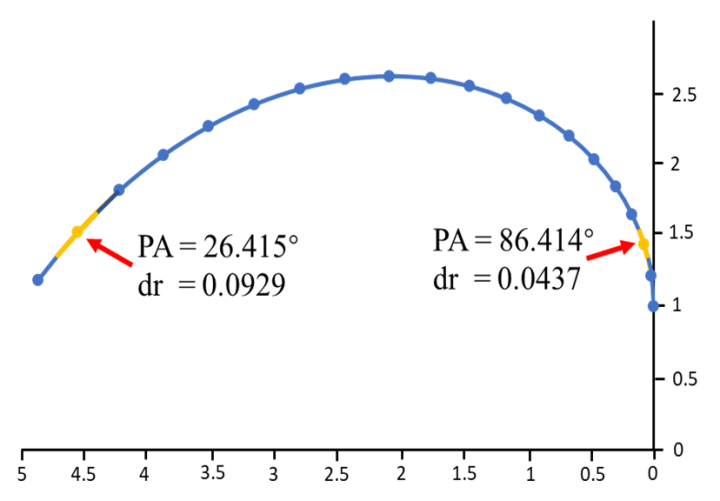
One can see that the pitch angle decreases with the length of spiral arm significantly, at the beginning of the arm near the bar end, it is almost perpendicular to the galactic bar so its pitch angle is 89°, very large; then, the pitch angle decreases quickly along the arm line, at the end of visible arm, the pitch angle is about 26.2° which is about 30% of the beginning value. Since the pitch angle of a galaxy is the average pitch angle of the entire galaxy, a reliable way has to be used to fairly reflect the reasonable contributions from all different parts of the galaxy. Here, an averaging method called Spiral Arm Length Weighted Average (SALWA) is proposed. This method is based on the fact that every equal variable increment (here: dθ) does not produce equal length of the spiral arm in the spiral arm calculation as clearly shown in Figure 4.

In Figure 4, the simulation of the spiral arm is plotted with every 5 degree galactic bar rotation angle which is used as the variable for the calculation (in actual calculation, the data points were calculated with every degree of bar rotation angle from 0° to 95°), one can see that the density of the data points gradually decreases from beginning at the right to the end of line at the left, in other words, the distance between the data points gradually increases along the arm line from the beginning to the end, the pitch angle at the third data (orange) point from the beginning is 86.414°, but it only represents about 0.0437 (dr) unit length of spiral arm section; however, the second last data (orange) point at the end of arm line at the left has much smaller pitch angle of 26.415°, but it represents about 0.0929 unit length of arm section, which is more than twice of the data (orange) point at the right. So, the proposed Spiral Arm Length Weighted Average (SALWA) pitch angle more fairly represents the entire galaxy, the SALWA pitch angle PA(w) is defined as:
 | (10) |
Where, the “w” in the PA(w) means “weighted”, the (PA)i is the pitch angle of ith data point, (dL)i is the spiral arm length at the ith data point, L is the total length of the spiral arm:
 | (11) |
Another method to average the pitch angle of entire galaxy is to simply add all pitch angles of all data points and the sum is divided by the total number of the data, this is the simple average pitch angle PA(s) defined as:
 | (12) |
Where, the “s” in the PA(s) means “simple”, the (PA)i is each individual pitch angle at the ith data point. N is the total number of data. Please note that the pitch angle in the Figure 2 and Figure 3 is the (PA)i. and all pitch angles are calculated using the simulation data before Euler rotation, i.e., the pitch angle is calculated with Face-on simulation data.

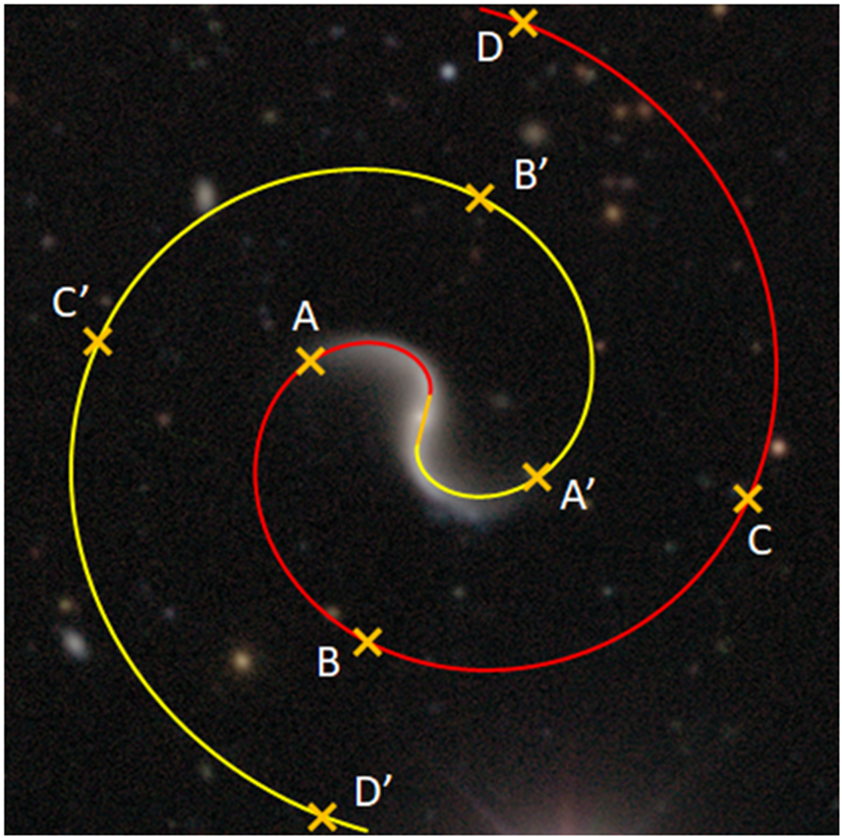
Based on the calculation with the simulation data and equation (10), the derivative of the spiral line and the tangent angle can be easily calculated, therefore, the calculated PA(w) of the galaxy J101652.52-004630.0 is 42.62°, the simple average pitch angle PA(s) is 46.77°, this value is larger than the PA(w) value, and reflects that the pitch angles in the beginning portion of the spiral arm is over contributed to the average pitch angle value. Due to the fact that the galaxy J101652.52-004630.0 has short spiral arms, in classical theory of the stellar dynamics of spiral galaxies, the size of the disc galaxies may be limited by 4/1 Lindblad resonance 12. However, in ROTASE model, the spiral arms are formed from the X-matter with nongravitational or anti-gravitational property, not by density waves, the limitation of the 4/1 Lindblad resonance on the size of galactic disc may not be followed. The length of the spiral arm of the galaxy J101652.52-004630.0 may grow longer in the future. It will be interesting to ask “what will happen to the PA(w) if its spiral arms get longer? Change significantly or not much?”. Figure 5 shows the extended simulation of the galaxy with one full loop of winding calculation, the bar rotation angle for this calculation is 390°.
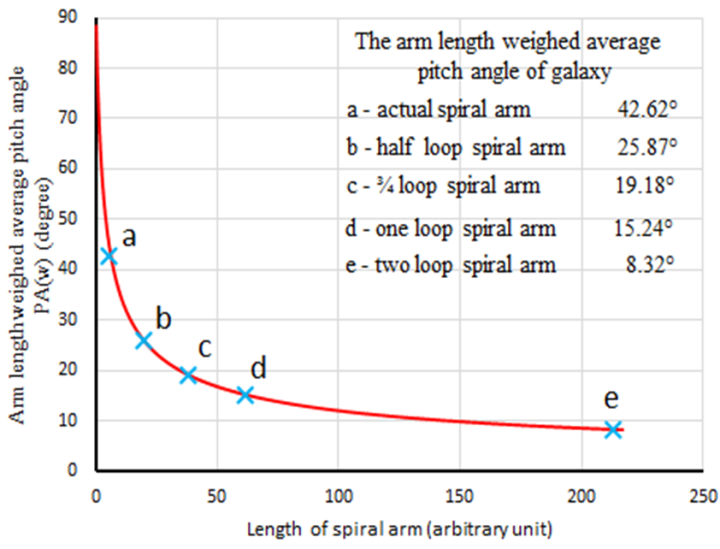
In Figure 5, the AA’ mark the end of visible spiral arms, BB’ mark the half loop spiral winding, the length of the visible spiral arms (up to AA’) is about only 30% of length of half loop winding; CC’ mark ¾ of the extended loop winding and DD’ mark an extended full loop winding. Figure 6 shows the extended calculation of the pitch angle PA(w) change with the length of the arm (up to 2 loop winding).

Figure 6 shows that if the visible spiral arm of the galaxy increases to a half loop winding, the average pitch angle PA(w) of the galaxy will drop to 25.87°; the PA(w) will drop to 15.24° if the visible arm is extended to a full loop winding length; the PA(w) will drop to 8.32° if the arm length increases to 2 full loop winding. Therefore, the PA(w) decreases sharply with the spiral arm length within one loop winding arm range, so, the PA(w) heavily depends on the spiral arm length, the impact of the spiral arm length on the PA(w) is far more than the impact by the mass of the central SMBH. Most of the spiral arm galaxies have spiral patterns with less than full loop winding spiral arms. The length of the spiral arms is affected by many factors such as the age of arms, the quality of the galactic disc which includes the uniformity of the flat rotation velocity and mass distribution, local fluid vortex and outside celestial objects, etc. the morphology of the spiral patterns changes dynamically in all time scale. The angular momentum and the gravity may also affect the length of arms (the size of galactic disc). Therefore, the correlation between the pitch angle PA(w) of the galaxy with the mass of its central SMBH could be unreliable, even such correlation could exist for a small group of galaxies, it will be very weak. It has to be pointed out that the Figure 5 does not mean that the spiral arms of this galaxy will certainly grow much longer in the future. It is certain that its spiral pattern will dynamically change in all time scale; however, it is a good model to illustrate the dependence of the average pitch angle of a galaxy on the length of spiral arms.
This galaxy rotates clockwise based on the image, the spiral arm profile has very clean distinguishable front line and very blurry/disperse rear line, this phenomenon is the result of the interaction between two fluids with different motions, the X-matter fluid stream moves in the rotating fluid of the galactic disc and is dragged by the rotating fluid, the front line of X-matter fluid stream faces the “head wind” and the rear line is at the “downwind”, fully matches the ROTASE model. The whole spiral pattern of the galaxy is “exact” same as the spiral water lines of the two-arm sprinkler watering the lawn shown in the Figure 3 of the reference 11.
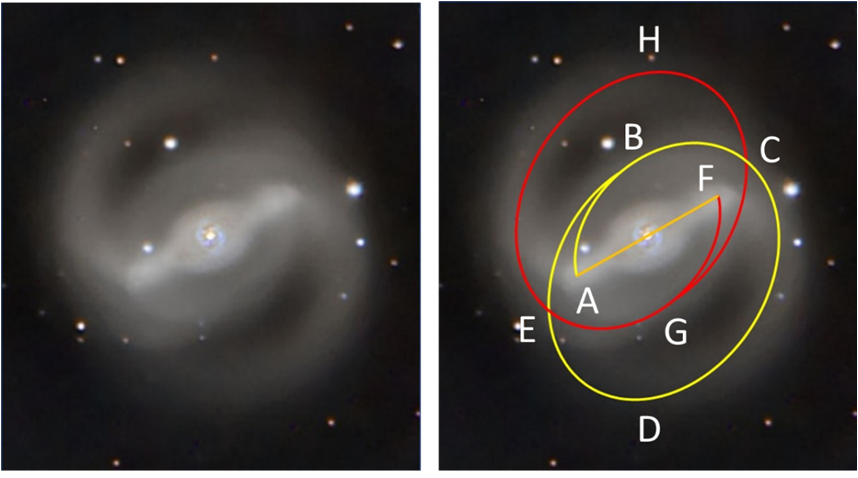
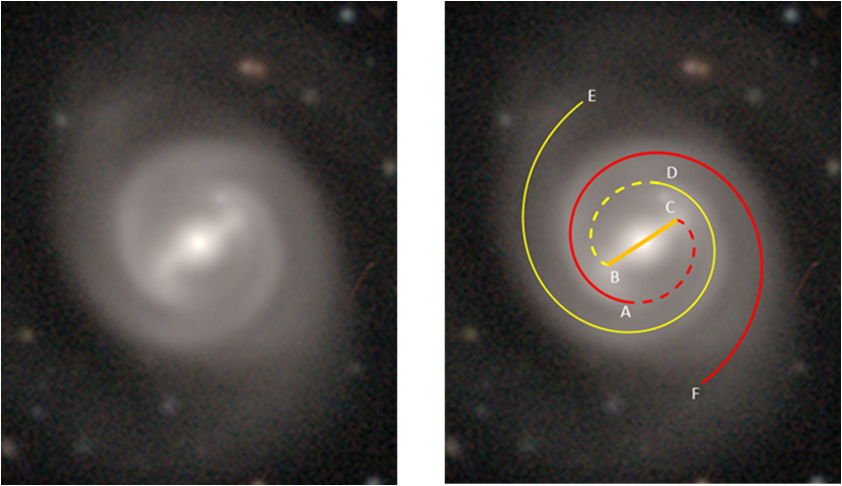
2.2. Pitch Angle of the Galaxy NGC 4314Figure 7 left is the original image of the galaxy NGC 4314. By visual inspection, this galaxy can be easily recognized as a double ring pattern similar to NGC 7098 and UGC 12646 which were studied in detail in the reference paper 11. The spiral pattern can be precisely simulated by the ROTASE model shown in Figure 7 right, the total bar rotation angle for this calculation is 530°. For this type of double ring spiral patterns, the parameter ρ change with time (here the θ) for NGC 4314 follows the general Gaussian equation:
 | (13) |
The  is the maximum value of ρ, k is a constant controlling the width of the Gaussian profile,
  is the angle (time) in the past from now, at the
  the X-matter has the peak emission. For NGC 4314,
  = 0.57, k = 0.00007 and
  The peak emission of the X-matter by the central black hole is back to 350° of galactic bar rotation time in the past. The spiral pattern of NGC 4314 is made of two identical rings (yellow line ring and red line ring), the yellow line ring starts at the galactic bar end A, extends to the inner half ring B, then to the point C where it crosses the red line arm; at this cross point, the luminosity of the yellow line arm is much stronger than the red line arm and looks on “top” of the red line arm because the red line arm in this area almost fades away; the yellow line arm continues to the outer half ring D, then to the point E where it crosses the red line arm again, but, at this cross point, the yellow line arm luminosity is much weaker than the red line arm and almost fades away, so the red line arm is on “top” of the yellow line arm; the yellow line arm then reach inner half ring B to complete the ring. The red line arm has the same characteristics. Therefore, each ring is actually made of a half small inner ring and a half large outer ring, the two identical rings cross each other twice with the chain-link style; Please refer the reference for the detailed explanation of the “chain-link style” 11. The image clearly shows that the quality of the spiral arm decreases along the arm line which reflects the age of the spiral arm, fully matches the ROTASE model. The age of the arm is defined as the time after the X-matter exits the end of galactic bar, the amount of the X-matter gradually decreases with the age of the X-matter due to conversion to hydrogens, and the amount of converted hydrogens gradually decreases also. The quality of the X-matter fluid stream also further decreases with time due to fluid diffusing/spreading. It has to be specially pointed out that the age of spiral arms and the age of the stars in the spiral arms are totally unrelated, the age of yellow line arm at E area is much older than the yellow line arm at C area, but the age of stars in the E area is the same as the stars in the C area. The inclination of the galaxy respect to the line of sight will make one spiral arm closer to the observer and will be brighter than other more far away arm, because the light from more far away arm has to go through more inter stellar dust; however, such attenuation of luminosity does not change the characteristics that the quality (luminosity) of the arm sequentially decreases along the arm line from the end of galactic bar, both arms CDE and EHC show the sequential decrease of the quality (luminosity) along the arm lines from the ends of the galactic bar no matter which one is closer to us. Such sequential decrease of the quality (luminosity) along the arm line is due to the decrease of the converted hydrogens and the X-matter diffusing/spreading.

It has to be pointed out that the new stars promoted by the extra hydrogens converted from X-matter should have similar ages along the entire spiral arm lines which are the X-matter stream bands, this completely matches the observation that star-forming regions in the spiral arms have a narrow range of ages, this is because new stars form at the same time from the extra hydrogens in the entire sweeping regions by X-matter bands.
The calculated average pitch angle PA(w) of this galaxy is 12.77° and the simple average pitch angle PA(s) is 17.75°, respectively. For comparison, the pitch angle by Hewitt and Treuthardt with improved P2DFFT:TRACE method is 12.53° 9, which matches the SALWA pitch angle PA(w) very well. The good match of the two results from different methods could be based on the fact that quality of the image of the galaxy is very good, it shows clean double ring pattern with well-defined spiral arm profile, there are not much inter arm signals or scattered high luminosity spots to interference the computer’s signal picking and the galactic bar has clear sharp ends which can be excluded during the visual tracing. The simple average pitch angle seems significantly higher than the SALWA pitch angle because of the high pitch angles near the galactic bar area over expressed in this average. So, the SALWA pitch angle seems more accurate.
It is well known that stars burn hydrogens to make them bright. The visible galactic bar and spiral arms are optical effect and rotate together as “rigid” pattern and does not co-rotate with the galactic disc, not materialized as a solid object, has no effect on the motion of local stars and the distribution of stars 10. The image of this galaxy shows a very bright and straight galactic bar if it is the original image without image processing. Such bright bar indicates that the concentration of hydrogens in the bar area is much higher than other area. This characteristic matches the ROTASE model very well. As described in the reference 11, the X-matter is emitted by central SMBH like light beams from a lighthouse, it will gradually convert to hydrogens after leaving the black hole, the amount of X-matter will decrease along its moving line, so the amount of converted hydrogens will decease also, this makes the amount of X-matter in the galactic bar area is much higher than spiral arm area, therefore, the amount of hydrogens converted from X-matter in the bar area will be much higher than spiral arm area, however, this does not mean that the bar is mainly composited with gas, the old stars are still the main components of the bar, and the X-matter only slightly increases the hydrogens which make the stars in this whole X-matter band regions brighter. The bright bar is perfectly straight through the central black hole from end to end and has sharp endings at the A and F labeled on the image, this clearly reflects that the X-matter stream is confined in a straight narrow pipe-like channel by a mysterious unknown mechanism and the converted hydrogens in this channel refuels the very dense stars and promote new star formation, continuous emission of X-matter by the central black hole provides stable supply of the hydrogens and make sustainable glowing of bright galactic bar through entire history of the spiral pattern. If the X-matter emission stops or reduces, its spiral pattern will have dramatical change like Hoag’s object and the galaxy MCG00-04-051 (see below). When the X-matter exits the confined pipe-like channel, it is immediately dragged by the rotating galactic disc fluid, the fluid stream of the X-matter is sharply bent immediately at the ends of galactic bar; the quality of the spiral arm gradually decreases along the spiral arm lines due to aging. There is a prominent ring of star formation around the galactic nucleus, the hydrogens for the new star formation in this ring are from the conversion of the X-matter. All those special features match the ROTASE model very well. No other models can explain such bright and straight bar structure, if the hydrogens come from outside of bar area by strong gravitational force of the SMBH, it would be expected that the hydrogens should come from all directions and should be more or less evenly distributed in whole area of the bar rotation circle due to bar rotation, and the density of hydrogens should gradually increase with the decrease of radius. In reality, it is impossible that the hydrogens can be concentrated in such straight pipe-like channel by gravitational force. The galaxy NGC 4314 is a perfect representative of the ROTASE model.

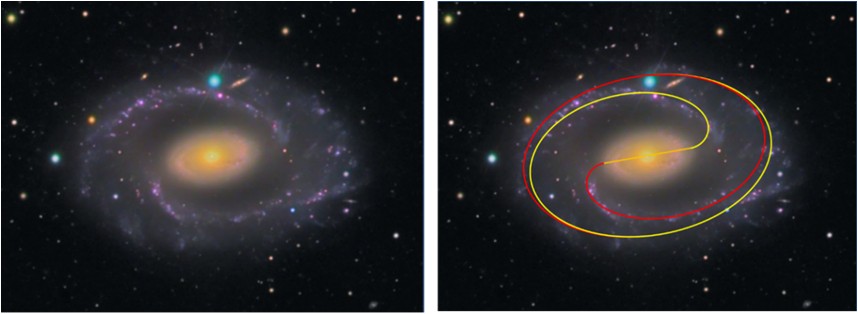
Figure 8 left is the original image of galaxy NGC210. The image of this galaxy shows that it is a spiral-ring pattern but the quality of the arms seems not so good, the spiral arm profiles are not well defined, there are a lot of inter arm signals and scattered high luminosity spots around the ring area, this may cause some problem for automated method in which the accurate discrimination of the spiral arm from random noises will be difficult. The spiral pattern of this galaxy can be nicely simulated by the ROTASE model with formulas (1) and the constant ρ = 0.65 shown in Figure 8 right, the total bar rotation angle for this simulation is 530°. The radius of the ring can be calculated by the equation (9). The spring-ring pattern is the special case of the chain-link two ring patterns with parameter  = 0.65 and k = 0 in the equation (13), the two rings are perfectly overlapped 11.
The SALWA pitch angle PA(w) is 6.06° and the simple average pitch angle PA(s) is 10.62° respectively. The pitch angle calculated by Hewitt and Treuthardt with improved P2DFFT:TRACE is 10.54°, which matches the simple average pitch angle, this may reflects that the P2DFFT:TRACE method may still pick up some inter arm signals and random high luminosity spots inside the galactic disc area.
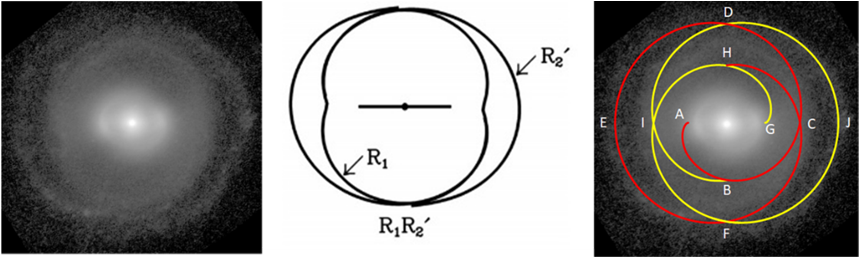
2.4. The Pitch Angle of the NGC 1079NGC 1079 is a very interesting and complicated spiral ring galaxy, it was studied in detail and simulated in the reference, the Figure 9 is the duplicated original image and its simulation by ROTASE model from the reference 11.
Figure 9 left is the original image of NGC 1079. If one just looks at this image, it will be difficult to figure out the spiral arm profile without extensive experience, where the spiral starts and where the spiral ends; computer signal picking may be unclear either. Buta made nice depiction of the pattern profile shown in the middle of Figure 9 13, but it still does not show where the spiral starts and where it ends. Fortunately, this unique spiral pattern can be precisely simulated in the reference by ROTASE model with formulas and parameter ρ following the general Gaussian equation (13) with  = 0.655, k = 0.00001 and
  Figure 9 right is the simulation, the total bar rotation angle for this simulation is 720°. It clearly reveals how the spiral arms are wound. This is very complicated spiral pattern which can only be precisely simulated by the ROTASE model at the moment. The red line arm starts at bar end A, extends to inner half ring B, then reaches C, extends to D, at D it crosses the yellow line arm, then extend to outer ring E, then extends to F, at F it crosses the yellow line again, then back to C and crosses itself at C, then reaches H to finish the pattern. The yellow line arm has the same characteristics. Each arm crosses other arm twice and cross itself once, such interesting information can only be revealed by the ROTASE model at the moment, the pattern is far more complicated than NGC 4314. Now, the pitch angle of this galaxy can be easily calculated from the simulation data, the SALWA pitch angle PA(w) is 8.44° and the simple average pitch angle PA(s) is 14.41°.
The galaxy MCG00-04-051 is a very interesting galaxy shown in Figure 10 left, because it has apparently broken connection of spiral arms with the ends of galactic bar, such phenomenon was believed to be that the arms rotate ahead of the galactic bar due to the direct impression in which the inner end of the spiral arms are “ahead” of closest galactic bar ends 14. However, the ROTASE model reveals that the arms actually rotate behind of the galactic bar ends from which the arms are generated. It was studied in detail in the reference 11. With careful inspection, one can find that one (red) arm does not completely break the connection with the galactic bar end C, a weak but still visible section AC of the arm connects the arm end A to the galactic bar end C. The galaxy was precisely simulated in the reference by the ROTASE model with formulas and the following parameter ρ equation:
 | (14) |


The Figure 10 right shows the simulation, the total bar rotation angle for this simulation is 550°. The red dash section of arm is the weak but clearly visible in the original image, so it is the solid proof that the red line arm is generated at the galactic bar end C and the yellow line arm is generated at the galactic bar end B, the yellow dash line section of the arm is not visible. The inner arm end D is so close to the bar end C that it will instantly give people the false impression that the D rotates ahead of C. The ROTASE model explained this phenomenon that the central black hole stopped the X-matter emission at one side and caused the one arm disconnected from the galactic bar end, but still emits weak X-matter at other side and gives the weak but still visible red dash arm section AC. Such special phenomenon was predicted in the first version of this model, the image of this galaxy fully matches the prediction 10. The pitch angle of this galaxy can be nicely calculated from the simulation data. An interesting question arises from this galaxy, should the pitch angle calculation of the galaxy include the weak AC section and missing BD section? In here, both situations are considered. The SALWA pitch angle PA(w) is 9.86° without the weak and missing arm sections, the simple average pitch angle PA(s) is 9.92° without the weak and missing arm sections; the weighted pitch angle PA(w) is 9.82° including the weak and missing arm sections, the simple average pitch angle PA(s) is 13.90° including the weak and missing section. For automated methods with computer signal picking, most likely, the weak and missing arm section will be ignored.
Table 1 lists the average pitch angles of 15 galaxies calculated with simulation data from ROTASE model in the author’s published papers and new simulations in this paper, available pitch angle data from other publications are also included for comparison. One can see that the pitch angles of those galaxies calculated by ROTASE model are very compatible to the results of available references.
According to ROTASE model, the spiral pattern is decided by the behavior of the ρ, small ρ will make tightly wound spiral patterns, large ρ will make more open spiral patterns, as demonstrated in the references 10, 11. The previous researches by many people suggest that the smaller PAs may correlate large SMBH. However, the Figure 5 clearly shows that the PA(w) heavily depends on the length of the visible spiral arm, the galaxy NGC 1300 was simulated with parameter ρ = 0.65 in the reference 10, it should be a spiral-ring pattern if the quality of the galactic disc is good enough like NGC 210, but, the NGC 1300 shows only a half loop winding spiral arm pattern in its image, its PA(w) is 14.44° as listed in the Table 1, which is more than twice of the PA(w) of NGC 210 which is simulated with the same ρ value.
Compare the PA(w) of NGC 4314 with PA(w) of NGC 210, the PA(w) of NGC 4314 is much greater than the PA(w) of NGC 210. The parameter ρ of NGC 4314 change with time (the θ) follows Gaussian equation (13), the average ρ of the NGC 4314 is much smaller than 0.65 due to Gaussian distribution, however, its PA(w) is much greater than the PA(w) of NGC 210. This example clearly demonstrates that the behavior of ρ has strong impact on the PA(w) of the galaxy. The image of NGC 4314 also shows that the quality of the spiral arm sections DE and HC are low and almost fade away, and spiral arm sections CD and EH will gradually shrink, the points D and H will gradually move to C and E respectively with time due to aging, therefore, at some time in the future, the morphology of this galaxy will be totally different due to spiral arm aging and fading, the calculated PA will be significantly different in the future. Such PA(w) change caused by morphology change due to aging and fading is not correlated to the mass of the central SMBH.
The famous Hoag’s object has an almost perfect ring with a spherical bugle in the center without spiral structure, the pitch angle of the galaxy is expected to be zero or very close to zero, it is absolutely no ground to claim that the zero pitch angle correlates to the mass of a “super-super” massive black hole in the galactic center. There are many galaxies belonged to Hoag’s object family with similar morphology. However, such unique ring pattern was nicely explained in the references 10, 11, the formation of such ring pattern is due to the termination of the X-matter emission by the central black hole in its evolution sequence, the spirals were merged to the ring and the galactic bar shrank to be a small central spherical bugle. On other hand, the radius of the ring defined by the equation (9) could be correlated to the mass of the central black hole, this will be a very interesting topic of research.
For the purpose of the pitch angle calculation of spiral galaxies, one can use many currently available spiral equations such as the logarithmic, Archimedean, hyperbolic spirals or the more popular equation proposed by Ringermacher and Mead 18, or invent new mathematic spiral equations to accomplish such task. However, those formulas are just pure mathematic formulas to produce mathematical lines imitating the patterns of spirals without any physical models or mechanism, in other words, those spiral formulas do not have any physical meanings because they were not derived from any physical model or mechanism, cannot explain why a galaxy has its unique spiral pattern, and cannot predict the possible pattern change in the future. None of those pure mathematical spiral formulas can define the radius (like the equation (9)) of the ring of the spiral-ring galaxies. The new spiral formulas derived from ROTASE model are completely based on a physical model, they describe how the spiral arms are initiated and developed, what is the physical mechanism to make a spiral galaxy adopting its unique spiral pattern, the ROTASE model is not just to provide mathematical line pattern fitting, it also provides full physical description for the formation of the spiral patterns with interpretation of special features (spiral-ring pattern with radius of the ring defined by the equation (9), double ring pattern with double crossings with chain-link style crossing, triple ring crossings, spiral arm broken connection from bar ends, the quality or luminosity of the arms decreases along the arm line not the distance from the galactic center, etc.), just like any formula in physics, every formula comes from a specific physical mechanism, and every parameter and variable in the formula have their specific physical properties in the physical model.
Hydrogens are the main component for the new star formation. According to the current leading Big Bang theory in cosmology, our universe was started after a Big Bang happened from a singularity about 14 billion year ago. The hydrogens were generated from the primary matter released in the Big Bang, the hydrogens are converted to other elements during the star formation and evolution in an irreversible mechanism. We do not know if all primary matter was converted to hydrogens and other materials shortly after the Big Bang or slowly and gradually converted to hydrogens and other materials, if there is still possible some remaining primary matter. After 14 billion years consumption, the amounts of hydrogens and the primary (if still available) should be significantly reduced, and will be depleted in the future if no more supply. In current physics and cosmology, there is no hypothesis to mention the possible re-generation of the hydrogens in the universe, therefore, no new stars will be formed after depletion of all hydrogens and (if any) the primary matter, the universe will gradually become darker and darker, and may eventually contract to a singularity again for a new cycle of the universe? The ROTASE model indicates that the hydrogens could be re-generated in the space from X-matter; the hydrogens could be re-generated from other mysterious matter by other possible future models, such re-generation hydrogens in the space could be the reason that after 14 billion years, there are still plentiful hydrogens to form new stars. Based on the author’s limited knowledge, such regeneration of the hydrogens is possibly the first proposed through ROTASE model and could be a very interesting topic in the future.
Most (if not all) of spiral galaxies have perfect or almost perfect symmetry with respect to the galactic centers as shown in all 18 galaxies studied by ROTASE model so far, even the special events such as the broken points of the spiral arms disconnecting from the galactic bar ends (such as the points A and D of the Figure 10 right of the galaxy MCG00-04-051) have perfect central symmetry. The Density Wave Theory (DWT) is the current leading theory for the spiral arm formation 19. Based on the DWT and its later variants, the spiral arms of galaxies are the products of density waves that propagate around the galactic disc, the passing wave compresses gas in the galactic disc to trig the star formation which enhances the luminosity of local area to be the visible spiral arms, such density waves are initiated by the gravitational instability. In reality, it is hardly believed that such wave propagation can produce spiral structures with such perfect central symmetry in perfect 180° opposite directions with perfectly synchronized fashion (time and intensity and location) at a rotating and dynamically changing object with such cosmic scale. In addition, it is not clear where and how the gravitational instabilities/density waves are initiated in the galaxies. For the galaxy MCG00-04-051, did the gravitational instabilities/density waves start at A and D points in Figure 10? How about the weak but still visible arm section AC? a weak gravitational instability/wave started first, then after a certain period of time, it suddenly and dramatically increased at the point A with huge gravitational instability turmoil? And another huge gravitational instability turmoil was perfectly synchronized in time, magnitude and the perfect 180° opposite propagation direction at the point D? For the galaxy NGC 4314 (same as the galaxy NGC 7098 and UGC 12646), did the density wave propagate outwardly from E to H, then precisely and inwardly propagate back to C with perfect central symmetry respect to E? or another density wave propagated outwardly with intensity gradually increased from C to H, and precisely and smoothly merged to the wave propagation from E to H? And similarly, did the density wave precisely propagate back from D to E with the perfect central symmetry respect to the arm section HC in Figure 7? How to explain the multiple arm crossings with the chain-link style? A good model must describe not only the general phenomena, but also the special events. So, it must be concluded, in reality, at current stage, the proposed density waves cannot produce the spiral arms; in other words, such waves may be theoretically possible, but practically impossible, do not exist in the galactic disc. The spiral patterns with central symmetry can only be initiated/started at the galactic centers, any non-central spiral arm initiators cannot produce such patterns in such cosmic scale. A completely new mechanism has to be adopted for the formation of the spiral arms. The ROTASE model is just the first attempt in this direction of research, certainly not the last. This model is not perfect, the proposed concepts such as black hole emission, X-matter, and the matter conversion may not be supported by current physical theories and limited observations, it is possible that more observations and new models with very novel/weird ideas may come up in the future. However, the universe is full of magic and surprises. It should be appropriate to use Einstein’s words to finish this paper: If at the first the idea is not absurd, then there is no hope for it.
Based on the result, the following conclusion can be made:
1. The ROTASE model provides an efficient mathematical method to simulate various spiral patterns and calculate the pitch angle of the spiral galaxies,
2. When a spiral pattern of a galaxy can be well simulated, the spiral arm length weighted average pitch angle from simulation will be more accurate than other automated methods, because the galactic bar, the inter arm signals background and foreground noises can be clearly excluded.
3. The average pitch angle of the galaxies heavily depends on the length of the spiral arms and decreases quickly with the length of spiral arms from the end of galactic bars; the quality of the galactic disc and the X-matter emission behavior of central black hole have strong impact on the PA values. Those new findings will make the attempt to correlate the pitch angle of the galaxy with the mass of its central supermassive black hole more difficult and unreliable.
4. The spiral pattern of NGC 4314 is made of two identical rings, each ring is made of a half inner smaller ring and a half outer larger ring, the two rings cross each other twice with chain-link style and the quality of the spiral arm sequentially decreases with age of the arm along the spiral arm line, fully matches the ROTASE model.
5. Spiral patterns with central symmetry can only be initiated/started at the galactic centers, any non-central spiral arm initiators cannot produce such patterns for such cosmic scale objects.
6. The density waves described in density wave theory for the spiral arm formation do not exist in the disc galaxies.
This publication uses data generated via the Zooniverse.org platform, development of which is funded by generous support, including a Global Impact Award from Google, and by a grant from the Alfred P. Sloan Foundation. Specially thank to Ine Theunissen, Christine Macmillan and Sylvia Beer for providing the information of the names of the Galaxy MCG+00-04-051, Galaxy SDSS J015701.50-001644.4 and Galaxy J101652.52-004630.0 through Galaxy Zoo Talk on Zooniverse.org. The author also like to thank Dr. Patrick Treuthardt and Dr. Yangsheng Wang for informative communication.
| [1] | Davis B. L., et.al., Updating the (supermassive black hole mass)-(spiral arm pitch angle) relation: a strong correlation for galaxies with pseudobulges, MNRAS, 2017, 471(2), 2187-2203. | ||
| In article | View Article | ||
| [2] | Masters K. L., et. al., Galaxy Zoo: unwinding the winding problem-observations of spiral bulge prominence and arm pitch angles suggest local spiral galaxies are winding, 2019, MNRAS, 487, 1808-1820. | ||
| In article | View Article | ||
| [3] | Kennicutt R. C., Jr., The shapes of spiral arms along the Hubble sequence, 1981, AJ, 86, 1847-1858. | ||
| In article | View Article | ||
| [4] | Puerari I., et. al., A new method to estimate local pitch angles in spiral galaxies: Application to spiral arms and feathers in M81 and M51 2014, AJ, 148, 133. | ||
| In article | View Article | ||
| [5] | Yu, S., Ho, L., Dependence of the Spiral Arms Pitch Angle on Wavelength as a Test of the Density Wave Theory, 2018, ApJ, 869, 29. | ||
| In article | View Article | ||
| [6] | Davis B. L., et. al., Measurement of Galactic Logarithmic Spiral Arm Pitch Angle Using Two-dimensional Fast Fourier Transform Decomposition, 2012, ApJS, 199, 33. | ||
| In article | View Article | ||
| [7] | Mutlu-Pakdil, B., et. al., The Illustris simulation: supermassive black hole-galaxy connection beyond the bulge, 2018, MNRAS, 474, 2594-2606. https://doi.org/10.1093/mnras/stx2935 | ||
| In article | |||
| [8] | Berrier J. C. et al., Further evidence fro a supermassive black hole mass-pitch angle relation, 2013, ApJ, 769, 132. | ||
| In article | View Article | ||
| [9] | Hewitt, I. B., Treuthardt, P., Comparison of galaxy spiral arm pitch angle measurements using manual and automated techniques, 2019, MNRAS 493, 3854-3865. | ||
| In article | View Article | ||
| [10] | Pan, H., New Formulas and Mechanism for the Spiral Arm Formation of Galaxies, 2019, IJP, 7(3), 73-85. | ||
| In article | View Article | ||
| [11] | Pan, H., Application of New Formulas for the Spiral Arm Formation to Selected Galaxies with Special Patterns, 2020, AJAA, 8(3), 45-60. | ||
| In article | View Article | ||
| [12] | Contopoulus G. and Grosbol, Stellar dynamics of spiral galaxies: nonlinear effects at the 4/1 resonance, 1986, Atron. Astrophys., 155, 11-23. | ||
| In article | |||
| [13] | Buta, R., Galactic rings revisited. II. Dark gaps and the locations of resonances in early-to-intermediate-type disc galaxies, 2017, MNRAS. 470, 3819-3849. | ||
| In article | View Article | ||
| [14] | Seigar, M., James, P., The structure of spiral galaxies—II. Near-infrared properties of spiral arms, 1998, MNRAS, 299, 685-698. | ||
| In article | View Article | ||
| [15] | Ma, J., A method of obtaining the pitch angle of spiral arms and the inclination of galactic discs, Chin. 2001, J. Astron. Astrophys, 1(5), 395-405. | ||
| In article | View Article | ||
| [16] | Martinez-Garcia, E., Testing Theories in Barred-spiral Galaxies, 2012, ApJ, 744, 92. | ||
| In article | View Article | ||
| [17] | Fusco, M. S., et. al., https://www.stsci.edu/~brammer/symposium_posters/posters/Fusco_Michael_poster.pdf. | ||
| In article | |||
| [18] | Ringermacher, H and Mead, L, Anew formula describing the scaffold structure of spiral galaxies, 2009, MNRAS, 397, 164-171. | ||
| In article | View Article | ||
| [19] | Dobbs, C. and Baba, J., Dawes Review 4: Spiral structures in disc galaxies, 2014, PASA, Vol. 31, e035. | ||
| In article | View Article | ||
Published with license by Science and Education Publishing, Copyright © 2021 Hongjun Pan
 This work is licensed under a Creative Commons Attribution 4.0 International License. To view a copy of this license, visit
http://creativecommons.org/licenses/by/4.0/
This work is licensed under a Creative Commons Attribution 4.0 International License. To view a copy of this license, visit
http://creativecommons.org/licenses/by/4.0/
| [1] | Davis B. L., et.al., Updating the (supermassive black hole mass)-(spiral arm pitch angle) relation: a strong correlation for galaxies with pseudobulges, MNRAS, 2017, 471(2), 2187-2203. | ||
| In article | View Article | ||
| [2] | Masters K. L., et. al., Galaxy Zoo: unwinding the winding problem-observations of spiral bulge prominence and arm pitch angles suggest local spiral galaxies are winding, 2019, MNRAS, 487, 1808-1820. | ||
| In article | View Article | ||
| [3] | Kennicutt R. C., Jr., The shapes of spiral arms along the Hubble sequence, 1981, AJ, 86, 1847-1858. | ||
| In article | View Article | ||
| [4] | Puerari I., et. al., A new method to estimate local pitch angles in spiral galaxies: Application to spiral arms and feathers in M81 and M51 2014, AJ, 148, 133. | ||
| In article | View Article | ||
| [5] | Yu, S., Ho, L., Dependence of the Spiral Arms Pitch Angle on Wavelength as a Test of the Density Wave Theory, 2018, ApJ, 869, 29. | ||
| In article | View Article | ||
| [6] | Davis B. L., et. al., Measurement of Galactic Logarithmic Spiral Arm Pitch Angle Using Two-dimensional Fast Fourier Transform Decomposition, 2012, ApJS, 199, 33. | ||
| In article | View Article | ||
| [7] | Mutlu-Pakdil, B., et. al., The Illustris simulation: supermassive black hole-galaxy connection beyond the bulge, 2018, MNRAS, 474, 2594-2606. https://doi.org/10.1093/mnras/stx2935 | ||
| In article | |||
| [8] | Berrier J. C. et al., Further evidence fro a supermassive black hole mass-pitch angle relation, 2013, ApJ, 769, 132. | ||
| In article | View Article | ||
| [9] | Hewitt, I. B., Treuthardt, P., Comparison of galaxy spiral arm pitch angle measurements using manual and automated techniques, 2019, MNRAS 493, 3854-3865. | ||
| In article | View Article | ||
| [10] | Pan, H., New Formulas and Mechanism for the Spiral Arm Formation of Galaxies, 2019, IJP, 7(3), 73-85. | ||
| In article | View Article | ||
| [11] | Pan, H., Application of New Formulas for the Spiral Arm Formation to Selected Galaxies with Special Patterns, 2020, AJAA, 8(3), 45-60. | ||
| In article | View Article | ||
| [12] | Contopoulus G. and Grosbol, Stellar dynamics of spiral galaxies: nonlinear effects at the 4/1 resonance, 1986, Atron. Astrophys., 155, 11-23. | ||
| In article | |||
| [13] | Buta, R., Galactic rings revisited. II. Dark gaps and the locations of resonances in early-to-intermediate-type disc galaxies, 2017, MNRAS. 470, 3819-3849. | ||
| In article | View Article | ||
| [14] | Seigar, M., James, P., The structure of spiral galaxies—II. Near-infrared properties of spiral arms, 1998, MNRAS, 299, 685-698. | ||
| In article | View Article | ||
| [15] | Ma, J., A method of obtaining the pitch angle of spiral arms and the inclination of galactic discs, Chin. 2001, J. Astron. Astrophys, 1(5), 395-405. | ||
| In article | View Article | ||
| [16] | Martinez-Garcia, E., Testing Theories in Barred-spiral Galaxies, 2012, ApJ, 744, 92. | ||
| In article | View Article | ||
| [17] | Fusco, M. S., et. al., https://www.stsci.edu/~brammer/symposium_posters/posters/Fusco_Michael_poster.pdf. | ||
| In article | |||
| [18] | Ringermacher, H and Mead, L, Anew formula describing the scaffold structure of spiral galaxies, 2009, MNRAS, 397, 164-171. | ||
| In article | View Article | ||
| [19] | Dobbs, C. and Baba, J., Dawes Review 4: Spiral structures in disc galaxies, 2014, PASA, Vol. 31, e035. | ||
| In article | View Article | ||