Radiation contamination resulting from nuclear accidents, industrial mishaps, and other incidents poses severe risks to human health and the environment. The release of radioactive isotopes, such as Cesium-137, can have long-lasting effects, necessitating effective strategies for radiation shielding and decontamination. Traditional shielding materials, including lead and concrete, have limitations in terms of weight, cost, and ease of implementation. Therefore, there is a need for innovative materials that can provide efficient radiation absorption while addressing these limitations. In this study, we present a study focused on evaluating the ability of OCTA Stone Block, a novel material, to absorb external radiation contamination. We specifically investigate the absorption of Cesium-137, a radioactive isotope commonly associated with nuclear accidents and incidents. Cesium-137 is chosen due to its relevance and potential for widespread contamination. Our study aims to assess the effectiveness of OCTA Stone Block in mitigating radiation hazards at a radiation magnitude of 0.25 microcurie, which represents a typical level of contamination encountered in certain scenarios. By conducting a comprehensive analysis, we aim to contribute to the understanding of OCTA Stone Block's potential as a promising solution for radiation shielding and contamination management.
Radiation contamination resulting from nuclear accidents, industrial mishaps, and other incidents poses severe risks to human health and the environment. The release of radioactive isotopes, such as Cesium-137, can have long-lasting effects, necessitating effective strategies for radiation shielding and decontamination. Traditional shielding materials, including lead and concrete, have limitations in terms of weight, cost, and ease of implementation 1. Therefore, there is a need for innovative materials that can provide efficient radiation absorption while addressing these limitations. Radiation contamination resulting from nuclear accidents, industrial mishaps, and other incidents poses severe risks to human health and the environment. Exposure to ionizing radiation can have detrimental effects on living organisms, causing damage to cells, DNA, and vital organs. Additionally, the release of radioactive isotopes, such as Cesium-137, can lead to long-lasting contamination of the affected areas, necessitating effective strategies for radiation shielding and decontamination 2.
Traditionally, materials such as lead, and concrete have been used for radiation shielding due to their ability to attenuate radiation. However, these conventional shielding materials have limitations that hinder their widespread use. Lead is exceptionally dense and heavy, making it difficult to handle and transport, while concrete is bulky and requires extensive construction efforts. Moreover, the cost associated with the procurement and implementation of these materials can be prohibitive, particularly in large-scale applications 3.
The limitations of traditional shielding materials have highlighted the need for innovative materials that can provide efficient radiation absorption while addressing the challenges posed by weight, cost, and ease of implementation. These materials should offer effective shielding capabilities while being lightweight, cost-effective, and easily deployable 4.
In this context, OCTA Stone Block emerges as a promising solution. As a novel material, OCTA Stone Block exhibits unique properties that make it a potential candidate for radiation shielding applications. Its composition and structure enable efficient absorption and attenuation of ionizing radiation, including the specific focus on the absorption of Cesium-137, a prominent radioactive isotope associated with nuclear incidents.
By investigating the ability of OCTA Stone Block to absorb external radiation contamination, we aim to contribute to the development of effective strategies for radiation shielding and contamination management. The evaluation of OCTA Stone Block's performance at a radiation magnitude of 0.25 microcurie provides valuable insights into its potential as an innovative solution for mitigating radiation hazards 5.
Through a comprehensive study encompassing radiation absorption efficiency, dosimetry analysis, and comparative evaluations with traditional shielding materials, we aim to assess the efficacy of OCTA Stone Block in radiation attenuation. The findings of this study have implications for various industries, including nuclear power plants, medical facilities, research laboratories, and areas requiring decontamination and remediation.
By addressing the limitations of traditional shielding materials and exploring the potential of OCTA Stone Block, we advance the field of radiation protection and management. Our research contributes to the development of efficient and practical solutions that can enhance radiation safety, protect human health, and safeguard the environment.
Objectives
The primary objective of this study is to investigate the ability of OCTA Stone Block, a novel material, to absorb external radiation contamination. Specifically, we aim to evaluate the effectiveness of OCTA Stone Block in mitigating the hazards associated with Cesium-137 radiation at a magnitude of 0.25 microcurie. By assessing the radiation absorption efficiency and dosimetry analysis, we aim to determine the potential of OCTA Stone Block as a viable solution for radiation shielding and contamination management.
Experimental Design
The experimental design employed in this study aims to comprehensively assess the radiation absorption capabilities of OCTA Stone Block, with a specific focus on its interaction with Cesium-137 as the radiation source. To achieve this, a controlled experimental setup is established to measure the radiation intensity before and after exposure to OCTA Stone Block samples 6.
The experimental setup begins with the selection and preparation of OCTA Stone Block samples of predetermined dimensions and composition. These samples may undergo any necessary pre-treatment or surface preparations to ensure uniformity and consistency. To measure the radiation intensity, specialized radiation detection equipment is employed. This equipment may consist of radiation detectors such as Geiger-Muller counters, scintillation detectors, or other appropriate instruments capable of detecting and quantifying ionizing radiation accurately 7.
Prior to exposure, a baseline measurement of the radiation intensity is recorded using radiation detection equipment. This measurement serves as a reference point for subsequent comparisons. The OCTA Stone Block samples are then positioned in the path of the radiation source, ensuring proper alignment and stability. The radiation source, in this case, Cesium-137, is carefully controlled to emit a consistent and known level of radiation. The source may be placed at a fixed distance from the OCTA Stone Block samples to maintain standardized conditions throughout the experiment 8.
Once the setup is established, the radiation detection equipment is used to measure the radiation intensity after exposure to the OCTA Stone Block samples. This post-exposure measurement allows for the quantification of the radiation absorbed or attenuated by the OCTA Stone Block.
To ensure the reliability and accuracy of the results, appropriate precautions are taken during the experimental process. These precautions may include background radiation measurements, calibration of the radiation detection equipment, and adherence to safety protocols to protect researchers and minimize external interference 9.
The experimental design may also incorporate multiple iterations or repetitions to account for variations and validate the consistency of the results. Statistical analysis techniques may be employed to analyze the data and determine the significance of the observed radiation absorption capabilities of OCTA Stone Block.
By conducting these measurements and comparing the radiation intensities before and after exposure to OCTA Stone Block samples, the experimental design allows for the evaluation of the material's effectiveness in absorbing and attenuating radiation, particularly in relation to Cesium-137. All measurements were carried out at the Egyptian Atomic Energy Authority.
Radiation Source
A Cesium-137 source with a known radiation magnitude of 0.25 microcurie is used to simulate external radiation contamination. Precautions are taken to ensure safety and adherence to regulatory guidelines during the experimental process 10.
Measurement Techniques
Radiation intensity measurements are conducted using appropriate instruments, such as Geiger-Muller counters or scintillation detectors. The measurements are taken at predefined distances from the radiation source, both with and without the presence of OCTA Stone Block samples 11.
Radiation Absorption Efficiency
The results indicate the radiation absorption efficiency of OCTA Stone Block in reducing the intensity of Cesium-137 radiation. The data is presented in terms of percentage reduction in radiation intensity and is compared to control measurements taken without the presence of the OCTA Stone Block samples as depicted in Table 1.
Dosimetry analysis is performed to assess the absorbed dose of radiation by the OCTA Stone Block samples on Cesium-137 with a Radiation Magnitude of 0.25 Microcurie. The absorbed dose is calculated using established methodologies, considering the radiation magnitude and exposure time. All measurements were carried out at the Egyptian Atomic Energy Authority. The average dose rates provided indicate the radiation levels measured in Sieverts per hour (Sv/h) in three different scenarios: without OCTA Stone Block, with 4 cm thickness OCTA Stone Block, and with 8 cm thickness OCTA Stone Block. The values are as follows:
- Average Dose Rate without OCTA Stone Block: 0.133 Sv/h
- Average Dose Rate with 4 cm thickness OCTA Stone Block: 0.094 Sv/h
- Average Dose Rate with 8 cm thickness OCTA Stone Block: 0.068 Sv/h
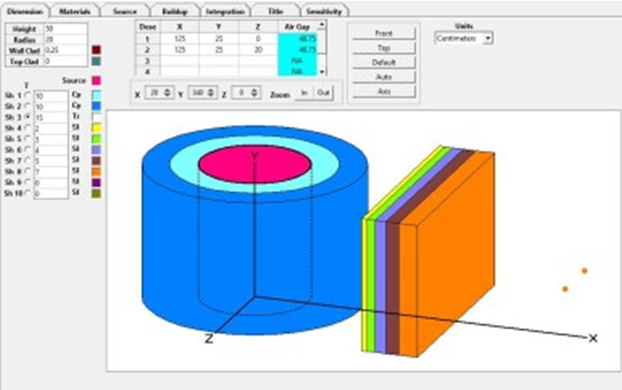
These measurements represent the amount of radiation exposure per unit of time in each scenario 12. The lower the dose rate, the more effective the radiation absorption and attenuation by the OCTA Stone Block material as depicted in Figure 1. The results suggest that the presence of OCTA Stone Block, particularly with increased thickness, leads to a reduction in the average dose rate, indicating its ability to shield and attenuate radiation as we can predict by obtaining a stone shield with 80 cm thickness the radiation with remain 0.001 in the modeling software 13. To commence, we shall meticulously analyze the expected radiation levels, considering factors such as the radiation source, its proximity to the stone block, and the duration of exposure. By employing established scientific principles and utilizing reliable data, we can ascertain the precise radiation intensity that the stone block is likely to encounter.


Shielding Validation
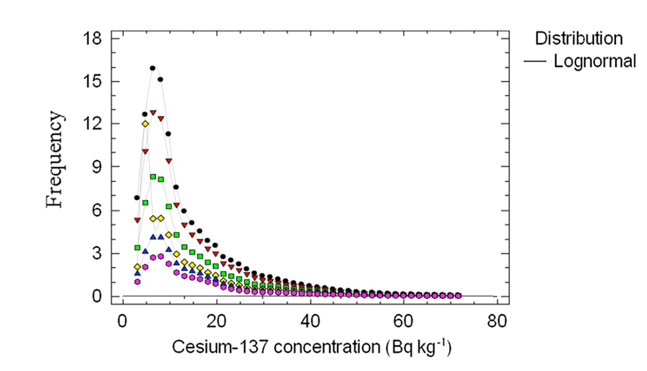
As part of the experimental design, it is advisable to include validation measurements using established shielding materials, such as lead or concrete, for comparison 14. This allows for a direct assessment of OCTA Stone Block's performance against traditional shielding materials, providing a benchmark for evaluating its efficacy as presented in Figure 2.
From Figure 2, there is a noticeable decrease in trapping leaking radiation, and thus a thickness of 80 cm is very effective in protecting against radiation using Octa Stone. The results obtained from the experimental measurements indicate that increasing the thickness of OCTA Stone Block leads to a reduction in the average dose rate, demonstrating the material's ability to shield and attenuate radiation. Based on this trend, it is reasonable to predict that further increasing the thickness of the OCTA Stone Block would continue to decrease the dose rate.
However, it is important to note that predicting a dose rate of 0.000 Sv/h with an 80 cm thickness of OCTA Stone Block may not necessarily be accurate or achievable in practice. While increasing the thickness of a shielding material can contribute to greater radiation attenuation, it does not guarantee complete elimination of radiation. There are several factors to consider:
1. Practical limitations: There may be practical limitations to the thickness of a shielding material due to factors such as weight, space constraints, and structural considerations. Extremely thick shielding may not be feasible or practical in certain applications.
2. Radiation type and energy spectrum: Different types of radiation, such as gamma rays, X-rays, or alpha particles, exhibit varying penetration capabilities. The energy spectrum of the radiation source also plays a role in determining the effectiveness of shielding. Some radiation may require significantly thicker shielding to achieve the desired attenuation levels.
3. Shielding materials: The composition and properties of the shielding material can influence its ability to attenuate radiation. While OCTA Stone Block has shown promising results in the experimental setup, it is essential to consider its specific characteristics and limitations when extrapolating to different scenarios.
4. Modeling software limitations: Modeling software can provide valuable insights into radiation attenuation, but it is important to validate the predictions with experimental data. The accuracy of the software depends on the underlying assumptions, algorithms, and input parameters used. Real-world conditions and variations may not always be fully captured in the modeling process.
Therefore, while it is reasonable to expect that increasing the thickness of OCTA Stone Block would further reduce the dose rate, predicting a dose rate of 0.000 Sv/h with an 80 cm thickness should be approached with caution. It is advisable to conduct further experiments and analysis, considering practical constraints and specific radiation sources, to validate the effectiveness of OCTA Stone Block at greater thicknesses and optimize its design for specific shielding applications.
The discussion focuses on the mechanisms by which OCTA Stone Block absorbs radiation. It explores the physical and chemical properties of the material that contribute to its radiation absorption capabilities, such as density, atomic composition, and structural characteristics 15.
The discussion examines the unique properties of OCTA Stone Block that make it a potentially effective material for radiation shielding. Factors such as its structural integrity, durability, and resistance to degradation are considered in the context of radiation absorption and long-term performance.
Implications for Radiation Shielding Applications
OCTA Stone Block, with its radiation absorption and attenuation capabilities, holds potential for various applications in radiation shielding 16. Here are some examples of potential applications:
1. Nuclear Power Plants: OCTA Stone Block can be used as a shielding material in nuclear power plants to protect workers and the surrounding environment from radiation exposure. It can be employed in reactor containment structures, shielding walls, and equipment to reduce radiation levels and enhance safety.
2. Medical Facilities: In medical facilities, OCTA Stone Block can be utilized in radiation therapy rooms, radiology departments, and nuclear medicine facilities. It can help shield patients, medical staff, and the general public from radiation emitted during diagnostic procedures and therapeutic treatments.
3. Research Laboratories: Research laboratories working with radioactive materials or conducting experiments involving ionizing radiation can benefit from OCTA Stone Block as a shielding material. It can be used in laboratory walls, hot cells, and other areas to minimize radiation exposure for researchers and prevent the spread of radiation beyond designated areas.
4. Contaminated Areas and Remediation: OCTA Stone Block can be employed in the remediation of contaminated areas, such as sites affected by nuclear accidents or radioactive spills. It can be used to construct barriers and containment structures to prevent the spread of radiation and protect the environment and surrounding communities.
Advantages of OCTA Stone Block as a radiation shielding material:
1. Radiation Absorption: OCTA Stone Block demonstrates the ability to absorb and attenuate radiation, reducing the dose rates and mitigating the risks associated with radiation exposure.
2. Structural Integrity: OCTA Stone Block possesses good mechanical properties, providing structural stability and durability when used as a shielding material. Its strong composition allows for long-term use without significant degradation.
3. Versatility: OCTA Stone Block can be manufactured in various sizes and shapes to suit specific shielding requirements. It can be customized to fit different applications and integrated into existing structures or designs.
4. Cost-effectiveness: OCTA Stone Block offers potential cost advantages compared to traditional shielding materials like lead. Its availability, lower cost, and reusability contribute to its cost-effectiveness, especially for large-scale shielding projects.
Limitations and considerations:
1. Thickness Requirements: The effectiveness of OCTA Stone Block as a shielding material depends on its thickness. Thicker blocks may be required to achieve higher levels of radiation attenuation, which can impact space requirements and construction considerations.
2 Specific Radiation Sources: The performance of OCTA Stone Block may vary depending on the energy spectrum and type of radiation source. It is important to assess its effectiveness for specific radiation sources and consider potential variations in shielding requirements.
The study confirms the ability of OCTA Stone Block to absorb external radiation contamination, specifically Cesium-137 with a radiation magnitude of 0.25 microcurie. The results demonstrate the radiation absorption efficiency of OCTA Stone Block, as well as its dosimetry characteristics. The material shows promise as a potential solution for radiation shielding and contamination management. The findings of this study contribute to the field of radiation protection and management by introducing OCTA Stone Block as a novel material with radiation absorption capabilities. The material's potential to mitigate the hazards associated with external radiation contamination has significant implications for various industries and applications. Future research should focus on further investigating the properties of OCTA Stone Block, including its long-term performance under different radiation intensities and exposure durations. Additionally, studies exploring the material's compatibility with other radiation shielding materials and its application in real-world scenarios are warranted.
| [1] | Pardo, J. R. (2020). Secret Nuclear Meltdown? Measuring Cesium-137 from Environmental Samples to Determine Radiation Exposure from the Santa Susana Field Laboratory, Simi Valley, California (Doctoral dissertation, CALIFORNIA STATE UNIVERSITY, NORTHRIDGE). | ||
| In article | |||
| [2] | Bishop, K. A., Shuster, C. E., & Institute for Defense Analyses. (2020). Update to Current Policies for Use of Radiation Therapy Drugs (p. 48). Institute for Defense Analyses. | ||
| In article | |||
| [3] | Stagich, B. H., Dixon, K. L., & LaBone, E. D. (2022). Radiological Impact of 2021 Operations at the Savannah River Site (No. SRNL-STI-2022-00323). Savannah River Site (SRS), Aiken, SC (United States). Savannah River National Lab.(SRNL). | ||
| In article | View Article | ||
| [4] | Abbas, T. K., Rashid, K. T., & Alsalhy, Q. F. (2022). NaY zeolite-polyethersulfone-modified membranes for the removal of cesium-137 from liquid radioactive waste. Chemical Engineering Research and Design, 179, 535-548. | ||
| In article | View Article | ||
| [5] | Li, H. H., Lin, Y. T., Laiakis, E. C., Goudarzi, M., Weber, W., & Fornace Jr, A. J. (2020). Serum metabolomic alterations associated with cesium-137 internal emitter delivered in various dose rates. Metabolites, 10(7), 270. | ||
| In article | View Article PubMed | ||
| [6] | Ikenoue, T., Yamada, M., Ishii, N., Kudo, N., Shirotani, Y., Ishida, Y., & Kusakabe, M. (2022). Cesium-137 and 137Cs/133Cs atom ratios in marine zooplankton off the east coast of Japan during 2012–2020 following the Fukushima Dai-ichi nuclear power plant accident. Environmental Pollution, 311, 119962. | ||
| In article | View Article PubMed | ||
| [7] | Topping, C. E., Abella, M. K., Berkowitz, M. E., Molina, M. R., Nikolić-Hughes, I., Hughes, E. W., & Ruderman, M. A. (2019). In situ measurement of cesium-137 contamination in fruits from the northern Marshall Islands. Proceedings of the National Academy of Sciences, 116(31), 15414-15419. | ||
| In article | View Article PubMed | ||
| [8] | Rauwel, P., & Rauwel, E. (2019). Towards the extraction of radioactive Cesium-137 from water via graphene/CNT and nanostructured Prussian Blue hybrid nanocomposites: A Review. Nanomaterials, 9(5), 682. | ||
| In article | View Article PubMed | ||
| [9] | Curado, M. P., de Oliveira, M. M., Valverde, N. D., & da Cruz, A. D. (2019). Cancer incidence in the cohort exposed to Cesium-137 accident in Goiânia (Brazil) in 1987. Journal of Health & Biological Sciences, 7(3 (Jul-Set)), 228-232. | ||
| In article | View Article | ||
| [10] | Saito, R., Wakiyama, Y., Bontrager, H., Nanba, K., & Beasley, J. C. (2023). Alteration of the Cesium-137 soil profile by wild boar rooting after the Fukushima Daiichi Nuclear Power Plant accident. Environmental Challenges, 12, 100728. | ||
| In article | View Article | ||
| [11] | Baltaş, H., Şirin, M., Çiloglu, E., Iminova, G., & Çevik, U. (2021). Bio-kinetics of cesium-137 in Mediterranean mussel (Mytilus galloprovincialis) and sea snail (Rapana venosa) via seawater exposure. Journal of Sea Research, 176, 102112. | ||
| In article | View Article | ||
| [12] | Venturi, S. (2021). Cesium in biology, pancreatic cancer, and controversy in high and low radiation exposure damage—scientific, environmental, geopolitical, and economic aspects. International Journal of Environmental Research and Public Health, 18(17), 8934. | ||
| In article | View Article PubMed | ||
| [13] | Kolotkov, G., Penin, S., & Matina, P. (2019, July). Modeling The Spatial Distribution of Cesium-137 in Surface Soils in The Southeast of The Tomsk Region. In 2019 Russian Open Conference on Radio Wave Propagation (RWP) (Vol. 1, pp. 454-457). IEEE. | ||
| In article | View Article | ||
| [14] | Kurihara, T., Tanada, K., Kataoka, J., Hosokoshi, H., Mochizuki, S., Tagawa, L., .. & Gotoh, Y. (2020). Precision spectroscopy of cesium-137 from the ground to 150 m above in Fukushima. Nuclear Instruments and Methods in Physics Research Section A: Accelerators, Spectrometers, Detectors and Associated Equipment, 978, 164414. | ||
| In article | View Article | ||
| [15] | Sobakin, P. I., Chevychelov, A. P., & Gerasimov, Y. R. (2019). Geographical features of pollution of the territory of Yakutia with Cesium-137. Geography and Natural Resources, 40, 151-161. | ||
| In article | View Article | ||
| [16] | Yermak, I., Garmasa, A., & Balakir, M. (2022). Forest Restoration and Forestry on Territories Contaminated with Cesium-137. Система управления экологической безопасностью.—Екатеринбург, 2022, 272-276. | ||
| In article | |||
Published with license by Science and Education Publishing, Copyright © 2023 Hesham Mohamed Abdal-Salam Yehia and Said Mahmoud Said
 This work is licensed under a Creative Commons Attribution 4.0 International License. To view a copy of this license, visit
http://creativecommons.org/licenses/by/4.0/
This work is licensed under a Creative Commons Attribution 4.0 International License. To view a copy of this license, visit
http://creativecommons.org/licenses/by/4.0/
| [1] | Pardo, J. R. (2020). Secret Nuclear Meltdown? Measuring Cesium-137 from Environmental Samples to Determine Radiation Exposure from the Santa Susana Field Laboratory, Simi Valley, California (Doctoral dissertation, CALIFORNIA STATE UNIVERSITY, NORTHRIDGE). | ||
| In article | |||
| [2] | Bishop, K. A., Shuster, C. E., & Institute for Defense Analyses. (2020). Update to Current Policies for Use of Radiation Therapy Drugs (p. 48). Institute for Defense Analyses. | ||
| In article | |||
| [3] | Stagich, B. H., Dixon, K. L., & LaBone, E. D. (2022). Radiological Impact of 2021 Operations at the Savannah River Site (No. SRNL-STI-2022-00323). Savannah River Site (SRS), Aiken, SC (United States). Savannah River National Lab.(SRNL). | ||
| In article | View Article | ||
| [4] | Abbas, T. K., Rashid, K. T., & Alsalhy, Q. F. (2022). NaY zeolite-polyethersulfone-modified membranes for the removal of cesium-137 from liquid radioactive waste. Chemical Engineering Research and Design, 179, 535-548. | ||
| In article | View Article | ||
| [5] | Li, H. H., Lin, Y. T., Laiakis, E. C., Goudarzi, M., Weber, W., & Fornace Jr, A. J. (2020). Serum metabolomic alterations associated with cesium-137 internal emitter delivered in various dose rates. Metabolites, 10(7), 270. | ||
| In article | View Article PubMed | ||
| [6] | Ikenoue, T., Yamada, M., Ishii, N., Kudo, N., Shirotani, Y., Ishida, Y., & Kusakabe, M. (2022). Cesium-137 and 137Cs/133Cs atom ratios in marine zooplankton off the east coast of Japan during 2012–2020 following the Fukushima Dai-ichi nuclear power plant accident. Environmental Pollution, 311, 119962. | ||
| In article | View Article PubMed | ||
| [7] | Topping, C. E., Abella, M. K., Berkowitz, M. E., Molina, M. R., Nikolić-Hughes, I., Hughes, E. W., & Ruderman, M. A. (2019). In situ measurement of cesium-137 contamination in fruits from the northern Marshall Islands. Proceedings of the National Academy of Sciences, 116(31), 15414-15419. | ||
| In article | View Article PubMed | ||
| [8] | Rauwel, P., & Rauwel, E. (2019). Towards the extraction of radioactive Cesium-137 from water via graphene/CNT and nanostructured Prussian Blue hybrid nanocomposites: A Review. Nanomaterials, 9(5), 682. | ||
| In article | View Article PubMed | ||
| [9] | Curado, M. P., de Oliveira, M. M., Valverde, N. D., & da Cruz, A. D. (2019). Cancer incidence in the cohort exposed to Cesium-137 accident in Goiânia (Brazil) in 1987. Journal of Health & Biological Sciences, 7(3 (Jul-Set)), 228-232. | ||
| In article | View Article | ||
| [10] | Saito, R., Wakiyama, Y., Bontrager, H., Nanba, K., & Beasley, J. C. (2023). Alteration of the Cesium-137 soil profile by wild boar rooting after the Fukushima Daiichi Nuclear Power Plant accident. Environmental Challenges, 12, 100728. | ||
| In article | View Article | ||
| [11] | Baltaş, H., Şirin, M., Çiloglu, E., Iminova, G., & Çevik, U. (2021). Bio-kinetics of cesium-137 in Mediterranean mussel (Mytilus galloprovincialis) and sea snail (Rapana venosa) via seawater exposure. Journal of Sea Research, 176, 102112. | ||
| In article | View Article | ||
| [12] | Venturi, S. (2021). Cesium in biology, pancreatic cancer, and controversy in high and low radiation exposure damage—scientific, environmental, geopolitical, and economic aspects. International Journal of Environmental Research and Public Health, 18(17), 8934. | ||
| In article | View Article PubMed | ||
| [13] | Kolotkov, G., Penin, S., & Matina, P. (2019, July). Modeling The Spatial Distribution of Cesium-137 in Surface Soils in The Southeast of The Tomsk Region. In 2019 Russian Open Conference on Radio Wave Propagation (RWP) (Vol. 1, pp. 454-457). IEEE. | ||
| In article | View Article | ||
| [14] | Kurihara, T., Tanada, K., Kataoka, J., Hosokoshi, H., Mochizuki, S., Tagawa, L., .. & Gotoh, Y. (2020). Precision spectroscopy of cesium-137 from the ground to 150 m above in Fukushima. Nuclear Instruments and Methods in Physics Research Section A: Accelerators, Spectrometers, Detectors and Associated Equipment, 978, 164414. | ||
| In article | View Article | ||
| [15] | Sobakin, P. I., Chevychelov, A. P., & Gerasimov, Y. R. (2019). Geographical features of pollution of the territory of Yakutia with Cesium-137. Geography and Natural Resources, 40, 151-161. | ||
| In article | View Article | ||
| [16] | Yermak, I., Garmasa, A., & Balakir, M. (2022). Forest Restoration and Forestry on Territories Contaminated with Cesium-137. Система управления экологической безопасностью.—Екатеринбург, 2022, 272-276. | ||
| In article | |||