Evaporation of a droplet in hotter environment for the same fluid in subcritical condition has been studied in this work by analyzing the thermodynamic properties. The physical model used is based on Navier-Stokes equations. To simplify the computations, we assumed that the droplet has a spherical symmetry and evolves in quasi steady case and laminar conditions. The study is mainly characterized by the fact that the equation of conservation of momentum is effectively taken into account and that the velocity of the droplet is not always uniform. The analysis of the evolution of temperature, mass flow and velocity in the droplet and in the gaseous phase reveals the presence of discontinuities in the drop towards its boundary and of an unbalanced energy layer attached to the interface when the speed is not uniform in the drop.
Droplet evaporation is an important process for the performance of fuel combustion systems, such as diesel, gas turbines and rocket engines. In these systems, fuel is injected as a cloud of droplets into the combustion chamber which vaporize and oxidize to release heat 1. At the moment of injection, the temperature and the pressure in the combustion chamber exceed the critical point of the fuel thus creating subcritical/supercritical conditions 2. According to the classical fuel injection theory 3 when the fuel is injected into the subcritical environment, a large number of droplets will be separated from the jet surface with the effects of surface tension and ambient gas disturbance. Many scientists and researchers have carried out work in the sense of knowing the behavior of fluid drops in subcritical environments. Sazhin 4 recent review summarizes the development of various droplet evaporation and heating models with varying levels of complexity. Maxwell 5, as early as 1877, provided the simplest model predicting the steady evaporation rate for a spherical drop in infinite and uniform medium. He assumed that the driving force for liquid evaporation is the difference in vapor concentration between the surface of the drop and the free stream 6. Similarly, in previous work on the subcritical regime, Spalding 7 and Godsave 8 simultaneously proposed a first quasi-steady model on the evaporation of isolated drops, the law of d2. This modeling shows that an isolated drop evaporating reaches a state of equilibrium during which the square of the diameter of the drop decreases linearly with time and the average temperature of the drop remains constant. Although this model is very successful in describing the vaporization process of fuel drop, the assumptions upon which the model has been developed are subjected to several experimental and numerical analyses 9, 10. Amongst the most controversial assumptions are those of constancy and uniformity of the macroscopic variables and the thermodynamic coefficients in the cold drop, the absence of convection and the steadiness of the gaseous phase which fits instantaneously the changes in the boundary conditions and the variation of the size of the drop. Sagna et al 11 studied the behavior of drop in the gas phase. It turns out that the square of the diameter of a combustion drop is no longer a linear function of time. The same results showed that a transition region generally separates two regions of the fluid under subcritical conditions, thus creating thermal and mass shock waves characterized by discontinuities. These precursor discontinuities of incomplete combustion in the engine combustion chamber 12 are partly responsible for air pollution.
Despite these criticisms 13 which they suffered, especially after experimental results invalidated some of the hypotheses on which they are based, the results of these theories remain valid and are still widely disseminated.
The main objective of the present study is to deepen the examination of the law of recession and the thermodynamic properties of the drop in the flow and in the gaseous phase by the analytical resolution of the asymptomatic method of order 0 and 1 using the models of the Navier-Stokes equations used in the study of droplet evaporation.
A drop of pure liquid of temperature uniformly equal to the temperature of saturated vapor at the subcritical pressure considered is abruptly introduced into a hotter infinite atmosphere initially in the rest. The radius, the density and the temperature of the drop at the initial moment are respectively 
 and
and  . The gaseous flow surrounding the drop is in a steady state characterized by a temperature
  , a pressure
  and a density
  . We suppose that there are neither external volume forces nor a forced convection, the initial spherical symmetry of the drop is thus preserved in the time 11.
We denote by  the distance from the center of the drop and by
  the radius of the drop. A law of state (which will never be specified in the study because of the uniformity of the pressure) gives the pressure
  in the flow as function of the density
  and the temperature
  ;
;  is the velocity of the flow. The fluid is supposed perfect and we obtain the following system of conservation equations for the problem:
 | (1) |
We rewrite these equations in a reference moving with the boundary of the drop and we introduce the variable  . We retain two characteristic times in the description of the phenomenon: the characteristic time of thermal diffusion
  and the drop’s lifetime
  . To take into account the gradient of density in the environment, we use two characteristic densities:
  in the drop and
  in the surrounding gas. We introduce the nondimensional numbers:
 and
and  and the following nondimensional variables:
  ;
;  ;
;  ;
;  ;
;  ;
;  ;
;  and
and  . Then the dimensionless equations of the problem are given by (2):
 | (2) |
with the initial conditions:
 | (3) |
 | (4) |
 | (5) |
the boundary conditions:
 | (6) |
 | (7) |
 | (8) |
and the jump relations at the interface take the dimensionless form:
 | (9) |
 is the total enthalpy corresponding to the relative motion.
Particular importance is given to the quasi-steady case in the study of drop evaporation and combustion. In the classical dimensional analyzes of the literature 14, 15 only one of the parameters  or
or  is used. The quasi-steady state being reached for small values of the chosen parameter. The form of system (2) of dimensionless equations shows that the unsteady phenomena in the mass and energy conservation equations are governed by the ratio
  . In the conservation of momentum equation,
  controls the terms related to the variation of the radius of the drop.
Thus, when  tends to zero, the system of equations (2) tends to a quasi-steady equation. We obtain to the first approximation the system of equations (10) 11, 16.
 | (10) |
And at second approximation of equations, we obtain (11):
 | (11) |
In the following, we assume that the heat capacity  and the thermal conductivity
  are uniform and therefore do not depend on the distance
The fact that the pressure is uniform makes it possible to decouple the system from the conservation equations and to treat separately the system formed by the mass conservation equation and the momentum conservation equation and the conservation equation of energy.
3.1. Velocity at Order 0 and 1The integration of the second equation of (10) and of (11) gives (12):
 | (12) |
where  are constants. The solution (12) makes it possible to take into account the variation of the relative velocity as a function of
  the drop and/or the gaseous phase.
According to Koffi Sagna et al. works 11, the constants  are determined by the boundary conditions on the interface.
From the first equation of relations (10) and (11), we obtain:
 | (13) |
Substituting equation (12) in (13), we obtain (14):
 | (14) |
(14) takes into account the variation of the relative velocity as a function of the drop and the gas phase.
3.3. Temperature at Order 0 and 1By considering  uniform in the drop and that the fluid is an ideal gas
  , integration of the third of the systems (10) and (11) gives (15):
 | (15) |
with
 |
 |
 |
 |
After integration by parts and consequently by whole series to the first order, we obtain from the second equation of the system (15) the system of equation (16):
 | (16) |
We integrate the third equations of the system (10) and (11) and we find (17):
 | (17) |
Taking into account that the drop is at rest, we obtain  and applying the jump relations (9) to equation (17) we obtain (18):
 | (18) |
The relations (13) written on the boundary of the drop taking into account the relation (17) give (19):
(19) gives the differential equation which describes the drop’s radius evolution versus the time. The integration of (19) gives a recession law  for the diameter of the drop with a nonlinear function of time 16. To determine the evolution of the temperature, we must know the functions
  with regard to equation (17).
The functions  and
and  are determined using the boundary conditions and they are:
 | (20) |
 | (21) |
 | (22) |
The substitution of relation (20) and (22) in the equation (19) and after the integration, we obtain the relations (23) and (24) respectively.
 | (23) |
 | (24) |
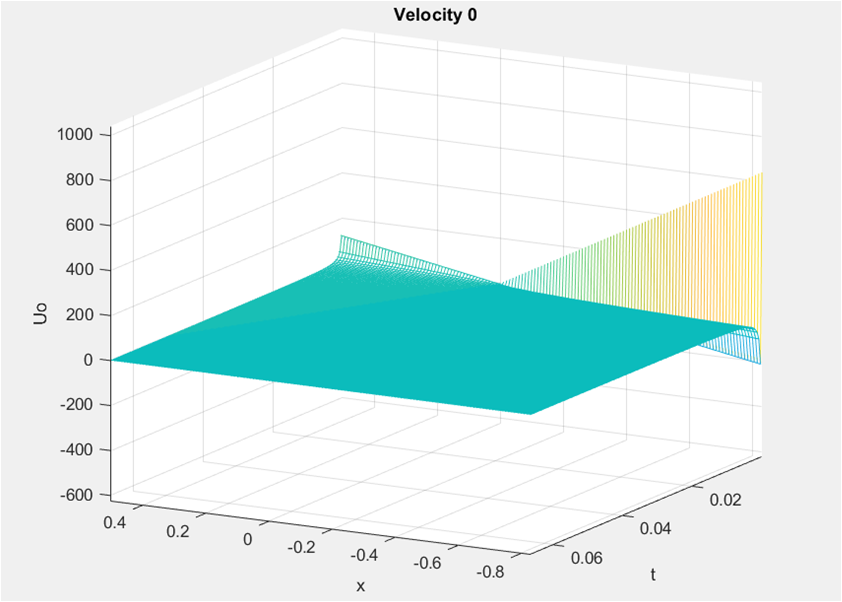
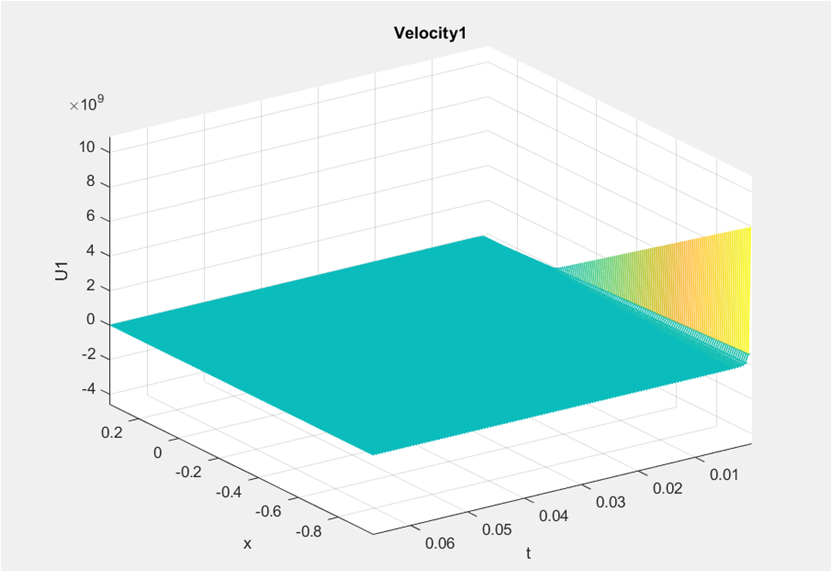
Figure 1 and Figure 2 represent the spatiotemporal evolution of the flow velocity inside droplet at order 0 and 1, introduced into a hotter gaseous environment of the same liquid during evaporation. They show that the velocity both at order 0 and 1 is continuous throughout the flow but with a profile varying over time. The velocity is non-monotonic in the drop where it can have extrema. These extrema show the existence of disturbances or discontinuities in the drop propagating towards the boundary of the drop. The same results are found by research carried out by 11, 17.


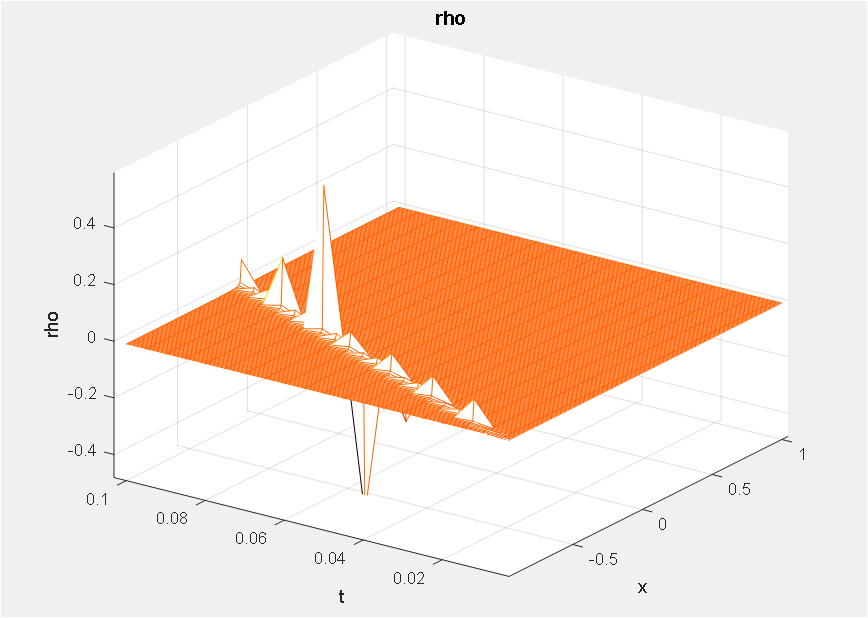
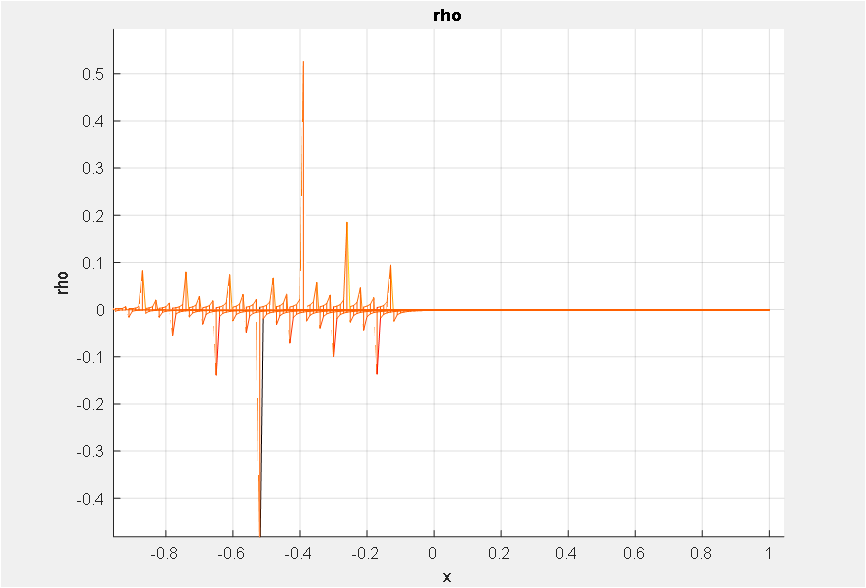
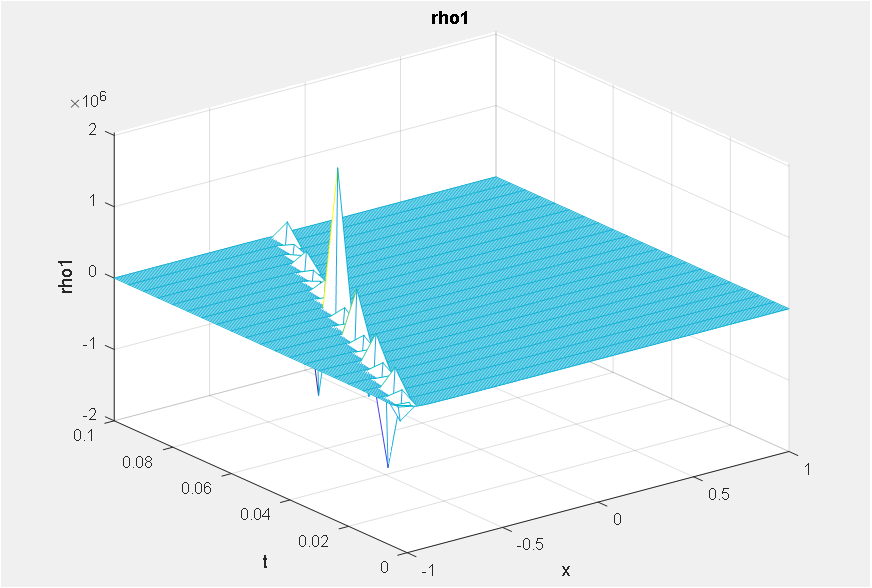
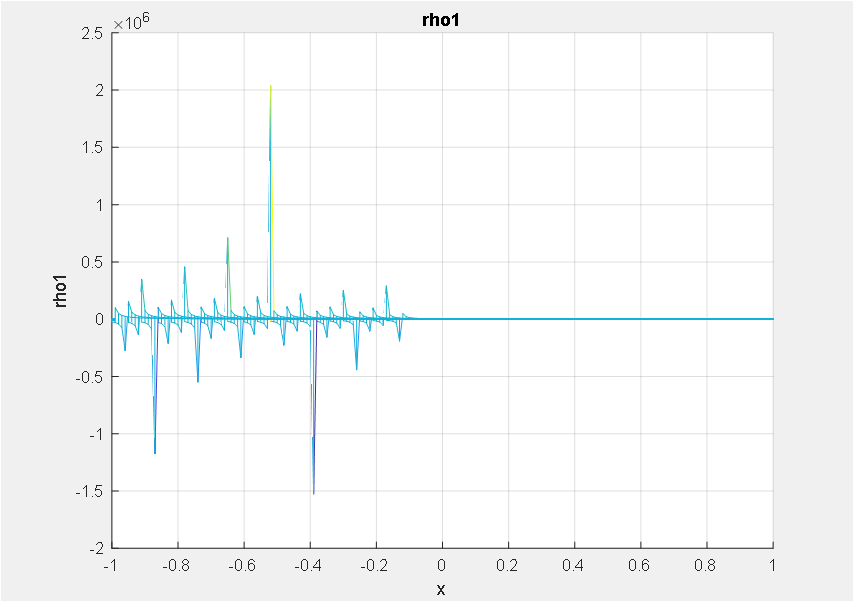
Figures 3 to 5 show the spatiotemporal evolution of the density of ethanol during evaporation.

We note the presence of the disturbances which develop from the center of the drop towards the border. Its thickness and lifetime depend on τ and the initial velocities of the drop and the gas.

These disturbances propagate in the whole inside of the drop and disappear at the boundary (see Figure 4 and Figure 6).

These results confirm the work of 17 both at order 1 of the mass flow.

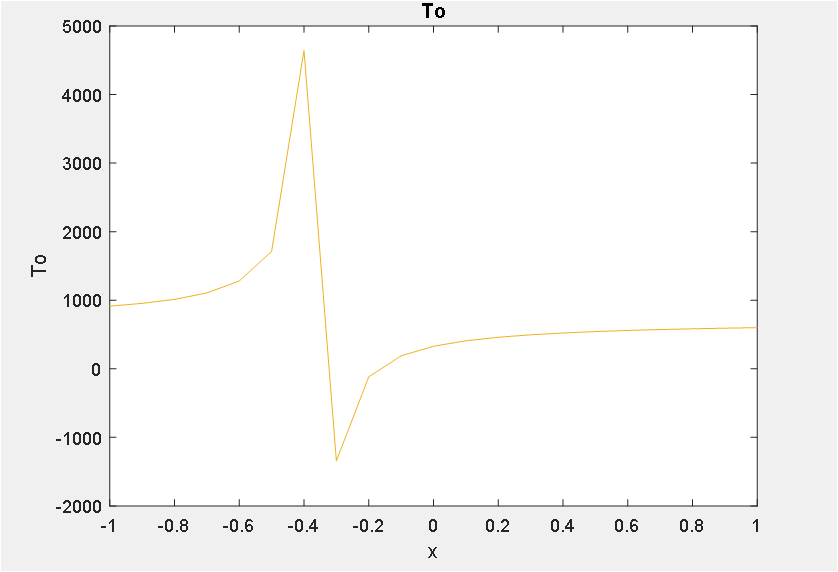
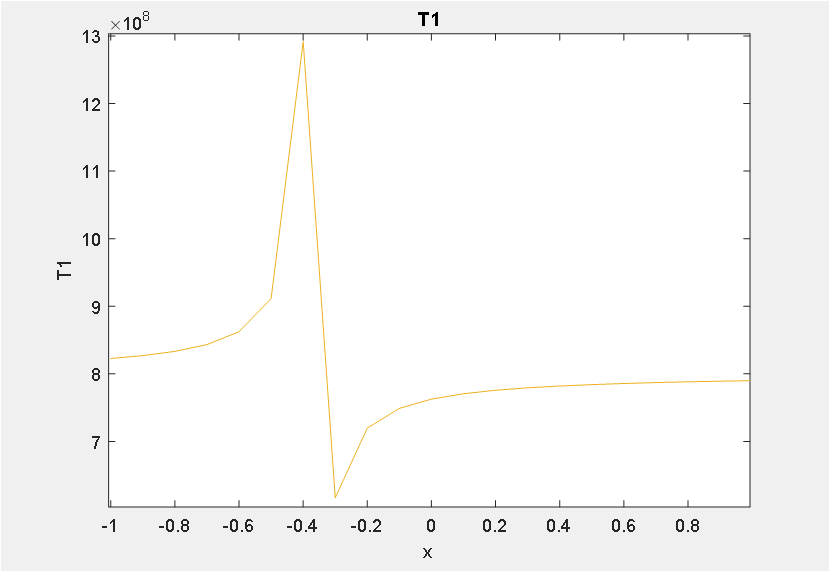
The spatial evolution of the temperature is presented in Figure 7 and Figure 8 and shows the intensity of the thermal shock wave inside the isolated drop.


This temperature trend is due to the existence of a transient warming period which precedes the evaporation of the droplets in the steady state 1, 17, 18. This shows that the effective heat flow and the vapor flow are continuous inside the drop. When approaching the boundary of the drop, we noted a discontinuity characterized by a thermal shock wave.
4.4. Evolution of the Radius of the Drop


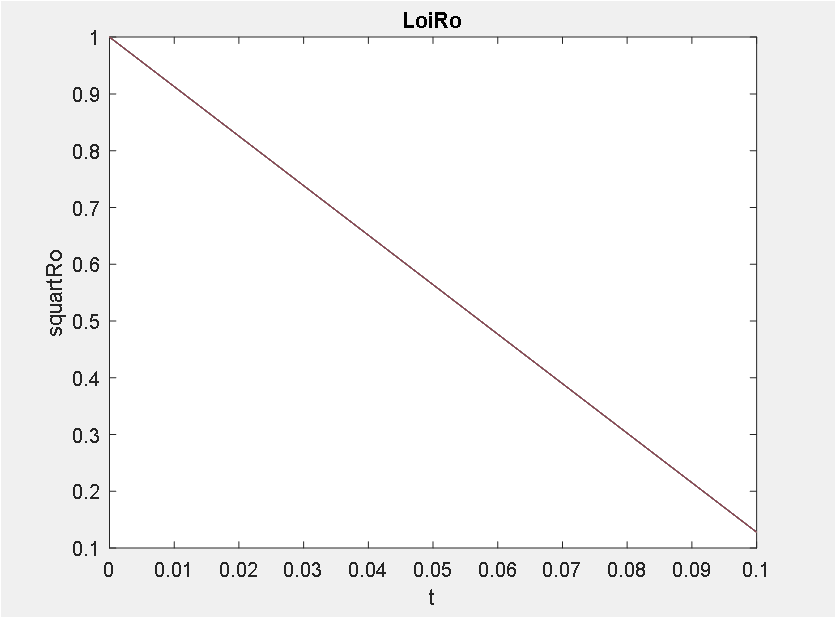
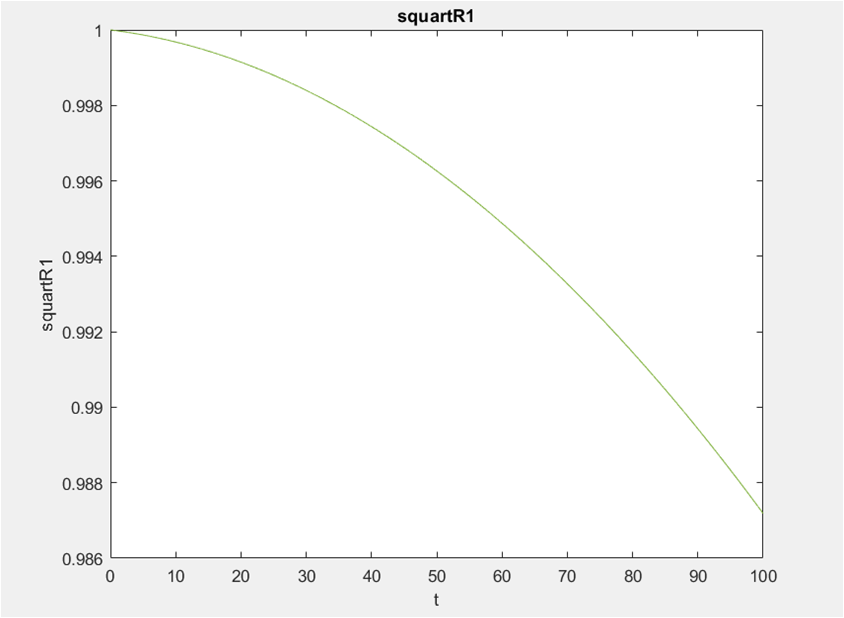
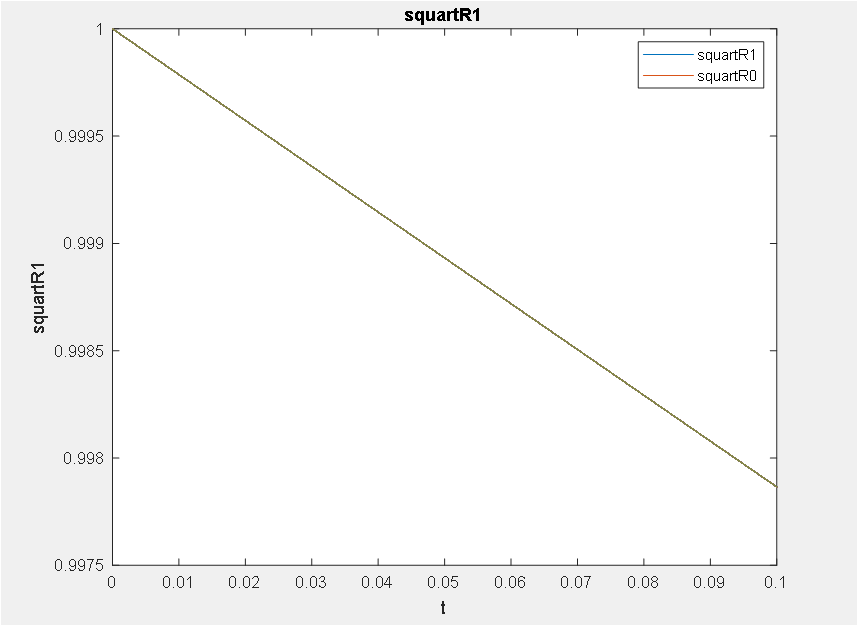
Figure 9 and Figure 10 present the temporal evolutions of the square of the diameter of the drop at order 0 and 1 respectively. Note that these graphs do not present the periods of heating of the drops. Figure 9 reveals that the law d2 is preserved throughout the lifetime of the drops, but this is not the case in Figure 10. However, for the small values of time, Figure 11 shows that the drop begins to evaporate according to the law d2.
We solved analytically the Navier-Stokes equations for a subcritical drop in evaporation in quasi-steady conditions. The solution obtained in first and second approximations, gives recession laws which give the square of the diameter of the drops as a nonlinear function of time if the ratio  is independent of x in the gaseous phase. We obtain the classical law of d² 8 if this ratio is a constant.
The study of the evolution of the macroscopic parameters both at order 0 and 1 shows that:
- The flow velocity is continuous throughout the flow except for the center of the drop and is strictly monotonic. It cancels out at the interface and changes sign.
- The density presents discontinuities at the center and at the boundary of the drop. Indeed, a shock wave whose intensity decreases as one moves away from the center of the drop develops in the drop and disappears near the liquid-gas interface. They are non-monotonic and have extrema that remain attached to the drop boundary until peeling.
- The temperature presents from the center and towards the border of the drop a continuous but not uniform progression. This shows that the effective heat flow and the vapor flow are continuous inside the drop. When approaching the boundary of the drop, we noted a discontinuity characterized by a thermal shock wave.
It follows that one of the main sources of the discontinuities is the transient heating of the drops persisting for most of the lifetime of the droplet. The existence of thermal and mass discontinuities during the evaporation process is proved whether at zero order or at order 1 of the asymptotic expansion method applied to analytical resolution of the Navier–Stokes equations. The control of these discontinuities during evaporation would therefore contribute enormously to the optimization of combustion in the combustion chambers of engines through an energy gain.
| [1] | Christian Chauveau, Madjid Birouk, Iskender Gökalp, “An analysis of the d2-law departure during droplet evaporation in microgravity,” International Journal of Multiphase Flow, vol. 37, p. 252-259, november 2011. | ||
| In article | View Article | ||
| [2] | D. Ju, L. Huang, K. Zhang et al., “Comparison of evaporation rate constants of a single fuel droplet entering subcritical and supercritical environments,” Journal of Molecular Liquids, vol. 347, 2022. | ||
| In article | View Article | ||
| [3] | R. Reitz, F. Bracco, “Mechanism of Atomization of a liquid Jet,” Phys. Fluids 25, pp. 1730-1742, 1982. | ||
| In article | View Article | ||
| [4] | Sazhin, Sergei S., “Advanced models of fuel droplet heating and evaporation,” Progress in Energy and Combustion Science, vol. 32, p. 162-214, 2006. | ||
| In article | View Article | ||
| [5] | Maxwell, J.C., “Diffusion,” in Encyclopaedia Britannica, ninth ed, 1877. | ||
| In article | |||
| [6] | G. C. S. Tonini, “An analytical model of liquid drop evaporation in gaseous environment,” International Journal of Thermal Sciences, vol. 57, pp. 45-53, 2012. | ||
| In article | View Article | ||
| [7] | Spalding D., B., “Combustion of fuel particles,” Fuel, vol. 30, 1951. | ||
| In article | |||
| [8] | GODSAVE, G. A. E., “Studies of the combustion of drops in a fuel spray the burning of single drops of fuel,” in in Fourth Symposium on Combustion, 1953. | ||
| In article | View Article | ||
| [9] | S. Saengkaew, T. Charinpanikul, C. Laurent, Y. Biscos, G., “Processing of individual rainbow signals,” Exp. Fluids, vol. 48, pp. 111-119, 2010. | ||
| In article | View Article | ||
| [10] | S. Saengkaew, D. Bonin, P. Briard, and G. Gréhan, “Réfractométrie d'arc-en-ciel global à faisceau pulsé: Estimation des concentrations et des distancesinter-particulaires,” in Congrès Francophone de Techniques Laser (CFTL2010), Vandoeuvre-lès-Nancy (France), 2010. | ||
| In article | |||
| [11] | Koffi Sagna, Amah D’Almeida, “A Study of Droplet Evaporation,” American Journal of Modern Physics, vol. 2, pp. 71-76, 2013. | ||
| In article | View Article | ||
| [12] | Koffi Sagna, Komi Apélété Amou, Tchamye Tcha-Esso Boroze, Djima Kassegne, Amah d’Almeida, Kossi Napo, “Environmental Pollution due to the Operation of Gasoline,” International Journal of Oil, Gas and Coal Engineering Engines: Exhaust Gas Law, vol. 5, no. 4, pp. 39-43, 2017. | ||
| In article | View Article | ||
| [13] | FAETH, G. M., “EVAPORATION AND COMBUSTION OF SPRAYS,” Prog. Energy Combust. Sci, vol. 9, pp. 1-76, 1983. | ||
| In article | View Article | ||
| [14] | Sanchez-Tarifa C., Crespo A., Fraga E., “Theoretical model for the combustion of droplets in super-critical conditions and gas pockets,” Astronautica Acta, vol. 17, pp. 685-692, 1972. | ||
| In article | |||
| [15] | MANUEL ARIAS-ZUGASTI, PEDRO L. GARCÍA-YBARRA & JOSE L. CASTILLO, “Unsteady Effects in droplet vaporisation lifetimes at subcritical and supercritical conditions,” Combust. Sci. and Tech, vol. 153, pp. 179-191, 2000. | ||
| In article | View Article | ||
| [16] | D’ALMEIDA, PRUD’HOMME, “Evaporation de gouttes: lois de recession du rayon,” in 19e Congres Franc¸ais de Mécanique, Marseille, 2009. | ||
| In article | |||
| [17] | SAGNA Koffi, “Étude de l’évaporation d’une goutte liquide isolée à pressions subcritique et supercritique,” Université de Lomé, Lomé, 2014. | ||
| In article | |||
| [18] | C. H. CHIANG, M. S. RAJUt and W. A. SIRIGNANO, “Numerical analysis of convecting, vaporizing fuel droplet with variable properties,” vol. 35, no. 5, pp. 1307-132, 1992. | ||
| In article | View Article | ||
Published with license by Science and Education Publishing, Copyright © 2023 Yendoubouame Lare, Koffi Sagna, Kodjo S. Apeke, Dzidula K. Afodanyi, Yendoubé Lare and Amah S. d’Almeida
 This work is licensed under a Creative Commons Attribution 4.0 International License. To view a copy of this license, visit
http://creativecommons.org/licenses/by/4.0/
This work is licensed under a Creative Commons Attribution 4.0 International License. To view a copy of this license, visit
http://creativecommons.org/licenses/by/4.0/
| [1] | Christian Chauveau, Madjid Birouk, Iskender Gökalp, “An analysis of the d2-law departure during droplet evaporation in microgravity,” International Journal of Multiphase Flow, vol. 37, p. 252-259, november 2011. | ||
| In article | View Article | ||
| [2] | D. Ju, L. Huang, K. Zhang et al., “Comparison of evaporation rate constants of a single fuel droplet entering subcritical and supercritical environments,” Journal of Molecular Liquids, vol. 347, 2022. | ||
| In article | View Article | ||
| [3] | R. Reitz, F. Bracco, “Mechanism of Atomization of a liquid Jet,” Phys. Fluids 25, pp. 1730-1742, 1982. | ||
| In article | View Article | ||
| [4] | Sazhin, Sergei S., “Advanced models of fuel droplet heating and evaporation,” Progress in Energy and Combustion Science, vol. 32, p. 162-214, 2006. | ||
| In article | View Article | ||
| [5] | Maxwell, J.C., “Diffusion,” in Encyclopaedia Britannica, ninth ed, 1877. | ||
| In article | |||
| [6] | G. C. S. Tonini, “An analytical model of liquid drop evaporation in gaseous environment,” International Journal of Thermal Sciences, vol. 57, pp. 45-53, 2012. | ||
| In article | View Article | ||
| [7] | Spalding D., B., “Combustion of fuel particles,” Fuel, vol. 30, 1951. | ||
| In article | |||
| [8] | GODSAVE, G. A. E., “Studies of the combustion of drops in a fuel spray the burning of single drops of fuel,” in in Fourth Symposium on Combustion, 1953. | ||
| In article | View Article | ||
| [9] | S. Saengkaew, T. Charinpanikul, C. Laurent, Y. Biscos, G., “Processing of individual rainbow signals,” Exp. Fluids, vol. 48, pp. 111-119, 2010. | ||
| In article | View Article | ||
| [10] | S. Saengkaew, D. Bonin, P. Briard, and G. Gréhan, “Réfractométrie d'arc-en-ciel global à faisceau pulsé: Estimation des concentrations et des distancesinter-particulaires,” in Congrès Francophone de Techniques Laser (CFTL2010), Vandoeuvre-lès-Nancy (France), 2010. | ||
| In article | |||
| [11] | Koffi Sagna, Amah D’Almeida, “A Study of Droplet Evaporation,” American Journal of Modern Physics, vol. 2, pp. 71-76, 2013. | ||
| In article | View Article | ||
| [12] | Koffi Sagna, Komi Apélété Amou, Tchamye Tcha-Esso Boroze, Djima Kassegne, Amah d’Almeida, Kossi Napo, “Environmental Pollution due to the Operation of Gasoline,” International Journal of Oil, Gas and Coal Engineering Engines: Exhaust Gas Law, vol. 5, no. 4, pp. 39-43, 2017. | ||
| In article | View Article | ||
| [13] | FAETH, G. M., “EVAPORATION AND COMBUSTION OF SPRAYS,” Prog. Energy Combust. Sci, vol. 9, pp. 1-76, 1983. | ||
| In article | View Article | ||
| [14] | Sanchez-Tarifa C., Crespo A., Fraga E., “Theoretical model for the combustion of droplets in super-critical conditions and gas pockets,” Astronautica Acta, vol. 17, pp. 685-692, 1972. | ||
| In article | |||
| [15] | MANUEL ARIAS-ZUGASTI, PEDRO L. GARCÍA-YBARRA & JOSE L. CASTILLO, “Unsteady Effects in droplet vaporisation lifetimes at subcritical and supercritical conditions,” Combust. Sci. and Tech, vol. 153, pp. 179-191, 2000. | ||
| In article | View Article | ||
| [16] | D’ALMEIDA, PRUD’HOMME, “Evaporation de gouttes: lois de recession du rayon,” in 19e Congres Franc¸ais de Mécanique, Marseille, 2009. | ||
| In article | |||
| [17] | SAGNA Koffi, “Étude de l’évaporation d’une goutte liquide isolée à pressions subcritique et supercritique,” Université de Lomé, Lomé, 2014. | ||
| In article | |||
| [18] | C. H. CHIANG, M. S. RAJUt and W. A. SIRIGNANO, “Numerical analysis of convecting, vaporizing fuel droplet with variable properties,” vol. 35, no. 5, pp. 1307-132, 1992. | ||
| In article | View Article | ||