A new planetary motion theory, spin-vector motion is developed, based on Kepler's second laws of planetary motion that a line segment joining a planet and the Sun sweeps out equal areas during equal intervals of time. The planetary motion follows the same Schrodinger wave equation as quantum particles. The planets have same particle-wave duality, wave length and momentum relation, energy and wave frequency relation as quantum particles too. Based on our deduction we conclude that the Schrodinger equation can be applied successfully to photons, quantum particles, and celestial bodies, but with different energy constant for celestial bodies. Even though these objects are with different masses, sizes and with different wave speeds. And we predict that the wave speed exceeding light speed will not have any impacts on the wave equation form. This spin-vector in motion theory or Spin-vector Mechanics will be a candidate theory leading to the theory of everything.
A theory of everything (TOE) 1, final theory, ultimate theory, or unified field theory is a singular, all-encompassing, theoretical framework of physics which is fully able to explain and to link together all aspects of the universe 2. The search for a theory of everything is one of the unfinished revolutions in physics 3.
Over the past few centuries, two theories have been developed that, together, most closely resemble the theory of everything. These two theories upon which all modern physics relies on are quantum mechanics and general relativity.
Quantum mechanics and general relativity have been repeatedly verified in their separate fields of relevance. However the usual domains of applicability of quantum mechanics and general relativity are in so big difference, most situations require that only one of them be applied 4, 5. The two theories are considered incompatible in realms of extremely small scale, the Planck scale, such as those that exist within a black hole or during the beginning stages of the universe. To resolve such an incompatibility, a new theory revealing a deeper underlying reality, unifying gravity with the other three interactions, must be discovered to harmoniously integrate the realms of general relativity and quantum mechanics into a seamless whole framework. Because the final theory of everything is an all-encompassing theory which is in principle able to describe all physical features in this universe.
For this ambitious goal, quantum gravity 6 has become an active research area. One example is string theory 7, which evolved into a candidate for the theory of everything, but with controversy and drawbacks, lack of currently testable predictions. String theory claims that at the beginning of the universe, the four fundamental forces were from a same fundamental force. According to string theory, at its most ultramicroscopic level (the Planck scale), every particle in the universe consists of varying combinations of vibrating strings (or strands) with preferred types of vibration. The theory further claims that it is through these specific oscillating patterns of strands that a particle of unique mass and force charge is generated. The string theory means that the electron is a type of string which vibrates in one way, while the up quark is a type of string vibrating in another way, and so on. String theory/M-theory 8, 9 innovatively proposes six or seven dimensions of hyperspace besides the four common spacetime dimensions for a ten or eleven-dimensional spacetime.
In pursuit of this goal, several grand unified theories (GUTs) have been proposed to unify electromagnetic force, the weak and strong forces. The grand unification predicts the existence of an electronuclear force. It is expected to set in at the energy level of 1016 GeV, far greater than could be reached by any of currently possible particle accelerators. Even though the simplest grand unified theories have been experimentally ruled out, the ambition of a grand unified theory, especially when linked with supersymmetry, is still a favorite candidate in the theoretical community of physics. Supersymmetric grand unified theories seem feasible not just for their theoretical beauty, but because they naturally generate large quantities of dark matter. But grand unified theories seem not the final solution. Both the current standard model and all proposed GUTs are quantum field theories which require the problematic renormalization to obtain rational answers 4.
Among other attempts to develop a theory of everything is the theory of causal fermion systems 10, giving the two current physical theories, general relativity and quantum field theory, as limiting cases. Another attempt may be related to ER=EPR, a conjecture in physics stating that entangled particles are connected by a wormhole, or Einstein–Rosen bridge 11.
Up to now, there is no successful candidate theory of everything which includes the standard model of particle physics and general relativity and which is capable of calculating the fine-structure constant or the mass of the electron at the same time. Most particle physicists expect that the outcome of ongoing experiments, finding new particles at the large particle accelerators and for dark matter, are needed in order to provide further input and supportive proof for a theory of everything.
By contrast to the intense search for a theory of everything, various scholars have seriously debated the possibility of the discovery of a theory of everything due to Gödel's incompleteness theory. Many scholars claim that Gödel's incompleteness theory suggests that any attempt to develop a theory of everything is deemed to fail. Gödel's theory implies that any formal theory sufficient to express elementary arithmetical facts and strong enough for them to be proved is either inconsistent or incomplete 12.
However besides the pure intellectual satisfaction of completing a century-long challenge, the motivation of seeking a theory of everything is that the previous examples of unification have predicted many new phenomena, some of which have demonstrated of great practical importance. And in these previous examples of unification, the theory of everything would probably allow us to confidently specify the domain of validity and residual error of low-energy approximations to the full theory. We strongly believe that it is still worthy of our efforts to explore further the intrinsic nature of our universe from different angles other than forces.
For a quantum particle, its wave motion follows the Schrodinger Equation 13 as Equation 1, where ħ is the reduced Planck constant, m is the particle mass, V is the potential energy, E is the total energy, and  is the Hamilton operator.
 | (1) |
For a free quantum particle, without any electromagnetic field, with the relativistic effect taken into consideration, its wave motion follows the Dirac Equation 14 as Equation 2, where  represents the summation of the four-component of its wave function,
  is the 4-gradient, and c is the light speed.
 | (2) |
For a photon according to the wave equation in vacuum 15, the electromagnetic wave equation of plane light waves in one dimension is expressed as Equation 3.
 | (3) |
If we change its equation format as cosine function or exponential function,
 |
 |
We once deduced and got the Equation 4 in our previously work 16
 | (4) |
If we substitute  with
with  and substitute the
  with
with  then
then
 | (5) |
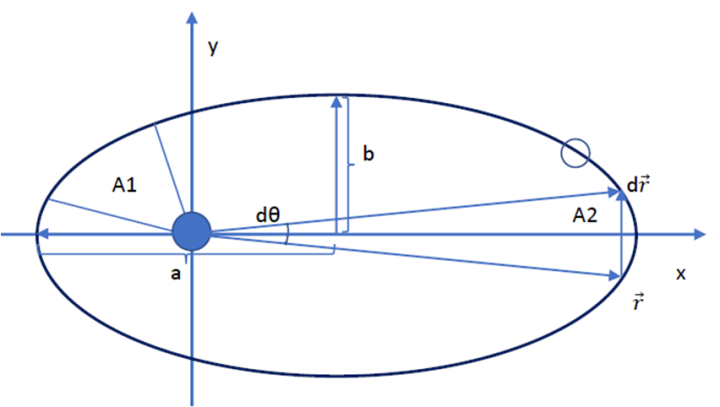
In astronomy, Kepler's laws 17 of planetary motion describe the orbits of planets around the Sun. Following Kepler's laws, each planet travels along an ellipse with the Sun at one of elliptical foci. The planets closer to the Sun with smaller semi-major axis travel more quickly because they are more affected by the Sun's gravity. On an elliptical orbit, a planet's distance from the Sun varies over the course of its revolution orbit. Let’s review the Earth motion around the Sun as an example as Figure 1.

According to Kepler’s second law, that a line segment joining the Earth and the Sun sweeps out equal areas during equal intervals of time, as in Figure 1, 
 |
 |
Where, a is the semi-major axis, b is the semi-minor axis, Tr is the revolution period. If there is a circle with same area as the trajectory ellipse. The square radius of the circle shall be:
 |
and
 |
 |
 | (6) |
 | (7) |
then
 | (8) |
In the Hilbert Space, we can define
 |
Then
 | (9) |
Obviously the conjugate variables of the Earth’s position and momentum vectors are same non-commutative as quantum particles.
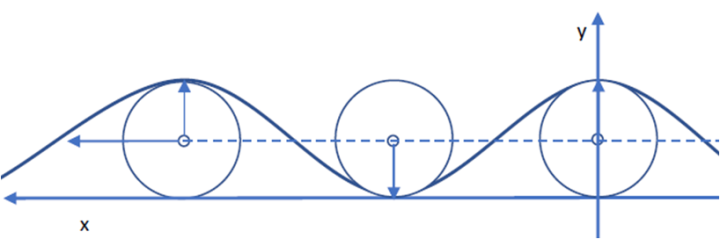
If we imagine there is a vector pointing from the Earth center to its equator, or the Shanghai People’s Square or the New York’s Times Square as the vector head, then the trajectory of any of the vector heads must form a wave during the Earth’s spin and revolution to the Sun according to our theory of spin vector in motion 18, 19, illustrated as Figure 2.

The wave period, the wave length of the vector motion, and the momentum of the Earth shall have the following relations based on Equation 6, where  is the period of the Earth’s spin,
  is the wave length of the Earth’s vector wave motion.
 |
Based on Equation 7, we can get
 |
and
 |
If we substitute the  with
with  then
then
 |
If we define j as the planetary energy constant of the Earth,
 |
because j is always a constant during the Earth’s spin and revolution, then
 | (10) |
And a wave equation 20 of the spin vector of the Earth will be described as below according to classical wave physics, where  is the wave function of the spin vector,
  is the angular frequency,
  is the wave speed,
  is the frequency of the spin vector:
 | (11) |
Since  if we define
 | (12) |
and define naturally
 | (13) |
then
 |
or
 | (14) |
When we compare the Equation 9 and 14, from mathematic deduction, we can conclude  Since the total energy is the sum of kinetic and potential energy of the Earth, the final wave equation is deduced as Equation 15 or 16, where V is the potential energy,
  is the Hamilton operator:
 |
 | (15) |
 | (16) |
Of course, we can deduce the similar energy lower limit and upper limit of the Earth’s orbital motion around the Sun according to Heisenberg’s inequality and our previous work 19, 21 as Equation 17. There must be an energy band between the lower and upper energy limit. The energy band will explain why the Earth’s motion trajectory is an ellipse instead of a circle.
 | (17) |
If we take the relativistic effect into account for a free planet without gravitational field and without potential energy taken into consideration, we can deduce further to get the similar Dirac Equation for planetary motion as Equation 18, but with a different constant 
 | (18) |
According to the classical wave theory and our theory of spin-vector in motion, and based on the planet spin period, u =  we can calculate the vector wave lengths for the celestial bodies in the Solar system as in Table 1.
Because the wave frequency of the spin-vector is so low while the vector wave length is so long, that is why we don’t realize or detect the planetary wave features generated by a planet. These waves are just neglectable, even though they exist authentically.
And the unique feature of the celestial body’s motion is that each celestial body has its own energy constant, compared to the Planck constant for all quantum particles.
3.2. Spin-Orbit ResonanceFor many years it was thought that Mercury was synchronously tidally locked with the Sun, spinning once for each orbit and always keeping the same face directed towards the Sun, in the same way that the same side of the Moon always faces the Earth. Radar observations in 1965 proved that the Mercury rotates three times about its spin axis for every two orbits around the Sun. This phenomenon is called as spin-orbit resonance in astronomy. In the solar system, each celestial body has different specific spin-orbit resonance. We attribute simply this resonance to the ratio(orbit-spin) of its revolution circumference to its vector wave length. Based on this number of spins in each revolution, we can also calculate the celestial body’s revolution period (spin period multiplying orbit-spin ratio), represented in Table 2.
When we compare the data in Table 2, we find that all the calculated revolution periods match very well with the periods observed. This is the real material wave evidence other than quantum particles.
When we compare the quantum particle’s Schrodinger Equation 1 with the photon’s wave Equation 5, we realize there is some discrepancy. If we change the format of Equation 5 as below:
 |
We can get the Equation 19, this is apparently the form as kinetic energy operator to a photon’s wave function.
 | (19) |
If we change the Equation 5 into another format as below:
 |
According to our previous work 16, we knew that there was potential energy existing between the positive charge and the negative charge of the photon’s electric dipole and it is equal to the kinetic energy, then we can get Equation 20 for a photon’s wave motion.
 | (20) |
Based on the above duction, we discover that a photon’s wave equation is in same form as a quantum particle, and as a planetary body. Even there is no relativistic effect for an object with much lower speed or for a photon with light speed. And we realize that all these objects are with different sizes, masses, wave speeds, and maybe even with different forces to drive the motion. But they all follow the same rule to move. They all behave with particle-wave duality. All these objects are with same wave length and momentum relation, the famous de Broglie Equation, and with same Planck energy equation(energy and wave frequency), but with different Planck constant and planetary energy constant. The intrinsic nature behind shall be that they are all spin-vectors in motion. We may name this theory as Spin-vector Mechanics to describe the wave motion of photons, quantum particles and celestial bodies in the universe. If we don’t take energy and energy constant into consideration in the equation form, while taking all the features of spin-vector in motion such as angular frequency, wave length, and wave speed into consideration. The wave equation of a spin object in motion will be as Equation 21 and 22 in different dimensions as we described in previous work 18. The object’s mass, size, spin period and wave speed will not have any impacts on the final form of the wave equation.
 | (21) |
 | (22) |
We all know that a photon is an electric dipole 18, 23, both the positive charge and negative charge are in spin, and the dipole as a whole is in spin and motion too. Based on the photon’s wave Equation 5, if there are binary stars with same mass for each, each star is in spin while two of them form a spin vector as a whole and in motion, the wave motion of these binary stars shall follow the same form as Equation 5, but with a special planetary energy constant. And if there were an object moving faster than light speed, and if it were in spin and motion, its wave motion would follow the same Schrodinger Equation 1, but the energy constant would be different and it would depend on the specific motion features of the object such as its mass, spin and revolution period, semi-major-axis, etc.
Based on the theoretical deduction, we prove that any objects as long as in spin and motion, they will behave as particle-wave duality, no matter they are the photons, the quantum particles, or the celestial bodies with different, mass, size, and wave speed of the spin-vector, their wave equations will have same form, the Schrodinger wave equation. The only difference is their energy constants. They all have same relation of wave-length and momentum, energy and wave frequency of the spin-vector. The energy band between the lower energy limit and upper energy limit is the reason resulting in the elliptical orbit of the planetary revolution. The de Broglie’s material wave theory and Planck quantum energy have been successfully extended from quantum particles to celestial bodies. The actual meaning of the de Broglie’s material wave theory is far more profound than we realized before. We can also conclude that there is no relativistic effect on spin objects in motion no matter they have much less wave speed or with same wave speed as light.
We are very confident that the new theory of spin-vector in motion or Spin-vector Mechanics will be absolutely applied to many other physical areas, especially in Astronomy and Cosmology with further development in the near future. But it still requires a further exploration of the planetary energy constant for a planetary motion other than the elliptical orbital motion, and for the electrons as well when in revolution to the nucleus.
| [1] | S.W. Hawking, The Theory of Everything: The Origin and Fate of the Universe, Phoenix Books, ISBN 978-1-59777-508-3. c2006. | ||
| In article | |||
| [2] | S. Weinberg, Dreams of Final Theory: The Scientist’s Search for the Ultimate law of Nature, New York: Pantheon Books, ISBN: 0-679-74408-8, c1992. | ||
| In article | |||
| [3] | L. Smolin, Einstein’s Unfinished Revolution. Penguin Press, New York, ISBN 978-1594206191, c2019. | ||
| In article | |||
| [4] | S. Carlip, “Quantum Gravity: A Progress Report”, Reports on Progress in Physics. 64 (8): p885-942(2001). | ||
| In article | View Article | ||
| [5] | S.H. Priest, Encyclopedia of Science and Technology Communication, SAGE Publications, ISBN 978-1-4522-6578-0, c2010. | ||
| In article | |||
| [6] | C.W. Misner, K.S. Thorne, J.A. Wheeler, Gravitation, San Francisco: W.H. Freeman and Company, ISBN 0-7167-0334-3. c1973. | ||
| In article | |||
| [7] | K. Becker, M. Becker, J. Schwarz, String theory and M-theory: A modern introduction, Cambridge University Press, ISBN 978-0-521-86069-7, c2007. | ||
| In article | |||
| [8] | John Ellis, “The Superstring: Theory of Everything, or of Nothing?”. Nature. 323(6089): p595-598(1986). | ||
| In article | View Article | ||
| [9] | John Ellis, “Physics gets physical”. Nature. 415(6875): p957 (2002). | ||
| In article | View Article PubMed | ||
| [10] | F. Finster, J. Kleiner, “Causal fermion systems as a candidate for a unified physical theory”, Journal of Physics: Conference Series. 626(2015): 012020. | ||
| In article | View Article | ||
| [11] | Ron Cowen, “The quantum source of space-time”. Nature. 527(7578): p290-293 (2015). | ||
| In article | View Article PubMed | ||
| [12] | D. S. Robertson, “Goedel's Theorem, the Theory of Everything, and the Future of Science and Mathematics”, Complexity. 5(5): p22-27(2007). | ||
| In article | View Article | ||
| [13] | R.A. Serway, J.W. Jewett, Physics for Scientists and Engineers with Modern Physics, Philadelphia: Saunders College Pub., c1983. | ||
| In article | |||
| [14] | P.A.M. Dirac, The Principles of Quantum Mechanics, Oxford University Press, c1947. | ||
| In article | |||
| [15] | J. Peatross, and M. Ware, The physics of Light and Optics, Brigham Young University, ISBN 978-1-312-92927-2, c2022 | ||
| In article | |||
| [16] | Zhonglin BO, “Is the String Theory Still Alive? Exploration of the Mass of Photon and the Origin of Matter.” International Journal of Physics, 10(2): p88-92(2022). | ||
| In article | |||
| [17] | Ian Morison, Introduction to Astronomy and Cosmology. John Wiley and Sons, Ltd., c2008. | ||
| In article | |||
| [18] | Zhonglin BO, “New Atom Configuration Based on Proton and Electron as Electric Monopole Pairs and Exploration of Quarks and Higgs Particle”, International Journal of Physics, 9(6): p269-274(2021). | ||
| In article | |||
| [19] | Zhonglin BO, “Quantum-Mechanical Description of Physical Reality Shall Be Considered Complete”, International Journal of Physics, 10(3): p174-181(2022). | ||
| In article | View Article | ||
| [20] | A.P. French, Vibration and Waves, The Massachusetts Institute of Technology, c1971. | ||
| In article | |||
| [21] | Zhonglin BO, “Reexamine Copenhagen Interpretations of Quantum Mechanics”, International Journal of Physics, 9(6): p275-279 (2021). | ||
| In article | View Article | ||
| [22] | Wikipedia, “Solar System”, https://en.wikipedia.org/wiki/Solar_System. | ||
| In article | |||
| [23] | Wikipedia, “Standard Model”, https://en.wikipedia.org/wiki/Standard_Model. | ||
| In article | |||
Published with license by Science and Education Publishing, Copyright © 2022 Zhonglin BO
 This work is licensed under a Creative Commons Attribution 4.0 International License. To view a copy of this license, visit
http://creativecommons.org/licenses/by/4.0/
This work is licensed under a Creative Commons Attribution 4.0 International License. To view a copy of this license, visit
http://creativecommons.org/licenses/by/4.0/
| [1] | S.W. Hawking, The Theory of Everything: The Origin and Fate of the Universe, Phoenix Books, ISBN 978-1-59777-508-3. c2006. | ||
| In article | |||
| [2] | S. Weinberg, Dreams of Final Theory: The Scientist’s Search for the Ultimate law of Nature, New York: Pantheon Books, ISBN: 0-679-74408-8, c1992. | ||
| In article | |||
| [3] | L. Smolin, Einstein’s Unfinished Revolution. Penguin Press, New York, ISBN 978-1594206191, c2019. | ||
| In article | |||
| [4] | S. Carlip, “Quantum Gravity: A Progress Report”, Reports on Progress in Physics. 64 (8): p885-942(2001). | ||
| In article | View Article | ||
| [5] | S.H. Priest, Encyclopedia of Science and Technology Communication, SAGE Publications, ISBN 978-1-4522-6578-0, c2010. | ||
| In article | |||
| [6] | C.W. Misner, K.S. Thorne, J.A. Wheeler, Gravitation, San Francisco: W.H. Freeman and Company, ISBN 0-7167-0334-3. c1973. | ||
| In article | |||
| [7] | K. Becker, M. Becker, J. Schwarz, String theory and M-theory: A modern introduction, Cambridge University Press, ISBN 978-0-521-86069-7, c2007. | ||
| In article | |||
| [8] | John Ellis, “The Superstring: Theory of Everything, or of Nothing?”. Nature. 323(6089): p595-598(1986). | ||
| In article | View Article | ||
| [9] | John Ellis, “Physics gets physical”. Nature. 415(6875): p957 (2002). | ||
| In article | View Article PubMed | ||
| [10] | F. Finster, J. Kleiner, “Causal fermion systems as a candidate for a unified physical theory”, Journal of Physics: Conference Series. 626(2015): 012020. | ||
| In article | View Article | ||
| [11] | Ron Cowen, “The quantum source of space-time”. Nature. 527(7578): p290-293 (2015). | ||
| In article | View Article PubMed | ||
| [12] | D. S. Robertson, “Goedel's Theorem, the Theory of Everything, and the Future of Science and Mathematics”, Complexity. 5(5): p22-27(2007). | ||
| In article | View Article | ||
| [13] | R.A. Serway, J.W. Jewett, Physics for Scientists and Engineers with Modern Physics, Philadelphia: Saunders College Pub., c1983. | ||
| In article | |||
| [14] | P.A.M. Dirac, The Principles of Quantum Mechanics, Oxford University Press, c1947. | ||
| In article | |||
| [15] | J. Peatross, and M. Ware, The physics of Light and Optics, Brigham Young University, ISBN 978-1-312-92927-2, c2022 | ||
| In article | |||
| [16] | Zhonglin BO, “Is the String Theory Still Alive? Exploration of the Mass of Photon and the Origin of Matter.” International Journal of Physics, 10(2): p88-92(2022). | ||
| In article | |||
| [17] | Ian Morison, Introduction to Astronomy and Cosmology. John Wiley and Sons, Ltd., c2008. | ||
| In article | |||
| [18] | Zhonglin BO, “New Atom Configuration Based on Proton and Electron as Electric Monopole Pairs and Exploration of Quarks and Higgs Particle”, International Journal of Physics, 9(6): p269-274(2021). | ||
| In article | |||
| [19] | Zhonglin BO, “Quantum-Mechanical Description of Physical Reality Shall Be Considered Complete”, International Journal of Physics, 10(3): p174-181(2022). | ||
| In article | View Article | ||
| [20] | A.P. French, Vibration and Waves, The Massachusetts Institute of Technology, c1971. | ||
| In article | |||
| [21] | Zhonglin BO, “Reexamine Copenhagen Interpretations of Quantum Mechanics”, International Journal of Physics, 9(6): p275-279 (2021). | ||
| In article | View Article | ||
| [22] | Wikipedia, “Solar System”, https://en.wikipedia.org/wiki/Solar_System. | ||
| In article | |||
| [23] | Wikipedia, “Standard Model”, https://en.wikipedia.org/wiki/Standard_Model. | ||
| In article | |||