In this present work, a theoretical study of the variation of the photoionization cross-section, the impact of the vibrational wave functions of the crystal lattice, and the choice of the acceptor nature of some impurities in the case of GaAs and CdTe on this last are carried out. In this work, we added the contribution of overlapping vibrational wave functions to the photoionization of cross section in a polar semiconductor for a charge carrier bound to an impurity. We adopted the Born Oppenheimer approximation to describe the initial state of impurity through a test function and the Lee-Low-Pines function for the final state. Chemical shift, charge carrier-phonon interaction, and central cell correction are taken into account. We used the variational method by minimizing the average value of the energy in order to calculate the binding energy. The behavior of the photoionization cross-section spectra obtained with various frequently used impurities is compared with the experimental and theoretical data. It is observed that the photoionization cross sections increase up to their peaks starting from a quasi-zero value and then decrease as the photon frequency increases. The peaks of the photoionization cross section are almost identical but sometimes shifted. This shows that the vibrational contribution of the crystal lattice is important in the process of calculating the photoionization cross-section. The spectra obtained indicate that the photoionization cross-section is sensitive to the choice and the nature of the impurity.
Nowadays, the design of optoelectronic devices 1 requiring more precision and efficiency with low power consumption is becoming more and more demanding. The semiconductor nanostructures can function wonderfully if the impurities and defects introduced are controlled during the design in order to obtain materials with a high degree of purity. In these low dimensional electronic systems, the photoionization process is described as an optical transition which takes place from the ground state of impurity as the initial state to the conduction sub-bands, which requires sufficient energy for the transition to occur realized; this photoionization is seen as one of the means of controlling unintentional impurities which are introduced into a semiconductor device. Thus the photoionization cross section is one of the important optical properties for the characterization of an impurity in a semiconductor device. Several methods are used to calculate the cross section of photoionization; Guoli Wang and al 2 have calculated photoionization cross sections from the excited 3s3p state of Mg using both the non-relativistic and relativistic R matrix method; the relativistic effects result in more extensive resonance structures due to many more coupled channels. N. Porras Montenegro and S.T. Perez Merchancano 3, 4 studied Hydrogenic impurities in GaAs- (Ga, Al) As quantum dots and showed that the strong electronic confinement in these quantum dots rejects itself in the ground state energy and in the impurity binding energies, which are higher than those found in GaAs- (Ga, Al) As quantum wells and quantum-well wires. El-Said and Tomak 5, 6 studied the energy dependence of photons of the photoionization cross-section of hydrogen impurities in quantum wells using infinite barrier model. They found that the photoionization cross section depend on the polarization of the incident light with respect to the direction of confinement of the carrier. The binding energy for acceptor impurities have been studied taking into account central cell effects on acceptor spectra in Si and Ge 7. Using a variational approach, A. Sali and al 8 have calculated the photon energy dependence of the photoionization cross-section for a hydrogenic donor impurity in an infinite barrier GaAs quantum dot as a function of the sizes of the dot and the impurity position. They show that the photoionization cross-section is strongly affected by the quantum size effects and the position of the impurity and its overall shape seems to be a signature of the quantum dot system. Zorkani et al 9 calculated the photoionization cross section by taking into account the charge carrier-phonon factor for an acceptor-type impurity and were interested in the central cell correction to account for chemical shift by means of an analytical model of the potential of impurity proposed by Munnix et al 10. Winnie Otieno and Hannington Oyoko 11, studied the dynamic behaviour of the cross section of photoionization in the presence of the hydogenoid type impurity in particular its position and showed that the cross section of photoionization in quantum wells is sensitive to the location of the impurity and the frequency of the incident photons.
To validate this study, we have chosen gallium arsenide, the results of which are compared with theoretical and experimental data. In order to better understand our results, cadmium tellurium as well as impurities often encountered in the calculation of the photoionization cross section were used. Indeed, cadmium tellurium is a polar semiconductor which crystallizes according to the stable cubic structure of zinc-blende 12. The gap is direct, with a band gap that varies with temperature. The main property of this compound lies in its peculiarity of being able to be developed in a range of electrical resistance (N or P type electrical conductivity) which gives it a remarkable place in the production of many optoelectronic devices such as solar cells, electronic modulators optics, infrared detectors based on HgCdTe and gamma and X-ray detectors. Although this material is produced from cadmium and electronic purity, residual impurities, those from various sources of contamination or handling of surface, as well as native defects resulting from stoichiometric imbalances, introduce electrically active levels into the forbidden band. Thus the electrical and electronic properties are sensitive to the presence of these levels and consequently the performance and quality of devices made from this material are greatly modified. The nature of the defects in CdTe has been the subject of much research for the understanding of several physical phenomena such as that of self-compensation 13. Due to the electron-phonon interaction the effective radius undergo a slight variation. Often, the calculation of the effective radius of a donor is done without difficulty using the quantum model. On the other hand, the case of acceptors is more complicated because of the degeneration and the anisotropy of the valence band. In the case of undoped samples, this acceptor was identified with copper which is a contaminant of CdTe.
The Born Oppenheimer approximation is used to describe the initial impurity state through a trial function and the Lee-Low-Pines function for the final state. The interaction potential is obtained by taking into account the chemical shift, the charge carrier-phonon interaction and the central cell correction. The variational method is used by minimizing the average value of the energy in order to calculate the binding energy. We used the impurities often retained after the identification of the dopant by excitation spectroscopy. As, Sb or even Cu impurities are very interesting in that they are used to make ohmic contacts, hence the possibility of correlation of optical measurements with electrical measurements. Therefore, the determination of energy levels becomes an asset for the design of optoelectronic devices. The behaviour of the photoionization cross-section spectra obtained with various frequently used impurities are compared with the experimental and theoretical data.
In the quantum dot systems, this transition requires higher photon energies than the quantum well and quantum-well wire structures. This is due to an enhancement of the optical photoionization threshold energy achieved by the increasing electronic confinement with reduction of the dimensionality. The excitation energy dependence of the photoionization cross-section associated with an impurity, starting from Fermi’s golden rule in the well-known dipole approximation, as in the bulk case is:
 |
 is the constant of the fine structure,
  the optical refractive index,
  the dielectric constant.
  is the ratio between the effective field which is equal to the Lorentz field and the nominal (electric) field of the incident wave. It is customary to think of it as an adjustable parameter. It is clear that it in no way affects the frequency position of the maximum of the photoionization cross section but only the height of the curve.
 is the element of matrix between the initial and final states of the dipole moment of the impurity,
  and
and  are the initial and final energies of the system. Using the Born-Oppenheimer adiabatic approximation, we can separate the electronic wave function
  from that of the lattice
  This allows for the impact of overlapping vibrational wave functions on the spectra of the photoionization cross section to be taken into account.
 | (2) |
 and
and  are the functions of electronic waves.

 are the wave functions of the crystal lattice
 translates the overlap of vibrational wave functions.
Taking into account the commutation relations between the operators  and
and  the overlap integral can be written as 14:
 | (3) |
where the quantity  measures the strength of the carrier-LO phonon interaction.
  and
and  are respectively the electron density and the phonon energy involved (Longitudinal Optical phonon) 15, 16.
  and
and  are the factors proper of the Hamiltonian of free phonons by:
 | (4) |
 (respectively
  ) is the number of phonons in the
  longitudinal optical mode of wave vector
  of the initial state
  (respectively
  ).
).
These wave functions are expressed as functions of the operators  and
and  as well as depending on the free LO-phonon states
 | (5) |
 | (6) |
The overlap of the wave functions can be derived 16:
 | (7) |
For zero or one phonon, transitions  per longitudinal optical mode, the overlap of the wave functions of the lattice is expressed as follows:
 | (8) |
 is the Huang-Rhys coupling factor; it gives the amplitude of the electron (hole) -phonon interaction.
The probability of transition  resulting from accompanied transitions the emission of a fixed number of LO phonons is characterized by modes in which the number of occupations increases
  and modes in which the number of occupations is decreasing
  Therefore, the transition probability is proportional to
  :
:
 | (10) |
 can also be expressed in terms of p and S. Low temperatures
  only the fundamental vibratory level is occupied, and we can have.
 | (11) |
We thus find the Poisson distribution:
 | (12) |
The shape of the theoretical emission spectrum at  is obtained from
  for different values of the coupling factor S 17.
In this work we choose the Z axis oriented along the direction of polarization of the incident photons. Born Oppenheimer's approximation assumes that heavy nuclei are frozen in their equilibrium position  The interaction potential between these ions and an electron of the conduction band identified by r is of the form:
 | (13) |
In a real atomic lattice, however, thermal agitation causes the atomic nuclei to vibrate  around their equilibrium position
  The interaction potential is then described by:
  with
with  In the expansion of
  as a function of
  the most important contribution is given by the linear term in
  In this case the electron-phonon interaction is a sum of contribution coming from the different normal modes of vibrations:
 | (14) |
Where  and
and  are the creation and destruction operators respectively for the q mode and
  measure the strength of the coupling between the electron and the longitudinal optical phonons (LO). In fact, in a crystal lattice, the negatively charged electron interacts with the ions or atoms of the crystal and creates a local deformation of the lattice. The electron and the deformation field associated with it is a quasi-particle called a "polaron" 18. The electron-phonon interaction reduces the energy of the particle by the amount
  which is the electron's own energy in the polarization field. The mass of the polaron 19 is given as a function of the mass of the particle by the relation:
 | (15) |
where the coupling constant:
 | (16) |
 is the optical dielectric constant
It is the energy expressed in  units of a particle of extension
  moving in a dielectric medium. In order to obtain the shape of the coefficient
  it is necessary to determine the macroscopic electric field produced by longitudinal optical vibrations of the crystal; this coefficient is worth:
 | (17) |
which can be expressed as a function of the coupling constant 
 | (18) |
 is the volume of the crystal.
The electronic charge density can also be expressed according to the nature of the acceptor conduction band or donor-acceptor recombination. The wave function attached to the acceptor hole is in the hydrogenoid form.
 | (19) |
where  is the effective radius of the acceptor. The coefficient
  is the Fourier transform of the electric charge density which is given by 18.
 | (20) |
Let  be the charge density of the conduction band-acceptor recombination.
 | (21) |
 | (22) |
 | (23) |
 | (24) |
 | (25) |
 | (26) |
The Huang-Rhys factor is given by
 | (27) |
 | (28) |
 | (29) |
 | (30) |
For ease of writing, in the following we replace the impurity ray  with
with 
Within the framework of the approximation of the effective mass, the Hamiltonian of the system related to the impurity is written:
 | (31) |
The term  is due to the contribution of phonons, while the term
  arises from the interaction between charge carriers (electron-nucleus) and optical longitudinal vibration modes. With the help of a suitable canonical transformation, the effective Hamiltonian can be written as:
 | (32) |
The term  can be eliminated using a canonical transformation of the form:
 | (33) |
The last term is calculated:
 | (34) |
So the Hamiltonian is written:
 | (35) |
We then see that the screening factor in Coulomb energy is indeed the static dielectric constant 
In the adiabatic approximation, the choice of the test function  allows H to be written in another form:
 | (36) |
where
 | (36) |
 is the radius of the impurity,
  the Fourier transform of the electron charge density in the ground state and
  is the vacuum state of the phonon.
 | (37) |
 | (38) |
The last term is the readjustment energy of the crystal lattice due to the electron (hole) -phonon interaction:
 | (39) |
Another physical quantity of interest is the ionic polarization charge density induced by the electron. In order to calculate this, we note that the interaction term in our Hamiltonian is just the potential energy of the electron in the ionic polarization field.
In using this Hamiltonian, we make the assumption that the dielectric may be treated as a continuum. This is a legitimate approximation since the phonons which interact strongly with the electron have a wave-length long compared to the lattice distance, and, as we shall see, the polaron extends over many lattice distances. So, the final state is described in the Lee-Low Pines (L.L.P) approximation by 10:
 | (40) |
where
 | (41) |
 are the phonons emitted and
  is the pulse of the charge carrier. Within the adiabatic approximation, the source of the lattice polarization is the charge distribution of the impurity center described by the Fourier transform.
 | (42) |
We recall that in this form, the integral over space cannot be done in a reasonable way 9. On the other hand, for low values of the wave vector  an approximation valid for slow charge carriers; doing a series development, we obtain the following expression of the photoionization cross section for the emission of a phonon 9:
 | (43) |
 is Heaviside's function,
  is the quantum radius of the polaron,
  is the charge-carrying phonon coupling constant, and
  is the volume of the crystal. In this expression, the term
  is added to take into account the overlap of vibrational wave functions on the spectra of the photoionization cross section.
 | (44) |
where  is the number of phonons emitted during the transition
 | (45) |
 | (46) |
 | (47) |
 | (48) |
The central cell potential must account for two facts:
- to reflect the relaxation of the electronic gas due to the excess charge of impurity; the optical dielectric constant  is replaced by a dielectric constant which depends on the wave vector
- lattice disruption due to the incorporation of impurity. The first condition is satisfied by taking into account the dispersion of the dielectric function as a function of the wave vector q 20.
 | (49) |
whose limits are respectively  for
for  and
and  for
for  infinite. The value of the constant
  is a characteristic of the crystal. It is obtained for different semiconductors by adjusting the analytical form of
  to the numerical calculations performed by Vinsome 21 the dielectric constant
  is measured by Litton.
The short-range potential resulting from this modification of the Coulomb potential is obtained by the Fourier transform:
 | (50) |
 | (51) |
 | (52) |
 | (53) |
 | (54) |
or
 | (55) |
and
 | (56) |
Finally, we get
 | (57) |
However, the second condition can be verified by taking a low-range potential which best accounts for the lattice disturbance caused by the impurity. In this case, the potential is chosen from the form:
 | (57) |
The dimensionless variational parameter  is determined for each impurity, using variational calculus, requiring the binding energy to be exactly equal to its experimental value.
The central cell correction is then given by:
 | (58) |
In conclusion, the overall potential is obtained by adding the potential of the central cell correction to the hydrogenoid potential:
 | (59) |
Munnix et al 10 proposed a potential with central cell correction of the same type as the previous one and applied it successfully to the recombination spectra of donor-acceptor pairs in the case of GaP and ZnTe. This potential is of the form:
 | (60) |
The parameter  can take the values
  or
or  depending on the depth of the impurity considered. The parameter K is the same as that described previously and the parameter
  is obtained, using a variational calculation, by requiring that the experimental binding energy is exactly equal to the theoretical energy. The values of the radius of the impurity
  and of the parameter δ are obtained by minimizing the energy of the charge carrier related to the impurity with respect to a and for different values of
  In a semiconductor, it should be noted that if the central cell correction is greater in the case of acceptors, it could not be processed by perturbation. Therefore the use of the variational method by minimizing the mean value of energy becomes an opportunity to be grasped and the computation of the binding energy with the potential of Munnix could be obtained analytically.
 | (61) |
Using a hydrogenoid wave function,
 | (62) |
 | (63) |
or
 | (64) |
 | (65) |
 | (66) |
 | (67) |
because
 | (68) |
 | (69) |
 | (70) |
 | (71) |
 | (72) |
 | (73) |
 | (74) |
 | (75) |
 | (76) |
 | (77) |
Consequently, the analytical expression of energy is written in the form:
 | (78) |
Where  and
and  are expressed in terms of
  and the effective Rydberg
  The minimization of the function
  provides the variational parameter a and subsequently the radius of the impurity. The variational computation of the bond energy with the Munnix potential is similar to the expression for
  These expressions make it possible, using a variational calculation, to evaluate the effective radii of the impurities which will be used in the calculation of the Huang-Rhys factor of the different radiative recombination.
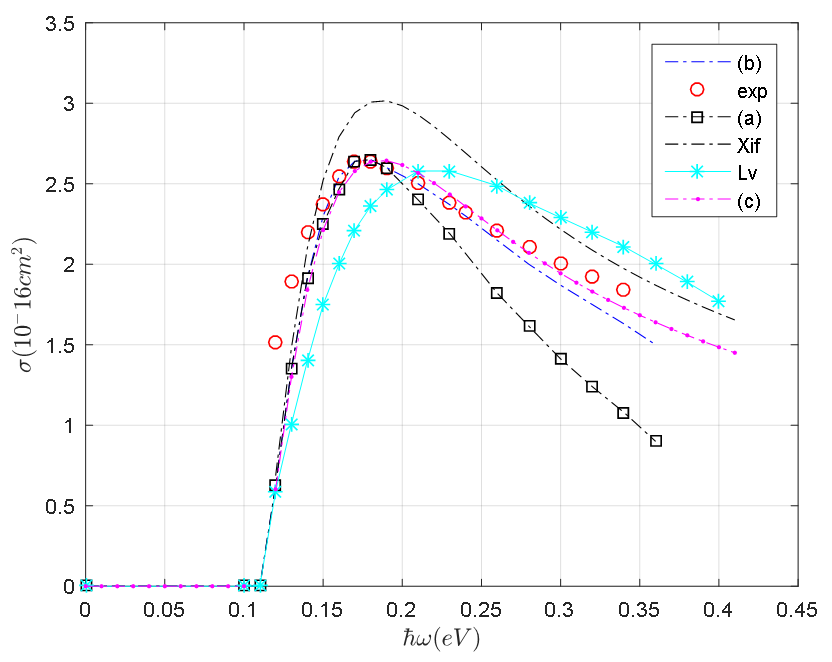
The binding energies in Table 1 result from the work of Molva 10, 21, 22 on Li, Na, Cu, Ag, Au, N, P and As introduced into CdTe crystals having undergone various treatments (annealed under atmospheres of cadmium or tellurium, diffusion of impurities, ion implantation, electron irradiation). To validate our study, we compare our results (Figure 1) with those obtained theoretically and experimentally in the case of GaAs 9 doped with manganese. We group together the physical parameters related to the different impurities in the table below.
To avoid the complexity of the real shape of the valence band, we used the value of the mass of the heavy hole because using the mass of the light hole gave us unreasonable results  It therefore seemed that the transitions from the impurity state to the heavy hole band are markedly favoured over the transitions to the light hole band. The problem of the choice of mass of the hole necessary for the calculations of the effective radius of the different (As, Sb and Cu) arises from the central cell correction models. We have shown in figures below the spectra of the photoionization cross section with different impurities often used in the case of GaAs and CdTe.
To avoid the complexity of the actual shape of the valence band, the value of the mass of the heavy hole often used because the use of light hole mass would lead to unreasonable results. In effect, when the coupling is weak (low bandwidth) and at the zero limit, electrons can’t move (stuck on their site), i.e. the effective mass is infinite. On the contrary, if the atoms are strongly coupled, the electrons will be lightened and may have zero mass (the band is very wide). In general, the masses are heavy, even very heavy. All of this is true if the mean field hypothesis is valid. Unfortunately when the masses are heavy i.e. the electrons located on their site, the electronic correlations come into play and complex models must be used (Hartree-Fock, the local density functional, the Hubbard style) 23.

It would therefore seem that the transitions from the state of impurity to heavy hole band are clearly favored over transitions to the light hole strip. This representation shows an almost perfect agreement for the form curves although the peak of the Lucovsky curve is shifted. Our curve (c) is much closer to the curve experimental than those of Zorkani et al. The maximum observed for the photoionization of cross section corresponds to the transition to a band state located at an energy above the minimum of the conduction band. The pics observed are attributed to energy transitions corresponding to the transition energy involving localized impurities in their site. We have implemented a numerical program to obtain the photoionization cross section curves of Zorkani et al. To validate our study, in the proposed model, we took into account the contribution of the wave functions of the lattice by adopting the parameters used by Zorkani.
Our two curves obtained are almost identical; the observed difference comes from the choice of value of  which is considered as an adjustable parameter which does not in any way affect the frequency position of the maximum of the cross section of photoionization but only the height of the curve.
The comparison of the curve (c) with the experimental one of R. A. Chapman and W. G. Hutchinson brings out a n almost agreement perfect result in the range of energies between 0.12 eV and 0.326 eV. Beyond this interval, there is a very slight disagreement due to the fact that the photoionization cross section is very sensitive to the exact shape of the valence band and in particular the use of approximations to evaluate the wave functions and potential.
The comparison of our model of the spectrum of the photoionization of cross section and that of Lucovsky's theory reveals a same pace. Beyond a near-perfect agreement in a weak range of energies between 0.12 eV and 0.14 eV, we observe a slight shift in the position of the peak of the Lucovsky curve. This lag is due to the fact that Lucovsky neglects the Coulomb potential long range in the calculation of the cross section of photoionization lucovsky because for a deep impurity, the extension of the wave function is strongly reduced in the vicinity of impurity. The contribution made by the central region, called heart region of impurity is no longer negligible. The shift of the Lucovsky curve would have been observed less also with a take taking into account the vibrational contribution of the lattice in the calculation of the photoionization cross section. We used our model (Xif) together with the data presented in Table I to represent the different spectra of the photoionization of cross section. In each of the figures shown, we have added a legend indicating the crystal and impurity used.
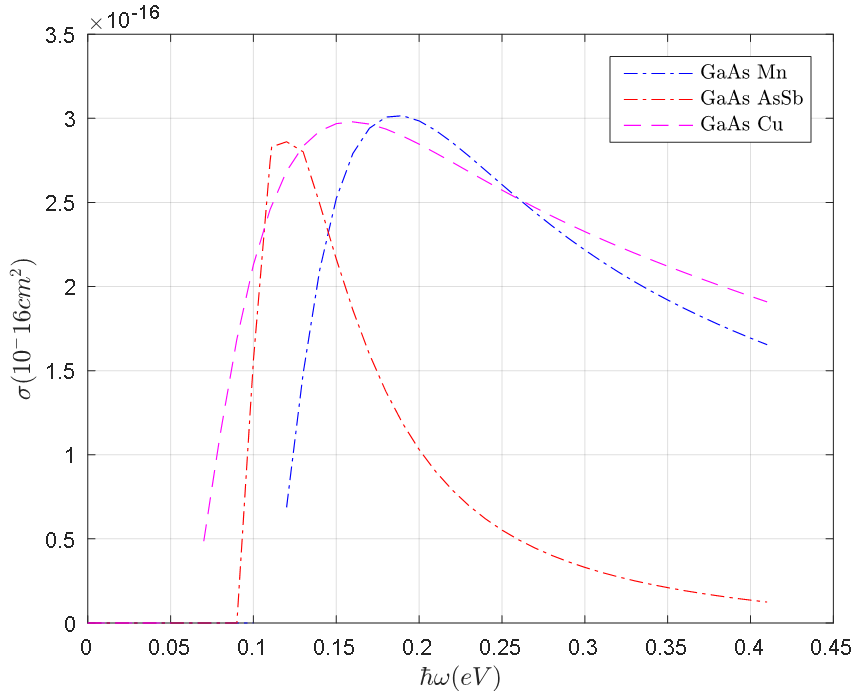
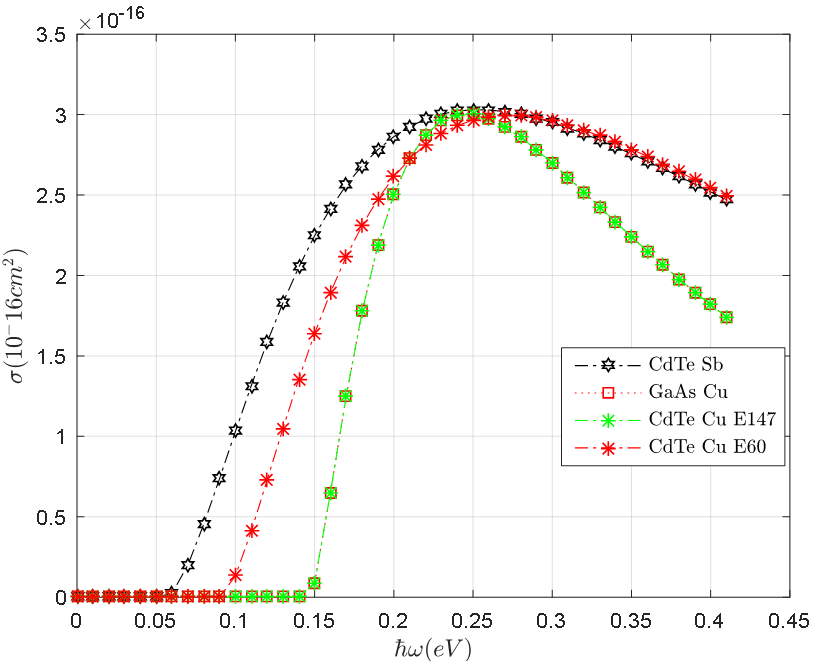
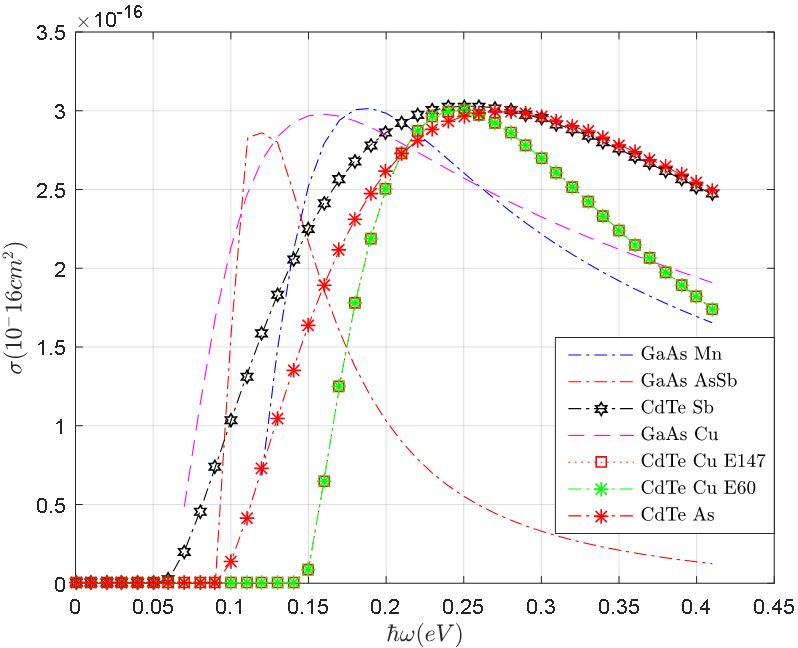
After the near-perfect agreement obtained in Figure 1, we are also interested in the behaviour and the variation of the photoionization cross section as a function of the choice of the impurity of acceptor nature. Indeed, in Figure 2 and Figure 3, we have represented all the spectra of the photoionization cross section of GaAs and CdTe doped with different impurities. It should be noted that the spectra obtained in the case of GaAs doped with an As and of GaAs doped with an Sb are identical. Therefore, we have represented them together, hence the connotation As-Sb. In order to have an overall view of the behaviour of these spectra, we have represented them all together in Figure 4. The shapes of the spectra obtained are almost the same, in particular with copper as the deep (Cu E147) or shallow (Cu E60). In figure 2, compared to GaAs_Mn, the spectra obtained show almost the same appearance with a slight shift in the position of the peak. The shift and reduced width observed in the case of As-Sb is due to the fact that these impurities are considered as surface acceptors. The copper case presents a more perfect agreement than that obtained in the As-Sb case. Its slight disagreement with the Mn spectrum may be due to the effect of electron (hole) phonon interaction which is an important factor in the family of semiconductors.


In the case of the CdTe material, Figure 3 also shows the same and more perfect appearance than that of Figure 2. Beyond a slight shift in a very small interval, energies between 0.05eV and 0.15eV, we note a perfect agreement in the case of As and Sb. The case of copper considered as a deep or superficial acceptor shows good agreement over the whole range of energies. We have gathered in Figure 4 all the spectra of the photoionization cross section with respect to the GaAs : Mn case. Admittedly, we obtained a good agreement, among other things, on the shape of the curves and the position of the peak which is sometimes shifted, but at high energies the agreement is less satisfactory because the photoionization cross section is very sensitive to the exact shape of the band. Valence as well as the coupling factor which gives the amplitude of the electron (hole) phonon interaction. Somewhat, one will note a shift of the curves of CdTe compared to those of GaAs in the energy range between 0.05 eV and 0.15 eV. Undoubtedly, the choice of the material and that of the impurity, in particular its nature (acceptor or donor) constitute essential elements which condition the behaviour of the spectra of the photoionization cross section. Beyond the approximations made on the potential and the wave functions, in the process of photoionization one often takes a state of sub-band like final state. In fact, the final state involves a carrier in the Coulomb impurity domain. The long-range nature of the Coulomb potential must be properly taken into account. The observed difference also comes from the choice of the value of  considered as an adjustable parameter which in no way affects the frequency position of the maximum of the photoionization of cross section but only the height of the curve. These slight shifts can also be due to the choice of wave functions because for a deep impurity, the extension of the wave function is strongly reduced in the vicinity of the impurity. For the case of these two materials, we have weak or even very weak binding energies. Therefore, even in the ground state, the impurity electron is quite far from the Coulomb center and the approximation of a second sub-band state taken as the end state in photoionization may not be totally unrealistic. It is clear that other approximations, such as using a static dielectric constant ε for screening and neglecting the non-parabolicity of the GaAs conduction band, are reasonable due to the very low energy of connection. The position of the impurity, that is, its deep or shallow nature somehow influences the behaviour of the spectra of the photoionization cross section. For the sake of simplicity, the central impurity is often considered; near the walls of the well, the impurity electron cannot sense the Coulomb potential better, and the binding energy decreases. This will increase the photoionization of cross section. Thus, for an unintentionally doped sample, there will be a band of impurity binding energies and the threshold energy for photoionization will be determined by the lowest binding energy. This study allows us to have information on the state of the impurity, the influence of the choice of impurities on the spectra of the cross-section of photoionization.
The variation of the photoionization cross section with the consideration of phonons through the vibrational contribution of the crystal lattice for acceptor-type impurities is calculated. The results show that the photoionization cross-section is sensitive to these impurities and that the taking into account of the phonons is real. On all the spectra (Figure 4), the maxima of the peaks observed have almost the same photoionization cross section value but sometimes they are still slightly offset (Figure 2). The positions of the first non-zero photoionization cross section values are different. Indeed, Figure 4 shows that the transition energy involving impurities localized in their site is more sensitive to the choice of the impurity than to the crystal. Moreover, it can be seen that the photoionization cross-section increases strongly at low frequencies, and gradually decreases to quasi-constant values for higher photon frequencies. The displacements of the peaks obtained reveal that the choice of the impurity influences the variation of the energy of the ground state of the system. These shifts could explain the interaction between the impurity and the crystal. In Figure 3, the choice of the Cu impurity with its different levels (depths), also reveal that the photoionization cross section can be controlled by adjusting the position of the acceptor impurity. Taking into account all these considerations, it is clear that one could not hide the importance of the choice and the position of the impurity as well as the electron-phonon interaction through the vibrational contribution of the crystal lattice in the study of photoionization cross section including the design of optoelectronic devices.
| [1] | Radu, A., Kirakosyan, Laroze, D., & Barseghyan, M. G., Semiconductor Science and. Technology, 30 (4), 045006, 2015. | ||
| In article | View Article | ||
| [2] | Guoli Wang, Jianjie Wan, Xiaoxin Zhou, Radiation Physics and Chemistry 130 (2017) 406-410. | ||
| In article | View Article | ||
| [3] | Porras-Montenegro N & Perez-Merchancano S T, Phys Rev B, 46, 9780, 1992. | ||
| In article | View Article PubMed | ||
| [4] | Porras-Montenegro N & Perez-Merchancano S T & Latge’A, J Appl Phys. 74, 7624, 1993. | ||
| In article | View Article | ||
| [5] | El-Said M & Tomak M, J Phys Chem Solids, 52, 603, 1991. | ||
| In article | View Article | ||
| [6] | H.G. Grimmeiss and La. Ledebo, Journal of Applied Physics 46, 2155 (1975). | ||
| In article | View Article | ||
| [7] | N.O Lippari, A Baldereschi & M.L.W Thewalt, Solid State Commun 33, (1980), 277. | ||
| In article | View Article | ||
| [8] | A. Sali, H. Satori, M. Fliyou, and H. Loumrhari, phys. stat. ground. (b) 232, No. 2, 209-219 (2002). | ||
| In article | View Article | ||
| [9] | Zorkani, El Hasnaoui, Y. Lepine, E. Kartheuser, Journal of Physics I, EDP Sciences, 1995, 5 (10), pp. 1311-1316. | ||
| In article | View Article | ||
| [10] | S. Munnix, E. Kartheuser, Phys Rev B 26, (1982), 6776. | ||
| In article | View Article | ||
| [11] | Winnie Otieno, Hannington Oyoko, American Journal of Optics and Photonics. Flight. 6, No. 3, (2018), pp. 25-30. | ||
| In article | View Article | ||
| [12] | E. Gaubas, S. Otajonov, Thin Solid Films Volume 660, August 30, 2018, Pages 231-235. | ||
| In article | View Article | ||
| [13] | 2nd International Symposium on CdTe-Strasbourg (1976), J. of Applied Phys Vol 12 N°2 (1977). | ||
| In article | |||
| [14] | M. Soltani, M. Certier, E. Kartheuser, Journal of Applied Physics. 78, 5626 (1995). | ||
| In article | View Article | ||
| [15] | K. Huang & A. Rhys, Proc roy soc (London) 204 A, (1950), 406. | ||
| In article | View Article | ||
| [16] | M. Lax, the journal of chemical physics 20, N° 11, (1952), 1752. | ||
| In article | View Article | ||
| [17] | M. Brousseau, Point defects in semiconductors, editions of Physics, Paris, 1988. | ||
| In article | |||
| [18] | H. Fröhlich, H. Pelzer & S. Zienan, Phils. Mag 41, (1951), 221. | ||
| In article | View Article | ||
| [19] | C. Kittel: Introduction to Solid State Physics, 7th edn. (Wiley, New York 1995) p.152. | ||
| In article | |||
| [20] | N.O Lippari, A. Baldereschi & M.L.W Thewalt, Solid State Commun 33, (1980), 277. | ||
| In article | View Article | ||
| [21] | Pk W. Vinsome & D. Richardson, J Phys C, Solid state Phys 4, (1971), 2650. | ||
| In article | View Article | ||
| [22] | E. Molva, J. L. Pautrat, K. Saminadayar, G. Milchberg, and N. Magnea Phys. Rev. B 30, 3344. | ||
| In article | View Article | ||
| [23] | André Moliton, Organic Electronics and Optoelectronics Springer-Verlag France, 2011. | ||
| In article | |||
Published with license by Science and Education Publishing, Copyright © 2022 Mamadou Coulibaly and Ibrahima Gueye Faye
 This work is licensed under a Creative Commons Attribution 4.0 International License. To view a copy of this license, visit
http://creativecommons.org/licenses/by/4.0/
This work is licensed under a Creative Commons Attribution 4.0 International License. To view a copy of this license, visit
http://creativecommons.org/licenses/by/4.0/
| [1] | Radu, A., Kirakosyan, Laroze, D., & Barseghyan, M. G., Semiconductor Science and. Technology, 30 (4), 045006, 2015. | ||
| In article | View Article | ||
| [2] | Guoli Wang, Jianjie Wan, Xiaoxin Zhou, Radiation Physics and Chemistry 130 (2017) 406-410. | ||
| In article | View Article | ||
| [3] | Porras-Montenegro N & Perez-Merchancano S T, Phys Rev B, 46, 9780, 1992. | ||
| In article | View Article PubMed | ||
| [4] | Porras-Montenegro N & Perez-Merchancano S T & Latge’A, J Appl Phys. 74, 7624, 1993. | ||
| In article | View Article | ||
| [5] | El-Said M & Tomak M, J Phys Chem Solids, 52, 603, 1991. | ||
| In article | View Article | ||
| [6] | H.G. Grimmeiss and La. Ledebo, Journal of Applied Physics 46, 2155 (1975). | ||
| In article | View Article | ||
| [7] | N.O Lippari, A Baldereschi & M.L.W Thewalt, Solid State Commun 33, (1980), 277. | ||
| In article | View Article | ||
| [8] | A. Sali, H. Satori, M. Fliyou, and H. Loumrhari, phys. stat. ground. (b) 232, No. 2, 209-219 (2002). | ||
| In article | View Article | ||
| [9] | Zorkani, El Hasnaoui, Y. Lepine, E. Kartheuser, Journal of Physics I, EDP Sciences, 1995, 5 (10), pp. 1311-1316. | ||
| In article | View Article | ||
| [10] | S. Munnix, E. Kartheuser, Phys Rev B 26, (1982), 6776. | ||
| In article | View Article | ||
| [11] | Winnie Otieno, Hannington Oyoko, American Journal of Optics and Photonics. Flight. 6, No. 3, (2018), pp. 25-30. | ||
| In article | View Article | ||
| [12] | E. Gaubas, S. Otajonov, Thin Solid Films Volume 660, August 30, 2018, Pages 231-235. | ||
| In article | View Article | ||
| [13] | 2nd International Symposium on CdTe-Strasbourg (1976), J. of Applied Phys Vol 12 N°2 (1977). | ||
| In article | |||
| [14] | M. Soltani, M. Certier, E. Kartheuser, Journal of Applied Physics. 78, 5626 (1995). | ||
| In article | View Article | ||
| [15] | K. Huang & A. Rhys, Proc roy soc (London) 204 A, (1950), 406. | ||
| In article | View Article | ||
| [16] | M. Lax, the journal of chemical physics 20, N° 11, (1952), 1752. | ||
| In article | View Article | ||
| [17] | M. Brousseau, Point defects in semiconductors, editions of Physics, Paris, 1988. | ||
| In article | |||
| [18] | H. Fröhlich, H. Pelzer & S. Zienan, Phils. Mag 41, (1951), 221. | ||
| In article | View Article | ||
| [19] | C. Kittel: Introduction to Solid State Physics, 7th edn. (Wiley, New York 1995) p.152. | ||
| In article | |||
| [20] | N.O Lippari, A. Baldereschi & M.L.W Thewalt, Solid State Commun 33, (1980), 277. | ||
| In article | View Article | ||
| [21] | Pk W. Vinsome & D. Richardson, J Phys C, Solid state Phys 4, (1971), 2650. | ||
| In article | View Article | ||
| [22] | E. Molva, J. L. Pautrat, K. Saminadayar, G. Milchberg, and N. Magnea Phys. Rev. B 30, 3344. | ||
| In article | View Article | ||
| [23] | André Moliton, Organic Electronics and Optoelectronics Springer-Verlag France, 2011. | ||
| In article | |||