A new nucleus configuration was developed, based on proton or neutron as electric monopole pairs in a thin plate deducted from “the theory of spin vector in motion” developed by us recently. According to the proton and neutron’s configuration proposed, we concluded that the protons and neutrons are bound simply by magnetic force. The protons or neutrons can be bound together in a mode, shoulder-to-shoulder or side by side. The nucleus will be treated as a vertical oval ball with neutrons as the spin axis, with protons filled on different intersection layers with minimum balanced repulsive electric force and repulsive magnetic forces. The radioactivity of isotopic nucleus shall result directly from the unbalanced magnetic force between neutron axis and protons induced by more or less neutron(s) compared to stable isotope. Based on inner structures, spin properties of proton and neutron, we also concluded that there is no “strong force” required to bind quarks or to bind proton(s) and neutron(s) to form a stable nucleus.
The nuclear physics as a distinct physics discipline started with the discovery of radioactivity by Henri Becquerel in 1896 1. The discovery of the electron by J. J. Thomson 2 indicated that the atom had inner structure. Based on his cathode rays experiment results, Thomson proposed a plum pudding model of the atom. He thought that the negatively-charged electrons were distributed throughout the atom.
In 1906-1910, Ernest Rutherford and his colleagues, Johannes, Geiger and Marsden performed a series of experiments 3, 4, 5, 6 in which they bombarded thin foils of gold with alpha particles. The spotted alpha particles were scattered by angles greater than 90°, which was conflict with Thomson’s pudding model. Rutherford proposed that the positive charge of the atom is not distributed throughout the atom's volume, but is concentrated in a tiny nucleus at the center.
In 1932 James Chadwick realized that radiation observed by Walther Bothe, Herbert Becker, Irèneand Frédéric Joliot-Curie was actually due to a neutral particle with about the same mass as the proton. And he named the particle as neutron (following a suggestion from Rutherford about the need for such a particle) 7. In the same year Dmitri Ivanenko proposed that there were no electrons in the nucleus — only protons and neutrons. With the discovery of the neutron, the Rutherford nucleus model is what we understand the constitute of the nucleus up to now.
Alexandru Proca developed and reported the massive vector boson field equations and a theory of the mesonic field of nuclear forces. Wolfgang Pauli mentioned Proca's equations in his Nobel address. Yukawa, Wentzel, Taketani, Sakata, Kemmer, Heitler, and Fröhlich who highly appreciated the content of Proca's equations, developed a theory of the atomic nuclei in Nuclear Physics together 8, 9, 10, 11.
In 1935 Hideki Yukawa 12 introduced significant concept of nuclear strong force, and developed the first theory of the strong force to explain how the proton(s) and the neutron(s) hold together to form a nucleus. In the Yukawa theory a virtual particle, later called a meson, mediated a force between all nucleons, including protons and neutrons. This strong force explained why nuclei did not disintegrate under the influence of electrical repulsion among protons, and it also gave an explanation why the attractive strong force had a more limited range than the electromagnetic repulsive forces among protons. The Later discovery of the π meson showed it to have the properties of Yukawa's particle. With Yukawa's theory, the modern model of the nucleus was finally completed. The inner center of the atom contains a tight ball of neutrons and protons, which is held together by the nuclear strong force. Unstable isotope nuclei may undergo alpha decay, in which they emit an energetic helium nucleus, or may undergo beta decay, in which they emit an electron (or positron). After one of these decays the resulting nucleus may be left in an excited state, and in this special case it decays to its ground state by emitting energetic photons (gamma decay).
According to modern nuclear physics, a heavy nucleus can contain up to hundreds of nucleons. It is rational that with some approximation it can be treated as a classical particle, rather than a quantum-mechanical one. Based on liquid-drop model, firstly proposed by George Gamow 13 and then further developed by Niels Bohr and John Archibald Wheeler, the nucleus has an energy that arises partly from surface tension and partly from electrical repulsion among the protons. The liquid-drop model can explain and reproduce many features of nuclei, including not only the general trend of binding energy with respect to mass number, but also the phenomenon of nuclear fission.
Superimposed on the classical feature, however, are quantum-mechanical effects, which can be described using the nuclear shell model which was first proposed by Dmitry Ivanenko and then developed mainly by J. Hans D. Jensen 14 and Maria Goeppert Mayer 15. Nuclei with some specific "magic" numbers of neutrons and protons are particularly stable, because their shells are filled. The nuclear shell model is partially analogous to the atomic shell model describing the arrangement of electrons in an atom, in that a filled shell produce the greater stability. When adding nucleons (protons and/or neutrons) to a nucleus, there are certain points where the binding energy of the next nucleon is significantly less than the last one. It is observed that there are certain magic numbers of nucleons (2, 8, 20, 28, 50,82, 126) tightly bound than the next higher number, is the origin of the shell model.
Other more complex models for the nucleus have also been developed, such as the interacting boson model 16, 17, in which pairs of neutrons and protons interact as bosons. The Ab initio methods tried to solve the nuclear many-body problem from the ground up, starting from the nucleons and their interactions 18, by solving the non-relativistic Schrödinger equation for all constituent nucleons and the forces among them. This is done either exactly for very light nuclei (up to four nucleons) or by employing some well-controlled approximations for heavier nuclei. Ab initio methods have become a more fundamental approach compared to the nuclear shell model. Recent progress has enabled ab initio treatment of heavier nuclei such as Nickel 19.
However up to now none of the above theories or models can elucidate what the nuclear strong force is to bind the proton(s) and neutron(s) together, how the protons and neutrons interact to form a stable nucleus, what the exact configuration of the nucleus looks like. We try to propose and develop a nucleus configuration based on the previous works on spin vector in motion and new atom configuration 20.
First step: Basic particle structure proposal is described as follows:
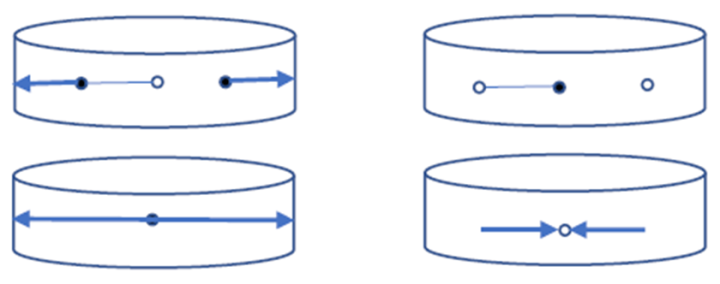
When we configured the inner structures of new proton and neutron with considering of quark’s mass and spin property, we once proposed 20 the 2 big balls for proton and neutron each with open diametrical pinholes. Now we would propose that a thin plate as a carrier is inserted by a dipole with negative point-charge located and fixed at plate center, then a positive point-charge is inserted and balanced with open pinholes at each side. Another thin plate is inserted by a dipole with positive point-charge located and fixed at plate center, a negative point-charge is inserted and balanced, and finally the thin plate’s open pinholes are sealed. The new proton and neutron with quark’s structures taken into consideration are represented as Figure 1, plate as the proton and neutron’s carrier or container, small black dots as positive point-charge, and small circles as negative point-charge, the proton is simplified as a thin plate with positive electrical monopole pairs and with pinholes open; while the neutron is simplified as a thin plate with negative electrical monopole pairs but with pinholes sealed.

Second step: Nucleus configuration is described as follows:
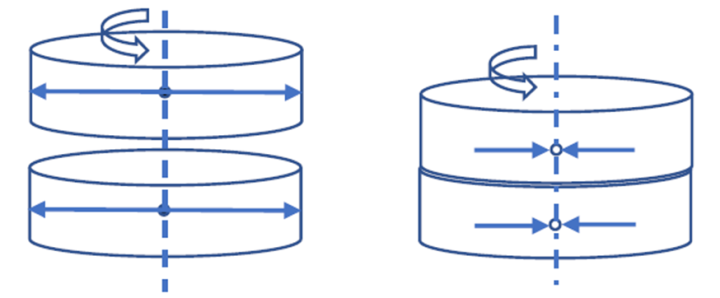
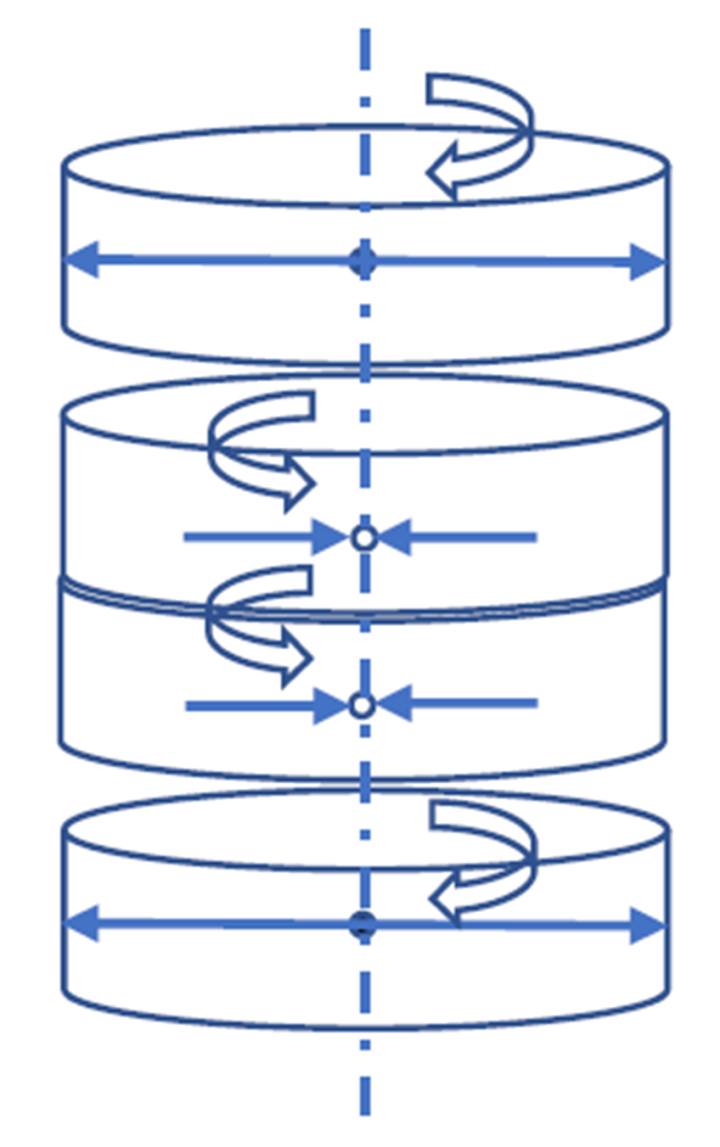
In order to configure the stable nucleus, we suppose that all the protons and neutrons are spinning with the axis perpendicular to their plates, either in counter-clock direction or in clockwise direction. To make it simple, we support neutrons always spin in counter-clock direction, while protons always spin in counter-clock direction too unless the proton play the role as capped proton. Since the proton is electrically positive charge, while the neutron is electrically negative charge within the plate though the net negative charge is sealed within the electrically insulated plate and it is electrically neutral. Their spins will generate the magnetic poles according to electromagnetic theory. Both protons and neutrons will be bound by magnetic force in head-to-tail mode due to their spins as represented Figure 2. Due to the electric repulsive force existing, there shall be some gap between two protons bound by magnetic force, the gap is determined by the force balance between electric repulsion and magnetic force, while there is almost no gap between two neutrons bound by magnetic force without electric repulsion.


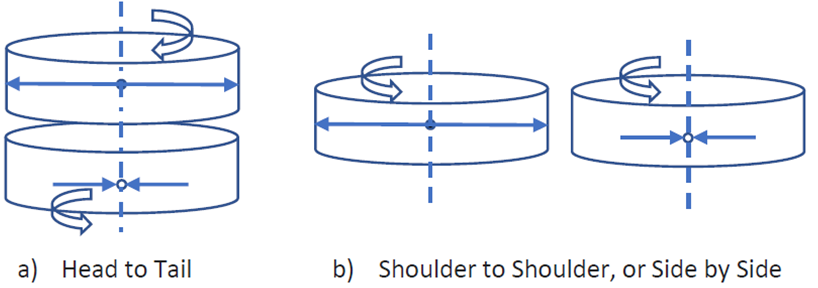
The proton and neutron can also be bound together with magnetic force. In head-to-tail mode, the proton and neutron shall spin in different direction, one in clockwise direction, the other has to be in counter-clock direction, but finally the proton and the neutron will be bumped away due to different spin and the attractive magnetic force. The binding will maintain in a very short time. While in shoulder-to-shoulder or side by side mode, the proton and the neutron have to be in same spin direction in order to generate attractive magnetic force, illustrated as Figure 3. This is the stable binding mode between the proton and the neutron.
Actually the Figure 3 represents the two different nucleus configurations of Deuterium, the isotope of hydrogen with one proton and one neutron, both stable and unstable configuration.
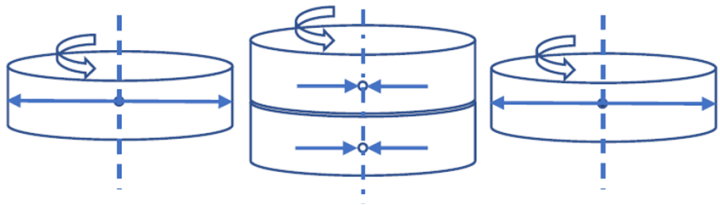
For Helium nucleus, in order to form a stable nucleus, all the two protons and the two neutrons will spin in same direction in side-by-side mode, two neutrons are bound as a neutron axis in head-to-tail mode, while the two protons shall be located at side of the neutron axis as far as possible due to both the repulsive electric and magnetic forces as illustrated in Figure 4. In order to hold all the protons together as a stable nucleus, the attractive magnetic force between neutrons and Protons shall be much stronger than the total repulsive electric and magnetic forces between protons, therefore it requires the angular speed of the neutron axis is faster than the proton spin.

In order to form a stable Helium nucleus, all the protons and neutrons can also be bound all in head-to-tail mode, but the spin directions of protons and neutrons must be different as represented in Figure 5. This is not the stable binding mode, the configuration will exist in a very short time.

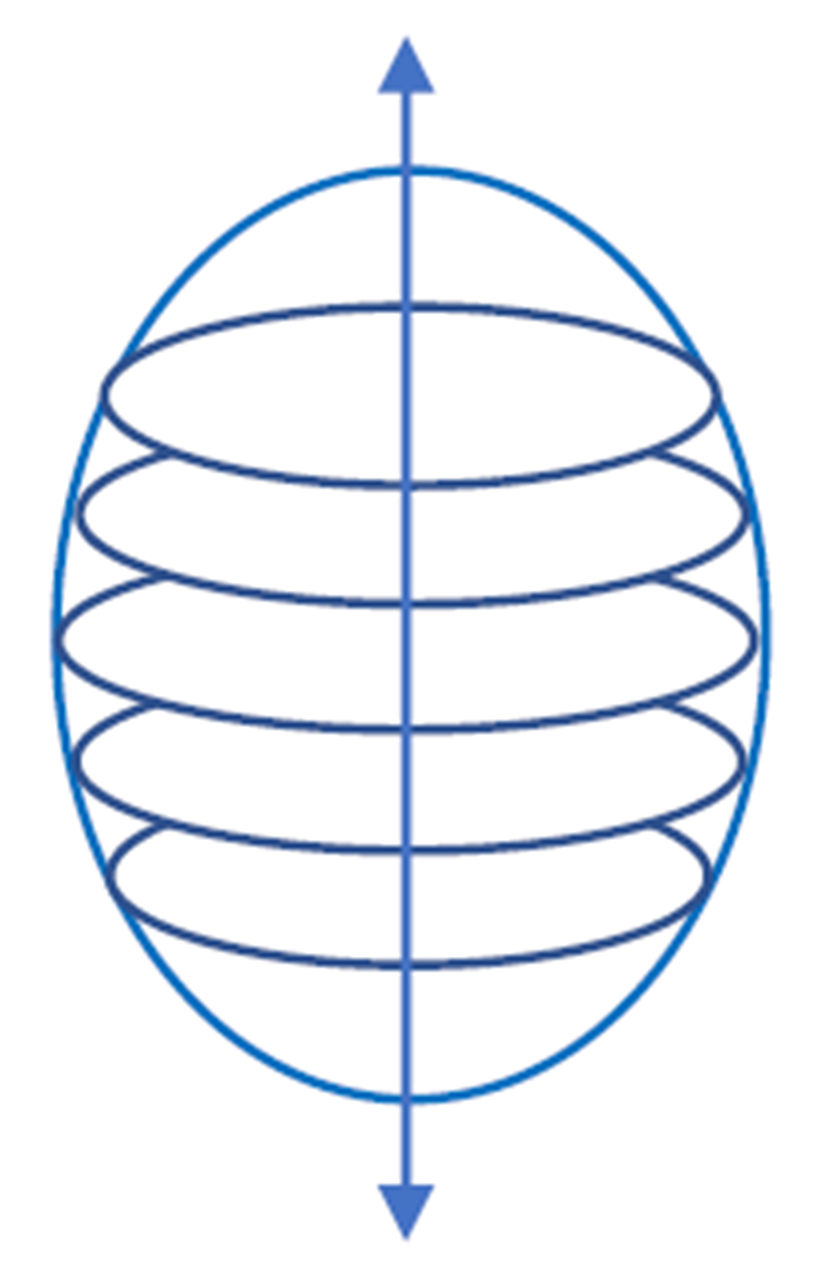
The nucleus configurations with number of protons up to 10 are represented in Table 1, the vertical elliptic ball as the nucleus, vector arrow as one of the proton’s orientation of its electric vector at some moment, spin axis is the neutrons bar bound with magnetic force. When the proton number is higher than 5, the side of each spin neutron axis end will be taken by one side proton as cap proton. Its electric vector direction of the cap proton will be simply treated as oriented to the oval ball end if we treat it from the perspective of far outside electrons.
The configurations of rest nuclei of elements on the periodic table shall follow same principle to ensure its vector directions oriented furthest with least electric and magnetic repulsive forces one another and without unbalanced electric repulsive forces or unbalanced repulsive magnetic forces one another on the surface of a nucleus. The protons and neutrons shall follow the orders as below to form a stable nucleus: (1) The spin neutrons shall form the neutron bar as the nucleus axis first.
(2) The protons shall be filled onto from the center layer of the elliptic ball to the outward vertical ends, the maximum number of protons will be either 7, or 5, or 4. It depends on the actual total proton number of the nucleus. In Period 4 and 5, there are layers with 5 protons, and in Period 6 and 7 there are layers with 7 protons.
(3) The last two protons will be filled around the side of the neutron axis end as capped protons.
The nucleus will be treated as a vertical oval ball with neutrons as the spin axis, with protons filled on different intersection layers with minimum balanced repulsive electric and magnetic forces as illustrated as Figure 6.

The configuration of proton profile for Group VIIIA nuclei on periodic table is summarized in Table 2. The proton layer number with 4 protons will follow the rule of 2(n-1), n the period number. The proton layer number with 5 protons will follow the rule of 2(n-3), n the period number(n≥3). The proton layer number with 7 protons will follow the rule of 2(n-5), n the period number (n≥5). The proton filling process for rest of the elements on the periodic table can refer to the Table 2 and the above three rules to form a stable nucleus configuration.
The Rutherford nucleus model worked quite well until the studies of nuclear spin were carried out by Franco Rasetti at the California Institute of Technology in 1929 21. By 1925 it was known that protons and electrons are all spin 1⁄2 particles with different mass, size and electric charge. According to Dmitri Ivanenko’s suggestion that neutrons were spin 1⁄2 particles too, in the Rutherford model of nitrogen-14, 20 of the total 21 nuclear particles should have paired up to cancel each other's spin, and the final odd particle should have left the nucleus with a net spin of 1/2. However Franco Rasetti discovered that nitrogen-14 had a spin of 1.
According to our nucleus configuration in Table 1, neutrons of nitrogen-14 have no contribution to the spin of nitrogen nucleus, because all the neutrons only play the role as a spin axis. All the six protons either oriented around the neutron bar or capped on the neutron bar in symmetry. Only one proton is filled on another proton layer as unpaired. When the nitrogen nucleus as whole in spin, the configuration of the nucleus determines its spin of 1.
Therefore based on our proposed nucleus configuration, we would conclude that the nucleus configuration of proton profile shall determine the spin properties of the nucleus.
3.2. Exploration of RadioactivityIsotopes are two or more types of atoms that have same atomic number or proton number but have different nucleon number in their nuclei. As to the configuration of other isotope nuclei, with the number of neutrons increasing or decreasing compared to the stable isotopes listed on the periodic table, the neutron axis will be either longer or shorter than the stable isotopes, which will result in the faster or slower angular speed of the neutron axis, and then will cause the unbalanced force between neutron axis and protons bound. Finally the isotope will decay to more stable nucleus configuration due to the more or less neutron(s) than the stable isotope.
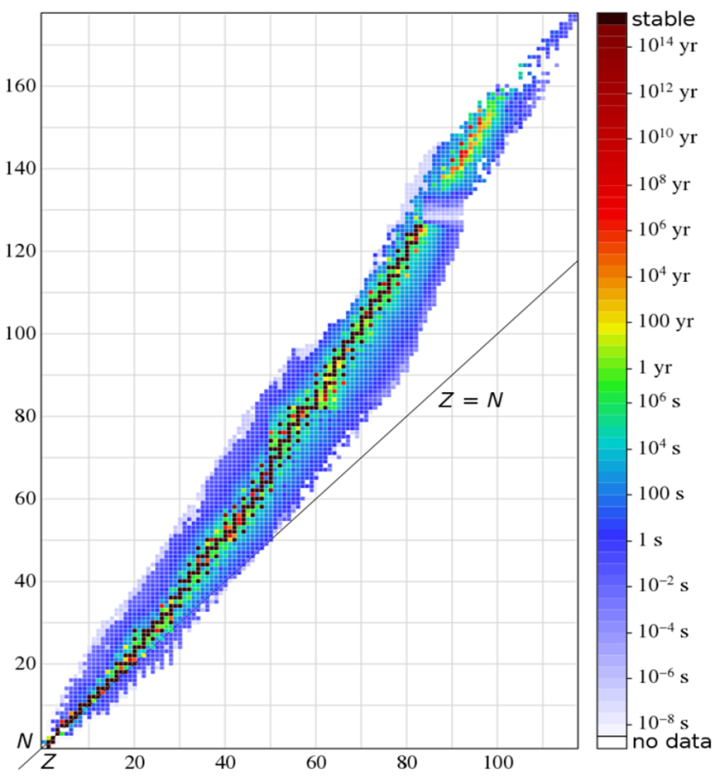
The Isotope stability and the relation with the ratio of neutron number, N, and proton number, Z, is plotted as Figure 7 22. The stable isotopes diverge from the line Z = N as the element number Z becomes larger.

If we compare the N/Z ratio in Table 2 and the Figure 7, we can conclude that in period 3, the isotopes with N/Z ratio between 1.000 and 1.222 shall be stable. In period 4 isotopes with N/Z ratio between 1.222 to 1.333 shall be stable. In period 5, isotopes with N/Z ratio between 1.333 and 1.426 are stable. In period 6, Isotopes with N/Z ratio between 1.426 and 1.581 are stable. In Period 7, the isotopes with N/Z ratio around 1.581 shall be stable according to the ratio trends in the other periods.
The radioactivity of nucleus shall result directly from the unbalanced magnetic force induced by more or less isotope neutron(s) compared to their stable isotope. The isotopes in each period table, with N/Z ratio either higher or less than the stable ratio range will result in either alpha decay or beta decay. In the same period, if the N/Z ratio of the isotope deviates the stable range with much higher value, it will undergo beta-minus decay; if the N/Z ratio of the isotope deviates the stable range with much lower value, it will undergo beta-plus decay.
For alpha decay 23, based on our nucleus configuration, no matter with more or less neutrons compared to their stable isotope, there must be a longer or shorter neutron axis, which results in the faster or lower spin speed of the neutron axis, and then cause the axis de-capped with two Deuterium nuclei in head-to-tail mode, and the two Deuterium nuclei form the alpha particle, Helium nucleus in head-to-tail mode.
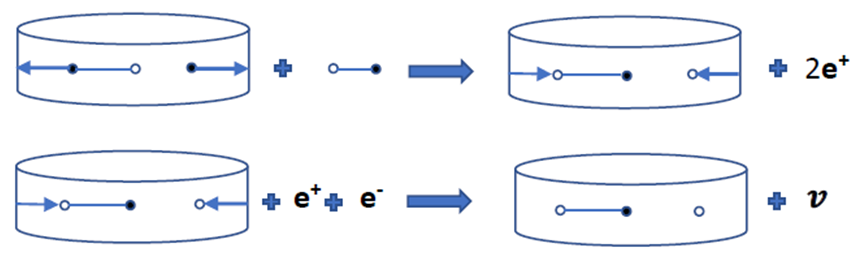
For beta-plus decay, based on our proton configuration and the charge conservation, we would propose that a photon induces the beta decay. When a proton and a photon spin in same direction, the magnetic force generated shall binds them together. At some point, due to the attractive electric force, the negative point-charge of the photon will break out and go into the proton and will leave the positive point-charge behind, and the proton will release a positive point-charge as an anti-proton. The decay process shall be described as Figure 8. When a proton decays to form a neutron, it shall emit two positrons. Because the mass of neutron is heavier than proton and with positron mass, if we take the mass conservation into consideration, we shall have to add some mass or energy to induce the decay, then it is logic to add photon to induce decay, considering Einstein’s mass energy equation, E=mc2 and charge conservation. A positron and an electron will be annihilated into energy to seal the pinholes of the anti-proton to form a real neutron with their mass, and to form a neutrino at same time.
For beta-minus decay, based on our neutron configuration and the charge conservation, we would propose that two gluons(photons in different spin) induce the beta decay. When a neutron and two photons spin in same direction, the magnetic force generated shall binds them together. At some point, due to the attractive electric force, the positive point-charge of one gluon will break out, the energy released will open the sealed pinholes of the neutron, and the positive point-charge of the gluon will go into the neutron and the gluon will leave the negative point-charge behind, and then the neutron will release a negative point-charge. Another gluon will be formed as an antineutrino at same time. The decay process shall be described as Figure 9. When a neutron decays to form a proton, it shall emit two electrons. Compared to the beta-plus decay, there is almost no concern on the mass conservation issue, because the mass of proton plus the mass of two electrons are almost same as the mass of the neutron, only charge conservation needs to take into consideration, and the energy to open the sealed pinholes of the neutron to form a real proton.


For gamma decay, when a proton emits a photon (a dipole), according to our proton configuration, a counterfeit proton compared to our new proton, with 100% mass of original proton is left behind.
3.3. Nuclear FissionThe nuclear fission occurs when a heavy nucleus, such as 235U, splits into two smaller nuclei. Fission is initiated when a heavy nucleus captures a thermal neutron as described by the Equation 1 23.
The absorption of the neutron creates a nucleus that is unstable and can change to a lower-energy configuration by splitting into two smaller nuclei. Based on our nucleus configuration, it is apparently that the thermal neutron will be absorbed either onto the neutron axis or onto the proton layer. If onto the proton layer, the original force balanced will be broken; if onto the neutron axis, according to the conservation of angular momentum, the angular speed of the axis will change with extra neutron. The attractive force between neutron axis and proton layers will be broken. This shall be the intrinsic reason to result in an unstable nucleus for the neutron axis to split into two shorter spin axes. According the N/Z ratio in the period table. The lower Z number, the lower N number, compared to the parent nucleus, the daughter nuclei shall have lower N/Z values, there must be some extra neutrons emitted after first split, the extra neutrons emitted will trigger the further nucleus fission. That is the mechanism of the chain reaction of the nuclear fission.
3.4. Nuclear FusionIn nuclear fusion, the protons shall undergo the beta-plus decay to form neutrons first. Then the Deuterium will be formed, when a proton and neutron come together no matter with same spin direction or different spin direction. The head-to-tail Deuterium will be formed with different spin direction, while the Shoulder-to-shoulder Deuterium will be formed with same spin direction. The next step shall be the Helium-3 or Tritium formation either in shoulder-to-shoulder mode or in side-by-side mode. When Deuterium and Tritium come together, Helium-4 will be formed as known as Deuterium-Tritium reaction 24, and when two Helium-3 come together, finally a Helium-4 nucleus will be formed in side-by-side mode as described as Proton-Proton Cycle 24. The nuclear fusion is a process of lighter nuclei to form heavier nucleus, it is a process to increase Z number and to increase the length of neutron axis (N number), and to re-arrange the protons around the neutron axis to have both minimum repulsive electric force and minimum repulsive magnetic force among protons to form a stable nucleus with right N/Z ratio as illustrated in Nucleus Configuration in section 2. And each nuclear fusion process is associated with huge energy release from the light nucleus Hydrogen to the heavy Iron, the fusion reaction of heavier nucleus than Iron will need extra energy to form a stable nucleus. The beta-plus decay is the most important step for all the nuclear fusion processes.
Based on our theory of spin vector in motion, we concluded that both proton and neutron are monopole pairs. A proton is an electric positive monopole pairs in a thin plate with two open pinholes, while a neutron is an electric negative monopole pairs sealed in a thin plate, therefore is electric neutral. A new nucleus configuration was developed as an oval ball, with all neutrons bound together as a spin axis, with all the protons filled on the intersection layers of the elliptic ball with minimum balanced repulsive electric and magnetic forces. Based on the N/Z ratio of neutron number and proton number in a nucleus, and the N/Z ratio of group VIIIA elements, we can predict the isotope stability, and potential nuclear decay undergoing. According to the new inner structures of proton and neutron, we concluded that there is no “strong force” required to hold the “quarks” together to form proton and neutron, there is no “strong force” required to hold proton(s) and neutron(s) to form a stable nucleus. Regarding the radioactivity of isotope, the so-called “weak force” to induce the decays is just the unbalanced electromagnetic force between proton(s) and neutron(s). For both beta-plus and beta-minus decay, we introduced a photon or gluon to induce the decay when we take the charge conservation into consideration and compare the current decay theory. As to the spin property, we also concluded that the nucleus configuration of proton profile would determine the spin properties of the nucleus. It provided a logic explanation, the spin of 1, to the nitrogen-14 according to our nucleus configuration.
But from the beta-decay process, no matter the beta-plus or the beta-minor decay, the mechanisms to form neutrino and antineutrino are still not clear. It is worthy for us to investigate further to understand how they are formed with such a low mass with different mechanisms, and to understand the mechanism of annihilation. It is apparent that the different point-charges will not be destroyed during annihilation.
| [1] | B.R. Martin, Nuclear and Particle Physics. John Wiley & Sons, Ltd (2006). | ||
| In article | |||
| [2] | J. J. Thomson, “Cathode Rays”, Proceedings of the Royal Institution of Great Britain. XV: 419-432 (1897). | ||
| In article | |||
| [3] | E. Rutherford. “On the retardation of the α particle from radium in passing through matter”. Philosophical Magazine. 12(68): p134-146 (1906). | ||
| In article | |||
| [4] | H. Geiger, “On the scattering of α-particles by matter”. Proceedings of the Royal Society A. 81(546): p174-177 (1908). | ||
| In article | |||
| [5] | H. Geiger, E. Marsden, “On the diffuse reflection of the α-particles”. Proceedings of the Royal Society A. 82(557): p495 (1909). | ||
| In article | |||
| [6] | H. Geiger, “The scattering of the α-particles by matter”. Proceedings of the Royal Society A. 83(565): p492-504(1910). | ||
| In article | |||
| [7] | J. Chadwick, “The existence of a neutron”. Proceedings of the Royal Society A. 136(830): p692-708 (1932). | ||
| In article | |||
| [8] | D.N. Poenaru, A. Calboreanu, “Alexandru Proca (1897-1955) and his equation of the massive vector boson field”. Europhysics News. 37(5): p25-27. (2006). | ||
| In article | |||
| [9] | C. Vuille, J. Ipser, J. Gallagher, “Einstein–Proca model, micro black holes, and naked singularities”. General Relativity and Gravitation. 34(5): p689 (2002). | ||
| In article | |||
| [10] | R. Scipioni, “Isomorphism between non-Riemannian gravity and Einstein–Proca–Weyl theories extended to a class of scalar gravity theories”. Class. Quantum Gravity. 16(7): p2471-2478 (1999). | ||
| In article | |||
| [11] | R.W. Tucker, C. Wang, “An Einstein–Proca-fluid model for dark matter gravitational interactions”. Nuclear Physics B: Proceedings Supplements. 57(1-3): p259-262 (1997). | ||
| In article | |||
| [12] | H. Yukawa, “On the Interaction of Elementary Particles. I”. Proceedings of the Physico-Mathematical Society of Japan. 3rd Series. 17: p48-57 (1935). | ||
| In article | |||
| [13] | G. Gamow, “Mass Defect Curve and Nuclear Constitution”. Proceedings of the Royal Society A. 126(803): p632-644 (1930). | ||
| In article | |||
| [14] | O. Haxel, J.H.D. Jensen, H.E. Suess, “On the ‘Magic Numbers’ in Nuclear Structure”. Physical Review. 75 (11): p1766 (1949). | ||
| In article | |||
| [15] | M.G. Mayer, “On Closed Shells in Nuclei. II”. Physical Review. 75(12): p1969-1970 (1949). | ||
| In article | |||
| [16] | F. Iachello, A. Arima, The Interacting Boson Model. Cambridge: Cambridge University Press. c1987. ISBN 978-0-511-89551-7. | ||
| In article | |||
| [17] | A. Arima, F. Iachello, “Interacting boson model of collective states I. The vibrational limit”. Annals of Physics. Elsevier BV. 99(2): p253-317 (1976). | ||
| In article | |||
| [18] | C. Stephenson, D. Lyon, A. Hubler “Topological properties of a self-assembled electrical network via ab initio calculation”. Scientific Reports. 7(1): p932 (2017). | ||
| In article | |||
| [19] | P. Navrátil, S. Quaglioni, G. Hupin, C. Romero-Redondo, A. Calci, “Unified abinitio approaches to nuclear structure and reactions”. Physica Scripta. 91(5): 053002 (2016). | ||
| In article | |||
| [20] | Zhonglin Bo, “New Atom Configuration Based on Proton and Electron as Electric Monopole Pairs and Exploration of Quarks and Higgs Particle.” International Journal of Physics, 9(6): p269-274 (2021). | ||
| In article | |||
| [21] | Wikipedia, “Nuclear Physics”, https://en.wikipedia.org/wiki/Nuclear_physics. | ||
| In article | |||
| [22] | Wikipedia, “Isotopes”, https://en.wikipedia.org/wiki/Isotope | ||
| In article | |||
| [23] | R.A. Serway, J.W. Jewett, Physics for Scientists and Engineers with Modern Physics, Philadelphia: Saunders College Pub., P1267-1326, c1983. | ||
| In article | |||
| [24] | K.S. Krane, Introductory Nuclear Physics. John Wiley & Sons Inc., P529-553, c1988. | ||
| In article | |||
Published with license by Science and Education Publishing, Copyright © 2022 Zhonglin BO
 This work is licensed under a Creative Commons Attribution 4.0 International License. To view a copy of this license, visit
http://creativecommons.org/licenses/by/4.0/
This work is licensed under a Creative Commons Attribution 4.0 International License. To view a copy of this license, visit
http://creativecommons.org/licenses/by/4.0/
| [1] | B.R. Martin, Nuclear and Particle Physics. John Wiley & Sons, Ltd (2006). | ||
| In article | |||
| [2] | J. J. Thomson, “Cathode Rays”, Proceedings of the Royal Institution of Great Britain. XV: 419-432 (1897). | ||
| In article | |||
| [3] | E. Rutherford. “On the retardation of the α particle from radium in passing through matter”. Philosophical Magazine. 12(68): p134-146 (1906). | ||
| In article | |||
| [4] | H. Geiger, “On the scattering of α-particles by matter”. Proceedings of the Royal Society A. 81(546): p174-177 (1908). | ||
| In article | |||
| [5] | H. Geiger, E. Marsden, “On the diffuse reflection of the α-particles”. Proceedings of the Royal Society A. 82(557): p495 (1909). | ||
| In article | |||
| [6] | H. Geiger, “The scattering of the α-particles by matter”. Proceedings of the Royal Society A. 83(565): p492-504(1910). | ||
| In article | |||
| [7] | J. Chadwick, “The existence of a neutron”. Proceedings of the Royal Society A. 136(830): p692-708 (1932). | ||
| In article | |||
| [8] | D.N. Poenaru, A. Calboreanu, “Alexandru Proca (1897-1955) and his equation of the massive vector boson field”. Europhysics News. 37(5): p25-27. (2006). | ||
| In article | |||
| [9] | C. Vuille, J. Ipser, J. Gallagher, “Einstein–Proca model, micro black holes, and naked singularities”. General Relativity and Gravitation. 34(5): p689 (2002). | ||
| In article | |||
| [10] | R. Scipioni, “Isomorphism between non-Riemannian gravity and Einstein–Proca–Weyl theories extended to a class of scalar gravity theories”. Class. Quantum Gravity. 16(7): p2471-2478 (1999). | ||
| In article | |||
| [11] | R.W. Tucker, C. Wang, “An Einstein–Proca-fluid model for dark matter gravitational interactions”. Nuclear Physics B: Proceedings Supplements. 57(1-3): p259-262 (1997). | ||
| In article | |||
| [12] | H. Yukawa, “On the Interaction of Elementary Particles. I”. Proceedings of the Physico-Mathematical Society of Japan. 3rd Series. 17: p48-57 (1935). | ||
| In article | |||
| [13] | G. Gamow, “Mass Defect Curve and Nuclear Constitution”. Proceedings of the Royal Society A. 126(803): p632-644 (1930). | ||
| In article | |||
| [14] | O. Haxel, J.H.D. Jensen, H.E. Suess, “On the ‘Magic Numbers’ in Nuclear Structure”. Physical Review. 75 (11): p1766 (1949). | ||
| In article | |||
| [15] | M.G. Mayer, “On Closed Shells in Nuclei. II”. Physical Review. 75(12): p1969-1970 (1949). | ||
| In article | |||
| [16] | F. Iachello, A. Arima, The Interacting Boson Model. Cambridge: Cambridge University Press. c1987. ISBN 978-0-511-89551-7. | ||
| In article | |||
| [17] | A. Arima, F. Iachello, “Interacting boson model of collective states I. The vibrational limit”. Annals of Physics. Elsevier BV. 99(2): p253-317 (1976). | ||
| In article | |||
| [18] | C. Stephenson, D. Lyon, A. Hubler “Topological properties of a self-assembled electrical network via ab initio calculation”. Scientific Reports. 7(1): p932 (2017). | ||
| In article | |||
| [19] | P. Navrátil, S. Quaglioni, G. Hupin, C. Romero-Redondo, A. Calci, “Unified abinitio approaches to nuclear structure and reactions”. Physica Scripta. 91(5): 053002 (2016). | ||
| In article | |||
| [20] | Zhonglin Bo, “New Atom Configuration Based on Proton and Electron as Electric Monopole Pairs and Exploration of Quarks and Higgs Particle.” International Journal of Physics, 9(6): p269-274 (2021). | ||
| In article | |||
| [21] | Wikipedia, “Nuclear Physics”, https://en.wikipedia.org/wiki/Nuclear_physics. | ||
| In article | |||
| [22] | Wikipedia, “Isotopes”, https://en.wikipedia.org/wiki/Isotope | ||
| In article | |||
| [23] | R.A. Serway, J.W. Jewett, Physics for Scientists and Engineers with Modern Physics, Philadelphia: Saunders College Pub., P1267-1326, c1983. | ||
| In article | |||
| [24] | K.S. Krane, Introductory Nuclear Physics. John Wiley & Sons Inc., P529-553, c1988. | ||
| In article | |||