The goals of this study were to identify sources of stress in dental education and to explore the role of year of study and gender on perceived stressors. A modified Dental Environment Stress (DES) Questionnaire was administered to 95 dental students. The main sources of stress were found to be fearing of inability to complete graduation requirements, exams and grades, failing in a course , patient being late to their appointments, lack of time for relaxation and PBL system.
Dentistry has been widely acknowledged as being associated with high levels of stress.
1, 2 Stressors associated with dentistry include time and scheduling pressures, home works, managing uncooperative patients, and the highly technical and intensive nature of work.
In recent years, the injurious effects of stress experienced by dental students have received much attention. Stress amongst dental students occurred from different sources and affected them differently, and some- times was shown to have significant negative effects on their performance. It has been reported that dental students express considerable stress symptoms during their training 3, 4, 5 and that they are more anxious than the general population, 6, 7 showing higher levels of depression, obsessive-compulsive disorders, and interpersonal sensitivity than age-matched norms 8, 9.
In fact, dentistry has been considered one of the most stressful of all healthcare professions. 10 Also It was noted that stress-related illnesses, together with musculoskeletal disorders, were the main factors influencing dentists to retire early 11.
The stressors producing the highest ratings for perceived stress were examinations and grades, fully loaded day, and lack of time for relaxation. For the clinical years, patients› being late or not showing for their appointments and completing clinical requirements were also substantial stressors.
The aim of this investigation was to identify sources of stress among dental students at Qassim university – college of dentistry and to explore the role of year of study and gender on perceived stressors.
The study sample was derived from officially registered students at the Qa- ssim university – Dental college during the academic year 2011-2012.
47 of male and female dental students completed the questionnaire conducted via Google spreadsheet. The purpose of the study was communicated well in advance to the students, and student participation in the research was voluntary. The questionnaire used in this research was based on the Dental Environment Stress (DES) questionnaire 12. The DES questionnaire was modified to make it applicable to a Saudi background. The modified version contained twenty-one stress-related items.
2.1. Stress Items- Self-Efficacy Beliefs.
- Faculty and Administration.
- Workload.
- Patient Treatment.
- Clinical Training.
- Performance Pressure.
Statistical analysis was performed using the Statistical Package for Social Sciences (SPSS) software for windows version.
A total of students in the three clinical academic years was (95), (47) of them completed the questionnaire with overall response rate (49.5%).
The study showed that there was no statistically difference between male and female of third year, regarding the out come variables of the study.


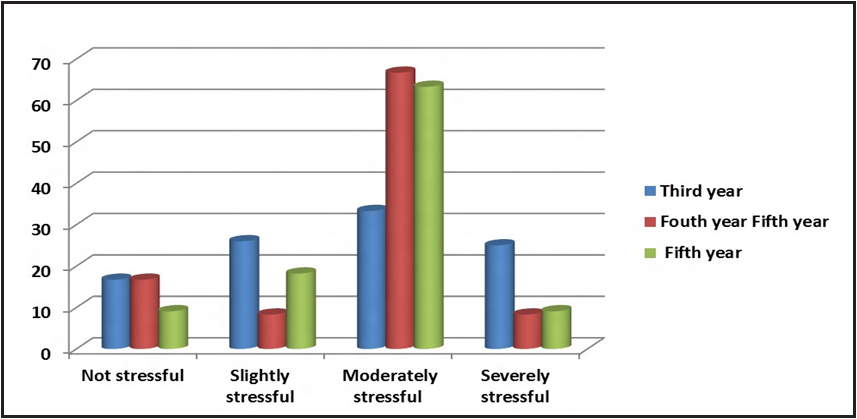
A (66.7%) of fourth year students reported that they are moderately stressed because lack of self confidence in becoming successful dentists in the future. while (63.6%), (30%) of fifth and third year showing the same result. (Figure 1).
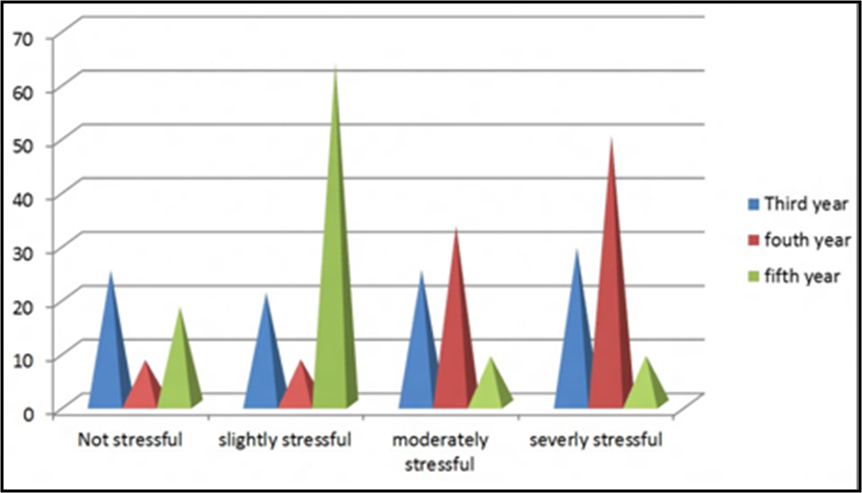
A significant greater No. (63.6%) of fifth year students are slightly stressed because of fear of falling in a course, as compared to (50.0%) , (29.2%) of fourth and third year. (p<0.05) (Figure 2).
When we asked about rules and regulation of the college (58.3%), (54.5%) and (41.7%) of fourth, fifth and third year are moderately stressed.
(66.7%), (37.5%) of fourth and third year are severely stressed because of amount of class work, while (45.5 %) of fifth year are moderately stressed.
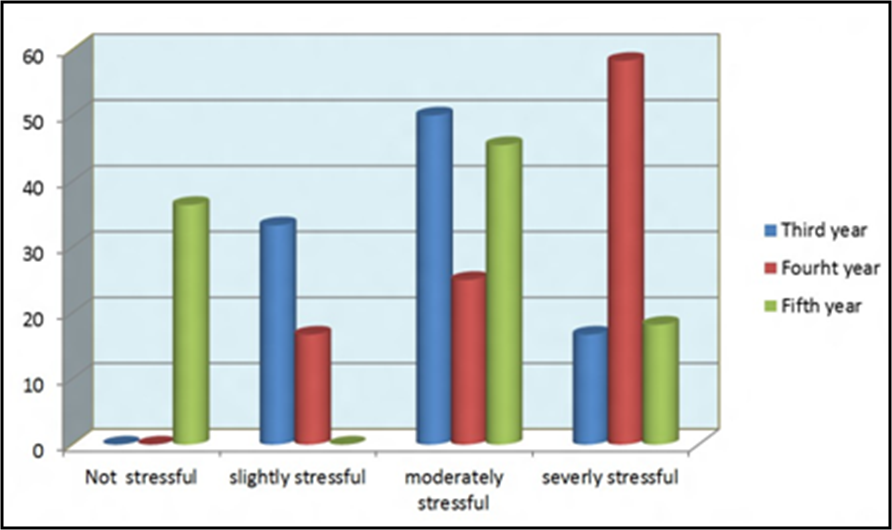
The result of the study also showed that a statistically higher percent of fourth year (58.3%) are severely stressed because of lack of time for relaxation, as compared to third year (50.0%) and (45.5%) of fifth year are moderately stressed. (P<0.05). (Figure 3)
(50.0%), (41.7%) of fourth and third year are moderately stressed because lack of time between lectures, while (45.5%) of fifth year are slightly stressed.
More than half of fifth year students are slightly stressed because lack of manual skills while (41.7%) of fourth and third year showing the same result. One question was about exams and grades (58.3%) of fourth year are moderately stressed while (54.2%), (45.5%) of third year are severely stressed. (Table 1)
One question was formed to seek their lack of clinical practice and training in the clinics, (41.7%) of fourth year students are moderately stressed while (37.5%) and (36.4%) of third and fourth year severely stressed.
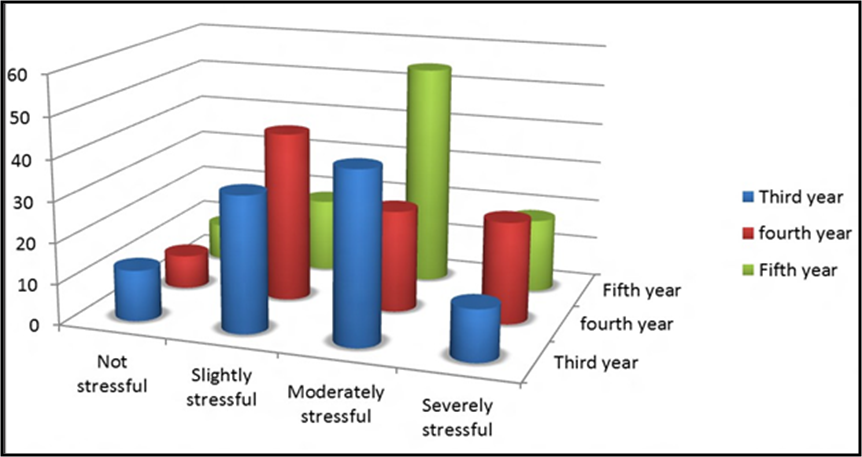
When we asked about patient being late or not showing for their appointments, (75.0%) of fourth year are severely stressed while (41.7%) of third year showing the same result and (63.6%) of fifth year are moderately stressed.
(54.4%) of fifth year are moderately stressed because of lack of patient co-operation, while (41.7%) of third year showing the same result, and (41.8) of fourth year are slightly stressed (Figure 4). The result of the study showed (66.7%) of fourth year are moderately stressed because of difficulty to make own decision to treat the patient while (45.8%) of the third year showing the same result, and (63.6%) of fifth year are slightly stressed. (Table 2)
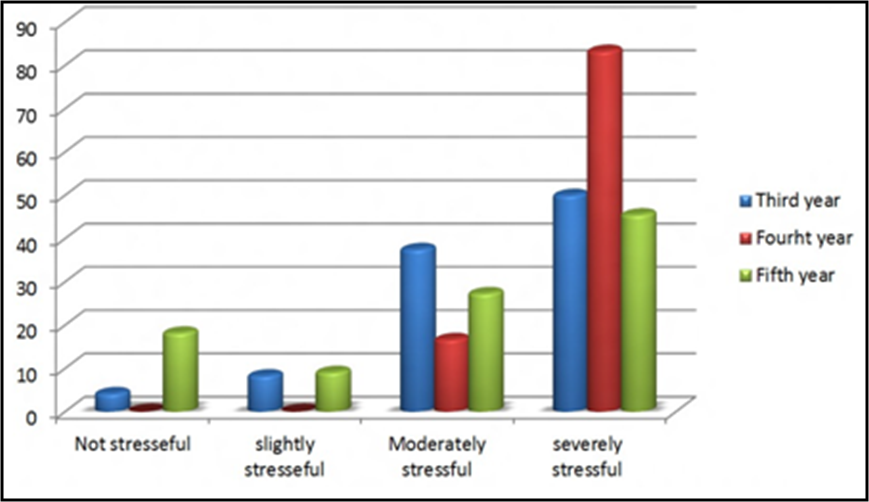
When we asked about the completing graduation requirements (83.3%), (50.0%) and (45.5%) of fourth, third and fifth year are severely stressed (Figure 5).


(54.2%) of third year are slightly stressed because of PBL system, as compared to (50.0%) (36.4%) of fourth and fifth year are moderately stressed. (Table 3).
Stress has been described as a double-edged sword that can either stimulate and motivate the students to peak performance or reduce the students to ineffectiveness. 13
The results of this study support the existing evidence in the literature, indicating that dental students are subject to numerous work-related and academic stressors that may adversely affect their physical and psychological health, 14, 15, 16, 17 The primary sources of stress in Qassim dental college are graduation requirements, exams and grads, patient being late.
Previous studies have reported that dental education induces considerable stress on students. The current results provide some initial indication of high levels of psychological disturbance in these dental students and it appears to be a significant concern for the fourth- year students may be because they have skills in both semesters, (4 blocks) also the clinical works.
Also in the Previous studies about stress amongst dental students Showed significant stressors mostly related to examinations, clinical requirements, patients, financial problems, lack of time for relaxation, and faculty feedback or criticism. 18, and in this we found almost the same factor which include (requirements, exams and grades, patient being late , failing in course , rules and regulation, lack of time for relaxation, lack of confidence and making own decision).
Many studies reported Some sources of stress were found more often in female than male, such as lack of confidence in clinical decision making, and doubt to be a successful dentist 19, while the result of this study showed there was no gender difference.
Among the three clinical years (Years 3, 4, 5), Differences in opinions between clinical staff, Completingclinical requirements, Concern about treatment grades awarded, and Shortage of clinical time were among some of the six most stressful items and reflect immediate concerns during this phase of the program. Similar concerns were reported in Jordan, 20 Singapore, 21 the UK, 22 and Australia, 23 where clinical students rated Falling behind with requirements among their highest six stressors.
An Indian recent study showed that Fear of failure was the most stressful item across all classes 24, Moreover the primary sources of stress in Greece as perceived by nearly 600 students at one public dental school were assigned workload, performance pressure, and their self-efficacy beliefs, while in the present study the most stressful factor to the students in the clinical academic years is fear of inability to complete the clinical requirements this may be because of shortage of patients attending to the dental clinic of the college. It was also seen that stress associated with examinations was high across classes.
This study was done to evaluate sources and factors affecting stress among students in Qassim university. Some of the conclusions that could be drawn from the study are:
- Fear of inability to complete graduation requirements was found to be the most stressful item among the students.
- There was no statistically gender dif- ference regarding different factor of stress.
- Fifth year dental students are less stressed than the others because of stopping PBL system in that year.
- Regarding the result of the present study fourth year is the most stress- ful year in Qassim university.
Dental college of Qassim university college is strongly recommended to implement more effective stress reduction program via different modalities These include counseling, introducing mind-body elective, using pass-fail grading instead of traditional grading
I would like to express my deepest gratitude to Prof. Abdelwahab Samaha, Dr. Hazem Mourad, Dr. AbdulHaleem Abdul Hameed.
| [1] | Atkinson TM, Millar K, Kay EJ, Blink- horn AS. Stress in dental practice. Dent Update 1991; 18: 60-4. | ||
| In article | |||
| [2] | Gorter RC, Albrecht G, Hoogstraten J, Eijkman MAJ. Professional burnout among Dutch dentists. Community Dent Oral Epidemiol 1999; 27: 109-16. | ||
| In article | View Article PubMed | ||
| [3] | Wexler M. Mental health and dental education. J Dent Educ 1978; 42(2): 74-7. | ||
| In article | |||
| [4] | Grandy TG, Westerman GH, Lupo JV, Combs CG. Stress symptoms among third-year dental students. J Dent Educ1988; 52(5): 245-9. | ||
| In article | |||
| [5] | Newbury-Birch D, Lowry RJ, Kamali F. The changing patterns of drink- ing, illicit drug use, stress, anxiety and depression in dental students in a UK dental school: a longitudinal study. Br Dent J 2002; 192(11): 646-9. | ||
| In article | View Article PubMed | ||
| [6] | Freeman RE. Dental students as op- erators: emotional reactions. Med Educ m1985; 19(1): 27-33. | ||
| In article | View Article PubMed | ||
| [7] | Piazza-Waggoner CA, Cohen LL, Kohli K, Taylor BK. Stress manage- ment for dental students perform- ing their first pediatric restorative procedure. J Dent Educ 2003; 67(5): 542-8. | ||
| In article | |||
| [8] | Musser LA, Lloyd C. The relationship of marital status and living arrange- ment to stress among dental stu- dents. J Dent Educ 1985; 49(8): 573-8. | ||
| In article | |||
| [9] | Sanders AE, Lushington K. Sources of stress among Australian dental stu- dents. J Dent Educ 1999; 63(9): 688- 97. | ||
| In article | |||
| [10] | Turley M, Kinirons M, Free- man R.Occupational stress fac- tors in hospitaldentists. Br Dent J 1993; 175: 285-288. | ||
| In article | View Article PubMed | ||
| [11] | Burke FJ. The practice of dentistry: an assessment of reasons for prema- ture retirement. Br Dent J 1997: 182: 250-254. | ||
| In article | View Article PubMed | ||
| [12] | Garbee WH Jr, Zucker SB, Selby GR. Perceived sources of stress among dental students. J Am Dent Assoc 1980; 100(6): 853-7. | ||
| In article | View Article PubMed | ||
| [13] | Sugiura G, Shinada K, Kawaguchi Y. Psychological well-being and per- ceptions of stress amongst Japanese dental students. Eur J Dent Educ 2005; 9(1): 17-25. | ||
| In article | View Article PubMed | ||
| [14] | Thornton LJ, Stuart-Buttle C, Wyszynski TC, Wilson ER. Physical and psychosocial stress exposures in US dental schools: the need for expanded ergonomics training. Ap- plErgon 2004; 35(2): 153-7. | ||
| In article | View Article PubMed | ||
| [15] | Grandy TG, Westerman GH, Lupo JV, Combs CG. Stress symptoms among third-year dental students. J Dent Educ1988; 52(5): 245-9. | ||
| In article | |||
| [16] | Anders P, Tedesco L, Davis E, Brewer J. Educational environment, perceived stress, and symptoms of distress among dental students at three schools. J Dent Educ1985; 49(1): 40. | ||
| In article | |||
| [17] | Ng V, Koh D, Mok BY, Chia SE, Lim LP. Salivary biomarkers associated with academic assessment stress among dental undergraduates. J Dent Educ 2003; 67(10):1091-4. | ||
| In article | |||
| [18] | A. M. Alzahem, H. T. van der Molen, A. H. Alaujan, H. G. Schmidt and M. H. Zamakhshary, Stress amongst dental students: a systematic review, European Journal of Dental Educa- tion ISSN 1396-5883. | ||
| In article | |||
| [19] | Rosli TI, Abdul Rahman R, Abdul Rahman SR, Ramli R. A survey of per- ceived stress among undergraduate dental students in Universiti Ke- bangsaan Malaysia. Singapore Dent J 2005: 27: 17-22. | ||
| In article | |||
| [20] | Lamis DR. Perceived sources of stress among dental students at the University of Jordan. J Dent Educ2001; 65: 23241. | ||
| In article | |||
| [21] | Yap AU, Bhole S, Teo CS. A cross cultural comparison of perceived stress in the dental school environment. J DentEduc 1996; 60: 459-64. | ||
| In article | |||
| [22] | Heath JR, Macfarlane TV, Umar MS. Perceived sources of stress in dental students. Dent Update 1999; 63: 688- 99. | ||
| In article | View Article PubMed | ||
| [23] | Sanders AE, Lushington K. Sources of stress for Australian dental stu- dents. J Dent Educ 1999; 63: 688-99. | ||
| In article | |||
| [24] | Pradeep S. Tangade, Anmol Mathur, Rahul Gupta, Shikha Chaudhary, Assessment of Stress Level among Dental School Students: An Indian Outlook, Dent Res J 2011; 8(2): 95-101. | ||
| In article | |||
Published with license by Science and Education Publishing, Copyright © 2020 Adel Alharbi
 This work is licensed under a Creative Commons Attribution 4.0 International License. To view a copy of this license, visit
http://creativecommons.org/licenses/by/4.0/
This work is licensed under a Creative Commons Attribution 4.0 International License. To view a copy of this license, visit
http://creativecommons.org/licenses/by/4.0/
| [1] | Atkinson TM, Millar K, Kay EJ, Blink- horn AS. Stress in dental practice. Dent Update 1991; 18: 60-4. | ||
| In article | |||
| [2] | Gorter RC, Albrecht G, Hoogstraten J, Eijkman MAJ. Professional burnout among Dutch dentists. Community Dent Oral Epidemiol 1999; 27: 109-16. | ||
| In article | View Article PubMed | ||
| [3] | Wexler M. Mental health and dental education. J Dent Educ 1978; 42(2): 74-7. | ||
| In article | |||
| [4] | Grandy TG, Westerman GH, Lupo JV, Combs CG. Stress symptoms among third-year dental students. J Dent Educ1988; 52(5): 245-9. | ||
| In article | |||
| [5] | Newbury-Birch D, Lowry RJ, Kamali F. The changing patterns of drink- ing, illicit drug use, stress, anxiety and depression in dental students in a UK dental school: a longitudinal study. Br Dent J 2002; 192(11): 646-9. | ||
| In article | View Article PubMed | ||
| [6] | Freeman RE. Dental students as op- erators: emotional reactions. Med Educ m1985; 19(1): 27-33. | ||
| In article | View Article PubMed | ||
| [7] | Piazza-Waggoner CA, Cohen LL, Kohli K, Taylor BK. Stress manage- ment for dental students perform- ing their first pediatric restorative procedure. J Dent Educ 2003; 67(5): 542-8. | ||
| In article | |||
| [8] | Musser LA, Lloyd C. The relationship of marital status and living arrange- ment to stress among dental stu- dents. J Dent Educ 1985; 49(8): 573-8. | ||
| In article | |||
| [9] | Sanders AE, Lushington K. Sources of stress among Australian dental stu- dents. J Dent Educ 1999; 63(9): 688- 97. | ||
| In article | |||
| [10] | Turley M, Kinirons M, Free- man R.Occupational stress fac- tors in hospitaldentists. Br Dent J 1993; 175: 285-288. | ||
| In article | View Article PubMed | ||
| [11] | Burke FJ. The practice of dentistry: an assessment of reasons for prema- ture retirement. Br Dent J 1997: 182: 250-254. | ||
| In article | View Article PubMed | ||
| [12] | Garbee WH Jr, Zucker SB, Selby GR. Perceived sources of stress among dental students. J Am Dent Assoc 1980; 100(6): 853-7. | ||
| In article | View Article PubMed | ||
| [13] | Sugiura G, Shinada K, Kawaguchi Y. Psychological well-being and per- ceptions of stress amongst Japanese dental students. Eur J Dent Educ 2005; 9(1): 17-25. | ||
| In article | View Article PubMed | ||
| [14] | Thornton LJ, Stuart-Buttle C, Wyszynski TC, Wilson ER. Physical and psychosocial stress exposures in US dental schools: the need for expanded ergonomics training. Ap- plErgon 2004; 35(2): 153-7. | ||
| In article | View Article PubMed | ||
| [15] | Grandy TG, Westerman GH, Lupo JV, Combs CG. Stress symptoms among third-year dental students. J Dent Educ1988; 52(5): 245-9. | ||
| In article | |||
| [16] | Anders P, Tedesco L, Davis E, Brewer J. Educational environment, perceived stress, and symptoms of distress among dental students at three schools. J Dent Educ1985; 49(1): 40. | ||
| In article | |||
| [17] | Ng V, Koh D, Mok BY, Chia SE, Lim LP. Salivary biomarkers associated with academic assessment stress among dental undergraduates. J Dent Educ 2003; 67(10):1091-4. | ||
| In article | |||
| [18] | A. M. Alzahem, H. T. van der Molen, A. H. Alaujan, H. G. Schmidt and M. H. Zamakhshary, Stress amongst dental students: a systematic review, European Journal of Dental Educa- tion ISSN 1396-5883. | ||
| In article | |||
| [19] | Rosli TI, Abdul Rahman R, Abdul Rahman SR, Ramli R. A survey of per- ceived stress among undergraduate dental students in Universiti Ke- bangsaan Malaysia. Singapore Dent J 2005: 27: 17-22. | ||
| In article | |||
| [20] | Lamis DR. Perceived sources of stress among dental students at the University of Jordan. J Dent Educ2001; 65: 23241. | ||
| In article | |||
| [21] | Yap AU, Bhole S, Teo CS. A cross cultural comparison of perceived stress in the dental school environment. J DentEduc 1996; 60: 459-64. | ||
| In article | |||
| [22] | Heath JR, Macfarlane TV, Umar MS. Perceived sources of stress in dental students. Dent Update 1999; 63: 688- 99. | ||
| In article | View Article PubMed | ||
| [23] | Sanders AE, Lushington K. Sources of stress for Australian dental stu- dents. J Dent Educ 1999; 63: 688-99. | ||
| In article | |||
| [24] | Pradeep S. Tangade, Anmol Mathur, Rahul Gupta, Shikha Chaudhary, Assessment of Stress Level among Dental School Students: An Indian Outlook, Dent Res J 2011; 8(2): 95-101. | ||
| In article | |||