Household waste management remains a delicate problem in the Republic of Congo due to the lack of household waste management infrastructure. Several wild landfills arise in outlying districts of the city of Brazzaville. The proliferation of uncontrolled landfills leads to household waste burning which essentially generates two (02) residue-type products: smoke and ashes. The objective of this study is to develop cementitious matrices containing burn ashes, sufficiently efficient to retain in their structure heavy metals contained in these ashes. To do this, we carried out static leaching tests at pH=4 and 7 and at 25°C in distilled water, cementitious matrices synthesized with different ash/cement/lime ratios (P0, P1, P2, P3, P4, P5 and P6). The static leaching tests carried out on monoliths for 30, 90 and 180 days made it possible to evaluate alteration kinetics of these cementitious matrices through cementitious matrices monitoring of leachate solution pH, of mass losses and dissolution rates. The results obtained show that the pH of all leaching solutions which contained cementitious matrices tend towards a basification causing a significant drift in the pH from the first stages of alteration at pH=4 and 7. The normalized total mass losses of cementitious matrices are higher in neutral medium (pH=7) rather than in acid medium (pH=4) except for the reference cementitious matrice P0. The P5 cementitious matrice (70% Ash + 20% Cement + 10% Lime) presents the lowest mass losses and dissolution rates, while the P0 reference matrice (100% cement) presents the highest mass losses and dissolution rates
These last years, congolese cities have been confronted with many problems related to accelerated urbanization. The consequences in terms of household waste management and sanitation are very worrying. This growth, which goes hand in hand with the waste increase quantity, leads to proliferation of uncontrolled landfills. Brazzaville, which has nearly 2 million inhabitants, has only one large landfill, unlike most cities in the world. However, there are small wild landfills scattered on vacant lots in the city. These multiple landfills scattered throughout the city cause enormous even if they are occasionally burned 1. Moreover, in the Congo, solid waste is generally burned on the ground, in the open air. The formation of fumes and ashes can be dangerous for environment, due to their pollutant load. Indeed, ashes obtained after waste burning can contain heavy metals such as mercury, lead and cadmium 2. These landfills present environmental risks, in particular by causing significant ecological imbalances in soil and in water, through leachate and atmospheric pollution linked to the released fumes 3. These ashes, considered as final hazardous waste, require additional treatment in order to reduce their impact on environment. Several treatments can be for ash management, including solidification/stabilization. Indeed, solidification makes it possible to transform the waste into a massive solid that is not very porous and not very permeable in order to limit as much as possible the risk of dispersion in environment 4. Stabilization consists of physical and/or chemical retention of polluting species in a solid matrix by absorption or ion exchange mechanisms 5, in order to make them poorly soluble and poorly mobilized. The product of these two processes thus makes it possible to limit pollutants dispersion in natural environment. The stabilization/solidification of waste containing more or less soluble metals by adding a hydraulic binder consists in producing a material in which waste replace sands or aggregates so that heavy metals remain "trapped" in the cementitious matrice. Several physico-chemical mechanisms at the solid/liquid interface allow the heavy metals trapping 6, 7 When cementitious matrices come into contact with water, a relatively acid leaching takes place compared to the alkalinity produced by the cement, a process of dissolution and release of hydrates is triggered, with less and less alkaline buffering effects 8. pH is generally considered to be a major influencing parameter in the mobilization of elements (influence on solubility, sorption mechanisms, etc.). In the case of stabilization/solidification by a hydraulic binder, the high buffering capacity of cement hydrates makes it possible to maintain a high pH favoring retention of some elements, in particular pollutants precipitated in hydroxides forms 9. Leaching leads in losses of mass and alkalinity attributable to Portlandite dissolution and other hydrates decalcification. However, the self-regulating mechanism of the cementitious matrice, linked to the hydrates strong basic power (buffering effect), gives it resistance which ensures a certain durability 10. The aim of this study is to evaluate the cementitious matrices alteration kinetics through the pH evolution monitoring, the mass losses and the dissolution rate of cementitious matrices resulting from the stabilization/solidification by binders hydraulic and pozzolanic in acid and neutral medium. This assessment is based on leaching tests inspired by standardized tests applied to porous materials obtained by stabilization/solidification of ashes.
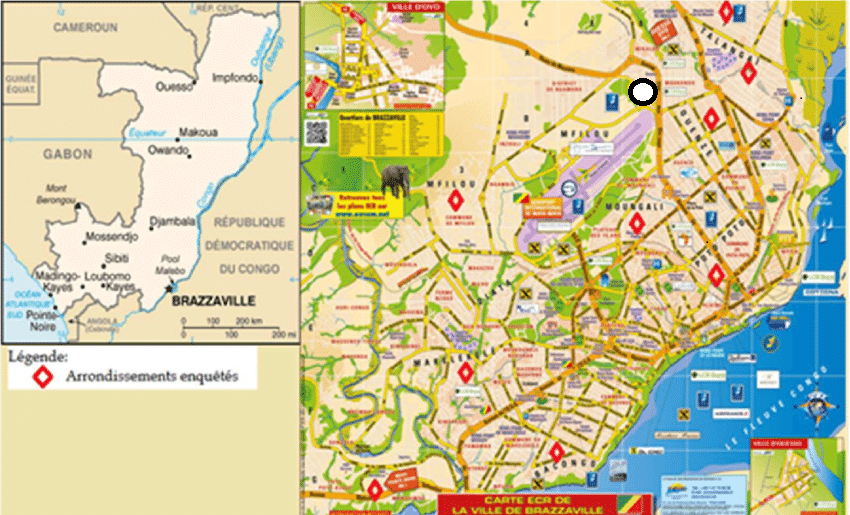
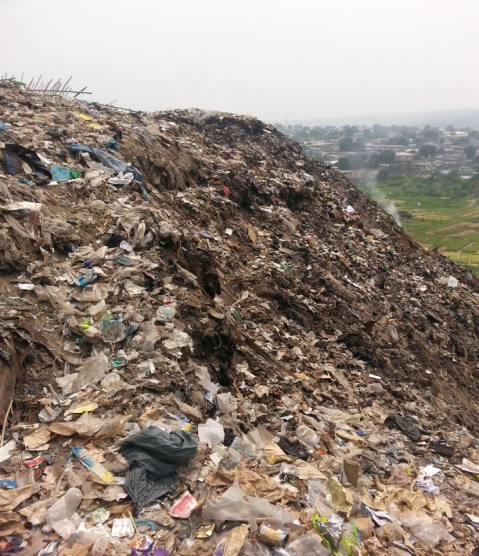
This study was carried out in Brazzaville in the Republic of Congo. Located in the heart of the equatorial forest, the Republic of Congo covers an area of 342,000 km2.It is located in Central Africa, straddling the equator between latitudes 3°30' North and 5° South and longitudes 11° and 18° East. Located on the right bank of the majestic Congo River, the agglomeration of Brazzaville covers an area of nearly 265 km2. Brazzaville is located in the southern part of Congo, between 4°6'15'' and 4°22'30'' of southern latitude and between 15°6'0'' and 15°19'15'' east longitude, bounded to the north by the Djiri River, to the south and east by the Congo River, and to the west by the sub-prefecture of Goma-Tsé-Tsé 11. The wild landfill chosen for this study was named «Landfill C». With a latitude of 4°13’13”S and a longitude of 15°15’46”E, it is located in «City of 17» quarter in district N°7 Mfilou. It has an inclined geomorphology and an approximately depth of 20m. It has been existing for over 20 years. Figure 1 shows a map of Brazzaville city and the localisation of the landfill C chosen for this study. Figure 2 shows a Landfill C picture.
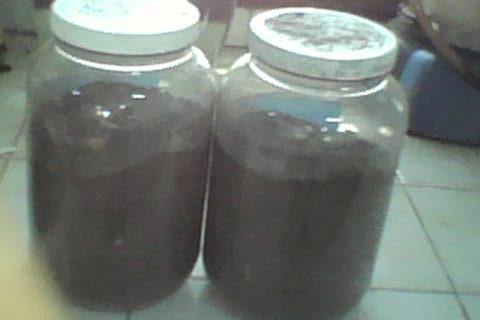
2.2. Landfills Waste SamplingHousehold waste collection in landfill C was carried out manually using gloves as well as a mask and garbage bags. The batches of household waste were then weighed using a Pocket LBS scale. Ten (10) kilos were taken and transported to a drying place at the Faculty of Sciences and Techniques of Marien Ngouabi University, within the plant chemistry and biohealth unit. Household waste was dried in the open air and at ambient temperature on plastic tablecloths of 2 m2 each for two weeks. Household waste was burned in a garden incinerator for at least 1 hour. After burning, the residues obtained (ashes) were sieved using a 2 mm sieve, then the ashes obtained were placed in plastic jars closed by a stopper to avoid any external contamination. It should be noted that these jars were carefully cleaned beforehand, then rinsed with distilled water to avoid any internal contamination. Figure 3 shows the jars containing the ashes that were stored in the laboratory at room temperature.
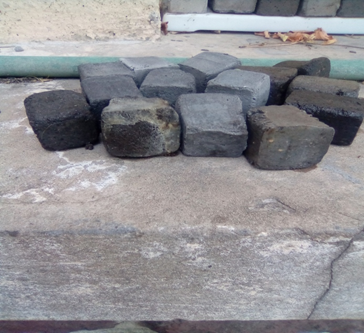
2.3. Materials StudiedIn the context of our study, the hydraulic binder that we used is Portland limestone cement from the FORSPAK company in Dolisie in Congo. This Portland cement is of the CEM II/B-M 32.5R type. This cement is composed of (65-79)% clinker, (21-35)% pozzolan and fly ash then (0-5)% secondary constituents. Table 1 gives the composition by weight of the Dolisie cement used for our study. We used pascual hydrated lime as an admixture, manufactured in Spain and sold in Congo. Cementitious matrices synthesis was carried out according to the formulations contained in Table 2. The ash masses, hydrated cement and quicklime were weighed using a Pioneer-type precision balance. The different mixtures types (ashes + cement + lime + water) were mixed for 5 minutes in a container. The paste obtained is placed in molds measuring 2 cm x 2 cm x 2 cm to obtain a cementitious matrice (Figure 4). After manufacture, the cementitious matrices were dried at ambient temperature, ie 25°C.


All leaching experiments in our study were carried out in static mode on monolith in a non-agitated closed environment. It consists of placing cementitious matrices monoliths in an altering solution in a rigid glass bottle so that all sample surfaces are in contact with solution. These experiments were carried out over short times, far from saturation, to avoid external contamination of solutions. The glass bottles were cleaned before each leaching experiment with 1N hydrochloric acid, then rinsed 5 times with deionized water. After leaching, cementitious matrices samples are then removed from the leaching solution and then dried and weighed. Then, a part of leachate is taken in order to measure pH. A single temperature was chosen for our experiments: 25°C. This temperature was chosen because it avoids evaporation. The ratio surface of matrice / volume of altering solution (S/V) was fixed for the entire leaching duration at 0.1. A low S/V ratio choice makes it possible to move away from saturation conditions and thus to follow pH evolution, masses losses and dissolution rates during alteration. We have selected two (2) solutions with differents pH: a solution of distilled water at pH=7 and a slightly chloride acidic solution HCl at pH=4. The solution at pH=7 was chosen to compare with the attack in a slightly corrosive medium and the slightly acidic solution at pH=4 was chosen to simulate acid rain attack. Twenty three (23) leaching times, between 0 and 180 days, were chosen in order to follow the cementitious matrices alteration kinetics.
2.5. pH Evolution of Cementitious Matrices LeachatesThe starting solutions pH is measured at ambient temperature. Before each analysis, the pH-meter is calibrated using standard solutions at pH=4, 7 and 10. After each leaching experiment, leachate pH is measured at ambient temperature (25°C), after removing cementitious matrice from solution. All leaching experiments were performed at pH=4 and 7 with S/V ratio=0.1. The solutions were not buffered, so the pH evolved freely over time. Leaching experiments at 25°C were performed on all matrices at all leaching times with HCl (pH=4) and distilled water (pH=7) leaching solutions.
2.6. Normalized Totals Mass Losses of Cementitious MatricesNormalized totals mass loss NLt (g/m2) are obtained by weighing. They represent the mass difference of cementitious matrices before and after leaching over an area of 1m2. A normalized total mass loss is calculated as following: NLt=∆m/S.
2.7. Normalized Dissolution Rates of Cementitious MatricesNormalized elementary dissolution rate is also a quantity that can describe cementitious matrices alterability. Dissolution rate measurements were deduced from the total sum of normalized mass losses of each cementitious matrice by following the evolution over time (linear regression).
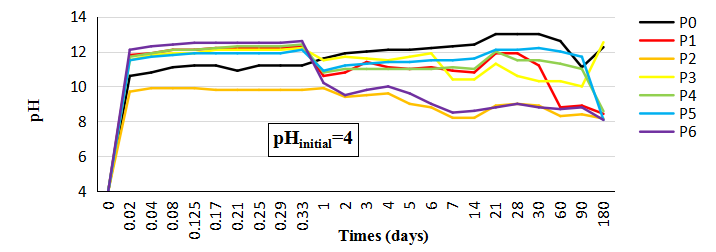
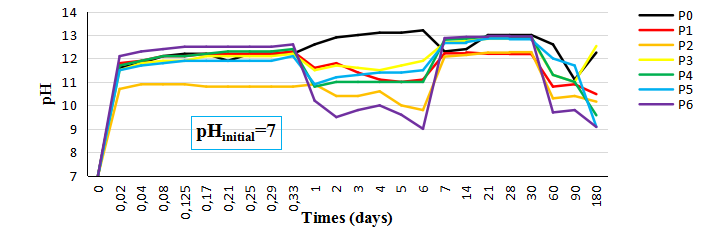
For a given cementitious matrice composition dried at 25° C, it is observed that all solutions have significant pHs whatever matrice composition. From all these cementitious matrices, it is observed that leaching solutions pH exhibits a drift from acidity to basicity and evolves similarly to the pH of reference cementitious matrice P0 leachate (Figure 5 and 6). This basification leads to a significant pH drift from the beginning of alteration at pH=4 and 7. This basicity of acid and neutral solution is due to alkalis extraction by ion exchange mechanisms between the protons of solution and the cementitious matrice elements 12. This exchange process is responsible for pH increase due to residual OH- ions accumulation in solution 13. The cementitious matrices being a strongly alkaline medium, it promotes hydroxides precipitation 14. Over long periods, leachate pH evolution seems to tend towards an asymptote, certainly due to medium saturation 13. For the leaching at 25°C, of all formulations, whatever medium pH, only the cementitious matrice P3 leachate presents a pH evolution similar to P0 reference cementitious matrice leachate. Over a fairly long period, i.e. 6 months or 180 days, the pH evolution of P2, P3, P4, P5, P6 cementitious matrices leachates, seems to drop slightly towards a low basicity close to neutrality (pH=8), this was observed in acid medium (pH=4). This decrease in pH can be explained by C-S-H type hydrates precipitation 5. Indeed, Hydrated Calcium Silicates (C-S-H) form a gel organized over a few hundred nanometers in order of 60 x 30 x 5 nm3 15. C-S-H essentially develop as a layer surrounding anhydrous cement grains 16. This layer retains alkalis such as calcium because alkalis and/or alkaline earth metals release causes an pH increase due to residual OH- ions accumulation in solution 17.


Table 3 shows results of cementitious matrices normalized totals mass losses which oscillate between 0.58 and 18.24 g/m2 at pH=7 and between 0.24 and 10.32 g/m2 at pH=4. The cementitious matrices normalized totals mass losses values are much higher in neutral medium than in acid medium. This phenomenon can be explained by the Ca2+ adsorption increase on the surface when the pH drops. The increase in normalized totals mass losses is explained by rapid dissolution and therefore very rapid dissolution rates. The decrease is due to the fact that dissolution mechanism must have changed over time 13.
However, only the P5 cementitious matrice (70% ash, 30% cement, 10% lime) presents the lowest normalized totals mass losses (less than 1g/m2) both in acid and in basic medium. The reference cementitious matrice P0 (100% cement) presents the highest normalized totals mass losses both in acid and in basic medium. Thus, we can thus classify these different cementitious matrices according to their resistance to mass loss in ascending order:
- In acid medium (pH= 4),
P5< P2< P1<P6<P4<P3<P0
- In neutral medium (pH= 7),
P5<P1< P6<P4<P2<P3<P0.
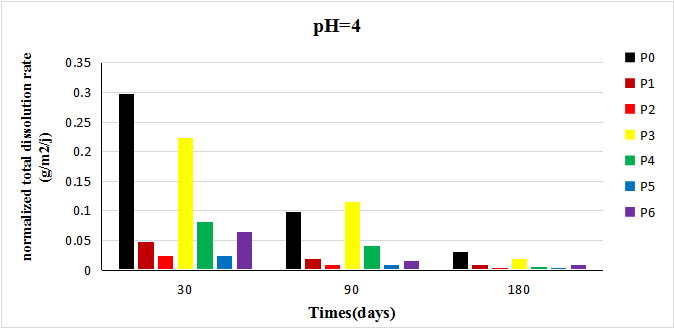
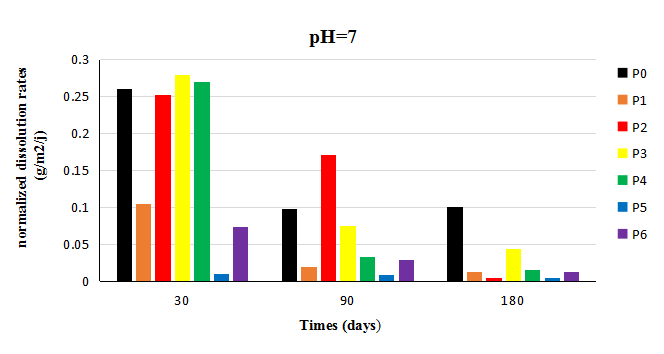
3.3. Normalized Dissolution Rates of Cementitious Matrices at 30, 90 and 180 DaysFigure 7 and Figure 8 show dissolution rates of cementitious matrices having undergone leaching tests in acidic (pH=4) and neutral (pH=7) medium at 30 days, 90 days and 180 days. Both in an acid medium and in a neutral medium, it is observed, on the one hand, that dissolution rates or alteration of matrices cementitious at 30 days are higher, whatever the medium, compared to those at 90 and 180 days. On the other hand, we only observe that cementitious matrices dissolution rates at 90 days are slightly higher than those at 180 days months. This decrease may be due to a rapid and transient interdiffusion phenomenon or to a development of a weathering film on the cementitious matrices surface by a diffusional control phenomenon which leads to a rate reduction 18. In order to fully understand cementitious matrices dissolution rates, we studied the normalised dissolution rates influence of pH on each cementitious matrice. Figure 7 and Figure 8 present the normalised dissolution rates of each cementitious matrice with respect to the pH at 30, 90 and 180 days. It can be observed that at 30 days, the cementitious matrices dissolution rates are higher in neutral medium compared to in acid medium, except for P0 and P5 cementitious matrices. This shows that elements dissolution is faster in neutral medium than in acid medium except for the cementitious matrices P0 and P5. At 90 days, cementitious matrices dissolution rates are higher in a neutral medium except for the cementitious matrices P0, P3 and P5. At 180 days, it can be seen that in neutral medium all cementitious matrices dissolution rates are higher than those of cementitious matrices in acid medium. Dissolution is therefore faster in neutral medium than in acid medium at 180 days.


In order to immobilize ashes and reduce soils and surface waters pollution, this study aimed to experiment with possible ways of recovering ashes from household waste burning (considered as "ultimate waste") in cementitious matrices, by following dissolution kinetics of said matrices. The results obtained showed that pH evolution of leaching solutions, having contained the cementitious matrices, as a function of time tends towards a basification causing a significant drift of pH from the first times of alteration at pH=4 and 7. The cementitious matrices normalized totals mass losses show that their dissolution is higher in neutral medium (pH=7) than in acid medium (pH=4) except for the reference cementitious matrice P0. The cementitious matrice P5 (70% Ash + 20% Cement + 10% Lime) presents the lowest normalized totals mass losses. Furthermore, we can observe that weathering rates of all matrices decrease over time. Thus, the results obtained show that the cementitious matrices P1 (50% Ash + 50% Cement), P5 (70% Ash + 20% Cement + 10% Lime) and P6 (70% Ash + 10% Cement + 20% Lime) present the lowest alteration rates both in acidic and neutral medium. These results highlight that the cementitious matrice P5, whose ash composition is the highest (70%), seems to have the lowest alteration kinetics, unlike P0, the reference matrice made up of 100% cement, which has the highest weathering kinetics.
The experimental data used to support the findings is included within the article.
The authors declare no conflict of interest or personal relationship that could have appeared to influence the work of this article.
Authors would like to thank SGS laboratory in Pointe-Noire, Republic of Congo, for their cordial support in carrying out this study.
| [1] | Kimbatsa F.G., Mouthou, J.L., Bakanahonda, S.F.L. 2018. The household waste management by pre-collection operators in Makélékélé, Bacongo and Talangai districts (Brazzaville, Congo). The journal of Social Sciences "Kafoudal", 2, pp. 12-27. | ||
| In article | |||
| [2] | Mekhous, S. 2011. Feasibility study of an assessment of health risks associated with the practice of burning waste in the Badamiers gross landfill (Petite-Terre) in Mayotte. School of Advanced Studies in Public Health. Mayotte Island. | ||
| In article | |||
| [3] | Ouiza Ould A. 2018. Impact of open landfills on Oued Cheliff (Algeria) environmental quality. Thesis from Abdelhamid Ibn Badis Mostaganem University. Algeria. 193p. | ||
| In article | |||
| [4] | Bouchelaghem, A., 1994. Stabilization and solidification of special industrial waste. Technique, Science and Methods, n°4, 9-13. | ||
| In article | |||
| [5] | Conner J.R. 1990. Chemical fixation and solidification of hazardous wastes. New York: Van Nostand Reinhold, 692. | ||
| In article | |||
| [6] | Ecole d’Avignon. 2016. Techniques and practices of Avignon lime. Eyrolles bookstores. France. | ||
| In article | |||
| [7] | Deschamps T., Benzaazoua M., Bussière B., Belem T. et Mbonimpa M. 2006. Retention mechanism of heavy metals in solid phase: case of stabilization of contaminated soils and industrial waste. Vertigo-the Journal of Environmental Science, 7(2). 11p. | ||
| In article | |||
| [8] | Jebli, M.B., Youssef, S.B. et Ozturk, I. 2015. The Role of Renewable Energy Consumption and Trade: Environmental Kuznets Curve Analysis for Sub-Saharan Africa Countries. African Development Review, 27(3): 288-300. | ||
| In article | View Article | ||
| [9] | EL Kharmouz M., Sbaa M., Chafi A.et Saadi S. 2013. Study of leachate impact from the former public landfill of city of Oujda (eastern Morocco) on the physicochemical quality of groundwater and surface water. Larhyss Journal, ISSN 1112-3680, No. 16, pp. 105-119. | ||
| In article | |||
| [10] | Manceau A., Marcus M. A. and Tamura N. 2002. Quantitative speciation of heavy metals in soils and sediments by synchrotron X-ray techniques. In Applications of Synchrotron Radiation in Low-Temperature Geochimistry and Environmental Science. Reviews in mineralogy and Geochimistry, Mineralogical society of America, 49,341-428p. | ||
| In article | View Article | ||
| [11] | Kimbatsa F.G., Mahoungou, E. et Berton Ofouemé Y. 2018. The importance of horticulture in the fight against food insecurity, poverty and environmental protection in Brazzaville (Republic of Congo). OpenEdition Journals Caribbean Studies. 38-40, pp. 1-47. | ||
| In article | |||
| [12] | Tait J. C., Jensen C. D. 1982. The effect of Zn (II) ion adsorption on the durability of sodium borosilicate glasses, Journal of Non-Crystalline Solids 49, 363-377. | ||
| In article | View Article | ||
| [13] | Mbemba, K. M. 2010. Study of the chemical durability of alkali-resistant glasses of the Cemfil type synthesized from REFIOM with a view to enhancing it as reinforcements in cementitious matrices. Thesis from Marne-la-Vallée University. France. 259p. | ||
| In article | |||
| [14] | Sterpenich, J. 1998. Alteration of medieval stained glass: Contribution to the study of long-term behavior of confinement glasses. Doctoral thesis from Henri Poincaré University, Nancy I. 464p. | ||
| In article | |||
| [15] | Chiang, W.S., Ferraro, G., Fratini, E., Ridi, F., Y., Yeh,c Y.Q., Jeng, U.S., Chen, S.H. et Baglioni, P. 2014. Multi-scale structure of calcium and magnesium silicate-hydrate gels. J. Mater. Chem., 2.32. | ||
| In article | View Article | ||
| [16] | Ruiz, A.I., Reyes, E., Argiz, C.,Rubia, M.A. and Moragues, A. 2022. Nano-scale aluminium interaction in synthetic hydrated calcium silicate gel studied by 29Si MAS-NMR. Bol. Soc. Esp. Cerám. Vidr. | ||
| In article | View Article | ||
| [17] | Ahmed Hisseini, B.H. 2021. Treatment by alkali-activation and geopolymerization of clay soils: physicochemical, geotechnical and environmental characterizations. Thesis presented to obtain the Doctor degree from the University of Paris-Est. 222p. | ||
| In article | |||
| [18] | Bellagh, K. 2017. Valorization of urban soil in the road sector: mobility of pollutants in treated and/or compacted soils. Paris-Est University thesis, 282p. | ||
| In article | |||
Published with license by Science and Education Publishing, Copyright © 2023 Mithé Brice Mabiala Loubilou, Kiele Molingo Mbemba and Jean Maurille Ouamba
 This work is licensed under a Creative Commons Attribution 4.0 International License. To view a copy of this license, visit
http://creativecommons.org/licenses/by/4.0/
This work is licensed under a Creative Commons Attribution 4.0 International License. To view a copy of this license, visit
http://creativecommons.org/licenses/by/4.0/
| [1] | Kimbatsa F.G., Mouthou, J.L., Bakanahonda, S.F.L. 2018. The household waste management by pre-collection operators in Makélékélé, Bacongo and Talangai districts (Brazzaville, Congo). The journal of Social Sciences "Kafoudal", 2, pp. 12-27. | ||
| In article | |||
| [2] | Mekhous, S. 2011. Feasibility study of an assessment of health risks associated with the practice of burning waste in the Badamiers gross landfill (Petite-Terre) in Mayotte. School of Advanced Studies in Public Health. Mayotte Island. | ||
| In article | |||
| [3] | Ouiza Ould A. 2018. Impact of open landfills on Oued Cheliff (Algeria) environmental quality. Thesis from Abdelhamid Ibn Badis Mostaganem University. Algeria. 193p. | ||
| In article | |||
| [4] | Bouchelaghem, A., 1994. Stabilization and solidification of special industrial waste. Technique, Science and Methods, n°4, 9-13. | ||
| In article | |||
| [5] | Conner J.R. 1990. Chemical fixation and solidification of hazardous wastes. New York: Van Nostand Reinhold, 692. | ||
| In article | |||
| [6] | Ecole d’Avignon. 2016. Techniques and practices of Avignon lime. Eyrolles bookstores. France. | ||
| In article | |||
| [7] | Deschamps T., Benzaazoua M., Bussière B., Belem T. et Mbonimpa M. 2006. Retention mechanism of heavy metals in solid phase: case of stabilization of contaminated soils and industrial waste. Vertigo-the Journal of Environmental Science, 7(2). 11p. | ||
| In article | |||
| [8] | Jebli, M.B., Youssef, S.B. et Ozturk, I. 2015. The Role of Renewable Energy Consumption and Trade: Environmental Kuznets Curve Analysis for Sub-Saharan Africa Countries. African Development Review, 27(3): 288-300. | ||
| In article | View Article | ||
| [9] | EL Kharmouz M., Sbaa M., Chafi A.et Saadi S. 2013. Study of leachate impact from the former public landfill of city of Oujda (eastern Morocco) on the physicochemical quality of groundwater and surface water. Larhyss Journal, ISSN 1112-3680, No. 16, pp. 105-119. | ||
| In article | |||
| [10] | Manceau A., Marcus M. A. and Tamura N. 2002. Quantitative speciation of heavy metals in soils and sediments by synchrotron X-ray techniques. In Applications of Synchrotron Radiation in Low-Temperature Geochimistry and Environmental Science. Reviews in mineralogy and Geochimistry, Mineralogical society of America, 49,341-428p. | ||
| In article | View Article | ||
| [11] | Kimbatsa F.G., Mahoungou, E. et Berton Ofouemé Y. 2018. The importance of horticulture in the fight against food insecurity, poverty and environmental protection in Brazzaville (Republic of Congo). OpenEdition Journals Caribbean Studies. 38-40, pp. 1-47. | ||
| In article | |||
| [12] | Tait J. C., Jensen C. D. 1982. The effect of Zn (II) ion adsorption on the durability of sodium borosilicate glasses, Journal of Non-Crystalline Solids 49, 363-377. | ||
| In article | View Article | ||
| [13] | Mbemba, K. M. 2010. Study of the chemical durability of alkali-resistant glasses of the Cemfil type synthesized from REFIOM with a view to enhancing it as reinforcements in cementitious matrices. Thesis from Marne-la-Vallée University. France. 259p. | ||
| In article | |||
| [14] | Sterpenich, J. 1998. Alteration of medieval stained glass: Contribution to the study of long-term behavior of confinement glasses. Doctoral thesis from Henri Poincaré University, Nancy I. 464p. | ||
| In article | |||
| [15] | Chiang, W.S., Ferraro, G., Fratini, E., Ridi, F., Y., Yeh,c Y.Q., Jeng, U.S., Chen, S.H. et Baglioni, P. 2014. Multi-scale structure of calcium and magnesium silicate-hydrate gels. J. Mater. Chem., 2.32. | ||
| In article | View Article | ||
| [16] | Ruiz, A.I., Reyes, E., Argiz, C.,Rubia, M.A. and Moragues, A. 2022. Nano-scale aluminium interaction in synthetic hydrated calcium silicate gel studied by 29Si MAS-NMR. Bol. Soc. Esp. Cerám. Vidr. | ||
| In article | View Article | ||
| [17] | Ahmed Hisseini, B.H. 2021. Treatment by alkali-activation and geopolymerization of clay soils: physicochemical, geotechnical and environmental characterizations. Thesis presented to obtain the Doctor degree from the University of Paris-Est. 222p. | ||
| In article | |||
| [18] | Bellagh, K. 2017. Valorization of urban soil in the road sector: mobility of pollutants in treated and/or compacted soils. Paris-Est University thesis, 282p. | ||
| In article | |||