The need to effectively support students with learning disabilities in the classrooms, more so within mathematics education has led to an increasing prominence on inclusive education. A qualitative phenomenological research design was applied utilizing a semi-structured interview with eleven (n = 11) high school mathematics teachers from non-traditional Jamaican High schools. The data were analyzed using Braun and Clarke’s six-phase thematic analysis process coupled with phenomenological approaches to identify patterns and themes across participants’ responses. The findings revealed that teachers frequently encountered various learning difficulties that affected students’ mathematics learning and identified accommodations to effectively promoting student understanding, engagement, confidence, and academic achievement. While most participants expressed positive attitudes toward inclusion, equity, and differentiated instruction, there remains tensions between teachers’ commitment to inclusive education and the practical realities of implementing accommodations within resource-constrained environments. In conclusion, while Jamaican high school mathematics teachers demonstrated a strong commitment to supports students with learning disabilities, greater professional development, institutional support, resource allocation, and policy awareness are needed to strengthen inclusive mathematics education.
Globally, inclusive education has emerged as a core value in educational policy as it is recognized as both a human right and a mechanism to ensure equitable access to learning for all students, more so, those with learning disabilities (LDs) 2. The study reported that students with disabilities will be less likely to be attending school in comparison to their non-disabled peers 2. Teachers serve as the vital bridge who turns official inclusion policy into real classroom practices, guiding the execution of inclusive strategies through their beliefs, instructional choices, and professional competencies, supporting students with LDs, to ensure they are accommodated in the classroom 3, 4, 5. Additionally, the Ministry of Education, Youth, and Information (MoESYI) has developed flexible learning frameworks designed to match students’ abilities and needs such as the Alternative Pathway to Secondary Education (APSE) I, II and III focusing on Grades 7-9 to match struggling learners with LDs learning paces, abilities and readiness 6, 7, 8, 9. Pathway II and III students are those in need of extra interventions, including additional instructional support to master primary level numeracy and literacy aimed at bridging learning gaps before advancing 10, 11, 12.
However, despite widespread endorsement of inclusion, the practical implementation remains inconsistent due to the fact that the promise of inclusive education is often constrained by systemic and resource-related challenges 13, 14. Studies have highlighted persistent gaps between policy and practice, citing factors such as limited teacher training, large class sizes, resource disparities, and insufficient professional support 15, 16, 17, 18, 19, 20. McIntosh 21, in her study on differentiated instruction in Jamaican mathematics classrooms, revealed that because of systemic and resource constraints, while teachers recognize the value of customizing teaching for different learner styles, many struggle to implement strategies effectively. These challenges are even more pronounced in non-traditional high schools, where communities are often faced with constrained access to educational resources and support services. Teachers who served non-traditional high schools within these communities, finds themselves navigating these environments in addressing varied students’ need while receiving limited professional guidance and institutional support, resulting in a heavy reliance on their own experiences and beliefs to guide instructional decisions 18, 22.
What’s more, learners with disabilities continue to face inequitable access to high-quality education, more so in subject of mathematics, which is often considered challenging due to its abstract and theoretical nature, accumulative curriculum design, and core mental skills 23. Mathematics teachers are currently noticing the unique challenges for students with learning disabilities (LDs), including dyslexia, autism spectrum disorder (ASD), and speech or language impairments 24, 25. Furthermore, most students who have learning difficulties in comprehending mathematics often tend to be the ones performing poorly 26. Murphy 27 reported following the PEP sitting in 2022 that about 50% of the students graduating from primary schools “were rated as merely developing and beginning in mathematics”, as cited by McIntosh 21. For instance, the researcher noticed significant disparities in students’ academic readiness, particularly in literacy consistently while teaching students in Grades 7 through 10 across Pathways 2 and 3. Concurring with this point, Fisher-Howe & Samuels 28 and Richards 29 explained that students’ academic readiness and mathematics outcome if not addressed swiftly and appropriately will cause hindrance in the future, particularly in pursuing mathematics-based degrees. The researcher went further to point out that many students struggle to access content due not only to conceptual difficulty but also to limited reading and language skills 30. These experiences highlight the importance of examining how high school mathematics teachers perceive and accommodate students with learning disabilities, especially within alternative education settings 31, 32. Within the APSE programme, students placed in Pathway 3 demonstrate substantial learning challenges where most of these students read at Grade 1, 2, or 3 primary school levels despite being enrolled in secondary education. These literacy limitations significantly affect students’ ability to interpret mathematical word problems, understand subject-specific vocabulary, and follow written instructions 33, 34, 35, 36. This study is deeply rooted through direct professional experience within the Alternative Pathways to Secondary Education (APSE) programme where mathematics is taught in a high school situated in Jamaica.
The importance of this study is to promote inclusion and equity in Mathematics within the Jamaican setting, as it is driven by broader societal and academic necessities. The beliefs of teachers of mathematics high schools about LDs are particularly influential, as they shaped more than the specific forms of support implemented, but also their own self confidence and willingness to adapt instruction to personalize the learning experience ( 37, 38. Even though global work has investigated these dynamics at the primary-school level, there is limited qualitative research examining how Jamaican high school mathematics teachers view, experience, and address the needs of students with LDs. Consequently, by examining the lived experiences of teachers in non-traditional high schools, the intent of this study is to target evidence to guide policymaking, teacher training, and classroom practices, driving higher educational achievement for students with learning disabilities in Jamaica.
1.1. Statement of the ProblemEven with national policies promoting inclusive education, Jamaican high school mathematics teachers still confront serious impediments in ensuring equitable access to students with learning disabilities (LDs) 13, 14. While current laws and educational measures promotes inclusive practices, their real-world application remains uneven, especially in non-traditional high schools that are under-resourced within marginalized communities 39, 40, 41. Teachers report difficulties in differentiating instruction to meet diverse learning needs, largely due to large class sizes, limited instructional materials, and insufficient professional development in special education strategies 21, 22. This is because teachers are increasingly accommodating students with learning disabilities while catering to mainstream classrooms, requiring a lot of juggling, which has caused them to experience burnout and affected their beliefs about inclusive instructional practices. Quite a few empirical studies have reported that the working conditions in inclusive classrooms have been affecting teachers adversely, such as high levels of stress, suffering from emotional fatigue, and getting insufficient support 42. These reports, though global, are also evident in the Jamaican context, based on research studies and articles by authors including Dossou & Williams, McGowan-Hunter, Peak, UNESCO, and Miller. Dossou & Williams 3 captured in a study of Jamaican high school teachers’ accounts as they implement inclusive education where they reported uncertainty about their competence to handle it, a sense of frustration and lacking confidence. Repeatedly, teachers have spoken about inconsistent support from administrators, even though they felt “responsible but unprepared” in navigating inclusion at the secondary schools, also expressing that they felt abandoned and isolated after administration assigned them to these classes 20.
1.2. Purpose of the StudyThe focus of this qualitative study is to explore the lived experiences, beliefs, and instructional planning approaches of Jamaican high school mathematics teachers intended to assist students with learning disabilities (LDs). Particularly, the study explores teachers’ perceptions of, and responses to, the diverse learning needs of students, the strategies they utilize in lesson planning and assessment, and the emotional and professional experiences associated with inclusive pedagogy. By capturing these perspectives, the research aims to supply data that enhance inclusive mathematics teaching in Jamaica, boost teacher preparedness and increase academic opportunities for students with LDs. Additionally, this research aims to enrich the literature on inclusive education and support the design of actionable strategies, professional development efforts, and policy reformations in Jamaican high schools 21, 43.
1.3. Significance of the StudyBy uncovering the lived experiences, beliefs and instructional methods on high school teachers in Jamaica, this study aims to provide insights into both practical classroom approaches and theoretical frameworks 21, 43. Within a theoretical context, the study broadens research on teachers’ perspectives and inclusive education by using a phenomenological approach to portray the lived experiences of educators 43. By appreciating the effective strategies for accommodating students with LDs and emphasizing the challenges teachers face, the study can direct the development of resources, pedagogical frameworks and focused intervention strategies to strengthen mathematics performance 21, 44. Despite the presence of government policies promoting inclusion, its implementations are patchy due to scare resources and the lack of teacher training to support this 13, 45, 46, 47, 48, 49. In summary, triangulating applied instructional methods, pedagogical theory, and policy considerations, this study aims to provide a comprehensive account of inclusive mathematics education in Jamaica in supporting the achievements of students with learning disabilities.
1.4. Research QuestionsThe research questions which guided this study are:
1. What are the key types of learning disabilities observed among high school mathematics teachers in Jamaica?
2. What types of accommodations do high school mathematics teachers perceive as most effective for students with learning disabilities in mathematics?
3. What are Jamaican high school mathematics teachers’ experiences in implementing accommodations for students with learning disabilities in their classrooms?
4. What perceived barriers do high school mathematics teachers encounter when attempting to accommodate students with learning disabilities, and how do they navigate these challenges?
5. How do high school mathematics teachers’ beliefs about learning disabilities and inclusive education influence their accommodation practices?
1.4. Scope and DelimitationsIn ensuring that the research is manageable and is aligned with its objectives, this study is intentionally focusing on mathematics high school teachers in a Jamaican non-traditional school. The emphasis is on non-traditional high schools and excludes primary schools, traditional high schools, and educators from other fields of study, focusing on a particular educational and instructional context. Focusing on depth rather than breadth the researcher intends to capture teachers’ lived experiences, and so engaged a targeted sampling approach of fifteen to establish data saturation for the qualitative phenomenology research study. The research reduces its scope further by focusing solely on students officially diagnosed with learning disabilities (LDs), such as dyslexia, autism spectrum disorder (ASD), and speech/language impairments. Methodologically, the study adopts a qualitative phenomenological approach, in which statistical generalization will be overlooked and the focus placed on emphasizing the depth of individual teachers. Lastly, while these delimitations may limit the generalizability of the findings, however, they are deliberate choices to strengthen practical viability, focus, and clarity of the research. Therefore, the study is bound by a six-week timeframe, restricting opportunities for longitudinal observation or extended follow-up with its data collection, transcription, member checking, and analysis conducted during this interval.
1.6. Definition of TermsNon-traditional high school: This is a secondary school typically described as upgraded where institutions such as comprehensive and junior high school evolved overtime. These high schools often have students who received lower placement scores on national primary exams (PEP/ GSAT).
Structured Teaching Practices (in mathematics): These are described as instructional approaches leveraged by teachers who identify and use clear step-by-step explanations and activities that allow break down of complex mathematics concepts as basic as possible for students to follow especially has students become exposed to harder problem-solving tasks 50.
Multi-Stage Instruction (in mathematics): This is a teaching method or problem-solving structure where the teacher breaks down a task into two or more sequential phases, operations, or levels, requiring students to understand the previous/ intermediate phase before transition to the next in completing the task 51.
This literature review seeks to provide foundational knowledge on inclusive education, teacher beliefs, accommodations for students with learning disabilities (LDs), and the associate problems in executing inclusion in mathematics classrooms. The literature justifies the current study within this local context, outlining the interplay between teacher beliefs, instructional practices, and systemic factors that shape the inclusion of students with LDs in the Jamaican context.
2.1. Theoretical FrameworkTo better understand the relevance of the research, the study’s theoretical framework developed by the researcher applied the Phenomenology Approach, Teacher Beliefs Theory, Social Model of Disability, and the Universal Design Learning (UDL).
To better understand the lived, exploring and describing experiences of the teachers, the study was rooted in phenomenology 43. By capturing the underlying structures and core aspect of these experiences, phenomenology recognizes that knowledge is co-created by both the researcher and participants, drawing focus to meaning making in specific contexts while alerting to a detailed exploration of how mathematics teachers experience inclusion, implement accommodations, and addressing encounters within non-traditional institutional settings within Jamaica. By incorporating phenomenological approach with an interpretivist paradigm, this study places their experiences shaped by overarching cultural dynamics, institutional, and social frameworks, fostering a refined insight into inclusive practices.
The Teacher Beliefs Theory was developed under Pajares 1992 and influenced by the Guskey’s model and the Cognitive Dissonance Theory that guide their practices in student learning, classroom management and professional development. Pajares 52 posits that the belief of teachers are crucial to their practice, whether these be personal, implicit and/ or value laden. Pajares 52 did a study on teachers’ beliefs, referring to these beliefs as a “messy construct” because one cannot clearly define, interpret or make clear assumptions. But teachers’ beliefs strongly influence their behaviours, this was revealed to be more significant than their content knowledge. McIntosh Henry, et al. 53 emphasized that teachers’ beliefs and attitudes are critical factors that must be given serious consideration to in examining actual classroom experiences. They shared that 144 Jamaican pre-service teachers in early childhood education from several teachers’ colleges participated in a study that examined teachers’ attitudes towards mathematics. Ramirez et al. 54 just like McIntosh Henry et al. 53 explained that it is important for teacher anxiety levels to be dealt with especially during the early years of learners because that’s when students perceived teachers as role models and pattern them. This theory highlights that teachers matter in facilitating professional development, educational reforms, and addressing classroom realities.
Disability rights activists, Mike Oliver and Vic Finkelstein developed the Social Model of Disability Theory (SMD) in the 1970s due to societal barriers (physical, attitudinal, and communication). They advocated for impaired and disabled individuals to have access like everyone else in the world (inclusive and equitable) 55, 56, 57, 58. This theory is fitting for this study that focuses on inclusive classrooms taking into consideration teachers’ perceptions of disability and how their beliefs have influenced inclusive practice to accommodate students with LDs. The theorists argue that disability is not about people by rather the social conditions they have to live and work in, particularly putting students at a disadvantage 55, 56, 57, 58. They expressed that what is crippling to students and teachers are rigid curricula, inaccessible pedagogy, or exclusionary classroom practices. As such, they call for structural changes in the schools based on human rights to make education accessible.
The UDL was developed in the 1980s by Ronald Mace who coined the term and it was further advanced by Dr. David Rose, Dr. Ann Meyer and their colleagues at CAST in the 1990s 59, 60, 71. This design was created with a focus on equitable access to education for all students in terms of classes, learning resources, content, and assessments. This design is divided into three key principles: “what”, “how”, and “why” of learning, which teachers consider as they plan their lessons. The “what” of learning is centered around teachers’ assessment of what tool or method they would use to present the information or content they plan to deliver focusing on the diverse senses of students and methods such as audio, text, manipulatives and videos 60. The “how” of learning, however, involve teachers identifying what methods they decide students should use in lesson delivery, such as writing, drawing, speaking, or any other way of conveying what they learn. Finally, the “why” of learning, where teachers consider learners’ interests, ways they can be challenged and motivated as well as self-regulated to make learning engaging and relevant. Overall, UDL intends reform of the curricula and instructions so as to move away from teaching learners who have ‘average’ brains to focus on the needs of diverse learners 59, 60, 61.
2.2. Teachers’ Beliefs and Attitudes Related to Students’ LDsTeachers’ beliefs significantly influence instructional decisions and classroom practices. According to McIntosh 21, Jamaican mathematics teachers’ perceptions of students with LDs affect the types of accommodations implemented and the degree of engagement with inclusive pedagogy. Teachers who hold positive beliefs about students’ capabilities are more likely to employ creative strategies and maintain high expectations, whereas negative perceptions can limit opportunities and reduce support. McIntosh 21 pointed out that teachers’ recognized student diversity based on how their LDs differ and that each category of LDs (including dyscalculia) required using unique teaching methods to facilitate understanding of mathematics content. The study also shared that the challenges teachers experienced such as limited resources and workload pressure affected their attitudes about inclusion and the feasibility of differentiated instructions, even though they believe there are benefits of differentiated strategies. The study indicates that teachers’ beliefs and attitudes support their inclusive intentions for their classroom, but they are frustrated about the factors preventing them from doing more to accommodate students with LDs. Similarly, Vagle 62 highlights that phenomenological research is central for research data on participants’ lived experiences and reported how educators’ personal values, prior experiences, and cultural context shape their professional interactions. The study emphasized that understanding these beliefs is essential to identifying facilitators and barriers to inclusive practice, as beliefs translate directly into lesson planning, assessment choices, and classroom interactions. This is because teachers contextualize their beliefs based on classroom realities in terms of how they engage students to meet their needs, so beliefs should not be considered as secondary but rather integral for inclusive practices.
2.3. Accommodations for Students with Learning DisabilitiesAccommodations are modifications in teaching methods, assessments, and classroom organization designed to provide equitable access to learning for students with LDs 44. In mathematics classrooms, common accommodations include extended time on tests, manipulatives, visual representations, simplified instructions, and peer-assisted activities. Onoshakpokaiye 44 stated that to provide these accommodations, teachers have to first identify each LD and recognize the most suited instructional adaptation needed along with support structures. Onoshakpokaiye 44 reported that teachers can consider the following approaches to identify specific accommodations to best support the students based on what they need: multi-sensory instruction, explicit and systematic teaching, use of assistive tools and technology, extended time and reduced cognitive load, and peer tutoring and collaborative support. These approaches benefited students by improving their performance as well as access to inclusive education. On the other hand, McIntosh 21 shared that the primary accommodation used by teachers was differentiated instruction because diverse learning needs could be addressed. The study also uncovered that teachers use other types of accommodations in the mathematics classrooms as well, including flexible grouping, manipulatives and visual supports, adjusting pacing, alternative explanations and scaffolds, and individualized feedback. The study reported that these accommodations were provided following teachers observation of students' behaviours. McIntosh 21 pointed out that even though these accommodations worked where students were more engaged and could better comprehend the mathematics content, there were structural barriers including limited time, large class size and curriculum pressure.
The study deduced that teachers viewed accommodation as a reflective practice — one where they used student performance as a signal for when and how to adjust their teaching. Teachers also believed that how effective these accommodations were depended on their own knowledge, access to resources, and institutional support. Empirical evidence demonstrates that customized accommodations strengthen engagement, confidence, and achievement among students with LDs, reinforcing the necessity of professional development and resource allocation 14, 63. Collins, et al. 64, It is also known that learning-based activities and manipulatives have caused students with LDs that are struggling with conceptual understanding to develop important life-long skills. The findings emerged that students had successfully made use of these strategies to boost their conceptual understanding and performance. Data have revealed that in approximately 41% of the topics taught in relation to geometric patterns and integer operation indicated that students achieve high levels of mastery.
2.4. Teacher Experiences and Emotional ImpactsMcIntosh 21 emphasizes that Jamaican mathematics teachers feel deep pride in learners’ outcomes, despite being faced with heavy stress, fatigue, and uncertainty brought on by balancing high expectations with large class sizes and resource constraints when implementing accommodations. The journey of teachers’ lived experiences in inclusive classrooms entailed addressing the varying needs of students, optimizing limited resources and encountering profound professional growth that can be enriching and complexed. While it can expose educators to emotional stress and feelings of inadequacy when resources or support are lacking, it can also offer opportunities for professional development, making the need for adequate training to be long-term to positively revert psychological symptoms of distress. Recognizing and addressing these emotional dimensions is essential for promoting teacher resilience, motivation, and long-term engagement in inclusive education. The research indicates that when the types of accommodation were implemented, teachers did not yield immediate results which left them feeling frustrated. In addition, the continuous reflection as educators succeeds in refining their practice, affected them emotionally as they spend quality time identifying ways to adapt instructions, since every learner is different and students had different types of LDs; and they lacked the support they believed they needed. Being on the frontline of inclusive education this has expanded their workload since this requires emotional investment.
2.5. Inclusive Education in Mathematics and Barriers to Inclusive PracticeAs inclusive education aims to ensure that special needs students have equal learning prospects alongside their peers, it is defined as a philosophy and practice that advocates for the participation of all learners in mainstream classrooms, including those with disabilities 2, 19, 65. Mathematics instruction poses unique multidimensional barriers for students with LDs due to abstract reasoning, problem-solving demands, and sequential learning requirements 21 and in some cases rigid curriculum, teacher competences, self-concept and low students' motivation and assistive technology. In Jamaica studies have shown that students suffering from LDs in mathematics often encounter challenges with attention, working memory and processing difficulties and give rise to the need for targeted accommodations and differentiated instruction 13. Anderson Leachman 13 & Samuels 65 identify insufficient teacher training, large class sizes, limited teaching resources, and inconsistent administrative support as major challenges. Nevertheless, Jacobs and Samuels 66 shared that Grade 7 students were accommodated using manipulatives to drive differentiation to help them improve performance in geometry. The results revealed that this accommodation assisted underperforming students resulting in a 64% boost in grades. Facey, et al. 67 also shared those teachers used active learning and problem-based learning strategies across several schools and grade levels to support diverse learners.
2.6. Summary and Gaps in the LiteratureAlthough earlier studies shed insight into inclusive education in Jamaica and globally, there remains an absence of intense studies on high school mathematics teachers’ experiences with LDs. Many scholarly research focus on general inclusion policies or primary education, with limited attention to teacher beliefs, emotional experiences in secondary mathematics settings and classroom practices 13, 21. Additionally, these studies tend to be survey-oriented instead of looking at teachers’ lived experiences. In understanding the contribution of both practical application and theoretical understanding in high schools in Jamaica, this research addresses these gaps thoroughly by investigating the interaction between teacher beliefs, accommodations, barriers, instructional planning, and emotional experiences. The major issues rooted in the study are emotional fatigue, stress, frustration, and tension as teachers question their beliefs and what is feasible. Inclusive education requires ongoing professional development, systemic support, and resources. In summarizing, the literature emphasizes the significance of teacher beliefs, instructional strategies, and accommodations when supporting students with LDs in mathematics classrooms. Inclusive education presents both opportunities and challenges and by grounding this study within the context of Jamaica and adopting a phenomenological approach, the research aims to provide discerning perspective into teachers lived experiences while deepening the insights of how inclusion can be effectively implemented in mathematics education in high schools.
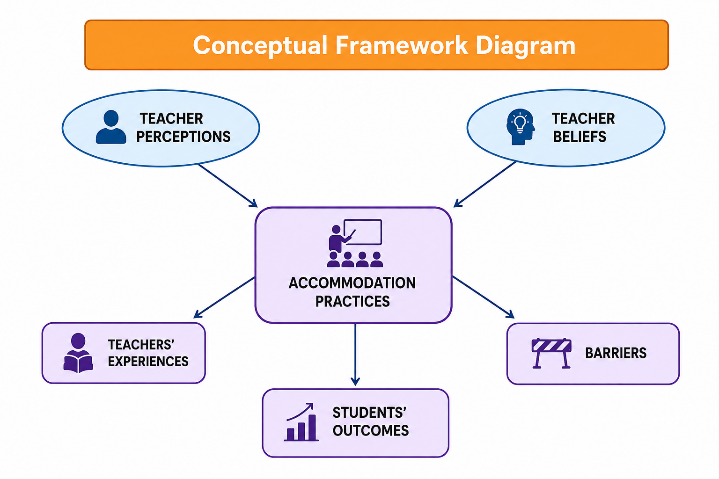
This methodological framework is aimed at providing a clear structured plan to ensure the validity of the results. It outlines the research design, population, sampling strategy, data collection methods, analysis procedures, and ethical considerations, while exploring the lived experiences, beliefs, and instructional practices of mathematics teachers supporting students with learning disabilities (LDs) in non-traditional high schools in Jamaica. By utilizing a qualitative phenomenological approach, it also sought to capture the teachers’ subjective perspectives, provide a thorough understanding of their instructional decision-making, perceived barriers, and emotional experiences in inclusive classrooms. The conceptual framework is also included acting as a roadmap to ground the data analysis of this study, which highlighted teacher beliefs, accommodations, barriers, and emotional experiences (Figure 1).
3.1. The Research DesignThis research employed a qualitative phenomenological design, which is appropriate for investigating teachers lived experiences and subjective interpretations of inclusive education 43, 62. Phenomenology focuses on understanding how individuals derive meaning from their experiences, enabling the researcher to explore how mathematics teachers perceive, plan, and implement accommodations for students with LDs. This design was used to examine Jamaican high school teachers’ experiences within non-traditional schools, where cultural, institutional, and resource factors shape inclusive practices 21.
3.2. Population, Sample and Sampling MethodThe population for this study comprised high school mathematics teachers in 5 non-traditional schools across the counties in Jamaica who have direct experience teaching students with LDs. Within the Jamaican context, non-traditional schools that evolved from junior secondary to comprehensive high, and presently, upgraded high schools 66. Based on the daily involvement of differentiating instruction and implementation of accommodations for the students with diverse learning needs, the teachers from these institutions are considered to be the key informants to MoESYI 13. The sample using purposive sampling which included 11 teachers instead of the original target of maximum 15 students who met the eligible criteria including at least two years of mathematics teaching experience and prior engagement with students formally deemed as having learning disabilities (LDs), such as autism spectrum disorder, dyslexia, or speech and language impairments 69 utilizing a purposive sampling method. According to Kirk 70, “A learning disability refers to a disorder, retardation or delayed development in one or more of the processes of speech, language, reading, writing, arithmetic, or other school subjects resulting from a psychological handicap caused by possible cerebral dysfunction and/or emotional or behavioral disturbances”.
3.2. Conceptual FrameworkThe study was guided by the principles of differentiated instruction and teacher beliefs as key drivers of inclusive practice 21, 38. The conceptual map below facilitates the visual depiction of the relationships between teachers’ beliefs, instructional practices, accommodations, barriers, and student outcomes. This map shown in Figure 1 was used to guide the analysis of how teachers’ perceptions influence classroom strategies and the overall success of inclusion.

The primary method to gather the information included semi-structured interviews, which allowed participants to share their viewpoints and experiences openly, while facilitating the researcher to probe for deeper insights 63. Additional data sources were also utilized, these included lesson plans and instructional materials to support methodological triangulation and provide context for teachers' narratives 21, 44. Daily insights outlining daily experiences, thoughts and feelings through the form of reflective journals from teachers were also obtained from teachers who were willing to share, to capture ongoing observations and personal insights.
The systematic data collection process of gathering, measuring and organizing information began with obtaining institutional ethical clearance to conduct the research under their purview. Then next a formal approval from MoESYI was sought and received to facilitate the research. Once eligible participants who are high school non-traditional teachers, were identified, consent letters were sent to them outlining the study's purpose. Voluntary participation was sought, confidentiality measures were utilized; and the right to withdraw without consequences was open to participants. Each interview lasted approximately 30–45 minutes and were audio-recorded and transcribed verbatim. Member checking was implemented by returning transcripts or summaries to participants for validation of accuracy and meaning 71. A pilot interview with 2 teachers was conducted which facilitated the refinement of the interview protocol.
3.3. Data AnalysisData collected were analyzed using thematic analysis following Braun and Clarke’s 1 six-phase process: familiarization with data, generating initial codes, searching for themes, reviewing themes, defining and naming themes, and producing the final report. This was coupled with phenomenological approaches including Interpretative Phenomenological Analysis (IPA), Van Manen’s hermeneutic analysis, and Colaizzi’s method. NVivo software was used to organize codes, identify patterns, and facilitate thematic development. IPA allowed the researcher to delve into the teachers’ lived experiences for deeper emotional, psychological, or meaningmaking insights 72. The Van Manen’s hermeneutic analysis, on the other hand, allowed the researcher to bring context to data specifically through a narrative style interpretation to capture and explain the teachers’ experiences 73. While the Colaizzi’s method was used to extract significant statements from the interviews aligned with the research objectives in order to formulate meanings and validate the meaning with the participants by doing checks and balances to ensure the teachers experiences are correctly interpreted 74. In ensuring that the findings are firmly supported in participants’ experiences, reflexive journaling was retained to analyze the researcher’s assumptions, interpretations, and reflections. To assist with the validation of the data, the researcher examined shared lesson plans and other instructional materials to facilitate data triangulation and provide context to the interpretation of teachers’ lived experiences, emotional response and beliefs.
3.4. Trustworthiness (Validity and Reliability)Trustworthiness in qualitative research is the process researchers use to demonstrate that their findings are credible, consistent, and applicable beyond the immediate study. In this research, trustworthiness was established through the qualitative criteria of credibility, confirmability, dependability, and transferability 75.
Credibility will be obtained through member checking, prolonged engagement with participants, and data triangulation using optional journals, interviews and documents.
Confirmability will be applied by way of reflexive journaling, in ensuring that findings are firmly established in participant report, rather than researcher bias.
Dependability will be sustained by an audit trail, that includes but not limited to records of data collection instruments, coding decisions, and research method reflections.
Transferability will be handled by supplying comprehensive contextual insights of participants, school settings, and instructional practices.
3.5. Ethical ConsiderationsEthical consideration principles will be strictly observed and these would include informed consent, voluntary participation, confidentiality, and anonymity to steer the research design and practices. To maintain confidentiality, pseudonyms will be utilized, and all collected information will be securely stored on encrypted devices and cloud storage that is password-protected. Recognizing the risk of emotional stress when reviewing challenges with students with LDs, participants will be given the choice to suspend interviews or discontinue them and seek support services when warranted.
This segment outlines the findings of the study, including descriptions of the participants, data collection, and data analysis methods. This section also provided evidence of trustworthiness, including confirmability, credibility, dependability and transferability.
4.1. Response RateThe participants for this study comprised 15 high school mathematics teachers from non-traditional schools across Jamaica who received invitations to participate of which 11 teachers responded, resulting in a response rate of 73.33%, calculated using the formula: (number of respondents ÷ number of invitees) × 100. Utilizing purposive sampling, the participants had mathematics teaching experience ranging from one year to a maximum of 33 years based on their practical experience in an inclusive classroom setting. The interviews offered rich, in-depth insights into teachers’ perceptions, experiences, and practices reflecting a broad spectrum of instructional perspectives and professional experience when accommodating students with learning disabilities in mathematics classrooms.
4.2. Participants’ ProfileThe demography profile of participants consists of a wide-ranging group of high school mathematics teachers with various levels of experience, training, and exposure to inclusive education (Table 1). This group of participants consisted of eleven teachers with practical experience ranging between 1 and 33 years that are able to provide a balanced perspective across early-career, mid-career, and highly experienced educators. Significantly, participants (ROM2018 and DAS1972) had over two decades of teaching experience, with DAS1972 serving as a Head of Department, which represents a leadership position, signifying a depth of instructional and institutional perspectives. Conversely, a high proportion of participants (approx. 50%) had at least five years or less of teaching experience, alluding to the fact that many were still in the early stages of their professional development.
All participants were trained high school mathematics teachers, possessing practical experience spanning from Grades 7 to 13, with concentrations in the lower to upper secondary levels that is Grades 7–11 (Table 1). This steadiness ensures that the data reflects experiences within comparable classroom contexts, more so those where foundational and intermediate concepts in mathematics are being delivered.
As it relates to training in special or inclusive education, the findings highlighted a striking variation. Within the findings, it is revealed that some teachers, despite receiving formal exposure in special education while serving as students at tertiary level institutions, were limited in context, particularly in terms of practical or practicum-based application. This suggests a gap between theoretical knowledge and classroom implementation. Additionally, a few participants indicated that they attended workshops or Government-run training sessions in special or inclusive education, however, these were generally characterized as partial or supplementary rather than hands-on or practical.
Importantly, having not received any formal training in special or inclusive education, a considerable number of these teachers relied on personal teaching development to support students with learning disabilities in classrooms. This was noticeable among both novice and experienced teachers who have explicitly stated that the lack of structured training is not confined to a distinct point in their professional phase. Overall, the demographic data suggested that while teachers possess strong course-content in mathematics, there was variability, and in some cases insufficiency, in their formal preparation for inclusive teaching, in accommodating students with learning disabilities which has implications for their confidence, instructional practices, and experiences.
4.3. Results Based on Research Question 1What are the key types of learning disabilities observed among high school mathematics teachers in Jamaica?
This research question unravels the specific learning challenges that affect students’ participation and performance in mathematics classrooms and attempts to uncover the main types of learning disabilities typically observed among Jamaican high school mathematics teachers (Table 2).
Theme 4.3.1. Dyscalculia or conceptual math difficulties
The outcomes under this theme revealed that teachers frequently encounter students who demonstrate difficulties associated with dyscalculia or broader conceptual challenges in mathematics. A notable issue emerging from the data is ‘teacher uncertainty in identifying learning disabilities, with some participants expressing a lack of confidence in formally recognizing or categorizing these difficulties. One teacher lamented, “I am not a clinical psychologist so I would not know.” Teachers regularly outlined students as possessing conceptual difficulties with mathematical ideas, particularly in logical reasoning, number sense, and the meaning of mathematical operations.
These challenges are indicative of core features of dyscalculia, in which students struggle not just with computation but also with understanding the underlying concepts that give mathematics meaning. Additionally, reasoning deficits emerged as a significant concern, where the participants observed that students do not have the capacity to logically cipher through mathematical concepts. Such limitations contribute to persistent learning gaps and hinder deeper conceptual understanding. Moreover, teachers highlighted issues related to number sense and calculation, supporting the presence of dyscalculia-like traits, where students are observed struggling with basic numerical operations and interpreting mathematical symbols leading to slow, inaccurate, or inconsistent computational performance. Overall, this theme supports the fact that teachers are presently being faced with challenges for effective classroom instructional support, despite being keenly aware of the students’ conceptual struggles in mathematics, due to their limited confidence in identifying specific learning disabilities, combined with the complex nature of dyscalculia.
Theme 4.3.2. ADHD or Processing Speed Difficulties
This theme highlights teachers’ lived experiences in identifying students with characteristics with ADHD or processing speed difficulties in order to accommodate them in mathematics classrooms. Teachers have recognized that students have attention-related difficulty, where one stated, “ADHD and ADP; ADHD affects students in such a way that it disallow them to be focused and on task in the Math classroom.” The findings indicate that teachers may find students hyperactive or attention-seeking during the lessons. This has caused students to lose focus becoming easily distracted and struggle to complete the tasks given. Teachers have also recognized that “Students with ADHD may lose focus during explanations, skip steps, or make careless errors.” The findings once again identified that students’ loss of focus impact on their learning outcomes because they may not have properly taken notes due to not capturing all explanations, as well as they struggle to problem solve because they cannot get which steps come first and make careless mistakes. As such, this affects students’ performance negatively. Teachers went on to say that “Students with processing speed difficulties may understand concepts but require extra time to complete tasks.” They explain that some students perform poorly even when they can complete the tasks and tests given due to struggling to keep up with the time duration given. Additionally, a teacher stated “sometimes executive function deficits”, indicating that due to attention and working memory issues students have problem completing multi-step problems, focusing to capture information to retain them while problem solving and apply appropriate strategies.
Theme 4.3.3. Language-Based Learning Disabilities
This theme highlights teachers’ identification of language-based learning difficulties, particularly those associated with dyslexia, and their impact on students’ performance in mathematics. As one participant explained, “Dyslexia affects the way how they see words, causing them to get wrong answers most of the time.” Another teacher noted, “Some students don’t understand what the question is asking because they struggle with the wording.” Due to these difficulties students often tend to misread numbers, misinterpret instructions, or attempt to answer questions without first making meaningful sense of them. As one teacher shared, “They try to answer, but sometimes it doesn’t make sense, or they just leave it blank.” Overall, one of the significant barriers to students’ comprehension, engagement, and success in mathematics identified was language-based learning disabilities, particularly dyslexia. The findings underscore that students have deficiencies in their foundational literacy skills especially in areas such as
reading comprehension, written communication, and spelling.
Theme 4.3.4. Visual-Spatial Processing Difficulties
This theme outlines teachers’ identification of the difficulties experienced with visual-spatial processing and how much they impact students’ understanding of mathematical concepts. Despite the participants indicating that these difficulties were less commonly observed, when compared to other learning challenges, they recognize the adverse effect it could have on the students’ mathematical performances. Teachers reported that students with visual-spatial difficulties may struggle to interpret diagrams, align numbers correctly, or understand spatial relationships in mathematical tasks. These challenges can affect students’ ability to engage with topics that require visualization, such as geometry, graphs, and place value. As one participant explained, “It is not very common, but when it occurs, it affects how students understand certain math topics.” Another suggestion by the participants is that these difficulties may be linked to forms of visuospatial dyscalculia proposing that students were experiencing trouble in mathematical contexts in processing visual and spatial information. Although rarely identified, teachers noted that when present, these challenges can hinder students’ ability to organize their work and accurately interpret mathematical representations. Overall, visual-spatial processing difficulties were perceived to being a significant factor influencing students’ understanding and performance in mathematics despite it being seen as a less frequent factor.
Theme 4.3.5. Emotional & Behavioural Learning Barriers
Teachers were able to demonstrate the identification of emotional and behavioural factors that influenced the ability of the students to learn mathematics. Teachers reported that once faced with mathematics tasks many students exhibits signs of frustration, withdrawal and disengagement brought on by their inability to link concepts and complete activities. As one teacher noted, “Some students get frustrated easily when they don’t understand and just stop trying.” Another teacher shared, “You can see when they shut down or lose interest because the work becomes too difficult.” Autism was another development condition highlighted by participants that affected the students’ behaviour and interaction in the classroom and negatively impact their learning experience. Some of these students may display anxiety-related behaviour (including fear of attempting questions) and have difficulty engaging socially or responding appropriately during lessons. As one participant explained, “Some students are afraid to even try because they think they will get it wrong.” Teachers further indicated that emotional responses such as “mathematics anxiety” or “math phobia,” is an anxiety that can negatively affect students’ ability to process and retain information and may develop low confidence. Overall, the significant factors influencing students’ confidence, engagement and performance in mathematics were identified as emotional and behaviour learning barriers which often compound existing learning difficulties as well.
4.4. Results from Research Question 2What types of accommodations do high school mathematics teachers perceive as most effective for students with learning disabilities in mathematics?
While focusing on strategies and practices utilized by teachers to help students to better understand mathematical concepts and succeed in the classroom, this research question explores the types of accommodations that high school mathematics teachers believe are most effective in supporting students with learning disabilities (Table 3).
Theme 4.4.1. Individual Attention
The study reported that teachers frequently used Individual Attention to support students showing signs of dyscalculia and related mathematical learning difficulties as an accommodation strategy. This was expressed in the responses such as, "Refer them to the Guidance Counselor so they can get a specialist," "Support from APSE coaches/parents," and "Getting professional help." One participant indicated that students should be given "Extended time on tests and assignments." In contrast, others recommended "Chunking tasks into smaller, manageable steps" and "Chunking multi-step problems into smaller, structured steps and explicit modeling."
For students who struggle with visual understanding of numbers and mathematical concepts, teachers suggested that visual aids, graph paper, and manipulatives must be used. Students with procedural difficulties benefit from step-by-step checklists, while those with semantic memory challenges are supported using formula sheets and mnemonics. Other accommodations included digital tools for students with visual-motor difficulties, repeated instructions and write-down aids for students with working memory challenges, and pre-teaching vocabulary for learners with language-based difficulties. Nonetheless, the findings indicate that there is no actual evidence of intervention strategies based on the reported data obtained from documents. In general, students with dyscalculia and related learning difficulties are supported through Individual Attention which plays a significant role as suggested by the respondents and that based on the specific challenges a different form of support would be warranted.
Theme 4.4.2. Multi-Sensory & Visual Aids
The study showed that teachers frequently used Multi-Sensory and Visual Aids as an accommodation strategy to facilitate students with learning difficulties and disabilities such as dyscalculia, dyslexia, and ADHD in mathematics classrooms. One participant shared that, “In my high school mathematics classes, I have encountered learning disabilities such as dyscalculia, dyslexia, and ADHD.” Participants explained that one effective approach utilized to support these students was “Multisensory instruction – using visual, auditory, and kinesthetic methods to teach concepts.” Also, based on the document analysis, the findings revealed that teachers used charts, diagrams, videos, manipulatives, counters, circular objects, fraction circles, place-value charts, calculators, physical models, and online manipulatives. The findings also showed that teachers often apply accommodations such as “providing extra time on assessments,” “using visual aids or manipulatives,” and “breaking tasks into smaller steps with scaffolded instruction.” The findings implies that within mathematics classrooms, Multi-Sensory and Visual Aids are essential accommodations for engaging students with dyscalculia, dyslexia, and ADHD.
Theme 4.4.3. Structured and Scaffolded Instruction
Teachers shared that they frequently used Structured and Scaffolded Instruction as an accommodation strategy. One participant explained, “I support students by using step-by-step instruction, visual aids, extended time, and breaking tasks into smaller parts. I also offer alternative assessments, frequent feedback, and assistive technology to create an inclusive learning environment.” Similarly, another participant stated that, “The most effective accommodations are step-by-step instruction, visual aids, manipulatives, extended time, and breaking tasks into smaller parts. These, along with frequent feedback, help students understand concepts and build confidence.” These quotes further demonstrates how teachers use scaffolded instruction to address procedural and dyscalculic difficulties. One teacher elaborated, “I used manipulatives to help them figure out mathematical concepts. I also give them one-on-one assistance.” This finding aligns with the document analysis of lessons, instructional materials, and reflection, where teachers used several methods including step-by-step demonstrations, think-aloud strategies, guided practice, CPA sequencing, bridge method, and chunking mathematical procedures. Overall, the findings indicate that structured and scaffolded instructions are a valuable accommodation strategy for students experiencing executive functioning difficulties, working memory challenges, dyscalculia, procedural difficulties, and visuospatial deficits.
Theme 4.4.4. Assessment Supports
Several teachers expressed that they frequently used Assessment Supports as an accommodation strategy to assist students with learning difficulties and disabilities such as dyscalculia, ADHD, dyslexia, working memory difficulties, math anxiety, and executive functioning challenges in mathematics classrooms. One participant elaborated that accommodations included “Extended time on tests and assignments” and “Chunking tasks into smaller, manageable steps.” Therefore, this finding highlights the importance of scaffolded assessment support for students who experience difficulties adhering to procedures or solving complex mathematical problems while explicit modeling allows teachers to demonstrate the sequence in completing tasks.
The findings further demonstrated that teachers used a variety of flexible assessment methods such as “extended time” and “alternative assessments” to develop inclusive learning environments. This response demonstrates that teachers understand the need for differentiated assessment practices that accommodate students’ individual learning needs. Assistive technology can support reading, organization, and calculation difficulties, while alternative assessments provide students with different ways to demonstrate understanding. Frequent feedback also aids students to identify mistakes, deepening their understanding, and boost confidence in mathematics.
Additionally, participants described several specific accommodations used to support students during assessments and classroom activities. These included:
• “Breaking down complex problems into smaller, manageable steps.”
• “Providing guided notes or structured templates.”
• “Allowing extra time for assignments and assessments.”
• “Using visual aids, graphic organizers, and concrete examples.”
• “Offering repeated instructions and clarification.”
• “Providing formula sheets or reference materials.”
• “Reducing the number of problems without reducing the level of difficulty.”
• “Using small-group or one-on-one support when possible”
These findings are closely tied to the document analysis, which reported that students are exposed to several assessment supports including oral assessments, worksheets, exit tickets, observation, independent practice, and differentiated homework tasks. These strategies focused on addressing LDs such as dyslexia, processing speed difficulties, math anxiety, and ADHD. Also, these assessment strategies are not the typical assessments especially in the high school system which normally tend to be similar to CSEC past papers to provide only written responses. Overall, the findings denote that an essential accommodation strategy for students with dyscalculia, ADHD, dyslexia, working memory difficulties, math anxiety, and executive functioning challenges are assessment supports.
Theme 4.4.5. Instructional Supports & Learning Aids
To make mathematical concepts more accessible, engaging and easier to grasp teachers emphasized the importance of using supportive teaching methods and learning tools to support students with diverse learning needs. The findings revealed that teachers used Instructional Supports and Learning Aids as accommodation strategies to support students with learning difficulties and disabilities such as dyscalculia, visuospatial difficulties, visual-motor challenges, semantic memory difficulties, procedural difficulties, working memory deficits, and dyslexia in mathematics classrooms.
One participant explained, “I used manipulatives to help them figure out mathematical concepts. I also give them one-on-one assistance.”
Likewise, another participant stated that, “Hands-on activities will be most effective.” This finding suggests that the benefits of active learning experiences in supporting students with learning difficulties are recognizable by the teachers. These are beneficial for students with visual-motor and working memory difficulties and actively engage them through practical experiences, rather than relying solely on written or verbal instruction. This can be achieved through direct interaction with learning materials hands-on activities, engaging students, encouraging active participation, improving concentration, and strengthening their understanding. The findings revealed that to assist struggling students with procedures and organizing information, teachers used structured instructional approaches. One participant shared, “Chunking multi-step problems into smaller, structured steps and explicit modeling.” This approach helps students remain organized and increases their ability to complete mathematical tasks successfully. Additionally, participants emphasized the effectiveness of multisensory teaching methods such as “visual, auditory, and kinesthetic methods to teach concepts” for supporting students with learning disabilities as visual supports, verbal explanations, movement, and tactile learning experiences can strengthen understanding and memory retention for students with dyslexia, semantic memory difficulties, and dyscalculia. Another participant suggested, “Create a school for them and get teachers with special needs skills to teach them.” Based on the document analysis, it was revealed that to accommodate students mainly with dyscalculia, working memory and executive function difficulties, teachers incorporated the following instructional supports and learning aids: formula references, guided examples, calculators, manipulatives, real-world scenarios, and graphic representations. One teacher shared that her students do other subjects such as Building Technology and Food & Nutrition, so she makes efforts to include real-world applications related to these subjects to help increase relevance of mathematics and students’ engagement. Overall, the findings suggest that Instructional Supports and Learning Aids play a significant role in helping students with all types of learning disabilities succeed in mathematics.
Theme 4.4.6. Language Support Strategies
Teachers stated that Language Support Strategies as accommodations was often utilized to assist students with various learning disabilities and math anxiety in mathematics classrooms. To assist students to better understand mathematical language and concepts, participants emphasized the importance of using clear communication, simplified instruction, repeated explanations, and individualized support to help them. One participant explained that they provided "Individual attention as best as I could." The findings further showed that to strengthen comprehension and communication in mathematics, teachers used manipulatives and individual support. These are especially beneficial for students with dyscalculia and dyslexia who struggle to interpret symbols, numbers, and mathematical terminology. Additionally, when teachers simplify instructions, provide visual supports, and offer consistent feedback, it is important that students possessing math anxiety to reduce their fear to boost their confidence in the subject. These findings align with the document analysis where language support strategies included vocabulary instruction, reading numbers aloud, sentence frames, think-aloud modelling, and word problem interpretation have been leveraged to address dyslexia, language-based learning disabilities, and working memory difficulties. Overall, the findings indicate that Language Support Strategies are important accommodations for students with dyscalculia, language-based learning difficulties, working memory deficits, dyslexia, procedural difficulties, and math anxiety as it help them to better understand mathematical concepts and language. Through individualized attention, step-by-step instruction, manipulatives, visual aids, feedback, and clear communication, teachers help improve academic understanding but also promote confidence, participation, and inclusion within the mathematics classroom.
Theme 4.4.7. Behavioral & Classroom Management Strategies
Teachers shared that they identified Behavioral and Classroom Management Strategies to provide support to students with ADHD and ADP in mathematics classrooms as it helps them to remain attentive, calm, and actively engaged in learning activities. One participant explained, "I normally bring them up front in the class to watch them closely. I also use a 2-minute strategy to calm them to ensure that they are on task." Students with ADHD often experience difficulties maintaining focus, especially in environments having multiple distractions and so the practice of seating students at the front of the classroom is a common behavioural accommodation intended to reduce distractions and increase teacher monitoring. These findings align with the literature reviewed which revealed that the strategies teachers use are leveraged to address LDs such as ADHD, executive function difficulties, emotional and behavioural learning barriers, and working memory difficulties while addressing behavioural issues and maintaining student engagement. Overall, the findings indicate that Behavioral and Classroom Management Strategies are important accommodations for students with ADHD and ADP, as not only does it support students academically, but it also helps to improve self-regulation, engagement, and overall classroom inclusion. Through strategies such as preferential seating, close supervision, calming techniques, and ongoing behavioral support, teachers create structured classroom environments that promote focus, participation, and positive behaviour.
Theme 4.4.8. Emotional & Motivational Support
Although the strategies mentioned focused on teaching methods and classroom accommodations, the findings revealed that the accommodations described by participants reflected not only instructional support, but also strong elements of emotional and motivational support for students with learning difficulties in mathematics. The responses indicated that teachers used feedback not only to correct mistakes, but also to reassure and encourage students. The focus on helping students "build confidence" to reduce fear and frustration, by allowing them to see mistakes as part of the learning process, rather than as failure. The findings also showed that accommodations strategies such as step-by-step instruction, manipulatives, and breaking tasks into smaller parts were particularly beneficial for students with dyscalculia, who often struggle with number sense, calculations, and understanding mathematical relationships that can cause frustration and low self-confidence. Similarly, the use of visual aids and structured instruction were identified as important for supporting students with dyslexia. These findings align to the evidence identified in the documents, where teachers used the following supports, confidence-building activities, consistent use of real-world contexts, collaborative learning, scaffolding tasks, and encouraging participation. The findings suggest that effective accommodations in mathematics classrooms extended beyond instructional strategies, and included emotional and motivational support, through the combination of structured teaching practices, confidence-building strategies, and supportive feedback.
Theme 4.4.9. Inclusive Strategies
Participants emphasized the importance of providing appropriate support, resources, and specialized assistance for students with learning disabilities, physical disabilities, and math anxieties. The findings revealed that teachers strongly supported the use of Inclusive Strategies to ensure that students with learning difficulties and disabilities receive equal opportunities to succeed in the classroom. One participant stated, "I believe inclusive education can be achieved once the challenges of time, resources, and human resources are overcome." The findings further showed that teachers viewed inclusion as a strategy that creates an environment where students would receive the support needed to meet their academic and emotional needs, and not as simply placing students with disabilities into mainstream classrooms. This is especially significant for students with dyscalculia ADHD, ADP, executive functioning difficulties and procedural difficulties, who may struggle with mathematical processes. It is also significant for students with dyslexia and language-based difficulties, who may experience challenges interpreting instructions, vocabulary, and written tasks. Another participant shared, "My belief about learning disabilities is that students should receive the best help possible to get them a quality education." The findings also imply that inclusive strategies involve collaboration and flexibility in teaching practices. Students with autism, working memory deficits, semantic memory difficulties, and visual-motor challenges may require modified instruction, assistive technology, visual supports, structured routines, and individualized guidance, to participate effectively in classroom activities. The findings from the document analysis indicated that the lesson plans and reflections revealed the following strategies used, differentiated instruction, multiple instructional representations, oral and written assessment methods, various pathways to solve problems, learning activities suited to diverse (visual, auditory, tactile, and kinesthetic) learners, and offering support distinctively for slow and advanced learner groups. However, there needed to greater emphasis on individualized planning for accommodating students carefully and IEP alignment. Overall, the findings indicate that teachers view that inclusive strategies are seen as an essential in supporting students with diverse learning difficulties and disabilities. However, the findings also highlighted that achieving effective inclusion requires adequate time, resources, trained personnel, and ongoing support within schools, aimed at creating learning environments that promote confidence, participation, equity, and success for all students, regardless of their individual learning needs.
4.5. Results from Research Question 3What are Jamaican high school mathematics teachers’ experiences in implementing accommodations for students with learning disabilities in their classrooms?
This research question explores the experiences of Jamaican high school mathematics teachers, as they implement accommodations for students with learning disabilities in their classrooms (Table 4). It focuses on the challenges, strategies, and support systems teachers faced while creating inclusive learning environments for their students.
Theme 4.5.1. Uncertainty and Professional Doubt
Participants' accounts revealed that they had a sense of uncertainty and professional doubt when trying to accommodate students with learning disabilities in mathematics classrooms. Despite being willing to support their students, some responses suggested that their confidence was lacking when it comes to selecting which strategies or accommodation would be most effective for students with different learning needs. One teacher disclosed, "It is an uphill task especially when you are not sure whether your approach will yield fruit." This uncertainty appeared to be brought on by challenges of managing diverse learning difficulties, limited training and lack of resources, in a single classroom. These disabilities include dyscalculia, dyslexia, ADHD, and working memory difficulties. Also, the findings indicate that professional doubt may negatively impact teachers' confidence in implementing inclusive education practices, more so when the behaviour seen is beyond general classrooms instruction, leaving a feeling of unpreparedness in their provision of specialized support. Teachers bearing these uncertainties may feel the need to rely on basic accommodations, rather than more targeted strategies designed for specific learning difficulties. However, lack of uncertainties does not demonstrate a lack of care or commitment from teachers which was also highlighted in the findings. Their responses suggest a desire for greater professional development, guidance, and support, to better meet the needs of students with learning disabilities. Overall, the findings highlight that uncertainty and professional doubt are important aspects of teachers' experiences in inclusive mathematics classrooms. While teachers demonstrated positive attitudes toward supporting students with learning disabilities, the findings suggest that additional training, resources, and institutional support are needed to strengthen teachers' confidence, and ability to implement effective accommodations successfully.
Theme 4.5.2. Tailoring Instructions Specific to Students’ Needs
To improve understanding, participation, and academic success, the participants emphasized the importance of adapting instruction, assessments, and classroom activities, based on students' individual learning needs. The findings revealed that teachers frequently use Tailoring Instruction Specific to Students' Needs as an accommodation strategy to support students with learning difficulties and disabilities, such as working memory deficits, dyscalculia, dyslexia, visuospatial difficulties, math anxiety, and executive functioning challenges in mathematics classrooms. One participant explained, "In my mathematics classroom, I implement accommodations by tailoring instruction to students' individual learning needs. I use visual aids, manipulatives, and step-by-step explanations to make concepts clear. I provide extended time, break tasks into smaller steps, and offer alternative ways for students to show understanding. With frequent feedback, supportive technology, and an inclusive classroom environment, I help students build confidence and succeed in mathematics." The findings also showed that once it was carefully matched with students' specific needs, teachers viewed 'accommodations' as most effective. One participant described their experience implementing accommodations as "both rewarding and challenging" and that "accommodations significantly improved students' confidence, participation, and overall performance, when they are properly aligned with students' needs." This suggests that teachers are aware that accommodations should not be generalized but instead, tailored to address the unique difficulties each student's experiences. Additionally, the significance of structured instructions and visual support was validated by participants. One teacher stated, "During instruction, I break multi-step problems into clearly structured steps and model my thinking aloud, so students can see the reasoning being processed. I also use visual supports such as guided notes, to help students." This finding support students with executive functioning difficulties, dyscalculia, and visuospatial challenges, and reflects the use of scaffolded strategies. The findings further revealed that multisensory and modified instructional approaches were utilized by teachers, to enhance student engagement and understanding. One participant shared, "I have used a mix of multisensory instruction, extended assessment time, and modified assignments, to help students with learning disabilities engage with math." Multisensory instruction supports students by engaging visual, auditory, and kinesthetic learning styles, while modifying assignments and extended time help reduce stress and cognitive overload for students experiencing math anxiety, working memory difficulties, and processing challenges. In general, the findings suggest that an essential accommodation strategy tailor instruction to students' individual learning needs, and is important to inclusive mathematics classrooms. Teachers create learning environments that promote confidence, participation utilizing visual aids, manipulatives, scaffolded instruction, multisensory teaching, modified assessments, and supportive feedback, to improved performance in mathematics, for students with diverse learning needs, requiring personalized support.
Theme 4.5.3. Frustration with Slow External Support
Analysis of the responses showed that some teachers experienced frustration by the slow pace of external support services when attempting to accommodate students with learning disabilities in mathematics classrooms. A participant explained that "My experience has been quite challenging, as when I refer them for professional help, the process is very slow." While teachers recognized the importance of professional intervention, one of the main strategies identified by participants was the referral of students to professionals or specialists, for additional support. Teachers appeared to understand that students with learning difficulties such as dyscalculia, dyslexia, ADHD, and other cognitive challenges, valued these services in helping students receive more targeted assistance, and improving their overall learning outcomes from specialized interventions, or individualized support plans from guidance counselors, psychologists, or special education specialists. This can lead to teachers feeling disheartened, as they wait for specialized intervention or formal diagnoses for students. Additionally, the findings imply that despite the slow intervention and formal diagnoses for students, teachers often continued to support students through various classroom interventions as best allowed; reflecting their commitment to their students, even when external resources are limited or delayed. The findings further highlight the importance of collaboration between schools and external support services, in inclusive education. When communication or access to these services is slow, teachers may experience stress and uncertainty about whether students are receiving the help they need; as effective accommodations for students with learning disabilities often require teamwork among teachers, guidance counselors, specialists, parents, and other professionals. Despite being an important accommodation strategy, the findings indicate that frustration with slow external support is a significant challenge faced by teachers in inclusive mathematics classroom; as it creates barriers to timely intervention and support. The findings suggest a need for more efficient support systems, which will help to better meet the needs of students with learning disabilities.
Theme 4.5.4. Acceptance and Resilience
The data indicated that some teachers demonstrated attitudes of acceptance and resilience when working with students with learning disabilities in mathematics classrooms; and demonstrated a willingness to continue supporting students, despite the challenges associated with inclusive education. One participant even said, "It can be challenging at times, but I knew what I was getting myself into, so I just work with it." Even when resources, training, or external support were limited, these attitudes reflected patience, adaptability, and a commitment, to helping students succeed. The findings suggest that teachers accepted the reality that, rather than viewing learning difficulties as barriers to learning, students who learn in different ways, may require additional support to fully participate in mathematics instruction. The findings also indicated that resilience played a significant role in teachers' experiences with implementing accommodations; as they continue the development of inclusive classroom environments where their students feel valued and supported. Their responses suggest that many teachers remain committed to supporting students, even when they experience frustration, uncertainty, or limited institutional support, that have a meaningful impact on the students' motivation and willingness to engage in mathematics activities. The findings further highlight that resilience among teachers may develop from their ongoing experiences in working with students with LDs and suggest that acceptance and resilience are important aspects of teachers' experiences in inclusive mathematics classrooms. This adaptability is essential in inclusive education where no single approach is effective, for all students promoting participation, confidence, and success.
Theme 4.5.5. Reliance on External Support
The study highlights that teachers frequently relied on external support systems, particularly APSE coaches, to help accommodate students with learning disabilities in mathematics classrooms, and that these coaches were viewed as valuable sources of guidance and assistance, in supporting students with learning difficulties. The findings also imply that collaboration between teachers and APSE coaches contributed to a more supportive educational environment and further suggest that teachers' reliance on external support may also reflect concerns about limited training or insufficient resources, within the classroom setting. This collaborative approach highlights the importance of supportive networks in promoting successful inclusion practices in schools, while creating learning environments that are more responsive to the needs of students with learning disabilities.
Theme 4.5.6. Skill Deficit and Workload Burden
Participants' accounts revealed that they encountered challenges concerning skill deficits and workload burden, when students with learning disabilities in mathematics classrooms are being accommodated. Although no specific accommodation was identified, participants' responses suggested that sometimes they feel overwhelmed to the point where they begin to doubt themselves, whether they have the necessary skillsets required to effectively support students with diverse learning needs in the classroom. Furthermore, the findings suggest that the teachers are not turned-off from their commitment, despite the challenges and constrained by external factors such as limited training opportunities, inadequate staffing, and increased classroom responsibilities, in supporting students with learning disabilities. Overall, the findings indicate that within the inclusive classrooms teachers' experiences with accommodation are not affected by challenges associated with skill deficits and workload burden. While teachers demonstrated a willingness to support students with learning disabilities, the findings suggest that additional training, resources, and support systems are needed to reduce workload pressures and strengthen teachers' ability to implement inclusive practices successfully.
Theme 4.5.7. Structured Teaching Practices
Participants consistently reported that Structured Teaching Practices is an accommodation strategy frequently used by them in supporting students with learning difficulties and cognitive impairment disorders in mathematics classrooms. The idea of breaking problem down into smaller structured steps can be described as scaffolded instruction, and is seen as key practice which helps to reduce cognitive overload for students with working memory and executive functioning difficulties. Additionally, 'modeling the reasoning process' is another structured teaching practice that allows students to better understand how mathematical procedures should be completed. Delving further, the results also showed that to successfully implement structured accommodations, it was important that additional support personnel are utilise to support teachers, more so in large classroom settings. Additionally, participants spoke of the importance of tailoring instruction to enhance accommodations to meet the learning needs of individual students. The findings further revealed that implementing structured accommodations was often demanding and time-consuming for teachers. One participant noted that, "The process of implementation wasn't easy. It was tedious because it required a lot of work, including repetition. It was observed that after implementation, students' behaviours and grades improved." Overall, the findings indicate for students with dyscalculia and other learning disabilities, an important accommodations to facilitate learning would be Structured Teaching Practices.
Theme 4.5.8. Multi-Strategy Instruction
Emerging from the data was the finding that another accommodation strategy frequently utilized by teachers in supporting students in mathematics classrooms with learning difficulties and disabilities is Multi-Strategy Instruction. This highlights respondents' use of several combined instructional strategies, including scaffolded instruction, explicit modeling, and visual supports. From this finding, it was suggesting that no one accommodations strategies can suffice when teaching students in the mathematics classroom, and so to meet the students' needs, a combination of assessment, instructional and emotional support strategies is applied to meet the objectives. The findings further allude us that the important components of multi-strategy instruction were multisensory and modified instructional approaches. One participant shared, "I have used a mix of multisensory instruction, extended assessment time, and modified assignments, to help students with learning disabilities engage with math." Overall, the evidence suggests that an important accommodation approach for assisting students with working memory deficits, visuospatial difficulties, semantic memory challenges, executive functioning difficulties, dyscalculia, dyslexia, and ADHD in mathematics classrooms, is Multi-Strategy Instruction. To assist students to improve their understanding engagement, confidence, and overall success in mathematics combination strategies of utilizing scaffolded instruction, visual supports, manipulatives, multisensory teaching, modified assessments, and supportive feedback, teachers create learning environments that are more responsive to students' diverse needs.
Theme 4.5.9. Experienced Reward and Challenge
Most teachers described that within mathematics classrooms, students with learning difficulties and disabilities such as dyscalculia, dyslexia, ADHD, ADP, and working memory deficits; when they (the teachers) implemented the accommodations are implemented by the teachers. They expressed experienced both reward and challenge. As one participant explained, "It can be challenging trying to meet the needs of all students, especially those who need extra support." Another teacher noted, "You have to constantly adjust your teaching to help them understand." One participant explained, "My experience implementing accommodations in the mathematics classroom has been both rewarding and challenging. I have found that accommodations significantly improve students' confidence, participation, and overall performance when they are properly aligned with students' needs." One participant shared, "It feels good when you see them finally understand something they struggled with." Overall, the findings indicate that while teachers recognized the positive impact accommodations can have on students in meeting diverse learning needs, improving their confidence, participation, and academic performance, they still faced significant challenges implementing them. To aid the reduction of workload pressures and strengthen teachers' ability to implement inclusive practices effectively, these findings highlight the importance of providing them with continuous professional development, adequate resources, and institutional support.
Theme 4.5.10. Effort-Intensive Implementation with Positive Outcomes
A shared perspective among participants was that implementing accommodations for students with dyslexia, dyscalculia, ADHD, and ADP was often viewed as an effort-intensive process, requiring significant time, patience, and support. One participant explained, "With the help of APSE coaches, it's easier to facilitate, otherwise, it is challenging to accommodate them alone with the larger group." Similarly, another participant stated, "It can be challenging at times, but I knew what I was getting myself into, so I just work with it." One participant shared, "It has been a difficult one since I don't have the skill set it burdens me sometime. These students take a lot of work to deal with. The needs of these students are equal to the needs of the entire class in one." Regardless, the findings suggest that because teachers recognize the positive outcomes associated with their efforts when implementing accommodation, they will continue regardless of the challenges. Overall, the results outlined that despite participants experiencing challenges, workload burden and limited skills implementing accommodations, they continue to show resilience and commitment in supporting students with dyslexia, dyscalculia, ADHD, and ADP. The results further highlighted how important it was in helping teachers manage the demands of inclusive education; and the importance of external support, professional development and adequate resources in contributing to students with learning disabilities, to improved outcomes.
4.6. Results from Research Question 4What perceived barriers do high school mathematics teachers encounter when attempting to accommodate students with learning disabilities; and how do they navigate these challenges?
This research question examines the classroom challenges that non-traditional high school mathematics teachers face in accommodating students with learning disabilities (Table 5). It also delve into the barriers that negatively impact support of students’ learning and participation, and how teachers respond to, and manage these barriers.
Theme 4.6.1. Limited Time for Planning and Lesson Differentiation
There was broad consensus among participants that when looking at limited time for planning and lesson differentiation, they experienced significant challenges while trying to accommodate students with learning disabilities in mathematics classrooms. Many challenges were disclosed by one participant, including "Limited time to tailor lessons, large class sizes, finding the right mix of accommodations, gauging understanding vs. just completing work, [and] lack of resource materials." Similarly, another participant explained that, "When trying to differentiate the lesson, coming up with ideas and strategies takes time." These teachers have to cater for students with several LDs including dyscalculia, ADHD, dyslexia, and working memory deficits. One participant shared that they were "Utilizing differentiated instruction, grouping students, and tailoring lessons to use whatever resources available." In addition, another participant simply identified "Time and resource constraints", as a major challenge in implementing accommodations. The findings continues to suggest that teachers remains committed to support their students through differentiated instructions despite challenges faced. One participant stated, "I try to prepare differentiated lesson materials. Doesn't always happen, but I try." Overall, the participants' views confirm that one of their major challenges affecting their ability to accommodate their students in inclusive mathematics classrooms are related to: - limited time for planning and lesson differentiation. These findings highlight the need for increased planning time, access to resources, and institutional support to help teachers more effectively, implement differentiated instruction for students with learning disabilities.
Theme 4.6.2. Inadequate Resources
Analysis of the responses showed that inadequate resources — including instructional materials such as manipulatives and assistive technology, sufficient planning time, and access to specialist support staff — was one of the factors that teachers faced in their ability to accommodate students with learning disabilities in mathematics classrooms. A significant challenge one participant simply identified was "Lack of resources and time". In general, the findings indicated that for implementation of accommodations in mathematics classrooms to be effective, not having adequate resources can be an obstacle. The outcomes demonstrated the need for greater access to resources, improved classroom support, and increased institutional investment in inclusive education, to better assist teachers to meet the needs of students with learning disabilities.
Theme 4.6.3. Difficulty Providing Individualized Learning
The data indicated that difficulties in providing individualized learning support for students with learning disabilities, in mathematics, were experienced by teachers in the classrooms. One participant stated, "I try to prepare differentiated lesson materials. Doesn't always happen, but I try." Overall, the outcomes expressed that one of the significant obstacles for teachers in inclusive mathematics classroom is being able to support individualized learning. Despite this, the findings also highlighted that teachers are committed in their efforts in adapting instruction and supporting students.
Theme 4.6.4. Curriculum and Systemic Constraints
The data suggested that curriculum and systemic constraints affected teachers' ability to accommodate students in mixed group mathematics classrooms exhibiting learning abilities, and was seen as major deterrents. The findings suggest that for teachers to fully apply individualized accommodations, they must overcome the systemic expectations related to curriculum coverage. Overall, the findings indicate that teachers' ability to accommodate students with learning disabilities in mathematics classroom are adversely affected by curriculum and systemic constraints. Consistently, being faced with these challenges to improve teaches efficiency; to effectively meet the needs of students with learning disabilities in inclusive classrooms requires a great need for flexibility in the education system, along with increased support and resources.
Theme 4.6.5. Instructional Complexity and Cognitive Demand
This finding points to challenges that are related to instructional complexity and cognitive demand that teachers experience when accommodating students with learning disabilities in mathematics classrooms. One participant stated, "I pray about it. I also ask questions and I'm always thinking of creative ways to help the students." Overall, the findings indicate that when executing accommodations in inclusive mathematics classrooms, important aspects of teachers' experiences demands instructional complexity and cognitive for positive results. These findings reinforce that to manage these challenges better, it is important that teachers must be equipped with adequate training, resources, and professional support to handle inclusive instruction systematically.
Theme 4.6.6. Students’ Lack of Interest and Motivation
The findings laid out that students' lack of interest and motivation was reviewed as a deterrent in accommodating students with learning disabilities which adversely affects teachers' experiences in accommodating students experiencing difficulties in mathematics classrooms. One participant stated, "They are uninterested in the subject." The findings also indicate teachers experience emotional strains brought on by the lack of motivation in their students. One participant explained, "Sometimes I don't overcome them. I just sit there and make it play out, because fixing most of those things is equal to breaking my own self." Overall, as it relates to the implementation of accommodation in inclusive classroom, the findings identified that a major challenge affecting students - is their lack of interest and motivation. These findings emphasized the importance of triangulating strategies such as instructional accommodations with motivational and emotional support, to inspire involvement, while building confidence among students with learning disabilities in mathematics.
Theme 4.6.7. Emotional and Personal Coping Challenges
Analysis of the responses showed that within mathematics classrooms student engagement and motivation goes hand in hand with emotional and personal challenges that teachers experienced while applying accommodations. One participant remarked that "Student engagement and motivation" was seen as a major challenge. The findings further imply that an important component of inclusive education that is often overlooked are emotional and personal coping challenges. In general, the findings indicate that within inclusive classrooms, emotional and personal coping challenges are closely linked to issues of student engagement and motivation, and is often recognizable by teachers when managing the demands of inclusive teaching, leading to difficulties being experienced in maintaining students' interest and participation. These findings highlight the importance of providing greater emotional, instructional and institutional support to promote positive learning experiences to both students and teachers in mathematics classrooms.
Theme 4.6.8. Systemic Multi-Factor Barriers
When attempting to accommodate students with learning disabilities in mathematics classroom, the findings revealed that teachers experienced systemic multi-factor barriers that shows wider concerns, broader issues related to curriculum expectations, time limitations, and the structure of the education system and extended beyond classroom instruction alone. Additionally, the findings indicate that these barriers are interconnected rather than isolated. Overall, the findings indicate that teachers' ability to implement accommodations in inclusive mathematics classroom are often hindered by systemic multi-factor barriers and the other barriers, such as curriculum demands, time limitations, and the cumulative nature of mathematics which, when combined, can be extremely overbearing for them. To better assist teachers from these findings, greater systemic support needs to be provided to accommodate students with learning disabilities, along with increased flexibility within the curriculum, and improved educational resources.
4.7. Results from Research Question 5How do high school mathematics teachers’ belief about learning disabilities and inclusive education influence their accommodation practices?
The results in Table 6 for this research question reveal the various ways mathematics teachers perceive an understanding of learning disabilities, and how inclusive education shape the accommodations they use in their classrooms. It focuses on how teachers’ perception impacts the decisions they make in supporting students with diverse learning needs.
Theme 4.7.1. Beliefs influence Teachers’ Instructions
Participants' accounts revealed that teachers' beliefs about learning disabilities and inclusive education strongly influenced their instructional practices and accommodation decisions in mathematics classrooms. One participant stated, "It influences whether you adopt inclusivity in your instruction, or not." Similarly, another participant explained, "I focus on process over answer, and build on students' confidences." One participant stated, "Because I believe that students with learning disabilities are capable of success, I maintain high expectations while adjusting the pathway to help them reach those expectations." Overall, the findings indicate that a major cause of differentiating inclusive classroom instructions and accommodations strategies in mathematics classroom encompass' the teachers' beliefs. These findings highlight the correlation between teachers' beliefs in promoting effective inclusion and elevating the quality of education of students with learning disabilities.
Theme 4.7.2. Support Equity and Inclusion as a Right
A shared perspective among participants was that equity and inclusion as a right are viewed by many teachers and strongly echoed through inclusive education practices, within mathematics classrooms in high school. One participant stated, "I strongly support inclusive education in the high school mathematics classroom. With appropriate support and differentiated instruction, all students can succeed. Inclusive settings promote equity, collaboration, and confidence, while benefiting both academic and social development." Similarly, another participant explained, "I believe every student has the right to access math content - regardless of their learning disability." One participant shared, "I view inclusive education as essential for fostering equity and belonging." The respondent stated, "I strongly support inclusive education in high school mathematics classroom. I believe that inclusive settings promote equity, social development, and access to the same academic opportunities for all students. Inclusive classrooms also encourage collaboration, peer learning, and the development of empathy among students." Overall, the findings indicate that teachers strongly supported the principles of equity and inclusion in mathematics education. These findings highlight the importance of positive teacher beliefs in fostering inclusive classrooms that support students with learning disabilities - through acceptance, differentiated instruction, and equitable learning opportunities.
Theme 4.7.3. Recognized Individualized Needs and Differentiated Strategies
Teachers described individualized learning needs and differentiated instructional strategies as important when supporting students with learning disabilities in mathematics classrooms. One participant stated, "Not everyone learn on the same level, so differentiation is important." Similarly, another participant explained, "It brings to perspective that we all learn at different levels." One participant shared, "Everyone learns differently, I just see learning disabilities as a different learning method, and I would try to meet that student's needs as best as I could." Additionally, another participant stated, "My belief is that learning disabilities do not reflect a student's intelligence or potential, but rather indicate that the student processes information differently." Overall, the findings indicate that the need for individualized support and differentiated instructional strategies was strongly recognized by teachers in inclusive mathematics classrooms. These beliefs encouraged teachers to adopt flexible teaching approaches and accommodations, designed to meet students' unique learning needs and promote academic success in mathematics.
Theme 4.7.4. Positive Belief-Practice Alignment
A direct link emerged between teachers' positive beliefs about students with learning disabilities, and their instructional practices in mathematics classrooms. One participant stated, "This belief influences my teaching practices by encouraging me to be more patient, flexible, and intentional in my instruction." Similarly, another participant explained, "I focus on conceptual understanding rather than rote memorization, and provide multiple ways to explain and demonstrate mathematical ideas." One participant stated, "I also emphasize a growing mindset in the classroom, helping students understand that mistakes are part of the learning process." Additionally, another participant shared, "I always strive to give those special students more time to complete tasks and assess them in the way they learn." The findings further revealed that as inclusivity "caters for diverse needs" it is valued by teachers. Overall, the findings indicate that accommodation practices and instructional decisions in mathematics classrooms are strongly influenced by positive beliefs of teachers, who established that students with learning disabilities demonstrate greater patience, flexibility, and commitment to differentiated instruction were capable of success. Teachers can create more supportive and inclusive learning environments through conceptual teaching, growth mindset practices, extended time, and multiple instructional approaches, that can support the needs of students with learning disabilities.
Theme 4.7.5. Conditional Support for Inclusivity
The data suggested that conditional support for inclusivity is assuming when adequate support systems and resources are in place, there is a presumption that only then can inclusive education be successful, as expressed by some teachers. As one participant remarked, "I believe inclusive education can be achieved once the challenges of time, resources, and human resources are overcome" suggesting that teachers generally support inclusive education, but feel that systemic barriers can limit its effectiveness in practice. The participant further explained, "I believe inclusion is most effective when it is properly supported with adequate resources, appropriate accommodations, and collaboration between general and special education teachers." In concluding, the findings indicate that teachers viewed inclusive education as being dependent on adequate time, resources, accommodations, and professional collaboration, but nevertheless was supported of it. These findings highlighted that for the effective implementation of inclusive practices to meet the diverse learning needs of students with learning disabilities, it was important that teachers received help in systemic support in mathematics classrooms.
Theme 4.7.6. Belief, Practice, Tension, and Constraints
This theme highlighted a clear tension in mathematics classrooms between teachers' beliefs about inclusive education and the practical realities of implementing it. One participant stated, "It sounds good in theory, but challenging in practice." In the same light, another participant elaborates, "I think that the education system is not inclusive at all, as students with disabilities are forced into the same spaces with persons without disabilities where they tend to get lost, and so we need to do better for disabled students." The findings further indicate that teachers' concerns were in the required lack of systemic support to make inclusion effective, but not necessarily derived from resistance to inclusion itself. Overall, the data confirmed that teachers experienced tension between their practical constraints of implementing accommodations, and their positive beliefs about inclusive education, within mathematics classrooms. These findings elaborate on the importance of strengthening institutional support, resources, and teacher preparation to serve as a bridge between the classroom's practical realities and the philosophies of inclusive education.
Theme 4.7.7. Alternative Views on Inclusion
It also emerged that some teachers held alternative views on inclusion, particularly for students with learning disabilities in mathematics classrooms, as to whether applying full inclusion was the most effective approach to take. Conversely, some teachers believe that separate instructional arrangements would better address these academic needs. One participant emphasized the importance of ensuring that no students are left academically neglected, stating, "Work on not making any students left behind. Create 2 different lesson plans." Simultaneously, the findings suggest that these views of the teachers did not directly stem from a negative attitude toward students with learning disabilities, but instead, were motivated by concerns for them. Overall, the findings indicate that teachers held mixed perspectives on inclusion, while effectively meeting students' individual learning needs, emphasizing the importance of instructional environments. These findings highlight the need for flexible well-supported instructional models ensuring all students succeed in mathematics amid the ongoing debate surrounding inclusive education.
Theme 4.7.8. Professional Growth and Reflection
The data further indicated that teachers' professional growth and reflective practice while working with students with learning disabilities in mathematics classrooms are contributing factors. Participants pointed to the experience that implementing accommodations encouraged them to develop new skills, reflect on their teaching methods; and become more adaptable educators. One participant stated, "It builds me as an individual to deal with things I am not used to, since I have to go out of my way to learn and improve my teaching abilities." The findings suggest that one of the triggers to motivate teachers to become more reflective about their teaching practices is accommodating students with learning disabilities. This has led to teachers starting to evaluate whether traditional teaching methods is completely learner effective, while exploring alternative approaches such as differentiated instruction, scaffolded learning, multisensory teaching, and individualized support. The findings also imply that 'over time' challenges associated with inclusion may contribute positively to teachers' personal growth and confidence. Furthermore, an important role in inclusive education is reflective practice. Overall, the findings indicate that implementing accommodations for students with learning disabilities is seen as a contributing factor to teachers' professional growth and self-reflection. These findings highlight that within mathematics classrooms inclusive education can contribute meaningfully in fostering continuous professional development and reflective teaching practices.
Theme 4.7.9. General Support for Inclusion
Nonetheless, participants expressed general support for inclusion within mathematics classrooms, despite not providing elaborate exposition or specific instructional strategies. One participant simply stated, "It should be recommended." The findings also suggest that teachers who advocate for inclusion recognize its relevance for students with diverse learning needs, in ensuring education equality. The data also suggest that how teachers approach students with learning disabilities can influence positive attitudes toward inclusion that helps students to succeed in mathematics. These teachers hold the belief that inclusion "should be recommended," and so may be more inclined toward the implementation of differentiated instruction, flexible teaching approaches, and supportive classroom strategies that help students succeed in mathematics. Overall, the findings indicate that some teachers demonstrated general support for inclusive education and believed that inclusion should be encouraged within schools.
4.7. Further Discussions and ImplicationsA shared perspective among participants was that the most frequently identified learning difficulties among students in Jamaican high school mathematics classrooms is dyscalculia or conceptual mathematics difficulties. Similarly, Anderson Leachman 13 emphasized that due to dyscalculia, students repeatedly struggle with mathematical reasoning and computation resulting in persistent difficulties in mathematics achievement. The prevalence of language-based learning difficulties, memory and retrieval challenges, and attention-related difficulties among students was indicated in the outcomes (Table 2). The impact of emotional and behavioural barriers - particularly, mathematics anxiety, low confidence, and disengagement from learning - was another significant finding. A significant finding was the uncertainty seen from teachers in identifying learning disabilities.
Analysis of the responses showed that in supporting students with learning disabilities in mathematics, teachers encountered a variety of accommodations as effective, with structured and scaffolded instruction emerging as the most frequently identified approach. These findings support the principles of Universal Design for Learning (UDL) that championed flexible instructional methods that reduce barriers to learning and increase learning access to curriculum content 60, 61. The study further revealed that to support students with dyscalculia, dyslexia, ADHD, working memory deficits, and other learning difficulties visual and multisensory approaches were widely used. This supports UNESCO’s 2 perspective that the adaptation of teaching and assessment practices to ensure equitable learning opportunities for all are required for inclusive education. Particularly significant findings were that accommodations are rarely implemented in isolation. The role of external support systems in facilitating accommodation practices was another important find in which frequent reference of assistances provided by APSE coaches, specialists, and other support personnel.
A tension between teachers' commitment to supporting students and the limitations imposed by the educational system was further revealed in the findings. These findings mirror concerns raised by UNESCO 2, which identified inadequate resources and insufficient professional support as significant barriers to the implementation of inclusive education. Furthermore, a strong connection between teachers' experiences and their beliefs about inclusion was revealed in the findings, which emerged more prominently in Table 6. This finding aligns with Pajares 52, who argued that teachers' beliefs served as powerful predictors of classroom practices and instructional behaviours. This finding supports UNESCO's 19 position that inclusive education promotes equity, participation, and access for all learners. A particularly noteworthy finding was the strong emphasis placed on a growth mindset, student potential, and maintaining high expectations.
For Jamaican high schools, the findings from this study have important ramifications for mathematics education, teacher preparation, and inclusive educational practices. First, the identification of diverse learning disabilities and difficulties, include dyscalculia, language-based learning difficulties, memory and attention challenges, and emotional barriers. Second, the findings demonstrated that promoting student engagement and achievement accommodations such as structured instruction, multisensory teaching, assessment flexibility, individualized support, and emotional encouragement are valuable. Third, the challenges reported by teachers indicate that successful inclusion requires more than just individual teacher effort. Finally, the study highlighted the important role of teachers' beliefs in shaping accommodation practices.
4.8. ConclusionThis study concluded that Jamaican high school mathematics teachers encountered a wide range of learning disabilities and difficulties that affected students’ learning and performance in mathematics such as including dyscalculia, language-based difficulties, memory and attention challenges, and emotional barriers. Taken together, the findings show that teachers employ various accommodations to enhance students’ understanding, confidence, participation, and academic achievement, utilizing structured instruction, multisensory approaches, assessment supports, and individualized strategies. Teachers reported despite their commitment they experienced challenges related to limited time, inadequate resources, insufficient training, heavy workloads, and systemic constraints that often hinder the effective implementation of accommodations. The study also found that teachers’ positive beliefs about inclusion and student potential influenced their willingness to adapt instruction and support diverse learners. A notable limitation was that some teachers were unaware of school policy documents that existed, while others indicated that access to such policies was largely restricted to administrators that included vice principals and principals. Therefore, the study highlights that for teachers there should be a greater need to access policy information; enhanced professional development; increased resources to augment teaching; and stronger institutional support to strengthen inclusive mathematics education practices in Jamaican high schools.
4.9. RecommendationsBased on the findings of this study, the following recommendations are proposed:
• MoESYI provide specialized training and ongoing professional development for mathematics teachers on inclusive education, accommodation strategies, and learning disabilities.
• High Schools to provide teachers with adequate time and opportunities, to develop differentiated lessons and accommodations.
• Teachers utilize a variety of instructional approaches, including structured instruction, multisensory teaching, assessment flexibility, and individualized support, to address diverse learning needs.
• Parents establish regular communication with teachers and schools regarding their child's learning needs, progress, and support strategies.
• Students develop positive learning habits, perseverance, and self-advocacy skills to support their academic progress.
First and foremost, I give thanks to The Almighty God for His blessings, guidance, and courage throughout this research journey. His sustenance made the completion possible. I want to express my sincere gratitude to my supervisor, Dr. Shaneille Samuels, for her unwavering support throughout this research. Her patience, valuable feedback and dedication significantly contributed to its success. My deepest gratitude to the mathematics teachers who participated in this research for sharing your experiences and insights as without you this study would not be possible. I would also express my gratitude to Dr. Orinthia Fisher-Howe who edited the final version of this study to facilitate this publication. Finally, I am grateful to my family, friends, and everyone whose overwhelming support and prayers kept me through this journey. To God be the glory!
| [1] | Braun, V., & Clarke, V. (2006). Using thematic analysis in psychology. Qualitative Research in Psychology, 3(2), 77–101. | ||
| In article | View Article | ||
| [2] | UNESCO. (2020a). Global education monitoring (GEM) report 2020 - Inclusion and education: All means all. https://unesdoc.unesco.org/ark:/48223/pf0000373724 | ||
| In article | |||
| [3] | Williams, D. G., & Dossou, S. R. (2025). Inclusive education in Jamaica: High school teachers' understanding, experiences, competencies, and received support. Journal of Classroom Practices, 4(1). | ||
| In article | View Article | ||
| [4] | Jordan, A., Schwartz, E., & McGhie-Richmond, D. (2021). Preparing teachers for inclusive classrooms. Teaching and Teacher Education, 98, 103256. | ||
| In article | |||
| [5] | Shanahan, T., Pierce, R., & Lomax, R. (2020). Teacher beliefs and inclusive practices. Journal of Educational Research, 113(3), 201–212. | ||
| In article | |||
| [6] | Davis, C. (2018, September 2). Good for the gifted - Special school lets young children soar above their age levels. Jamaica Gleaner. https://jamaica-gleaner.com/article/news/20180902/good-gifted-special-school-lets-young-children-soar-above-their-age-levels | ||
| In article | |||
| [7] | Feraria, P. J. (2016). Engendering curriculum pedagogy for alternative pathways to secondary education in Jamaica. Caribbean Teaching Scholar, 6(2), 45–61. https:// journals.sta.uwi.edu/ ojs/index.php/cts/article/view/819. | ||
| In article | |||
| [8] | Gayle-Geddes, A. (2020). Disability and education in Jamaica: Analysis of policy and praxis. UNESCO Global Education Monitoring Report 2020. https:// unesdoc.unesco.org/ ark:/48223/pf0000374691. | ||
| In article | |||
| [9] | Ministry of Education, Jamaica. (2016). Alternative pathways and curriculum strategies for secondary education. Kingston, Jamaica: Government of Jamaica. | ||
| In article | |||
| [10] | Ministry of Education, Youth & Information. (2020a). National standards curriculum mathematics: Grades 7-9 APSE II. https://pep.moey.gov.jm/wp-content/uploads/2020/09/NSC_APSE-II-Mathematics-Jan2020.pdf | ||
| In article | |||
| [11] | Ministry of Education, Youth & Information. (2020b). National standards curriculum mathematics: Grades 7-9 APSE III. uploads/2020/ 12/NSC_ APSE-III-Mathematics-FINAL.pdf. | ||
| In article | |||
| [12] | Walker, B. (2018, June 25). PEP to place students on suitable learning pathway – officials. The Gleaner Company. https://jamaica-gleaner.com/article/lead-stories/20180626/pep-place-students-suitable-learning-pathway-officials. | ||
| In article | |||
| [13] | Anderson Leachman, K. (2026). School leadership and inclusive education policy implementation in Jamaican primary schools: Exploring knowledge, challenges, and opportunities. Exceptionality Education International, 36(1), 21-46. | ||
| In article | View Article | ||
| [14] | Armstrong, A. C., Armstrong, D., Lynch, C., & Severin, S. (2005). Special and inclusive education in the eastern Caribbean: Policy practice and provision. International Journal of Inclusive Education, 9(1), 71-87. | ||
| In article | View Article | ||
| [15] | Achuo, D. E., Daouda, M., & Lawrence, N. (2025). Impact of class sizes on inclusive instructional practices for learners with visual impairments in government bilingual high school in Mendong, Yaounde 6 subdivision, Cameroon. International Journal of Social Science and Human Research, 08(07). | ||
| In article | View Article | ||
| [16] | Morris, F. (2021). Inclusive education: The key to social transformation. Ian Randle Publishers. | ||
| In article | |||
| [17] | Bourne, P. A. (2025). Comparative analysis of educational challenges: Jamaica and global perspectives. International Journal of Current Research in Education, Culture and Society, 9(2), 45-59. https://www.eurekajournals.com/IJCRECS.html. | ||
| In article | |||
| [18] | Morris, F. (2011, May 1). Official report on access and inclusion in Jamaican schools - Report on access and inclusion for persons with disabilities in the Jamaican education system. CCB Eye Care Caribbean. https://www.eyecarecaribbean.com/site/ecc/education-for-all-caribbean/official-report-on-access-and-inclusion-in-jamaican-schools/. | ||
| In article | |||
| [19] | UNESCO. (2020b). Disability and education in Jamaica: Analysis of policy and praxis. UNESDOC. https:// unesdoc.unesco.org/ ark:/48223/pf0000374691. | ||
| In article | |||
| [20] | McGowan-Hunter, S. (2024). Come get these students: An exploration of teachers' and administrators' experiences in an inclusive secondary school setting in urban Jamaica. Caribbean Journal of Education and Development, 1(2), 29-46. | ||
| In article | View Article | ||
| [21] | McIntosh, R. M. (2024). Differentiated instruction for mathematics: Teachers' perspectives on struggling learners and students with exceptionalities in Jamaica. International Journal of Science and Research (IJSR), 13(12), 857-873. | ||
| In article | View Article | ||
| [22] | Bryan, J., & Mitchell, R. (2018). Supporting students with special needs in Jamaica: Policies and practices. Journal of Caribbean Education, 40(1), 24–39. | ||
| In article | |||
| [23] | Geary, D. C., Hoard, M. K., Nugent, L., & Bailey, D. H. (2021). Mathematical learning disabilities. Journal of Child Psychology and Psychiatry, 62(6), 674–689. | ||
| In article | |||
| [24] | American Psychiatric Association. (2013). Diagnostic and statistical manual of mental disorders (5th ed.). Arlington, VA: American Psychiatric Publishing. | ||
| In article | View Article | ||
| [25] | Shaywitz, S. (2003). Overcoming dyslexia: A new and complete science-based program for reading problems at any level. New York, NY: Alfred A. Knopf. | ||
| In article | |||
| [26] | Nelson, G., & Powell, S. R. (2018). A systematic review of longitudinal studies of mathematics difficulty. Journal of Learning Disabilities, 51(6), 523–539. | ||
| In article | View Article PubMed | ||
| [27] | Murphy, J. (2022, July 9). Girls outshine boys in PEP. The Gleaner Company. https://jamaica-gleaner.com/article/lead-stories/20220709/girls-outshine-boys-pep. | ||
| In article | |||
| [28] | Fisher-Howe, O., & Samuels, S. (2026, January 3). The role of curriculum quality and teaching methods in shaping students' intentions to pursue mathematics in higher education. American Journal of Educational Research, 14(1), 14-29. | ||
| In article | View Article | ||
| [29] | Richards, T. (2025). Integrating reading strategies into grade 7 mathematics: An investigation of performance outcomes. International Journal of Science and Research (IJSR), 683-693. | ||
| In article | View Article | ||
| [30] | Samuels, S. (2023, July 15). An investigation into the effects of secondary mathematics trainee teachers' use of mathematical language in reducing mathematical errors: A Jamaican context. International Journal of Science and Research (IJSR), 12(7), 634-644. | ||
| In article | View Article | ||
| [31] | Yap, E. (2025). Building numeracy and adapted instruction: Teachers' perspectives on development. International Journal of Research and Innovation in Social Science. https:// rsisinternational.org/journals/ijriss/articles/building-numeracy-and-adapted-instruction-sped-teachers-perspectives-on-development/. | ||
| In article | View Article | ||
| [32] | Rosli, R., Chai, X. N., Misri, S. I., & Khairuddin, K. F. (2025). Teaching mathematics to students with learning disabilities. Pegem Journal of Education and Instruction. https:// pegegog.net/ index.php/pegegog/article/view/3800. | ||
| In article | |||
| [33] | CAST. (2018). Universal Design for Learning guidelines version 2.2. Wakefield, MA: CAST. https://udlguidelines.cast.org | ||
| In article | |||
| [34] | Florian, L., & Black-Hawkins, K. (2011). Exploring inclusive pedagogy. British Educational Research Journal, 37(5), 813–828. | ||
| In article | View Article | ||
| [35] | Azme, A. S. M., Rosli, R., Khairuddin, K. F., & Abdul Razak, F. (2025). Teachers' readiness in teaching mathematics to special educational needs students with learning disabilities. International Journal of Research and Innovation in Social Science, 9(8), 6831–6839. | ||
| In article | View Article | ||
| [36] | Tomlinson, C. A. (2014). The differentiated classroom: Responding to the needs of all learners (2nd ed.). Alexandria, VA: ASCD. | ||
| In article | |||
| [37] | Almalky, H. A., & Alwahbi, A. A. (2023). Teachers' perceptions of their experience with inclusive education practices in Saudi Arabia. Research in Developmental Disabilities, 140, 104584. | ||
| In article | View Article PubMed | ||
| [38] | McLeskey, J., Waldron, N. L., & Redd, L. (2022). Inclusive instruction and teacher effectiveness. Journal of Special Education, 55(1), 5–18. | ||
| In article | |||
| [39] | Miller, D. (2025, March 2). The hidden challenges of inclusive education. Jamaica Observer. https:// 2025/03/02/hidden-challenges-inclusive-education/. | ||
| In article | |||
| [40] | Peak, M. H. (2023). Perspectives on instructional barriers to inclusion at primary schools in Jamaica. Walden Dissertations and Doctoral Studies Collection. https:// scholarworks.waldenu.edu/ cgi/viewcontent.cgi?article=16028&context=dissertations. | ||
| In article | |||
| [41] | Samms, J. (2017). Inclusion in Jamaican primary schools: Teachers' self-efficacy, attitudes, and concerns. Walden Dissertations and Doctoral Studies Collection. https://scholarworks.waldenu.edu/cgi/viewcontent.cgi?article=4470&context=dissertations&httpsredir=1&referer=. | ||
| In article | |||
| [42] | Candeias, A., Galindo, E., Calisto, I., Borralho, L., & Reschke, K. (2020). Stress and burnout in teaching. Study in an inclusive school workplace. Health Psychology Report, 9(1), 63-75. | ||
| In article | View Article PubMed | ||
| [43] | Creswell, J. W., & Poth, C. N. (2018). Qualitative inquiry and research design: Choosing among five approaches (4th ed.). SAGE Publications. | ||
| In article | |||
| [44] | Onoshakpokaiye, O. E. (2021). Mathematics learning disability: Some strategies to teach students who have mathematics learning disability. Innovations. www.journal-innovations.com. | ||
| In article | |||
| [45] | Cunningham, D., Samuels, S., Fisher-Howe, O., Haye, K., Jacobs, N., & Morris, C. (2025). Leveraging AI for self-reflection in teacher training: Insights from Jamaican trainee teachers. International Journal of Science and Research (IJSR), 14(6), 1773-1784. | ||
| In article | View Article | ||
| [46] | Cunningham, D., Cunningham, S., Haye, K., Ellis, A., Facey, D., Hamilton, A., Jacobs, N., Miller, J., Morris, C., Morris, S., Ogeare, J., Samuels, S., & White, C. (2024, December 6). Beyond the horizon: An investigation to unravel the impact of AI on Jamaican students' performance. American Journal of Educational Research, 12(12), 479-502. | ||
| In article | View Article | ||
| [47] | Ellis, A., Cunningham, D., Cunningham, S., Haye, K., Facey, D., Hamilton, A., Jacobs, N., Miller, J., Morris, C., Morris, S., Noble, R., Ogeare, J., Samuels, S., & White, C. (2025, January 3). Navigating tomorrow's Jamaican classrooms: Assessing the impact of AI on teacher training during teaching practicum in Jamaica. American Journal of Educational Research, 13(1), 1-16. | ||
| In article | View Article | ||
| [48] | Haye, K., Samuels, S., Cunningham, D., Jacobs, N., Stephens, T., Waldron, S., McKay, A., Clunie, O., Bartlett, M., Fisher-Howe, O., Williamson, C., Richards, T.-A., McFarlane, M., Bryan, S., Gonzales, M., Cobourne, R., Francis, O., & Johnson-Clayton, K. (2025, July). Transforming classrooms: Exploring the impact of artificial intelligence and online learning on high school students' academic engagement and performance. American Journal of Educational Research, 13(7), 344–359. | ||
| In article | |||
| [49] | Samuels, S., Fisher-Howe, O., & Haye, K. (2025). Teacher training in the digital age: The role of AI in professional development and mentorship. International Journal of Science and Research (IJSR), 14(4), 1027-1044. | ||
| In article | View Article | ||
| [50] | Sutton, E. (2021, January 20). Top 10 high-leverage math strategies used in 2020. MTSS Program - MTSS Platform - RTI Program. https://www.branchingminds.com/blog/top-10-math-strategies-used-in-2020. | ||
| In article | |||
| [51] | Chestnutt, C. (2025). Multisensory Mathematics Instruction for Differentiation in the Elementary Mathematics Classroom. In Education and Human Development. IntechOpen. | ||
| In article | View Article | ||
| [52] | Pajares, M. F. (1992). Teachers' beliefs and educational research: Cleaning up a messy construct. Review of Educational Research, 62(3), 307. | ||
| In article | View Article | ||
| [53] | McIntosh Henry, R., Williamson, C., & Samuels, S. (2021). Pre-service early childhood teachers' attitudes towards mathematics: A Jamaican inquiry. Psychology Research, 11(4), 18-27. | ||
| In article | View Article | ||
| [54] | Ramirez, G., Hooper, S. Y., Kersting, N. B., Ferguson, R., & Yeager, D. S. (2018). Teacher math anxiety relates to adolescent students' math achievement. AERA Open, 4(1), 1–13. | ||
| In article | View Article PubMed | ||
| [55] | Barnes, C., & Mercer, G. (Eds.). (2004). Implementing the social model of disability: Theory and research. The Disability Press. | ||
| In article | |||
| [56] | Macmbinj, V. (2023). The social model of disability: Implications for inclusion. International Journal of Innovative Science and Research Technology, 8(5), 161-165. | ||
| In article | |||
| [57] | Oliver, M. (2013). The social model of disability: Thirty years on. Disability & Society, 28(7), 1024–1026. | ||
| In article | View Article | ||
| [58] | Silvers, A. (2010). An essay on modelling: The social model of disability. In D. C. Ralston & J. Ho (Eds.), Philosophical reflections on disability (Philosophy and Medicine, Vol. 104, pp. 19–36). Springer Netherlands. | ||
| In article | View Article | ||
| [59] | Benton Kearney, D. (2022, February 28). 1.1: Origins of UDL – Universal design for learning (UDL) for inclusivity, diversity, equity, and accessibility (IDEA). Open Library Publishing Platform – Pressbooks for Ontario's Postsecondary Educators. https://ecampusontario.pressbooks.pub/universaldesign/chapter/origins-of-udl/. | ||
| In article | |||
| [60] | Connell, B. R., Jones, M., Mace, R., Mueller, J., Mullick, A., Ostroff, E., Sanford, J., Steinfeld, E., Story, M., & Vanderheiden, G. (1997). The principles of universal design. NC State University. https://projects.ncsu.edu/ncsu/design/cud/about_ud/udprinciplestext.htm. | ||
| In article | |||
| [61] | Rose, D. H., Meyer, A., Strangman, N., & Rappolt, G. (2002). Teaching every student in the digital age: Universal design for learning. Association for Supervision and Curriculum Development. | ||
| In article | |||
| [62] | Vagle, M. D. (2022). Crafting phenomenological research (2nd ed.). Routledge. | ||
| In article | |||
| [63] | Patton, M. Q. (2015). Qualitative research & evaluation methods (4th ed.). SAGE Publications. Please confirm exact edition/details and add to the bibliography.] | ||
| In article | |||
| [64] | Collins, A., Mattocks, A., Lewis, A., Samuels, S., Williams, T., King, M., & Willis, S. (2023, July 14). A cross-sectional study investigating the effects of learning-based activities, algebra tiles and problem-solving techniques on students' conceptual understanding and problem-solving skills in the Jamaican classroom. American Journal of Educational Research, 11(7), 440-456. | ||
| In article | View Article | ||
| [65] | Samuels, S. (2024, August). Exploring sustainability in Jamaican education: Trends, insights and future implication. International Journal of Science and Research (IJSR), 13(8), 1152-1159. | ||
| In article | View Article | ||
| [66] | Jacobs, N., & Samuels, S. (2025, July). Improving grade 7 students' geometry performance using manipulatives: A study from a Jamaican secondary school. International Journal of Science and Research (IJSR), 14(7), 1711-1726. | ||
| In article | View Article | ||
| [67] | Facey, D., Morris, C., Morris, S., Ogeare, J., & Samuels, S. (2024, September). Investigating the effects of active learning and problem-based learning strategies on students' poor reasoning skills in understanding mathematics concepts across four different schools' mathematics classroom in Kingston & St. Andrew, Jamaica. American Journal of Educational Research, 12(9), 376-390. | ||
| In article | View Article | ||
| [68] | Hunter, J. A. (2014, June 13). Non-traditional high school students beating the odds. Jamaica Information Service. https:// jis.gov.jm/non-traditional-high-school-students-beating-odds/. | ||
| In article | |||
| [69] | Guest, G., Bunce, A., & Johnson, L. (2006). How many interviews are enough? An experiment with data saturation and variability. Field Methods, 18(1), 59–82. | ||
| In article | View Article | ||
| [70] | Kirk, S. A. (1962). Educating exceptional children. Boston, MA: Houghton Mifflin. | ||
| In article | View Article PubMed | ||
| [71] | Lincoln, Y. S., & Guba, E. G. (1985). Naturalistic inquiry. SAGE Publications. | ||
| In article | View Article | ||
| [72] | Smith, J. A., Flowers, P., & Larkin, M. (2009). Interpretative phenomenological analysis: Theory, method and research. Sage Publications. | ||
| In article | |||
| [73] | van Manen, M. (1990). Researching lived experience: Human science for an action sensitive pedagogy. State University of New York Press. | ||
| In article | |||
| [74] | Colaizzi, P. F. (1978). Psychological research as the phenomenologist views it. In R. S. Valle & M. King (Eds.), Existential-phenomenological alternatives for psychology (pp. 48–71). Oxford University Press. | ||
| In article | |||
| [75] | Shenton, A. K. (2004). Strategies for ensuring trustworthiness in qualitative research projects. Education for Information, 22(2), 63–75. | ||
| In article | View Article | ||
Published with license by Science and Education Publishing, Copyright © 2026 Ashette Dixon and Shaneille Samuels
 This work is licensed under a Creative Commons Attribution 4.0 International License. To view a copy of this license, visit
http://creativecommons.org/licenses/by/4.0/
This work is licensed under a Creative Commons Attribution 4.0 International License. To view a copy of this license, visit
http://creativecommons.org/licenses/by/4.0/
| [1] | Braun, V., & Clarke, V. (2006). Using thematic analysis in psychology. Qualitative Research in Psychology, 3(2), 77–101. | ||
| In article | View Article | ||
| [2] | UNESCO. (2020a). Global education monitoring (GEM) report 2020 - Inclusion and education: All means all. https://unesdoc.unesco.org/ark:/48223/pf0000373724 | ||
| In article | |||
| [3] | Williams, D. G., & Dossou, S. R. (2025). Inclusive education in Jamaica: High school teachers' understanding, experiences, competencies, and received support. Journal of Classroom Practices, 4(1). | ||
| In article | View Article | ||
| [4] | Jordan, A., Schwartz, E., & McGhie-Richmond, D. (2021). Preparing teachers for inclusive classrooms. Teaching and Teacher Education, 98, 103256. | ||
| In article | |||
| [5] | Shanahan, T., Pierce, R., & Lomax, R. (2020). Teacher beliefs and inclusive practices. Journal of Educational Research, 113(3), 201–212. | ||
| In article | |||
| [6] | Davis, C. (2018, September 2). Good for the gifted - Special school lets young children soar above their age levels. Jamaica Gleaner. https://jamaica-gleaner.com/article/news/20180902/good-gifted-special-school-lets-young-children-soar-above-their-age-levels | ||
| In article | |||
| [7] | Feraria, P. J. (2016). Engendering curriculum pedagogy for alternative pathways to secondary education in Jamaica. Caribbean Teaching Scholar, 6(2), 45–61. https:// journals.sta.uwi.edu/ ojs/index.php/cts/article/view/819. | ||
| In article | |||
| [8] | Gayle-Geddes, A. (2020). Disability and education in Jamaica: Analysis of policy and praxis. UNESCO Global Education Monitoring Report 2020. https:// unesdoc.unesco.org/ ark:/48223/pf0000374691. | ||
| In article | |||
| [9] | Ministry of Education, Jamaica. (2016). Alternative pathways and curriculum strategies for secondary education. Kingston, Jamaica: Government of Jamaica. | ||
| In article | |||
| [10] | Ministry of Education, Youth & Information. (2020a). National standards curriculum mathematics: Grades 7-9 APSE II. https://pep.moey.gov.jm/wp-content/uploads/2020/09/NSC_APSE-II-Mathematics-Jan2020.pdf | ||
| In article | |||
| [11] | Ministry of Education, Youth & Information. (2020b). National standards curriculum mathematics: Grades 7-9 APSE III. uploads/2020/ 12/NSC_ APSE-III-Mathematics-FINAL.pdf. | ||
| In article | |||
| [12] | Walker, B. (2018, June 25). PEP to place students on suitable learning pathway – officials. The Gleaner Company. https://jamaica-gleaner.com/article/lead-stories/20180626/pep-place-students-suitable-learning-pathway-officials. | ||
| In article | |||
| [13] | Anderson Leachman, K. (2026). School leadership and inclusive education policy implementation in Jamaican primary schools: Exploring knowledge, challenges, and opportunities. Exceptionality Education International, 36(1), 21-46. | ||
| In article | View Article | ||
| [14] | Armstrong, A. C., Armstrong, D., Lynch, C., & Severin, S. (2005). Special and inclusive education in the eastern Caribbean: Policy practice and provision. International Journal of Inclusive Education, 9(1), 71-87. | ||
| In article | View Article | ||
| [15] | Achuo, D. E., Daouda, M., & Lawrence, N. (2025). Impact of class sizes on inclusive instructional practices for learners with visual impairments in government bilingual high school in Mendong, Yaounde 6 subdivision, Cameroon. International Journal of Social Science and Human Research, 08(07). | ||
| In article | View Article | ||
| [16] | Morris, F. (2021). Inclusive education: The key to social transformation. Ian Randle Publishers. | ||
| In article | |||
| [17] | Bourne, P. A. (2025). Comparative analysis of educational challenges: Jamaica and global perspectives. International Journal of Current Research in Education, Culture and Society, 9(2), 45-59. https://www.eurekajournals.com/IJCRECS.html. | ||
| In article | |||
| [18] | Morris, F. (2011, May 1). Official report on access and inclusion in Jamaican schools - Report on access and inclusion for persons with disabilities in the Jamaican education system. CCB Eye Care Caribbean. https://www.eyecarecaribbean.com/site/ecc/education-for-all-caribbean/official-report-on-access-and-inclusion-in-jamaican-schools/. | ||
| In article | |||
| [19] | UNESCO. (2020b). Disability and education in Jamaica: Analysis of policy and praxis. UNESDOC. https:// unesdoc.unesco.org/ ark:/48223/pf0000374691. | ||
| In article | |||
| [20] | McGowan-Hunter, S. (2024). Come get these students: An exploration of teachers' and administrators' experiences in an inclusive secondary school setting in urban Jamaica. Caribbean Journal of Education and Development, 1(2), 29-46. | ||
| In article | View Article | ||
| [21] | McIntosh, R. M. (2024). Differentiated instruction for mathematics: Teachers' perspectives on struggling learners and students with exceptionalities in Jamaica. International Journal of Science and Research (IJSR), 13(12), 857-873. | ||
| In article | View Article | ||
| [22] | Bryan, J., & Mitchell, R. (2018). Supporting students with special needs in Jamaica: Policies and practices. Journal of Caribbean Education, 40(1), 24–39. | ||
| In article | |||
| [23] | Geary, D. C., Hoard, M. K., Nugent, L., & Bailey, D. H. (2021). Mathematical learning disabilities. Journal of Child Psychology and Psychiatry, 62(6), 674–689. | ||
| In article | |||
| [24] | American Psychiatric Association. (2013). Diagnostic and statistical manual of mental disorders (5th ed.). Arlington, VA: American Psychiatric Publishing. | ||
| In article | View Article | ||
| [25] | Shaywitz, S. (2003). Overcoming dyslexia: A new and complete science-based program for reading problems at any level. New York, NY: Alfred A. Knopf. | ||
| In article | |||
| [26] | Nelson, G., & Powell, S. R. (2018). A systematic review of longitudinal studies of mathematics difficulty. Journal of Learning Disabilities, 51(6), 523–539. | ||
| In article | View Article PubMed | ||
| [27] | Murphy, J. (2022, July 9). Girls outshine boys in PEP. The Gleaner Company. https://jamaica-gleaner.com/article/lead-stories/20220709/girls-outshine-boys-pep. | ||
| In article | |||
| [28] | Fisher-Howe, O., & Samuels, S. (2026, January 3). The role of curriculum quality and teaching methods in shaping students' intentions to pursue mathematics in higher education. American Journal of Educational Research, 14(1), 14-29. | ||
| In article | View Article | ||
| [29] | Richards, T. (2025). Integrating reading strategies into grade 7 mathematics: An investigation of performance outcomes. International Journal of Science and Research (IJSR), 683-693. | ||
| In article | View Article | ||
| [30] | Samuels, S. (2023, July 15). An investigation into the effects of secondary mathematics trainee teachers' use of mathematical language in reducing mathematical errors: A Jamaican context. International Journal of Science and Research (IJSR), 12(7), 634-644. | ||
| In article | View Article | ||
| [31] | Yap, E. (2025). Building numeracy and adapted instruction: Teachers' perspectives on development. International Journal of Research and Innovation in Social Science. https:// rsisinternational.org/journals/ijriss/articles/building-numeracy-and-adapted-instruction-sped-teachers-perspectives-on-development/. | ||
| In article | View Article | ||
| [32] | Rosli, R., Chai, X. N., Misri, S. I., & Khairuddin, K. F. (2025). Teaching mathematics to students with learning disabilities. Pegem Journal of Education and Instruction. https:// pegegog.net/ index.php/pegegog/article/view/3800. | ||
| In article | |||
| [33] | CAST. (2018). Universal Design for Learning guidelines version 2.2. Wakefield, MA: CAST. https://udlguidelines.cast.org | ||
| In article | |||
| [34] | Florian, L., & Black-Hawkins, K. (2011). Exploring inclusive pedagogy. British Educational Research Journal, 37(5), 813–828. | ||
| In article | View Article | ||
| [35] | Azme, A. S. M., Rosli, R., Khairuddin, K. F., & Abdul Razak, F. (2025). Teachers' readiness in teaching mathematics to special educational needs students with learning disabilities. International Journal of Research and Innovation in Social Science, 9(8), 6831–6839. | ||
| In article | View Article | ||
| [36] | Tomlinson, C. A. (2014). The differentiated classroom: Responding to the needs of all learners (2nd ed.). Alexandria, VA: ASCD. | ||
| In article | |||
| [37] | Almalky, H. A., & Alwahbi, A. A. (2023). Teachers' perceptions of their experience with inclusive education practices in Saudi Arabia. Research in Developmental Disabilities, 140, 104584. | ||
| In article | View Article PubMed | ||
| [38] | McLeskey, J., Waldron, N. L., & Redd, L. (2022). Inclusive instruction and teacher effectiveness. Journal of Special Education, 55(1), 5–18. | ||
| In article | |||
| [39] | Miller, D. (2025, March 2). The hidden challenges of inclusive education. Jamaica Observer. https:// 2025/03/02/hidden-challenges-inclusive-education/. | ||
| In article | |||
| [40] | Peak, M. H. (2023). Perspectives on instructional barriers to inclusion at primary schools in Jamaica. Walden Dissertations and Doctoral Studies Collection. https:// scholarworks.waldenu.edu/ cgi/viewcontent.cgi?article=16028&context=dissertations. | ||
| In article | |||
| [41] | Samms, J. (2017). Inclusion in Jamaican primary schools: Teachers' self-efficacy, attitudes, and concerns. Walden Dissertations and Doctoral Studies Collection. https://scholarworks.waldenu.edu/cgi/viewcontent.cgi?article=4470&context=dissertations&httpsredir=1&referer=. | ||
| In article | |||
| [42] | Candeias, A., Galindo, E., Calisto, I., Borralho, L., & Reschke, K. (2020). Stress and burnout in teaching. Study in an inclusive school workplace. Health Psychology Report, 9(1), 63-75. | ||
| In article | View Article PubMed | ||
| [43] | Creswell, J. W., & Poth, C. N. (2018). Qualitative inquiry and research design: Choosing among five approaches (4th ed.). SAGE Publications. | ||
| In article | |||
| [44] | Onoshakpokaiye, O. E. (2021). Mathematics learning disability: Some strategies to teach students who have mathematics learning disability. Innovations. www.journal-innovations.com. | ||
| In article | |||
| [45] | Cunningham, D., Samuels, S., Fisher-Howe, O., Haye, K., Jacobs, N., & Morris, C. (2025). Leveraging AI for self-reflection in teacher training: Insights from Jamaican trainee teachers. International Journal of Science and Research (IJSR), 14(6), 1773-1784. | ||
| In article | View Article | ||
| [46] | Cunningham, D., Cunningham, S., Haye, K., Ellis, A., Facey, D., Hamilton, A., Jacobs, N., Miller, J., Morris, C., Morris, S., Ogeare, J., Samuels, S., & White, C. (2024, December 6). Beyond the horizon: An investigation to unravel the impact of AI on Jamaican students' performance. American Journal of Educational Research, 12(12), 479-502. | ||
| In article | View Article | ||
| [47] | Ellis, A., Cunningham, D., Cunningham, S., Haye, K., Facey, D., Hamilton, A., Jacobs, N., Miller, J., Morris, C., Morris, S., Noble, R., Ogeare, J., Samuels, S., & White, C. (2025, January 3). Navigating tomorrow's Jamaican classrooms: Assessing the impact of AI on teacher training during teaching practicum in Jamaica. American Journal of Educational Research, 13(1), 1-16. | ||
| In article | View Article | ||
| [48] | Haye, K., Samuels, S., Cunningham, D., Jacobs, N., Stephens, T., Waldron, S., McKay, A., Clunie, O., Bartlett, M., Fisher-Howe, O., Williamson, C., Richards, T.-A., McFarlane, M., Bryan, S., Gonzales, M., Cobourne, R., Francis, O., & Johnson-Clayton, K. (2025, July). Transforming classrooms: Exploring the impact of artificial intelligence and online learning on high school students' academic engagement and performance. American Journal of Educational Research, 13(7), 344–359. | ||
| In article | |||
| [49] | Samuels, S., Fisher-Howe, O., & Haye, K. (2025). Teacher training in the digital age: The role of AI in professional development and mentorship. International Journal of Science and Research (IJSR), 14(4), 1027-1044. | ||
| In article | View Article | ||
| [50] | Sutton, E. (2021, January 20). Top 10 high-leverage math strategies used in 2020. MTSS Program - MTSS Platform - RTI Program. https://www.branchingminds.com/blog/top-10-math-strategies-used-in-2020. | ||
| In article | |||
| [51] | Chestnutt, C. (2025). Multisensory Mathematics Instruction for Differentiation in the Elementary Mathematics Classroom. In Education and Human Development. IntechOpen. | ||
| In article | View Article | ||
| [52] | Pajares, M. F. (1992). Teachers' beliefs and educational research: Cleaning up a messy construct. Review of Educational Research, 62(3), 307. | ||
| In article | View Article | ||
| [53] | McIntosh Henry, R., Williamson, C., & Samuels, S. (2021). Pre-service early childhood teachers' attitudes towards mathematics: A Jamaican inquiry. Psychology Research, 11(4), 18-27. | ||
| In article | View Article | ||
| [54] | Ramirez, G., Hooper, S. Y., Kersting, N. B., Ferguson, R., & Yeager, D. S. (2018). Teacher math anxiety relates to adolescent students' math achievement. AERA Open, 4(1), 1–13. | ||
| In article | View Article PubMed | ||
| [55] | Barnes, C., & Mercer, G. (Eds.). (2004). Implementing the social model of disability: Theory and research. The Disability Press. | ||
| In article | |||
| [56] | Macmbinj, V. (2023). The social model of disability: Implications for inclusion. International Journal of Innovative Science and Research Technology, 8(5), 161-165. | ||
| In article | |||
| [57] | Oliver, M. (2013). The social model of disability: Thirty years on. Disability & Society, 28(7), 1024–1026. | ||
| In article | View Article | ||
| [58] | Silvers, A. (2010). An essay on modelling: The social model of disability. In D. C. Ralston & J. Ho (Eds.), Philosophical reflections on disability (Philosophy and Medicine, Vol. 104, pp. 19–36). Springer Netherlands. | ||
| In article | View Article | ||
| [59] | Benton Kearney, D. (2022, February 28). 1.1: Origins of UDL – Universal design for learning (UDL) for inclusivity, diversity, equity, and accessibility (IDEA). Open Library Publishing Platform – Pressbooks for Ontario's Postsecondary Educators. https://ecampusontario.pressbooks.pub/universaldesign/chapter/origins-of-udl/. | ||
| In article | |||
| [60] | Connell, B. R., Jones, M., Mace, R., Mueller, J., Mullick, A., Ostroff, E., Sanford, J., Steinfeld, E., Story, M., & Vanderheiden, G. (1997). The principles of universal design. NC State University. https://projects.ncsu.edu/ncsu/design/cud/about_ud/udprinciplestext.htm. | ||
| In article | |||
| [61] | Rose, D. H., Meyer, A., Strangman, N., & Rappolt, G. (2002). Teaching every student in the digital age: Universal design for learning. Association for Supervision and Curriculum Development. | ||
| In article | |||
| [62] | Vagle, M. D. (2022). Crafting phenomenological research (2nd ed.). Routledge. | ||
| In article | |||
| [63] | Patton, M. Q. (2015). Qualitative research & evaluation methods (4th ed.). SAGE Publications. Please confirm exact edition/details and add to the bibliography.] | ||
| In article | |||
| [64] | Collins, A., Mattocks, A., Lewis, A., Samuels, S., Williams, T., King, M., & Willis, S. (2023, July 14). A cross-sectional study investigating the effects of learning-based activities, algebra tiles and problem-solving techniques on students' conceptual understanding and problem-solving skills in the Jamaican classroom. American Journal of Educational Research, 11(7), 440-456. | ||
| In article | View Article | ||
| [65] | Samuels, S. (2024, August). Exploring sustainability in Jamaican education: Trends, insights and future implication. International Journal of Science and Research (IJSR), 13(8), 1152-1159. | ||
| In article | View Article | ||
| [66] | Jacobs, N., & Samuels, S. (2025, July). Improving grade 7 students' geometry performance using manipulatives: A study from a Jamaican secondary school. International Journal of Science and Research (IJSR), 14(7), 1711-1726. | ||
| In article | View Article | ||
| [67] | Facey, D., Morris, C., Morris, S., Ogeare, J., & Samuels, S. (2024, September). Investigating the effects of active learning and problem-based learning strategies on students' poor reasoning skills in understanding mathematics concepts across four different schools' mathematics classroom in Kingston & St. Andrew, Jamaica. American Journal of Educational Research, 12(9), 376-390. | ||
| In article | View Article | ||
| [68] | Hunter, J. A. (2014, June 13). Non-traditional high school students beating the odds. Jamaica Information Service. https:// jis.gov.jm/non-traditional-high-school-students-beating-odds/. | ||
| In article | |||
| [69] | Guest, G., Bunce, A., & Johnson, L. (2006). How many interviews are enough? An experiment with data saturation and variability. Field Methods, 18(1), 59–82. | ||
| In article | View Article | ||
| [70] | Kirk, S. A. (1962). Educating exceptional children. Boston, MA: Houghton Mifflin. | ||
| In article | View Article PubMed | ||
| [71] | Lincoln, Y. S., & Guba, E. G. (1985). Naturalistic inquiry. SAGE Publications. | ||
| In article | View Article | ||
| [72] | Smith, J. A., Flowers, P., & Larkin, M. (2009). Interpretative phenomenological analysis: Theory, method and research. Sage Publications. | ||
| In article | |||
| [73] | van Manen, M. (1990). Researching lived experience: Human science for an action sensitive pedagogy. State University of New York Press. | ||
| In article | |||
| [74] | Colaizzi, P. F. (1978). Psychological research as the phenomenologist views it. In R. S. Valle & M. King (Eds.), Existential-phenomenological alternatives for psychology (pp. 48–71). Oxford University Press. | ||
| In article | |||
| [75] | Shenton, A. K. (2004). Strategies for ensuring trustworthiness in qualitative research projects. Education for Information, 22(2), 63–75. | ||
| In article | View Article | ||