There has been a rapidly evolving education landscape and digital technologies, where social media, especially platforms like TikTok and Instagram, have become a feature of the lives of our university students. These platforms have influenced students’ access to information (notes), collaboration, and how they manage their academic study habits. The study examined the relationship between students’ social media use and their academic achievement, as well as identifying the implications for institutional teaching strategies. The study employed a mixed-methods approach adopting a convergent parallel research design involving a sample of 63 educators and 1000 students at the tertiary level through questionnaires, focus groups, and interviews. The simultaneous collection and analysis ensured triangulation and, through merger, facilitate richer insights into the phenomenon. The findings revealed that there is no significant association between overall social media distraction levels and GPA (p > 0.05). This suggests that examining the frequency of social media use was found to be a weak predictor of academic performance. However, through further analyses, now including educational content and entertainment-oriented activities, particularly watching videos, messaging friends, and browsing feeds revealed there exist statistical differences between these activities (p < 0.001). Furthermore, the findings support structured educational integration of social media within Jamaican higher education. These results indicated that for successful integration there is need for digital literacy training, structured, integrated adaptive strategies, and developing clear policy frameworks. Additionally, infrastructural developments are necessary for the teaching and learning process, especially for social media integration. Also, this study is relevant to other tertiary institutions in the Caribbean to optimally leverage digital tools to ensure inclusivity and sustainability in higher education.
The rise of social media over the past two decades has revolutionized how people communicate, access information, and engage with the world around them. Originating from early platforms like MySpace, Hi5, and Friendster, social media has grown into a powerful global phenomenon with platforms such as Facebook, Instagram, Twitter, and TikTok, which boast billions of active users worldwide 1. The proliferation of smartphones and the widespread availability of internet access have been pivotal in this adoption, making social media an integral part of everyday life. Today, social media facilitates instant communication across borders, connects individuals to vast networks of people and information, and shapes social, political, and cultural discourse on a global scale.
For students, particularly undergraduates, social media has become a central part of their daily lives. On one hand, it provides access to digital learning tools and academic group chats that foster collaboration, engagement, and knowledge-sharing among students 2. On the other hand, its entertainment content and influencer-driven distractions have raised concerns about time mismanagement and diminished academic focus. This study focuses on evaluating both the positive and negative aspects of social media use, particularly how it motivates or hinders academic success among Jamaican undergraduate students.
The study also explores the broader implications of these dynamics on teaching practices within Jamaican tertiary institutions. Understanding the extent of social media's influence on students' academic activities will inform the development of strategies to optimize the integration of these platforms into the educational environment, potentially transforming them from distractions into valuable educational tools. This research, therefore, addresses an urgent need to balance social media’s role in education, aiming to provide insights that will help educators harness its potential to improve academic performance while mitigating its disruptive effects.
1.1. Statement of the ProblemThe increasing integration of social media into everyday life has reshaped how students, particularly undergraduates, access and engage with information. Social media platforms, such as Facebook, Instagram, and TikTok, have become vital channels for communication and collaboration, offering various digital learning tools that can enhance academic performance 3, 4. However, despite these advantages, a study by Gok 5 highlights concerns about the negative impact of social media on students' study habits. The author noted that excessive social media use has been linked to distractions that divert students from academic tasks, leading to poor time management and decreased academic focus. As a result, there is growing concern among educators about the extent to which social media serves as both a learning aid and a source of distraction.
This study explored the positive and negative effects of social media use on Jamaican undergraduate students learning experiences. It also examined how lecturers’ perspectives on the integration of social media as educational tools into the teaching and learning process. Specifically, it assessed how these platforms simultaneously offer opportunities for academic collaboration while also posing risks to students' productivity and academic success. Furthermore, the study examined the implications of social media use on teaching practices within Jamaican tertiary institutions. Ultimately, this research sought to provide insights that will help educators balance the benefits and drawbacks of social media, enabling them to incorporate these tools into the educational environment in ways that optimize learning outcomes while minimizing distractions.
1.2. Purpose of the StudyThis study assessed the impact of social media on undergraduate academic activities and educational tools at the tertiary level. Specifically, this research aimed to examine the potential distractions caused by social media and their effects on students' productivity and academic success. It also sought to determine how different types of social media activities influence students' learning outcomes, and identify best practices that tertiary institutions can adopt to effectively integrate social media into teaching and learning processes for enhanced academic success.
1.3. Research QuestionsThe following research questions are explored in this study:
1. What is the correlation between the frequency and type of social media platform usage and the academic performance of undergraduate students at Jamaican tertiary institutions?
2. How statistically significant are the specific types of social media activities in impacting undergraduate students’ study habits?
3. In enhancing student engagement and improving academic performance, which strategies can tertiary institutions in Jamaica adopt to leverage social media?
Research Question 1 Hypotheses
Null hypothesis: There is no statistically significant relationship between usage of social media platforms and undergraduate students’ academic performance.
Alternative hypothesis: There is a statistically significant relationship between usage of social media platforms and undergraduate students’ academic performance.
Research Question 2 Hypotheses
Null hypothesis: There is no significant impact on specific types of social media activities on undergraduate students’ study habits.
Alternative hypothesis: There is a significant impact on specific types of social media activities on undergraduate students’ study habits.
1.4. Significance of the StudyThis study is significant for several key reasons, particularly within the context of Jamaican tertiary education. As social media continues to grow in influence, understanding its impact on academic performance is crucial. The study addresses an important gap by exploring how social media serves both as a tool for academic collaboration and as a source of distraction among undergraduate students. By examining the dual nature of social media use, this research will provide valuable insights into how these platforms influence study habits and learning outcomes.
For educators and policymakers, the findings of this study could offer practical strategies for integrating social media into teaching and learning processes. The research aims to identify best practices that tertiary institutions can adopt to harness the educational potential of social media, thereby improving academic productivity. Additionally, it will offer recommendations on minimizing the distracting effects of social media, allowing for a balanced approach to its use in academic settings.
Furthermore, this study is relevant to students, as it will help them understand how to manage social media use more effectively, balancing its benefits with its potential to hinder academic success. By offering insights into the ways different types of social media activities affect learning outcomes, the research will empower students to make more informed choices about how they engage with these platforms.
Ultimately, this study will contribute to the broader conversation on how digital tools can be optimized in education, particularly in developing countries like Jamaica. It will provide a foundation for future research on the evolving role of social media in higher education.
1.5. Definition of Key TermSocial media: This is a mass media communication platform over the internet which is accessible to anyone to facilitate social networking and opportunities for microblogging where they can create contents and share ideas and information in various forms such as videos and advertisement, as well as to send and receive messages 6.
Undergraduate academic activities: These are tasks and coursework given at the tertiary level to undergraduate students over a 3-4 year period in a course of study programme related to advancing to a particular field or industry in a country 7.
Educational tools: According to UNESCO 8, these are resources or instruments such as software, applications, textbooks, and interactive materials used to facilitate learning and student engagement.
Social media distractions: This refers to a process which students’ attention become engaged with the various activities on the social media platforms that negatively affect organizing study times, completion of academic activities and comprehending subject matter content 9.
Student academic performance: This is a coined terminology used to indicate students’ achievement after being enrolled in an education programme in various subjects or course/ modules which involves meeting educational goals through evaluations focusing on grades, GPA, and/ or standardized test scores 10.
The purpose of this literature review is to provide a comprehensive understanding of the existing research on the impact of social media on academic activities and its role as an educational tool. By examining previous studies, this review with establish a foundation for understanding the dual nature of social media in education – both as a facilitator of learning and a potential distraction. The review will explore global perspectives on social media’s influence on academic success while paying special attention to studies that focus on the Jamaican content, highlighting relevant trends, challenges, and gaps in research. This will ultimately support the research by identifying best practices and informing strategies for effective integration of social media in education at the tertiary level in Jamaica.
2.1. Theoretical FrameworkAccording to Grant & Osanloo 11, the theoretical framework is the blueprint for the entire research inquiry. In other words, it outlines the guiding theories, which validate and build the study, it also provides a systematic structure for the methodology and analytical approach used in this study. With this understanding, the Cognitive Loaded Theory (CLT), and the Technology Acceptance Model (TAM) guide this study. Since one of the concerns in the study is the negative impact of social media as a distraction, Cognitive Loaded Theory can be used to analyze how multitasking and exposure to digital entertainment content affect students’ focus and learning. On the other hand, the Technology Acceptance Model (TAM) could be used to provide an understanding of how students use social media as digital learning tools. The TAM can also help explain why certain platforms are adopted more readily for academic purposes, based on students’ perceptions of their usefulness and ease of use.
CLT was coined by John Sweller in the 1980s which focused on human cognitive load where he explains working memory and its limitations 12, 13. He stated that the brain has two primary memories: working memory and long-term memory which must be considered carefully in the teaching and learning process. He went on to say that educators need to understand that as they plan they must take into consideration that students’ learning memory is limited in terms of capacity and time span (how much they can remember in a short time span). Thus, students’ working memory can become overloaded if they have too much on their mind impacting their ability to learn and retain subject matter content 14. Additionally, this type of memory, i.e., working memory, is used more than their long-term memory, even though long-term memory allows limited retention through its organization into schemas.
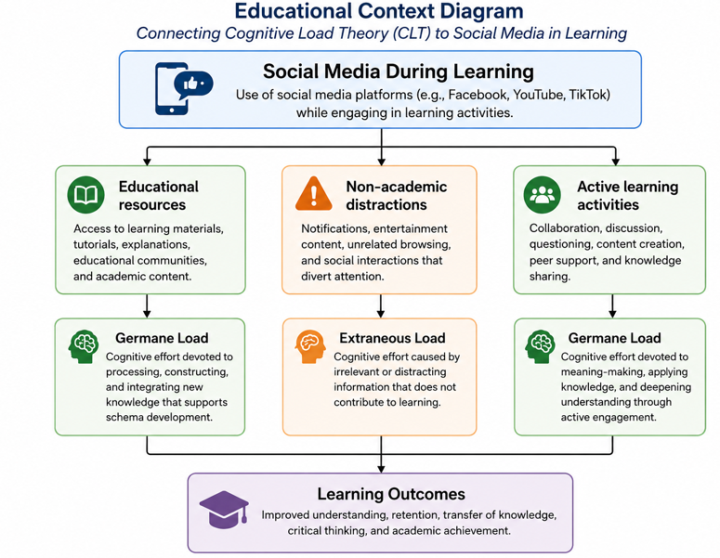
The CLT theory further defines three types of cognitive load: intrinsic, extraneous, and germane (Figure 1). Ayres et al. 12 pointed out that social media in education aligns well with the cognitive learning theory. Social media platforms are attention demanding but typically provides information of various forms in multimodal, which if leveraged by educators allow the sharing of resources, collaboration, student engagement, and support the learning process informally or peer-related. Intrinsic cognitive load exists based on students’ prior knowledge as they become exposed to other concepts, especially complex content 12, 13. To manage intrinsic cognitive load, the idea is to expose students to concepts or topics bit by bit (breaking them into pieces) to facilitate scaffolding so they can better process what they have learnt. For instance, a lecturer may use social media to create videos via YouTube and TikTok into snippets where concepts, particularly complex ones are explained into understandable portions where students can learn and process the information much better understand. Ref 12, Ref 14, and Ref 15 further elaborated that when students lack guidance or exposed to too much content at once, students can benefit from managing intrinsic load by using social media for a better, richer, more organized experience, particularly when they are novice learners.
Ref 12, Ref 14, and Ref 15 went on to explain that students who identify the teaching methodologies quality to be poor or that some information learnt are irrelevant are usually the ones struggling with extraneous cognitive load. For this students social media can be an amplifier due to distractions such as notifications and pop-up alerts and excessive texts particularly on their phones, as well as being on several social media at once multi-tasking. For example, a student may be watching educational content on YouTube but on Instagram, his or her favourite influencer may be doing a live causing this student to multi-task. This, Karpinski & Kirschner 16 and Nass et al. 17 pointed out overload the student’s working memory leading to negative learning outcomes. On the other hand, Ayres et al. 12, Sweller 13 and Sweller 14 have stated that germane cognitive load is desirable for students because deeper and more meaningful learning can take place as they can assimilate information into their schema. For instance, a lecturer can use social media platforms such as Facebook that facilitate a closed space with students where they can work on projects or case studies through discussions peer-led or collaboration and knowledge constructions for meaningful learning. De Jong 18 highlighted that students with increased germane cognitive load are active learners desirous of understanding concepts or topics actively as they organize what they learn into schemas carefully. Thus, Ayres et al. 12 emphasised that educators can make effective instruction, if they consider managing students’ intrinsic workload, minimize their extraneous load, and optimize their germane load.

Fred Davis developed the TAM in the 1980s influenced by two primary beliefs: perceived usefulness and perceived ease of use as individuals leverage technology. These perceptions were pointed out by Davis 19 which are necessary to determine whether individuals intend to use or reject technology. The theory emphasise that when persons’ believe that the technology they are exposed to is useful is because they have experienced improved performance in some task they have used it for. For example, a lecturer provides his/her students with tutorial sessions on his/her YouTube channel which the students found to help them better understand the content delivered in the lecture sessions because the information was focused on breaking up and explaining topics. This channel helped the students where they saw improvement in their learning outcomes (assessments).
Additionally, since the existence of social media, students have found various platforms such as WhatsApp (particularly with the desktop format) to be easy to use to send and receive notes as well as asking questions by creating WhatsApp groups for classes or study groups, especially due to years of familiarity. Research studies have shared that currently students are increasingly accepting and using social media for education purposes 20, 21, 22. Al-Rahmi et al. 21 shared that students who have leveraged social media technologies for learning educational content have seen significantly positive improvements as they participate in educational activities such as online discussions and videos giving revision tips. Additionally, Venkatesh et al. 23 pointed out that social media is quickly becoming more prominent in education due to students and educators’ promotion of these platforms as long as they can access via the internet and from a device. Students have not only found these platforms engaging but fun-filled.
2.2. Global Trends in Social Media UsageGlobal trends have revealed that social media usage is growing worldwide, where it has now reached a global majority status. In other words, social media has become very renowned across the world where almost everyone is using it for various reasons. Currently, data have shown that between 5.6 and 5.7 billion people worldwide (at least two third of the world’s population) is using it on a monthly basis 24, 25. Most countries, especially developing ones have considered social media and smartphones as fundamental particularly since the COVID-19 pandemic. In 2025, social media platforms have gotten new trafficking of about 250 million people across Asia, Africa, and South America being described as first-time internet users 24. These tools have become prioritized forms of media in comparison to traditional media like newspapers. In Jamaica, for instance, government, news network and other companies and institutions have been using these tools as a medium of communication. For example, increasingly The Gleaner, Jamaica Observer, Jamaica Information Service, and RJR Communication have been utilising social media platforms particularly Instagram (most widely used); and also, WhatsApp Channels which are currently on the rise. Additionally, tertiary institutions like University of Technology, Jamaica (UTech, Ja) and the University of the West Indies (UWI) have been using these platforms connecting with staff, students, and the wider populace. For example, at UTech, Ja the President Dr. Kevin Brown shares President Weekly Drop on platforms such as YouTube and TikTok. Furthermore, tertiary institutions are increasingly having an online presence across several social media channels for purposes including recruitment, academic outreach, knowledge sharing, professional networking, public relations, brand visibility, reputation management, student engagement and community building. However, there are others that also use the social media platform for hosting classes as part of its teaching and learning activities like Atlantic International University (AIU) which is supplemental to its virtual campus.
Moreover, based on the trends, Data Reportal 24 and Thuy 26 reported that each social media user spends on average 2 hours and 20-25 minutes daily mostly by scrolling through various news feed. It was also found that even in day-to-day activities, individuals are increasingly using the platforms whether they are traveling, waiting in lines, taking breaks from other activities, or even before bedtime. Thuy 26 and Ysul Zulkarnain 27 further stated that countries including Kenya, Brazil, and the Philippines are considered the main ones using these platforms for at least 3.5 hours on average each day. However, Japan and countries in Europe have used these platforms the least, where the data revealed that mean social media usage daily is less than 1 hour. Additionally, Thuy 26 and Ysul Zulkarnain 27 explained that the more these platforms are used individuals have increasingly become interested in modernized media instead of traditional ones like news, television, traditional entertainment, and even storefront shopping. The most utilized social media platform is Facebook which is used by 3 billion people on a monthly basis, while the others are strongly competing particularly TikTok, YouTube, WhatsApp, and Instagram 26, 27. The data shows that even though most people use Facebook, due to social media bans it is not used in countries like China, Iran, North Korea, Myanmar, Russia, Turkmenistan, and Uganda. Nonetheless, families, friends, and various have remained connected worldwide using it as well as for marketplace access to advertise and facilitate transaction activities. However, TikTok or Instagram has become the ‘new’ entertainment of various forms. Currently, the go-to place for short videos is TikTok which is growing rapidly with between 1.5-1.6 billion monthly active users worldwide to hold the highest average time spent per user 26. Thuy 26 shared that users of TikTok have shared that when they go on it they end up stating longer than intended particularly due to the platform’s highly engaging algorithm.
Furthermore, Data Reportal 24 and Thuy 26 went on to say that young people between ages 16-34 are of the heaviest users of social media platforms worldwide believing that it is not just a communication tool. They leverage these platforms to express themselves, connect with their peers, entertainment purposes, and activism on platforms such as Instagram, TikTok, WhatsApp, YouTube, Snapchat, Discord, and X (Twitter). These individuals share who they are as they construct and negotiate about their identity, and interact with their local and international communities. Also, they use this space to publicly showcase their interests and abilities, cultural affiliation and daily lifestyles by sharing images, captions, and videos as they interact online.
Nottle 28 shared that young people have increasingly become activists on their platforms by engaging in online campaigns, creating videos through livestreams or otherwise focusing on societal issues such as social justice issues, politics, mental health, gender equality, climate change, and educational concerns. Also, depending on the issues they mobilise support to address activities where some even become influencers as they become empowered based on followers status. Thuy 26, on the other hand, highlights that entertainment and peer interaction has been a large part of young people’s social media usage to develop friendships and maintain social belongings. Thuy 26 also pointed out that social media has become a way to cope with stress which can strongly influence their self-esteem, social validation, and perceptions of popularity or acceptance. However, DataReportal 24 and Thuy 26 shared that young people should be cautious in using social media mainly to avoid excessive dependence on online validation and continuous connectivity. Otherwise, if not kept in check may lead to anxiety, social comparison, and difficulties balancing online and offline identities. Gottfried & Park 29 and Pew Research Center 30 shared that older adults of at least 50 years old are increasingly joining social media platforms, though mostly Facebook, YouTube, and WhatsApp to keep in touch with their friends and family overseas. The data indicates that the generational digital divide has narrowed with the increasing number of older people being active on social media.
2.3. Educational Value of Social Media IntegrationResearch studies have shared results of improved students’ engagement and motivation since using social media. According to Alalwan 31, Barman 32 and Bui et al. 33 shared that there exists a positive linear relationship between social media usage for educational content and student engagement. These findings indicate that students engage in educational content on social media which allows them to be highly engaged behaviourally, emotionally, and cognitively. Also, based on their educational outcomes they experience increased satisfaction levels. Mojtabai 34 also shared that educators reported that students who participate in educational content on social media especially in discussions, they become more willing to participate in class lessons especially the passive ones. They ask more questions, express themselves, and contribute to discussions, particularly in groups on Facebook of WhatsApp. Furthermore, social media has helped to improve collaborative learning due to its ability to support it. The support takes the form of resource sharing amongst students and teachers, participation in problem-solving activities within the groups and peer discussions 2, 37. Based on this support students’ performance has improved and their self-efficacy has been enhanced where they now can organize and direct their learning paths.
Ashraf et al. 2 pointed out that besides teachers adding students on Telegram and WhatsApp groups for courses, students have taken initiatives to form their own groups on these platforms to discuss and clarify assignments and class notes, as they share their versions of class notes from their perspective. This type of collaborative learning Ashraf et al. 2 and Jayasingh et al. 36 mentioned facilitates knowledge sharing amongst students and other individuals within and across educational institutions. This helps students fortify their schema development by understanding content, become motivated, and working to improve their academic performance. Mojtabai 34 went further to state that students do file sharing frequently within social media groups which broadens the curriculum providing greater insights into concepts than what textbook offer. Students share links to external sources, videos, and summary notes. Furthermore, schooling is now taking place within open and flexible learning environments because social media platforms have the ability to support this regardless of geographical regions once internet access is present 36, 37.
The most well-known platforms providing these supports are YouTube and WhatsApp, particularly because they are free and do not have a lot of restrictions 38, 39. This, Abuzar 38 and Abuzar & Hussain 39 explained facilitates enhanced students’ academic learning outcomes more than using paid learning management systems. Deb & Ghosh 40 and Jagtap 41 emphasized that students’ benefit from instructional content on social media based on digital literacy skills. So, the more exposed students and educators are to social media integration in education, the more they become digitally literate where they improve their communication skills, collaborate with each other and engage in critical thinking activities. Eventually, students can become equipped for the modern workplace especially as they engage in informal activities such as content creation which require video-making, infographics, and posts 34.
Ref 34, Ref 39 and Ref 42 pointed out that since students leveraged social media purposefully for academic activities, their GPA has improved, where teachers stated that students through consistent engagement with instructional content and practice activities via discussions and revision groups have been better prepared for their exams and submitted assignment quality has improved. On the other hand, there are studies that reported that there are students who exhibit lower performance because they used social media excessively 38, 44, 45, 46, 47, 48, 49. These studies shared that with students spending too much time on social media and less time on academic activities due to reduced concentration, poor time management, and increased distractions, they struggle to complete their overall learning outcomes and perform poorly on exams. As a consequence students are studying less or not adequately because of competing activities causing high-frequency multitasking between social media and academic work which affect their academic experiences negatively. Nonetheless, social media has opened several avenues for academic engagement where they can access tutorials, share academic resources, participate in discussion forums, and facilitating collaboration 47, 49, 50, 51. Furthermore, studies have emphasized that the impact of social media on academic performance and students’ learning outcomes is related to context-dependence 45, 47, 48, 49, 50. These researchers suggest that the value of social media integration in education is not entirely related to negative or positive experiences especially in terms of performance. They went on to say that structured strategies are necessary to moderate the negative influences of social media for improved learning outcomes. They pointed out that these strategies should include guided academic use, effective time management, and structured learning activities 45, 47, 48, 49, 50. Additionally, they went on to say it is important to establish guided integration making it intentional by clearly defining rules and learning objectives. This will help create a distinction between productive academic social media use and non-academic distractions.
2.4. Social Media Usage in the Caribbean and JamaicaCurrently across the Caribbean, particularly Jamaica, social media has become widespread and increasingly adopted. Statista 52 shared that at least 31 million people in the Caribbean are internet users. However, between 22-23 million of these users are active on social media, including WhatsApp, Facebook, Instagram, TikTok, YouTube, and X (Twitter), indicating a strong social media presence of Caribbean people. Nonetheless, despite the strong social media usage and penetration across the Caribbean it is not the same across all the islands. For the Caribbean, social media has become the primary means for communication on a daily basis, facilitating information-sharing practices amongst young people as well as students. This has facilitated improved regional connectivity and minimize long-distance calls. Additionally, Statista 52 revealed that these platforms are not only used for interaction but for learning, social and business networking, and content consumption. Furthermore, for students across secondary and tertiary institutions communication with peers within and across these institutions is facilitated; also these platforms provide students with access to educational materials, they can participate in discussions and manage academic responsibilities 52. However, the data did not reveal any evidence of the institutions accurately integrating social media in their curricula besides sharing opportunities to use it in educational institutions to facilitate teaching and learning to enhance students’ engagement. Additionally, there are disparities across the islands and communities, particularly educational institutions based on technological infrastructure, internet affordability, rural connectivity, economic conditions, and access to digital devices. Consequently, students and teachers cannot fully participate in digitally supported learning environments. Statista 52 also pointed out that users of mobile devices across Latin America and the Caribbean have mostly used social media platforms compared to computers (laptops and desktops). This is because people on the go who have cellphones, particularly smartphones have quick access to these platforms. Also, since prepaid mobile data is not only accessible but also affordable, individuals are using these platforms because they are very compatible with mobile phones requiring only low data to facilitate messaging and videos. The data also reported that the dominant social media platforms used are Facebook, WhatsApp, Instagram, YouTube, and TikTok; of which WhatsApp groups are the most commonly used by schools, families, small businesses and churches. Also, countries have been using social media as a cultural and economic tool where they promote culture through various activities, market products especially for tourism purposes, and the growth of small businesses. Statista 52 noted that the creative industries across the islands focusing on music and crafts use social media platforms primarily Instagram and TikTok instead of the traditional media.
In Jamaica, there is a high internet and social media penetration revealed over 2024 and 2025. Data Reportal 53 reported that in 2024, there was 85.1% (2.40 million users) internet penetration across the island which is an increase following the COVID-19 pandemic which required work from home measures that contributed to increased internet use. These users had to use internet regardless of interest due to job requirements across several industries, institutions, and companies. During the pandemic, social media became increasingly used with TikTok arriving on the scene where individuals desired entertainment outside of work activities. Data Reportal 53 explained that 56.9% of the Jamaican population, especially students and young people, were using social media everyday (WhatsApp, YouTube, Instagram, TikTok, and Facebook). However, by 2025, Data Reportal 24 and Munroe 54 revealed that though social media usage remained high, of the 1.61 million social media active users reported in 2024, there were 1.56 million active users in early 2025 engaging on WhatsApp, YouTube, Instagram, TikTok, Facebook, and X (Twitter) for communication, entertainment, information sharing, and increasingly for educational interaction. Even politicians are using it for activities such as national debates amongst other things. DataReportal 24 and Munroe 54 further shared that in Jamaica 45.6% Jamaicans use Instagram, 21.5% use Facebook, and 11.5% equally use YouTube and TikTok. However, TikTok and Instagram are mostly used by young people for various activities such as dance, comedy, music, and commentary rooted in Jamaican culture; while WhatsApp is used for messaging including education. Additionally 80% of Jamaicans under 34 years old have internet access on their mobile (smart) phones and account for the greatest social media usage rate where some have used developed their entrepreneurial skills and learn about current trends 24, 53, 54. These young Jamaicans mostly engage with TikTok, YouTube, and Instagram Reels. Also, based on the polls, 70% of the people eligible to participate in voting activities have been found to be on social media where more and more of them are involved in Grassroots movements, public debates, and community advocacy 24, 53, 54. Ref 54, Ref 55 and Ref 56 that social media platforms account for different mental health and social concerns for various reasons. These researchers shared that individuals show high anxiety levels from intensive usage of social media platforms. Anxiety is due to stress and emotional strain from social media pressure, conflicts arising on these platforms, and cultural clashes, especially for those creating and sharing content.
On the other hand, UNICEF Jamaica 57 shared that there are currently education, engagement and youth development initiatives made available across the island. These initiatives include UNICEF Jamaica’s UReport and FunDoo platform which has been successfully implemented on WhatsApp, Instagram, and Facebook Messenger. These initiatives facilitate young people with educational content, career guidance, digital skills, and psychosocial support. Through these initiatives, mentorship programmes are provided to guide young people as they try to develop their life skills and prepare for job opportunities. Tertiary institutions can benefit from the success of these initiatives to support students learning experiences.
2.5. Empirical Studies on Social Media DistractionResearch studies have identified social media distraction as a negative impact on the teaching and learning process, particularly students’ learning outcomes. Büttner & Koessmeier 9 and Haywood et al. 58 noted that social media distraction stems from students “quick checks” of various platforms such as WhasApp, TikTok, and Instagram during educational sessions which has led to disengagement of academic content. Students reported that they unintentionally spend lengthy time scrolling during lectures where they lose time and attention from academic task-focused activities such as listening to lessons or studying 9, 58. Instead they engage with non-academic digital content such as messaging, notifications, and watching short videos. Elder & May 59, Korhohen et al. 60, Poles 61 and Shanmugasundaram & Tamilarasu 62 that these attention deficits causing interruptions overload students’ working memory which is consistent with the CLT where students simultaneously attend lecture sessions or studying while scrolling social media. These researchers explained that students frequent use of social media impair their sustained attention and reduce their comprehension skills. Overtime, these learners have difficulty concentrating during lectures as well as notetaking which require extensive time and concentration thereby negatively affecting students’ GPA. They went on to say that this is as a result of frequent time spent on social media content that is short-form and fast-paced. Liao et al. 63 noted that a classroom experiment was done revealing that smartphone notifications are key distractions to students whenever they popup where students felt the urge to check even when the notifications are muted. Giguere & Huey 64 further reported that the exclusion of smartphones from lectures have been very beneficial to students where they showed signs of lower anxiety issues, could better understand content taught, and they had good mental state. Students are affected by several psychological social media distraction drivers including fear of missing out on what is happening (messages and trends), habitual checking due to enjoyment of social media activities, and weak selfregulation that leads to media multitasking during classes 9, 65, 66. Walker 67 reported about a study done at a vocational school in China where groups of students were held under controlled circumstances in a series of experiments. This study revealed that students exposed to guided learning using smartphone during class had improved performance by 26%, because they could focus better.
2.6. Barriers Affecting the Implementation of Social Media in Curriculum DesignResearch studies show that social media is a challenge due to lack of pedagogical alignment and curriculum clarity due to the sporadically and additive nature of its introduction 69. These studies emphasise that the effectiveness of social media lies in making it pedagogically ready; however educators feel uncertain about the direction institutions are going with social media and how to fit it into the syllabus. Thus, educators are treading in unchartered water but rather experimenting, lacking the needed training, struggling with confidence as they use social media and have limited technological–pedagogical content knowledge (TPACK). Ref 69 and Ref 70 noted that teachers personal use of social media indicate that they are comfortable with it but are not prepared to integrate it effectively in the teaching and learning process by using designed social media activities. Furthermore, teachers are concerned about students being distracted by social media or even losing control of their classrooms due to non-academic social media content.
These researchers further shared that students can become unwilling to participate in lessons if the learning goals are unclear to them which may lead to offtask behavior and cognitive distraction. Additionally, Ref 69 and Ref 71 pointed out that teachers based on these concerns may be reluctant to integrate social media into the curriculum believing that students focus more on entertainment content instead of assigned tasks in the class and assessments. Moreover, most institutions lack institutional policies and governance for the integration of social media in the teaching and learning process or even if they do there is ambiguity and policies are not up-to-date 72. Ref 72 and Ref 73 explained that this happens based on priorities of the institutions focusing mainly on risk management, hereby limiting educators’ ability to innovate social media pedagogy. Also, concerns have been raised about privacy, ethics, and data protection of students and staff data, particularly students making parents and educators uncomfortable, and identifying ethical responsibilities in facilitating social media integration in the curriculum 71, 74.
Another barrier pointed out by teachers is that even though students have been accessing educational content on social media, not all of them are equipped to evaluate the information for meaningful academic contexts. Bishop et al. 75 and Smith & Storrs 76 explained that this happens due to not being digitally literate enough even though they frequent social media a lot. On the other hand, Ref 69 and Ref 74 stated that disparity exists across secondary and higher education in accessing the internet and devices which is a deterrent to social media integration in curricula. Furthermore, teachers struggle to distinguish between personal and pedagogical use of social media platforms especially to use their personal accounts in the teaching and learning process 71, 77. Also, since there has been limited social media integration in curriculum design, there are little to no assessment and evaluation frameworks for students’ learning outcomes from leveraging social media as they participate in learning activities, collaborate and construct knowledge.
2.7. Balancing Opportunities and Challenges for Academic OutcomesSocial media platforms can have both beneficial and harmful effects on students’ academic performance and learning. Higher education students now often use social media sites like Facebook, Twitter, Instagram, and Snapchat for everything from social interactions to academic collaboration 78, 79. Research findings have been conflicting, showing both advantages and disadvantages of social media use, including increased learning, more distraction, and decreased or increased access to academic resources 79, 80, 81. Furthermore, according to Talaue et al. 82, social media can enhance communication between teachers and students but can also negatively affect students' grades if they lack time management abilities.
Beckingham 72 argued that higher educational institutions should embrace social media in the classroom in an integrative manner where students are guided to use it. She stated that through integration in the curriculum, students should be exposed to various professional networks and develop their digital competencies encouraging safe usage. Ref 67 and Ref 83 pointed out that social media helps encourage collaborative learning if structured properly and can positively impact academic performance. For instance, students can organize support groups using platforms such as WhatsApp and Teams. Additionally, Kaur 84 stated that accessing asynchronous learning can be done through social media through platforms such as YouTube and Instagram to review educational content related to school curricula at their own place. Research studies also point out that students may also struggle with cognitive overload due to media multi-tasking especially during lectures and can miss out on comprehending concepts and study time 34, 85. Furthermore, students study time is being lost the more time they spend scrolling on social media which leads to academic procrastination, struggling to meet deadlines and low self-control. Research studies indicate that a balance needs to be achieved between opportunities and challenges where use of social media is being encouraged but with guided, purpose-specific focus and goal-directed tailored in line with the curricula with the intention of significantly lowering academic performance 31. Dai et al. 86 shared that students who develop self-regulated learning skills such as track screen time and set-up notification controls have less distraction problems and improve their learning outcomes, thus encouraging educators to teach students self-regulation strategies. Finally, studies are encouraging intentional integration of social media into curriculum and assessment frameworks which can help with greater student accountability by designing social media tasks that are graded accordingly.
2.8. Global Best Practices for Using Social Media in EducationResearch studies have highlighted that one of the best global practices for using social media in education is to align social media use with pedagogical goals and learning outcomes. In other words, educators are encouraged to identify and establish structured social media activities which reflect learning objectives in the curricula and pedagogical frameworks which are closely tied to appropriate assessment criteria 37, 86, 87. Additionally, Azam et al. 88 and Lampropoulos et al. 89 emphasized the need to use social media as a complement to formal learning systems rather than a replacement, especially in cases where educational institutions use Learning Management Systems (LMS) to improve discussion, collaboration and learning. This can become feasible by establishing everyday digital practices for the teaching and learning process where students can improve their learning experiences beyond class hours. Ref 31 and Ref 90 expressed that emphasizing on structured participation where students are guided in completing social media tasks can reduce distraction and cognitive overload. This will help enhance performance and students comprehension.
Research studies have also indicated the need for institutions to leverage social media platforms to develop learning communities to facilitate students’ engagement through actively scaffolding for both students’ and teachers 33, 91. In these communities, students’ confidence is boosted where they feel comfortable to ask questions and share their thoughts. Also, teachers need training to garner pedagogical skills and digital capability in order for the social media integration to be successful. Ref 8 and Ref 92 went on to emphasise prioritizing on ethical concerns and digital literacy as teachers guide students and students use social media where schools leverage digital citizenship guidelines 8, 92, 93. This would help with incidents of cyberbullying and inappropriate online behaviours.
2.9. Summary and Gaps in the LiteratureThe literature revealed that social media has become a significant part of individuals’ lives (livelihood) across the world especially since the COVID-19 pandemic. It comes with its positive and negative effects on individuals, particularly for students’ daily lives with focus on social media integration in education. Research studies have pointed out that communication, collaboration, information sharing, and learning experiences have increasingly changed, especially in the education sphere at tertiary institutions. They further explained that excessive use of social media is a hindrance to academic learning outcomes, specifically it lowers students’ academic performance. Several studies shared that this is due to affect students’ concentration, study time, time management because students focus more on entertainment activities or try to multi-task but struggles. However, these studies reported that there are educational gains such as enhanced student engagement, interaction, and access to learning materials. Furthermore, with how developed social media is students are supported academically by tutorials, academic discussion groups, peer collaboration, and resource sharing. Additionally, the Caribbean has become penetrated by internet and social media especially amongst young people. Studies pointed out that social media has the potential to influence tertiary institutions to integrate these platforms into teaching and learning practices through structured strategies. However, social media brings educational value when it is context-dependent where defining rules may be necessary. Nevertheless, there is limited research on how social media influence undergraduate activities across Jamaican tertiary institutions. These studies indicate the need for mixed-methods studies particularly in the Caribbean on how social media as educational tools impact students’ engagement and academic performance, by combining both quantitative and qualitative perspectives of students and educators. Additionally, there are not many studies that compare the negative and positive social media use beyond focusing broadly on internet usage or general technology adoption.
This study adopted a mixed-methods approach, leveraging the convergent parallel research design to evaluate the influence of social media on undergraduate students' academic activities in Jamaican tertiary institutions. This methodology allowed us to blend both quantitative and qualitative data, offering a well-rounded perspective on the subject 94, 95. It facilitated the simultaneously collection of the data but separately complete the data analysis for both types of data, to capture comprehensive insights into real-world contexts of undergraduate academic activities and their use of educational tools.
The findings were combined at the interpretation stage to provide meaningful comparison, contrast, and corroboration for a more holistic understanding of how social media influenced Jamaican tertiary education. Tied to this design was a cross-sectional and correlational approach to effectively investigate the effects that social media may have had on undergraduate students studying at Jamaican tertiary institutions. The correlational approach required the examination of the frequency and nature of social media usage concerning the academic productivity of undergraduate students, which allowed for the identification of any significant relationships between these variables 96. Also, by adopting a cross-sectional approach, this integration ensured that we effectively explored the relationships between variables and captured data at a specific point in time. This approach helped us provide thorough and insightful answers to the core issues being investigated, as we employed appropriate data analysis techniques.
3.2. Population and SamplingTo ensure our study is both statistically valid and provides in-depth insights, we identified and outlined the different groups from which we collected data. Our primary focus was on undergraduate students and lecturers/ tutors at 10 local tertiary institutions (5 universities and 5 colleges) involved in the research. These institutions are in the parishes of Kingston & St. Andrew, Manchester, St. Elizabeth, St. Thomas, Hanover, Westmoreland, St. Catherine, St. Ann, St. Mary, Portland, and St. James. Additionally, the students and educators are affiliated with the following areas: Engineering, Marine & Nautical Studies, Arts & Humanities, Built Environment, Sports, Natural Sciences, Medical Sciences, Business, Law, and Early Childhood Education.
The student sample consisted of 1000 undergraduate students who completed the questionnaire. Students, after receiving the instrument, were encouraged to share it with their peers within their institutions and at other tertiary institutions to enhance participation. The data collectors gathered data using online questionnaires at different tertiary institutions.
The study included a total of 63 lecturers from participating tertiary institutions. Of these, 42 completed the lecturer questionnaire. Among the questionnaire respondents, five also participated in follow-up interviews. An additional 21 lecturers participated in interviews only. Consequently, the qualitative component comprised 26 lecturer interviews, while the quantitative component comprised 42 questionnaire responses. These lecturers have shared educational content with students through social media channels, providing what they prepared or referring them to various sources they assessed to be credible for use. The total sample size from each university was determined based on its respective size, ensuring adequate representation from each institution. To enhance representativeness, we implemented a stratified sampling technique, ensuring a proportionate number of students from various faculties or departments are included in the survey. We also employed purposive sampling to select lecturers with substantial experience using social media in educational contexts, focusing on those who can provide meaningful contributions to the study.
In terms of data collection techniques, we distributed structured surveys to selected undergraduate students and lecturers to quantify their social media usage, academic productivity, and perceptions regarding social media’s role in education. Additionally, for the qualitative component, we conducted interviews and focus group discussions with 5 and 10 undergraduate students, respectively, from the participating tertiary institutions, ensuring diversity in academic performance, social media usage, and course disciplines. However, only five of the lecturers who responded to the questionnaire were engaged in a semi-structured interviews for greater insights, who were actively engaged in using social media or who expressed opinions about its impact on student engagement and academic performance. This comprehensive data collection process allowed us to capture a wide range of perspectives and insights, ultimately enriching our study's findings.
3.3. Data Collection Instruments and MethodsTo answer the first research question, we gathered data through questionnaires that students completed. These surveys asked about their social media use and how it relates to their academic work. We also looked at existing academic records, such as grades and attendance, to get a clearer picture of students' academic performance. For the second research question, we continued using surveys to collect specific information about the different types of social media activities students engage in and how these activities impact their study habits. This helped us to understand which social media behaviors are most influential on their learning. To explore the third research question, we conducted interviews and focus groups with a variety of participants, including students, faculty, and administrators. This qualitative approach allowed us to gather detailed insights and personal experiences related to integrating social media into teaching practices. We also used surveys in this phase to collect additional data.
The quantitative component involved the distribution of structured questionnaires to a representative sample of students, aimed at collecting data on their social media usage, study habits, and academic performance. By using a mix of surveys, interviews, and focus groups, we aimed to capture a well-rounded view of the issues at hand. This diverse set of data collection methods enabled us to explore the research questions from different angles and gather valuable perspectives from all stakeholders involved 97. This approach was guided by the CLT which examines the potential for social media-induced distractions, and the TAM, which assesses students' adoption of social media for academic purposes, according to Grant & Osanloo 11. By combining both qualitative and quantitative data, this mixed methodology enhanced the validity and depth of the research findings.
3.4. Data AnalysisTo analyze the data for the first research question, we used descriptive statistics. This helped us summarize how often students use social media and provide a clear overview of their academic performance, such as GPA scores. Following this, we employed Pearson correlation and regression analyses to investigate the relationship between social media usage and academic productivity. This step allowed us to see if there are any significant connections between how students use social media and their academic outcomes.
The study also used themes and codes focusing on lecturers’ observational evidence and students accounts that align with social media usage and academic productivity. For the second research question, we used factor analysis to identify the key components of social media use. Based on the Kaiser–Meyer–Olkin (KMO) test, the data was assessed and found suited for the factor analysis since the variables shared enough common patterns 98, 99. While Bartlett’s Test of Sphericity examined whether the variables are related to each other, then these variables were reduced into underlying factors (components of social media) using the Principal Component Analysis with Varimax rotation to make the data easier for interpretation.
This analysis allowed us to understand which specific activities students engage with on social media to uncover the challenges and opportunities they identified. We then applied multiple regression, and the chi-square test of independence analyses to find out which types of social media activities have the most significant impact on students' study habits. This approach helped clarify which behaviours might positively or negatively influence their learning. Also, thematic analysis was used to provide lecturers and students explanations that support the quantitative analyses.
In addressing the third research question, we conducted a thematic analysis of the qualitative data gathered from interviews and focus groups. This method helped us identify recurring themes and insights related to the integration of social media into teaching practices. Additionally, we used descriptive statistics to summarize the quantitative survey data collected, and content analysis to interpret open-ended survey responses. Together, these analyses provided us with a comprehensive understanding of the challenges and opportunities associated with using social media in educational settings, helping us to formulate effective strategies for improvement.
3.5. Ethical ConsiderationsIn our study, we recognize the importance of ethical considerations in safeguarding the well-being of our participants and maintaining the integrity of our research. We ensured that all participants, including students and lecturers, provide informed consent, clearly outlining the study’s objectives and emphasizing their right to withdraw at any time without any consequences. We took meticulous steps to protect anonymity and confidentiality by removing personal identifiers from our data and securely storing all information to prevent unauthorized access. Furthermore, we provided participants with detailed information about how their responses would contribute to our understanding of social media's impact on academic performance, ensuring they feel valued and respected throughout the process. To strengthen transparency and accountability, we submitted our research proposal to the relevant ethics review board, ensuring our methods align with ethical standards while fostering an environment of trust and respect among all participants. This commitment to ethical practices not only enriches the quality of our findings but also upholds our responsibility to our academic community.
3.6. LimitationsDespite the benefits that the study derived, it also came with its challenges, such as the potential for biases which may have taken the form of over-reporting or under-reporting. The study mitigated the biases through the triangulation of data by using more than one data collection instrument such as focus group discussions, questionnaires, and interviews. Moreover, this study was able to encapsulate a wide range of experiences from various institutions having different faculties by using both a large and diverse sample. This helped account for the validity and reliability of the data collected. Additionally, there was the possibility of a lower response rate than expected, but this was addressed by providing incentives to the participants or even revising the instruments or doing follow-up interviews where necessary.
The findings are presented according to the three research questions guiding the study. Quantitative findings are first presented, followed by qualitative evidence to explain and deepen understanding of the statistical patterns observed. This approach provides a more comprehensive understanding of the influence of social media on undergraduate academic activities and educational tools within Jamaican tertiary institutions.
4.1. Demographic Profile of ParticipantsThe demographic characteristics of the participants provide important context for interpreting the study findings on the influence of social media on undergraduate academic activities and educational tools within Jamaican tertiary institutions. The profiles of both lecturers and students reflect the diversity of experiences and perspectives captured in the study and highlight the breadth of representation across institutions, disciplines, and stages of the undergraduate journey.
Lecturer Profile
A total of 63 lecturers participated in the study. Of these, 42 completed the questionnaire, including five who participated in follow-up interviews, while an additional 21 lecturers participated in interviews only. Table 1 presents the demographic characteristics of the lecturer respondents. The sample reflected a relatively balanced gender distribution and consisted predominantly of experienced educators, many of whom had over 15 years of teaching experience. Most lecturers taught undergraduate students and represented a wide range of disciplines and tertiary institutions across Jamaica, although the majority were based in Kingston and St. Andrew. These characteristics suggest that the study captured perspectives from educators with diverse academic backgrounds and substantial experience in the teaching and learning process, particularly in engaging and motivating students and in using social media as an educational tool.
Student Profile
Table 2 presents the demographic characteristics of the student respondents. The sample was predominantly composed of traditionally aged undergraduate students, with most participants between 18 and 25 years old, although mature learners were also represented. Female students accounted for a slightly larger proportion of the sample than males. In terms of year group, the respondents were drawn from different stages of undergraduate study, with Year 1 students comprising the largest proportion. This distribution indicates that perspectives were captured from students with varying academic experiences and levels of engagement in undergraduate academic activities across Jamaican tertiary institutions.
The predominance of students in the earlier years of study reflects the perspectives of those who may still be adjusting to the learning environment, norms, and expectations associated with tertiary education. At the same time, the inclusion of students from the upper-year groups broadens the understanding of social media use across different stages of undergraduate study. Although the experiences of students may vary throughout their academic journey, perspectives from all year groups were relevant in garnering insights into the educational implications of social media use within Jamaican tertiary institutions.
What is the correlation between the frequency and type of social media platform usage and the academic performance of undergraduate students at Jamaican tertiary institutions?
The analysis underscores a shared perception among students and lecturers about the frequency and type of social media platforms to give insights into social media impact on academic performance of Jamaican undergraduate students.
Social Media Platform Usage Patterns
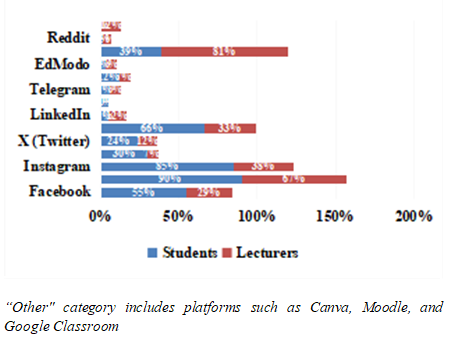
The analysis highlights similarities and differences in the social media platforms used by students and lecturers, providing insights into how these platforms may support undergraduate academic activities and, ultimately, academic performance. Figure 2 illustrates that a substantial proportion of students reported using WhatsApp (90%), Instagram (85%), TikTok (66%), and Facebook (55%) to support their academic success, while the remaining proportion reported using other platforms.
Among lecturers, YouTube (81%) emerged as the most frequently used platform for educational purposes, followed by WhatsApp (67%). Lecturers reported using these platforms to create and share instructional videos, demonstrations, recorded lectures, tutorials, and supplementary learning resources to facilitate classroom instruction and clarify difficult concepts. WhatsApp emerged as a common platform for academic communication among both students and lecturers. Students used it to obtain updates and reminders, engage in peer discussions, and share files, particularly outside formal classroom settings, while lecturers used it to facilitate group communication and distribute educational materials.
Notable differences were observed in platform preferences. YouTube usage was substantially higher among lecturers than students (42%), reflecting lecturers' reliance on video-based instructional resources. In contrast, Instagram and TikTok were more commonly used by students, with differences of 47% and 33%, respectively, suggesting variations in how both groups engaged with social media for educational purposes. Students appeared to favour platforms characterised by visual interaction and short-form content, whereas lecturers preferred platforms that supported instructional delivery and the sharing of structured educational resources. Although Facebook was used more frequently by students than lecturers, it was not among the dominant platforms for academic purposes. Lower levels of use reported for Snapchat, X/Twitter, Pinterest, Telegram, Edmodo, Reddit, Roblox, and LinkedIn suggest that these platforms played a comparatively limited role in teaching, learning, networking, and academic communication within this study.

Overall, the findings indicate that while students and lecturers shared common platforms, particularly WhatsApp, they differed in the ways they engaged with social media. Students were more active on interactive and visually engaging platforms, whereas lecturers primarily used social media to support instructional activities. These patterns highlight the potential of social media to support undergraduate learning when used strategically and aligned with educational objectives.
Frequency and Intensity of Social Media Use
Table 3 provides further insight into students' frequency of social media use and the amount of time spent on these platforms. A substantial majority of students (62.4%) reported using social media multiple times a day, indicating that these platforms form part of their daily routines. Among these students, the largest proportions spent between 5 – 6 hours (21.4%) and more than 6 hours (19.5%) on social media, while 14.9% spent between 3 – 4 hours, 5.8% spent between 1 – 2 hours, and less than 1% spent less than one hour per day.
Additionally, 25.1% of students reported using social media a few times a week. Within this group, 11.1% spent between 3 – 4 hours on social media, 10.1% spent between 1 – 2 hours, and smaller proportions reported either 5 – 6 hours, more than 6 hours, or less than one hour of use. A further 6.6% of respondents indicated that they used social media once a day, while 5.4% reported rarely using these platforms. Only a very small proportion (0.5%) reported never using social media.
The variation in frequency and duration of use suggests that students engage with social media with differing levels of intensity. For many students, social media appears to be embedded within their daily activities, while others use these platforms more selectively. Collectively, these patterns highlight that social media serves multiple functions within students' lives, including communication, entertainment, information seeking, and access to academic content.
Although the majority of students reported frequent engagement with social media, the extent to which these patterns of use relate to academic performance requires further examination through inferential analyses. The following sections therefore explore whether the frequency and type of social media use are associated with undergraduate students' academic performance.
Lecturers' Perceptions of Social Media and Academic Performance
Lecturers' perceptions of the effect of social media on students' overall academic performance were predominantly negative. The majority of lecturers (77%) believed that social media worsened students' academic performance, either somewhat (62%) or significantly (15%). In contrast, 21% perceived that social media improved academic performance, either somewhat (19%) or significantly (2%), while 2% believed that it had no effect.
Overall, these findings suggest that educators largely viewed social media as having the potential to negatively influence students' academic outcomes, although a notable proportion also recognised its educational value when used appropriately. The extent to which these perceptions align with the actual relationship between social media use and academic performance is explored in the subsequent inferential analyses.
Relationship Between Social Media Frequency and GPA
To examine whether the frequency of social media use was associated with undergraduate students' academic performance, a simple regression analysis was conducted using GPA as the outcome variable. Statistical significance was assessed at the 5% level (α = 0.05). The findings revealed a weak positive association between social media usage frequency and GPA . As shown in Table 4, social media frequency accounted for only 3.6% of the variation in GPA scores, (R2=0.036) indicating limited practical significance despite the statistically significant relationship. The regression equation,
 , suggests that students who reported more frequent social media use tended to have slightly higher GPA scores. However, the small effect size indicates that social media frequency alone is a poor predictor of academic performance.
Influence of Type of Social Media Activity on GPA
While the preceding analysis focused on the frequency of social media use, a multiple regression analysis was conducted to examine whether specific types of social media activities were more relevant to undergraduate students' academic performance. GPA was entered as the dependent variable, while social media usage frequency, engagement with educational content, and messaging friends were included as predictors. Statistical significance was assessed at the 5% level (α = 0.05). The regression equation was: .
.
As shown in Table 5, frequency of social media use was not a significant predictor of GPA when the type of social media activity was considered . In contrast, engagement with educational content was positively associated with GPA
 , whereas messaging friends was negatively associated with GPA
 .
.
Although the model explained a modest proportion of the variance in GPA scores ; Adjusted
 ), the overall model was statistically significant
 . These findings suggest that the type and purpose of social media use are more relevant to academic performance than frequency of use alone. Students who engaged with educational content tended to report slightly higher GPA scores, whereas those who frequently used social media to message friends tended to report lower GPA scores.
Qualitative Explanations of Social Media Use and Academic Performance: Lecturers' Perspectives
To complement the quantitative findings, qualitative evidence from lecturers was examined to provide deeper insights into the statistical patterns observed. As shown in Table 6, four themes emerged from lecturers' observations: frequency of social media use during class, perceived impact on academic performance, coursework completion challenges, and platform-specific distractions. Lecturers generally reported observing students using social media during classes, although the frequency varied. Most described this behaviour as occasional and often influenced by circumstances or emerging trends, while a smaller number perceived it as frequent. One lecturer noted, "On a scale of 1–3 (never, occasionally, and frequently), I observe it occasionally (2) during my classes." These observations align with the quantitative findings, which indicated that most students engaged with social media multiple times a day but with varying levels of intensity.
Lecturers largely perceived excessive social media engagement as detrimental to students' academic performance, reflecting the earlier finding that most believed social media worsened academic outcomes. They also observed that distracted students were more likely to miss instructions, participate less actively in class, and struggle to complete coursework, suggesting that the effects of social media extend beyond temporary lapses in attention to broader challenges in academic engagement. Messaging applications and short-form video platforms, particularly WhatsApp, TikTok, Snapchat, and Instagram Reels, were repeatedly identified as major sources of distraction during lectures and tutorials. These observations complement the quantitative findings, which showed that messaging friends was negatively associated with GPA, whereas overall frequency of use alone had limited explanatory value.
Overall, the qualitative findings suggest that social media may compete with academic productivity when it diverts attention from learning activities. More importantly, they help explain why the type and purpose of social media use, rather than frequency alone, emerged as more relevant to academic performance.
Qualitative Explanations of Social Media Use and Academic Performance: Students' Perspectives
Students' accounts provided further context for understanding the quantitative findings by illustrating how they navigated social media in their everyday academic lives. As shown in Table 7, four themes emerged from their experiences: platform preferences, frequency and intensity of use, time displacement, and perceived academic impact.
Students described social media as serving both academic and non-academic purposes. WhatsApp emerged as the preferred platform for communication and collaboration related to coursework. One student explained, "As it pertains to studying and for academic purposes, it will definitely be WhatsApp because WhatsApp is easier to share information." Another noted, "Our lecturers use WhatsApp groups and Moodle to share notes, assignments and reminders." In contrast, Instagram and TikTok were commonly associated with entertainment and social interaction, while YouTube was viewed as a learning support tool. These accounts support the quantitative findings that students selected platforms based on their immediate academic and social needs. Students also reported frequent engagement with social media. One participant stated, "Oh Lord, I think I am on social media at least eight hours of the day. Even when I'm studying, I'm on social media," while another admitted, "Mi use it often, maybe too much." These experiences align with the earlier findings showing that many students accessed social media multiple times a day and spent extended periods using these platforms.
Time displacement emerged as a recurring concern. Students acknowledged that social media often diverted attention away from studying and academic tasks. One participant remarked, "I use it a lot ... sometimes I don't even notice the time, which affects my study time," while another explained that opening YouTube to study could quickly lead to unrelated viewing and delayed studying. These accounts suggest that even when students accessed social media with academic intentions, they were susceptible to procrastination and reduced study time. Despite these challenges, students recognised both the benefits and drawbacks of social media use. One participant noted, "It has caused procrastination, but it has not caused lower performance," whereas another stated, "It affects my concentration at times ... but it helps with difficult topics." These perspectives mirror the quantitative findings, which showed that educational content was positively associated with GPA scores, whereas messaging friends was negatively associated with GPA. Overall, the findings suggest that the academic implications of social media depend less on how frequently students use these platforms and more on the purpose for which they are used.
Integrated Summary of Findings for Research Question 1
The quantitative and qualitative findings collectively suggest that the relationship between social media use and undergraduate students' academic performance is more nuanced than frequency of use alone. Although a weak positive association was found between social media usage frequency and GPA, frequency ceased to be a significant predictor when the type and purpose of use were considered. Engagement with educational content was associated with slightly higher GPA scores, whereas messaging friends was associated with lower GPA scores.
The qualitative findings provided further context for these statistical patterns. Lecturers largely perceived social media as a source of distraction that reduced students' engagement and academic productivity, while students recognised both the educational benefits and challenges associated with its use. Taken together, these perspectives suggest that social media can simultaneously support and hinder academic outcomes depending on how students engage with these platforms.
Overall, the findings indicate that social media use is neither inherently beneficial nor detrimental to academic performance. Rather, its influence appears to depend on the purpose and nature of its use. Social media can support academic success when used purposefully for educational activities, but it may undermine academic engagement when it diverts attention away from learning tasks. Therefore, Research Question 1 revealed that it is not simply how often students use social media that matters, but rather how and why they use it.
4.3. Results from Research Question 2How statistically significant are the specific types of social media activities in impacting undergraduate students’ study habits?
The findings for this research question provide insights into specific social media activities to provide explanation of their frequency patterns and their impact on undergraduate students’ study habits.
Frequency of Engagement in Social Media Activities
The findings for this research question provide insights into students' engagement in specific social media activities that may influence their study habits. Students reported participating in a wide range of activities, reflecting the multiple roles that social media plays in their daily lives. Watching videos emerged as the most frequently reported social media activity. Almost all students indicated that they watched videos on social media, with 45% reporting doing so often or always and a further 52% reporting doing so sometimes. This suggests that video-based content forms a central component of students' social media engagement, whether for entertainment, academic support, or both. Messaging friends was the second most frequently reported activity, with 98% of students indicating that they engaged in this activity at least occasionally. Similarly, approximately 98% of students reported browsing news feeds and viewing educational content, suggesting that social media served not only as a means of communication and entertainment but also as a source of academic support through access to learning materials and tutorials.
Following influencers or celebrities, posting updates, and participating in groups or forums were comparatively less prominent activities, although most students still reported some level of engagement. Overall, these findings indicate that students used social media for a combination of academic, informational, and social purposes, providing important context for understanding how specific activities may influence undergraduate students' study habits.
Overall, the findings indicate that students engaged in social media for a combination of academic, informational, and social purposes. Watching videos and messaging friends were the most prominent activities, while educational content was also widely accessed. These patterns provide important context for understanding whether specific social media activities are associated with differences in undergraduate students' study habits.
Perceived Impact of Social Media Activities on Study Time
Students reported that different social media activities influenced their study time in different ways. Viewing educational content was most frequently associated with increased study time, with 36% of students indicating that it either somewhat or significantly increased the amount of time they spent studying. This suggests that educational resources accessed through social media may encourage greater engagement with academic activities outside the classroom. In contrast, watching videos was more commonly associated with reduced study time. Although some students perceived videos as supporting their studies, a larger proportion (31%) reported that watching videos decreased the time they spent studying, suggesting that entertainment-oriented content may compete with academic tasks.
Browsing news feeds produced mixed effects, with equal proportions of students (19%) reporting increases and decreases in study time. This finding suggests that the impact of browsing may depend on the type of content encountered and students' ability to regulate their engagement. Similarly, messaging friends appeared to have a predominantly negative influence on study time. While some students perceived messaging as beneficial, a greater proportion (23%) reported that it reduced the amount of time available for studying. This pattern is consistent with earlier findings indicating that communication-based activities may interrupt concentration and sustained academic engagement.
Overall, these findings suggest that the influence of social media on study habits is activity specific. Educationally oriented activities appeared to support study engagement, whereas entertainment and communication-oriented activities were more likely to reduce study time. These patterns provide a foundation for examining whether the observed differences in study habits were statistically significant.
Statistical Significance of Social Media Activities on Study Time
To determine whether specific social media activities were associated with differences in undergraduate students' study time, chi-square tests of independence were conducted comparing educational content with messaging friends, browsing news feeds, and watching videos. Statistical significance was assessed at the 5% level (a=0.05).
The chi-square results presented in Table 8 revealed statistically significant differences in study time across all comparisons ( ). Educational content differed significantly from messaging friends,
 , suggesting that communication-oriented activities may interrupt concentration and compete with time devoted to studying despite their potential for academic support.A significant difference was also observed between educational content and browsing news feeds,
  , indicating that browsing may either facilitate access to useful information or contribute to passive scrolling and time displacement, depending on the nature of the content encountered. The largest difference emerged between educational content and watching videos,
  , suggesting that entertainment-oriented videos may compete more strongly with academic responsibilities, whereas educational videos may support learning through tutorials and demonstrations.
Since all p-values were below .., the null hypothesis was rejected. The findings indicate that the influence of social media on study habits depends on the type of activities in which students engage, directly addressing the research question.
Underlying Dimensions of Social Media Activities
To further understand how different social media activities relate to undergraduate students' study habits, an exploratory factor analysis (EFA) was conducted to identify underlying patterns of engagement. The analysis revealed a two-factor solution, suggesting that social media activities are clustered into distinct dimensions based on their potential influence on students' study habits.
As shown in Table 9, entertainment-oriented activities, including watching videos, browsing news feeds, and messaging friends, clustered under the factor labelled Distraction Impact of Social Media Use, suggesting that these activities may compete with academic responsibilities and hinder effective study practices when not well regulated. In contrast, viewing educational content and participating in academic groups or forums formed the factor labelled Academic Productivity from Using Social Media, reflecting the potential of social media to support learning through collaboration, access to educational resources, and independent study.
Collectively, these findings indicate that social media activities are not uniform in their influence on study habits. Rather, they appear to cluster into behaviours that either support or hinder academic engagement, reinforcing the view that the educational impact of social media depends largely on the nature and purpose of students' engagement.
Students' and Lecturers' Perceptions of Social Media Activities Influencing Study Habits
A comparison of students' and lecturers' perceptions provided additional insight into the social media activities most likely to influence undergraduate students' study habits. The findings revealed considerable agreement between both groups regarding the activities perceived to have the greatest influence on students' academic engagement. As shown in Table 10, watching videos, messaging friends, and browsing news feeds were consistently identified as the activities most likely to interfere with effective study habits. While educational videos were recognised as valuable learning resources, entertainment-oriented videos were perceived as competing with study time. Similarly, messaging friends was viewed as disrupting concentration and sustained academic effort, whereas browsing news feeds was associated with both access to useful information and the potential for excessive scrolling and procrastination.
Overall, the findings suggest that both students and lecturers recognized that the influence of social media on study habits depends on the nature of the activities undertaken and how students manage their engagement. Although certain activities may support learning, others may compete with academic responsibilities and undermine effective study practices.
Social Media Distraction and GPA
A simple regression analysis was conducted to determine whether perceived social media distraction predicted students' GPA. The results presented in Table 11 indicated that social media distraction was not a statistically significant predictor of academic performance. Although the distraction coefficient was positive (coefficient = 0.015), the relationship was not statistically significant ( ), suggesting that differences in reported distraction levels were not associated with meaningful differences in GPA.
The regression model demonstrated virtually no explanatory power, as reflected by the negligible adjusted  value and the non-significant overall model (
 ). These findings suggest that perceived social media distraction alone does not explain variation in students' academic performance. This result complements the earlier analyses, which showed that the type and purpose of social media use were more important than perceived distraction levels in understanding students' study habits and academic outcomes. In particular, educationally oriented activities were associated with more productive study patterns, whereas communication- and entertainment-oriented activities were more likely to compete with study time. Consequently, the academic impact of social media appears to depend less on perceived distraction and more on how students engage with social media platforms.
Challenges Associated with Academic Use of Social Media
Students and lecturers identified several challenges associated with the academic use of social media. While both groups acknowledged the educational benefits of social media platforms, they also recognised barriers that may limit their effectiveness for learning and academic engagement.
The results presented in Table 12 show that distraction from non-academic content emerged as the most frequently reported challenge among both lecturers (86%) and students (72%). These findings suggest that students often encounter competing content such as entertainment videos, advertisements, chats, trending posts, and unrelated feeds when attempting to use social media for academic purposes. The consistency of these responses highlights distraction as the primary obstacle to effective academic use of social media. Lecturers also expressed concerns regarding students' ability to manage their time effectively while using social media, with 79% identifying poor time management as a challenge. Additionally, 64% raised concerns about the credibility of information obtained through social media platforms, while 45% believed that students may become overly reliant on social media instead of consulting more authoritative academic sources. These concerns suggest that lecturers view self-regulation and information literacy as important factors influencing the educational value of social media.
Students, in contrast, placed greater emphasis on technical barriers, with 64% reporting challenges such as poor internet connectivity, limited data access, device limitations, and difficulties accessing shared resources. Students also identified privacy concerns and limited instructor engagement as barriers to effective academic use, suggesting that technological and institutional factors may influence their learning experiences on social media platforms.
Taken together, the findings indicate that both students and lecturers recognise distraction as the most significant challenge associated with academic use of social media. However, lecturers were more concerned about time management and information credibility, whereas students were more likely to highlight technical and access-related barriers. These findings suggest that effective integration of social media into higher education requires attention to both behavioural factors, such as self-regulation and critical evaluation of information, and practical factors, including accessibility, privacy, and technological support.
Qualitative Explanations of Social Media Activities and Study Habits
The qualitative evidence helped explain why certain social media activities were associated with differences in study habits. As summarised in Table 13, five interconnected themes emerged across both lecturer and student responses: educational versus entertainment use, communication and collaboration, concentration and focus, study time reduction and procrastination, and self-regulation.
The themes presented in Table 13 highlight the dual role of social media in students' academic lives. Both lecturers and students recognised that social media could support learning through access to educational resources, academic discussions, and collaboration. At the same time, the benefits of these platforms may be undermined when educational activities are replaced by entertainment-oriented content. This supports the earlier quantitative findings that the purpose of social media use is more important than frequency alone in understanding study habits.
Communication emerged as both a strength and a challenge. While platforms such as WhatsApp facilitate collaboration, resource sharing, and peer support, they may also create opportunities for distraction when interactions become unrelated to academic tasks. Similarly, both groups acknowledged that notifications, messaging, and short-form video content can disrupt concentration and reduce the quality of study sessions.
These findings provide qualitative support for the earlier analyses that identified messaging, browsing feeds, and entertainment videos as the activities most closely associated with distraction. Study time reduction and procrastination were also recurring concerns. Students described delaying assignments and spending more time on social media than intended, while lecturers perceived that non-academic social media activities often competed with productive study time. These experiences help explain why certain social media activities were associated with less effective study habits, despite the educational potential of the platforms.
The final theme centred on self-regulation. Both lecturers and students recognised that the academic impact of social media depends largely on students' ability to manage distractions and remain focused on academic goals. Taken together, the qualitative findings reinforce the broader conclusion that social media is neither inherently beneficial nor harmful; rather, its influence on study habits is shaped by the activities students engage in and how effectively they regulate their use.
Integrated Summary of Findings for Research Question 2
A central finding of this study is that the influence of social media on study habits depends less on the platforms students use and more on the activities they perform while using them. Across the quantitative analyses, educationally oriented activities were consistently associated with more productive study behaviours, whereas messaging, browsing feeds, and entertainment-oriented videos were more likely to compete with study time and disrupt concentration. The exploratory factor analysis reinforced this pattern by identifying two distinct dimensions of social media use: one associated with academic productivity and the other with distraction.
The qualitative findings provided important context for these relationships. Both lecturers and students described the same platforms, particularly YouTube and WhatsApp, as serving both academic and non-academic purposes. These platforms were used to access tutorials, share resources, clarify concepts, and support collaboration, but they also exposed students to notifications, messaging, short-form videos, and other distractions that interrupted studying and encouraged procrastination. These findings suggest that the educational impact of social media depends less on the platform itself and more on how students engage with the activities available on those platforms.
Taken together, the findings indicate that social media functions simultaneously as a learning resource and a source of distraction. Consequently, students' study habits appear to be influenced not only by the activities they engage in but also by their ability to regulate attention, manage distractions, and maintain focus on academic objectives while using social media.
4.4. Results from Research Question 3In enhancing student engagement and improving academic performance, which strategies can tertiary institutions in Jamaica adopt to leverage social media?
The analysis underscores a shared perception among students and lecturers about the strategies that tertiary institutions can adopt in each course/ module to facilitate the integration of social media.
Current Integration of Social Media in Teaching and Learning
Current patterns of social media integration suggest that these platforms are already embedded within teaching and learning activities across the institution. Table 14 summarises the academic uses of social media reported by students and lecturers. Distinct patterns of social media integration were evident across student and lecturer responses. Students largely viewed social media as a space for engagement and collaboration, whereas lecturers used these platforms primarily to support teaching through resource sharing and academic communication.
The distribution of activities also points to a clear imbalance in how social media is currently being integrated into courses. While communication- and content-sharing activities were widely reported, more structured pedagogical practices, such as peer review and dedicated academic communication spaces, were considerably less common. This pattern suggests that social media is being used primarily to facilitate access to information and interaction rather than to support higher-order learning processes such as critical evaluation, reflection, and collaborative knowledge construction. Consequently, the current integration of social media appears to be characterised more by its communicative function than by its potential as a pedagogical tool for deeper academic engagement.
Strategies Most Likely to Enhance Engagement and Academic Performance
The strategies identified by students and lecturers reveal both shared priorities and differences in emphasis regarding the effective academic use of social media. Students placed the greatest value on group discussions and collaborative projects (78%), followed by live lectures or question-and-answer sessions (75%) and the sharing of educational content (68%). These preferences highlight the importance students place on interaction, collaboration, and real-time engagement as part of the learning process. Lecturers, in contrast, most strongly endorsed the sharing of educational content (57%) and supplemental learning materials (52%). This suggests that lecturers view social media primarily as a means of extending instructional support beyond the classroom through guided access to resources, academic content, and learning support mechanisms.
A notable point of convergence was the value both groups placed on educational content sharing. Given the earlier findings linking educational content to academic productivity and improved academic outcomes, this shared priority suggests that purposeful content sharing represents one of the most promising strategies for leveraging social media in tertiary education. Collectively, the results indicate that effective integration requires a balance between opportunities for interaction and collaboration and the provision of structured academic guidance and support.
Barriers to Effective Academic Use of Social Media
Several barriers were identified that may limit the effective academic use of social media within tertiary education. The most frequently reported barrier was the lack of clear institutional policies or guidelines (71%), followed by distraction from non-academic content (64%) and inadequate training for students and lecturers (62%). Privacy and data protection concerns (45%) and limited access to technology (36%) were also identified as challenges.
An important finding is that the most frequently reported barriers were associated with governance and capacity building rather than access to technology. The prominence of institutional policies and training suggests that lecturers are not questioning whether social media can be used academically; rather, they are concerned about how it should be integrated into teaching and learning in a consistent, appropriate, and effective manner. The findings indicate that uncertainty surrounding expectations, professional boundaries, and digital competencies may present greater challenges to implementation than the technology itself.
While distraction remained a significant concern, lecturers also identified privacy, data protection, and unequal access to digital resources as factors that may limit participation and engagement. Together, these findings suggest that successful social media integration requires more than the availability of digital platforms. It also depends on the institutional environment within which those platforms are used, including the policies, support mechanisms, and resources that enable their effective academic application.
Institutional Readiness and Support Requirements
The effective integration of social media into teaching and learning requires more than access to digital platforms; it also depends on the readiness of lecturers and the institutional support structures available to facilitate implementation. Most lecturers (67%) considered themselves somewhat prepared to integrate social media into teaching and learning, while only 5% reported being very well prepared. This suggests that although lecturers generally recognise the educational potential of social media, many do not yet feel fully confident in leveraging these platforms strategically to support student engagement and academic success.
The support needs identified by lecturers further illuminate this gap between interest and implementation. Training workshops (28%) and institutional guidance or policy support (28%) emerged as the most frequently identified requirements, followed by access to better technological resources (25%) and assistance with managing privacy concerns (18%). These findings suggest that lecturers require not only technological access but also clearer direction regarding appropriate platform use, communication boundaries, privacy expectations, and effective pedagogical practices.
Table 15 provides additional insight into the factors influencing institutional readiness. Lecturers highlighted the importance of professional development, reliable technological infrastructure, and structured approaches to implementation. They also emphasised that social media should be integrated purposefully into teaching and learning rather than adopted solely because of its popularity. Platforms such as YouTube and WhatsApp were viewed as particularly useful for supporting explanations, tutorials, communication, and collaborative learning when aligned with specific learning objectives. Lecturers also identified several social media features that could contribute to academic success, particularly file sharing, group collaboration, discussion boards, real-time communication, and live question-and-answer sessions. Notably, these features closely align with the strategies previously identified by students, suggesting a shared recognition that social media is most effective when it facilitates collaboration, communication, and access to educational resources rather than passive content consumption.
Taken together, the findings suggest that institutional readiness is influenced less by the availability of social media platforms and more by the capacity to support their purposeful academic use. Lecturer preparedness, professional development, policy guidance, technological infrastructure, and alignment with curriculum objectives appear to be critical factors in determining whether social media functions as a meaningful educational resource capable of enhancing student engagement and academic performance.
4.5. Qualitative Explanations and Recommendations for Social Media IntegrationWhile the quantitative findings identified the strategies, barriers, and support requirements associated with social media integration, the qualitative evidence provides deeper insight into how lecturers and students envision its effective use within tertiary education (Table 16). Across both groups, a shared set of priorities emerged, centred on policy and governance, digital literacy, curriculum integration, collaboration, infrastructure, and the purposeful use of digital platforms.
Several areas of convergence became apparent across lecturer and student responses. Despite approaching social media from different positions within the educational process, both groups emphasised the importance of structure, accountability, and intentionality in its academic use. Rather than advocating unrestricted adoption, participants consistently viewed social media as most beneficial when supported by clear expectations and integrated within an organised educational framework.
Particular attention was placed on policy development and digital literacy. Lecturers called for institutional guidance, governance frameworks, and professional development opportunities, while students highlighted the need for training, ethical awareness, and clearly defined communication boundaries. These perspectives reinforce the earlier quantitative evidence that identified inadequate training and the absence of institutional policies as major barriers to effective implementation. Collectively, the responses point towards the need for a coordinated institutional approach that supports both competence and consistency in social media use.
Equally important was the emphasis placed on curriculum integration and collaborative learning. Lecturers viewed social media as most valuable when aligned with learning outcomes and embedded within instructional activities, whereas students highlighted the educational benefits of platforms such as YouTube, WhatsApp, and Moodle for accessing explanations, discussing coursework, sharing resources, and supporting peer learning. A common thread throughout the responses was that social media contributes most meaningfully to academic success when it encourages active participation, collaboration, and engagement with learning content rather than passive browsing.
Attention was also drawn to the practical realities influencing implementation. Reliable internet connectivity, access to suitable devices, and institutional technological support were repeatedly identified as prerequisites for meaningful participation. These concerns suggest that efforts to integrate social media into teaching and learning must be accompanied by investments in digital infrastructure to ensure that opportunities for engagement are accessible to all students.
Across both stakeholder groups, the discussion ultimately shifted away from the platforms themselves and towards the conditions under which they are used. The evidence points toward a model of social media integration that is guided, collaborative, and aligned with educational objectives. In this regard, social media appears most capable of enhancing student engagement and academic performance when supported by clear policies, ongoing training, curriculum alignment, collaborative learning opportunities, and adequate technological resources.
4.6. Further Discussions and ImplicationsAt the centre of this study is the recognition that the relationship between social media and academic performance is more nuanced than perspectives that portray social media as either entirely beneficial or entirely detrimental to learning. Within Jamaican tertiary institutions, social media has become deeply embedded in students' academic and social experiences, influencing how they communicate, access information, collaborate, and engage with learning. However, the evidence suggests that the educational consequences of social media are determined less by platform usage itself and more by the nature and purpose of students' engagement with these platforms. This distinction emerged consistently across the quantitative and qualitative strands of the study and represents one of its most important contributions.
Perhaps the most important contribution emerging from the study is the distinction between platform use and platform activity, demonstrating that the academic impact of social media is activity-dependent rather than platform-dependent. Although WhatsApp, Instagram, TikTok, and YouTube were among the most frequently used platforms, their usage alone was not found to be a significant predictor of GPA. In contrast, engagement with educational content demonstrated a positive relationship with academic performance, while messaging friends exhibited a negative association.
These findings suggest that academic outcomes are shaped less by the platforms themselves and more by the behaviours they facilitate. In doing so, the study offers a possible explanation for inconsistencies within the existing literature, where social media is often examined as a single construct despite encompassing a wide range of activities with different educational implications. Such findings support the Uses and Gratifications Theory 100, while also extending it by demonstrating that different gratifications sought within the same platform may be associated with different academic consequences. Similarly, the TAM by Davis 19 helps explain why students continue to engage with platforms they perceive as useful and accessible; however, the findings suggest that perceived usefulness may influence not only platform adoption but also the extent to which social media contributes to academic engagement and learning. Consequently, understanding social media's influence on academic performance requires greater attention to what students do on these platforms rather than simply how often they use them.
Further insight emerged when attention shifted from platform usage to the activities students performed while using social media. Educational content and participation in academic groups were associated with more productive study habits, whereas messaging, entertainment videos, and browsing feeds were more closely associated with distraction and reduced study time. The exploratory factor analysis reinforced this distinction by identifying separate dimensions reflecting academic productivity and distraction, while the chi-square analyses demonstrated significant relationships between specific social media activities and study habits. Collectively, these findings indicate that the educational value of social media is highly dependent on the activities being performed. This pattern was particularly evident in relation to YouTube, which emerged as the platform most frequently associated with academic support. Students and lecturers identified YouTube as a valuable source of tutorials, explanations, and supplementary learning resources, yet also acknowledged the challenges created by its entertainment-oriented features, including short-form videos, notifications, and algorithm-driven recommendations. Consequently, educational and non-educational activities frequently coexist within the same digital environment, creating both opportunities and challenges for student learning.
This interpretation aligns with previous research suggesting that excessive or poorly regulated social media engagement contributes to task-switching, reduced concentration, and weaker academic performance 16, 101, 102. At the same time, the positive association observed between educational content and academic performance supports the constructive possibilities identified by Ref 81 and Ref 103, who argue that digital platforms can enhance collaboration, communication, and access to academic resources when intentionally integrated into learning environments. Rather than supporting either perspective exclusively, the present findings suggest that both positions may be valid depending on how social media is used. The implication is that discussions surrounding social media and academic performance should move beyond simplistic debates regarding whether social media is beneficial or harmful and instead focus on the conditions under which educational benefits are most likely to emerge.
A deeper understanding of these patterns emerged from the qualitative evidence, which helped explain how and why social media influences students' learning experiences. Students frequently described social media as a source of academic support through peer discussions, collaborative study groups, resource sharing, and access to simplified explanations of difficult concepts. These accounts suggest that social media may function as an extension of the learning environment, enabling forms of peer-assisted learning that extend beyond traditional classroom boundaries. Some participants also indicated that active participation in online learning communities enhanced motivation, accountability, and engagement with coursework. These experiences resonate with Bandura's 104 Social Cognitive Theory, particularly the role of observation, peer influence, and social interaction in shaping behaviour. Lecturers similarly acknowledged the educational potential of social media but expressed concerns regarding distraction, privacy, professional boundaries, and information credibility. Together, these perspectives suggest that educational benefits are not guaranteed simply through access to social media; rather, they are more likely to emerge when engagement is purposeful, collaborative, and aligned with academic goals.
Despite approaching social media from different positions within the educational process, students and lecturers demonstrated remarkable agreement regarding its future role in higher education. Rather than questioning whether social media should be used in tertiary education, both groups focused on the conditions necessary for its effective implementation. Policy guidance, digital literacy, curriculum alignment, collaborative learning opportunities, lecturer preparedness, and reliable technological infrastructure emerged repeatedly across the study. This convergence is significant because it suggests that stakeholders largely agree on both the opportunities and challenges associated with social media use and recognise the need for more structured and intentional approaches to integration. The findings therefore imply that successful implementation depends not only on student behaviour but also on the extent to which institutions create environments that support meaningful and academically focused engagement. Consequently, institutions seeking to maximise the educational benefits of social media should prioritise the development of supportive policies, digital literacy initiatives, lecturer preparedness, and curriculum designs that encourage purposeful academic engagement.
The significance of these results extends beyond individual institutions and contributes to broader conversations surrounding digital transformation within higher education across Jamaica and the wider Caribbean. While much of the existing literature originates from North America, Europe, and Asia, this study provides locally grounded evidence regarding the opportunities and challenges associated with social media use in tertiary education. Given the limited empirical evidence available from Caribbean tertiary institutions, the study contributes important regional insight into how social media functions within developing higher education systems undergoing digital transformation. In doing so, it supports broader regional conversations concerning technology-enhanced learning, pedagogical innovation, digital literacy, and the development of digitally competent graduates 105. The results suggest that social media integration should be viewed not merely as a technological initiative but as part of a wider educational transformation requiring attention to pedagogy, institutional readiness, and student development.
Taken beyond the immediate context of social media use, the study raises important questions about the relationship between digital engagement, learning behaviours, and institutional capacity. The evidence suggests that academic outcomes are influenced by the interaction between digital behaviours, learning activities, and institutional capacity. Consequently, efforts to understand or leverage social media in higher education must move beyond measures of platform use and focus more closely on the activities students perform, the learning contexts in which those activities occur, and the structures that support them. The findings further highlight the importance of self-regulation, digital literacy, and purposeful engagement in shaping academic outcomes. Given that educational content was positively associated with academic performance while messaging activities demonstrated a negative relationship, there is a need for greater emphasis on helping students develop the skills required to navigate digital environments productively. This includes fostering critical evaluation of online information, responsible digital behaviour, effective time management, and strategies for managing digital distractions. The findings also suggest that institutions should move beyond using social media solely as a communication tool and explore ways of leveraging it to support collaborative learning, academic discussions, peer support, and access to educational resources.
Overall, the evidence challenges simplistic assumptions that social media either enhances or undermines academic performance. Instead, the findings suggest that its educational value is activity-dependent rather than platform-dependent and is shaped by the interaction between student engagement, learning activities, and institutional support structures. The study therefore shifts the conversation from whether social media should be used in higher education to how it can be leveraged to create meaningful, collaborative, and academically productive learning experiences. In doing so, it provides a more nuanced framework for understanding social media's role in contemporary tertiary education and contributes to ongoing discussions regarding the future of digital learning within Jamaica, the Caribbean, and higher education more broadly. More importantly, the findings suggest that the educational benefits of social media are most likely to be realised when institutions, lecturers, and students work collectively to promote purposeful engagement while minimising opportunities for distraction, misuse, and digital fatigue.
4.7. ConclusionSocial media has become an established part of students' academic and social experiences within Jamaican tertiary institutions. As a result, the question is no longer whether students use social media, but how their patterns of engagement influence learning. The findings of this study demonstrate that social media cannot be viewed as a single, uniform influence on academic performance. Rather, its impact varies according to the activities students perform and the purposes those activities serve.
One of the most important insights emerging from the study is that educational and non-educational activities frequently coexist within the same digital spaces. Platforms that provide access to tutorials, academic discussions, peer support, and educational resources can also expose students to distractions that compete for attention and study time. Consequently, the findings suggest that the educational value of social media is not determined by the platform itself, but by the extent to which students engage with activities that support learning rather than those that divert attention away from academic goals.
The study further highlights that students and lecturers share similar views regarding both the opportunities and challenges associated with social media in higher education. While both groups recognised its potential to support communication, collaboration, and access to information, they also acknowledged concerns relating to distraction, information credibility, privacy, and digital self-regulation. This convergence suggests that the future role of social media in tertiary education is unlikely to be shaped by debates over its usefulness, but rather by how effectively institutions, lecturers, and students navigate its complexities.
Ultimately, the study argues for a shift in how social media is understood within higher education. Rather than framing social media as either a threat to academic success or a guaranteed solution for student engagement, the evidence points towards a more balanced perspective. Its educational value emerges from the interaction between student behaviours, learning activities, and institutional support. In this regard, the findings contribute to a growing body of knowledge suggesting that meaningful learning outcomes are most likely to occur when social media is used purposefully, integrated thoughtfully, and supported within an environment that encourages productive academic engagement.
The authors would like to sincerely thank the participants (students and lecturers/ tutors) for consenting to generously share their time, experiences, and perspectives. Their contributions have played an invaluable role in completing this study. We would also extend gratitude to the institutions that were willing to support the data collection process. Additionally, we are deeply appreciative of the School of Graduate Studies, Research and Entrepreneurship (SGSRE) for supporting us with the necessary grant funding to drive the data collection process.
| [1] | Ortiz-Ospina, E. (2019, September 18). The rise of social media. Our World in Data. https://ourworldindata.org/rise-of-social-media. | ||
| In article | |||
| [2] | Ashraf, M. A., Khan, M. N., Chohan, S. R., Khan, M., Rafique, W., Farid, M. F., & Khan, A. U. (2021). Social media improves students’ academic performance: Exploring the role of social media adoption in the open learning environment among international medical students in China. Healthcare, 9(10), 1272. | ||
| In article | View Article PubMed | ||
| [3] | Manca, S., & Ranieri, M. (2017). Exploring digital literacy in higher education: The role of social media in fostering a critical approach. Computers & Education, 113, 125-133. | ||
| In article | |||
| [4] | Mizrachi, R., & Shoham, S. (2020). The impact of social media on students’ academic performance: A case study of undergraduate students. Education and Information Technologies, 25(3), 1-20. | ||
| In article | |||
| [5] | Gok, T. (2015). The effects of social networking sites on students’ studying and habits. International Journal of Research in Education and Science, 2(1), 85. | ||
| In article | View Article | ||
| [6] | Britannica Editors. (2026a, April 7). Social media. Encyclopedia Britannica. https://www.britannica.com/topic/social-media. | ||
| In article | |||
| [7] | Britannica Editors. (2026b). Social media. Encyclopedia Britannica. https://www.britannica.com. | ||
| In article | |||
| [8] | UNESCO. (n.d.). Educational tools. UNESCO: Building Peace through Education, Science and Culture, communication and information. https://www.unesco.org/en/query-list/e/educational-tools. | ||
| In article | |||
| [9] | Büttner, O. B. & Koessmeier, C., (2021). Why are we distracted by social media? Distraction situations and strategies, reasons for distraction, and individual differences. Frontiers in Psychology, 12. | ||
| In article | View Article PubMed | ||
| [10] | Lamas, H. (2015). School Performance. Propósitos y Representaciones, 3(1), 313-386. | ||
| In article | View Article | ||
| [11] | Grant, C., & Osanloo, A. (2014). Understanding, selecting, and integrating a theoretical framework in dissertation research: Creating the blueprint for your “House”. Administrative Issues Journal Education Practice and Research, 4(2). | ||
| In article | View Article | ||
| [12] | Kirschner, P. A., Ayres, P., & Chandler, P. (2011). Contemporary cognitive load theory research: The good, the bad and the ugly. Computers in Human Behavior, 27(1), 99–105. | ||
| In article | View Article | ||
| [13] | Sweller, J. (1988). Cognitive load during problem solving: Effects on learning. Cognitive Science, 12(2), 257–285. | ||
| In article | View Article | ||
| [14] | Sweller, J., van Merrienboer, J.J.G. & Paas, F.G.W.C. Cognitive Architecture and Instructional Design. Educational Psychology Review 10, 251–296 (1998). | ||
| In article | View Article | ||
| [15] | Mayer, R. E. (2020). Multimedia learning (3rd ed.). Cambridge University Press. | ||
| In article | |||
| [16] | Kirschner, P. A., & Karpinski, A. C. (2010). Facebook® and academic performance. Computers in Human Behavior, 26(6), 1237–1245. | ||
| In article | View Article | ||
| [17] | Ophir, E., Nass, C., & Wagner, A. D. (2009). Cognitive control in media multitaskers. Proceedings of the National Academy of Sciences, 106(37), 15583–15587. | ||
| In article | View Article PubMed | ||
| [18] | De Jong, T. (2010). Cognitive load theory, educational research, and instructional design: Some food for thought. Instructional Science, 38(2), 105–134. | ||
| In article | View Article | ||
| [19] | Davis, F. D. (1989). Perceived usefulness, perceived ease of use, and user acceptance of information technology. MIS Quarterly, 13(3), 319–340. | ||
| In article | View Article PubMed | ||
| [20] | Al-Rahmi, W. M., & Zeki, A. M. (2017). A model of using social media for collaborative learning to enhance learners’ performance on learning. Journal of King Saud University – Computer and Information Sciences, 29(4), 526–535. | ||
| In article | View Article | ||
| [21] | Venkatesh, V., & Davis, F. D. (2000). A theoretical extension of the Technology Acceptance Model. Management Science, 46(2), 186–204. | ||
| In article | View Article PubMed | ||
| [22] | Sanchez, K. L., Harrington, M., Lee, C., & Eberhardt, J. L. (2024). Observers of social media discussions about racial discrimination condemn denial but also adopt it. Scientific Reports, 14(1). | ||
| In article | View Article PubMed | ||
| [23] | Venkatesh, V., Morris, M. G., Davis, G. B., & Davis, F. D. (2003). User acceptance of information technology: Toward a unified view. MIS Quarterly, 27(3), 425–478. | ||
| In article | View Article | ||
| [24] | Data Reportal. (2025). Digital 2025: Jamaica. https:// datareportal.com/ reports/digital-2025-jamaica. | ||
| In article | |||
| [25] | Kemp, S. (2024) Digital 2024: Global Overview Report. Data Reportal. | ||
| In article | |||
| [26] | Thuy, N. T., Nguyen, T. H., & Le, P. H. (2025). TikTok as an academic tool: A bibliometric review of TikTok research. Information, Communication & Society. https:// tandf.figshare.com/ articles/ dataset/ TikTok_as_an_ academic_ tool_a_bibliometric_review_of_TikTok_research/30437383?utm_source=chatgpt.com. | ||
| In article | |||
| [27] | Ysul Zulkarnain, D. (2025, December 29). Social media usage by country in 2025: Which country spends most time? AWISEE.com - Link Building Agency. https://awisee.com/blog/social-media-usage-by-country/. | ||
| In article | |||
| [28] | Nottle, L. (2024, November 11). The Power of Social Media in Youth Activism: Amplifying Voices for Justice. We Are Restless. https://wearerestless.org/2024/11/11/the-power-of-social-media-in-youth-activism-amplifying-voices-for-justice/. | ||
| In article | |||
| [29] | Gottfried, J., & Park, E. (2025, November 20). Americans’ social media use 2025. Pew Research Center. https:// www.pewresearch.org/ internet/2025/11/20/americans-social-media-use-2025/. | ||
| In article | |||
| [30] | Pew Research Center. (2025, August 14). Social media fact sheet. https://www.pewresearch.org/internet/fact-sheet/social-media/. | ||
| In article | |||
| [31] | Alalwan, N. (2022). Actual use of social media for engagement to enhance students' learning. Education and Information Technologies, 27(7), 9767-9789. | ||
| In article | View Article PubMed | ||
| [32] | Barman, D. (2025). The Impact Of Social Media On Educational Engagement And Learning. JNRID, 3(6). https:// tijer.org/jnrid/papers/JNRID2506017.pdf. | ||
| In article | |||
| [33] | Bui, H. P., Ulla, M. B., Tarrayo, V. N., & Pham, C. T. (2023). Editorial: The roles of social media in education. Frontiers in Psychology, 14. | ||
| In article | View Article PubMed | ||
| [34] | Mojtabai R. Problematic social media use and psychological symptoms in adolescents. Soc Psychiatry Psychiatr Epidemiol. 2024 Dec; 59(12): 2271-2278. Epub 2024 Apr 7. Erratum in: Soc Psychiatry Psychiatr Epidemiol. 2025 Nov; 60(11): 2719. | ||
| In article | View Article PubMed | ||
| [35] | Liu, S., Zaigham, G. H., Rashid, R. M., & Bilal, A. (2022). Social media-based collaborative learning effects on student performance/Learner performance with moderating role of academic self-efficacy. Frontiers in Psychology, 13. | ||
| In article | View Article PubMed | ||
| [36] | Sivakumar, A., Jayasingh, S., & Shaik, S. (2025). Social media influence on students' knowledge sharing and learning: An empirical study. Proposing Empirical Research, 149-152. | ||
| In article | View Article | ||
| [37] | Perez, E., Manca, S., Fernández-Pascual, R., & Mc Guckin, C. (2023). A systematic review of social media as a teaching and learning tool in higher education: A theoretical grounding perspective. Education and Information Technologies, 28(9), 11921-11950. | ||
| In article | View Article | ||
| [38] | Abuzar, M. (2024). Examining the impact of social media usage on high school students’ academic performance and study habits. ERIC. . | ||
| In article | |||
| [39] | Abuzar, M. & Hussain, S. (2024). Integrating social media into educational strategies: Examining the impact of social media usage on high school students’ academic performance. International Journal of Research in Education and Science (IJRES), 10(4), 826-840. | ||
| In article | View Article | ||
| [40] | Deb, K., & Ghosh, P. S. (2025). "A study on the impact of social media and online collaboration tools on student learning". International Journal For Multidisciplinary Research, 7(1). | ||
| In article | View Article | ||
| [41] | Jagtap, A. S. (2025). A Study On The Impact Of Social Media On Students' Learning And Academic Performance. International Journal of Creative Research Thoughts, 13(4). https:// ijcrt.org/ papers/IJCRT25A4237.pdf. | ||
| In article | View Article | ||
| [42] | Akanpaadgi, E., Kuuyelleh, E. N., Kumi, E., Korantwi-Barimah, J. S., & Akanpaadgi, E. (2025). Social media usage and its impact on the academic performance of students of higher education institutions. | ||
| In article | View Article | ||
| [43] | Anwar, S. (2025). Impact of social media on students' academic performance. ASSA Journal. . | ||
| In article | |||
| [44] | Bhandarkar, A. M., et al. (2021). Impact of social media on the academic performance of medical students. PMC. . | ||
| In article | View Article PubMed | ||
| [45] | Bou-Hamad, I., et al. (2020). The impact of social media usage and lifestyle habits on academic performance. ScienceDirect. . | ||
| In article | |||
| [46] | Dadzie, O. S. O. (2019). Effects of social media use on the academic performance of students of public tertiary institutions in Ghana. University of Ghana Repository. . | ||
| In article | |||
| [47] | Gong, Z., Guo, Y., & Tan, J. (2025). Social media use and academic performance among college students: The chain mediating roles of social anxiety and fear of missing out and the moderating effect of teacher-student relationship. Frontiers in Psychology, 16. | ||
| In article | View Article PubMed | ||
| [48] | Junaid, I., & Hadi Faizan, M. (2022). The impact of social media on student academic performance and digital wellbeing. The International Conference on Education, Social Sciences and Technology (ICESST), 1(2), 363-369. | ||
| In article | View Article | ||
| [49] | The Social Institute. (2025). Is social media impacting students’ academic performance? What new research reveals. . | ||
| In article | |||
| [50] | Casal, S. S., et al. (2019). The impact of social media participation on academic performance in undergraduate and postgraduate students. International Review of Research in Open and Distributed Learning. . | ||
| In article | |||
| [51] | Gordon, M. (2024). Social media use and academic achievement. University of Delaware. . | ||
| In article | |||
| [52] | Statista. (2025). Social media usage in the Caribbean – statistics & facts. https://www.statista.com/topics/5935/social-media-usage-in-the-caribbean/. | ||
| In article | |||
| [53] | Data Reportal. (2024). Digital 2024: Jamaica. https:// datareportal.com/reports/digital-2024-jamaica. | ||
| In article | View Article | ||
| [54] | Munroe, M. (2025). Social media has intensified how citizens engage, connect and participate in public life. University of the West Indies, Mona. https://www.mona.uwi.edu/news/social-media-has-intensified-how-citizens-engage-connect-and-participate-public-life. | ||
| In article | |||
| [55] | Bourne, P. A. (2025). Social media, vulgarity, and mental health in Jamaica: Examining the cultural and psychological implications of digital content creation. International Journal of Social Sciences and Management Review, 08(05), 148-175. | ||
| In article | View Article | ||
| [56] | Bourne, P. A., Elliott, Z. U., Thorpe, F., Brooks, D., Quarrie, V. L., & Solan, I. (2024). Social Media Use Types and their Influence on the Mental Health Status of Jamaicans. International Journal on Transformations of Media, Journalism & Mass Communication, 9(2). https:// management.eurekajournals.com/ index.php/ IJTMJMC/article/view/976. | ||
| In article | |||
| [57] | UNICEF Jamaica. (2022). Reimagine education: NSSC & UNICEF report on digital learning in Jamaica. Retrieved from . | ||
| In article | |||
| [58] | Martin, F., Long, S., Haywood, K., & Xie, K. (2025). Digital distractions in education: A systematic review of research on causes, consequences and prevention strategies. Educational technology research and development, 73(6), 3423-3451. | ||
| In article | View Article | ||
| [59] | May, K. E., & Elder, A. D. (2018). Efficient, helpful, or distracting? A literature review of media multitasking in relation to academic performance. International Journal of Educational Technology in Higher Education, 15(1). | ||
| In article | View Article | ||
| [60] | Lax, M., Mölsä, M. E., Korhonen, J., & Söderberg, P. (2025). Media multitasking and academic achievement among different educational levels: A scoping review. Discover Education, 5(1). | ||
| In article | View Article | ||
| [61] | Poles, A. (2025). Impact of social media usage on attention spans. Psychology, 16(06), 760-772. | ||
| In article | View Article | ||
| [62] | Shanmugasundaram, M., & Tamilarasu, A. (2023). The impact of digital technology, social media, and artificial intelligence on cognitive functions: A review. Frontiers in Cognition, 2. | ||
| In article | |||
| [63] | Liao, H., Liu, T., & Lin, Y. (2026). External and internal smartphone distractions: Effects on phone use and learning performance in college classrooms. Instructional Science, 54(1). | ||
| In article | View Article | ||
| [64] | Huey, M., & Giguere, D. (2022). The impact of smartphone use on course comprehension and psychological well-being in the college classroom. Innovative Higher Education, 48(3), 527-537. | ||
| In article | View Article | ||
| [65] | Fan, L., Pan, C., Bai, X., & Li, S. (2025). The impact of relevant versus irrelevant media multitasking on academic performance. Frontiers in Psychiatry, 16. | ||
| In article | View Article PubMed | ||
| [66] | Tang, Y., & He, W. (2025). Impact of social media addiction on college students' academic procrastination: A chain mediated effect of lack of self-control and fear of missing out. Frontiers in Psychology, 16, 1668567. doi.org. | ||
| In article | View Article PubMed | ||
| [67] | Walker, B. S. (2025, February 13). Turning distraction into an advantage in the classroom. University of Miami News and Events. https:// news.miami.edu/ miamiherbert/ stories/ 2025/02/turning-distraction-into-advantage-in-the-classroom.html. | ||
| In article | View Article PubMed | ||
| [68] | Van Den Beemt, A., Thurlings, M., & Willems, M. (2019). Towards an understanding of social media use in the classroom: A literature review. Technology, Pedagogy and Education, 29(1), 35-55. | ||
| In article | |||
| [69] | Beckingham, S. (2014, July 20). Using social media in learning, teaching and research. LinkedIn. https:// pulse/20140720085446-20331736-using-social-media-in-learning-teaching-and-research/. | ||
| In article | View Article | ||
| [70] | Jaffer, R., Davids, Z., & Seymour, L. (2023). Challenges of using social media as a teaching tool in secondary schools. European Conference on e-Learning, 22(1), 131-138. | ||
| In article | |||
| [71] | Knopf, E., Leidy, L., Peters, D., Luck, G. R., & Jacomino, M. (2025). Social media policies in U.S. medical education: An analysis of content, consistency, and gaps. Cureus. | ||
| In article | View Article | ||
| [72] | Pomerantz, J., Hank, C., & Sugimoto, C. R. (2015). The state of social media policies in higher education. PLOS ONE, 10(5), e0127485. | ||
| In article | View Article | ||
| [73] | Gottschalk, F., OECD, & Weise, C. (2023). Digital equity and inclusion in education: An overview of practice and policy in OECD countries. OECD Education Working Papers No. 99. | ||
| In article | View Article PubMed | ||
| [74] | Bishop, S., Quintanilla-Muñoz, C., & Marshall, T., III. (2022, September). Literature review – Digital equity and inclusion for education. Intercultural Development Research Association.. | ||
| In article | |||
| [75] | Smith, E. E., & Storrs, H. (2023). Digital literacies, social media, and undergraduate learning: What do students think they need to know? International Journal of Educational Technology in Higher Education, 20(1). | ||
| In article | |||
| [76] | Fox, A., & Bird, T. (2015). The challenge to professionals of using social media: Teachers in England negotiating personal-professional identities. Education and Information Technologies, 22(2), 647-675. | ||
| In article | View Article PubMed | ||
| [77] | Hill, K., Xie, J., Gallo, K., Wood, S., Parlow, M., Hynes, J., & Stewart, S. (2024). The role of a major social media platform on students’ academic performance: Perception versus reality. European Journal of Interactive Multimedia and Education, 5(1), e02401. | ||
| In article | View Article | ||
| [78] | Paul, S. A. V., & Paul, S. A. V. (2024). The impact of social media on academic performance among college students. Integrated Journal for Research in Arts and Humanities, 4(3), 115–117. | ||
| In article | View Article | ||
| [79] | Manca, S., & Ranieri, M. (2016). Facebook and the others: Potentials and obstacles of social media for teaching in higher education. Computers & Education, 95, 216–230. | ||
| In article | View Article | ||
| [80] | Tess, P. A. (2013). The role of social media in higher education classes (real and virtual): A literature review. Computers in Human Behaviour, 29(5), A60-A68. . | ||
| In article | View Article | ||
| [81] | Talaue, M. G., Alsaad, A., Alrushaidan, N., Alhugail, A., & Alfahhad, S. (2018). The impact of social media on academic performance of selected college students. International Journal of Advanced Information Technology, 8(4). . | ||
| In article | View Article | ||
| [82] | Martin, F., Long, S., Haywood, K., & Xie, K. (2025). Digital distractions in education: A systematic review of research on causes, consequences and prevention strategies. Educational technology research and development, 73(6), 3423-3451. | ||
| In article | View Article | ||
| [83] | Kaur, S. (2025). Unseen barriers: The impact of distraction on student learning. Global Journal of Advanced Research, 12(2), 25-33. https://www.gjar.org/publishpaper/vol12issue2/s1218.pdf. | ||
| In article | View Article | ||
| [84] | Keep Adding Value. (2021, August 5). How To Use Social Media Effectively For Students' Learning. YouTube. https:// watch?v=2TQOK5c93d0. | ||
| In article | View Article PubMed | ||
| [85] | Wang, C.H., SalisburyGlennon, J. D., Dai, Y., Lee, S., & Dong, J. (2022). Decreasing digital distraction through selfregulated learning. Contemporary Educational Technology, 14(3). | ||
| In article | |||
| [86] | Purvis, A., & Beckingham, S. (2024). A decade of social media for learning: A systematic review. Journal of University Teaching and Learning Practice, 21(05). | ||
| In article | View Article | ||
| [87] | Hamadi, M., El-Den, J., Narumon Sriratanaviriyakul, C., & Azam, S. (2020). A social media adoption framework as pedagogical instruments in higher education classrooms. E-Learning and Digital Media, 18(1), 55-85. | ||
| In article | View Article | ||
| [88] | Lampropoulos, G., Siakas, K., Makkonen, P., & Siakas, E. (2021). A 10-year longitudinal study of social media use in education. International Journal of Technology in Education (IJTE), 4(3), 373-398. | ||
| In article | View Article | ||
| [89] | Aggarwal, N., & Gujral, M. (2025). The Role of Social Media in Fostering Academic Engagement in Higher Education: A Systematic Review. | ||
| In article | View Article | ||
| [90] | Dwinggo Samala, A., Rawas, S., Criollo-C, S., Fortuna, A., Feng, X., Prasetya, F., Özsavaş Uluçay, N., Jaya, P., & Hidayat, R. (2024). Social media in education: Trends, roles, challenges, and opportunities for digital-native generations – A systematic literature review. Asian Journal of University Education, 20(3), 524-539. | ||
| In article | |||
| [91] | OECD (2025), How's Life for Children in the Digital Age?, OECD Publishing, Paris. | ||
| In article | View Article | ||
| [92] | UNSECO Press Release. (2024, April 25). New UNESCO report warns social media affects girls’ wellbeing, learning and career choices. UNESCO. https:// articles.unesco.org/ sites/ default/files/medias/fichiers/2024/07/PR_New_UNESCO_report_warns_social_media_affects_girls_well-being_l earning _ and_ career _ choices_en.pdf. | ||
| In article | |||
| [93] | Creswell, J. W., & Plano Clark, V.L. (2018). Designing and conducting mixed methods research (3rd ed.). SAGE Publications. | ||
| In article | |||
| [94] | Teddlie, C., & Tashakkori, A. (2009). Foundations of mixed methods research: Integrating quantitative and qualitative approaches in the social and behavioral sciences. Sage. ISBN-13 978-0761930129. | ||
| In article | |||
| [95] | Kivunja, C., & Kuyini, A.B. (2017). Understanding and applying research paradigms in educational contexts. International Journal of Higher Education, 6(5), 26-41. | ||
| In article | |||
| [96] | Albert, M., & Laberge, S. (2020). The positivism paradigm of research. Academic Medicine, 95(5), 690-695. . | ||
| In article | View Article | ||
| [97] | Kaiser, H. F. (1974). An index of factorial simplicity. Psychometrika, 39(1), 31–36. | ||
| In article | View Article PubMed | ||
| [98] | Hair, J. F., Black, W. C., Babin, B. J., & Anderson, R. E. (2019). Multivariate data analysis (8th ed.). Cengage Learning. | ||
| In article | View Article | ||
| [99] | Katz, E., Blumler, J. G., & Gurevitch, M. (1974). Utilization of mass communication by the individual. In J. G. Blumler & E. Katz (Eds.), The uses of mass communications: Current perspectives on gratifications research (pp. 19–32). Sage. | ||
| In article | |||
| [100] | Junco, R. (2012 January). The relationship between frequency of Facebook use, participation in Facebook activities, and student engagement. Computers & Education, 58, 162-171. | ||
| In article | |||
| [101] | Rosen, L. D., Carrier, L. M., & Cheever, N. A. (2013). Facebook and texting made me do it: Media-induced task-switching while studying. Computers in Human Behavior, 29(3), 948–958. | ||
| In article | View Article | ||
| [102] | Al-Rahmi, W. M., & Othman, M. S. (2013). The impact of social media use on academic performance among university students: A pilot study. Journal of Information Systems Research and Innovation, 4(12), 1–10. | ||
| In article | View Article | ||
| [103] | Bandura, A. (1986). Social foundations of thought and action: A social cognitive theory. Prentice-Hall. | ||
| In article | |||
| [104] | Caribbean Examinations Council. (2021). Digital transformation in Caribbean education: Emerging opportunities and challenges. Bridgetown, Barbados: CXC. | ||
| In article | |||
| [105] | Samuels, S., Haye, K., Cunningham, D., Jacobs, N., Stephens, T., Waldron, S., McKay, A., Clunie, O., Bartlett, M., Fisher-Howe, O., Williamson, C., Richards, T.-A., McFarlane, M., Bryan, S., Gonzales, M., Cobourne, R., Francis, O., & Johnson-Clayton, K. (2025, July). Transforming classrooms: Exploring the impact of artificial intelligence and online learning on high school students' academic engagement and performance. American Journal of Educational Research, 13(7), 344–359. | ||
| In article | |||
Published with license by Science and Education Publishing, Copyright © 2026 Shaneille Samuels, Tricia Morris, Dennis Xavier, Stacey Franklin and Vanessa Dillon
 This work is licensed under a Creative Commons Attribution 4.0 International License. To view a copy of this license, visit
http://creativecommons.org/licenses/by/4.0/
This work is licensed under a Creative Commons Attribution 4.0 International License. To view a copy of this license, visit
http://creativecommons.org/licenses/by/4.0/
| [1] | Ortiz-Ospina, E. (2019, September 18). The rise of social media. Our World in Data. https://ourworldindata.org/rise-of-social-media. | ||
| In article | |||
| [2] | Ashraf, M. A., Khan, M. N., Chohan, S. R., Khan, M., Rafique, W., Farid, M. F., & Khan, A. U. (2021). Social media improves students’ academic performance: Exploring the role of social media adoption in the open learning environment among international medical students in China. Healthcare, 9(10), 1272. | ||
| In article | View Article PubMed | ||
| [3] | Manca, S., & Ranieri, M. (2017). Exploring digital literacy in higher education: The role of social media in fostering a critical approach. Computers & Education, 113, 125-133. | ||
| In article | |||
| [4] | Mizrachi, R., & Shoham, S. (2020). The impact of social media on students’ academic performance: A case study of undergraduate students. Education and Information Technologies, 25(3), 1-20. | ||
| In article | |||
| [5] | Gok, T. (2015). The effects of social networking sites on students’ studying and habits. International Journal of Research in Education and Science, 2(1), 85. | ||
| In article | View Article | ||
| [6] | Britannica Editors. (2026a, April 7). Social media. Encyclopedia Britannica. https://www.britannica.com/topic/social-media. | ||
| In article | |||
| [7] | Britannica Editors. (2026b). Social media. Encyclopedia Britannica. https://www.britannica.com. | ||
| In article | |||
| [8] | UNESCO. (n.d.). Educational tools. UNESCO: Building Peace through Education, Science and Culture, communication and information. https://www.unesco.org/en/query-list/e/educational-tools. | ||
| In article | |||
| [9] | Büttner, O. B. & Koessmeier, C., (2021). Why are we distracted by social media? Distraction situations and strategies, reasons for distraction, and individual differences. Frontiers in Psychology, 12. | ||
| In article | View Article PubMed | ||
| [10] | Lamas, H. (2015). School Performance. Propósitos y Representaciones, 3(1), 313-386. | ||
| In article | View Article | ||
| [11] | Grant, C., & Osanloo, A. (2014). Understanding, selecting, and integrating a theoretical framework in dissertation research: Creating the blueprint for your “House”. Administrative Issues Journal Education Practice and Research, 4(2). | ||
| In article | View Article | ||
| [12] | Kirschner, P. A., Ayres, P., & Chandler, P. (2011). Contemporary cognitive load theory research: The good, the bad and the ugly. Computers in Human Behavior, 27(1), 99–105. | ||
| In article | View Article | ||
| [13] | Sweller, J. (1988). Cognitive load during problem solving: Effects on learning. Cognitive Science, 12(2), 257–285. | ||
| In article | View Article | ||
| [14] | Sweller, J., van Merrienboer, J.J.G. & Paas, F.G.W.C. Cognitive Architecture and Instructional Design. Educational Psychology Review 10, 251–296 (1998). | ||
| In article | View Article | ||
| [15] | Mayer, R. E. (2020). Multimedia learning (3rd ed.). Cambridge University Press. | ||
| In article | |||
| [16] | Kirschner, P. A., & Karpinski, A. C. (2010). Facebook® and academic performance. Computers in Human Behavior, 26(6), 1237–1245. | ||
| In article | View Article | ||
| [17] | Ophir, E., Nass, C., & Wagner, A. D. (2009). Cognitive control in media multitaskers. Proceedings of the National Academy of Sciences, 106(37), 15583–15587. | ||
| In article | View Article PubMed | ||
| [18] | De Jong, T. (2010). Cognitive load theory, educational research, and instructional design: Some food for thought. Instructional Science, 38(2), 105–134. | ||
| In article | View Article | ||
| [19] | Davis, F. D. (1989). Perceived usefulness, perceived ease of use, and user acceptance of information technology. MIS Quarterly, 13(3), 319–340. | ||
| In article | View Article PubMed | ||
| [20] | Al-Rahmi, W. M., & Zeki, A. M. (2017). A model of using social media for collaborative learning to enhance learners’ performance on learning. Journal of King Saud University – Computer and Information Sciences, 29(4), 526–535. | ||
| In article | View Article | ||
| [21] | Venkatesh, V., & Davis, F. D. (2000). A theoretical extension of the Technology Acceptance Model. Management Science, 46(2), 186–204. | ||
| In article | View Article PubMed | ||
| [22] | Sanchez, K. L., Harrington, M., Lee, C., & Eberhardt, J. L. (2024). Observers of social media discussions about racial discrimination condemn denial but also adopt it. Scientific Reports, 14(1). | ||
| In article | View Article PubMed | ||
| [23] | Venkatesh, V., Morris, M. G., Davis, G. B., & Davis, F. D. (2003). User acceptance of information technology: Toward a unified view. MIS Quarterly, 27(3), 425–478. | ||
| In article | View Article | ||
| [24] | Data Reportal. (2025). Digital 2025: Jamaica. https:// datareportal.com/ reports/digital-2025-jamaica. | ||
| In article | |||
| [25] | Kemp, S. (2024) Digital 2024: Global Overview Report. Data Reportal. | ||
| In article | |||
| [26] | Thuy, N. T., Nguyen, T. H., & Le, P. H. (2025). TikTok as an academic tool: A bibliometric review of TikTok research. Information, Communication & Society. https:// tandf.figshare.com/ articles/ dataset/ TikTok_as_an_ academic_ tool_a_bibliometric_review_of_TikTok_research/30437383?utm_source=chatgpt.com. | ||
| In article | |||
| [27] | Ysul Zulkarnain, D. (2025, December 29). Social media usage by country in 2025: Which country spends most time? AWISEE.com - Link Building Agency. https://awisee.com/blog/social-media-usage-by-country/. | ||
| In article | |||
| [28] | Nottle, L. (2024, November 11). The Power of Social Media in Youth Activism: Amplifying Voices for Justice. We Are Restless. https://wearerestless.org/2024/11/11/the-power-of-social-media-in-youth-activism-amplifying-voices-for-justice/. | ||
| In article | |||
| [29] | Gottfried, J., & Park, E. (2025, November 20). Americans’ social media use 2025. Pew Research Center. https:// www.pewresearch.org/ internet/2025/11/20/americans-social-media-use-2025/. | ||
| In article | |||
| [30] | Pew Research Center. (2025, August 14). Social media fact sheet. https://www.pewresearch.org/internet/fact-sheet/social-media/. | ||
| In article | |||
| [31] | Alalwan, N. (2022). Actual use of social media for engagement to enhance students' learning. Education and Information Technologies, 27(7), 9767-9789. | ||
| In article | View Article PubMed | ||
| [32] | Barman, D. (2025). The Impact Of Social Media On Educational Engagement And Learning. JNRID, 3(6). https:// tijer.org/jnrid/papers/JNRID2506017.pdf. | ||
| In article | |||
| [33] | Bui, H. P., Ulla, M. B., Tarrayo, V. N., & Pham, C. T. (2023). Editorial: The roles of social media in education. Frontiers in Psychology, 14. | ||
| In article | View Article PubMed | ||
| [34] | Mojtabai R. Problematic social media use and psychological symptoms in adolescents. Soc Psychiatry Psychiatr Epidemiol. 2024 Dec; 59(12): 2271-2278. Epub 2024 Apr 7. Erratum in: Soc Psychiatry Psychiatr Epidemiol. 2025 Nov; 60(11): 2719. | ||
| In article | View Article PubMed | ||
| [35] | Liu, S., Zaigham, G. H., Rashid, R. M., & Bilal, A. (2022). Social media-based collaborative learning effects on student performance/Learner performance with moderating role of academic self-efficacy. Frontiers in Psychology, 13. | ||
| In article | View Article PubMed | ||
| [36] | Sivakumar, A., Jayasingh, S., & Shaik, S. (2025). Social media influence on students' knowledge sharing and learning: An empirical study. Proposing Empirical Research, 149-152. | ||
| In article | View Article | ||
| [37] | Perez, E., Manca, S., Fernández-Pascual, R., & Mc Guckin, C. (2023). A systematic review of social media as a teaching and learning tool in higher education: A theoretical grounding perspective. Education and Information Technologies, 28(9), 11921-11950. | ||
| In article | View Article | ||
| [38] | Abuzar, M. (2024). Examining the impact of social media usage on high school students’ academic performance and study habits. ERIC. . | ||
| In article | |||
| [39] | Abuzar, M. & Hussain, S. (2024). Integrating social media into educational strategies: Examining the impact of social media usage on high school students’ academic performance. International Journal of Research in Education and Science (IJRES), 10(4), 826-840. | ||
| In article | View Article | ||
| [40] | Deb, K., & Ghosh, P. S. (2025). "A study on the impact of social media and online collaboration tools on student learning". International Journal For Multidisciplinary Research, 7(1). | ||
| In article | View Article | ||
| [41] | Jagtap, A. S. (2025). A Study On The Impact Of Social Media On Students' Learning And Academic Performance. International Journal of Creative Research Thoughts, 13(4). https:// ijcrt.org/ papers/IJCRT25A4237.pdf. | ||
| In article | View Article | ||
| [42] | Akanpaadgi, E., Kuuyelleh, E. N., Kumi, E., Korantwi-Barimah, J. S., & Akanpaadgi, E. (2025). Social media usage and its impact on the academic performance of students of higher education institutions. | ||
| In article | View Article | ||
| [43] | Anwar, S. (2025). Impact of social media on students' academic performance. ASSA Journal. . | ||
| In article | |||
| [44] | Bhandarkar, A. M., et al. (2021). Impact of social media on the academic performance of medical students. PMC. . | ||
| In article | View Article PubMed | ||
| [45] | Bou-Hamad, I., et al. (2020). The impact of social media usage and lifestyle habits on academic performance. ScienceDirect. . | ||
| In article | |||
| [46] | Dadzie, O. S. O. (2019). Effects of social media use on the academic performance of students of public tertiary institutions in Ghana. University of Ghana Repository. . | ||
| In article | |||
| [47] | Gong, Z., Guo, Y., & Tan, J. (2025). Social media use and academic performance among college students: The chain mediating roles of social anxiety and fear of missing out and the moderating effect of teacher-student relationship. Frontiers in Psychology, 16. | ||
| In article | View Article PubMed | ||
| [48] | Junaid, I., & Hadi Faizan, M. (2022). The impact of social media on student academic performance and digital wellbeing. The International Conference on Education, Social Sciences and Technology (ICESST), 1(2), 363-369. | ||
| In article | View Article | ||
| [49] | The Social Institute. (2025). Is social media impacting students’ academic performance? What new research reveals. . | ||
| In article | |||
| [50] | Casal, S. S., et al. (2019). The impact of social media participation on academic performance in undergraduate and postgraduate students. International Review of Research in Open and Distributed Learning. . | ||
| In article | |||
| [51] | Gordon, M. (2024). Social media use and academic achievement. University of Delaware. . | ||
| In article | |||
| [52] | Statista. (2025). Social media usage in the Caribbean – statistics & facts. https://www.statista.com/topics/5935/social-media-usage-in-the-caribbean/. | ||
| In article | |||
| [53] | Data Reportal. (2024). Digital 2024: Jamaica. https:// datareportal.com/reports/digital-2024-jamaica. | ||
| In article | View Article | ||
| [54] | Munroe, M. (2025). Social media has intensified how citizens engage, connect and participate in public life. University of the West Indies, Mona. https://www.mona.uwi.edu/news/social-media-has-intensified-how-citizens-engage-connect-and-participate-public-life. | ||
| In article | |||
| [55] | Bourne, P. A. (2025). Social media, vulgarity, and mental health in Jamaica: Examining the cultural and psychological implications of digital content creation. International Journal of Social Sciences and Management Review, 08(05), 148-175. | ||
| In article | View Article | ||
| [56] | Bourne, P. A., Elliott, Z. U., Thorpe, F., Brooks, D., Quarrie, V. L., & Solan, I. (2024). Social Media Use Types and their Influence on the Mental Health Status of Jamaicans. International Journal on Transformations of Media, Journalism & Mass Communication, 9(2). https:// management.eurekajournals.com/ index.php/ IJTMJMC/article/view/976. | ||
| In article | |||
| [57] | UNICEF Jamaica. (2022). Reimagine education: NSSC & UNICEF report on digital learning in Jamaica. Retrieved from . | ||
| In article | |||
| [58] | Martin, F., Long, S., Haywood, K., & Xie, K. (2025). Digital distractions in education: A systematic review of research on causes, consequences and prevention strategies. Educational technology research and development, 73(6), 3423-3451. | ||
| In article | View Article | ||
| [59] | May, K. E., & Elder, A. D. (2018). Efficient, helpful, or distracting? A literature review of media multitasking in relation to academic performance. International Journal of Educational Technology in Higher Education, 15(1). | ||
| In article | View Article | ||
| [60] | Lax, M., Mölsä, M. E., Korhonen, J., & Söderberg, P. (2025). Media multitasking and academic achievement among different educational levels: A scoping review. Discover Education, 5(1). | ||
| In article | View Article | ||
| [61] | Poles, A. (2025). Impact of social media usage on attention spans. Psychology, 16(06), 760-772. | ||
| In article | View Article | ||
| [62] | Shanmugasundaram, M., & Tamilarasu, A. (2023). The impact of digital technology, social media, and artificial intelligence on cognitive functions: A review. Frontiers in Cognition, 2. | ||
| In article | |||
| [63] | Liao, H., Liu, T., & Lin, Y. (2026). External and internal smartphone distractions: Effects on phone use and learning performance in college classrooms. Instructional Science, 54(1). | ||
| In article | View Article | ||
| [64] | Huey, M., & Giguere, D. (2022). The impact of smartphone use on course comprehension and psychological well-being in the college classroom. Innovative Higher Education, 48(3), 527-537. | ||
| In article | View Article | ||
| [65] | Fan, L., Pan, C., Bai, X., & Li, S. (2025). The impact of relevant versus irrelevant media multitasking on academic performance. Frontiers in Psychiatry, 16. | ||
| In article | View Article PubMed | ||
| [66] | Tang, Y., & He, W. (2025). Impact of social media addiction on college students' academic procrastination: A chain mediated effect of lack of self-control and fear of missing out. Frontiers in Psychology, 16, 1668567. doi.org. | ||
| In article | View Article PubMed | ||
| [67] | Walker, B. S. (2025, February 13). Turning distraction into an advantage in the classroom. University of Miami News and Events. https:// news.miami.edu/ miamiherbert/ stories/ 2025/02/turning-distraction-into-advantage-in-the-classroom.html. | ||
| In article | View Article PubMed | ||
| [68] | Van Den Beemt, A., Thurlings, M., & Willems, M. (2019). Towards an understanding of social media use in the classroom: A literature review. Technology, Pedagogy and Education, 29(1), 35-55. | ||
| In article | |||
| [69] | Beckingham, S. (2014, July 20). Using social media in learning, teaching and research. LinkedIn. https:// pulse/20140720085446-20331736-using-social-media-in-learning-teaching-and-research/. | ||
| In article | View Article | ||
| [70] | Jaffer, R., Davids, Z., & Seymour, L. (2023). Challenges of using social media as a teaching tool in secondary schools. European Conference on e-Learning, 22(1), 131-138. | ||
| In article | |||
| [71] | Knopf, E., Leidy, L., Peters, D., Luck, G. R., & Jacomino, M. (2025). Social media policies in U.S. medical education: An analysis of content, consistency, and gaps. Cureus. | ||
| In article | View Article | ||
| [72] | Pomerantz, J., Hank, C., & Sugimoto, C. R. (2015). The state of social media policies in higher education. PLOS ONE, 10(5), e0127485. | ||
| In article | View Article | ||
| [73] | Gottschalk, F., OECD, & Weise, C. (2023). Digital equity and inclusion in education: An overview of practice and policy in OECD countries. OECD Education Working Papers No. 99. | ||
| In article | View Article PubMed | ||
| [74] | Bishop, S., Quintanilla-Muñoz, C., & Marshall, T., III. (2022, September). Literature review – Digital equity and inclusion for education. Intercultural Development Research Association.. | ||
| In article | |||
| [75] | Smith, E. E., & Storrs, H. (2023). Digital literacies, social media, and undergraduate learning: What do students think they need to know? International Journal of Educational Technology in Higher Education, 20(1). | ||
| In article | |||
| [76] | Fox, A., & Bird, T. (2015). The challenge to professionals of using social media: Teachers in England negotiating personal-professional identities. Education and Information Technologies, 22(2), 647-675. | ||
| In article | View Article PubMed | ||
| [77] | Hill, K., Xie, J., Gallo, K., Wood, S., Parlow, M., Hynes, J., & Stewart, S. (2024). The role of a major social media platform on students’ academic performance: Perception versus reality. European Journal of Interactive Multimedia and Education, 5(1), e02401. | ||
| In article | View Article | ||
| [78] | Paul, S. A. V., & Paul, S. A. V. (2024). The impact of social media on academic performance among college students. Integrated Journal for Research in Arts and Humanities, 4(3), 115–117. | ||
| In article | View Article | ||
| [79] | Manca, S., & Ranieri, M. (2016). Facebook and the others: Potentials and obstacles of social media for teaching in higher education. Computers & Education, 95, 216–230. | ||
| In article | View Article | ||
| [80] | Tess, P. A. (2013). The role of social media in higher education classes (real and virtual): A literature review. Computers in Human Behaviour, 29(5), A60-A68. . | ||
| In article | View Article | ||
| [81] | Talaue, M. G., Alsaad, A., Alrushaidan, N., Alhugail, A., & Alfahhad, S. (2018). The impact of social media on academic performance of selected college students. International Journal of Advanced Information Technology, 8(4). . | ||
| In article | View Article | ||
| [82] | Martin, F., Long, S., Haywood, K., & Xie, K. (2025). Digital distractions in education: A systematic review of research on causes, consequences and prevention strategies. Educational technology research and development, 73(6), 3423-3451. | ||
| In article | View Article | ||
| [83] | Kaur, S. (2025). Unseen barriers: The impact of distraction on student learning. Global Journal of Advanced Research, 12(2), 25-33. https://www.gjar.org/publishpaper/vol12issue2/s1218.pdf. | ||
| In article | View Article | ||
| [84] | Keep Adding Value. (2021, August 5). How To Use Social Media Effectively For Students' Learning. YouTube. https:// watch?v=2TQOK5c93d0. | ||
| In article | View Article PubMed | ||
| [85] | Wang, C.H., SalisburyGlennon, J. D., Dai, Y., Lee, S., & Dong, J. (2022). Decreasing digital distraction through selfregulated learning. Contemporary Educational Technology, 14(3). | ||
| In article | |||
| [86] | Purvis, A., & Beckingham, S. (2024). A decade of social media for learning: A systematic review. Journal of University Teaching and Learning Practice, 21(05). | ||
| In article | View Article | ||
| [87] | Hamadi, M., El-Den, J., Narumon Sriratanaviriyakul, C., & Azam, S. (2020). A social media adoption framework as pedagogical instruments in higher education classrooms. E-Learning and Digital Media, 18(1), 55-85. | ||
| In article | View Article | ||
| [88] | Lampropoulos, G., Siakas, K., Makkonen, P., & Siakas, E. (2021). A 10-year longitudinal study of social media use in education. International Journal of Technology in Education (IJTE), 4(3), 373-398. | ||
| In article | View Article | ||
| [89] | Aggarwal, N., & Gujral, M. (2025). The Role of Social Media in Fostering Academic Engagement in Higher Education: A Systematic Review. | ||
| In article | View Article | ||
| [90] | Dwinggo Samala, A., Rawas, S., Criollo-C, S., Fortuna, A., Feng, X., Prasetya, F., Özsavaş Uluçay, N., Jaya, P., & Hidayat, R. (2024). Social media in education: Trends, roles, challenges, and opportunities for digital-native generations – A systematic literature review. Asian Journal of University Education, 20(3), 524-539. | ||
| In article | |||
| [91] | OECD (2025), How's Life for Children in the Digital Age?, OECD Publishing, Paris. | ||
| In article | View Article | ||
| [92] | UNSECO Press Release. (2024, April 25). New UNESCO report warns social media affects girls’ wellbeing, learning and career choices. UNESCO. https:// articles.unesco.org/ sites/ default/files/medias/fichiers/2024/07/PR_New_UNESCO_report_warns_social_media_affects_girls_well-being_l earning _ and_ career _ choices_en.pdf. | ||
| In article | |||
| [93] | Creswell, J. W., & Plano Clark, V.L. (2018). Designing and conducting mixed methods research (3rd ed.). SAGE Publications. | ||
| In article | |||
| [94] | Teddlie, C., & Tashakkori, A. (2009). Foundations of mixed methods research: Integrating quantitative and qualitative approaches in the social and behavioral sciences. Sage. ISBN-13 978-0761930129. | ||
| In article | |||
| [95] | Kivunja, C., & Kuyini, A.B. (2017). Understanding and applying research paradigms in educational contexts. International Journal of Higher Education, 6(5), 26-41. | ||
| In article | |||
| [96] | Albert, M., & Laberge, S. (2020). The positivism paradigm of research. Academic Medicine, 95(5), 690-695. . | ||
| In article | View Article | ||
| [97] | Kaiser, H. F. (1974). An index of factorial simplicity. Psychometrika, 39(1), 31–36. | ||
| In article | View Article PubMed | ||
| [98] | Hair, J. F., Black, W. C., Babin, B. J., & Anderson, R. E. (2019). Multivariate data analysis (8th ed.). Cengage Learning. | ||
| In article | View Article | ||
| [99] | Katz, E., Blumler, J. G., & Gurevitch, M. (1974). Utilization of mass communication by the individual. In J. G. Blumler & E. Katz (Eds.), The uses of mass communications: Current perspectives on gratifications research (pp. 19–32). Sage. | ||
| In article | |||
| [100] | Junco, R. (2012 January). The relationship between frequency of Facebook use, participation in Facebook activities, and student engagement. Computers & Education, 58, 162-171. | ||
| In article | |||
| [101] | Rosen, L. D., Carrier, L. M., & Cheever, N. A. (2013). Facebook and texting made me do it: Media-induced task-switching while studying. Computers in Human Behavior, 29(3), 948–958. | ||
| In article | View Article | ||
| [102] | Al-Rahmi, W. M., & Othman, M. S. (2013). The impact of social media use on academic performance among university students: A pilot study. Journal of Information Systems Research and Innovation, 4(12), 1–10. | ||
| In article | View Article | ||
| [103] | Bandura, A. (1986). Social foundations of thought and action: A social cognitive theory. Prentice-Hall. | ||
| In article | |||
| [104] | Caribbean Examinations Council. (2021). Digital transformation in Caribbean education: Emerging opportunities and challenges. Bridgetown, Barbados: CXC. | ||
| In article | |||
| [105] | Samuels, S., Haye, K., Cunningham, D., Jacobs, N., Stephens, T., Waldron, S., McKay, A., Clunie, O., Bartlett, M., Fisher-Howe, O., Williamson, C., Richards, T.-A., McFarlane, M., Bryan, S., Gonzales, M., Cobourne, R., Francis, O., & Johnson-Clayton, K. (2025, July). Transforming classrooms: Exploring the impact of artificial intelligence and online learning on high school students' academic engagement and performance. American Journal of Educational Research, 13(7), 344–359. | ||
| In article | |||