Within the framework of game-based learning, Educational Escape Games (EEGs) are intended to motivate students to engage with subject content through gameplay. However, their educational potential depends not merely on the inclusion of game elements but on the deliberate alignment of gameplay and subject-related learning processes. Consequently, the relationship between subject content and game mechanics requires careful consideration in both the design and investigation of EEGs intended to support learning. Against this background, the present paper describes the conceptual design of an intrinsically integrated EEG implemented as an extracurricular experimental day in chemistry education and reports findings from a qualitative study examining students’ perceptions of the learning environment. The study investigates how participating students evaluate the subject content, the game-based learning approach, and the interplay between gameplay and subject-related learning processes. The findings indicate that the EEG was perceived positively by the participating students regarding both the subject content and the game-based learning approach. In particular, students reported intensive engagement with the subject matter and evaluated the integration of experimental activities, puzzle-solving, and subject-related reasoning especially positively. The results further suggest that intrinsically integrated EEGs can support disciplinary content without subject learning being overshadowed by gameplay. Overall, the study contributes to research on EEGs by illustrating how principles of intrinsically integrated game-based learning can be translated into chemistry education practice and by providing empirical insights into students’ perceptions of the relationship between gameplay and learning.
In recent years, increasing attention has been paid to the design of learning environments that actively engage students in subject-specific inquiry while fostering motivation and higher-order competences. In chemistry education in particular, this has led to the exploration of innovative instructional approaches that move beyond traditional teacher-centered formats. Among these approaches, game-based learning has emerged as a promising strategy for combining cognitive engagement with motivational support 1. This challenge is particularly relevant in chemistry education, as many subject-specific concepts require students to connect abstract symbolic representations with experimental observations and conceptual understanding. Consequently, there is a growing need for learning environments that promote active engagement with disciplinary content while simultaneously supporting student motivation.
The present study contributes to research on Educational Escape Games (EEGs) by demonstrating how principles of intrinsically integrated game-based learning can be translated into the design of an extracurricular chemistry EEG. In addition, it empirically investigates students’ perceptions of the relationship between gameplay and subject-related learning.
The use of games in (chemistry) education has attracted considerable attention in recent years 2, 3, 4, 5. Within the framework of game-related pedagogy 2, 6, game-specific structures are integrated into teaching-learning processes in order to capitalize on the positive effects of play. Most notably, these effects include increased motivation, which may foster deeper engagement with subject matter and facilitate the emergence of a flow experience as described by Csikszentmihalyi (2008) 7. Such motivational effects are assumed to contribute to the development of competences and practical skills, strengthen social interaction, and ultimately enhance subject-specific learning outcomes 2, 6, 8, 9, 10, 11.
Games can be integrated into teaching-learning processes in different ways. A central distinction is commonly made between gamification and game-based learning 12, 13.
Gamification refers to the incorporation of individual game elements into non-game learning contexts and primarily aims to increase motivation through extrinsic incentives such as competition, rewards, or challenges. In contrast, game-based learning involves the use of games in which playing itself constitutes the learning process and subject matter is intrinsically embedded within the gameplay 6, 12, 14.
Empirical research identifies game-based learning as a promising instructional approach. Studies have shown positive effects not only on learners’ engagement but also on long-term knowledge acquisition, particularly when compared with conventional teaching methods 6, 15, 16. Zhang and Yu (2022) 6 emphasize that game-based learning environments are especially effective when game mechanics are closely aligned with learning content. However, findings regarding motivational outcomes remain heterogeneous. For example, Wouters et al. (2013) 15 reported no significant effects on motivation in their meta-analysis, although they identified positive effects on cognitive learning outcomes. Similarly, Sailer and Homner (2020) 12 found small-to-medium positive effects on cognitive outcomes, whereas effects on motivational and behavioral outcomes were less consistent.
EEGs can be regarded as a specific implementation of intrinsically integrated game-based learning. Similar to traditional Escape Games (EGs), EEGs are build around an overarching problem that must be solved through the successive decoding of puzzles 17, 18. Unlike non-educational EGs, however, EEGs incorporate an additional dimension alongside puzzles and narrative: the subject content itself. Accordingly, EEGs are characterized by three central facets: puzzles (How is the problem solved?), narrative (In which story is the game embedded?), and subject content (What is to be learned?) 17, 19, 20.
The design of these three facets enables EEGs to be adapted flexibly to different learning contexts. Empirical studies indicate that EEGs can increase students’ learning motivation 3, 21, 22, 23, 24. In addition to supporting subject-specific learning 25, EEGs can foster interdisciplinary competences such as communication, collaboration, problem-solving, creativity, and abstract thinking, either intentionally or as incidental learning outcomes. In this regard, EEGs offer considerable potential for promoting so-called 21st century skills 21, 26, 27.
Against this theoretical background, the design of EEGs requires a deliberate alignment of game mechanics and subject content in order to realize the potential of intrinsically integrated game-based learning. A key challenge is to prevent competition between gameplay and subject learning while simultaneously fostering meaningful engagement with disciplinary content 21. Furthermore, implementing EEGs in learning environments beyond the regular classroom entails additional considerations. Such settings often involve heterogeneous learner groups of varying levels of prior knowledge, and a stronger emphasis on self-directed exploration. Consequently, the design must not only address the relationship between game and content perspectives but also provide sufficient structure, guidance, and accessibility for diverse learners 5, 21.
The following section presents the design of an EEG implemented as an extracurricular experimental day and illustrates how these theoretical considerations were translated into concrete design decisions.
The experimental day “Chemistry Escape – Find the Way!” is conceptually situated within the domain of organic chemistry (cf. Learning Objectives, 28) and is designed as an EEG in which subject content is intrinsically integrated into gameplay, following the principles of game-based learning outlined above.
3.1. Basic Design DecisionsThe EEG is implemented as an extracurricular experimental day in a laboratory learning center and therefore takes place outside regular school instruction. This setting is characterized by a heterogeneous student population, including learners from different age groups, school types, and levels of prior knowledge. Accordingly, the design aims not only to reinforce, apply, and deepen previously acquired knowledge of carbon compounds but also to ensure participation for students with diverse learning prerequisites. To achieve this, structured support elements, most notably the laboratory journal and continuous supervision, are integrated into the design. At the same time, the EEG remains aligned with curricular requirements, ensuring that the subject content addressed can be meaningfully connected to formal chemistry instruction despite the extracurricular setting.
Learning Objectives for the Extracurricular Experimental Day (in Alignment with the German Curriculum 29)
Students are expected to be able to
• classify organic compounds into substance classes based on their functional groups
• assign esterification reactions to the reaction type of condensation reactions and justify their classification
• conduct qualitative experiments based on a given research question and document their observations (e.g., when investigating the properties of organic compounds)
• formulate hypotheses about the properties of selected substances based on structural formulas and propose suitable experiments to test these hypotheses
• describe observations from experiments on the oxidation of alcohols
• use chemistry-specific tables and reference materials, both with guidance and independently, for planning and evaluating experiments and determining substance properties
• describe typical chemical reactions of representatives of the substance classes of alcohols, aldehydes, ketones, carboxylic acids, and esters
• explain the color of selected substances in terms of light absorption
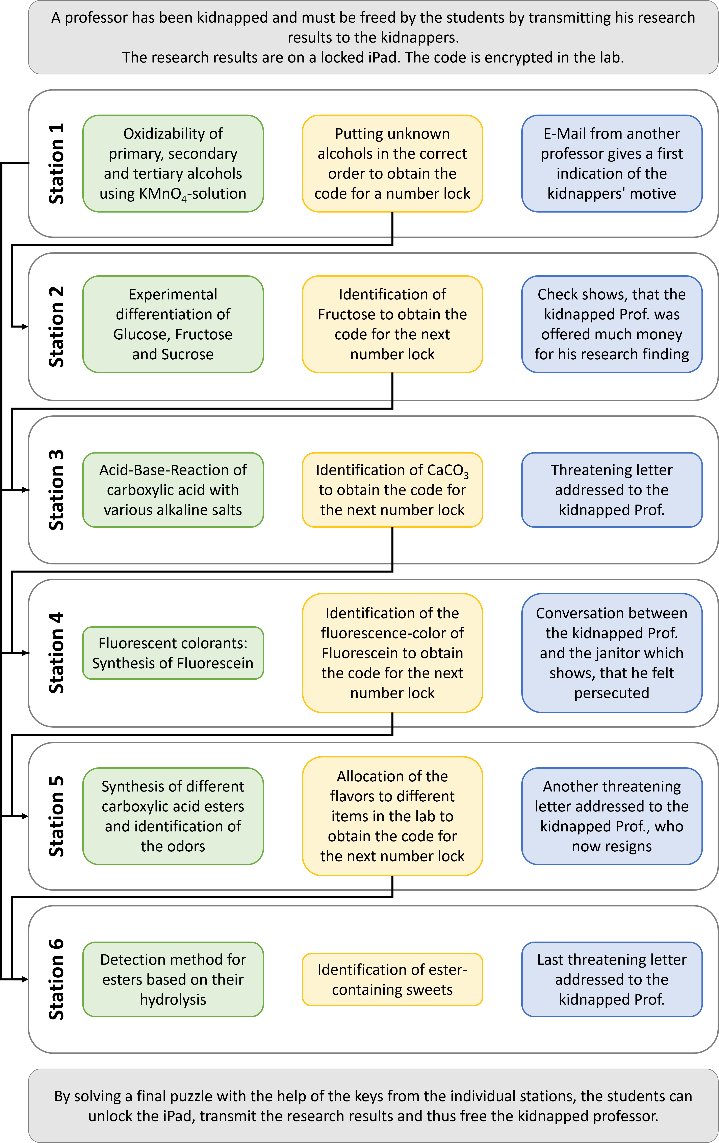
The experimental day is embedded in a narrative framework centered on the abduction of a senior chemistry lecturer. Students are tasked with deciphering the lecturer’s research findings and transmitting them to the abductors within a specified time frame. To accomplish this, they enter a specially prepared laboratory environment in which they progressively uncover both the scientific content and the storyline by identifying clues and conducting experiments (cf. Figure 1).
The narrative is deliberately designed as an independent and coherent storyline that does not rely directly on the subject content. This allows students to decide individually to what extent they wish to engage with the narrative, thereby accommodating different learner preferences 30. At the same time, the realistic context supports situated learning processes 31. Consequently, the narrative helps contextualize the learning process while remaining flexible enough to accommodate different levels of immersion, a feature that is particularly important in heterogeneous extracurricular learning environments.
The EEG is structured as a linear sequence of puzzles, meaning that both the overall progression and the order of activities are predefined (cf. Figure 1). This design reduces cognitive load and prevents students, especially those with little prior experience of EGs, from being overwhelmed by game mechanics.
At the same time, the linear structure enables a systematic progression of subject content, allowing concepts to build upon one another in a meaningful sequence 32, 33, 34. This design decision is particularly relevant within the given extracurricular context, as it provides orientation and accessibility for students who may be unfamiliar with either EEG formats or the specific content being addressed.
All puzzles follow a standardized structure: students open locked boxes by decoding numerical codes derived from experimental investigations. This recurring format allows students to develop routines 35. As a result, cognitive resources can increasingly be directed toward engaging with subject content rather than understanding game mechanics. The intention behind this design is to minimize competition between gameplay and learning, as emphasized in research on intrinsically integrated game-based learning 14. Consequently, the game mechanics can gradually recede into the background, allowing subject content to become the primary focus of cognitive activity. In this way, the design directly addresses a central challenge identified in game-based learning research, namely preventing competition between gameplay and learning processes 6.
A distinctive feature of the EEG is that puzzle solutions are based on experimental work. Students must conduct experiments in order to decode clues and progress through the game. This close connection between experimentation and puzzle-solving reflects the defining characteristics of chemistry-based EEGs 19.
Given the open nature of the learning environment, students are supported through multiple scaffolding elements. The most important of these is the initially incomplete laboratory journal, which structures the problem-solving process and provides guidance throughout the activity. In addition, supervising university students are present during the activity. They assume the role of the lecturer’s assistant and provide both subject-related and game-related support whenever required. This adaptive support structure helps balance challenge and ability, thereby creating conditions that may facilitate the emergence of flow experiences 7. Such an intensive support system is characteristic of the extracurricular laboratory setting and enables flexible, needs-based assistance that would be difficult to provide in regular classroom environments.
The EEG is designed as a team-based experience. Students work in small groups and compete against other groups to complete the game in the shortest time. This combination of collaboration and competition has been shown to enhance engagement and motivation 3. At the same time, the collaborative setting promotes communication, cooperation, and shared problem-solving, thereby supporting the development of 21st century skills 21, 26, 27.
The laboratory journal plays a central role in structuring and supporting learning. It provides an overview of the lecturer’s research and establishes a framework for solving the puzzles. At the same time, it links experimental observations with theoretical explanations, thereby fostering reflection and conceptual understanding. Because the journal is gradually completed during gameplay, it serves both as a learning tool throughout the EEG and as a foundation for subsequent reflection. In this way, it creates a sustainable connection between the EEG experience and later chemistry lessons.
While the overall design of the EEG establishes the structural and didactic framework, the implementation of intrinsically integrated game-based learning becomes particularly visible at the level of the individual experimental stations. Each station combines subject content, experimental activity, and puzzle-solving, thereby operationalizing the alignment between gameplay and learning described above. At the same time, the stations are connected through the overarching narrative and the linear progression of the game, ensuring both coherence and cumulative knowledge development.
The following section presents the individual stations of the EEG and illustrates how subject-specific learning processes are embedded within experimental and game-based activities.
3.2. Detailed Description of the Individual StationsAt each experimental station, subject content, experimental activity, and puzzle-solving are closely interconnected in order to ensure intrinsically integrated learning processes. Progression through the game depends directly on the successful application of subject-specific knowledge and experimental reasoning. Experimental observations therefore serve as the basis for solving the puzzles, ensuring a close alignment between subject content and gameplay (cf. Figure 1). Consequently, experimental identification and conceptual understanding are directly linked to progression within the game structure.

Station 1: Oxidizability of primary, secondary and tertiary alcohols using KMnO4-solution
The first station addresses the differing oxidizability of primary, secondary, and tertiary alcohols. Within an experimental puzzle setting, students are required to arrange these three classes of alcohols in the correct order. To this end, a permanganate solution is provided together with the information that the time required for a color change varies depending on the alcohol under investigation. Correct sequencing yields the access code for the subsequent station. Thus, the experimental observations themselves form the basis of the decoding process, ensuring that subject-related reasoning and gameplay progression are intrinsically interconnected.
As an extension task, students determine the oxidation states of the carbon atoms bearing the hydroxyl group, thereby establishing a connection to the systematic determination of oxidation numbers. In addition, the corresponding oxidation reactions are illustrated using appropriate structural formulae, and differences in reactivity are explained at a conceptual level. The station therefore builds on content typically covered in German chemistry lessons while extending it through an experimental approach 29.
Station 2: Experimental differentiation of Glucose, Fructose and Sucrose
The second station focuses on the oxidation products of primary and secondary alcohols, namely aldehydes and ketones. Differentiation is again achieved through an experimental task; however, instead of pure carbonyl compounds, various sugars are used as naturally occurring analogues. Using Tollens’ test, students distinguish between reducing and non-reducing sugars. As a result, the experimental differentiation of substances becomes an integral component of the puzzle-solving process rather than a separate learning activity.
Particular emphasis is placed on fructose, which produces an apparently false-positive result due to keto-enol tautomerism. This phenomenon is used to introduce the concept of keto-enediol rearrangement, thereby extending beyond the standard German school curriculum 29. In addition, students analyze the open-chain structural formulae of the sugars and deduce their names at the symbolic level. Supporting information on mono- and disaccharides, as well as on reducing sugars is provided. Correct identification of fructose ultimately yields the code for the next station. Furthermore, this station establishes interdisciplinary links to upper secondary biology.
Station 3: Acid-Base-Reaction of carboxylic acid with various alkaline salts
The third station builds on the oxidation products of aldehydes and focuses on carboxylic acids, with particular emphasis on acid-base chemistry. Initially, students separate a mixture of acetic acid and octane, thereby revisiting intermolecular interactions and differences in density. Subsequently, the acetic acid is identified using a litmus test.
Building on this, students use the acetic acid to identify a carbonate from three visually indistinguishable salts by observing gas evolution following acid addition. Correct identification provides the access code for the next station. Progression within the EEG therefore depends directly on the successful application of acid-base concepts. As an extension task, students draw the structural formulae of various carboxylic acids, including dicarboxylic acids, which are typically not addressed explicitly in German school curricula.
Station 4: Fluorescent colorants: Synthesis of Fluorescein
The fourth station represents a thematic extension of the preceding content. Students synthesize fluorescein and investigate its fluorescence under UV light. The observed emission wavelength serves as the code for the next station.
As the underlying reaction mechanism exceeds the scope of German school-level chemistry 29, mechanistic considerations are not treated in detail. Instead, students are provided with fundamental information on color and fluorescence phenomena. The primary purpose of this station is to broaden the scope of organic chemistry content while enhancing student motivation through visually engaging effects.
Station 5: Synthesis of different carboxylic acid esters and identification of the odors
The fifth station addresses esterification as the reaction between alcohols and carboxylic acids, thereby linking the content of Stations 1 and 3. The synthesis is carried out experimentally and corresponds to procedures commonly encountered in German school chemistry 29.
The code for the next station is obtained by correctly assigning characteristic odors to the synthesized esters. In this way, sensory observations and subject-specific interpretation become directly embedded within the gameplay mechanics. As an additional task, students draw the structural formulae of the synthesized esters and revisit the general reaction scheme of esterification, which is systematically presented and explained.
Station 6: Detection method for esters based on their hydrolysis
The sixth station extends the previous one by focusing on the base-catalyzed hydrolysis of esters. Although this reaction is generally familiar to students from classroom instruction 29, it is applied here in the context of the Rojahn test to identify ester-containing sweets.
Particular attention is paid to the change in pH during the course of the reaction, an aspect that is often underemphasized in school chemistry. This perspective is further elaborated through accompanying informational texts. In addition, the reaction scheme of base-catalyzed ester hydrolysis is presented. Successful identification of the sweets provides the final clue required to solve the concluding puzzle. Thus, the application of a familiar reaction mechanism is transformed into a game-relevant problem-solving process.
Final Puzzle
The final task consists of a crossword puzzle in which key concepts and characteristic features from all stations are revisited and assessed.
Overall, the design of the EEG “Chemistry Escape – Find the Way!” reflects a systematic translation of theoretical principles of intrinsically integrated game-based learning into a concrete extracurricular learning environment.
Based on the theoretical considerations outlined above, an intrinsically integrated EEG was designed as a game-based learning environment intended to support and motivate students’ subject-related learning through gameplay.
The aim of the empirical study is to evaluate the EEG from the students’ perspective, as they are the central participants and primary addressees of the learning environment. Accordingly, the study seeks to identify which key aspects of the subject content and the implemented game elements are perceived positively by the participating students.
The research questions are derived from the theoretical assumption that intrinsically integrated EEGs may foster intensive engagement with subject content as well as positive perceptions of the interplay between gameplay and learning processes. The following research questions (RQ) guided the evaluation of the EEG:
1. Overall EEG: How do students evaluate the EEG in relation to the topic (subject content) and the method (game) as a whole?
2. Subject content: To what extent do students experience the subject content as being addressed intensively?
3. Game: To what extent does the way of playing an escape game motivate students?
4. Interaction between subject content and game mechanics (intrinsically integration): Which aspects of the interplay between subject content and game mechanics do students rate as particularly positive?
4.1. Sample and MethodsThe lab day has been evaluated qualitatively since 2021. The sample currently comprises N = 350 data sets. The participating students came from 26 classes at different secondary schools in North-Rhine-Westphalia, Germany (average age 16.5 years, gender: 52% male, 41% female, 7% diverse). Participation in the study was entirely voluntary and required written informed consent from the students’ parents or legal guardians. Prior to giving consent, parents received a detailed written description of the project outlining its overall objectives, the methods and instruments of data collection, and the procedures for data handling, storage, and processing. This information was provided to ensure that consent could be given with full awareness of the purpose and scope of the study. Parents were invited to sign the consent form voluntarily, with no obligation to participate or negative consequences in the case of refusal. The signed consent forms were collected on the day of the student laboratory visit. Only students whose parents had submitted a signed and valid consent form were included in the evaluation. Data processing and preparation was fully anonymized. Furthermore, all survey data were collected independently of students’ examination performance in order to reduce the risk of response bias due to social desirability.
For the evaluation, a semi-structured questionnaire was used, which was completed by the participating students after the EEG. The questionnaire was divided into three parts and included both closed and open questions. The closed items were answered using a four-point Likert scale. The open questions gave students the opportunity to describe their specific experiences. In the first part of the questionnaire (A), students evaluated their subject-related engagement with the topic of carbon compounds (perception of the subject content). In the second part (B), they evaluated the game design, i.e., the method and way of learning (perception of the game elements). Finally, in the third part (C), students evaluated the EEG as a whole and thus the implementation of the subject matter as a game (perception of the connection and interaction between subject content and game elements).
The data were analyzed using descriptive statistics and qualitative content analysis 36. As a theory-based method for systematically processing qualitative data, qualitative content analysis was carried out in a multi-step cyclical procedure. First, main categories were formed deductively according to the structure of the questionnaire. Second, the responses were structured inductively based on the data material. The data material was coded by three coders during coding conferences.
4.2. Findings and Discussion1. How do students evaluate the EEG in relation to the topic (subject content) and the method (game) as a whole?
Overall, students evaluated the EEG very positively, both with regard to the topic (subject content, M = 1.78) and the game-based learning approach (method of learning, M = 1.74) (Figure 2).

The findings suggest that the selected topic can be successfully implemented within an educational escape game format and that the EEG is perceived by students as a highly positive learning opportunity. Both the subject content and its game-based implementation were evaluated favorably by the participants. In particular, students rated the overall structure of the EEG positively: "I liked that there was a clear pattern and system with the stages" (CE_79) {1}, and "I liked the step-by-step development of the information" (CE_39), "I liked the playful development of specialized knowledge and the use of professional materials" (CE_187). Taken together, these findings suggest that the intended balance between subject content and game elements was successfully achieved, as both dimensions were perceived positively by the students.
2. Subject content: To what extent do students experience the subject content as being addressed intensively?
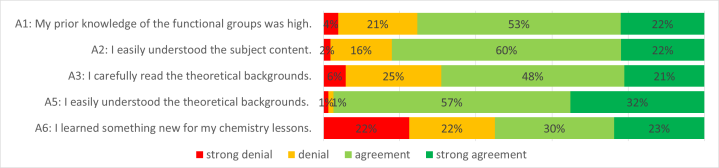
With regard to intensive engagement with the subject content, the findings reveal a generally positive, albeit differentiated, picture (Figure 3).

For example, 82% of the students stated that they understood the subject content easily (A2) and 89% reported that they understood the theoretical background of the experiments conducted (A5). These findings suggest that the level of subject content was well aligned with the learning prerequisites of the participating students. From the students' perspective, subject-related learning gains appear to have occurred, and the achievement of the intended learning objectives does not seem to have been hindered by the game-based presentation of the content.
The positive evaluations further indicate that the deliberately designed linear structure of the EEG may have facilitated students’ progression through the learning process. Beyond perceived learning outcomes, students also reported intensive engagement with the subject matter during the activity itself. For instance, 69% stated that they engaged intensively with the subject content, particularly when analyzing the experiments (A3). However, only 53% believed that participation in the EEG contributed to an increase in subject knowledge relevant for future chemistry lessons (A6). This finding is not unexpected, as the EEG was primarily designed to support the application, consolidation, and repetition of previously acquired knowledge. It can therefore be assumed that most of the content had already been covered in regular chemistry lessons prior to participation in the EEG. Consequently, only limited gains in subject-specific knowledge would be expected as a direct outcome of the activity. This interpretation is supported by the responses to the open-ended questions. For example, 75% of the students reported that they were already familiar with and had mastered most of the organic chemistry content addressed (A1): "I particularly liked the opportunity to deepen the subject matter that I knew from my lessons" (CE_92) and "I particularly liked: Refreshing old knowledge" (CE_95). Only the puzzle focusing on fluorescein synthesis represented a substantial extension beyond the regular school curriculum, which was also explicitly recognized by the students: "Overall, I was able to consolidate my previous knowledge from the lessons. For example, we didn't even have fluorescence in class, which is why it really stuck with me" (CE_199).
Taken together, the findings relating to the perception of subject content (RQ2) indicate that the EEG can facilitate intensive and learning-supportive engagement with disciplinary content. These findings support the theoretical assumption that intrinsically integrated EEGs can promote sustained engagement with subject matter without gameplay overshadowing disciplinary learning processes. The intended objectives of the conceptual design therefore appear to have been realized through the linear sequence of puzzles, the structured progression of content, and the support provided by the standardized design.
3. Game: To what extent does the way of playing an escape game (EEG) motivate students?
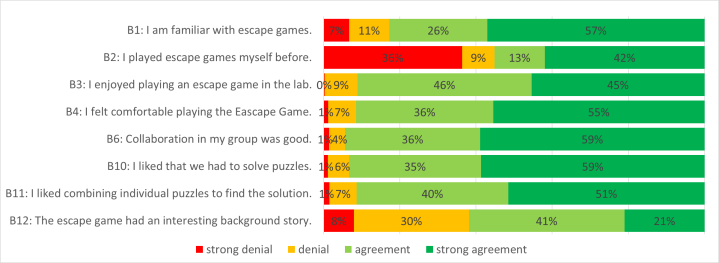
With regard to the game-based learning approach, the findings indicate that the EEG was perceived as motivating by the participating students (Figure 4).

Not only did many students report prior experience with EGs (B1: 83%, B2: 55%), they also described feeling comfortable within the team-based EEG setting and expressed enjoyment during gameplay (B3: 91%, B4: 91%, B6: 95%). Furthermore, working with the puzzles and the puzzle-solving process as a whole was evaluated very positively (B10: 94%, B11: 91%). These findings suggest that students were not overwhelmed by the game mechanics of the EEG. Rather, the game elements appear to have motivated students to engage with the subject matter while simultaneously supporting the interdisciplinary competences targeted in the conceptual design, particularly collaboration, cooperation, and problem-solving. This interpretation is further supported by the responses to the open-ended questions and the competitive team-based setting.
When asked which aspects of the method they particularly appreciated, n = 47 of 114 {2} students explicitly referred to collaborative group work: "I liked staying together in the group and working in a team" (CE_103), "I liked that we had to work together to reach the goal" (CE_157), and "You can do it easier and faster with the team" (CE_106). These findings are consistent with theoretical assumptions that collaborative and competitive game elements can foster engagement and motivation within game-based learning environments 3.
Only 62% of the students stated that they found the narrative particularly interesting (B12). Given the diversity of student interests and preferences, this finding is not surprising. This underlines the importance of the prior design decision to keep the narrative sufficiently independent so it would not interfere negatively with gameplay progression or subject-related learning processes. The narrative therefore appears to support immersion in the game without becoming a prerequisite for successful engagement with the subject content.
4. Interaction between subject content and game mechanics (intrinsically integration): Which aspects of the interplay between subject content and game mechanics do students rate as particularly positive?
A closer examination of the third part of the questionnaire provides more detailed insights into students’ positive evaluation of the puzzle-solving process, which combines subject content and game elements in a particularly integrated way through the incorporation of experiments into the decoding process (Figure 5).

Overall, 95% of the students evaluated the experiment-based decoding process positively (C2). In particular, students appreciated the combination of experiments and puzzles, as well as the resulting interplay between subject-related knowledge and problem-solving processes: "Finding solutions with the help of chemistry knowledge and logic was great" (CE_66), "Solving the puzzle with the help of chemical experiments (CE_84), "Creativity of the experiments and the solution approaches (CE_145), and "Use of the topics from the lessons in exciting situations" (CE_196). Furthermore, 96% of the students positively emphasized the high degree of independence during experimentation and problem-solving (C1). This finding is likewise reflected in the responses to the open-ended questions. For example, n = 47 out of 114 students who answered the question about particularly appreciated aspects of the method referred to independent work: "Independent approach to the solutions and experiments/independent learning" (CE_40) and "There was no intervention or prohibition to do things because you didn't have enough knowledge, but you were allowed to do everything yourself” (CE_13). From the students’ perspective, this independence contributed to more intensive engagement with the subject matter: "It's fun to explore different challenges with the help of puzzles. I was able to deepen and expand previous knowledge, and it was cool to delve into the subject matter again" (CE_40). Accordingly, independent practical experimentation represents the most positively evaluated aspect of the EEG (C1: 96%).
At the same time, the responses to the open-ended questions indicate that, despite the importance of independent experimentation, the needs-based support provided by the supervisors was also perceived very positively (n = 20/114). The extracurricular laboratory setting particularly benefits from its high support ratio enabling students to work independently while still receiving assistance when required and ensuring safe experimentation: "I liked the support, if necessary, helpfulness" (CE_5). In addition, the laboratory journal appears to support reflection on the experiments and thereby facilitate learning processes: "The explanations after the experiments/explanations of the experiments helped me a lot" (CE_18).
Overall, the findings indicate that the deliberate integration of subject content and game elements within the puzzle-solving process represents a particular added value from the students' perspective. Independent experimentation and puzzle-solving are simultaneously supported by the laboratory journal and the supervisors in a goal-orientated manner. The standardized structure of the puzzle-solving process, the progressively completed laboratory journal, and the needs-based support provided by the supervisors appear to facilitate students’ engagement with and acquisition of subject-related knowledge.
Moreover, the evaluation findings suggest that the intended balance between subject content and game elements was successfully achieved from the students’ perspective. Neither the subject content nor the gameplay appears to recede into the background in favor of the other dimension. At the same time, the narrative enables students to immerse themselves in the role of the player without preventing them from focusing on the disciplinary content. This is reflected particularly in the positive evaluations of subject-related engagement throughout the EEG. Although no direct measurement of flow was conducted, students’ descriptions of immersion, sustained engagement, and collaborative problem-solving point toward conditions commonly associated with flow experiences 7. The conceptual design decisions therefore appear to have created favorable conditions for a positive and engaging learning experience 5, 18.
Accordingly, EEGs of this kind can be regarded as serious games with the potential to foster deeper engagement with subject content and, consequently, enhanced learning outcomes 14. Within the framework of game-related pedagogy 2, 6, the developed EEG represents a concrete example of intrinsically integrated game design and illustrates how such an approach can support a coherent and meaningful learning experience.
The findings presented above indicate that EEGs designed in accordance with principles of game-based learning, particularly through the deliberate alignment of gameplay and subject content, can lead to positively perceived learning experiences among participants. At the same time, the game-inherent characteristics of EEGs appear to enhance learners’ motivation, especially their willingness to engage intensively with subject matter. Intrinsically integrated EEGs may therefore be regarded as a promising instructional approach in chemistry education and as a meaningful form of serious games.
The findings further suggest that extracurricular learning centers provide particularly favorable conditions for implementing such approaches, not least because of the extensive support structures available in these settings. However, the transferability of these findings to regular chemistry lessons requires careful consideration. In particular, the successful implementation of EEGs in classroom settings presupposes an explicit awareness of their conceptual design requirements in order to ensure that subject-specific learning is effectively supported. This includes a theoretically grounded and reflective consideration of the relationship between gameplay and subject content, as well as their balanced integration 14, 19, 20. This challenge is equally relevant for future research investigating the educational potential of self-developed EEGs as serious games.
Taken together, the findings suggest that the educational value of EEGs does not arise from gameplay alone but rather from the deliberate didactic alignment of gameplay and subject-related learning processes.
Several limitations of the present study should be acknowledged. First, the study is based on a qualitative analysis of students’ perceptions and evaluations of the EEG. Consequently, no conclusions can be drawn regarding its actual effects on learning outcomes, conceptual understanding, or long-term knowledge retention. Such claims would require pre-post designs or comparable approaches capable of measuring learning gains over time. Second, the reliance on self-reported data may have introduced bias, as students’ responses could have been influenced by social desirability, novelty effects, or individual preferences regarding games and extracurricular activities. Although measures were taken to minimize such influences, they cannot be ruled out entirely. Third, although narrative elements appeared to contribute positively to students’ engagement and motivation, narrative engagement itself was not systematically assessed. Future research should therefore employ validated instruments to measure narrative engagement and examine its relationship with immersion, motivation, and learning outcomes.
More broadly, future studies should adopt longitudinal and comparative research designs, include objective measures of achievement, and investigate the implementation of intrinsically integrated EEGs in regular classroom settings and across different learner groups. Such research would provide a stronger empirical basis for evaluating the educational effectiveness of EEGs and the conditions under which they are most beneficial.
Despite these limitations, the present study represents an important first step toward empirically substantiating theoretical considerations on intrinsically integrated EEGs through evidence derived from practical implementation. The findings illustrate how deliberate integration of subject content, experimentation, and gameplay can create a learning environment that is perceived by students as both engaging and educationally meaningful.
{1}. Note: All quotations from the data material were translated by the authors
{2}. A total of N = 144 participants answered the open-ended questions
| [1] | Hu, Y., Gallagher, T., Wouters, P., van der Schaaf, M. et al., "Game‐based learning has good chemistry with chemistry education: A three‐level meta‐analysis", J Res Sci Teach, 59 (9). 1499–1543. 2022. | ||
| In article | View Article | ||
| [2] | Kim, S., Song, K., Lockee, B., Burton, J., Gamification in Learning and Education, Springer International Publishing, Cham, 2018. | ||
| In article | View Article | ||
| [3] | Fotaris, P., Mastoras, T., "Escape Rooms for Learning: A Systematic Review" in Proceedings of the 12th European Conference on Game Based Learning, ACPI, 30. | ||
| In article | |||
| [4] | Avargil, S., Shwartz, G., Zemel, Y., "Educational Escape Room: Break Dalton’s Code and Escape!", J. Chem. Educ., 98 (7). 2313–2322. 2021. | ||
| In article | View Article | ||
| [5] | Veldkamp, A., van de Grint, L., Knippels, M.-C. P., van Joolingen, W. R., "Escape education: A systematic review on escape rooms in education", Educational Research Review, 31). 100364. 2020. | ||
| In article | View Article | ||
| [6] | Zhang, Q., Yu, Z., "Meta-Analysis on Investigating and Comparing the Effects on Learning Achievement and Motivation for Gamification and Game-Based Learning", Education Research International, 2022). 1–19. 2022. | ||
| In article | View Article | ||
| [7] | Csikszentmihalyi, M., Flow: The Psychology of Optimal Experience (Harper Perennial Modern Classics), 1st edn., Harper Perennial Modern Classics., USA, 2008. | ||
| In article | |||
| [8] | Krath, J., Schürmann, L., Korflesch, H. F. von, "Revealing the theoretical basis of gamification: A systematic review and analysis of theory in research on gamification, serious games and game-based learning", Computers in Human Behavior, 125). 106963. 2021. | ||
| In article | View Article | ||
| [9] | Howard, C., Bevins, K., "Game mechanics and why they are employed: What we know about gamification so far", Issues and Trends in Educational Technology, 6 (1. 2018. | ||
| In article | View Article | ||
| [10] | Faiella, F., Ricciardi, M., "Gamification and learning: a review of issues and research. 2015. | ||
| In article | |||
| [11] | Eukel, H., Frenzel, J., Frazier, K., Miller, M., "Unlocking Student Engagement: Creation, Adaptation, and Application of an Educational Escape Room Across Three Pharmacy Campuses", Simulation & Gaming, 51 (2). 167–179. 2020. | ||
| In article | View Article | ||
| [12] | Sailer, M., Homner, L., "The Gamification of Learning: a Meta-analysis", Educ Psychol Rev, 32 (1). 77–112. 2020. | ||
| In article | View Article PubMed | ||
| [13] | Landers, R. N., Auer, E. M., Collmus, A. B., Armstrong, M. B., "Gamification Science, Its History and Future: Definitions and a Research Agenda", Simulation & Gaming, 49 (3). 315–337. 2018. | ||
| In article | View Article | ||
| [14] | Habgood, M. P. J., Ainsworth, S. E., "Motivating Children to Learn Effectively: Exploring the Value of Intrinsic Integration in Educational Games", Journal of the Learning Sciences, 20 (2). 169–206. 2011. | ||
| In article | View Article | ||
| [15] | Wouters, P., van Nimwegen, C., van Oostendorp, H., van der Spek, E. D., "A meta-analysis of the cognitive and motivational effects of serious games", Journal of Educational Psychology, 105 (2). 249–265. 2013. | ||
| In article | View Article | ||
| [16] | Clark, D. B., Tanner-Smith, E. E., Killingsworth, S. S., "Digital Games, Design, and Learning: A Systematic Review and Meta-Analysis", Review of Educational Research, 86 (1). 79–122. 2016. | ||
| In article | View Article PubMed | ||
| [17] | Nicholson, S., "Peeking behind the locked door: A survey of escape room facilities. http:// scottnicholson.com/ pubs/ erfacwhite.pdf. Accessed 3 May 2023. | ||
| In article | |||
| [18] | Nicholson, S., "A RECIPE for Meaningful Gamification, Reiners, T., Wood, L. C. (Ed.)" in Gamification in Education and Business, Springer International Publishing, Cham, 2015, 1–20. | ||
| In article | View Article | ||
| [19] | Yachin, T., Barak, M., "Science-Based Educational Escape Games: A Game Design Methodology", Res Sci Educ, 54 (7). 299–313. 2023. | ||
| In article | View Article | ||
| [20] | Groß, K., Prewitz, N., Belova, N., Lathwesen, C. et al., "Spiel oder Lernangebot? – Eine analytische Sicht auf den Einsatz von Educational Escape Games im Chemieunterricht", CHEMKON, 31 (3). 96–102. 2023. | ||
| In article | View Article | ||
| [21] | Taraldsen, L. H., Haara, F. O., Lysne, M. S., Jensen, P. R. et al., "A review on use of escape rooms in education – touching the void", Education Inquiry, 13 (2). 169–184. 2022. | ||
| In article | View Article | ||
| [22] | Martín-González, E., Godoy-Giménez, M., Fernández-Martín, P., León, J. J. et al., "ESCAPE ROOM AS A TOOL TO IMPROVE THE MOTIVATION AND COMMITMENT OF STUDENTS" in INTED2021 Proceedings, Gómez Chova, L., López Martínez, A., Candel Torres, I. (Ed.), IATED, 5868–5873. | ||
| In article | View Article | ||
| [23] | González-Yubero, S., Mauri, M., Cardoso, M. J., Palomera, R., "Learning through Challenges and Enigmas: Educational Escape Room as a Predictive Experience of Motivation in University Students", Sustainability, 15 (17). 13001. 2023. | ||
| In article | View Article | ||
| [24] | Borrego, C., Fernández, C., Blanes, I., Robles, S., "Room escape at class: Escape games activities to facilitate the motivation and learning in computer science", J. Technol. Sci. Educ., 7 (2). 162. 2017. | ||
| In article | View Article | ||
| [25] | Engstler, V. L., Marohn, A., "Designing Effective Educational Escape Games: Results from the Design-Based Research Project chemical [esc]ape", J. Chem. Educ., 102 (10). 4498–4507. 2025. | ||
| In article | View Article | ||
| [26] | OECD, "OECD Future of Education and Skills 2030: OECD Learning Compass 2030. A Series of Concept Notes. compass_ 2030-concept_notes?fr=xKAE9_zU1NQ. Accessed 10 March 2024. | ||
| In article | |||
| [27] | Klopfer, E., Haas, J., Osterweil, S., Rosenheck, L., Resonant games: Design principles for learning games that connect hearts, minds, and the everyday, The MIT Press, Cambridge, Massachusetts, 2018. | ||
| In article | View Article | ||
| [28] | Groß, K., Schumacher, A., "Chemistry Escape – Finde den Weg", ChiUZ, 54 (2). 126–130. 2020. | ||
| In article | View Article | ||
| [29] | Ministerium für Schule und Bildung des Landes Nordrhein-Westfalen (MSB NRW), Kernlehrplan für die Sekundarstufe II Gymnasium / Gesamtschule in Nordrhein-Westfalen: Chemie, 1st edn., 2022. | ||
| In article | |||
| [30] | Caillois, R., Man, play and games, University of Illinois Press, Urbana, Ill., 2001. | ||
| In article | |||
| [31] | Herrington, J., Oliver, R., "An instructional design framework for authentic learning environments", ETR&D, 48 (3). 23–48. 2000. | ||
| In article | View Article | ||
| [32] | Peleg, R., Yayon, M., Katchevich, D., Moria-Shipony, M. et al., "A Lab-Based Chemical Escape Room: Educational, Mobile, and Fun!", J. Chem. Educ., 96 (5). 955–960. 2019. | ||
| In article | View Article | ||
| [33] | Morrell, B. L. M., Ball, H. M., "Can You Escape Nursing School? Educational Escape Room in Nursing Education", Nursing education perspectives, 41 (3). 197–198. 2020. | ||
| In article | View Article PubMed | ||
| [34] | Lopez-Pernas, S., Gordillo, A., Barra, E., Quemada, J., "Examining the Use of an Educational Escape Room for Teaching Programming in a Higher Education Setting", IEEE Access, 7). 31723–31737. 2019. | ||
| In article | View Article | ||
| [35] | Collier-Meek, M. A., Johnson, A. H., Sanetti, L. H., Minami, T., "Identifying Critical Components of Classroom Management Implementation", School Psychology Review, 48 (4). 348–361. 2019. | ||
| In article | View Article | ||
| [36] | Kuckartz, U., Rädiker, S., Qualitative content analysis: Methods, practice and software, 2nd edn., SAGE, Los Angeles, London, New Delhi, Sinmgapore, Washington DC, Melbourne, 2023. | ||
| In article | |||
Published with license by Science and Education Publishing, Copyright © 2026 Katharina Groß and Niklas Prewitz
 This work is licensed under a Creative Commons Attribution 4.0 International License. To view a copy of this license, visit
http://creativecommons.org/licenses/by/4.0/
This work is licensed under a Creative Commons Attribution 4.0 International License. To view a copy of this license, visit
http://creativecommons.org/licenses/by/4.0/
| [1] | Hu, Y., Gallagher, T., Wouters, P., van der Schaaf, M. et al., "Game‐based learning has good chemistry with chemistry education: A three‐level meta‐analysis", J Res Sci Teach, 59 (9). 1499–1543. 2022. | ||
| In article | View Article | ||
| [2] | Kim, S., Song, K., Lockee, B., Burton, J., Gamification in Learning and Education, Springer International Publishing, Cham, 2018. | ||
| In article | View Article | ||
| [3] | Fotaris, P., Mastoras, T., "Escape Rooms for Learning: A Systematic Review" in Proceedings of the 12th European Conference on Game Based Learning, ACPI, 30. | ||
| In article | |||
| [4] | Avargil, S., Shwartz, G., Zemel, Y., "Educational Escape Room: Break Dalton’s Code and Escape!", J. Chem. Educ., 98 (7). 2313–2322. 2021. | ||
| In article | View Article | ||
| [5] | Veldkamp, A., van de Grint, L., Knippels, M.-C. P., van Joolingen, W. R., "Escape education: A systematic review on escape rooms in education", Educational Research Review, 31). 100364. 2020. | ||
| In article | View Article | ||
| [6] | Zhang, Q., Yu, Z., "Meta-Analysis on Investigating and Comparing the Effects on Learning Achievement and Motivation for Gamification and Game-Based Learning", Education Research International, 2022). 1–19. 2022. | ||
| In article | View Article | ||
| [7] | Csikszentmihalyi, M., Flow: The Psychology of Optimal Experience (Harper Perennial Modern Classics), 1st edn., Harper Perennial Modern Classics., USA, 2008. | ||
| In article | |||
| [8] | Krath, J., Schürmann, L., Korflesch, H. F. von, "Revealing the theoretical basis of gamification: A systematic review and analysis of theory in research on gamification, serious games and game-based learning", Computers in Human Behavior, 125). 106963. 2021. | ||
| In article | View Article | ||
| [9] | Howard, C., Bevins, K., "Game mechanics and why they are employed: What we know about gamification so far", Issues and Trends in Educational Technology, 6 (1. 2018. | ||
| In article | View Article | ||
| [10] | Faiella, F., Ricciardi, M., "Gamification and learning: a review of issues and research. 2015. | ||
| In article | |||
| [11] | Eukel, H., Frenzel, J., Frazier, K., Miller, M., "Unlocking Student Engagement: Creation, Adaptation, and Application of an Educational Escape Room Across Three Pharmacy Campuses", Simulation & Gaming, 51 (2). 167–179. 2020. | ||
| In article | View Article | ||
| [12] | Sailer, M., Homner, L., "The Gamification of Learning: a Meta-analysis", Educ Psychol Rev, 32 (1). 77–112. 2020. | ||
| In article | View Article PubMed | ||
| [13] | Landers, R. N., Auer, E. M., Collmus, A. B., Armstrong, M. B., "Gamification Science, Its History and Future: Definitions and a Research Agenda", Simulation & Gaming, 49 (3). 315–337. 2018. | ||
| In article | View Article | ||
| [14] | Habgood, M. P. J., Ainsworth, S. E., "Motivating Children to Learn Effectively: Exploring the Value of Intrinsic Integration in Educational Games", Journal of the Learning Sciences, 20 (2). 169–206. 2011. | ||
| In article | View Article | ||
| [15] | Wouters, P., van Nimwegen, C., van Oostendorp, H., van der Spek, E. D., "A meta-analysis of the cognitive and motivational effects of serious games", Journal of Educational Psychology, 105 (2). 249–265. 2013. | ||
| In article | View Article | ||
| [16] | Clark, D. B., Tanner-Smith, E. E., Killingsworth, S. S., "Digital Games, Design, and Learning: A Systematic Review and Meta-Analysis", Review of Educational Research, 86 (1). 79–122. 2016. | ||
| In article | View Article PubMed | ||
| [17] | Nicholson, S., "Peeking behind the locked door: A survey of escape room facilities. http:// scottnicholson.com/ pubs/ erfacwhite.pdf. Accessed 3 May 2023. | ||
| In article | |||
| [18] | Nicholson, S., "A RECIPE for Meaningful Gamification, Reiners, T., Wood, L. C. (Ed.)" in Gamification in Education and Business, Springer International Publishing, Cham, 2015, 1–20. | ||
| In article | View Article | ||
| [19] | Yachin, T., Barak, M., "Science-Based Educational Escape Games: A Game Design Methodology", Res Sci Educ, 54 (7). 299–313. 2023. | ||
| In article | View Article | ||
| [20] | Groß, K., Prewitz, N., Belova, N., Lathwesen, C. et al., "Spiel oder Lernangebot? – Eine analytische Sicht auf den Einsatz von Educational Escape Games im Chemieunterricht", CHEMKON, 31 (3). 96–102. 2023. | ||
| In article | View Article | ||
| [21] | Taraldsen, L. H., Haara, F. O., Lysne, M. S., Jensen, P. R. et al., "A review on use of escape rooms in education – touching the void", Education Inquiry, 13 (2). 169–184. 2022. | ||
| In article | View Article | ||
| [22] | Martín-González, E., Godoy-Giménez, M., Fernández-Martín, P., León, J. J. et al., "ESCAPE ROOM AS A TOOL TO IMPROVE THE MOTIVATION AND COMMITMENT OF STUDENTS" in INTED2021 Proceedings, Gómez Chova, L., López Martínez, A., Candel Torres, I. (Ed.), IATED, 5868–5873. | ||
| In article | View Article | ||
| [23] | González-Yubero, S., Mauri, M., Cardoso, M. J., Palomera, R., "Learning through Challenges and Enigmas: Educational Escape Room as a Predictive Experience of Motivation in University Students", Sustainability, 15 (17). 13001. 2023. | ||
| In article | View Article | ||
| [24] | Borrego, C., Fernández, C., Blanes, I., Robles, S., "Room escape at class: Escape games activities to facilitate the motivation and learning in computer science", J. Technol. Sci. Educ., 7 (2). 162. 2017. | ||
| In article | View Article | ||
| [25] | Engstler, V. L., Marohn, A., "Designing Effective Educational Escape Games: Results from the Design-Based Research Project chemical [esc]ape", J. Chem. Educ., 102 (10). 4498–4507. 2025. | ||
| In article | View Article | ||
| [26] | OECD, "OECD Future of Education and Skills 2030: OECD Learning Compass 2030. A Series of Concept Notes. compass_ 2030-concept_notes?fr=xKAE9_zU1NQ. Accessed 10 March 2024. | ||
| In article | |||
| [27] | Klopfer, E., Haas, J., Osterweil, S., Rosenheck, L., Resonant games: Design principles for learning games that connect hearts, minds, and the everyday, The MIT Press, Cambridge, Massachusetts, 2018. | ||
| In article | View Article | ||
| [28] | Groß, K., Schumacher, A., "Chemistry Escape – Finde den Weg", ChiUZ, 54 (2). 126–130. 2020. | ||
| In article | View Article | ||
| [29] | Ministerium für Schule und Bildung des Landes Nordrhein-Westfalen (MSB NRW), Kernlehrplan für die Sekundarstufe II Gymnasium / Gesamtschule in Nordrhein-Westfalen: Chemie, 1st edn., 2022. | ||
| In article | |||
| [30] | Caillois, R., Man, play and games, University of Illinois Press, Urbana, Ill., 2001. | ||
| In article | |||
| [31] | Herrington, J., Oliver, R., "An instructional design framework for authentic learning environments", ETR&D, 48 (3). 23–48. 2000. | ||
| In article | View Article | ||
| [32] | Peleg, R., Yayon, M., Katchevich, D., Moria-Shipony, M. et al., "A Lab-Based Chemical Escape Room: Educational, Mobile, and Fun!", J. Chem. Educ., 96 (5). 955–960. 2019. | ||
| In article | View Article | ||
| [33] | Morrell, B. L. M., Ball, H. M., "Can You Escape Nursing School? Educational Escape Room in Nursing Education", Nursing education perspectives, 41 (3). 197–198. 2020. | ||
| In article | View Article PubMed | ||
| [34] | Lopez-Pernas, S., Gordillo, A., Barra, E., Quemada, J., "Examining the Use of an Educational Escape Room for Teaching Programming in a Higher Education Setting", IEEE Access, 7). 31723–31737. 2019. | ||
| In article | View Article | ||
| [35] | Collier-Meek, M. A., Johnson, A. H., Sanetti, L. H., Minami, T., "Identifying Critical Components of Classroom Management Implementation", School Psychology Review, 48 (4). 348–361. 2019. | ||
| In article | View Article | ||
| [36] | Kuckartz, U., Rädiker, S., Qualitative content analysis: Methods, practice and software, 2nd edn., SAGE, Los Angeles, London, New Delhi, Sinmgapore, Washington DC, Melbourne, 2023. | ||
| In article | |||