Research on vocational–academic integration consistently highlights a risk of narrowing integration towards labor-market content, often at the expense of democratic and civic education. Building on these discussions, this study investigates whether an English for Specific Purposes (ESP)-mediated sustainability intervention can achieve employability gains without perpetuating civic exclusion by embedding democratic voice and ethical reasoning within workplace-relevant sustainability tasks. A mixed-methods intervention, spanning 8 weeks and involving 60 Saudi Technical and Vocational Education and Training (TVET) students, operationalized the ESP–Sustainability Employability Framework (ESEF) through task-based projects grounded in SDG-aligned workplace scenarios. Quantitative outcomes, including communication, critical thinking, problem-solving, and civic awareness, were measured pre- and post-intervention and analyzed using paired t-tests, Cohen's d, and 95% confidence intervals. Qualitative evidence, derived from 18 focus groups and 120 reflective journal entries, was subjected to reflexive thematic analysis. The findings revealed significant improvements across all outcomes from pre- to post-test: communication (d = .84, 95% CI [.59, 1.11]), critical thinking (d = .82, 95% CI [.54, 1.03]), problem-solving (d = .79, 95% CI [.45, .90]), civic awareness (d = .79, 95% CI [.47, .92]), and authentic performance task scores (d = .98, 95% CI [2.56, 4.38]). Qualitative themes further indicated: (1) strengthened vocational identity through language-for-work genres; (2) sustainability as a motivating real problem context; (3) expanded civic agency via rights/voice discourse embedded in workplace cases; and (4) implementation constraints necessitating differentiated scaffolding. This study advances integration theory by offering an intervention-based alternative to purely diagnostic accounts of exclusion. It specifies a replicable pedagogy (ESEF), introduces a Dual Integration Model (DIM) to prevent democratic dropout, and provides empirical outcome evidence alongside student perspectives. The implications suggest that TVET systems can effectively integrate employability, green skills, and civic competence through ESP tasks, thereby supporting broader workforce preparation aligned with national reforms and international Education for Sustainable Development (ESD) agendas.
Vocational education and training (VET) systems face intensifying pressure to deliver on three intersecting agendas: employability, green transition capacity, and democratic/civic education. Across OECD contexts, the green transition is reshaping skill demands and widening the need for transversal capabilities—communication, critical thinking, and problem-solving—alongside technical competence 1. Yet research in VET has repeatedly warned that curricular integration can drift toward a narrow "worker-only" orientation in which education reduces to labor-market adjustment, leaving democratic rights and civic agency marginalized 2, 3.
Recent scholarship has made this risk visible: integration is often constructed around what is administratively convenient, assessable, or "naturally" connected to vocational content, producing subtle but consequential exclusion patterns for students' citizenship preparation. Ekström 4 exemplifies this diagnostic strength by showing how civics teachers' interpretative repertoires can prioritize students as workers and consumers, thereby deprioritizing democratic training in vocational tracks. While analytically powerful, such work remains primarily diagnostic: it shows how exclusion happens but offers limited evidence on how to design and test pedagogies that prevent it.
This study responds with an explicit design question: Can an ESP-mediated sustainability intervention produce measurable employability gains while simultaneously strengthening civic awareness and democratic "voice" rather than excluding it? The intervention is situated in Saudi Arabia's TVET context, where reform agendas emphasize labor-market alignment and human capital development under Vision 2030 5. The study's logic also aligns with UNESCO's ESD for 2030 roadmap emphasizing action-oriented pedagogy 6.
• RQ1: To what extent does an 8-week ESEF intervention improve TVET students' communication, critical thinking, and problem-solving?
• RQ2: To what extent does the intervention strengthen civic awareness (rights/voice/ethics) rather than reproducing civic exclusion?
• RQ3: How do students explain changes in relevance, engagement, identity, and agency?
• RQ4: What design features prevent democratic "dropout" in integrated curricula?
This section reviews the literature related to vocational–academic integration, civic education in TVET, ESP-mediated learning, and sustainability-oriented pedagogies to establish the theoretical and empirical foundation of the study.
3.1. Vocational–Academic Integration as a Contested ProjectIntegration is often framed as connecting school knowledge and workplace practice, strengthening coherence between academic and vocational learning, and enhancing transition outcomes 7, 8. Yet integration is not neutral: it is a political and epistemic project about which knowledge counts, whose futures are imagined, and how learners are positioned 2, 3. Research shows that integration can either broaden access to powerful knowledge or reinforce stratification by narrowing content for vocational students 9.
Work on citizenship preparation in VET underscores that democratic competence is not automatically supported by vocational curricula; it requires deliberate pedagogic design and attention to "pedagogic rights" 10. Citizenship education frameworks distinguish between personally responsible citizenship, participatory citizenship, and justice-oriented citizenship—an important lens because "responsible worker" discourses can masquerade as citizenship while excluding participation and critique 11.
3.2. Exclusion Dynamics in Integration PracticesEkström 4 demonstrates a crucial exclusion mechanism: integration practices in civics drift toward labor-market relevance, while democratic training (rights, voice, collective agency) becomes harder to integrate and therefore more likely to be deprioritized. This aligns with broader concerns that vocational tracks may encode "middle-class bias" in democratic theory, placing vocational learners outside the imagined political subject 3. The broader implication is not merely that "democracy is missing," but that integration itself can amplify exclusion if governed by convenience and employability-only logic.
3.3. Language, Integration, and ESP/CLILResearch on content-and-language integration in vocational settings suggests that language can function as a bridge when treated as part of vocational learning rather than peripheral remediation. Studies on CLIL in technical vocational education show that teachers' language awareness shapes whether integration supports learning or becomes superficial 12. ESP scholarship emphasizes that needs analysis, genre awareness, and workplace discourse practices enable learners to access the communicative demands of occupations 13, 14.
In VET contexts, the strongest rationale for ESP is not only employability but also participation: learners gain access to workplace communities of practice through communicative competence 15. A key theoretical claim of this study is thus: if ESP can teach the discourse of work, it can also teach the discourse of ethical and civic participation in work contexts.
3.4. Sustainability Education as an Integration ContextSustainability provides a uniquely powerful integration context linking technical practice, ethical reasoning, systems thinking, and policy constraints. Competency frameworks identify systems thinking, anticipatory thinking, normative competence, strategic competence, and interpersonal competence as core 16. For VET specifically, the green transition requires curricula updates and combinations of STEM and transversal capabilities 1. Literature on "green skills integration" warns against cosmetic reform: sustainability language may appear in curricula without deep pedagogic change 17.
3.5. Synthesis and GapThe literature converges on a problem: integration is desirable but risky; it can privilege employability while excluding democracy. The gap is an empirically tested, replicable intervention model that (1) uses an integrative pedagogy (ESP), (2) uses a high-value context (sustainability), and (3) safeguards civic/democratic learning through deliberate design.
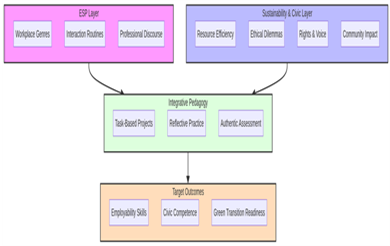
This study is grounded in an integrated theoretical perspective combining ESP pedagogy, sustainability competence frameworks, and vocational–academic integration theory. The framework supports the development of employability and civic outcomes within sustainability-oriented TVET contexts.
4.1. ESP–Sustainability Employability Framework (ESEF)ESEF proposes that ESP tasks (workplace genres, interaction routines, report writing, presentations, negotiation) can be designed around sustainability scenarios (resource efficiency, waste reduction, safety/environmental compliance, ethical dilemmas, community impact), producing employability outcomes while also embedding civic elements such as rights, voice, and responsibility.
ESEF synthesizes:
• Sociocultural learning 15
• ESP curriculum design 13, 14
• Sustainability competence frameworks 16, 18
• Employability-as-capital 19

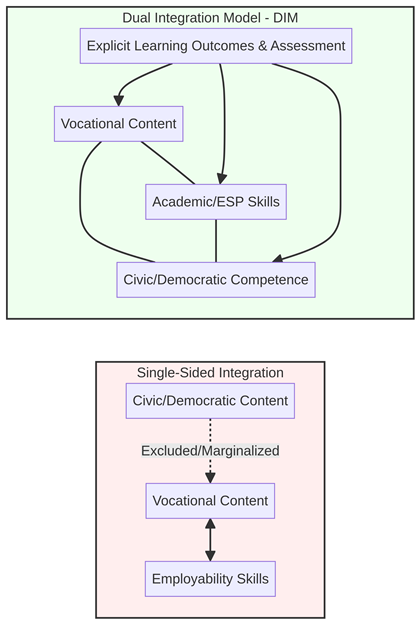
DIM extends integration theory by distinguishing two integration pathways:
• Single-sided integration: Vocational + employability alignment, often excluding democratic/civic content because it is "harder" to integrate, assess, or justify under time pressure.
• Dual integration: Vocational + academic + civic integration, where democratic competence is protected by design through explicit learning outcomes and assessment supports.

This section outlines the research design, participant characteristics, intervention procedures, data collection instruments, and analytical methods employed to examine the effectiveness of the ESEF intervention in the Saudi TVET context.
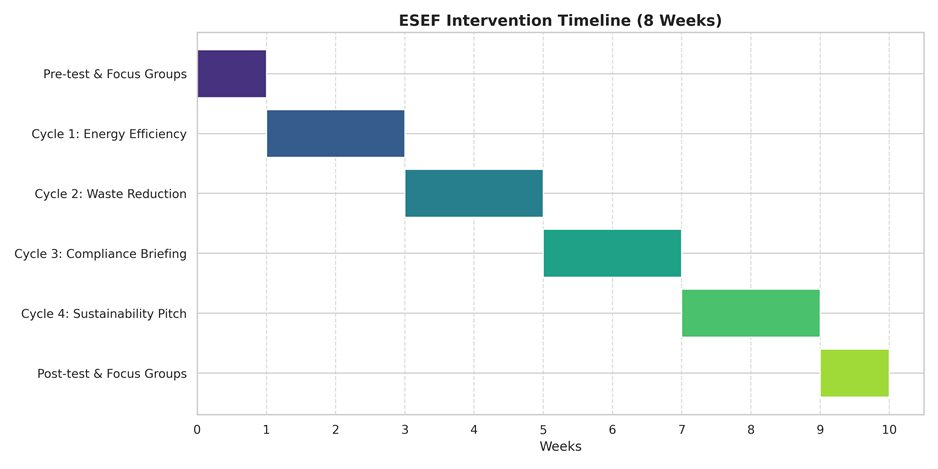
5.1. DesignA sequential explanatory mixed-methods design was used: quantitative pre/post assessment followed by qualitative exploration to explain how and why changes occurred 20. The intervention ran for 8 weeks, two 90-minute sessions per week, integrated into an ESP module embedded in a diploma-level TVET program.
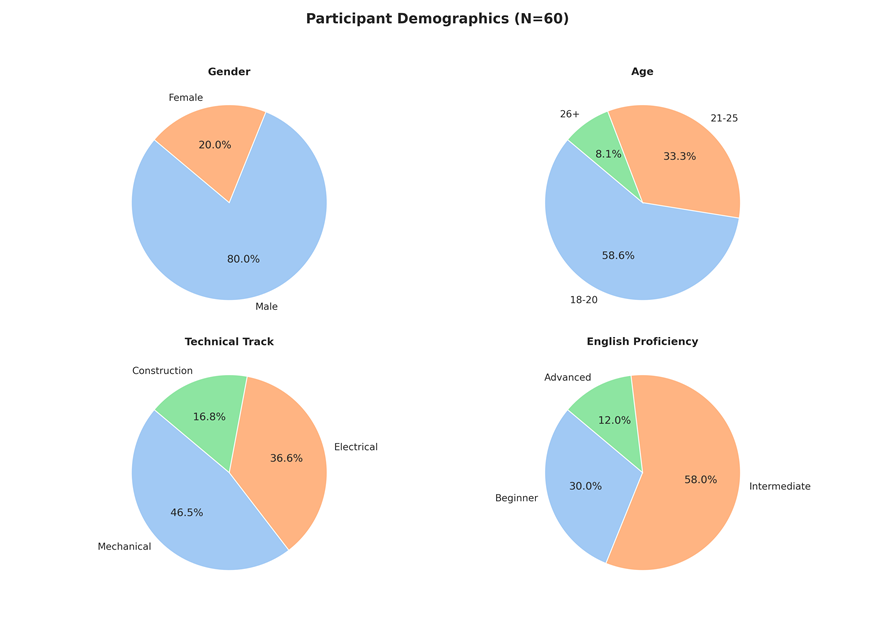
5.2. Setting and ParticipantsParticipants were N = 60 second-year students enrolled in a Saudi TVET college program aligned with technical specializations (mechanical, electrical, and construction tracks).
5.3. Ethical ProceduresStudents participated voluntarily with informed consent. Data were de-identified and stored securely. Participation/nonparticipation had no effect on course grades. Ethics approval was obtained from the TVTC Institutional Review Board (Protocol #TVTC-EDU-2024-087).

The ESEF intervention consisted of four task cycles (2 weeks each).

Each cycle integrated:
• Workplace genre (incident report, toolbox talk, compliance memo, sustainability pitch)
• Sustainability problem scenario (energy efficiency, waste reduction, safety/environment compliance, circularity)
• Civic/voice component (rights/responsibilities, stakeholder impact, collective decision-making, reporting mechanisms)
• Performance output (written product + oral presentation + peer feedback)
• Reflection (short journal entry on learning, ethics, and communication)
5.5. MeasuresQuantitative measures (all scales 1–5 unless noted):
• Communication: ESP workplace communication self-assessment adapted from communication competence measures (Cronbach's α = .87 pre, .89 post)
• Critical thinking: Items targeting evaluative reasoning, evidence use, and justification (α = .84 pre, .86 post)
• Problem-solving: Scenario-based self-assessment aligned with VET integration literature (α = .82 pre, .85 post)
• Civic awareness: Items reflecting workplace rights, voice, reporting channels, and community impact (α = .79 pre, .83 post)
• Authentic performance task (0–20): Rubric-scored integrated task combining written workplace product and oral briefing (interrater agreement = 92%)
Qualitative sources
• Focus groups: 3 groups (6 students each; total n = 18), audio-recorded and transcribed
• Reflective journals: weekly entries (120 total entries analyzed)
5.6. Data AnalysisPrior to conducting the parametric analyses, the assumptions of normality were examined using the Shapiro–Wilk test together with inspection of skewness and kurtosis values. The results indicated no substantial deviations from normality across the measured variables; therefore, paired-samples t-tests were considered appropriate for the quantitative analysis.
Quantitative analysis used paired-samples t-tests, effect sizes (Cohen's d for paired designs), and 95% confidence intervals. Holm adjustment was used to check robustness against multiple comparisons. Qualitative codes were iteratively developed using reflexive thematic analysis 21, with an audit trail and peer debriefing.
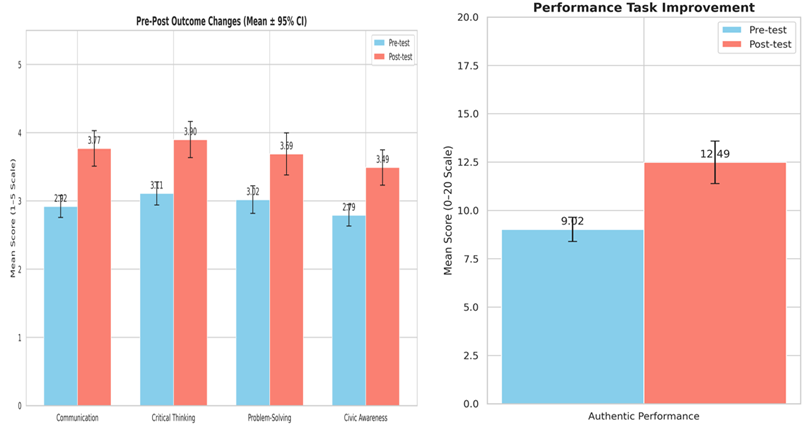
The quantitative findings indicate consistent improvements across all measured outcomes following the ESEF intervention. Table 4 summarizes the pre–post comparisons, effect sizes, and confidence intervals for the main study variables.
6.1. Quantitative ResultsAll outcomes improved significantly from pre- to post-test. Communication showed a mean increase of 0.85 points (d = .84, 95% CI [.59, 1.11]), critical thinking increased by 0.79 points (d = .82, 95% CI [.54, 1.03]), problem-solving increased by 0.67 points (d = .79, 95% CI [.45, .90]), civic awareness increased by 0.70 points (d = .79, 95% CI [.47, .92]), and the authentic performance task improved by 3.47 points (d = .98, 95% CI [2.56, 4.38]).
Holm-adjusted p-values remained significant for all four main outcomes (adjusted p < .001), indicating the pattern is not an artifact of multiple testing.

Four themes explained how the intervention produced change and why civic competence did not "drop out" of integration.
• Theme 1: "English became part of my trade, not a separate subject" Students described a shift from viewing English as generic schooling to seeing it as vocational participation.
• "Before this class, English was memorizing words and grammar exercises. Now it's the report I would actually write in the workshop. I feel like I'm learning my job, not just a language." (Student 23, Focus Group 1)
• Theme 2: Sustainability problems created 'seriousness' and motivation Sustainability scenarios were repeatedly framed as real, consequential, and future-oriented.
• "When we talk about waste and energy costs, it's not just class. It's real money. It's our reputation. It makes you want to find the right words." (Student 45, Focus Group 2)
• Theme 3: Civic voice was learned as a workplace practice Civic awareness increased because "voice" was embedded in workplace ethics and reporting.
• "We practiced how to disagree respectfully in a toolbox meeting and still be professional. I never thought about 'rights' at work before. Now I know I can speak up about safety without being punished." (Student 31, Focus Group 3)
• Theme 4: Constraints and uneven starting points Students reported time pressure, varying proficiency, and fear of speaking as constraints.
• "If you are weak in English, you need more scaffolding. Sometimes I only copied what my partner said because I was afraid to make mistakes." (Student 19, Focus Group 1)
This study provides evidence—quantitative outcome gains plus qualitative explanations—that vocational–academic integration can be designed to broaden citizenship preparation rather than narrow it. The ESEF intervention uses sustainability as an authentic problem space where vocational practice, academic reasoning, and civic agency are naturally interdependent. In this sense, sustainability serves as a structural bridge for dual integration.
The effect sizes (d = .79–.98) are comparable to or larger than those reported in similar ESP/CLIL intervention studies 12, suggesting practical significance. Notably, civic awareness gains (d = .79) matched problem-solving gains, countering the concern that civic outcomes are inherently harder to achieve in integrated settings.
This study demonstrates how TVET can avoid "worker-only" integration by deploying ESP-mediated sustainability tasks that simultaneously build employability and civic competence. The contribution is both conceptual (ESEF, DIM) and practical (replicable intervention), offering a solution-oriented advance beyond descriptive accounts of integration and exclusion. The findings suggest that when democratic "voice" is embedded into sustainability-relevant workplace scenarios, integration can broaden rather than narrow citizenship preparation—a crucial finding for VET systems navigating employability pressures and broader educational missions.
| [1] | OECD. (2025). Vocational education and training (VET) and the green transition. OECD Publishing. | ||
| In article | |||
| [2] | Wheelahan, L. (2007). How competency-based training locks the working class out of powerful knowledge: A modified Bernsteinian analysis.British Journal of Sociology of Education, 28(5), 637-651. | ||
| In article | View Article | ||
| [3] | Nylund, M., Ledman, K., Rosvall, P.-Å., & Rönnlund, M. (2020). Socialization and citizenship preparation in vocational education: Pedagogic codes and democratic rights in VET-subjects. British Journal of Sociology of Education, 41(1), 1-17. | ||
| In article | View Article | ||
| [4] | Ekström, L. (2026). What is integrated and what is excluded? Exploring vocational–academic integration in civics education in Swedish VET.Journal of Vocational Education & Training. | ||
| In article | View Article | ||
| [5] | Vision 2030 Kingdom of Saudi Arabia. (2016). Saudi Vision 2030. Government of Saudi Arabia. | ||
| In article | |||
| [6] | UNESCO. (2020). Education for sustainable development: A roadmap (ESD for 2030). UNESCO. | ||
| In article | |||
| [7] | Baartman, L. K. J., & de Bruijn, E. (2018). Integrating knowledge, skills and attitudes: Conceptualizing learning processes towards vocational competence. Educational Research Review, 24, 1-14. | ||
| In article | |||
| [8] | Orozco, M., Gijbels, D., & Timmerman, C. (2021). Conceiving the relationship between theory and practice in T-VET: An in-depth study on key actors' epistemological perspectives. Journal of Vocational Education & Training, 73(3), 392-412. | ||
| In article | View Article | ||
| [9] | Rosvall, P.-Å., & Nylund, M. (2022). Civic education in VET: Concepts for a professional language in VET teaching and VET teacher education. Journal of Vocational Education & Training. | ||
| In article | View Article | ||
| [10] | Bernstein, B. (2000). Pedagogy, symbolic control and identity: Theory, research, critique (Rev. ed.). Rowman & Littlefield. | ||
| In article | View Article | ||
| [11] | Westheimer, J., & Kahne, J. (2004). What kind of citizen? The politics of educating for democracy. American Educational Research Journal, 41(2), 237-269. | ||
| In article | View Article | ||
| [12] | Wildeman, E., Koopman, M., & Beijaard, D. (2023). Content and language integrated learning in technical vocational education: Teachers' practical knowledge and teaching behaviour. Journal of Vocational Education & Training. | ||
| In article | View Article | ||
| [13] | Basturkmen, H. (2010). Developing courses in English for specific purposes. Palgrave Macmillan. | ||
| In article | View Article | ||
| [14] | Anthony, L. (2018). Introducing English for specific purposes. Routledge. | ||
| In article | View Article | ||
| [15] | Lave, J., & Wenger, E. (1991). Situated learning: Legitimate peripheral participation. Cambridge University Press. | ||
| In article | View Article | ||
| [16] | Wiek, A., Withycombe, L., & Redman, C. L. (2011). Key competencies in sustainability: A reference framework for academic program development. Sustainability Science, 6(2), 203-218. | ||
| In article | View Article | ||
| [17] | Chen, P. (2025). Green skills in logistics vocational education: A comparative study of curriculum integration in China and Germany. International Journal of Training and Development, 29(2). | ||
| In article | View Article | ||
| [18] | Brundiers, K., Barth, M., Cebrián, G., et al. (2021). Key competencies in sustainability in higher education—Toward an agreed-upon reference framework. Sustainability Science, 16(1), 13-29. | ||
| In article | View Article | ||
| [19] | Clarke, M. (2018). Rethinking graduate employability: The role of capital, individual attributes and context. Studies in Higher Education, 43(11), 1923-1937. | ||
| In article | View Article | ||
| [20] | Creswell, J. W., & Plano Clark, V. L. (2018). Designing and conducting mixed methods research (3rd ed.). SAGE. | ||
| In article | |||
| [21] | Braun, V., & Clarke, V. (2006). Using thematic analysis in psychology. Qualitative Research in Psychology, 3(2), 77-101. | ||
| In article | View Article | ||
Published with license by Science and Education Publishing, Copyright © 2026 Abdullah M.A. Alhomaidan
 This work is licensed under a Creative Commons Attribution 4.0 International License. To view a copy of this license, visit
http://creativecommons.org/licenses/by/4.0/
This work is licensed under a Creative Commons Attribution 4.0 International License. To view a copy of this license, visit
http://creativecommons.org/licenses/by/4.0/
| [1] | OECD. (2025). Vocational education and training (VET) and the green transition. OECD Publishing. | ||
| In article | |||
| [2] | Wheelahan, L. (2007). How competency-based training locks the working class out of powerful knowledge: A modified Bernsteinian analysis.British Journal of Sociology of Education, 28(5), 637-651. | ||
| In article | View Article | ||
| [3] | Nylund, M., Ledman, K., Rosvall, P.-Å., & Rönnlund, M. (2020). Socialization and citizenship preparation in vocational education: Pedagogic codes and democratic rights in VET-subjects. British Journal of Sociology of Education, 41(1), 1-17. | ||
| In article | View Article | ||
| [4] | Ekström, L. (2026). What is integrated and what is excluded? Exploring vocational–academic integration in civics education in Swedish VET.Journal of Vocational Education & Training. | ||
| In article | View Article | ||
| [5] | Vision 2030 Kingdom of Saudi Arabia. (2016). Saudi Vision 2030. Government of Saudi Arabia. | ||
| In article | |||
| [6] | UNESCO. (2020). Education for sustainable development: A roadmap (ESD for 2030). UNESCO. | ||
| In article | |||
| [7] | Baartman, L. K. J., & de Bruijn, E. (2018). Integrating knowledge, skills and attitudes: Conceptualizing learning processes towards vocational competence. Educational Research Review, 24, 1-14. | ||
| In article | |||
| [8] | Orozco, M., Gijbels, D., & Timmerman, C. (2021). Conceiving the relationship between theory and practice in T-VET: An in-depth study on key actors' epistemological perspectives. Journal of Vocational Education & Training, 73(3), 392-412. | ||
| In article | View Article | ||
| [9] | Rosvall, P.-Å., & Nylund, M. (2022). Civic education in VET: Concepts for a professional language in VET teaching and VET teacher education. Journal of Vocational Education & Training. | ||
| In article | View Article | ||
| [10] | Bernstein, B. (2000). Pedagogy, symbolic control and identity: Theory, research, critique (Rev. ed.). Rowman & Littlefield. | ||
| In article | View Article | ||
| [11] | Westheimer, J., & Kahne, J. (2004). What kind of citizen? The politics of educating for democracy. American Educational Research Journal, 41(2), 237-269. | ||
| In article | View Article | ||
| [12] | Wildeman, E., Koopman, M., & Beijaard, D. (2023). Content and language integrated learning in technical vocational education: Teachers' practical knowledge and teaching behaviour. Journal of Vocational Education & Training. | ||
| In article | View Article | ||
| [13] | Basturkmen, H. (2010). Developing courses in English for specific purposes. Palgrave Macmillan. | ||
| In article | View Article | ||
| [14] | Anthony, L. (2018). Introducing English for specific purposes. Routledge. | ||
| In article | View Article | ||
| [15] | Lave, J., & Wenger, E. (1991). Situated learning: Legitimate peripheral participation. Cambridge University Press. | ||
| In article | View Article | ||
| [16] | Wiek, A., Withycombe, L., & Redman, C. L. (2011). Key competencies in sustainability: A reference framework for academic program development. Sustainability Science, 6(2), 203-218. | ||
| In article | View Article | ||
| [17] | Chen, P. (2025). Green skills in logistics vocational education: A comparative study of curriculum integration in China and Germany. International Journal of Training and Development, 29(2). | ||
| In article | View Article | ||
| [18] | Brundiers, K., Barth, M., Cebrián, G., et al. (2021). Key competencies in sustainability in higher education—Toward an agreed-upon reference framework. Sustainability Science, 16(1), 13-29. | ||
| In article | View Article | ||
| [19] | Clarke, M. (2018). Rethinking graduate employability: The role of capital, individual attributes and context. Studies in Higher Education, 43(11), 1923-1937. | ||
| In article | View Article | ||
| [20] | Creswell, J. W., & Plano Clark, V. L. (2018). Designing and conducting mixed methods research (3rd ed.). SAGE. | ||
| In article | |||
| [21] | Braun, V., & Clarke, V. (2006). Using thematic analysis in psychology. Qualitative Research in Psychology, 3(2), 77-101. | ||
| In article | View Article | ||