Moral education remains a central mission of schooling in societies shaped by Confucian traditions, where teachers are expected to function not only as transmitters of knowledge but also as moral exemplars. In Vietnam, Confucian Heritage Culture continues to exert a strong influence on educational values, teacher professionalism, and moral expectations, while contemporary educational reforms increasingly emphasise competency-based learning and learner-centred pedagogy. This coexistence creates both opportunities and tensions for primary teachers, who must reconcile inherited moral traditions with modern pedagogical demands. Despite growing international scholarship on Confucian Heritage Culture, existing studies have largely focused on students’ learning behaviours or system-level characteristics, offering limited conceptual insight into how teachers mediate, reinterpret, and enact Confucian moral values in everyday educational practice. Addressing this gap, the present paper adopts a conceptual approach to examine the role of Confucian Heritage Culture in shaping moral education practices among Vietnamese primary teachers. Drawing on key international literature on Confucian Heritage Culture and moral education, the paper proposes a conceptual framework that conceptualises Confucian Heritage Culture as a dynamic cultural resource operating across four interrelated dimensions: cultural moral values, teacher moral identity, moral education pedagogical practices, and adaptive strategies in response to contemporary educational tensions. The framework foregrounds teachers as active cultural agents who interpret, enact, and transform Confucian moral values within modern primary classrooms. By reconceptualising moral education as a culturally mediated and professionally enacted process, this study contributes theoretically to the literature on Confucian Heritage Culture and moral education, and offers implications for teacher education, moral education policy, and culturally responsive pedagogical reform in Vietnam and other Confucian-influenced educational contexts.
Moral education has consistently been regarded as a core mission of schooling, particularly in societies where education is closely intertwined with cultural traditions and ethical philosophies. In contemporary educational discourse, moral education is increasingly understood not only as the transmission of normative values but also as a socially situated process shaped by teachers’ professional identities, pedagogical practices, and institutional contexts. At the primary level, where children’s moral dispositions and social behaviours are first systematically cultivated, teachers play a particularly influential role as both educators and moral agents.
In East Asian societies influenced by Confucian philosophy, moral education is deeply embedded in long-standing cultural traditions. Confucian Heritage Culture (CHC) is commonly used in comparative education to describe a constellation of moral values and social norms derived from Confucian thought, including respect for teachers, moral self-cultivation, hierarchical social relations, and collective responsibility 1, 2, 3. These values have historically shaped educational purposes, teacher-student relationships, and expectations of the teaching profession across Confucian-influenced societies.
Existing international scholarship on CHC has provided valuable insights into its influence on student learning behaviours, academic achievement, and educational leadership. At the same time, scholars have increasingly recognised the tensions that may arise between Confucian moral traditions and contemporary educational paradigms emphasising learner autonomy, critical thinking, and creativity 4, 5. However, much of this literature has focused on learners or system-level characteristics, leaving the role of teachers - particularly as cultural mediators of moral values - relatively under-theorised.
This gap is especially salient in the Vietnamese context. As a society profoundly shaped by Confucian traditions, Vietnam has long positioned moral education as a foundational goal of schooling, reinforced by cultural principles such as tôn sư trọng đạo (respect for teachers and moral authority) and tu thân (moral self-cultivation) 6, 7. At the same time, Vietnamese education is undergoing significant transformation. The implementation of the 2018 General Education Curriculum marks a shift towards competency-based education, learner-centred pedagogy, and the holistic development of students’ qualities and competencies 8. Within this reform-oriented context, primary teachers are expected not only to uphold traditional moral responsibilities but also to adopt new pedagogical roles aligned with contemporary educational objectives.
Researchers in moral and philosophical education have conceptualised teachers not merely as implementers of curriculum, but as moral agents whose professional identities, ethical judgements, and everyday practices shape the moral climate of classrooms 9, 10. The coexistence of Confucian moral expectations and policy-driven educational reform places Vietnamese primary teachers in a complex professional position. Unlike in many Western contexts, primary teachers in Vietnam are socially and institutionally expected to assume extended moral responsibilities that go beyond classroom instruction, encompassing students’ character formation, behavioural regulation, and moral socialisation. Yet how teachers interpret, negotiate, and enact Confucian moral values within the constraints and possibilities of contemporary educational reform remains insufficiently theorised.
Addressing this conceptual gap, the present paper adopts a conceptual approach to examine the role of CHC in shaping moral education practices among Vietnamese primary teachers. Rather than reiterating established accounts of Confucian values, the study reconceptualises CHC as a dynamic cultural resource that operates through teachers’ moral identities, pedagogical practices, and adaptive responses to educational tensions. By synthesising international CHC scholarship with the specific policy and cultural context of Vietnam, the paper proposes a conceptual framework that foregrounds teachers as active cultural agents mediating moral continuity and pedagogical change in primary education.
CHC has been widely discussed in comparative education and cultural studies as a historically grounded yet dynamically evolving cultural-educational construct. Rather than referring solely to Confucian philosophy as a system of classical thought, CHC is commonly used to describe a constellation of moral values, social norms, and educational orientations that continue to shape schooling practices in Confucian-influenced societies. From this perspective, CHC operates not as a static legacy of the past but as a cultural framework through which educational purposes, professional expectations, and pedagogical practices are interpreted and enacted.
Early scholarship on CHC emphasised its influence on learning orientations, particularly in East Asian contexts. Biggs 1 and Watkins and Biggs 2 argue that Confucian-influenced educational cultures place strong emphasis on effort, perseverance, respect for teachers, and moral discipline, challenging Western assumptions about passive learning and rote memorisation. Subsequent studies have further conceptualised CHC as an educational orientation that integrates moral cultivation with academic learning, positioning education as a moral endeavour rather than a purely cognitive enterprise. Marginson 3, for instance, highlights that CHC underpins distinctive forms of educational aspiration and professional commitment, particularly in societies where teachers are entrusted with both intellectual and ethical responsibilities.
Within this body of scholarship, moral education occupies a central position. Confucian thought foregrounds moral self-cultivation as a lifelong process, guided by virtues such as Nhân (humaneness), Lễ (propriety), Nghĩa (righteousness), Trí (wisdom), and Tín (trustworthiness). Importantly, these virtues are not conceptualised as abstract principles to be transmitted through formal instruction alone, but as ethical dispositions to be embodied and enacted in everyday social relations. In educational settings, this emphasis gives rise to pedagogical traditions in which moral learning is closely intertwined with relational practices, exemplarity, and the cultivation of appropriate conduct.
At the same time, contemporary scholarship has increasingly problematised essentialised or monolithic interpretations of CHC. While Confucian moral traditions have been associated with strong professional responsibility and social cohesion, they may also generate tensions when intersecting with modern educational paradigms that prioritise learner autonomy, critical inquiry, and participatory pedagogy 4, 5. These tensions suggest that CHC should not be understood in binary terms - as either an educational asset or a constraint - but rather as a cultural resource that is selectively interpreted, negotiated, and transformed within specific institutional and pedagogical contexts.
Conceptualising CHC as a cultural-educational construct thus requires attention to both continuity and change. It involves recognising the enduring influence of Confucian moral values while also accounting for the ways in which these values are recontextualised in response to contemporary educational demands. This perspective provides an important theoretical foundation for examining how moral education is shaped not only by inherited cultural traditions but also by the professional agency of educators operating within evolving educational systems.
Vietnam represents a distinctive case within Confucian-influenced educational systems due to the enduring presence of Confucian moral traditions alongside socialist educational ideals and contemporary reform-oriented policies. Historically, Vietnamese schooling has been closely associated with moral formation, viewing education as a means of cultivating ethically grounded individuals who contribute to family, community, and society 6. Within this tradition, teachers have been accorded a morally authoritative role, reflected in cultural principles such as tôn sư trọng đạo (respect for teachers and moral authority) and học để làm người (learning to become a moral person).
In contemporary Vietnam, moral education remains a central objective of primary education, particularly given the formative role of early schooling in shaping children’s values, behaviours, and social dispositions 11. Primary teachers are widely expected to assume responsibilities that extend beyond academic instruction, encompassing character formation, behavioural regulation, and moral socialisation. These expectations are reinforced through policy discourse, curricular frameworks, and community norms, positioning teachers as key moral figures in children’s everyday lives.
At the same time, Vietnam’s education system is undergoing significant transformation. The implementation of the 2018 General Education Curriculum 8 marks a strategic shift towards competency-based education, learner-centred pedagogy, and the holistic development of students’ qualities and competencies. This reform agenda promotes pedagogical approaches that emphasise student agency, critical thinking, creativity, and participatory learning. For primary teachers, these changes entail a reconfiguration of professional roles, requiring them to move beyond traditional authoritative practices towards more facilitative and dialogic forms of teaching.
The intersection of Confucian moral expectations and policy-driven pedagogical reform creates a complex professional landscape for Vietnamese primary teachers. On the one hand, teachers are expected to maintain moral authority and serve as ethical exemplars; on the other, they are encouraged to foster learner autonomy and flexible classroom interactions. Navigating these potentially competing demands requires teachers to continuously interpret and adapt inherited moral values within contemporary instructional contexts, rather than simply reproducing established traditions.
Despite the significance of these dynamics, existing Vietnamese scholarship on Confucian influences in education has largely remained descriptive or normative, focusing on philosophical foundations or idealised moral goals. There has been comparatively limited theoretical attention to how teachers actively mediate cultural heritage in their professional practices, particularly under conditions of ongoing educational reform. As a result, the processes through which moral values are translated into everyday pedagogical decisions remain insufficiently conceptualised.
This study addresses this gap by situating Vietnamese primary teachers at the centre of moral education analysis. By conceptualising teachers as professional actors who negotiate cultural continuity and pedagogical change, the paper highlights the need for a framework that captures the dynamic relationship between inherited moral traditions, teacher moral identity, and contemporary educational practices in Vietnam’s primary education system. This context-sensitive perspective provides a foundation for understanding moral education not as a static transmission of values, but as a culturally mediated and professionally enacted process.
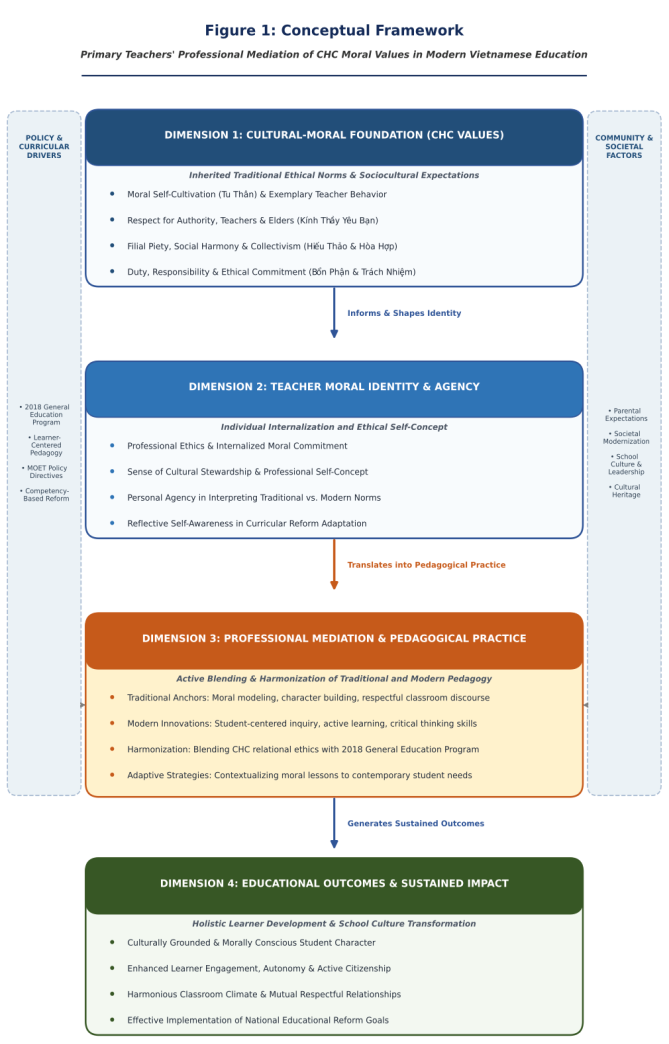
Building on the theoretical discussion of CHC and the contextual analysis of moral education in Vietnam, this section introduces a conceptual framework designed to explain how Confucian moral values are translated into moral education practices through teachers’ professional roles. Rather than reiterating cultural or policy backgrounds, the framework focuses on the mediating processes that connect cultural values, teacher moral identity, and pedagogical enactment.
The framework conceptualises moral education as a dynamic and recursive process in which teachers actively interpret and negotiate inherited moral values within their everyday professional practices. In doing so, it shifts analytical attention away from static representations of culture towards the mechanisms through which moral meanings are constructed, enacted, and adapted in contemporary educational settings.
4.2. Structure of the Conceptual FrameworkThe proposed framework consists of four interrelated components: (1) cultural moral values, (2) teacher moral identity, (3) moral education pedagogical practices, and (4) tensions and adaptive strategies. These components are analytically distinct but mutually constitutive, forming a coherent process through which moral education is enacted.
4.3. Cultural Moral Values as an Interpretive ResourceAt the first level, cultural moral values are conceptualised as an interpretive resource rather than a prescriptive set of norms. These values provide teachers with a moral vocabulary through which they make sense of their professional responsibilities and pedagogical decisions. Importantly, the framework does not assume a direct or uniform influence of cultural values on practice. Instead, cultural moral values shape the horizons of meaning within which teachers interpret what it means to act ethically and professionally in educational contexts.
4.4. Teacher Moral Identity as a Mediating ConstructTeacher moral identity occupies a central mediating position within the framework. It refers to the ways in which teachers internalise, prioritise, and embody moral expectations in relation to their professional roles. Moral identity is not treated as a fixed personal attribute, but as a socially and professionally constructed orientation that is continually shaped through interaction with students, colleagues, and institutional norms.
By foregrounding teacher moral identity, the framework highlights teachers as active moral agents whose professional self-understandings mediate the relationship between cultural values and pedagogical action. This mediating role explains why similar cultural values may be enacted differently across classrooms and contexts.
4.5. Moral Education Pedagogical PracticesAt the level of practice, teacher moral identity is enacted through a range of pedagogical strategies that embed moral learning within everyday classroom interactions. These practices include modelling ethical behaviour, establishing relational forms of discipline, guiding students’ moral reasoning, and engaging in moral dialogue. Moral education is thus conceptualised not as a discrete curricular component but as an integral dimension of teaching practice that permeates classroom life.
The framework emphasises that such practices are shaped not only by teachers’ moral commitments but also by situational demands and pedagogical judgments, reinforcing the need to understand moral education as contextually situated and professionally enacted.
4.6. Tensions and Adaptive StrategiesThe final component of the framework addresses the tensions that emerge when cultural moral expectations intersect with contemporary pedagogical demands. Rather than treating these tensions as deficits or obstacles, the framework conceptualises them as productive sites of adaptation. Teachers respond to tensions - such as those between authority and student agency or discipline and autonomy - by selectively reinterpreting moral values and adjusting their pedagogical practices.
These adaptive strategies give rise to what the framework terms adaptive Confucian moral pedagogy, a hybrid form of moral education that integrates cultural continuity with pedagogical change. A feedback loop from this adaptive process back to teacher moral identity captures the recursive nature of moral practice, illustrating how teachers’ experiences of adaptation reshape their ongoing moral self-understandings.

By integrating cultural moral values, teacher moral identity, pedagogical practices, and adaptive strategies into a single analytical model, the framework offers a coherent lens for examining moral education as a culturally mediated and professionally enacted process. It avoids deterministic accounts of cultural influence and instead foregrounds teacher agency and professional judgment. This conceptualisation provides a foundation for future empirical research and comparative studies that seek to understand moral education in reform-oriented and culturally diverse educational systems.
This paper has advanced a conceptual understanding of moral education by re-examining the role of CHC through the lens of teacher professionalism in contemporary primary education. Rather than treating Confucian moral values as static cultural determinants or abstract philosophical ideals, the study has foregrounded teachers as active mediators who interpret, enact, and adapt these values within evolving educational contexts. In doing so, the paper shifts analytical attention from cultural influence as an external force to moral practice as a professionally enacted and contextually situated process.
The primary theoretical contribution of this study lies in its reconceptualisation of CHC as a dynamic cultural resource that operates through teacher moral identity and pedagogical agency. Existing CHC scholarship has predominantly focused on learners’ behaviours or system-level characteristics, often overlooking the mediating role of teachers in translating moral values into everyday educational practice. By positioning teachers at the centre of analysis, this paper extends the CHC literature beyond student-centred and outcome-oriented perspectives, offering a more nuanced account of how moral education is shaped through professional judgement and interaction.
Furthermore, the study contributes to moral education research by conceptualising moral education not as a discrete curricular domain but as an integral dimension of teaching practice embedded in classroom relationships, disciplinary interactions, and pedagogical decision-making. This perspective challenges instrumental or prescriptive approaches to moral education and underscores the importance of examining the moral dimensions of routine teaching practices. It also highlights the need to move beyond binary evaluations of Confucian traditions as either enabling or constraining, instead recognising the adaptive and hybrid forms of moral pedagogy that emerge in reform-oriented educational systems.
From a contextual perspective, the paper offers insights into the particular case of Vietnam as a Confucian-influenced society undergoing significant educational transformation. By situating teachers’ moral work within a policy environment characterised by competency-based reform and learner-centred pedagogy, the study illustrates how cultural continuity and pedagogical change are negotiated at the level of professional practice. While the framework is grounded in the Vietnamese context, its conceptual implications extend to other Confucian-influenced and reform-oriented educational systems, where teachers similarly navigate tensions between inherited moral expectations and contemporary pedagogical demands.
Several implications arise from this conceptual contribution. For teacher education, the findings suggest the importance of supporting teachers’ critical reflection on cultural values and moral responsibilities, rather than assuming a straightforward transmission of tradition. Teacher education programmes may benefit from explicitly addressing moral identity formation and the pedagogical enactment of values in diverse classroom contexts. For educational policy, the study underscores the need to recognise teachers’ moral agency and professional judgement when designing and implementing moral education reforms.
As a conceptual study, this paper does not offer empirical evidence, which may be seen as a limitation. However, its primary purpose is theoretical clarification and framework development. Future empirical research may build on this framework to examine how teachers’ moral identities and practices are shaped in specific institutional settings, using qualitative or mixed-methods approaches. Comparative studies across Confucian-influenced societies may also further refine understanding of how moral education is mediated through professional practice under different cultural and policy conditions.
In conclusion, by foregrounding teachers as moral and cultural agents, this study provides a theoretically grounded and context-sensitive contribution to the literature on Confucian Heritage Culture and moral education. It invites further scholarly engagement with the moral dimensions of teaching as a dynamic and professionally enacted process, particularly in societies navigating the intersection of cultural tradition and educational reform.
This research is supported by the Vietnam National Science and Technology Development Fund (NAFOSTED) under grant code: 501.01-2023.17.
| [1] | Biggs, J. B., "Western misperceptions of the Confucian-heritage learning culture," in The Chinese learner: Cultural, psychological and contextual influences, D. A. Watkins & J. B. Biggs, Eds., Comparative Education Research Centre & Australian Council for Educational Research, 1996, pp. 45–67. | ||
| In article | |||
| [2] | Watkins, D. A. and Biggs, J. B., Eds., Teaching the Chinese learner: Psychological and pedagogical perspectives, Comparative Education Research Centre & Australian Council for Educational Research, 2001. | ||
| In article | |||
| [3] | Marginson, S., "Higher education in East Asia and Singapore: Rise of the Confucian model," Higher Education, 61 (5), 587–611, 2011. | ||
| In article | View Article | ||
| [4] | Chan, E. Y. M., "Blended learning dilemma: Teacher education in the Confucian heritage culture," Asia Pacific Journal of Education, 39 (4), 536–550, 2019. | ||
| In article | |||
| [5] | Tan, C. and Liu, W., "Confucianism and education," in Encyclopedia of educational philosophy and theory, M. A. Peters, Ed., Springer, 2018, pp. 1–6. | ||
| In article | View Article | ||
| [6] | Hằng, N. V. T., Meijer, M. R., Bulte, A. and Pilot, A., "The implementation of a social constructivist approach in primary science education in Confucian heritage culture: the case of Vietnam," Cultural Studies of Science Education, 10 (3), 665–693, 2015. | ||
| In article | View Article | ||
| [7] | Hằng, N. V. T., "The Influences of Confucian Heritage Culture on Education and Teaching Activities in Vietnam," European Journal of East Asian Studies. | ||
| In article | |||
| [8] | MOET, "General Education Curricula 2018," Ministry of Education and Training, Vietnam, 2018. | ||
| In article | |||
| [9] | Sockett, H., The moral base for teacher professionalism, Teachers College Press, New York, 1993. | ||
| In article | |||
| [10] | Hansen, D. T., Exploring the moral heart of teaching: Toward a teacher’s creed, Teachers College Press, New York, 2001. | ||
| In article | |||
| [11] | Hằng, N. V. T., "The Implementation of Critical Thinking in Vietnamese Primary Moral Education Classes," Issues in Educational Research, 29 (3), 732–755, 2019. | ||
| In article | |||
| [12] | Confucius, The Analects, E. Slingerland, Trans., Hackett Publishing Company, 2003. | ||
| In article | |||
| [13] | Hansen, D. T., "Among school teachers: Bearing witness as an orientation in educational inquiry," Educational Theory, 67 (1), 9–30, 2017. | ||
| In article | View Article | ||
| [14] | Tu, W., Confucian traditions in East Asian modernity: Moral education and economic culture in Japan and the Four Mini-Dragons, Harvard University Press, 1996. | ||
| In article | |||
Published with license by Science and Education Publishing, Copyright © 2026 Nguyễn Thị Liên, Ngô Vũ Thu Hằng, Vũ Thị Ngọc Tú, Trương Thị Bích and Bùi Thị Thủy
 This work is licensed under a Creative Commons Attribution 4.0 International License. To view a copy of this license, visit
http://creativecommons.org/licenses/by/4.0/
| [1] | Biggs, J. B., "Western misperceptions of the Confucian-heritage learning culture," in The Chinese learner: Cultural, psychological and contextual influences, D. A. Watkins & J. B. Biggs, Eds., Comparative Education Research Centre & Australian Council for Educational Research, 1996, pp. 45–67. | ||
| In article | |||
| [2] | Watkins, D. A. and Biggs, J. B., Eds., Teaching the Chinese learner: Psychological and pedagogical perspectives, Comparative Education Research Centre & Australian Council for Educational Research, 2001. | ||
| In article | |||
| [3] | Marginson, S., "Higher education in East Asia and Singapore: Rise of the Confucian model," Higher Education, 61 (5), 587–611, 2011. | ||
| In article | View Article | ||
| [4] | Chan, E. Y. M., "Blended learning dilemma: Teacher education in the Confucian heritage culture," Asia Pacific Journal of Education, 39 (4), 536–550, 2019. | ||
| In article | |||
| [5] | Tan, C. and Liu, W., "Confucianism and education," in Encyclopedia of educational philosophy and theory, M. A. Peters, Ed., Springer, 2018, pp. 1–6. | ||
| In article | View Article | ||
| [6] | Hằng, N. V. T., Meijer, M. R., Bulte, A. and Pilot, A., "The implementation of a social constructivist approach in primary science education in Confucian heritage culture: the case of Vietnam," Cultural Studies of Science Education, 10 (3), 665–693, 2015. | ||
| In article | View Article | ||
| [7] | Hằng, N. V. T., "The Influences of Confucian Heritage Culture on Education and Teaching Activities in Vietnam," European Journal of East Asian Studies. | ||
| In article | |||
| [8] | MOET, "General Education Curricula 2018," Ministry of Education and Training, Vietnam, 2018. | ||
| In article | |||
| [9] | Sockett, H., The moral base for teacher professionalism, Teachers College Press, New York, 1993. | ||
| In article | |||
| [10] | Hansen, D. T., Exploring the moral heart of teaching: Toward a teacher’s creed, Teachers College Press, New York, 2001. | ||
| In article | |||
| [11] | Hằng, N. V. T., "The Implementation of Critical Thinking in Vietnamese Primary Moral Education Classes," Issues in Educational Research, 29 (3), 732–755, 2019. | ||
| In article | |||
| [12] | Confucius, The Analects, E. Slingerland, Trans., Hackett Publishing Company, 2003. | ||
| In article | |||
| [13] | Hansen, D. T., "Among school teachers: Bearing witness as an orientation in educational inquiry," Educational Theory, 67 (1), 9–30, 2017. | ||
| In article | View Article | ||
| [14] | Tu, W., Confucian traditions in East Asian modernity: Moral education and economic culture in Japan and the Four Mini-Dragons, Harvard University Press, 1996. | ||
| In article | |||