The aim of this approach is to support chemistry teacher students to better interconnect chemical contents during their studies. This is focused on university level and thereby referred on university course contents as we assume that at this point students are missing relevant interconnections among chemical subdisciplines. Therefore, we developed and tested a tool to better demonstrate the interconnectedness of chemistry topics. In a first step, an advance organizer in the form of a concept map was designed to help students to realize and internalize connections between chemical topics. The design of the concept map focusses on the required contents for prospective high school teachers. A case study was performed to investigate the effect of these concept maps on the students’ awareness of interconnections and their understanding of interconnection. They were interviewed, performed eye-tracking while working with a concept map and created interconnecting tasks to see if they could adapt the idea of interconnection. Additionally, the students had to write a learning diary based on key question during the whole length of the study. First results are available and will be described in this article.
Chemistry education students are not only meant to learn and understand chemistry contents but at the same time they are supposed to learn how to teach chemical contents in their future class. Therefore, the German curriculum - later in school - acts as a support by clearly defining the contents to teach and serving as a well-structured guide for teachers. But it also contains some basic, overarching principles that should be taught and that touch different subdisciplines of chemistry and combine them. By this, the curriculum demands to teach chemical contents in an interconnected way, which – according to literature 1 - newly-teachers are not well prepared for. It can be assumed that if interconnection is not gained by prospective teachers in university already, it will less likely occur in their school lessons later. In addition, in our teaching we were able observe general difficulties of our students’ understanding – not only in terms of a lack of interconnections, but also to some extent related to scientific incorrect classifications of contents and therefore incorrect interconnection in particular. For example, the basics of infrared (IR) spectra are originally located in the area of physical chemistry, but our students encounter them for the first time in a seminar of organic chemistry. That is why they tend to classify IR spectra to organic chemistry only (this was seen in a previous seminar, where students were asked to create their own concept map).
The interconnection of (specific) knowledge is described as “the inclusion and coordination of topics already dealt with” 2. According to this, the contents of subjects should not be viewed isolated but are in reciprocal relation to each other – as well as to prior knowledge 2.
The interconnection of knowledge can be classified into two categories: The vertical interconnection on the one hand and the horizontal interconnection on the other hand. Whereby the vertical interconnection means intra-subject and chronologically consecutive interconnections and the horizontal interconnection means the inter-subject interconnection, both mostly occurring parallel 2.
2.2. The Importance of InterconnectionFor chemistry teacher’s training the ‘Conference of the Ministers of Education in Germany (KMK)’ stated that the students “are able to structure chemical areas by identifying coherent questions, interconnections and establish references to school chemistry and their development.” 3. The acquisition of interconnected content knowledge seems to be of particular importance to future teachers as the quality of future teaching is closely linked to teachers’ professionalism: “Those who can, do; those who understand, will teach” – “to teach is first to understand” to this short formula, Shulman 4 brings the connection between the professional knowledge of a teacher, his teaching and the importance of his training (“first to understand”). Shulman has divided this professional knowledge into a total of seven categories whereat the three dimensions of content knowledge (CK), pedagogical content knowledge (PCK) and pedagogical knowledge (PK) are mostly focused at in investigations 5. According to Shulman, content knowledge is composed of different aspects: it is a multifaceted understanding of a given content and brings alternative explanations along, that are influencing the learners understanding considerably 4. “This […] places special demands on the teacher’s own depth of understanding of the structures of the subject matter” 4. In Shulman’s definition of content knowledge, the interconnection of given contents is therefore already implied 4. Borowski assumes that “content knowledge forms the possible frame for the development of pedagogical content knowledge for a successful class” 5, an assumption which is supported by Kirschner 6 and is in line with earlier results of Fischer et al. 1. According to them, a lack of interconnection of a teacher’s scientific offer or rather a lack of fit in the extent of interconnections between the teacher’s offers and the learner’s demands is a crucial factor for low increase in knowledge of a learner and thus directly influences the learning efficiency. This can be explained by the assumption that isolated, poorly interconnected knowledge of single facts is forgotten much more quickly than knowledge which is complexly processed and correspondingly well integrated into one’s own concept 2. So, we can summarize, that the interconnectedness of the teachers own content knowledge plays an important role in teaching. In this context, Shulman rises the important question which price would have to be paid if the professional competence of the teacher itself is to be regarded as limited due to deficits in his own training and thereby lacks relevant interconnections of the scientific contents 4. The fact that this is not a theoretical question, but describes a real problem, is shown by Lorentzen et al. 1. They identified that student teachers are often lacking relevant interconnections of the curricular contents for their future school lessons, so they tend to lose perception of relevant contents, especially the subject contents 1. This leads to the presumption that students are already having troubles in their own role as a learner in interconnecting content knowledge. For chemistry teachers-to-be, the traditional sub-areas of chemistry (inorganic, organic and physical chemistry) are usually taught separately during their studies, whereas a chemical phenomenon will never be explained holistically by looking at only one of those areas. It rather needs an interaction of the sub-areas and their respective concepts to fully understand a phenomenon – and hence students are often left alone with the work of bringing the perspectives together in an interconnected way in their framework of knowledge. Although the aspect of interconnecting content knowledge already is of great importance in the training of aspiring teachers, there are very few projects working in this area. While we are focusing on the university level and the teacher-to-be as learners themselves, the other approaches in this area often directly include school-teaching, like Eghtessad & Borchert 7, who are working on arrangements to better interconnect chemical contents with the contents to be taught later in school.
2.3. Understanding of Interconnection in This ProjectIn relation to this research project, the vertical interconnection can be seen as the interconnection within one chemical subdiscipline (e.g., organic chemistry) whereas the horizontal interconnection can be seen as the interconnection between two chemical subdisciplines (e.g., organic, and physical chemistry). Furthermore, interconnection can be understood as the “transfer of knowledge” from one discipline of chemistry to another, i.e., that content/knowledge from physical chemistry is used to explain phenomena from organic chemistry (e.g., color of organic molecules is explained with knowledge/concepts from physical chemistry). That means that explanatory approaches from physical chemistry are transferred and applied to organic chemistry to adequately explain (in this example) the color. Whereas giving this explanation is ‘doing’ or ‘using’ the interconnection, the recognition of the interconnection done/used and the awareness of its necessity is labelled as ‘the understanding of interconnection’ in our project.
Aims of our project:
1. Developing an intervention to help students to understand and to use interconnections of chemical knowledge.
2. Evaluate the effects of the approach developed.
In order to generate knowledge which is stable, interconnected and therefore permanently available, an effective transfer into the long-term memory is required. To this end, we have used the assimilation theory developed by David P. Ausubel 8. The assimilation theory explains the process of integrating new knowledge into a learner’s cognitive concept 8. The theory assumes that learning takes place through the development of new cognitive structures that contain the newly learned information 9. According to Ausubel, the cognitive structure is defined as: “individual’s organization, stability, and clarity of knowledge in a particular subject matter field at any given time. And it is hierarchically organized in terms of highly inclusive concepts under which are subsumed less inclusive subconcepts and informational data” 9. According to Ausubel’s view, the hierarchical arrangement of knowledge is comparable to the construction of a pyramid. The further at the top of the hierarchy such a concept is, the more “simple/basal” and also more durable it is. More complex concepts are correspondingly further down in the hierarchy, as they require more “space” on the one hand and represent deep knowledge on the other hand (deep knowledge means more deeply anchored in the hierarchy). New knowledge is aligned in this hierarchy by a specific process, called ‘subsumption’. In the course of the subsumption the new knowledge is connected to the already known concepts, i.e., the previous knowledge. These spots to which new knowledge is connected or anchored are the so-called “subsumers”, which serve as anchoring sites in the existing concepts. An important and sometimes controversial 10 approach of Ausubel’s theory is the advance organizer. The advance organizer is intended to serve as a tool that is used before an instruction is given to act as a bridge between what the learner already knows and what he should learn in the future 11. An advance organizer should help to show the learner where new information can be incorporated in relation to the prior knowledge of the respective content. It can therefore make clear which existing subsumer is the most useful for adding of new knowledge. In addition, it can also help to replace a learner’s missing concept, i.e., anchoring sites, in order to enable the learner to connect new information nevertheless 9.
An already proven form of an advance organizer is the concept map method developed by Joseph D. Novak in 1972. A concept map serves as a graphical tool to organize and present knowledge in a structured way 12. It includes concepts and make their relationships clear through connections. These concepts should be structured as hierarchically as possible 13. Similar to the hierarchical organization in Ausubel’s assimilation theory, a more general concept is at the top, with the more complex and more specific concepts placed on the lower levels. Concept maps can thus ensure to form a template for the organization of knowledge and help to structure the knowledge accordingly. In particular, they can ensure that different contexts are easily correctly assigned to a phenomenon and can ultimately prevent the emergence of misconceptions among learners 12. Interconnected learning with concept maps can ensure cumulative learning 2. International studies, especially in the USA, have shown that advance organizers in the form of concept maps have a positive effect on the understanding of chemistry 14. Some of these studies have investigated the effectiveness of concept maps in relation to the interconnection of chemistry and other natural sciences, such as biology 15, or concepts of chemistry (binding + electrons, electronegativity, binding geometry, etc.) 14. However, the interconnection of the chemical subdisciplines themselves, i.e., interconnections between inorganic, organic and physical chemistry, seemed to be left out so far. Therefore, in this project concept maps shall be used as means of intervention.
3.2. EvaluationAccording to the definition of interconnection in this project, there are two separate aspects that are to be examined more closely in this work – the interconnection on the content level and the understanding of interconnection. These aspects are separate in the way that being able to use interconnected chemical knowledge does not guarantee that one really is aware of having used interconnections as well as the other way around: knowing about the interconnections of chemical subdisciplines does not necessarily mean that one is able to use interconnected knowledge adequately. In other words, an adequate horizontal interconnection of contents does not ensure that the understanding of interconnection is as adequate. In order to finally bring both aspects together, there are four theoretical categories of how students could deal with interconnections that are important:
1. Interconnection adequate (IA)/Understanding of Interconnection adequate (UIA)
2. Interconnection adequate (IA)/Understanding of Interconnection inadequate (UII)
3. Interconnection inadequate (II)/Understanding of Interconnection adequate (UIA)
4. Interconnection inadequate (II)/Understanding of Interconnection inadequate (UII)
A major aim of this approach is to find out whether the interventions we have developed have a positive effect on the interconnection and the understanding of interconnection among students. Therefore, it is important to first gain an insight into the personal perception of the students and at the same time to follow the students’ development regarding their understanding of interconnection. Both should serve the purpose of being able to assess whether our Concept Maps are actually able to serve as a suitable help for interconnecting chemical contents and whether the interconnections can be made more accessible to students in the long term. Interviews are a suitable method for examining these inner processes in individuals 16. They offer the opportunity to follow people’s train of thoughts and, in particular, to understand them. This understanding of what is perceived by the participants can provide information on how (in this case) a tool can be designed to improve understanding of interconnection, and whether the materials that have already been worked out – Concept Map – are perceived as being helpful 17. To that end, a guided interview was chosen in order to produce data that are comparable between the individuals interviewed 18. From the developed key questions, categories were deductively developed and used to qualitatively evaluate the interviews according to Patton 19.
In the learning diaries, students should independently reflect on their own learning processes with regard to the intervention for interconnecting chemical contents. Learning diaries were used in addition to the interviews to make the inner processes, to which access is usually difficult, better available for us 20. During the interviews, students may feel overly scrutinized and experience a type of stress that may lead to more reserved responses. Like the interviews, the learning diaries are qualitatively evaluated following Patton 19. For the purpose of triangulation 21, the same categories are used as a basis, which at the same time leads to the results being backed from different perspectives (interview statements and learning diary statements).
In addition, the learning diary as a method can serve both as a measurement tool and as an intervention itself 20. By being asked to reflect on their own learning behavior, the students are offered a stimulus through which their own behavior can be viewed critically. In this way, one’s own strategies can be automatically evaluated and filtered according to successful and unsuccessful, so that the learning diary itself has an effect in the sense of an intervention 22.
In order to better understand possible effects of using concept maps to foster the perception of interconnections in chemistry it may be crucial to know how learners perceive the concept maps themselves and whether and to what extent the way students work with the concept map is related to their interconnection and their understanding of interconnection. Various studies provide indications that the individual handling of materials (whatever kind) has an influence on the learning process or rather on the metacognitive activation of the students 23. For example, Madsen et al. show that students give correct answers to problems when given a certain order of cues, while students without given cues tend to give wrong answers 24. Chen et al. were also able to show in their study that the specific order of the fixations (i.e., a point that is actively looked at) has an influence on the correct results of the students 25. This means, by a look at the literature it is reasonable to assume that there could be a relation between the way students work with the concept map and their interconnection and their understanding of interconnection. To record the way students work with the concept maps they were individually eye-tracked while using it. As we are interested in how the students are working with the concept map, we focused on their gaze paths, i.e., from which areas of interest (AOI) to which AOI they are looking instead of producing a heat map. As we are interested in the students’ pathways, the possible pathways were categorized as well. We distinguished between a total of four categories for the pathways:
++: path of interest, direct relation (i.e., structure to reaction)
+: relation existing – intermediate relation (i.e., kinetics to thermodynamics)
O: relation to guess, at least one relevant explaining step is missing (i.e., properties to reaction)
-: no helpful relation between the AOI’s” (i.e., structure analysis to chemical equilibrium)
The students’ pathways are assigned accordingly to the categories and the hits per category are being counted and then compared to their designated interconnection category that are based on an initial analysis of their first interview and learning diaries each. The next step is to analyze their eye tracking results.
At the end of the study, the students were asked to design so-called interconnection tasks themselves. They should select an experiment that requires contents of organic and physical chemistry in order to be explained holistically. For this purpose, tasks should be formulated in a way that interconnection is cognitively stimulated without being explicitly mentioned. The content of the experiment or rather the tasks should focus on university level. In addition, the students should justify their choice both professionally and educationally.
On the basis of these interconnection tasks, it is finally analyzed which effect the interventions and the use of the advance Organizer in the form of the concept map have on the students’ interconnection and their understanding of interconnection.
With regard to interconnection, the tasks are analyzed to see whether the interconnection itself is technically correct. In order to analyze the understanding of interconnection, it will be examined whether the interconnection tasks are cognitively activating, i.e., whether the interconnection is stimulated by the question itself. The tasks will further be examined in a seminar in the summer semester of 2023.
The interconnection tasks in this study primarily serve to evaluate the interventions, but such tasks developed by students themselves can also serve as an intervention itself in order to build up in-depth knowledge 26.
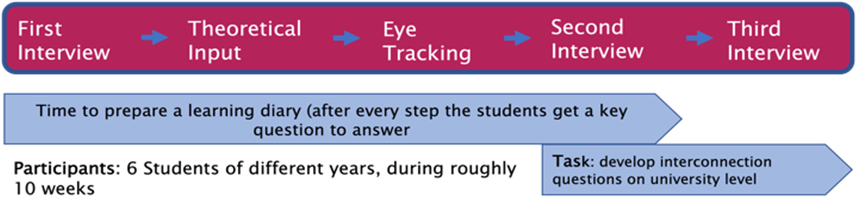
3.3. Case Study DesignAs the expected effects address the interconnectedness of the content knowledge in the students’ minds the most meaningful way of evaluation is a detailed exploration 27. Therefore, we decided to carry out case studies to evaluate the effect of the measures on individual students. The case study was designed as shown in the figure beneath. So far, in total six students of different years participated during approximately ten weeks in December 2020 and January 2021.
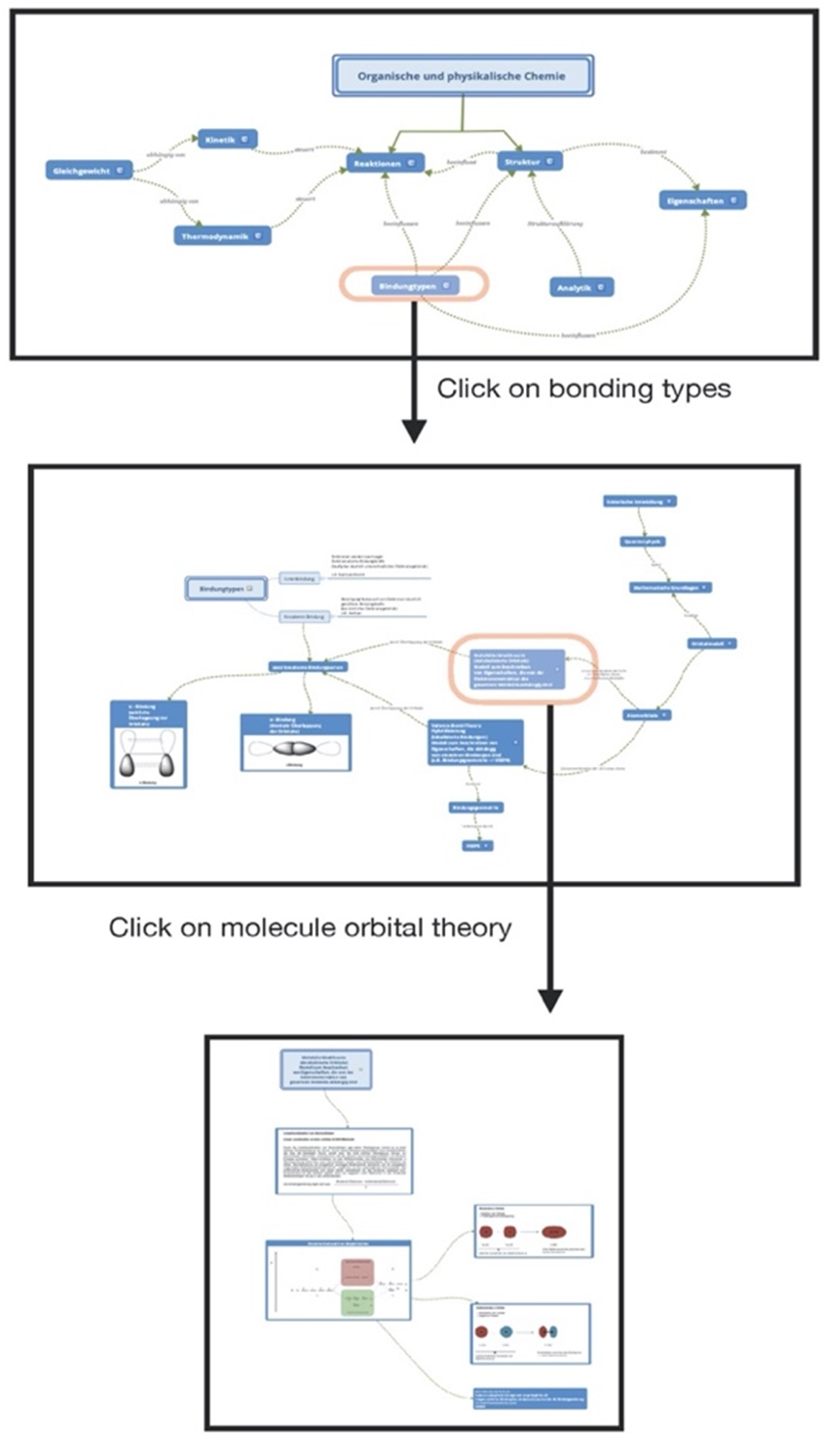
The initial plan regarding the design of the concept map was to create a concept map which interconnects all three chemical-subdisciplines (i.e., organic, physical, and inorganic chemistry). Since it turned out that this approach was more complex than expected and would have needed much more time, a concept map only for the two chemical subdisciplines physical and organic chemistry was created. It is important that the concept of interconnection becomes clear and interconnecting only two subdisciplines still serves to cognitively activate this concept. This means, by deciding to create a concept map only interconnecting two subdisciplines, we should still be able to measure an effect - if present. Nevertheless, while creating the concept map emphasis was placed on scientific depth since the subsequent interconnection of the subdisciplines can often not be seen in the context of a superficial but only in a more detailed examination of the topics. This concept map shows, for example, how the individual subdisciplines can jointly help to clarify the structures of compounds, as well as their properties and reactions. The contents of the concept map are based on an analysis of relevant national and international specialist literature, which was compared, summarized, and transferred accordingly to the concept map. Another important point was to integrate Ausubel’s idea of a hierarchical order of the contents since the concept map is meant to serve as an advance organizer. To create such an arrangement, the concept mapping tool ‘Xmind’ was used. An important feature of this concept map is that it is multilayered, so that by clicking on a concept students can obtain a concept map giving details to this very concept. These layers can be perfectly (inter-) connected with each other. This feature makes it easy to show the specific interconnections of the contents without the concept map becoming too overloaded and thereby confusing.

Based on an analysis of the first interview and the first entries in the learning diaries the participants were assigned to an interconnecting level in each category. So, we have Lara (names are anonymized) in category II/UIA, Pia in category II/UII, Olivia in category II/UIA and Frida in category IA/UIA, assigned according to the following reasons:
Excerpt Interview #1 (translated from German):
Interviewer:
Have you noticed any overlaps in the courses you have taken during your studies?
Student:
uh yes, I was able to find overlaps with PC and uh OC 2 [PC: physical chemistry; OC: organic chemistry], i.e., in the photochemistry lecture, uh, so photochemical overlaps uh otherwise hm so in chemistry education, of course, there are often references to the technical subdisciplines, so to speak, and there you still have references anyway to what you had from OC, AC or PC and I can't think of anything else.
Excerpt Interview#2 (translated from German):
Interviewer:
Would you say that your own understanding of interconnection changed after you used the map?
Student:
Definitely! Well, beforehand I would not have thought so consciously about the extent to which the individual things are interconnected with each other and that's why I also think that I understand the whole thing a little bit better through the interconnection, so to speak.
Excerpt Interview #3 (translated from German)
Interviewer:
(…) You have now dealt intensively with interconnection yourself. And now, of course, I would be interested in whether this has changed your attitude towards the understanding and meaning of interconnections. Could you elaborate this in terms of a learner’s and teacher’s point of view?
Student:
(…) For me as a learner these interconnections are (...) helpful for understanding chemistry and the content knowledge underlying it much better, so that I [uh] can explain it better (…) That means that I have a better content knowledge or a better understanding which is beneficial for me as a teacher in school anyway, [uh] that on the one hand I am confident in my content knowledge and know how everything works […] and then of course that I can also pass on the correct understanding to students (…).
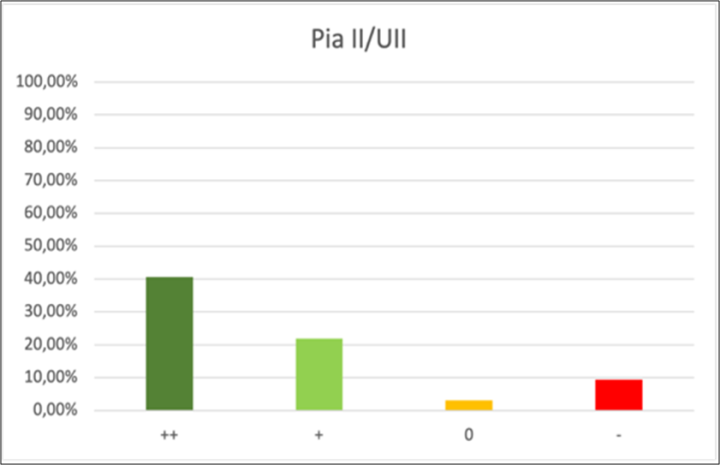
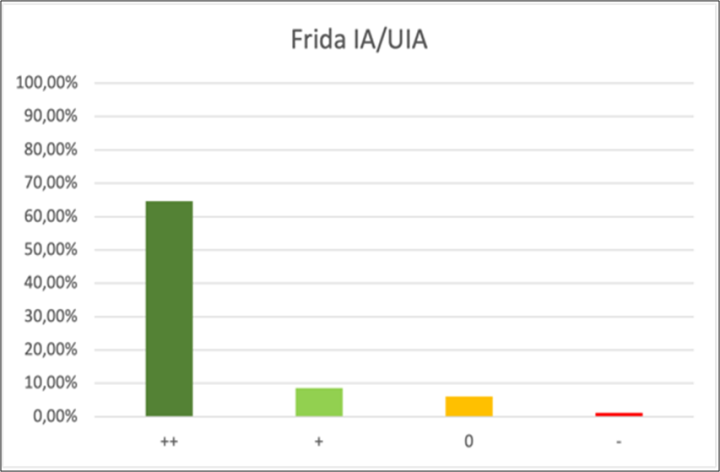
The analysis of the gaze paths described above (4.5. Overview – Eye-Tracking) results in a bar chart for each participant as shown for Pia and Frida beneath:

The results of our evaluation so far clearly show that on the one hand students do have different ideas and preconcepts about interconnection and it’s understanding and on the other hand that it is possible and appropriate to assign students to the defined categories concerning the use and the understanding of interconnection. We could also proof our assumption that an adequate interconnection does not ensure that one’s understanding of interconnection is as adequate: we found two cases (Lara and Olivia) who’s interconnection is assigned to be inadequate but their understanding of interconnection each assigned to be adequate.
Frida’s answers in the first interview excerpt shows what we already expected and therefore constitutes the reasoning for this approach: Most students only tend to notice the most obvious interconnections between chemical subdisciplines as this was the most common answer to this question but also tend to neglect less obvious but not less important interconnections.
The statements presented show that Frida thinks that dealing with our concept map is being helpful to better perceive and understand interconnections and to feel more confident in the broad field of chemistry according to future teaching. This trend was also seen in the interview statements of the other participants, so we can actually say that within our case-study working with a concept map had a positive effect on the students’ ability to interconnect knowledge or rather the chemical subdisciplines and their understanding of interconnection.
Looking at Pia and Frida (as an example) we can state that there are differences between the participants eye tracking results (for the first level/page of the concept map) and their interconnection/understanding of interconnection category. Frida stayed much longer on the first level than Pia did, which resulted in more total hits for Frida. A look at the hits’ quality shows that compared to Pia that Frida has more ‘++hits’ and less ‘-hits’. Frida is assigned in the categories interconnection adequate and understanding of interconnection adequate whereas Pia is assigned to both as inadequate. Comparing Pia’s and Frida’s assigned categories with their eye-tracking results indicates that there is a correlation between their interconnection/understanding of interconnection category and how they work with the concept map. The eye tracking results of Olivia and Lara also support our findings.
The results show that the concept map itself is being helpful for students’ interconnection and their understanding – at least for the students who participated in this case study. So, a next step would be to examine the effect of the same concept map on a larger group of prospective chemistry teachers to be able to make a general statement about its effect. Another future project could be to examine the question whether there is a need of help to work with the concept map adequately and how such help could possibly look like to be effective.
| [1] | Lorentzen, J., Friedrichs, G., Ropohl, M., & Steffensky, M. (2019). Förderung der wahrgenommenen Relevanz von fachlichen Studieninhalten: Evaluation einer Intervention im Lehramtsstudium Chemie. Unterrichtswissenschaft, 29-49. | ||
| In article | View Article | ||
| [2] | Fischer, H. E., Glemnitz, I., Kauertz, A., & Sumfleth, E. (2007). Auf Wissen aufbauen - kumulatives Lernen in Chemie und Physik. Physikdidaktik, 657-678. | ||
| In article | View Article | ||
| [3] | Kultusministerkonferenz. (2016). Ländergemeinsame inhaltliche Anforderungen für die Fachwissenschaften und Fachdidaktiken in der Lehrerbildung Ländergemeinsame inhaltliche Anforderungen für die Fachwissenschaften und Fachdidaktiken in der Lehrerbildung. 1-90. | ||
| In article | |||
| [4] | Shulman, L. (1986). Those Who Understand: Knowledge Growth in Teaching. Educational Researcher, 15(2), 4-14. | ||
| In article | View Article | ||
| [5] | Borowski, A., Neuhaus, B. J., Tepner, O., Wirth, J., Fischer, H. E., Leutner, D., … Sumfleth, E. (2010). Professionswissen von Lehrkräften in den Naturwissenschaften (ProwiN) - Kurzdarstellung des BMBF-Projekts [Professional Knowledge of Science Teachers (ProwiN) – A Brief Outline of the BMBF-Project]. Zeitschrift Für Didaktik Der Naturwissenschaften [Journal for Didactics of Science], 16, 341-350. | ||
| In article | |||
| [6] | Kirschner, S., Sczudlek, M., Tepner, O., Borowski, A., Fischer, H. E., Lenske, G., … Wirth, T. (2017). Professionswissenswissen in den Naturwissenschaften (ProwiN). In C. Gräsel & K. Trempler (Eds.), Entwicklung von Professionalität pädagogischen Personals. Interdisziplinäre Betrachtungen, Befunde und Perspektiven (pp. 113–130). Wiesbaden: Springer Fachmedien. | ||
| In article | View Article | ||
| [7] | Eghtessad, A., Borchert, C., & Höner, K. (2017). Expedition durch die Chemie – Fachwissen vernetze. (Jahrgangsstufe 10), 2017. | ||
| In article | |||
| [8] | Ausubel, D. P. (1960). The use of Advance Organizers in the Learning and retention of meaningful verbal material. Journal of Educational Psychology, 51, 267-272. | ||
| In article | View Article | ||
| [9] | Ausubel, D. P. (1962). A subsumption theory of meaningful verbal learning and retention. Journal of General Psychology, 66(2), 213-224. | ||
| In article | View Article PubMed | ||
| [10] | Barnes, B. R., & Clawson, E. U. (1975). Do Advance Organizers Facilitate Learning? Recommendations for Further Research Based on an Analysis of 32 Studies (Vol. 5). | ||
| In article | View Article | ||
| [11] | Denham, A. R. (2018). Using a digital game as an advance organizer. Educational Technology Research and Development, 66(1), 1-24. | ||
| In article | View Article | ||
| [12] | Novak. (2008). The Theory Underlying Concept Maps and How to Construct and Use Them. IHMC CmapTools, 1-36. | ||
| In article | |||
| [13] | Willerman, M., & Mac Harg, R. A. (1991). The concept map as an advance organizer. Journal of Research in Science Teaching, 28(8), 705-711. | ||
| In article | View Article | ||
| [14] | Nicoll, G., Francisco, J., & Nakhleh, M. (2001). An investigation of the value of using concept maps in general chemistry. Journal of Chemical Education, 78(8), 1111. | ||
| In article | View Article | ||
| [15] | Pernaa, J., & Aksela, M. (2008). Concept Maps as Meaningful Learning Tools in a Web-Based Chemistry Material. Third Int. Conference of Concept Mapping, 1(2002), 282-289. | ||
| In article | |||
| [16] | Seidman, I. (2006). Review of Interviewing as Qualitative Research: A Guide for Researchers in Education and the Social Sciences. In Contemporary Psychology: A Journal of Reviews (3rd ed., Vol. 37). New York: Teachers College Press. | ||
| In article | |||
| [17] | Kvale, S. (1996). The Interviews: An Introduction. In InterViews. An instriduction to qualitative research interviewing. London New Delhi: SAGE Publications, Inc. | ||
| In article | |||
| [18] | Froschauer, U., & Lueger, M. (2020). Das qualitative Interview (2. Auflage). Wien: utb. | ||
| In article | View Article | ||
| [19] | Patton, M. Q. (2014). Qualitative Research & Evaluation Methods. Integrating Theory and Practice (Fourth). Los Angeles: SAGE Publications, Inc. | ||
| In article | |||
| [20] | Panadero, E., Klug, J., & Järvelä, S. (2016). Third wave of measurement in the self-regulated learning field: when measurement and intervention come hand in hand. Scandinavian Journal of Educational Research, 60(6), 723-735. | ||
| In article | View Article | ||
| [21] | Panadero, E., Tapia, J. A., & Huertas, J. A. (2012). Rubrics and self-assessment scripts effects on self-regulation, learning and self-efficacy in secondary education. Learning and Individual Differences, 22(6), 806-813. | ||
| In article | View Article | ||
| [22] | Schmitz, B., & Perels, F. (2011). Self-monitoring of self-regulation during math homework behaviour standardized diaries. Metacognition Learning, 6, 255-273. | ||
| In article | View Article | ||
| [23] | Hahn, L., & Klein, P. (2022). Eye tracking in physics education research: A systematic literature review. Physical Review Physics Education Research, 18(1), 13102. | ||
| In article | View Article | ||
| [24] | Madsen, A., Rouinfar, A., Larson, A. M., Loschky, L. C., & Rebello, N. S. (2013). Can short duration visual cues influence students’ reasoning and eye movements in physics problems? Physical Review Special Topics - Physics Education Research, 9(2). | ||
| In article | View Article | ||
| [25] | Chen, S. C., She, H. C., Chuang, M. H., Wu, J. Y., Tsai, J. L., & Jung, T. P. (2014). Eye movements predict students’ computer-based assessment performance of physics concepts in different presentation modalities. Computers and Education, 74, 61-72. | ||
| In article | View Article | ||
| [26] | King, A. (1992). Facilitating Elaborative Learning Through Guided Student-Generated Questioning. Educational Psychologist, 27(1), 111-126. | ||
| In article | View Article | ||
| [27] | Bortz, J., & Döring, N. (2006). Forschungsmethoden und Evaluation für Human- und Sozialwissenschaftler (4.). Heidelberg: Springer Medizin Verlag. | ||
| In article | View Article | ||
Published with license by Science and Education Publishing, Copyright © 2023 Marina Birkenstock and David-Samuel Di Fuccia
 This work is licensed under a Creative Commons Attribution 4.0 International License. To view a copy of this license, visit
http://creativecommons.org/licenses/by/4.0/
This work is licensed under a Creative Commons Attribution 4.0 International License. To view a copy of this license, visit
http://creativecommons.org/licenses/by/4.0/
| [1] | Lorentzen, J., Friedrichs, G., Ropohl, M., & Steffensky, M. (2019). Förderung der wahrgenommenen Relevanz von fachlichen Studieninhalten: Evaluation einer Intervention im Lehramtsstudium Chemie. Unterrichtswissenschaft, 29-49. | ||
| In article | View Article | ||
| [2] | Fischer, H. E., Glemnitz, I., Kauertz, A., & Sumfleth, E. (2007). Auf Wissen aufbauen - kumulatives Lernen in Chemie und Physik. Physikdidaktik, 657-678. | ||
| In article | View Article | ||
| [3] | Kultusministerkonferenz. (2016). Ländergemeinsame inhaltliche Anforderungen für die Fachwissenschaften und Fachdidaktiken in der Lehrerbildung Ländergemeinsame inhaltliche Anforderungen für die Fachwissenschaften und Fachdidaktiken in der Lehrerbildung. 1-90. | ||
| In article | |||
| [4] | Shulman, L. (1986). Those Who Understand: Knowledge Growth in Teaching. Educational Researcher, 15(2), 4-14. | ||
| In article | View Article | ||
| [5] | Borowski, A., Neuhaus, B. J., Tepner, O., Wirth, J., Fischer, H. E., Leutner, D., … Sumfleth, E. (2010). Professionswissen von Lehrkräften in den Naturwissenschaften (ProwiN) - Kurzdarstellung des BMBF-Projekts [Professional Knowledge of Science Teachers (ProwiN) – A Brief Outline of the BMBF-Project]. Zeitschrift Für Didaktik Der Naturwissenschaften [Journal for Didactics of Science], 16, 341-350. | ||
| In article | |||
| [6] | Kirschner, S., Sczudlek, M., Tepner, O., Borowski, A., Fischer, H. E., Lenske, G., … Wirth, T. (2017). Professionswissenswissen in den Naturwissenschaften (ProwiN). In C. Gräsel & K. Trempler (Eds.), Entwicklung von Professionalität pädagogischen Personals. Interdisziplinäre Betrachtungen, Befunde und Perspektiven (pp. 113–130). Wiesbaden: Springer Fachmedien. | ||
| In article | View Article | ||
| [7] | Eghtessad, A., Borchert, C., & Höner, K. (2017). Expedition durch die Chemie – Fachwissen vernetze. (Jahrgangsstufe 10), 2017. | ||
| In article | |||
| [8] | Ausubel, D. P. (1960). The use of Advance Organizers in the Learning and retention of meaningful verbal material. Journal of Educational Psychology, 51, 267-272. | ||
| In article | View Article | ||
| [9] | Ausubel, D. P. (1962). A subsumption theory of meaningful verbal learning and retention. Journal of General Psychology, 66(2), 213-224. | ||
| In article | View Article PubMed | ||
| [10] | Barnes, B. R., & Clawson, E. U. (1975). Do Advance Organizers Facilitate Learning? Recommendations for Further Research Based on an Analysis of 32 Studies (Vol. 5). | ||
| In article | View Article | ||
| [11] | Denham, A. R. (2018). Using a digital game as an advance organizer. Educational Technology Research and Development, 66(1), 1-24. | ||
| In article | View Article | ||
| [12] | Novak. (2008). The Theory Underlying Concept Maps and How to Construct and Use Them. IHMC CmapTools, 1-36. | ||
| In article | |||
| [13] | Willerman, M., & Mac Harg, R. A. (1991). The concept map as an advance organizer. Journal of Research in Science Teaching, 28(8), 705-711. | ||
| In article | View Article | ||
| [14] | Nicoll, G., Francisco, J., & Nakhleh, M. (2001). An investigation of the value of using concept maps in general chemistry. Journal of Chemical Education, 78(8), 1111. | ||
| In article | View Article | ||
| [15] | Pernaa, J., & Aksela, M. (2008). Concept Maps as Meaningful Learning Tools in a Web-Based Chemistry Material. Third Int. Conference of Concept Mapping, 1(2002), 282-289. | ||
| In article | |||
| [16] | Seidman, I. (2006). Review of Interviewing as Qualitative Research: A Guide for Researchers in Education and the Social Sciences. In Contemporary Psychology: A Journal of Reviews (3rd ed., Vol. 37). New York: Teachers College Press. | ||
| In article | |||
| [17] | Kvale, S. (1996). The Interviews: An Introduction. In InterViews. An instriduction to qualitative research interviewing. London New Delhi: SAGE Publications, Inc. | ||
| In article | |||
| [18] | Froschauer, U., & Lueger, M. (2020). Das qualitative Interview (2. Auflage). Wien: utb. | ||
| In article | View Article | ||
| [19] | Patton, M. Q. (2014). Qualitative Research & Evaluation Methods. Integrating Theory and Practice (Fourth). Los Angeles: SAGE Publications, Inc. | ||
| In article | |||
| [20] | Panadero, E., Klug, J., & Järvelä, S. (2016). Third wave of measurement in the self-regulated learning field: when measurement and intervention come hand in hand. Scandinavian Journal of Educational Research, 60(6), 723-735. | ||
| In article | View Article | ||
| [21] | Panadero, E., Tapia, J. A., & Huertas, J. A. (2012). Rubrics and self-assessment scripts effects on self-regulation, learning and self-efficacy in secondary education. Learning and Individual Differences, 22(6), 806-813. | ||
| In article | View Article | ||
| [22] | Schmitz, B., & Perels, F. (2011). Self-monitoring of self-regulation during math homework behaviour standardized diaries. Metacognition Learning, 6, 255-273. | ||
| In article | View Article | ||
| [23] | Hahn, L., & Klein, P. (2022). Eye tracking in physics education research: A systematic literature review. Physical Review Physics Education Research, 18(1), 13102. | ||
| In article | View Article | ||
| [24] | Madsen, A., Rouinfar, A., Larson, A. M., Loschky, L. C., & Rebello, N. S. (2013). Can short duration visual cues influence students’ reasoning and eye movements in physics problems? Physical Review Special Topics - Physics Education Research, 9(2). | ||
| In article | View Article | ||
| [25] | Chen, S. C., She, H. C., Chuang, M. H., Wu, J. Y., Tsai, J. L., & Jung, T. P. (2014). Eye movements predict students’ computer-based assessment performance of physics concepts in different presentation modalities. Computers and Education, 74, 61-72. | ||
| In article | View Article | ||
| [26] | King, A. (1992). Facilitating Elaborative Learning Through Guided Student-Generated Questioning. Educational Psychologist, 27(1), 111-126. | ||
| In article | View Article | ||
| [27] | Bortz, J., & Döring, N. (2006). Forschungsmethoden und Evaluation für Human- und Sozialwissenschaftler (4.). Heidelberg: Springer Medizin Verlag. | ||
| In article | View Article | ||