This study examines the common challenges of strategic planning for Higher Education in Egypt. Semi-structured interviews were undertaken with 13 academic leaders in Egyptian universities. The study highlighted lack of awareness, lack of monitoring, unsupportive environment, shortage of knowledge and experience, bureaucracy barriers, non- availability of training courses and no- regular assessment as prominent internal challenges, while university laws and regulations, integration, economic crisis, social changes and lack of technology were highlighted as prominent external challenges. The study identified some coping strategies suggested by university academic leaders to overcome these challenges, which have implications for further research and practice. Apart from developing an empirical picture of the common challenges of strategic planning in higher education institutions in Egypt, the study also provides further insight into strategic planning process and raise additional research questions which merit further study.
For the last third of the 20th century, higher education institutions (HEIs) around the world have been struggling under two different types of pressure: the first is financial, as the provision of public funds has been decreasing. The second refers to the political, economic and social demands on higher education, which have been increasing. Under the paradigms of “New Public Management” and “Public Governance”, HEIs have been endowed with greater autonomy for a new beginning. It is now up to the institutions to bridge the gap between increasing internal and external demands for societal services and the limited available resources by improving the efficiency and effectiveness of their work 1. HEIs contribute to the formation and development of human capital; provide the framework for the advancement of knowledge in a more constituted manner that re-orientates the products for the benefit of the society. HEIs have the main responsibility of training professional personnel who help to develop the economy and create new knowledge through research, as well as have the responsibility to develop the future human capital through the educational value that is proposed to the stakeholders (i.e. students, graduates, employment markets, etc.) 2.
Strategic planning was first developed for and used in the business-related firms in order to increase profits 3, the concept of strategic planning emerged in the business sector in the late 1950’s 4. Strategic Planning is the designing of an institution’s future by analyzing its present situation, the analysis of those targets which it wants to attain in the future and how it will attain these targets and the effective and efficient use of its resources to this end ( 5, 68). The power of strategic planning lies in its ability to help organizations anticipate and respond to change in wise and effective ways ( 6, 34). It has been proven that organizations which focus on the long-term through strategic planning promote quality level rather than other organization ( 7, 1151).
Strategic planning is a means of establishing major directions for HEIs 8. It is a comprehensive process for determining what HEIs should become, what the current gaps of HEIs are, and how it can be best achieved throughout the strategic planning process 8, 9.
This paper aims to set forth the key determinants to help universities to prepare strategic plans fulfilling the requirements of both legal documents.
Much of literature strongly advocates strategic planning as the key to superior institutional and system performance. This is a process that focuses on strategic and operational goals, objectives and strategies based on organizational policies, programs and actions designed to achieve the institution’s aims and desired results. It is argued that it is an extremely important tool for organizational effectiveness. This literature would support the contention that institutions which correctly implement strategic plans are more likely to be successful 10.
The primary tasks of strategic management are to understand the environment, define organizational goals, identify options, make and implement decisions, and evaluate actual performance. Thus, strategic planning aims to exploit the new and different opportunities of tomorrow 11.
Properly applied, Strategic planning really can help organizations “create their future”, and deal with the many political and emotional variables surrounding any planning process. It is vital to the success of the universities as it allows the institution to analyze the present and forecast the future in order to create and sustain competitive advantages 12. That is, a strategic plan is a road map to lead an organization from where it is now to where it would like to be in five or ten years 11. The purpose of strategic planning is to position the institutions for the future 13.
2.1. Concept of Strategic PlanningThe word “strategy” comes from the Greek strategos, referring to a military general and combining stratos (the army) and ago (to lead) 11. In modern times strategic planning has its roots from the Harvard Business School which developed as Harvard Policy Model and taught in the early 1920s to students for the systematic assessment of strength, weakness, opportunities and threats 14.
In literature there are several definitions on strategic planning. Strategic planning is management of the decisions and activities which define a company’s long-run performance 15. According to Shawyun ( 2, 6) strategic planning is “the systematic programming of pre-identified strategies from which an action plan is developed”. Samad ( 16, 67) defines strategic planning as the process of developing and maintaining a strategic fit between the organization and its changing marketing opportunities. This definition suggests the appropriate steps that a faculty or university can take to improve itself. In addition, strategic planning is defined as “a process that enables the leaders of an organization to establish a vision for the future of the organization in addition to defining the means of achieving this vision” ( 17, 11).
Strategic planning is a complex and a participatory process designed to scan the environment and create mission, vision and strategies, capable to enhance institutional capacity and make university more attractive and competitive in the market 18. It is the process of investigating the organizational future and the identification of issues and trends that align with the priorities of the organization 18.
2.2. Why Strategic Planning for HEIsStrategic planning process has an important role in every organizational setting 19. Institutions that have an effective planning process are telling others they have a commitment to the direction their institution is taking and the future it will realize. Strategic planning provides a clear direction for an institution and allows its leaders to chart the proper course. Strategic planning sets the priorities in the decision-making process. It makes discretionary judgments easier to formulate 20.
In addition, Chen et al., 21 argued that Strategic planning process is a way to systematically plan the development of education resources and practices for the future. It is considered to be a powerful guideline and a tool for helping all levels of higher education institutions (HEIs). For instance, it helps HEIs develop their strategic plan, find their competitive advantage and place within their environment.
The application of strategic planning in HEIs allows the institution to: (i) devise a realistic framework for determining the process a university should take in achieving its stated and desired future; (ii) embrace continuous innovation and quality improvement; (iii) establish goals and priorities; and (iv) involve key implementers and stakeholders in defining the strategic direction of the institution 22.
The purpose of strategic planning is to assist an organization in establishing priorities and to better serve the needs of its constituency 11. Strategic planning may encourage the clarification of existing goals and serve to develop the institution’s mission, and thus reduce ambiguity 4. Effective strategic planning enables the organization to be proactive and to actively shape its own destiny 8. According to Ruzsbánszki 23, effective planning helps institutions to identify what makes them distinctive and what they have in common with other institutions, and therefore it helps them to maintain their individuality.
Samad 16; Guerra et al., 8 and Ruzsbánszki 23 refer to several reasons why strategic planning should be considered for HEIs in order to:
- improve performance toward meeting the mission statement;
- increase the academic standing of the institution;
- increase accomplishments with the available resources;
- clarify the future direction of the institution;
- meet the requirements of accreditation;
- solve major problems (threats);
- address significant opportunities facing the institution;
- provide an opportunity for leadership;
- bring the university community together in a cooperative effort;
- create a framework for determining the direction a university should take;
- provide a framework for achieving competitive advantage;
- allow all university constituencies to participate and work together;
- allow the dialogue between the participants;
- align the university with its environment;
- allow the university to set priorities.
Moreover, researchers and scholars argue that the purpose of strategic planning process is to create and add value to a product or service in a way that promotes the public interest and the common good 17.
2.3. Requirements of Strategic PlanningAccording to Simerson 24 strategic planning strongly requires strategic thinking that contributes to identify future trends and formulate future possibilities, decide on the institution’s core values and value proposition, develop or firm up the institution’s mission and vision, determine the means the institution will employ to attain its vision and accomplish its mission, and identify ways to mitigate or address challenges or obstacles likely to impede the institution’s progress. Guerra et al., 8 mentioned the five components essential for an effective strategic planning process as follows: the right people, good data, preparation, a structured process, and adequate resources of time and dollars.
The process of strategic planning involves two interrelated steps. The first step includes formulating goals, objectives, and action steps based on institutional values and mission. This step requires communicating with a wide swath of university stakeholders and developing a coherent set of institutional priorities. In order to be effective, the plan should not merely outline institutional needs, but must describe a reasonable and ambitious path that will advance the institution toward its desired state. This latter component is occasionally referred to as the implementation plan. The second step includes monitoring implementation, tracking progress, and revising the strategic plan as necessary. This step requires that the strategic plan include measurable criteria for success, assessment methods, and clear accountability. In addition, it is important for the institution to routinely report its progress toward achieving its goals to all stakeholders 25.
Wilcoxson 26 refers to some problems affecting strategic planning such as: Lack of financial resources, Lack of human resources, Lack of technological resources, Adequate implementation of the process, Excessive fast change in the environment, Lack of time, Absence of communication, Lack of information, Lack of motivation of staff, and Lack of engagement of senior administration.
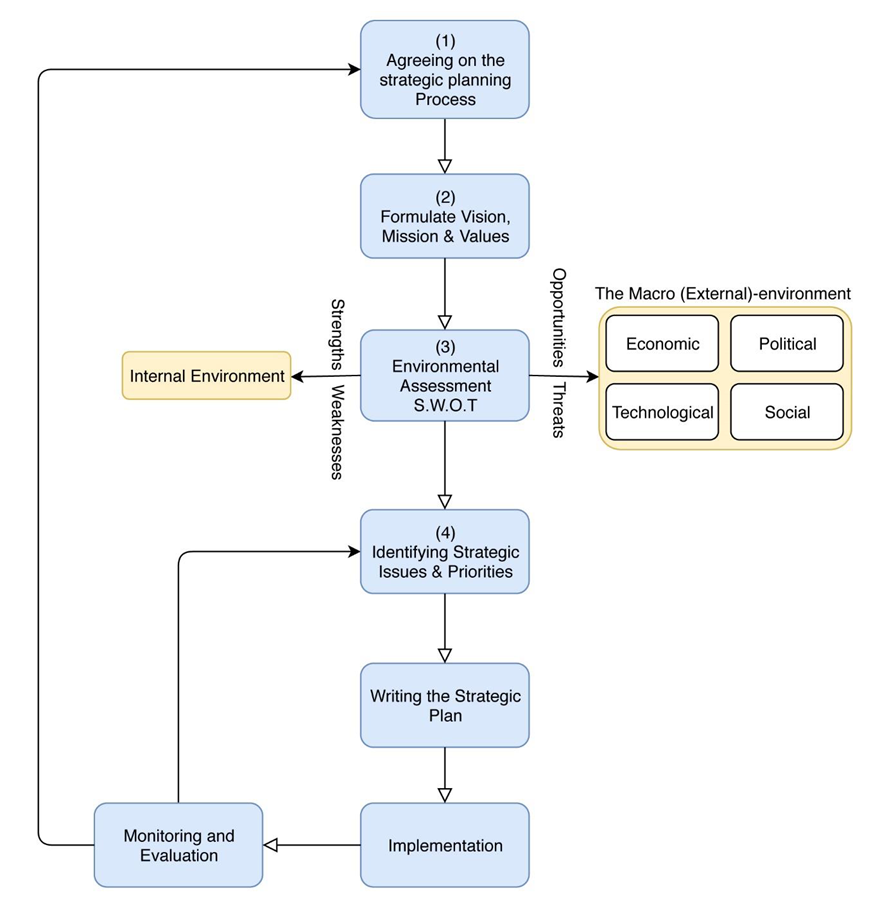
2.4. Steps of Strategic Planning ProcessStrategic planning process is designed to fit the specific need of the organization. It’s argued that every successful model must include vision and mission, environmental analysis, setting objectives and strategic analysis choice 19. There are ten known steps to organize participation, come up with ideas for strategic actions, build a successful team and implement strategies. These are referred to as the Strategy Change Cycle. It consists of the so called coalition of the willing to 27:
- initiate and agree on a strategic planning process;
- identify organizational mandates through its founding decree;
- clarify the mission and values;
- assess internal and external environment;
- determine strategic issues;
- formulate strategies to face the issues;
- formulate a strategic plan;
- establish an organizational vision;
- develop an effective implementation process;
- reassess the strategic planning process.
The steps of Strategic planning process could be summarized in 7 fundamental steps as follows: (See Figure 1):

There are many models of strategic planning that have been designed, developed and implemented by HEIs. Shawyun 2 assured that there is no one perfect planning model, and identified six different models of strategic planning that an organization can select to use when they embark on the journey of strategic planning as follows:
Model 1: Vision based or Goal based strategic planning is normally done by a small organization that has not done any planning in the past to kick, start the whole strategic planning process to ensure a well-rounded direction.
Model 2: Issues based planning which is done by organization with limited resources and want to achieve immediate buy-in.
Model 3: Alignment Model with the overall purpose of strong alignment of its missions and its resources to effectively operate the organization.
Model 4: Scenario planning which is normally used in conjunction with other planning model to undertake strategic thinking and identify strategic issues and goals.
Model 5: “Organic” or self-organizing planning which is the traditional approach that looks at the general-to-specific or cause-effect mechanism of a broad assessment and analysis of the environment leading to a set of alternatives.
Model 6: Real time planning asserts that planning must be done continuously or “real time” as the circumstances and operating environment changes rapidly.
HE in Egypt is the oldest education system in the world, as it dates to the opening of the Al-Azhar University in 365 AH/975 CE 28. In the Middle East and North Africa region; Egypt has the largest education system 29. HE in Egypt includes 27 Governmental Universities, 20 National Universities, 3 Technological Universities, 27 Private Universities, in addition to the American University in Cairo and 223 institutions (https://mohesr.gov.eg/en-us/Pages/home.aspx, accessed: March 22, 2023).
In Egypt the governmental or state universities usually absorb most of the Egyptian students. Being governmental institutions, they often use Arabic-language curricula, and work under political censorship. Generally, HE in Egypt suffers from different problems, mainly, overly centralized governance, overcrowding, poor quality of education, and widespread inefficiencies 30.
3.2. Common ChallengesHEIs in Egypt are constrained by low-quality education, and mismatch between education and the needs of labor market 31; universities usually produce low-caliber graduates who cannot compete in the global market and show relatively poor performance in the workplace 32, 33. There is widespread consensus that Arab universities are under-performing, delivering outcomes that do not reflect the size of the investment 34. In this regard, Guessoum 35 noted that the state of most Arab universities is known to be poor.
Most universities in Egypt have a poor international reputation; therefore, considerable efforts are being made to enhance the quality of higher education institutions, and governmental initiatives are being implemented to create a national quality assurance commission 36. The Egyptian government, over the past two decades, has undertaken various efforts to raise quality standards at higher education institutions. In 2006, the National Authority for Quality Assurance and Accreditation of Education (NAQAAE) was established. Notably, it has pushed for the establishment of internal quality assurance centers at university faculties 37. NAQAAE accredits universities as a whole, as well as individual faculties and programs. In order for universities to be granted full institutional accreditation, at least 60 percent of their faculties must be accredited 38.
In spite of all efforts made to enhance the education quality, it has been noted that most quality assurance commissions concentrate their efforts only to comply with the rules of higher education accreditation bodies, which are linked directly to governments, rather than really attempt to improve the education quality 39, 40. In Egypt, while governmental HEIs have a certain degree of academic autonomy, the Ministry of Higher Education and the Supreme Council of Public Universities— a body headed by the Ministry of Higher Education— regulate matters like the structure of degree programs, admissions requirements, and enrollment quotas. Private institutions have greater freedoms, but they need government approval to operate and must comply with the regulations of the Supreme Council of Private Universities 38.
While several higher education institutions in Egypt have progressed in size, their contribution to the scientific literature remains relatively modest 37. Currently most Egyptian universities suffer from lack of strategic plans, lack of independence, and weak research 36. Therefore, the Egyptian universities are not able to compete on the international levels 41. One of the main reasons why Egyptian universities lagged back behind world class universities is lack of research excellence 39, as the poor contribution of universities to the production of knowledge affects their position in global rankings 42.
According to Aladwan 43— the secretary general of the Association of Arab Universities — there are some challenges confronting research activities in most Arab universities, prominent among them has been the low rates of expenditure and low output from scientific research. Al-Kabi 39 assured that high-quality research needs a financial support. Badran 40 argued that the functional links between universities with industry and the marketplace do not exist, and contractual research is minimal. Literature (e.g. 44, 45, 46, 47) assured the disconnection between scientific research and development in Arab universities. Forster 48 reported that the lack of investment in high-quality research at Egyptian universities is one plausible reason for their low ranking.
The economic challenges make many faculty members in Egyptian universities feel frustrated 36. Faculty’s salaries in Egyptian public universities are hardly sufficient to support a family 49. Lack of proper faculty salary is considered as one factor affecting the quality of higher education in Egypt 33. To make up for economic shortages, faculty members have recourse to private tutoring and charge students for academic notes and reading materials 50. The findings by Albargouty and Abosamrah 51 referred to low salaries and financial incentives as among the main reasons for weak research by faculty members in Egyptian universities. Almansour 41 argued that faculty members in Egyptian universities often cannot afford publication fees that may be as high as three or four times their salary. These factors make the level and quality of education in Egyptian universities problematic 33. Besides, they may cause the brain drain from Egyptian universities 43.
As for the governance challenges, Egyptian universities lack to the institutional autonomy experience 48; they operate under a very centralized control system and stiff bureaucracies 52. This lack of autonomy is connected with the absence of accountability and transparency and the lack of academic freedom and participation in decision-making process 53. This lack of autonomy and restrictions on intellectual freedom and expression discourage faculty members from conducting high-quality research 48. This type of centralized state model negatively affects the institution’s ability to innovate and significantly reduces the capacity for innovation in the domain of research and development 42. The prevalence of a top-down authority approach which lays the grounds for the Egyptian universities’ subordination to higher authorities, and the lack of partnerships with local communities are other major concerns 53. This state-dominated approach has led to numerous dysfunctions in the Egyptian higher education system; more importantly, weak responsiveness to student demands, the needs of labor market and development goals. In terms of infrastructure and learning materials, Egyptian universities are severely underfinanced 52. Most universities are underequipped; they do not have the necessary scientific equipment and libraries and they are in a very poor condition as well 53. Budget allocation do not reflect the actual needs of HEIs or provide the incentives required to align their educational processes and programs with the needs of local community and the expectations of labor market 54.
One criterion for the success of a university in global ranking is measured by research productivity 55. Most world rankings are based on Institute of Scientific Information (ISI) or SCOPUS as measures of productivity in research 39. Egyptian universities are still low in terms of research productivity 37.
The poor quality of higher education programs in Egypt and the level of scientific research are of the most important challenges faced world rankings of Egyptian universities. Only very few Egyptian universities have been found among the Top 500 of the major world university rankings; and no university has been found among the Top 100 of any of the world rankings. Only Cairo University has been vigorously competing with each other and worldwide to find a place in the Shanghai (ARWU) ranking of top 500 universities 36.
Despite the international interest in the study of strategic planning in the western context, there is a significant gap in the literature when it comes to studies on the strategic planning practices in the middle east region as a whole and Egypt in specific ( 17, 6). Therefore, this research attempts to bridge that gap by providing an overview of the strategic planning process in the Egyptian higher education sector.
This study is designed to identify the common challenges of strategic planning for Higher Education in Egypt from reviewing the literature and from Experts' Perspective. This study was designed as a qualitative study due to its exploratory nature; this qualitative approach provides a holistic and comprehensive understanding of common challenges of strategic planning for Higher Education in Egypt in context-specific settings ( 56, 29).
In view of the nature of the research issue, a qualitative exploratory study was designed using interview techniques to seek the views of academic leaders in Egyptian Universities. A qualitative approach is often suitable when trying to understand the way in which participants make sense of a particular phenomenon, as it often provides deep understanding of “the particular context within which the participants act, and the influence that this context has on their actions” ( 57, 22). The primary instrument for data collection used in this research was a semi-structured interview protocol. The interview instrument consisted of an open-ended question designed around the common challenges of strategic planning for Higher Education in Egypt.
The study sample consisted of academic leaders from some Egyptian Universities, selected using the purposive sampling technique. Purposeful sampling is widely used in qualitative research for the identification and selection of information-rich cases related to the phenomenon of interest 58, which means that participants were intentionally chosen for their relevance to the nature of the study. The criterion for selection was academicians with leadership responsibilities, expecting that they may “purposefully inform an understanding of the research problem and central phenomenon in the study” ( 59, 156). The final sample of the study included 13 academic leaders; all participants were experienced enough to contribute to the research. The participants happened to be diverse in leadership responsibilities as they include university presidents/vice presidents, deans/vice deans, and department heads. The interviews occurred through professional social media platforms such as WhatsApp, based on the participants’ schedules. The participants were asked to reflect on their overall experience regarding common challenges of strategic planning for Higher Education in Egypt.
The gathered interview data was transcribed into working copies. Thematic analysis was utilized 60, and the interview data coding was performed through “immersion in the details and specifics of the data to discover important patterns, themes, and interrelationships” ( 61, 362). The most prominent codes that emerged from reading data transcripts included: planning culture among faculty members, qualified faculty members and personnel, collecting data. The interviews generated rich and interesting data unveiling the common challenges of strategic planning for Higher Education in Egypt.
The data shown in this research is extracted from a relatively small number of academic leaders in HEIs in Egypt. This poses a limitation to the study. This limitation is that the results of this research cannot be generalized globally or on a Middle Eastern scale, as some of the challenges faced by HEIs in Egypt are related to their political and regulatory contexts.
As mentioned above, strategic planning process has an important role in every organizational setting. It enables the organization to be proactive and to actively shape its own destiny. Strategic planning process helps institutions to identify what makes them distinctive and what they have in common with other institutions, and therefore; it helps them to maintain their individuality. According to Wassif 17 Strategic planning importance emerges from its ability to help institutions manage and anticipate changes in the internal environment as well as manage external practices and allocate limited resources to achieve their mission.
The strategic planning process of HEIs in Egypt may be problematic because of the challenges affecting the success of the process. The data collected from the interviews highlighted the common challenges of strategic planning for Higher Education in Egypt as viewed by some academic leaders in Egyptian universities. The findings are introduced under six main themes drawn from the research question, and these themes are identified as affecting negatively the strategic planning process in Egyptian HEIs:
- Absence of planning culture, philosophy and concept.
- Limited number of trained and qualified staff with non- availability of training courses.
- Difficulty of collecting accurate data, information with non- real Statistics.
- Lack of budget and lack of time allocated for planning.
- No- regular assessment/ evaluation of the HEIs’ environment.
- HEIs’ faculty members’ resistance to change.
5.1. Common Challenges of Strategic Planning for Higher Education in EgyptParticipants’ responses revealed common challenges –as they see– of strategic planning for Higher Education in Egypt. However, for the purposes of discussion, the challenges are categorized and discussed under two main categories: namely internal and external challenges.
5.2. Internal ChallengesThe internal challenges are the result of the internal management processes within the institution. In this section, the participants were asked about their perceptions of the common challenges of strategic planning inside HEIs in Egypt.
In terms of the inside challenges of strategic planning for HEIs in Egypt, one of the participants mentioned:
“In adopting a strategic planning approach, limited resources and environmental uncertainty may be significant obstacles in the Egyptian setting”
Another participant added:
“The Egyptian higher education institutions have insufficient materials and human resources needed for fulfilling the strategic planning process”
In the Egyptian setting, Elbanna 62 argued that the resources required for adopting a strategic planning approach may not be a significant obstacle, while environmental uncertainty certainly could be.
The absence of planning culture and lack of awareness among faculty members are key components in affecting negatively the strategic planning process in universities. One participant provided insight to the inside challenges of strategic planning for HEIs in Egypt by saying that:
“Lack of awareness is regarded as the prominent challenge against the implementation of strategic planning process. There is lack of awareness of strategic planning tools among faculty members and university staff”
Another participant added:
“Unfortunately, the majority of faculty members in universities have no idea about the strategic plan of their institutions”
The participants’ perception of the inside challenges of strategic planning matches to a good extent the findings of Elbanna 62 who argued that the lack of awareness of strategic tools, such as experience curve analysis, value chain analysis, Porter’s 5-forces analysis, the Boston consulting group matrix, General Electric matrix and the Delphi technique, could be seen as a major weakness undermining the effectiveness of strategic planning.
One particular interviewee sheds some light on the need for increasing awareness regarding understanding of strategic planning tools among faculty members by saying that:
“There is clearly a need for wider understanding of planning tools and their significant role in the application of strategic planning process in the university”
According to Afonina 63 strategic planning tools can be used effectively in gaining new insights, understanding and making sense of complex issues. However, it must be remembered that those tools neither make strategy nor implement it.
Another Participant highlighted the issue of failing to apply the strategic planning process in universities as a result of lacking monitoring and collaborative thinking by stating that:
“Because we have no monitoring or strategic direction correctly in universities or a plan or collaborative thinking, strategic planning process may be problematic”
The leadership is responsible for creating a participatory process that involves all the actors, including faculty members and staff to ensure that the strategic plan reflects the interests of the different actors. This means that the organizational culture also plays a critical role in the success of strategic planning. One respondent noted:
“If the organizational culture is lacking in the university, it makes all people unable to function……”
One participant responded to the question about whether the university evaluates the strategic plan regularly as follows:
“No, I don’t think so; the only thing the university evaluates maybe the annual budget plan ...”
One important challenge that was identified as inside challenge is the faculty’s lack of sufficient knowledge and experience required to participate in the strategic planning process. This is highlighted by one of the interviewees by saying that:
“The prominent challenge for strategic planning process in universities [as I see] is the lack of faculty members who have sufficient knowledge, training and experience”
Moreover, the interview data revealed that the difficulty of getting the data and information as a result of administrative bureaucracy in universities can be seen as one major challenge against strategic planning process. One participant said:
“Honestly, I see the administrative bureaucracy in universities as a big obstacle regarding the strategic planning process. Sometime you cannot get the information and data required for the planning process”
In the process of strategic planning, resistance to change can be considered as one of the major hindrances to strategic planning efforts in the university. The respondents in this study considered fear of change as a difficult hurdle, as indicated by one participant:
“Some faculty members and staff are unopen to change, others are resistant to change, [for me] this is a big challenge stands against the success of strategic planning process in the university”
On the other hand, some participants agreed that the strategic planning is a process of looking into the future and identifying trends to a successful change management. It attempts to underline that motivating and managing change in the mentality of its environment to be cope with social circumstances and with society's changing. Accordingly, there will be a change in universities’ activities, programs, projects, and strategies. However, some of university faculty members show resistance to change. One participant assured that:
“Some university faculty members prefer to keep the situation as it is, rejecting development, reform processes or foreseeing the future. Thus, they show resistance to change”
5.3. External ChallengesExternal challenges are a set of challenges imposed by the external environment of the institution such as political, economic, social and technological contexts. The economic environment in Egypt poses major challenges to universities. Egyptian universities are operating in a rapidly changing economic environment that poses specific challenges to their strategic planning efforts as highlighted by one of the participants:
“In Egypt [we face] financial challenges related to … the general financial situation that stands as a major obstacle against strategic planning efforts in the university”
Another participant highlighted the benefit of generating new fund resources beside the government budget for achieving university financial sustainability as follows:
“It [gonna] open up more doors for strategic planning if universities can generate new resources of income instead of trying to receive funds from the government”
On the other hand, the political environment in Egypt forces HEIs to change plans accordingly. One participant declared:
“The political context imposes laws, regulations, centralization, censorship, and decision- making restricting the members’ work with no innovation or creativity in HEIs”
Another participant added:
“Centralization of Higher Education in Egypt decreases educational quality and affects negatively the institutions capability of strategic planning”
Moreover; the strategic planning is affected negatively by some external challenges such as: The lack of alignment between the outcomes of higher education and the changing needs of the labor market, the focus is on the needs of the local market without taking into account the possible future dimensions of the market regionally and internationally, the entry of foreign/ private universities into the Arab market, non-traditional educational systems, the trend towards academic education without the technical one although the labor market focuses on technical needs, and the Egyptian brain drain abroad. ( 64, 353) emphasized that all these challenges are due to the lack of clear scientific criteria for evaluating the competitive position of the Egyptian universities.
The findings of this study support mainstream literature about the strategic planning process within the context of higher education institutions 17, 62, 63, 65. This study focused on common challenges of strategic planning in Egyptian HEIs. First, it is worth noting that higher education in Egypt faces specific challenges. These include attracting funding, strengthening research capacity and output, and addressing mismatches between education outcomes and career opportunities, as well as issues of quality and access 66. The interviews with some academic leaders in Egyptian universities shed light on a variety of challenges in the strategic planning process and their most prominent causes. While some of those challenges are internal, there are specific challenges that are unique to the outside context of the Egyptian universities.
In terms of the internal challenges to strategic planning process, the interview findings revealed that there was a lack of awareness among faculty members and staff regarding the process of strategic planning and its tools. Considerable literature supports this finding. Elbanna’s findings 62 indicated that the lack of knowledge in the application of strategic analytical tools could be seen as a major weakness undermining the effectiveness of strategic planning in the organization. Furthermore, Wassif’s 17 results indicated that organizations depend mostly on the experience of their leadership in planning strategically. While some board members and decision makers in the organization may be equipped with vast experience in their fields and therefore able to plan well, others are lacking the academic or practical experience in running the strategic planning process.
The lack of the organizational culture in Egyptian universities was another key theme. Data collected from the interviews revealed that the resources required for adopting a strategic planning approach may not be a significant obstacle in the Egyptian setting, whereas environmental uncertainty certainly could be 62.
The data collected from the interviews suggest that lack of experience, lack of funds and the administrative bureaucracy are major obstacles regarding the strategic planning process in the Egyptian universities. This means that when faculty members and staff are not qualified enough and are not provided with sufficient support from the university administration, this may inhibit them from participating actively in the strategic planning process.
All the participants expressed the importance of knowing of planning tools and their significant role in the implementation of strategic planning process. Participants expressed the importance of having good knowledge about the tactics of strategic planning process and the tools used in that process in order to have an active role in the success of strategic planning cycle in their institutions. George et al., 67 claimed that the adoption of a strategic approach and the use of relevant tools would appear to offer real benefits to the organization.
Egyptian HEIs are faced with many challenges in their external environment that hinder their strategic planning ability and efforts ranging from laws and regulations that need to be modified and to finical shortage that need to be overcome. Additionally, there are some challenges related to the internal environment within the institution that hinder its ability to plan ranging from leadership buy-in to the lack of a formal strategic planning process.
The results of this study raise additional research questions which merit further study. For example, what is the role of strategic planning in enhancing the competitive advantage of HEIs in Egypt? According to Elbanna 65 in the strategic management field, replication and extension research is much needed.
Therefore, this study contributes to the existing literature by providing an understanding of the context in which HEIs in Egypt operate. It also examines the challenges faced by such institutions in the strategic planning process from the perspective of some academic leaders in Egyptian universities.
Given the current interest in expanding strategic planning in HEIs in Egypt, it is expected that the findings of this paper will help inform universities administration and policymakers in higher education field concerning the strategic planning common challenges facing HEIs and, therefore, encourage them to find appropriate solutions.
Based on the research findings, the literature review and the participants’ responses, the following recommendations are provided to help in overcoming the challenges facing the strategic planning process of higher education institutions in Egypt:
- The HEIs strategic plan, culture, philosophy and concept must be clear, written, real, flexible and have enough time to settle. It shouldn’t be rushed because rushing the plan will cause problems in HEIs.
- The HEIs strategic plan has to allow the smooth transitions of leadership and hire specialized consultants in HEIs. Also, training courses should be available to university faculty members to be more qualified and experienced in planning.
- The HEIs strategic plan must be a systematic process. It’s a hope from the work team to get accurate data and information with real statistics which help to allow priorities in alignment with its mission, vision and values so as to develop a suitable action plan to tackle those priorities.
- The strategic plan should overcome the challenge of financial stability in HEIs by diversifying sources of funds in colleges and universities, and generating activities, special programs or courses to increase the funds. The sufficient funds may contribute to support the material and human resources needed for developing the HEIs, raise the efficiency of the internet, and achieve the quality of these institutions.
- The HEIs strategic plan requires developing the environment of institutions by using regular assessment, and this will happen by using the environmental analysis of SWOT to understand the points of strength, weakness, opportunities and threats. Moreover, the HEIs strategic plan has to be regular to assure the institutions’ assessment. The assessment process provides valuable insight on whether the institution’ projects, programs and activities meet the needs of administrators and achieve their intended outcomes. Any university can develop specific strategies and allocate resources to close the gap.
- In fact, understanding the economic, social, technological and political components of the environment enables the institutions to anticipate the changes in their activities and identify the priorities in the action plan. To overcome resistance to change in HEIs, there should be “a Supreme Council for Strategic Planning of HEIs”.
Indeed, the university strategic planning process requires the participation of all stakeholders starting with the Ministry of Higher Education, the university president, faculty members, businessmen, administrators, students, and parents. They must share the responsibility in identifying the action plan, implementing it, and getting the outcomes which need feedback. One participant said:
“We all should cooperate in preparing graduates whose specializations and abilities are compatible with labor market conditions and development needs and strategies”
No potential conflict of interest was reported by the authors.
The authors received no financial support for the research, authorship, and/or publication of this article.
| [1] | Zechlin L. (2010). Strategic Planning in Higher Education. In: Penelope Peterson, Eva Baker, Barry McGaw, (Editors), International Encyclopedia of Education. volume 4, pp. 256-263. Oxford: Elsevier. | ||
| In article | View Article | ||
| [2] | Shawyun, T. (2010). Developing And Actioning Strategic Planning in Higher Education Institutions, Assumption University Press, Bangkok, Thailand. | ||
| In article | |||
| [3] | Piorun, M. (2011). Evaluation of Strategic Plans in Academic Medical Libraries, Library & Information Science Research, 33(1), 54-62. | ||
| In article | View Article | ||
| [4] | Machado, M. L. & Taylor, S. J. (2010). ‘The struggle for strategic planning in European higher education: The case of Portugal’, Research in Higher Education Journal (6), 44-64. | ||
| In article | |||
| [5] | Akyel, N., KorkusuzPolat, T., & Arslankaya, S. (2012). Strategic planning in institutions of higher education: A case study of Sakarya University. In 8th International Strategic Management Conference, Social and Behavioral Sciences (58), 66-72. | ||
| In article | View Article | ||
| [6] | Sart, G. (2014). Strategic Model and Strategic Planning in Higher Education, International Journal of Social and Economic Sciences, 4(1), 34-37. | ||
| In article | |||
| [7] | Yarmohammadian, M., Maryam, F., Somayeh, S., Ahmad, A. & Badri, S. (2013, April). An Integrated Strategic Quality Model (ISQM) for Non-governmental Universities: Integration between Strategic Planning and BSC Applied Iranian Higher Education System, Interdisciplinary Journal of Contemporary Research in Business, 4(12), Institute of Interdisciplinary Business Research, 1150-1159. | ||
| In article | |||
| [8] | Guerra, F., Zamora, R., Hernandez, R., & Menchaca, V. (2017). University Strategic Planning: A Process for Change in a Principal Preparation Program. NCPEA International Journal of Educational Leadership Preparation, 12(1), USA, 1-14. | ||
| In article | |||
| [9] | Hinton, K. (2012). A Practical Guide to Strategic Planning in Higher Education, Society for College and University Planning, USA. | ||
| In article | |||
| [10] | Al-Mahdi, M. (2021). An Investigation of Leadership Style and the Strategic Planning Process of Public and Private Colleges in Iraq: An Empirical Study, Unpublished doctoral dissertation, University of Southern Queensland. | ||
| In article | |||
| [11] | Southern University at New Orleans (SUNO) (2010). Strategic Planning Handbook and Managers Implementation Tools. Strategic Implementation Plan, Academic Years 2006 to 2011, 1-46. | ||
| In article | |||
| [12] | Fathi, M. & Wilson, L. (2009). Strategic Planning in Colleges and Universities, the Business Renaissance Quarterly, 4(1), 91-103. | ||
| In article | |||
| [13] | Beg, N. & Gupta, A. (2014). Strategic planning for Governance in Higher Education System: A Conceptual Approach, Abhinav-International Monthly Refereed Journal of Research in Management & Technology, 2(3), 32-39. | ||
| In article | |||
| [14] | Candy, V., & Gordon, J. (2011). The Historical Development of Strategic Planning Theories. International Journal of Management & Information Systems, 15(4), 71-89. | ||
| In article | View Article | ||
| [15] | Wheelen, T. & Hunger, J. (2012). Strategic Management and Business Policy: Achieving Sustainability (13th ed.), Prentice Hall. ISBN: 978-0132153225. | ||
| In article | |||
| [16] | Samad, M. (2015). Issues and Prospects of Strategic Planning for Higher Education Especially in Veterinary Medical Education in Bangladesh, Bangladesh Journal of Veterinary Medicine, 1(2), 59-80. | ||
| In article | |||
| [17] | Wassif, B. (2020). Challenges to Strategic Planning in the Context of Egyptian Non-profit Organizations: A critical review, Unpublished MA Thesis, the American University in Cairo (AUC), Egypt. | ||
| In article | |||
| [18] | Tarifi, N. (2021). A Critical Review of Theoretical Aspects of Strategic Planning and Firm Performance, Open Journal of Business and Management, 9(4), 1980-1996. | ||
| In article | View Article | ||
| [19] | Kibachia, J., Iravo, M., & Luvanda, A. (2014). A Survey of Risk Factors in the Strategic Planning Process of Parastatals in Kenya, European Journal of Business and Innovation Research, 2(3), 51-67. | ||
| In article | |||
| [20] | Hossler, D. & Bontrager, B. (2014). Handbook of Strategic Enrollment Management, Jossy-Bass, San Francisco, California. | ||
| In article | |||
| [21] | Chen, S., Nasongkhla, J. & Donaldson, J. (2015). From Vision to Action – a Strategic Planning Process Model for Open Educational Resources, Journal of Social and Behavioral Sciences (174), Procedia, 3707-3714. | ||
| In article | View Article | ||
| [22] | Ibrahim, O., Sundgren, D. & Larsson, A. (2014). An Integrated Decision Support System Framework for Strategic Planning in Higher Education Institutions, Conference Paper, June, 2014. | ||
| In article | View Article | ||
| [23] | Ruzsbánszki, N. (2022). Strategic Planning Process at a Swedish Higher Education Institution: The Case of Malmö University, Unpublished MA thesis, Faculty of Technology and Society (TS), Malmö University, Sweden. | ||
| In article | |||
| [24] | Simerson, B. (2011). Strategic Planning: A Practical Guide to Strategy Formulation and Execution, California: Praeger. | ||
| In article | |||
| [25] | Hanover Research (2013). Strategic Planning in Higher Education –Best Practices and Benchmarking, Academy Administration Practice, Washington, DC. | ||
| In article | |||
| [26] | Wilcoxson, J. (2012). Strategic Planning Implementation: A Case Study of a California Community College, unpublished Ph.D. dissertation, California State University. | ||
| In article | |||
| [27] | Bryson, J. (2011). Strategic Planning for Public and Non Profit Organizations, 4th edition, San Francisco, CA: Wiley. | ||
| In article | |||
| [28] | Abdelkhalek, F. & Langsten, R. (2019). Track and Sector in Egyptian Higher Education: Who Studies Where and Why?, FIRE: Forum for International Research in Education, 6(2), 45-70. | ||
| In article | View Article | ||
| [29] | Rasmy, M. (2018). The World Bank's Support to Higher Education Reform in Egypt: Educator's Perspective on its Impact for Quality and Equality (Unpublished master’s thesis), The American University in Cairo, Egypt. | ||
| In article | |||
| [30] | Said, M. (2009). The Impact of Reform Projects in Higher Education: The Case of Egypt. Retrieved April 19, 2023 from: http://search.shamaa.org/PDF/41452/SaidEn41509.pdf. | ||
| In article | View Article | ||
| [31] | Adams, A. & Winthrop, R. (2011). The Role of Education in the Arab World Revolutions: Brookings Institution. Retrieved from: http://www.brookings.edu/research/opinions/2011/06/10-arab-world-education-winthrop. | ||
| In article | |||
| [32] | Djeflat, A. (2009). Building Knowledge Economies for Job Creation, Increased Competitiveness, and Balanced Development, Paper presented at the High Level International Conference, Carthage, Tunisia. December, 2009. | ||
| In article | |||
| [33] | Hanafi, S. (2011). University Systems in the Arab East: Publish Globally and Perish Locally vs Publish Locally and Perish Globally, Current Sociology, 59(3), 291-309. | ||
| In article | View Article | ||
| [34] | Waterbury, J. (2018). Governance of Arab Universities: Why Does It Matter?. In: Badran A., Baydoun E., Hillman J. (eds) Universities in Arab Countries: An Urgent Need for Change (pp. 55-70), Springer, Cham. | ||
| In article | View Article | ||
| [35] | Guessoum, N. (2018). Is Liberal Arts Education a Good Model for Arab Universities? In: Badran A., Baydoun E., Hillman J. (eds) Universities in Arab Countries: An Urgent Need for Change (pp. 175-185), Springer, Cham. | ||
| In article | View Article | ||
| [36] | Sywelem, M. (2020). Challenges of International Ranking of Egyptian Universities from the Academicians’ Perspective, American Journal of Educational Research, 8(7), 465-474. | ||
| In article | View Article | ||
| [37] | Bouri, E. & Maalouf, M. (2018). “The Impact of Governance in Higher Education Institutions on Scientific Research in the Arab World.” In: Azzi G. (eds) Higher Education Governance in the Arab World (pp. 65-82). Palgrave Macmillan, Cham. | ||
| In article | View Article | ||
| [38] | Ramage, Y. (2019). Education in Egypt, World Education News + Reviews, February 21, 2019. Retrieved March 20, 2023 from: https://wenr.wes.org/2019/02/education-in-egypt-2#_ftn1. | ||
| In article | |||
| [39] | Al-Kabi, M. (2014). Towards Building World Class Universities in the Arab World, Paper presented at the 4th International Arab Conference on Quality Assurance in Higher Education, Zarqa University, Jordan. April, 2014. | ||
| In article | |||
| [40] | Badran, A. (2018). Landscape of Higher Education in the Arab World: Quality, Relevance, and Student Mobility, In: Badran A., Baydoun E., Hillman J. (eds) Universities in Arab Countries: An Urgent Need for Change (pp. 71-84). Springer, Cham. | ||
| In article | View Article | ||
| [41] | Almansour, S. (2016). The Crisis of Research and Global Recognition in Arab Universities, Near and Middle Eastern Journal of Research in Education, 2016(1), 1-13. | ||
| In article | View Article | ||
| [42] | Habchi, A. (2018). The Role of Governments in Shaping Governance of Higher Education Institutions in the Arab World, In: Azzi G. (eds) Higher Education Governance in the Arab World (pp. 105-130), Palgrave Macmillan, Cham. | ||
| In article | View Article | ||
| [43] | Aladwan, S. (2013). Scientific Research and Higher Education in the Arab World, Paper presented at the 1st Annual Higher Education Leadership Forum: Inspiring the Leaders of Today, Dubai, UAE. November, 2013. | ||
| In article | |||
| [44] | Albomohammed, A. & Albadrie, S. (2012). “Realities and Challenges of Scientific Research in the Arab World.” Paper presented at the 2nd International Arab Conference on Quality Assurance in Higher Education, Gulf University, Bahrain. April, 2012. | ||
| In article | |||
| [45] | Farah, H. (2014). Developing Scientific Research Methodology, Paper presented at the 1st International Conference on Development of Research in Higher Education, Amman, Jordan. August, 2014. | ||
| In article | |||
| [46] | Hafiz, A. (2014). Challenges Confronting Social Studies Research Centers at Arab Countries and Problems in Dealing with Current Issues, Paper presented at the 1st International Conference on Development of Research in Higher Education. Amman, Jordan. August, 2014. | ||
| In article | |||
| [47] | Ismael, M. (2014). Challenges of the Private Sector Participation in Scientific Research Funding, Paper presented at the 1st International Conference on Development of Research in Higher Education. Amman, Jordan. August, 2014. | ||
| In article | |||
| [48] | Forster, N. (2018). Why are there so few World-class Universities in the Middle East and North Africa?, Journal of Further and Higher Education, 42(8), 1025-1039. | ||
| In article | View Article | ||
| [49] | Altbach, P. (2013). The International Imperative in Higher Education. Rotterdam: Sense Publishers. https://link.springer.com/book/10.1007%2F978-94-6209-338-6. | ||
| In article | View Article | ||
| [50] | Anderson, L. (2012). Fertile Ground: The Future of Higher Education in the Arab World, Social Research, 79(3), 771-784. | ||
| In article | View Article | ||
| [51] | Albargouty, E. & Abosamrah, M. (2007). Difficulties of Scientific Research in the Arab World: An Islamic View, Islamic University Journal, 15(2), 1133-1155. | ||
| In article | |||
| [52] | OCDE & World Bank (2010). Higher Education in Egypt, Report of the 2008-2009 International Review, March 22, 2010, Organization of Cooperation, Development and Economics (OCDE) and the World Bank, 3-23. | ||
| In article | |||
| [53] | Ahmed, H. (2015). Strategic Approach for Developing World-Class Universities in Egypt, Journal of Education and Practice, 6(5), 125-145. | ||
| In article | |||
| [54] | Fahim, Y. & Sami, N. (2010). Access to and Equity in Financing Higher Education in Egypt. In: Gala and T. Kanaan (eds), Financing higher education in Arab countries (pp. 11-28), Cairo, Egypt: the Economic Research Forum. | ||
| In article | |||
| [55] | Altunay, E., & Tonbul, Y. (2015). Comparison of Scientific Research Projects of Education Facilities, Studies in Higher Education, 40(6), 972-987. | ||
| In article | View Article | ||
| [56] | Starman, A. (2013). The Case Study as a Type of a Qualitative research, Journal of Cotemporary Educational Studies (1), Slovenian Research Agency, Slovenia, 28-44. | ||
| In article | |||
| [57] | Maxwell, J. (2005). Qualitative Research Design: An Interactive Approach, Thousand Oaks, CA., Sage. | ||
| In article | |||
| [58] | Palinkas, L., Horwitz, S., & Green, C. (2015). Purposeful Sampling for Qualitative Data Collection and Analysis in Mixed Method Implementation Research. Administration and Policy in Mental Health, 2015(42), 533-544. | ||
| In article | View Article | ||
| [59] | Creswell, J. (2013). Qualitative Inquiry and Research Design: Choosing among Five Approaches (3rd ed.), Thousand Oaks, CA: Sage. | ||
| In article | |||
| [60] | Braun, V. & Clarke, V. (2006).Using Thematic Analysis in Psychology, Qualitative Research in Psychology, 3(2), 77-101. | ||
| In article | View Article | ||
| [61] | Johnson, B. & Christensen, L. (2004). Educational Research: Quantitative, Qualitative, and Mixed Approaches (2nd ed.). Boston, MA: Pearson Education Inc. | ||
| In article | |||
| [62] | Elbanna, S. (2008). The Nature and Practice of Strategic Planning in Egypt, Journal of Strategic Change, 16(5), 227-243. | ||
| In article | View Article | ||
| [63] | Afonina, A. (2015). Strategic Management Tools and Techniques and Organizational Performance: Findings from the Czech Republic. Journal of Competitiveness, 7(3), 19-36. | ||
| In article | View Article | ||
| [64] | Abdelnaby, K. (2021). The Status- Quo of Strategic Planning of Egyptian Universities in the light of Quality Standards and its Foundations from an Islamic Perspective, Journal of Education, Al-Azhar University, Egypt, 190(2), 300-377. | ||
| In article | |||
| [65] | Elbanna, S. (2010). Strategic Planning in the United Arab Emirates, International Journal of Commerce and Management, 20(1), 26-40. | ||
| In article | View Article | ||
| [66] | Loveluck, L. (2012), Education in Egypt: Key Challenges, Middle East and North Africa Programme, Chatham House, London. | ||
| In article | |||
| [67] | George, B., Walker, R. & Monster, J. (2019). Does Strategic Planning Improve Organizational Performance? A Meta-Analysis, Public Administration Review, 79(6), Wiley, 810-819. | ||
| In article | View Article | ||
Published with license by Science and Education Publishing, Copyright © 2023 Mohamed M. Ghoneim Sywelem and Asmaa Mohamed Elsayed Makhlouf
 This work is licensed under a Creative Commons Attribution 4.0 International License. To view a copy of this license, visit
http://creativecommons.org/licenses/by/4.0/
This work is licensed under a Creative Commons Attribution 4.0 International License. To view a copy of this license, visit
http://creativecommons.org/licenses/by/4.0/
| [1] | Zechlin L. (2010). Strategic Planning in Higher Education. In: Penelope Peterson, Eva Baker, Barry McGaw, (Editors), International Encyclopedia of Education. volume 4, pp. 256-263. Oxford: Elsevier. | ||
| In article | View Article | ||
| [2] | Shawyun, T. (2010). Developing And Actioning Strategic Planning in Higher Education Institutions, Assumption University Press, Bangkok, Thailand. | ||
| In article | |||
| [3] | Piorun, M. (2011). Evaluation of Strategic Plans in Academic Medical Libraries, Library & Information Science Research, 33(1), 54-62. | ||
| In article | View Article | ||
| [4] | Machado, M. L. & Taylor, S. J. (2010). ‘The struggle for strategic planning in European higher education: The case of Portugal’, Research in Higher Education Journal (6), 44-64. | ||
| In article | |||
| [5] | Akyel, N., KorkusuzPolat, T., & Arslankaya, S. (2012). Strategic planning in institutions of higher education: A case study of Sakarya University. In 8th International Strategic Management Conference, Social and Behavioral Sciences (58), 66-72. | ||
| In article | View Article | ||
| [6] | Sart, G. (2014). Strategic Model and Strategic Planning in Higher Education, International Journal of Social and Economic Sciences, 4(1), 34-37. | ||
| In article | |||
| [7] | Yarmohammadian, M., Maryam, F., Somayeh, S., Ahmad, A. & Badri, S. (2013, April). An Integrated Strategic Quality Model (ISQM) for Non-governmental Universities: Integration between Strategic Planning and BSC Applied Iranian Higher Education System, Interdisciplinary Journal of Contemporary Research in Business, 4(12), Institute of Interdisciplinary Business Research, 1150-1159. | ||
| In article | |||
| [8] | Guerra, F., Zamora, R., Hernandez, R., & Menchaca, V. (2017). University Strategic Planning: A Process for Change in a Principal Preparation Program. NCPEA International Journal of Educational Leadership Preparation, 12(1), USA, 1-14. | ||
| In article | |||
| [9] | Hinton, K. (2012). A Practical Guide to Strategic Planning in Higher Education, Society for College and University Planning, USA. | ||
| In article | |||
| [10] | Al-Mahdi, M. (2021). An Investigation of Leadership Style and the Strategic Planning Process of Public and Private Colleges in Iraq: An Empirical Study, Unpublished doctoral dissertation, University of Southern Queensland. | ||
| In article | |||
| [11] | Southern University at New Orleans (SUNO) (2010). Strategic Planning Handbook and Managers Implementation Tools. Strategic Implementation Plan, Academic Years 2006 to 2011, 1-46. | ||
| In article | |||
| [12] | Fathi, M. & Wilson, L. (2009). Strategic Planning in Colleges and Universities, the Business Renaissance Quarterly, 4(1), 91-103. | ||
| In article | |||
| [13] | Beg, N. & Gupta, A. (2014). Strategic planning for Governance in Higher Education System: A Conceptual Approach, Abhinav-International Monthly Refereed Journal of Research in Management & Technology, 2(3), 32-39. | ||
| In article | |||
| [14] | Candy, V., & Gordon, J. (2011). The Historical Development of Strategic Planning Theories. International Journal of Management & Information Systems, 15(4), 71-89. | ||
| In article | View Article | ||
| [15] | Wheelen, T. & Hunger, J. (2012). Strategic Management and Business Policy: Achieving Sustainability (13th ed.), Prentice Hall. ISBN: 978-0132153225. | ||
| In article | |||
| [16] | Samad, M. (2015). Issues and Prospects of Strategic Planning for Higher Education Especially in Veterinary Medical Education in Bangladesh, Bangladesh Journal of Veterinary Medicine, 1(2), 59-80. | ||
| In article | |||
| [17] | Wassif, B. (2020). Challenges to Strategic Planning in the Context of Egyptian Non-profit Organizations: A critical review, Unpublished MA Thesis, the American University in Cairo (AUC), Egypt. | ||
| In article | |||
| [18] | Tarifi, N. (2021). A Critical Review of Theoretical Aspects of Strategic Planning and Firm Performance, Open Journal of Business and Management, 9(4), 1980-1996. | ||
| In article | View Article | ||
| [19] | Kibachia, J., Iravo, M., & Luvanda, A. (2014). A Survey of Risk Factors in the Strategic Planning Process of Parastatals in Kenya, European Journal of Business and Innovation Research, 2(3), 51-67. | ||
| In article | |||
| [20] | Hossler, D. & Bontrager, B. (2014). Handbook of Strategic Enrollment Management, Jossy-Bass, San Francisco, California. | ||
| In article | |||
| [21] | Chen, S., Nasongkhla, J. & Donaldson, J. (2015). From Vision to Action – a Strategic Planning Process Model for Open Educational Resources, Journal of Social and Behavioral Sciences (174), Procedia, 3707-3714. | ||
| In article | View Article | ||
| [22] | Ibrahim, O., Sundgren, D. & Larsson, A. (2014). An Integrated Decision Support System Framework for Strategic Planning in Higher Education Institutions, Conference Paper, June, 2014. | ||
| In article | View Article | ||
| [23] | Ruzsbánszki, N. (2022). Strategic Planning Process at a Swedish Higher Education Institution: The Case of Malmö University, Unpublished MA thesis, Faculty of Technology and Society (TS), Malmö University, Sweden. | ||
| In article | |||
| [24] | Simerson, B. (2011). Strategic Planning: A Practical Guide to Strategy Formulation and Execution, California: Praeger. | ||
| In article | |||
| [25] | Hanover Research (2013). Strategic Planning in Higher Education –Best Practices and Benchmarking, Academy Administration Practice, Washington, DC. | ||
| In article | |||
| [26] | Wilcoxson, J. (2012). Strategic Planning Implementation: A Case Study of a California Community College, unpublished Ph.D. dissertation, California State University. | ||
| In article | |||
| [27] | Bryson, J. (2011). Strategic Planning for Public and Non Profit Organizations, 4th edition, San Francisco, CA: Wiley. | ||
| In article | |||
| [28] | Abdelkhalek, F. & Langsten, R. (2019). Track and Sector in Egyptian Higher Education: Who Studies Where and Why?, FIRE: Forum for International Research in Education, 6(2), 45-70. | ||
| In article | View Article | ||
| [29] | Rasmy, M. (2018). The World Bank's Support to Higher Education Reform in Egypt: Educator's Perspective on its Impact for Quality and Equality (Unpublished master’s thesis), The American University in Cairo, Egypt. | ||
| In article | |||
| [30] | Said, M. (2009). The Impact of Reform Projects in Higher Education: The Case of Egypt. Retrieved April 19, 2023 from: http://search.shamaa.org/PDF/41452/SaidEn41509.pdf. | ||
| In article | View Article | ||
| [31] | Adams, A. & Winthrop, R. (2011). The Role of Education in the Arab World Revolutions: Brookings Institution. Retrieved from: http://www.brookings.edu/research/opinions/2011/06/10-arab-world-education-winthrop. | ||
| In article | |||
| [32] | Djeflat, A. (2009). Building Knowledge Economies for Job Creation, Increased Competitiveness, and Balanced Development, Paper presented at the High Level International Conference, Carthage, Tunisia. December, 2009. | ||
| In article | |||
| [33] | Hanafi, S. (2011). University Systems in the Arab East: Publish Globally and Perish Locally vs Publish Locally and Perish Globally, Current Sociology, 59(3), 291-309. | ||
| In article | View Article | ||
| [34] | Waterbury, J. (2018). Governance of Arab Universities: Why Does It Matter?. In: Badran A., Baydoun E., Hillman J. (eds) Universities in Arab Countries: An Urgent Need for Change (pp. 55-70), Springer, Cham. | ||
| In article | View Article | ||
| [35] | Guessoum, N. (2018). Is Liberal Arts Education a Good Model for Arab Universities? In: Badran A., Baydoun E., Hillman J. (eds) Universities in Arab Countries: An Urgent Need for Change (pp. 175-185), Springer, Cham. | ||
| In article | View Article | ||
| [36] | Sywelem, M. (2020). Challenges of International Ranking of Egyptian Universities from the Academicians’ Perspective, American Journal of Educational Research, 8(7), 465-474. | ||
| In article | View Article | ||
| [37] | Bouri, E. & Maalouf, M. (2018). “The Impact of Governance in Higher Education Institutions on Scientific Research in the Arab World.” In: Azzi G. (eds) Higher Education Governance in the Arab World (pp. 65-82). Palgrave Macmillan, Cham. | ||
| In article | View Article | ||
| [38] | Ramage, Y. (2019). Education in Egypt, World Education News + Reviews, February 21, 2019. Retrieved March 20, 2023 from: https://wenr.wes.org/2019/02/education-in-egypt-2#_ftn1. | ||
| In article | |||
| [39] | Al-Kabi, M. (2014). Towards Building World Class Universities in the Arab World, Paper presented at the 4th International Arab Conference on Quality Assurance in Higher Education, Zarqa University, Jordan. April, 2014. | ||
| In article | |||
| [40] | Badran, A. (2018). Landscape of Higher Education in the Arab World: Quality, Relevance, and Student Mobility, In: Badran A., Baydoun E., Hillman J. (eds) Universities in Arab Countries: An Urgent Need for Change (pp. 71-84). Springer, Cham. | ||
| In article | View Article | ||
| [41] | Almansour, S. (2016). The Crisis of Research and Global Recognition in Arab Universities, Near and Middle Eastern Journal of Research in Education, 2016(1), 1-13. | ||
| In article | View Article | ||
| [42] | Habchi, A. (2018). The Role of Governments in Shaping Governance of Higher Education Institutions in the Arab World, In: Azzi G. (eds) Higher Education Governance in the Arab World (pp. 105-130), Palgrave Macmillan, Cham. | ||
| In article | View Article | ||
| [43] | Aladwan, S. (2013). Scientific Research and Higher Education in the Arab World, Paper presented at the 1st Annual Higher Education Leadership Forum: Inspiring the Leaders of Today, Dubai, UAE. November, 2013. | ||
| In article | |||
| [44] | Albomohammed, A. & Albadrie, S. (2012). “Realities and Challenges of Scientific Research in the Arab World.” Paper presented at the 2nd International Arab Conference on Quality Assurance in Higher Education, Gulf University, Bahrain. April, 2012. | ||
| In article | |||
| [45] | Farah, H. (2014). Developing Scientific Research Methodology, Paper presented at the 1st International Conference on Development of Research in Higher Education, Amman, Jordan. August, 2014. | ||
| In article | |||
| [46] | Hafiz, A. (2014). Challenges Confronting Social Studies Research Centers at Arab Countries and Problems in Dealing with Current Issues, Paper presented at the 1st International Conference on Development of Research in Higher Education. Amman, Jordan. August, 2014. | ||
| In article | |||
| [47] | Ismael, M. (2014). Challenges of the Private Sector Participation in Scientific Research Funding, Paper presented at the 1st International Conference on Development of Research in Higher Education. Amman, Jordan. August, 2014. | ||
| In article | |||
| [48] | Forster, N. (2018). Why are there so few World-class Universities in the Middle East and North Africa?, Journal of Further and Higher Education, 42(8), 1025-1039. | ||
| In article | View Article | ||
| [49] | Altbach, P. (2013). The International Imperative in Higher Education. Rotterdam: Sense Publishers. https://link.springer.com/book/10.1007%2F978-94-6209-338-6. | ||
| In article | View Article | ||
| [50] | Anderson, L. (2012). Fertile Ground: The Future of Higher Education in the Arab World, Social Research, 79(3), 771-784. | ||
| In article | View Article | ||
| [51] | Albargouty, E. & Abosamrah, M. (2007). Difficulties of Scientific Research in the Arab World: An Islamic View, Islamic University Journal, 15(2), 1133-1155. | ||
| In article | |||
| [52] | OCDE & World Bank (2010). Higher Education in Egypt, Report of the 2008-2009 International Review, March 22, 2010, Organization of Cooperation, Development and Economics (OCDE) and the World Bank, 3-23. | ||
| In article | |||
| [53] | Ahmed, H. (2015). Strategic Approach for Developing World-Class Universities in Egypt, Journal of Education and Practice, 6(5), 125-145. | ||
| In article | |||
| [54] | Fahim, Y. & Sami, N. (2010). Access to and Equity in Financing Higher Education in Egypt. In: Gala and T. Kanaan (eds), Financing higher education in Arab countries (pp. 11-28), Cairo, Egypt: the Economic Research Forum. | ||
| In article | |||
| [55] | Altunay, E., & Tonbul, Y. (2015). Comparison of Scientific Research Projects of Education Facilities, Studies in Higher Education, 40(6), 972-987. | ||
| In article | View Article | ||
| [56] | Starman, A. (2013). The Case Study as a Type of a Qualitative research, Journal of Cotemporary Educational Studies (1), Slovenian Research Agency, Slovenia, 28-44. | ||
| In article | |||
| [57] | Maxwell, J. (2005). Qualitative Research Design: An Interactive Approach, Thousand Oaks, CA., Sage. | ||
| In article | |||
| [58] | Palinkas, L., Horwitz, S., & Green, C. (2015). Purposeful Sampling for Qualitative Data Collection and Analysis in Mixed Method Implementation Research. Administration and Policy in Mental Health, 2015(42), 533-544. | ||
| In article | View Article | ||
| [59] | Creswell, J. (2013). Qualitative Inquiry and Research Design: Choosing among Five Approaches (3rd ed.), Thousand Oaks, CA: Sage. | ||
| In article | |||
| [60] | Braun, V. & Clarke, V. (2006).Using Thematic Analysis in Psychology, Qualitative Research in Psychology, 3(2), 77-101. | ||
| In article | View Article | ||
| [61] | Johnson, B. & Christensen, L. (2004). Educational Research: Quantitative, Qualitative, and Mixed Approaches (2nd ed.). Boston, MA: Pearson Education Inc. | ||
| In article | |||
| [62] | Elbanna, S. (2008). The Nature and Practice of Strategic Planning in Egypt, Journal of Strategic Change, 16(5), 227-243. | ||
| In article | View Article | ||
| [63] | Afonina, A. (2015). Strategic Management Tools and Techniques and Organizational Performance: Findings from the Czech Republic. Journal of Competitiveness, 7(3), 19-36. | ||
| In article | View Article | ||
| [64] | Abdelnaby, K. (2021). The Status- Quo of Strategic Planning of Egyptian Universities in the light of Quality Standards and its Foundations from an Islamic Perspective, Journal of Education, Al-Azhar University, Egypt, 190(2), 300-377. | ||
| In article | |||
| [65] | Elbanna, S. (2010). Strategic Planning in the United Arab Emirates, International Journal of Commerce and Management, 20(1), 26-40. | ||
| In article | View Article | ||
| [66] | Loveluck, L. (2012), Education in Egypt: Key Challenges, Middle East and North Africa Programme, Chatham House, London. | ||
| In article | |||
| [67] | George, B., Walker, R. & Monster, J. (2019). Does Strategic Planning Improve Organizational Performance? A Meta-Analysis, Public Administration Review, 79(6), Wiley, 810-819. | ||
| In article | View Article | ||