To protect the value of records in an organization, not just records management per se must be put in place, but rather, records management that is based on a quality management system. The study assessed the level of compliance of the records management practices of the Bicol University libraries against the documentation requirements of ISO 9001 along Quality Policy, Procedures, Work Instructions, and References/Records. Using the descriptive-evaluative research design, a self-made questionnaire was distributed purposively to library and faculty personnel and randomly selected students. Frequency, weighted mean, ranking, ANOVA, Tukey Test and Pearson r were used for analysis. Findings showed a very satisfactory level of compliance along the four aspects; a significant difference in the level of compliance among libraries but not among aspects; and (3) identified personal, professional, and institutional factors affect the level of compliance. The study recommends creating documented procedures for records management and a thorough competency assessment to establish core skills and competencies of the librarians on records management. A proposed Quality Management System documentation process and online records management system served as output of this study.
The records of an organization are one of its most valuable assets. Its ability to serve as proof of an activity or event is a crucial aspect of records. According to ISO 15489-1 1, records are information created, received, and maintained by a person or organization as proof and as an asset in order to comply with legal responsibilities or do business. Through proper documentation of events and history, records help preserve the “institution’s memory,” supports decision-making, and demonstrate compliance.
Good records management practices would include managerial activities involved concerning the process of creating, classifying, indexing, distributing, using, tracking, storing, retrieving, safeguarding, and discarding records. These refer to the stages of creation, maintenance, use, and disposition collectively called the records' life cycle. According to Stilwell, Ngulube, and Chachage 2, effective records management is crucial since it makes it easier to retrieve information. Also, if documents are not managed through a record management system, there will be no proof that a corporation carried out sustainable development initiatives.
State Universities and Colleges (SUCs) in the Philippines are required under Republic Act 9470, also known as the National Archives of the Philippines Act of 2007, to adopt a records management and archival program for the effective use of records and their protection 3.
A Quality Management System (QMS) is a collection of connected procedures created and carried out to satisfy client needs 4. The International Organization for Standardization (ISO) has developed a set of international standards on quality management and quality assurance known as the ISO 9000 series. The most well-known of the ISO 9000 family of published standards is ISO 9001 quality management standard 5.
Bicol University (BU) is a premier State University and College Level IV institution located in Legazpi City, Philippines. It is an ISO certified Higher Education Institution (HEI) since 2010. BU has one (1) University Library, two (2) college libraries within the Main Campus and five (5) off-campus libraries which comprises the Bicol University Library System (BULS). The BULS is part of the university’s academic support services unit and supports the teaching, learning and research functions of the university by providing adequate and current resources and facilities, quality service and user education to its clientele consisting of students, faculty and the non-teaching personnel of the university as well as other stakeholders of the academic community.
The library's quality management system is one of the crucial pillars that determines the caliber of services provided to higher education institutions 6, while the effectiveness of the records management system greatly influences the success of the quality management system 5. Professionals in records and quality management assert that organizations planning to establish a quality management system that can be certified must also, and frequently concurrently, integrate systematic information and records management as a component of the quality management system. In short, the success of an organization’s QMS depends on the effectiveness of its records management system.
Literature and studies corroborate that the ISO 9000 standards has direct and implied records management requirements and puts emphasis on quality documentation and recordkeeping. According to Pember 7, one of the first standards to have an international impact on recordkeeping was ISO 9000. This suite of quality standards specifies particular requirements for the management of quality records, such as the ability to identify, collect, index, store, and access the records, while at the same time preventing loss or damage and ensuring retention in accordance with a relevant schedule.
With the ISO 9001 QMS standards being implemented in BU and with the scarcity of written work regarding the university’s records management system and practices and an absence of studies focused on the Library System and its relationship with the institution’s QMS or institutional evaluative studies regarding the implementation of ISO in the university or other similar studies, this study was sought to determine whether the BU libraries’ present records management procedures were compliant along the four (4) Quality Management System documentation requirements of ISO 9001, namely: quality policy, procedures, work instructions, and references/records as well as the factors affecting their compliance.
Overall, the research aims to advance our understanding of the connection between records management and the ISO 9001 QMS standard. By offering fresh perspectives on the multidisciplinary subject of librarianship, the study hopes to make a significant contribution.
This study aimed to assess the records management practices of the libraries under the Bicol University Library System by determining the level of compliance of these practices against the standard of ISO 9001 and the factors affecting the level of compliance to develop a QMS documentation process for the library system.
Specifically, the objectives of the study are to:
1. determine the level of compliance of the records management practices as provided by the standard of ISO 9001 along:
a. Quality Policy
b. Procedures
c. Work Instructions
d. References/Records;
2. examine if there are significant differences among libraries and aspects;
3. identify the personal, professional, and institutional factors affecting the level of compliance; and
4. propose a Quality Management System documentation process for Bicol University.
This study employed the descriptive-evaluative research design. The survey method was used throughout the study using a structured self-made questionnaire. Through purposive sampling, specifically expert sampling, all the members of the library system staff, consisting of 15 professional librarians and 11 non-librarians, served as key informants of the study. The same sampling technique was used in choosing the faculty respondents; as such, 14 college deans, 13 associate deans, and 59 department chairs served as added respondents to validate the responses from the library staff. Survey questionnaires were likewise distributed to 400 randomly selected students.
The questionnaire is composed of two (2) major parts. Part I comprises the four (4) QMS documentation requirements of ISO 9001. The parameters for each QMS documentation requirement were developed based on the records management implications of the ISO 9001 standard. The respondents were asked to use a 5-Point Likert Scale to rate how closely the concerned unit or satellite library complied with each records management practice statement. Part II of the questionnaire asked the respondents to rate the level of personal and professional competencies or factors exhibited by the librarians and some institutional factors, using the same rating scale used in the first part of the questionnaire. The parameters for the personal and professional factors were adapted from the National Competency-Based Standards for Filipino Librarians (NCBSFL) formulated by the Professional Regulation Commission’s Board for Librarians 8, while the institutional factors were taken from the accreditation survey instrument of the Accrediting Agency of Chartered Colleges and Universities in the Philippines (AACCUP).
In the presentation and analysis of data, frequency, weighted mean, standard deviation and probability value (p-value) were used. Analysis of Variance, or ANOVA, was conducted to see if there were any notable variations between the unit/college libraries in terms of how closely their records management procedures complied with the standards of the ISO 9001 QMS specification. Tukey test was performed to examine further the link between the variables while Pearson r was used to determine what group of factors affect the level of compliance.
Compliance is the state of being in accordance with established guidelines or specifications, or the process of becoming so. The level of compliance of the libraries’ records management practices in relation to the four (4) QMS documentation requirements or aspects of the ISO 9001 standard was evaluated through the perception of the library staff and selected members of the faculty and students from each of the service college/s of each unit/college library.
Table 1 to Table 4 shows the level of compliance of the unit/college libraries along quality policy, procedures, work instructions and references/records. For every parameter, the over-all weighted mean from responses of the library staff, faculty and students for each specific library being evaluated was computed. The result of the mean scores were interpreted using the following scale:
4.50 - 5.00 = Excellent (E)
3.50 - 4.49 = Very Satisfactory (VS)
2.50 - 3.49 = Satisfactory (S)
1.50 - 2.49 = Fair (F)
1.00 - 1.49 = Poor (P)
For confidentiality, the libraries were coded by number and not by name.
4.1. Level of Compliance on the Records Management Standard4.1.1. Quality Policy. As shown in Table 1, along quality policy, having a documented statement of the quality policy ranked first (4.15) while management meets (the members) regularly to review the quality system, initiating improvements and recording progress ranked the lowest (3.88).
The result affirms the presence of a documented BU quality policy being a fundamental component in the establishment of a quality management system of the university and the institution’s Quality Manual. It has been communicated within Bicol University and the library personnel, faculty and students have been made aware of its importance as an ISO certified institution. On the contrary, the parameter which ranked the lowest suggests that faculty and students are not fully aware that the BULS conducts regular management meetings or reviews for improving and recording progress of the QMS. Over-all satisfaction level is Very Satisfactory.
4.1.2. Procedure. Along procedures (Table 2), the highest was, procedures are established, documented, implemented and maintained (4.02), while the lowest was, there is a documented procedure to ensure control of non-conforming products or services/processes (3.85).
Over-all, the respondents perceived that the unit/college libraries comply to the records management practices along ISO’s quality procedures Very Satisfactorily at a mean score of 3.93. This implies that in general, the BU Libraries are perceived to have established and maintained the essential documented procedures.
4.1.3. Work Instructions. Along work instructions (Table 3), first in rank was, work instructions are written by knowledgeable individuals (4.02) while the last in rank was, work instructions are reviewed by others in the organization that is also familiar with the activity that is described (3.89).
The result shows that library work instructions are designed by process owners but falls short on the process of reviewing the document before approval or dissemination.
The over-all rating is also Very Satisfactory.
4.1.4. References/Records. Table 4 shows the level of compliance along references/records. Important data of records which are received and released are properly captured and registered and are legible and identifiable ranked highest (4.04), while retention times of quality records are established, and records are retained according to these pre-determined periods of time (3.88) was lowest in rank. The perceived satisfaction level for this documentation requirement is Very Satisfactory.
The result shows that while creation of records follows the standard procedure, retention of records is not observed.
4.2. Significant Differences on the Level of ComplianceThe following table (Table 5) shows the ANOVA for the significant differences in the level of compliance of the records management practices among libraries and among aspects.
4.2.1. Among Libraries. The computed F-value of 18.815 shows a highly significant result (p<0.01) implying significant differences in the level of compliance among libraries.
4.2.2. Among Aspects. Among the four (4) QMS documentation aspects, the computed F-value 0.784 shows a non-significant result (p>0.05). The result implies that there is no significant difference in the level of compliance of libraries along Quality Policy, Procedures, Work Instructions, and Records/References. The result is an indication that the unit/college libraries are perceived by the respondents to be performing the records management practices compliant to these QMS documentation aspects.
4.3. Perceived Factors Affecting the Level of ComplianceThe following discussion presents the data gathered on the library staff, faculty and students’ perception on the underlying factors affecting the compliance of the unit/college libraries’ records management practices along the four QMS documentation requirements of the ISO standard. The scale range for this is:
4.50-5.00 = Very High (VH)
3.50-4.49 = High (H)
2.50-3.39 = Moderate (M)
1.50-2.49 = Low (L)
1.00-1.49 = Very Low (VL)
4.3.1. Personal Factors. These factors pertain to underlying individual/personal attitude, personality and perceptions that influence the compliance of records management practices to the ISO documentation requirements. Based on the result, there is high ethical and professional expectation for librarians to follow and comply with the Code of Ethics for Filipino librarians and records management practices embedded in the ISO 9001 standard.
Based on Table 6, the respondents highly perceived that the librarians’ adherence and understanding of the basic values and ethics of library services as embodied in the Librarian’s Code of Ethics (4.15) affected compliance. The last in ranking is leadership skills with a mean of 3.98.
4.3.2. Professional Factors. These factors refer to professional knowledge, capabilities, skills that influence the compliance of the records management practices to the ISO documentation requirements.
Table 7 shows the professional factors and the result of the assessment on the librarian’s professional competencies. Based on the table, the librarian being a registered professional (4.32) ranked first among this set of factors. This also got a descriptive rating of Very High.
On the other hand, the competency of possessing knowledge and skills in managing information tools and technologies (i.e., core e-mail, hardware, internet, Operating Systems, software application, etc.) least affected the level of compliance.
4.3.3. Institutional Factors. This refers to rules, processes, procedures of Bicol University that influence the compliance of the records management practices to the ISO documentation requirements.
Of the institutional factors (Table 8), the respondents perceived fees and funds being allocated for library resources and services and utilized solely for such purposes and are properly audited (3.96) affects compliance first, while at the bottom of the ranking is having a regular and realistic budget (3.79).
4.3.4. Summary of Factors Affecting Compliance Along All Aspects. To determine over-all what group of factors affect the level of compliance, further analysis using Pearson's r and p-values were computed. Table 9 shows that the computed r-values and p-values for the personal. professional and institutional factors all show a highly significant test result at α = 1% (p-values 0.000, 0.000, 0.000, 0,000 < 0.01) indicating that these group of factors significantly affect the level of compliance of libraries along all four aspects.
The findings of this study showed that there are differences in the level of compliance among the libraries. There are observed inconsistencies in the practice of records management among libraries as some have high compliance while others are low.
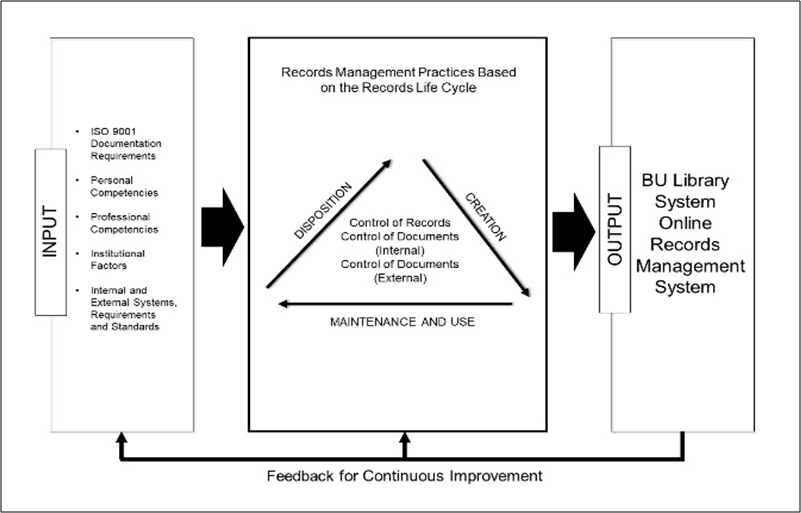
Looking at the records management practices of the BU libraries along the four (4) QMS documentation requirements of ISO 9001 and the perceived factors affecting the level of compliance, a developmental model using the Process Approach is proposed.
At present, there is no existing model of records management being implemented by the BULS or the university for this study to evaluate and use as a basis for the creation of this new contextual model.
Inputs. The model incorporates the documentation requirements of the ISO 9001 standard, the personal and professional competencies of librarians, institutional factors and internal and external systems and requirements/standards as Inputs.
Process. The framework for Records Management comprising of the processes a record undergoes from creation, maintenance and use and disposition covers the Process phase. However, there also has to be processes for control of documents and records to ensure good documentation. The model proposes documented procedure for Control of Records, and Internal and External Documents
Output. The result is an output specifically, the development of the BU Library System Online Records Management.

A Feedback mechanism after the implementation of the output is also included indicating that the Library System needs to be reviewed to determine if there needs to be changes in the inputs and process for the continual improvement of the quality management system is present. Figure 1 gives an illustration of the model.
The proposed online system aims to standardize the library records management practices in relation with the ISO 9001 documentation standard to continually deliver quality services. Specifically, it hopes to aid in the compliance and maintenance of a quality records management system and to organize records, work effort, and maintain accountability. The model’s output will serve as an online repository of library records with efficient and systematic control over their creation, receipt, maintenance, use, retention, and disposition. The BULS Online Records Management System will systematically create and enforce the BU records retention policy. Metadata consisting of a time period is attached to the records series where the specific record belongs. Records with permanent value are also automatically tagged as Archives. When it has outlived its retention period, it is not automatically deleted from the system, but is stored temporarily for review. The system also puts emphasis on security of the library records. The system ensures that only authorized personnel (i.e., Document Custodian and librarian) have access to the system, backup, and recovery of records.
This paper concludes that: (1) the documented quality policy has been communicated within the university and the library personnel, faculty and students have been made aware of its importance as an ISO certified institution. On the contrary, the faculty and students are not fully aware that the BULS conducts regular management meetings or reviews for improving and recording progress of the QMS; (2) procedure of library functions are established, documented, implemented, and maintained, however, there is no documented procedure to ensure control of non-conforming products or services/processes; (3) library work instructions are designed by process owners but falls short on the process of reviewing the document before approval or dissemination; and (4) the creation of records follows the standard procedure however retention of records is not observed.
The study also concludes that there is a significant difference in the level of compliance of the unit/college libraries but not among the aspects. Furthermore, all the personal, professional, and institutional factors identified in the instrument affect the level of compliance of libraries along Quality Policy, Procedures, Work Instructions and References/Records.
In light of the study's results and conclusions, the following salient recommendations are made: (1) Develop a documented procedure to control non-conformities or a non-conformance log with Plan-of-Action to address the non-conformities; (2) Establish or design standardized procedures of its records management practices in relation with the ISO 9001 documentation standard to continually deliver quality services; (3) Top management should provide programs that will support the continued enhancement of the librarians’ personal competencies giving focus on leadership skills by providing leadership trainings and considering the job rotation strategy. The cultural competency of librarians can also be developed to provide culturally competent library services; (4) The librarians should engage should engage more in trainings on digital literacy and upgrading of technological knowledge and skills to cope up with the current demand of its clientele in terms of technology-related services in the library and proper management of electronic records and use of online platforms; (5) The library top management should also lobby for a realistic budget to fund modern services and facilities and possibly source-out external funding. It should apportion budget for supplies, equipment, and digitization expenditures needed to implement proper archives and records management.
| [1] | ISO 15489-1:2016(en) Information and documentation — Records management — Part 1: Concepts and principles. (2016). ISO. Retrieved June 15, 2017, from https://www.iso.org/obp/ui/#iso:std:iso:15489:-1:ed-2:v1:en. | ||
| In article | |||
| [2] | C. Stilwell, P. Ngulube, and B. Chachage, (2022). Developing a model corporate records management system for sustainability reporting: A case of the Iringa region in 61 Tanzania. Ukzn. Retrieved March 13, 2023, from https://www.academia.edu/20966004/Developing_a_model_corporate_records_management_system_for _sustainability_reporting_A_case_of_the_Iringa_region_in_Tanzania. | ||
| In article | |||
| [3] | Republic Act 9470: The National Archives of the Philippines Act of 2007. (2007, May 21). National Archives of the Philippines. Retrieved March 5, 2017, from http://www.nationalarchives.gov.ph/2007/05/21/republic-act-no-9470/. | ||
| In article | |||
| [4] | Alolayan, S. (2014). An assessment of quality management system indicators for the ISO 9001:2008 certified work organisations in Kuwait olko- DORAS [PhD thesis]. Dublin City University. | ||
| In article | |||
| [5] | Gunnlaugsdottir, J. (2012b). Information and records management. Records Management Journal, 22(3), 170-185. | ||
| In article | View Article | ||
| [6] | Taib, C. A., Warokka, A., & Hilman, H. (2012). The library’s quality management system and quality assurance in higher education: A lesson from southeast emerging educational hub. Communications of the IBIMA, 1-11. | ||
| In article | View Article | ||
| [7] | Margaret Pember, (2006) "Sorting out the standards: what every records and information professional should know", Records Management Journal, Vol. 16 Issue: 1, pp.21-33. | ||
| In article | View Article | ||
| [8] | Prescription-adoption-and-promulgation-of-National-Competency-Based-Standards-for-Filipino-Librarians.pdf. (2015). Scribd. https://www.scribd.com/document/405034469/Prescription-Adoption-and-Promulgation-of-National-Competency-Based-Standards-for-Filipino-Librarians-pdf#. | ||
| In article | |||
Published with license by Science and Education Publishing, Copyright © 2023 Laila A. Belardo and Sipronio B. Belardo
 This work is licensed under a Creative Commons Attribution 4.0 International License. To view a copy of this license, visit
http://creativecommons.org/licenses/by/4.0/
This work is licensed under a Creative Commons Attribution 4.0 International License. To view a copy of this license, visit
http://creativecommons.org/licenses/by/4.0/
| [1] | ISO 15489-1:2016(en) Information and documentation — Records management — Part 1: Concepts and principles. (2016). ISO. Retrieved June 15, 2017, from https://www.iso.org/obp/ui/#iso:std:iso:15489:-1:ed-2:v1:en. | ||
| In article | |||
| [2] | C. Stilwell, P. Ngulube, and B. Chachage, (2022). Developing a model corporate records management system for sustainability reporting: A case of the Iringa region in 61 Tanzania. Ukzn. Retrieved March 13, 2023, from https://www.academia.edu/20966004/Developing_a_model_corporate_records_management_system_for _sustainability_reporting_A_case_of_the_Iringa_region_in_Tanzania. | ||
| In article | |||
| [3] | Republic Act 9470: The National Archives of the Philippines Act of 2007. (2007, May 21). National Archives of the Philippines. Retrieved March 5, 2017, from http://www.nationalarchives.gov.ph/2007/05/21/republic-act-no-9470/. | ||
| In article | |||
| [4] | Alolayan, S. (2014). An assessment of quality management system indicators for the ISO 9001:2008 certified work organisations in Kuwait olko- DORAS [PhD thesis]. Dublin City University. | ||
| In article | |||
| [5] | Gunnlaugsdottir, J. (2012b). Information and records management. Records Management Journal, 22(3), 170-185. | ||
| In article | View Article | ||
| [6] | Taib, C. A., Warokka, A., & Hilman, H. (2012). The library’s quality management system and quality assurance in higher education: A lesson from southeast emerging educational hub. Communications of the IBIMA, 1-11. | ||
| In article | View Article | ||
| [7] | Margaret Pember, (2006) "Sorting out the standards: what every records and information professional should know", Records Management Journal, Vol. 16 Issue: 1, pp.21-33. | ||
| In article | View Article | ||
| [8] | Prescription-adoption-and-promulgation-of-National-Competency-Based-Standards-for-Filipino-Librarians.pdf. (2015). Scribd. https://www.scribd.com/document/405034469/Prescription-Adoption-and-Promulgation-of-National-Competency-Based-Standards-for-Filipino-Librarians-pdf#. | ||
| In article | |||