Study Objectives: The study aimed to develop and test the psychometric properties of the smart phone addiction scale, and to estimate its incidence among a sample of Egyptian children as perceived by parents after Corona pandemic. Methodology: An electronic link was developed on the websites of schools and WhatsApp groups in some Egyptian governorates. The study sample consisted of 238 male and female school age children, distributed according to gender to 93 (36.3%) boys and 145 (63.7%) girls, with an average age of 7.94 years and a standard deviation of 2.2. Research Instrument: Smartphone addiction scale was developed by the first researcher. Results: The exploratory factor analysis revealed one factor for the manifestations of smartphone addiction, and the general factor model proved a good match with the sample data, and a satisfactory degree of omega squared internal consistency, and the percentage of smartphone addiction among children reached (52.1%) as perceived by parents. Recommendation: The study recommended the need to address the phenomenon of mobile phone addiction due to its negative impact on the personal, psychological and educational aspects of children after the Corona pandemic.
The Corona pandemic brought about great and sudden changes in all areas of life, especially the educational aspects in all educational stages, especially among children in the kindergarten and primary education stages, which represent an age group from four to 12 years, and the Corona pandemic has negative effects on the learning and education process, as children are from families Families with lower incomes and less opportunities for parental support are the group most exposed to these negative effects. The American Psychological Association (APA) report indicates that the most important risks of relying on technology in the learning process are addiction to smart phones, distress and boredom, and bullying through social media. and others 1.
In developing countries, the Corona pandemic, in addition to the Ukrainian-Russian war, led to an increase in the economic burdens on families, especially those with limited incomes. In light of this, the importance of the current study comes in dealing with the phenomenon and addiction of smart phones in terms of its measurement, and its incidence, among a sample of Egyptian children in the primary stage after the Corona pandemic and in light of the Ukrainian-Russian war and the consequent deterioration of their economic conditions.
Forced residence and distance learning from home during the Corona pandemic led children to indulge in the use of smart phones to play games, watch videos, and conversations, and this reached what is called in the heritage the addiction to smart phones or the increasing use of them Excessive smartphone use, and smart phone addiction is known as A kind of immersion or involvement in the use of mobile phones on an ongoing basis, and one of its most important manifestations is the heavy dependence on it, the difficulty of cutting it off, and the difficulty of controlling its use, the continuous use of it.
Many problems arose as a result of mobile addiction, the most important of which is the increase in academic and academic problems, as the use of mobile phones in schools does not improve students’ performance because they use them in conversations with friends, playing games, taking pictures, and searching for useless information, in addition to economic problems because the use of phones requires packages Charging the Internet requires a lot of money and personal problems, as it develops feelings of distress, frustration, insecurity, emotional and physical problems, and neglect of personal hygiene 2. As a result of the Corona pandemic, smartphone addiction levels have increased significantly 3, and with regard to the rates of mobile phone addiction, it ranged from 5% 4 to 50% 5, and for a meta-analysis of about 31 studies dealing with mobile phone addiction The researcher Sohn et al concluded that the prevalence of mobile phone addiction among samples of children and adolescents ranged from 10% to 30% with a median value of 23.3% 6, and in Iranian society Mokhtarinia et al. concluded that the percentage of mobile phone addiction during the Corona pandemic It reached 53.3% 3 and among children and adolescents in German society, Klisener et al. concluded that 2.3% of the sample use smart phones satisfactorily 7.
In the Egyptian society, not many studies were conducted to build and measure the addiction of smart phones to primary school children, in light of the students staying in their homes for more than a full year as a result of the Corona pandemic, as they were receiving their lessons through electronic learning, and also in light of the families’ preoccupation with providing food, drink and housing, and from Here came the importance of the current study in an attempt to bridge the gap in the research heritage in the Egyptian environment, and based on the foregoing, the objectives of the study stem from the following:
- Psychometric evaluation of the scale of smart phone addiction among a sample of primary school children in Egypt in terms of validity and reliability.
Determining the percentage of smartphone addiction among primary school children in Egypt after the Corona pandemic.
Smartphone addiction: It is the continuous use of smart phones to watch games and others, so that if the child is cut off from them, he feels upset and angry, and it is measured through five aspects that reflect the increasing use of it.
The study sample: It is a sample of children from the age of six to twelve, and it represents primary school children.
3.2. Procedural MethodsThe design of quantitative cross-sectional studies was used, and the descriptive survey method was employed by sending the smartphone addiction scale to parents of primary school children to determine the incidence of mobile addiction difficulties.
Participants: A sample of primary school children in Egypt, and the smart phone addiction scale was applied by sending a Google form link to the school websites in Ismailia Governorate in Egypt, and to the private lessons groups on the teachers’ WhatsApp, and in light of this, the sample size was 238 boys and girls, and also A teacher and a parent, and the ages of the sample of children ranged from 6 to 12 years, with an average of 8.94 years, and a standard deviation of 2.22.
Research Instrument (Mobile addiction scale):
After looking at some measures of smartphone addiction in the research heritage such as 8, 9 it was measured in light of the manifestations of continuing to play with the mobile phone, intolerance, distress and crying when taking it from him, and others, and five were formulated Vocabulary such as “he gets intolerant and cries when the phone is taken from him” and “he watches videos constantly”. These vocabulary were presented to three experts in the field of educational psychology and mental health to verify the correct wording of the vocabulary and its relevance to the concept. The experts recognized the validity of the vocabulary to measure addiction to smart phones, and the answer was given in the light of a three-point scale, the response is rare (1), moderately (2), and continuously (3).
3.3. Procedural StepsThe smart phone addiction scale was designed electronically by sending a link on Google form to parents in many governorates of Egypt, and they were alerted that the father or mother apply the study scale, during the period from the beginning of November 2022 to the end of December 2022, and it was emphasized Parents respond with reliability, transparency, and credibility, and the name can also not be written if desired as a form of reassurance and psychological comfort during the response, as well as reassuring them that the data has a confidentiality, and is used for research purposes without including children’s names in the results of the study, and after completing the application process, the transfer was made The data file is from an Excel sheet into a SPSS file, then basic data is encoded.
3.4. Data Analysis StrategyWith regard to the psychometric verification of the smart phone addiction scale, the data was analyzed using the SPSS program [28], where the exploratory factor analysis was carried out using the Basic Components Method to reveal the Factorial Structure of the scale, and it was relied on the criterion of the value of the latent root greater than the correct one with the logical and theoretical interpretation of the factors resulting from Analysis, and it was considered that the item was saturated on the factor if the value of saturation was greater than 0.32 10, and the MPLUS program 7 was used to conduct the confirmatory factor analysis and the smart phone addiction scale, and the Weighted least square mean variance (WLSMV) estimation method was employed) because it is suitable for non-normal data, taxonomic rank, and small sample sizes 11, and the confirmatory factor analysis model was evaluated in the light of the Comparative Fit Index (CFI), the Tucker-Lewis index (TLI) (greater than 0.90), and the RMSEA index (0.08). and less), and the chi-squared statistic and the non-statistically significant p-value at 0.05 12, 13, and the stability of internal consistency was estimated using Cronbach's alpha coefficient for the data of the study tools. The percentages, averages, and standard deviations of smartphone addiction manifestations were estimated.
As for the criterion for identifying a child addicted to smart phones, the researcher adopted the criterion adopted by Young 14 in his Young Diagnostic Questionnaire, whose list included eight items to define Internet addiction, and classified the person as being addicted to mobile phones if he answered yes to three items from his list, and accordingly, the list of mobile addiction Smart includes five aspects, and therefore, if the child answers to two items continuously, he is described as a mobile phone addict.
The first objective: the psychometric evaluation of the validity and reliability of the smartphone addiction scale among a sample of primary school children in Egypt.
To investigate the psychometric properties of the Telephone Addiction Scale, the following were estimated:
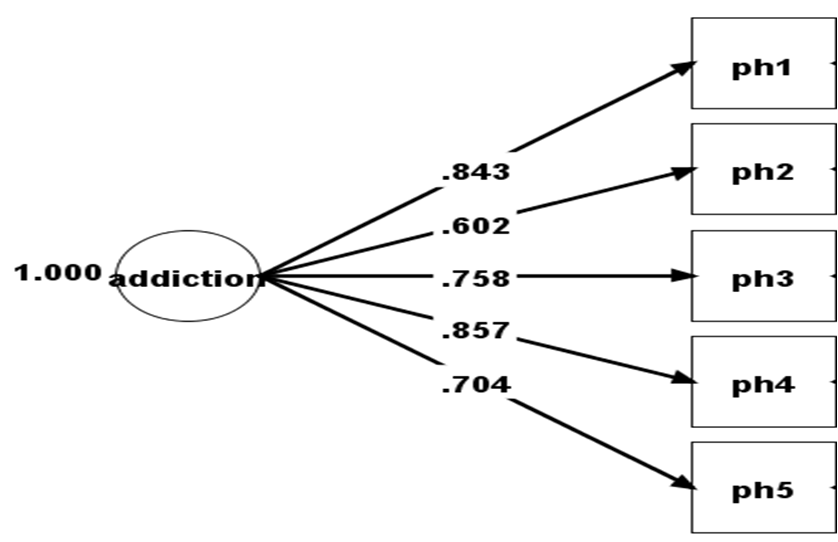
Structural validity of the scale: Structural validity was carried out using the exploratory factor analysis using the principal components method, and the value of the Kaiser-Meyer-Olkin criterion was KMO = 0.84, which indicates the appropriateness of the correlation coefficients between the items for the analysis. The saturations of the five items in the factor ranged from 0.70 to 0.85, which indicates a high validity of the items and their association with the infrastructure of smart phone addiction. The stability of the internal consistency omega squared scale was 0.87, which is a satisfactory value for statistical analyses. The confirmatory factor analysis was carried out using the WLSMV method, and the indicators of statistical fit or fit were chi-square = 9.96 (p = 0.04), which is not statistically significant at the level of statistical significance 0.01, and the index RMSEA = 0.079 (CI90 0.015-0.14), and the index CFI = 0.99, The TLI index = 0.97, after adding the relationship between the two measurement errors for the second and fifth items, which are indicators that indicate good statistical compatibility and relevance of the scale with the sample data. The following is the path form for the confirmatory factor analysis model:

Stability: The stability of the internal consistency omega-square scale was estimated at 0.87, which is a satisfactory value for statistical analyses.
The second objective: Determining the percentage of smartphone addiction among primary school children in Egypt after the Corona pandemic.
Percentages and averages of different manifestations of smartphone addiction were estimated as follows:
It is clear from Table 2 that all manifestations of smartphone addiction are present in a medium degree, and the most common occurrence is “continuously playing with the phone”, “continuously watching videos”, and the least common occurrence is “not sleeping except when holding the phone”, and in general, the availability of smart phone addiction among primary school children In a medium degree, and in general, the percentage of smartphone addiction among primary school children reached 0.52.1%.
“The world before the Corona pandemic is not the same as after it.” In other words, did this pandemic causes children to become more addicted to smart phones? and do the economic changes resulting from the Corona pandemic and the Ukrainian-Russian war have an impact on increasing the addiction to smart phones? All these questions, the current study tried to answer, and for that the credibility of the smart phone addiction scale was verified, and its validity and stability were proven to a satisfactory degree, and the percentage of smart phone addiction reached 52.1% in the primary stage, which is certainly a higher percentage than what the studies reported 4, 5, 6, but it is close to its percentage in Iranian society 3. This is relatively high percentage due to the cultural and economic changes that arose as a result of the pandemic and wars, in addition to Parents were preoccupied with their children as a result of harsh life conditions, and also allow children to use telephones as a means to satisfy them so that they do not cause problems and get angry, and to prevent them from crying and other behaviors that annoy parents.
Although the current study was characterized by many aspects of strength in its methodological and statistical treatment, it suffers from some limitations, the most important of which are: First; The study procedures were carried out in the light of the awareness of teachers and parents of learning difficulties and addiction to smart phones, but the results could differ if the study relied on the self-report of the children themselves, without intermediaries, whether parents or teachers.
Second: The study sample included parents of children who have at least an average degree of educational level because they had the ability to respond to the study questions electronically. Therefore, what if the study relied on parents of low or medium educational levels, meaning that the children are of low economic levels? Therefore The results of the study are not generalized except to people of the lower and/ or middle economic levels.
Third: The study relied on an electronic link sent to the parents of the study sample, and this does not mean the availability of randomness 15. Therefore, the results of the study must be taken with caution, and its results cannot be generalized unless it is conducted on other samples in order to verify the cross-validation.
Fourth: The majority of the sample of children in the study are children or students of governmental and private experimental schools with languages, but the results of the study might differ if it was relied on a sample of children from public schools whose courses are taught in Arabic?
• Smartphone addiction scale has satisfactory and good psychometric characteristics of structural validity and internal consistency stability for childhood.
• Conducting a study on the same population to ensure the credibility of the results of the current study, including samples at the national level, taking into account the economic levels and place of living, whether in rural and urban areas, and other demographic variables.
• The need to educate parents and stakeholders in educational system about the danger of the increasing phenomenon of smartphone addiction for kindergarten and primary school children, because of its negative consequences on their personal and academic lives in the future educational stages.
• Enhancing cooperation between the family and the school to reduce the increasing use of smart phones.
| [1] | APA [American Psychological Association] (2020). Human behavior in the time of COVID-19: Learning from psychological science. https://www.psychologicalscience.org/observer/human-behavior-in-thetime-of-covid-19. | ||
| In article | |||
| [2] | Bian, B. (2021). The Impact of COVID-19 pandemic on problematic smartphone using among adolescents. Advances in Social Science, Education and Humanities Research, 615. Proceedings of the 4th International Conference on Humanities Education and Social Sciences (ICHESS 2021). | ||
| In article | View Article | ||
| [3] | Mokhtarinia, H. R., Torkamani, M. H., Farmani, O., Mokhtarinia, E. (2022). Smartphone addiction in children: patterns of use and musculoskeletal discomfort during the COVID-19 pandemic in Iran. BMC Pediatrics, 22,681, 2-8. | ||
| In article | View Article PubMed | ||
| [4] | Riva, G., Wiederhold, B. K, & Cipresso, P. (2016). The psychology of social networking: Identity and relationships in online communities. Warsaw/Berlin: DGruyter Open Ltd, 2. | ||
| In article | View Article | ||
| [5] | Yen, C. F., Tang, T. C., Yen, J. Y., Lin, H. C., Huang, C. F., & Liu, S. C. (2009). Symptoms of problematic cellular phone use, functional impairment and its association with depression among adolescents in Southern Taiwan. J. Adolesc., 32, 863-73. | ||
| In article | View Article PubMed | ||
| [6] | Sohn, S., Rees, P., Wildridge, B., Kalk, N. J., & Carter, B. R. (2019). Prevalence of problematic smartphone usage and associated mental health outcomes amongst children and young people: A systematic review, meta-analysis and GRADE of the evidence. BMC Psychiatry, 19. | ||
| In article | View Article PubMed | ||
| [7] | Kliesener, T., Meigen, C., Kiess, W., & Poulain, T. (2022). Associations between problematic smartphone use and behavioural difficulties, quality of life, and school performance among children and adolescents. BMC Psychiatry, 22, 195. | ||
| In article | View Article PubMed | ||
| [8] | Serra, G., Scalzo, L., Giuffrè, M., Ferrara, P., & Corsello, G. (2021). Smartphone use and addiction during the coronavirus disease 2019 (COVID-19) pandemic: Cohort study on 184 Italian children and adolescents. Italian Journal of Pediatrics, 47. | ||
| In article | View Article PubMed | ||
| [9] | Abu-Taieh, E. M., AlHadid, I., Kaabneh, K., Alkhawaldeh, R. S. Khwaldeh, S., Masa’deh, R., & Alrowwad, A. (2022). Predictors of Smartphone Addiction and Social Isolation among Jordanian Children and Adolescents Using SEM and ML. Big Data Cognitive Computing, 6, 2-36. | ||
| In article | View Article | ||
| [10] | Tabachnick, B. G., & Fidel, L. S. (2007). Using multivariate statistics (4th.ed). Boston: Allgn & Bacon. | ||
| In article | |||
| [11] | Muthen, L. K., & Muthen, B. O. (1998 – 2012). Mplus User's Guide (7th.ed). LOS Angeles, CA; Muthen & Muthen. | ||
| In article | |||
| [12] | Hu, L., & Bentler, P. M. (1999). Cutoff criteria for fit indexes in covariance structure analysis. Conventional criteria versus new alternatives. Structural Equation Modeling, 6, 1-55. | ||
| In article | View Article | ||
| [13] | Amer, Abdel Nasser Al-Sayed. (2018). Structural Equation Modeling for Psychological and Social Sciences: Foundations, Applications and Issues (Part One). Riyadh: Naif Arab University for Security Sciences Publishing House. | ||
| In article | |||
| [14] | Young, K. S. (1996). Internet Addiction: The Emergence of a New Clinical Disorder. CyberPsychology & Behavior, 1, 237-244. | ||
| In article | View Article | ||
| [15] | Amer, Abdel Nasser Al-Sayed. (2021). Quantitative and qualitative research methodologies and mixed methods” design, measurement, analysis and scientific writing (Part 1). Available on Amazon for publishing, digital Arabic books. https://www.amazon.com/dp/B09K5MYLRF. | ||
| In article | |||
Published with license by Science and Education Publishing, Copyright © 2023 Abdul-Naser El-sayed Aamer and Shewikar Farrag
 This work is licensed under a Creative Commons Attribution 4.0 International License. To view a copy of this license, visit
http://creativecommons.org/licenses/by/4.0/
This work is licensed under a Creative Commons Attribution 4.0 International License. To view a copy of this license, visit
http://creativecommons.org/licenses/by/4.0/
| [1] | APA [American Psychological Association] (2020). Human behavior in the time of COVID-19: Learning from psychological science. https://www.psychologicalscience.org/observer/human-behavior-in-thetime-of-covid-19. | ||
| In article | |||
| [2] | Bian, B. (2021). The Impact of COVID-19 pandemic on problematic smartphone using among adolescents. Advances in Social Science, Education and Humanities Research, 615. Proceedings of the 4th International Conference on Humanities Education and Social Sciences (ICHESS 2021). | ||
| In article | View Article | ||
| [3] | Mokhtarinia, H. R., Torkamani, M. H., Farmani, O., Mokhtarinia, E. (2022). Smartphone addiction in children: patterns of use and musculoskeletal discomfort during the COVID-19 pandemic in Iran. BMC Pediatrics, 22,681, 2-8. | ||
| In article | View Article PubMed | ||
| [4] | Riva, G., Wiederhold, B. K, & Cipresso, P. (2016). The psychology of social networking: Identity and relationships in online communities. Warsaw/Berlin: DGruyter Open Ltd, 2. | ||
| In article | View Article | ||
| [5] | Yen, C. F., Tang, T. C., Yen, J. Y., Lin, H. C., Huang, C. F., & Liu, S. C. (2009). Symptoms of problematic cellular phone use, functional impairment and its association with depression among adolescents in Southern Taiwan. J. Adolesc., 32, 863-73. | ||
| In article | View Article PubMed | ||
| [6] | Sohn, S., Rees, P., Wildridge, B., Kalk, N. J., & Carter, B. R. (2019). Prevalence of problematic smartphone usage and associated mental health outcomes amongst children and young people: A systematic review, meta-analysis and GRADE of the evidence. BMC Psychiatry, 19. | ||
| In article | View Article PubMed | ||
| [7] | Kliesener, T., Meigen, C., Kiess, W., & Poulain, T. (2022). Associations between problematic smartphone use and behavioural difficulties, quality of life, and school performance among children and adolescents. BMC Psychiatry, 22, 195. | ||
| In article | View Article PubMed | ||
| [8] | Serra, G., Scalzo, L., Giuffrè, M., Ferrara, P., & Corsello, G. (2021). Smartphone use and addiction during the coronavirus disease 2019 (COVID-19) pandemic: Cohort study on 184 Italian children and adolescents. Italian Journal of Pediatrics, 47. | ||
| In article | View Article PubMed | ||
| [9] | Abu-Taieh, E. M., AlHadid, I., Kaabneh, K., Alkhawaldeh, R. S. Khwaldeh, S., Masa’deh, R., & Alrowwad, A. (2022). Predictors of Smartphone Addiction and Social Isolation among Jordanian Children and Adolescents Using SEM and ML. Big Data Cognitive Computing, 6, 2-36. | ||
| In article | View Article | ||
| [10] | Tabachnick, B. G., & Fidel, L. S. (2007). Using multivariate statistics (4th.ed). Boston: Allgn & Bacon. | ||
| In article | |||
| [11] | Muthen, L. K., & Muthen, B. O. (1998 – 2012). Mplus User's Guide (7th.ed). LOS Angeles, CA; Muthen & Muthen. | ||
| In article | |||
| [12] | Hu, L., & Bentler, P. M. (1999). Cutoff criteria for fit indexes in covariance structure analysis. Conventional criteria versus new alternatives. Structural Equation Modeling, 6, 1-55. | ||
| In article | View Article | ||
| [13] | Amer, Abdel Nasser Al-Sayed. (2018). Structural Equation Modeling for Psychological and Social Sciences: Foundations, Applications and Issues (Part One). Riyadh: Naif Arab University for Security Sciences Publishing House. | ||
| In article | |||
| [14] | Young, K. S. (1996). Internet Addiction: The Emergence of a New Clinical Disorder. CyberPsychology & Behavior, 1, 237-244. | ||
| In article | View Article | ||
| [15] | Amer, Abdel Nasser Al-Sayed. (2021). Quantitative and qualitative research methodologies and mixed methods” design, measurement, analysis and scientific writing (Part 1). Available on Amazon for publishing, digital Arabic books. https://www.amazon.com/dp/B09K5MYLRF. | ||
| In article | |||