The spread of the Covid-19 coronavirus worldwide triggered a national emergency, and institutions in more than 100 countries were forced to restrict their operations temporarily. Institutions like schools were pushed to switch from conventional classroom education to online learning. This study applied a phenomenological and qualitative research design to investigate the participants' experiences in in-person and remote learning settings. The inquiry revealed themes relating to graduate school students' lived experiences which served as the foundation for developing a blended learning framework for the graduate studies department. Human interaction with sub-themes of engagement and participation and social connection emerged during the in-depth interview of graduate students in in-person and remote learning; passive learning with its sub-theme engaging learning environment, immediate feedback, availability, and accessibility of resources; and saving time incurred expenses in in-person learning. Subsequently, the benefits of remote education and its sub-themes were cost-saving measures, resiliency, adaptability and convenience, and flexibility under remote learning technical issues like internet connectivity and technical problems in learning platforms. Difficulty and challenges with sub-themes, such as physical fatigue and lack of concentration, also emerged. The lack of communication and timely communication and coordination were also revealed in their remote learning experiences. This study also identified the graduate students' in-person and remote learning coping mechanisms. The in-person coping mechanism of a graduate student was social connection, and the remote learning coping mechanisms were time management and seeking support. The proposed blended learning framework was the expected output of this research.
As a result of the COVID-19 outbreak, conventional in-person learning activities have been replaced with a more rapid and strong reliance on remote learning resources. The educational environment has been dramatically reshaped due to this shift from in-person to wholly remote learning. Even though remote learning is no longer a novel teaching strategy in higher education, previous analyses have shown several challenges. The lack of flexibility in instructional methods, a lack of empowerment in content creation, and just teaching from pre-existing materials are some of the issues that need to be addressed. Furthermore, many universities and colleges do not have the infrastructure to facilitate remote learning, and students do not have access to computer devices or internet connections.
In the Philippines, the Department of Education and the Commission on Higher Education developed guidelines for implementing remote and modular distance learning instruction to protect students from contracting the disease. While the government strictly implemented safety measures to prevent the spread of the contagious virus, educational institutions had to adjust their learning modalities from planning to execution of the new plans. As they altered to unconventional or remote teaching modes, both synchronous and asynchronous, teachers and administrators were entrusted to adjust and change course curricula and requirements from the comfort of their own homes.
As a result of the virus, the government launched a crisis response to mitigate the adverse effect of COVID-19 on education. This reaction included, but was not limited to, curriculum revisions, the provision of technological resources and infrastructure, calendar shifts, and instructional delivery and assessment policies. Inevitably, these developments compelled educational institutions to transition entirely to remote learning until in-person education is permitted. The current situation is unique because it can potentially reinforce the difficulties encountered during remote learning due to the restrictions and health protocols.
In-person learning provides opportunities for student engagement that are difficult to recreate remotely, especially when virtual learning professors are not well-trained. Although certain distance education approaches have proved useful during school closures, the remote learning experience has mostly mirrored in-person instruction, with different degrees of success.
As a result of the worldwide well-being crisis, one emerging reality is migration to remote learning platforms to mitigate the risk of in-person interaction. Due to the pandemic, universities were forced to transition from in-person to remote instruction. Most universities in the Philippines resorted to remote education during school lockdowns. However, this abrupt shift created difficulties for learners who lack access to technology. When remote learning was used in response to a pandemic, the divide between those with and without connectivity widened. Due to access and internet connectivity issues, teachers and students struggled to maintain academic engagement.
Santos 1 states remote learning demonstrates a digital gap among graduate students in this setting. This present remote learning scenario can worsen changes frequently and create barriers to participation in remote learning programs. According to the results of cross-sectional research nationwide, 32 percent of graduate students experienced difficulties shifting to new learning methods, and 22 percent said they did not have a dependable internet connection, according to the findings 2. For others, it may be challenging to use facilitative learning equipment that allows them to tune in to remote courses and promptly turn in assignments in the remote system 1. However, there are still numerous problems that Filipino university students have to hurdle in practicing distance education, despite the attempts to make education more accessible to all members of society.
Despite the distinct impact of remote learning on the learning environment and the tremendous potential for revolutionizing education, it rapidly developed into hybrid or blended learning, implying a fusion of remote and conventional learning methods 3. It offers a chance to combine technology advancements and innovations in remote education with the contact and involvement inherent in the finest conventional education 3.
According to Toquero 4, educational institutions must strengthen practices in the learning modalities and develop the essential requirements of students beyond the conventional classroom. In reacting to the changing educational landscape, the research results of this study may assist graduate school departments in revising their learning platforms, both in-person and remote learning. The study's findings can also aid graduate school department staff in improving the in-person and remote learning environment. Specifically, according to Chiu, Lin, and Lonka 5, the pandemic demonstrates the urgent need to improve the technological infrastructure of the educational system, increase the instructional competency of instructors, and broaden the learning capacity of the students.
As a result, this study aimed to describe the lived experiences of graduate students participating in in-person and remote learning in the aftermath of the COVID-19 pandemic and to propose a blended learning framework that students can appreciate in the new educational system model of the graduate school department.
This research contributes to the community of inquiry framework based on John Dewey's practical inquiry. The framework emphasized the importance of social, instructional, and cognitive presence in practical educational experiences in remote distance learning situations.
According to this framework, a community of inquiry in education is a group of persons who collectively participate in deliberate critical dialogue and reflection to develop personal meaning and confirm mutual knowledge.
The Community of Inquiry theoretical framework entails developing a rich and meaningful (collaborative-constructivist) learning experience by developing three interconnected elements: social, cognitive, and instructional presence.
The Community of Inquiry (CoI) framework outlines how learning happens for a group of individual learners via the educational experience at the intersection of social, cognitive, and teaching presence. According to Garrison 6, it is via the effective organization of different types of presence that remote academic professors and students, in partnership, establish a productive remote learning environment through which knowledge is generated.
The CoI framework has three initial presences (social, cognitive, and teaching). Based on the CoI framework, blended learning promotes self-reflection, active cognitive processing, interaction, and peer teaching. Additionally, professional support from faculty at the appropriate moment fosters engagement and collaborative application activities, underlining the critical nature of establishing communities of inquiry in the classroom – whether in-person, remote learning or integrated.
Creating communities of inquiry through blended learning is a well-researched pedagogical strategy in universities and colleges. The original Garrison et al. 7 essay elucidating this paradigm has been mentioned more than 4,000 times in the scientific literature. Much early research focused on social presence as a novel teaching method beyond traditional transmission models 8. According to a recent literature review, the most often used and widely accepted instrument for measuring and applying the CoI is "the CoI survey instrument created by Arbaugh et al. 9.
Social presence is defined as "participants' capacity to connect with a community (e.g., a course of study), speak meaningfully in a trusting atmosphere, and create interpersonal relationships via the projection of their unique personalities" 10.
Teaching presence conceptualizes, facilitates, and directs cognitive and social presences to achieve personally meaningful and educationally beneficial learning results 11. In a CoI, the teaching function applies to both faculty and students. While the teacher, or faculty of record, serves as the leader, teaching presence enables and promotes cooperative learning among students. Recent research demonstrates the critical role of teaching presence in creating pleasurable student learning experiences. It is, nevertheless, inextricably related to other presences 12.
The amount to which learners can build and reinforce meaning via extended thinking and discourse is called cognitive presence 7. Cognitive presence develops from four independent but complementary components of practical inquiry: triggering experiences, investigation, integration, and resolution. Establishing a foundation for deep and meaningful learning requires engagement in all four components. On the other hand, the evidence that cognitive presence involves a mix of cognitive, social, and instructional presence. Beyond just delivering information, direct teaching and encouraging cognitive activity are critical roles for faculty utilizing this approach.
Considering everything, I firmly believe that the community of inquiry provided a detailed approach to establishing a learning modality that considers various situational factors when determining how students learn.
2.2. Complex Adaptive Blended Learning SystemThe Complex Adaptive Blended Learning System (CABLS) Framework was developed by Wang, Han, and Yang 13. The significance of this framework to my study is that it explained the blended learning approach as 1) complex – involves a multitude of learning components to ensure the success of the blended learning approach; 2) adaptive – allowing for easy adjustment to meet the needs of current learning (aspects of content, learner, teacher, and instructional strategy); 3) dynamic – an approach that is capable of evolving in response to technological advancements and current learning issues; 4) "self-organizing" – a structural approach that adapts to its interaction with other learning components; and 5) "co-evolving" – an approach that is capable of evolving in response to the development of new learning characteristics, current technology, current skills based on the teachers' backgrounds, and improvement of learning objectives.
Based on the CABLS framework, the six subsystems illustrate the six subsystems and their relationships: learner, teacher; technology; content; and learning support.
In CABLS, "learner" refers to a complex subsystem in which learners interact with other subsystems while performing various roles. The blended learning environment would shift learners' positions from passive to active participants in the learning process. This change is possible due to the dynamic environment and the varied ways the subsystems interact within the blended learning approach.
In CABLS, the teacher's role differs from the learners' roles. The interaction of the subsystems would provide the instructor with a new identity as a facilitator, counselor, advisor, or e-moderator.
CABLS material is enhanced and more dynamic, rather than rigid, as it was previously. The interaction of the subsystems would generate an environment conducive to discovering and developing profound content.
CABLS technology, with its enhanced characteristics, facilitates the interaction of the subsystems. The interplay of technologies and strategies would produce a suitable learning environment.
CABLS's learning support is divided into two distinct areas, academic support and technical help. Academic support is provided to help learners build successful learning strategies, while technical support is provided to help learners enhance their knowledge of technology as they work on their assignments. These aids are targeted to the particular requirements of learners through the experience of teachers, the usability of technology, and institutional assistance.
In CABLS, "institution" refers to an institution's involvement in providing assistance and policy, strategy, and service planning to establish a blended learning environment in schools. These responsibilities would evolve in reaction to feedback from the other subsystems. In other words, the institution is the primary subsystem that aids in establishing and extending the other subsystems.
The CABLS framework enabled this study to acquire a more complete and accurate understanding of blended learning environments' dynamic and adaptive architecture. Graduate students may utilize this system's approach to create and provide blended learning courses that consider the importance of precisely understanding what occurs at work. The relationship between content, learners, and technology was particularly interesting to the faculty members.
The findings of a qualitative inquiry into the in-person and remote learning experiences of the people chosen to participate in this study served as the basis for this investigation's assumptions and findings. This research utilized a qualitative approach founded on phenomenology to understand better the phenomenon being investigated 14. According to Creswell 15, qualitative research is a methodology that begins with developing assumptions and applying interpretative and theoretical frameworks that lead to exploring research concerns about the meaning that individuals or groups attach to a social or human situation. This paper aimed to provide additional information on a particular characteristic related to a specific field of inquiry.
3.1. ParticipantsParticipants in this research endeavor were graduate students of the chosen institution. Six of them participated in my study. Three are Doctors of Philosophy, and the remaining are from the master's program.
As a researcher, it was my obligation to protect and safeguard the identity of my participants. The participants were interviewed under ethical conditions, and their identities and information were confidential. Table 1 shows the codes used to safeguard their identity and responses.
The interview employed a verified instrument guide. Before data collection, I obtained interview materials. Graduate students were interviewed using an interview guide. The researcher established rapport with the subject and performed the interview at the individual's request through an online platform like Google Meet, MS Teams, and Zoom.
3.3. Data ConstructionData analysis involves the systematic search and arrangement of interview transcripts, observation notes, and other non-textual resources in qualitative research. The data analysis based on Creswell 16 aims to identify themes from lived experiences of graduate students. The raw interview data were transcribed to be analyzed. After data coding, I read all of the data and discovered themes. These interpretations and understandings were utilized to construct a blended learning paradigm.
In this study, I defined trustworthiness using Gunawan's 17 four criteria: credibility, dependability, confirmability, and transferability.
All interviewees commented on or provided feedback on the author's interpretation of the data to ensure credibility. Credibility was established through prolonged engagement with participants or getting data from various sources. As a researcher, I listened to the audio several times and compared it to the transcripts to ensure the findings were dependable and confirmable.
Ensuring the dependability confirmed that the data represents the changing conditions of the phenomenon under study 18 and should be consistent across time, researchers, and analysis techniques 19.
On the other hand, validation of confirmability was assumed that the findings reflect the participants' perspectives as evidenced in the data rather than reflect the perceptions of bias. It enhanced confirmability by explicitly stating the assumptions about the topic of interest related to the unique contributions.
To maximize transferability, I included participants who were unrelated to one another, as this was one of the parameters set by the institution when they submitted the names of the graduate students for interview.
According to Bashir et al. 20, the validation of research data was enhanced by relying on the participants' literal statements about the descriptive data that had been collected. Along this line, I conducted casual member checks with the participants for accuracy and reviewed the synthesis of interview results. The result of the in-depth interview was shared with each participant in the verbatim transcript of the individual interviews, and the emerging themes and concepts were validated by participants' validation 21 or member checks 19.
From the interpretivist's views, the five primary themes and three subthemes were identified for the lived experiences of graduate students in in-person learning.
From the participants' lived experiences relative to in-person learning, various recurring themes emerged, such as human interaction, passive learning, immediate feedback, availability, and accessibility of the resources. In addition, multiple subthemes surfaced under human interaction and passive learning.
The basic premise of in-person learning is that human interaction is crucial in the classroom. The information deliverer is usually the center of attention. The human interaction paradigm fosters two-way class discourse. Under human interaction, student engagement, participation, and social connection were subthemes. The most popular subtheme was that graduate students were more engaged in the classroom than online. The results suggested they had more chances to discuss due to higher participation. As stated by PP-3,
"I don't think the remote class is engaging. Interaction is necessary for me. I want to ask questions during face-to-face classes."
Moreover, in-person learning creates peer conversations. Students are encouraged to engage with course requirements in class and with the professor's help. Graduate student connections allow students to engage in learning actively or passively. Because of student connection strategies, students may better advocate for themselves and their classmates, and professors are more receptive to their needs.
Passive learning puts the duty to retain material on the graduate student. Lectures or reading assignments may teach graduate students about the topic. Graduate students must acquire rather than applying knowledge, making learning passive. An engaging learning environment is one of the essential parts of passive learning, especially for graduate students in each course. The third theme of in-person learning is immediate feedback from peers and professors. The importance of feedback in helping students grow as learners cannot be overstated. Building positive relationships with our students and seeing them combine learning requirements into their objectives may be vital. The fourth theme that surfaced was the availability and accessibility of the resource within graduate students' reach. Any references and books needed during the examination, reports and other requirements of graduate students were available in the institution's graduate school office, library, and other facilities. The last theme was saving time and money. Remote learning was their option to continue their education after they experienced the convenience that remote learning can offer. Because of remote classes, students will no longer have to spend time and money traveling to and from class daily.
4.2. Remote LearningOn the other hand, five themes and eight subthemes have emerged for the lived experiences of graduate students in remote learning. Technical issues surfaced during the data gathering, like internet connectivity and difficulty logging in to the learning platform. Moreover, physiological fatigue and lack of concentration were subthemes under difficulties and challenges at the onset of remote learning. Lastly, lack of communication, timely communication, and coordination were independent themes during data gathering.
Various themes emerged in the remote learning modality, such as the benefits and technical remote learning problems, difficulties, challenges, lack of communication, and timely communication and coordination. Subsequently, subthemes emerged regarding the benefits of remote learning, such as cost-saving measures, resilience, convenience, flexibility, and being environmentally friendly. PP-5 uttered,
"I can adapt to the new model of the educational system. I can't do anything about it but adjust to the new normal; we are resilient to changes, modifications, and the like."
On the other hand, the benefits of remote learning, as perceived by the participants, were described. The cost and time effectiveness, being resilient, convenient, flexible, and environmentally friendly emerged as the subthemes under the benefit of remote learning. However, remote technical issues also surfaced as a theme during data gathering. The internet connectivity and technical problem in using the learning platform occurred under the technical issues of the graduate student. Difficulty and challenge also arose as main themes. Under this were physical fatigue and lack of concentration, which emerged as the subthemes. Timely communication and coordination were also a concern of the graduate school students, particularly reaching out to the learners, especially during enrollment and graduate school activities.
4.3. Coping Mechanisms of Graduate Students in the in-person and Remote Learning PlatformsTable 4 shows the graduate students' coping mechanisms toward in-person and remote learning. Even though the graduate student participants had faced difficulties and challenges at school, at home, and in the community, they had a positive attitude and coping mechanisms that enabled them to overcome these difficulties and challenges that they had met.
The graduate students' coping mechanisms have surfaced in my study. The graduate students coped and connected with their classmates through social activities during an in-person social engagement. In most cases, the participants can get by without relying on others for help with learning. It is said that the students' new learning method could not engage with other peers.
Graduate students' remote learning coping techniques vary. The students' responses highlighted time management, breaks, and seeking support. Graduate students' coping methods involved scheduling classes and chores. Four of six individuals claimed time management helped them balance school and family. PP-4 shared,
"With the assistance of my friends, I can manage my difficulties. Because my friends are going through the same thing, talking to them will help mede-stress. We both have strong feelings about modular distance learning, which allows us to have a productive debate about approaching our respective difficulties."
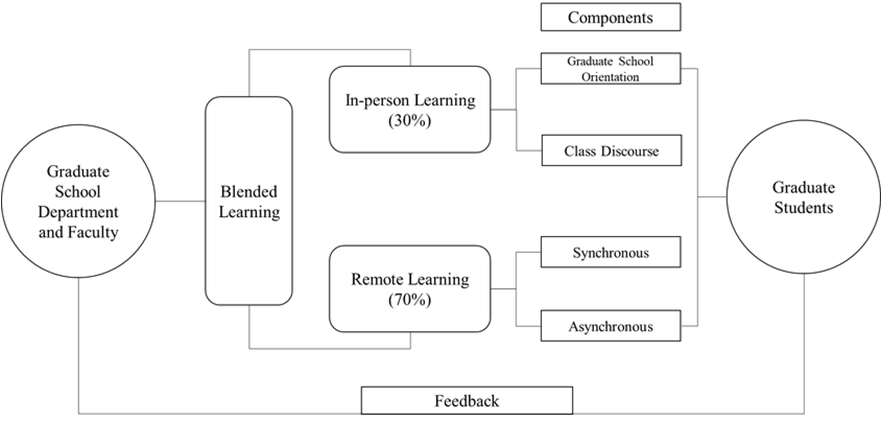
This coping technique involves students seeking help from others to deal with obstacles when asked if they sought help from friends, parents, or teachers. As indicated in the figure below, the following merging aspects formed the blended learning framework: Information and communication technologies may provide adaptable learning experiences for graduate students.

In teaching and learning, blended learning is a notion that encompasses structuring the process in a way that involves both in-person instruction and remote learning aided by technology. In blended learning, instructional methods include direct and indirect education and collaborative and personalized computer-aided learning.
Blended learning combines in-person education with remote, technology-assisted learning. Blended learning includes direct and indirect teaching and collaborative and personalized computer-aided learning.
Blended learning combines in-person and online learning. Innovation in these learning experiences does not require physical presence during remote education. Online communities may link these parts digitally. In one scenario, students may attend a traditional classroom with an instructor while completing online course components outside of class. A classroom discourse approach could validate the graduate students' learning from the previous discussion during synchronous or remote learning. This approach helps the faculty identify who needs to improve their communication skills among graduate students. This is also a venue for the professors to discuss the results of the activities given during asynchronous.
As proposed, the time allotment for remote learning is seventy percent, equivalent to ten (10) meetings. Consequently, most participants' choices were the remote learning platforms during my data gathering. Seventy percent (70%) could utilize synchronous classes and asynchronous modalities. Interaction, collaboration, and discussion could employ during synchronous courses and all graduate school programs and activities held remotely. The graduate school department could apply the blended learning framework by carefully planning the implementation of the new model. The professors and students must enhance their skills using ICT and the learning management system. To arrange the new educational model, the graduate school department must ensure timely communication and coordination about implementing the new educational framework of in-person and remote learning to make the graduate students adjust to the new framework.
This study aimed to identify how graduate students' lived experiences in in-person and remote learning as well as their coping mechanisms and blended learning framework.
In-person learning is preferable to remote learning because human interactions are more beneficial to graduate students. Muir et al. 22 pointed out that effective learning occurs when the student is dedicated, prepared, self-motivated, has good support, and provides relevant comments that increase participation and quality interaction. The reaction time that a person receives from peers and professors. However, traditional physical resources promote a teacher-centered method, the most direct and effective way to teach students because it provides in-person interaction 23. It is one of the most substantial aspects of physically being in a classroom. A person's inquiries are answered immediately during in-person learning. The study shows quick and accurate feedback response time is critical for optimal learning. It may also have the option of working in small groups in a classroom setting, where you can cooperate on challenging issues and receive quick feedback from peers and professors. In-person learning provides real-time contact with resources and others, takes place within a specified contact time, and provides prompt feedback to students 24. Proper learning environments require efficient and effective constructive feedback, such as what graduate students might receive in a classroom. The importance of feedback in helping students grow as learners cannot be overstated.
Building positive relationships with our students and seeing them combine learning requirements into their objectives may be vital. Rapid feedback can improve academic performance by encouraging students to be more motivated, self-regulated, and efficient, decreasing the gap between their current and desired performance.
Attending classes in person also helps students become more disciplined and controlled. Social interaction is one of the most acceptable ways to make new friends and meet new people in the classroom. Meeting new people is a unique method to improve your social skills. Being a student in a real classroom situation is a terrific method to connect with professors. Interacting with the professor teaches graduate students how to communicate appropriately, respond to, and work with peers and professors.
It can be much easier to talk about issues or problems with the professor in person rather than typing them out or trying to explain them in real-time remote classes. Graduate students must become more disciplined by attending planned courses in today's environment. The graduate students are prepared for "real-world" events by sticking to a class schedule.
The remote learning environment is usually more flexible in terms of time control. Alejandrino 25 explained that remote (synchronous and asynchronous) and offline strategies ensure accessibility and flexibility in learning. Remote learning has been deemed valuable for learning, cost-effectiveness, flexibility, and the prospect of offering world-class education 26.
Remote learning eliminates these opportunities for social interaction. Collaborating with others provides additional advantages for students to succeed in the real world rather than spending time at home behind a computer screen. In addition, remote learning may be seen as a technology that enables a more student-centered, inventive, and flexible teaching-learning process. Remote instruction is "synchronous or asynchronous learning experiences using various devices (e.g., mobile phones, computers, etc.) with an internet connection. Students may be anywhere (independent) in these spaces to study and connect with teachers and other students 27.
The remote learning classroom provides more opportunities to become sidetracked and wander from improved learning than an actual classroom. Many people believe that because conventional education has traditionally taken place in a school, students become more distracted in this setting. The opposite is true, however. Graduate students are more distracted by other individuals, family members, and cell phones, whether by remote learning from home.
Finally, high-speed internet service, wi-fi, or data plans compatible with the remote learning environment are not available to everyone. Some students live in site-specific areas without high-speed internet or wi-fi access. Students on a tight budget tend to avoid expensive internet and phone data plans because they are costly. If a power outage occurs or the internet connection is disrupted.
This finding was consistent with the outcomes in the research conducted by Guevarra and Cimanes 28, which found that student's primary coping technique was social support. Examples of social support are getting guidance from others, talking to someone who has had a similar experience, expressing emotions, receiving compassion, or telling someone how you feel. When students believe their sentiments about an unpleasant circumstance or an issue are real, they think they have been heard and understood.
It was also pointed out by Kwaah and Essilfie 29 that receiving emotional support from friends and family members is a helpful method of dealing with students' stress. Because student life is by its very nature difficult, students need the understanding as well as the compassion of their friends and family, mainly when they are under a tremendous deal of strain due to their academic burden.
Regarding being a student, in-person learning in a real classroom has been preferable. Despite the ever-increasing use of technology, remote learning does not adequately prepare a well-rounded student for the real world. Students who use the traditional classroom option are considerably more successful in their jobs because they increase social connections, become more rigid in their schedules, and learn to engage with professors and classmates.
In in-person and remote learning platforms, professors must be able to assess student performance in both in-person and remote learning modalities. The graduate school department could be established rubrics to measure the performance of the graduate students. When it comes down to it, generally, all evaluate the effectiveness of teaching methods by how much graduate students learn in the classroom. Moreover, synchronous learning has a significant impact on raising educational standards. Asynchronous communication between graduate students and professors is possible with technology. The graduate school department can immediately change the proposed blended learning if they notice that graduate students have difficulty adjusting to the new educational model.
It is essential to apply the knowledge from this study to the growing body of knowledge surrounding it so that the experiences in both environments can improve and become more efficient and effective.
Strengthen the interactive learning activities and involve graduate students in designing and implementing the new system. Students and professors should have a well-established relationship during remote learning. Professors should recognize how vital building meaningful relationships with and among graduate students is. This importance is equal to, if not greater than, remote learning.
Review and assess the proposed blended learning framework as a future reference in designing the educational model and learning platforms for professors and graduate students.
Continuous faculty development to the Graduate School office to increase interactivity during remote learning classes, although some may believe that revision classes and ICT hands-on training should be implemented after the COVID-19 pandemic has been brought under control.
Educational instruction should be developed by combining in-person and remote learning elements for the Graduate School Office. Compared to purely in-person and purely remote instruction, the blended learning model should provide a more significant advantage. The graduate students will be more efficient and effective in this combined model.
Formulate policies and procedures on in-person and remote learning platforms for the Graduate School in preparation for the blended or hybrid learning system.
Examine the effectiveness of in-person and remote learning modalities. Future research should better accommodate student learning and collaboration in a remote educational setting. Researchers should also consider the ICT's role in transforming students' beliefs about the role of technology in education. Also, future researchers can include other stakeholders like the faculty members, dean, or administrators as respondents/participants to have a comprehensive view of the blended learning implementation.
| [1] | Santos, A. P. (2020, October 6). In the Philippines, distance learning reveals the digital divide. Retrieved from https://eu.boell.org/en/2020/10/06/philippines-distance-learning-reveals-digital-divide. | ||
| In article | |||
| [2] | Baticulon, R. E., Alberto, N. R., Baron, M. B., Mabulay, R. E., Rizada, L. G., Sy, J. J., Tiu, C. J., Clarion, C. A. & Reyes, J. C. (2020). Barriers to online learning in the time of COVID-19: A national survey of medical students in the Philippines. medRxiv. | ||
| In article | View Article | ||
| [3] | Hrastinski, S. (2019). What Do We Mean by Blended Learning? TechTrends, 63(5), 564-569. | ||
| In article | View Article | ||
| [4] | Toquero, C. M. (2020). Challenges and opportunities for higher education amid the COVID-19 pandemic: The Philippine context. Pedagogical Research, 5(4). | ||
| In article | View Article | ||
| [5] | Chiu, T. K. F., Lin, T.-J., & Lonka, K. (2021). Motivating online learning: The challenges of COVID-19 and beyond. In (pp. 1-4): Springer. | ||
| In article | View Article PubMed | ||
| [6] | Garrison, D. R. (2018). Designing a Community of Inquiry. Community of Inquiry. Available from http://www.thecommunityofinquiry.org/editorial9. | ||
| In article | |||
| [7] | Garrison, D. R., Anderson, T., Archer, W. (2001). Critical thinking, cognitive presence, and computer conferencing in distance education. American Journal of Distance Education, 15(1). | ||
| In article | View Article | ||
| [8] | O'Connell, A. (2016). Seven blended learning models used today in higher ed. Retrieved from http://acrobatiq.com/seven-blended-learning-models-used-today-in-higher-ed/. | ||
| In article | |||
| [9] | Arbaugh, J., Cleveland-Innes, M., Diaz, S., Garrison, D. R., Ice, P., Richardson, J., & Swan, K. (2008). Developing a community of inquiry instrument: Testing a measure of the community of inquiry framework using a multi-institutional sample. The Internet and Higher Education, 11(3-4), 133-136. | ||
| In article | View Article | ||
| [10] | Garrison, D. R. (2009). Cognitive presence for effective asynchronous remote learning: The role of reflective inquiry, self-direction, and metacognition. In J. Bourne & J. C. Moore (Eds.), Elements of quality remote education: Practice and direction. Volume 4 in the Sloan C Series. Needham, MA: The Sloan Consortium. | ||
| In article | |||
| [11] | Anderson, T., Rourke, L., Garrison, D. R., & Archer, W. (2001). Assessing teaching presence in a computer conferencing environment. Journal of Asynchronous Learning Networks, 5(2). | ||
| In article | View Article | ||
| [12] | Chakraborty, Misha, Nafukho, Fredrick Muyia (2015). Strategies for Virtual Learning Environments: Focusing on Teaching Presence and Teaching Immediacy. Internet Learning Journal. Spring 2015, 4 (1), 8-37. | ||
| In article | View Article | ||
| [13] | Wang, Y., Han, X., & Yang, J. (2015). Revisiting the blended learning literature: Using a complex adaptive systems framework. Educational Technology & Society, 18 (2), 390. | ||
| In article | |||
| [14] | Creswell, J., & Plano Clark, V. (2007). Designing and conducting mixed methods research. Thousand Oaks, CA: Sage | ||
| In article | |||
| [15] | Creswell, J. W. (2013). Educational research: Planning, conducting, and evaluating quantitative and qualitative research. (4th ed.). Boston, MA: Pearson. | ||
| In article | |||
| [16] | Cresswell, JW, Plano Clark VL (2014). Designing and conducting mixed-method research. 2nd Sage; Thousand Oaks, CA: 2014. | ||
| In article | |||
| [17] | Gunawan, J. (2015). Ensuring trustworthiness in qualitative research. Belitung Nursing Journal, 1(1), 10-11. | ||
| In article | View Article | ||
| [18] | Brown, S.C., Richard a. Stevens, J., Troiano, P.F., & Schneider, M.K. (2002). Exploring Complex Phenomenon: Grounded Theory in Student Affairs Research, Journal of College Student Development, 43, 2, 1-11. | ||
| In article | |||
| [19] | Morrow, SL 2005, 'Quality and trustworthiness in qualitative research in counseling psychology, Journal of Counseling Psychology, 52(2), 250-60. | ||
| In article | View Article | ||
| [20] | Bashir, M., Afzal, M. T., & Azeem, M. (2008). Reliability and validity of qualitative and operational research paradigm. Pakistan journal of statistics and operation research, 35-45. | ||
| In article | View Article | ||
| [21] | Carcary, M. (2009). The research audit trial—enhancing trustworthiness in qualitative inquiry. Electronic Journal of Business Research Methods, 7(1), pp11-24. | ||
| In article | |||
| [22] | Muir, T.; Milthorpe, N.; Stone, C.; Dyment, J.; Freeman, E.; Hopwood, B. Chronicling engagement: Students’ experience of online learning over time. Distance Educ. 2019, 40, 262–277. | ||
| In article | View Article | ||
| [23] | Biel, R., and Brame, C. J. (2016). Traditional versus remote biology courses: connecting course design and student learning in an remote setting. J. Microbiol. Biol. Educ. 17, 417-422. | ||
| In article | View Article PubMed | ||
| [24] | Waghid F (2018) Action research and educational technology: cultivating disruptive learning. South African J High Educ 32(4): 1-11. | ||
| In article | View Article | ||
| [25] | Alejandrino, P. (2020). UST Implements' Enriched Virtual Mode' Next Academic Year; Extends Financial Assistance. Manila, PH: TomasinoWeb. | ||
| In article | |||
| [26] | Gratton-Lavoie, C., and Stanley, D. (2019). Teaching and learning principles of microeconomics remote: An empirical assessment. J. Econ. Educ. 40, 3-25. | ||
| In article | View Article | ||
| [27] | Singh, V., & Thurman, A. (2019). How many ways can we define remote learning? A systematic literature review of definitions of remote learning (1988-2018). American Journal of Distance Education, 33(4), 289-306. | ||
| In article | View Article | ||
| [28] | Guevarra, R., & Cimanes, R. (2017). Stress coping mechanism and its impact to their age among Senior High School students at Parañaque National High School -Baclaran. International Journal for Innovative Research in Multidisciplinary Field, 3(7), 53-65. | ||
| In article | |||
| [29] | Kwaah, C. Y., & Essilfie, G. (2017). Stress and coping strategies among distance education students at the University of Cape Coast, Ghana. Turkish Online Journal of Distance Education, 18(3), 120-134. | ||
| In article | View Article | ||
Published with license by Science and Education Publishing, Copyright © 2023 Joel M. Cuadra and Ena A. Bernal
 This work is licensed under a Creative Commons Attribution 4.0 International License. To view a copy of this license, visit
http://creativecommons.org/licenses/by/4.0/
This work is licensed under a Creative Commons Attribution 4.0 International License. To view a copy of this license, visit
http://creativecommons.org/licenses/by/4.0/
| [1] | Santos, A. P. (2020, October 6). In the Philippines, distance learning reveals the digital divide. Retrieved from https://eu.boell.org/en/2020/10/06/philippines-distance-learning-reveals-digital-divide. | ||
| In article | |||
| [2] | Baticulon, R. E., Alberto, N. R., Baron, M. B., Mabulay, R. E., Rizada, L. G., Sy, J. J., Tiu, C. J., Clarion, C. A. & Reyes, J. C. (2020). Barriers to online learning in the time of COVID-19: A national survey of medical students in the Philippines. medRxiv. | ||
| In article | View Article | ||
| [3] | Hrastinski, S. (2019). What Do We Mean by Blended Learning? TechTrends, 63(5), 564-569. | ||
| In article | View Article | ||
| [4] | Toquero, C. M. (2020). Challenges and opportunities for higher education amid the COVID-19 pandemic: The Philippine context. Pedagogical Research, 5(4). | ||
| In article | View Article | ||
| [5] | Chiu, T. K. F., Lin, T.-J., & Lonka, K. (2021). Motivating online learning: The challenges of COVID-19 and beyond. In (pp. 1-4): Springer. | ||
| In article | View Article PubMed | ||
| [6] | Garrison, D. R. (2018). Designing a Community of Inquiry. Community of Inquiry. Available from http://www.thecommunityofinquiry.org/editorial9. | ||
| In article | |||
| [7] | Garrison, D. R., Anderson, T., Archer, W. (2001). Critical thinking, cognitive presence, and computer conferencing in distance education. American Journal of Distance Education, 15(1). | ||
| In article | View Article | ||
| [8] | O'Connell, A. (2016). Seven blended learning models used today in higher ed. Retrieved from http://acrobatiq.com/seven-blended-learning-models-used-today-in-higher-ed/. | ||
| In article | |||
| [9] | Arbaugh, J., Cleveland-Innes, M., Diaz, S., Garrison, D. R., Ice, P., Richardson, J., & Swan, K. (2008). Developing a community of inquiry instrument: Testing a measure of the community of inquiry framework using a multi-institutional sample. The Internet and Higher Education, 11(3-4), 133-136. | ||
| In article | View Article | ||
| [10] | Garrison, D. R. (2009). Cognitive presence for effective asynchronous remote learning: The role of reflective inquiry, self-direction, and metacognition. In J. Bourne & J. C. Moore (Eds.), Elements of quality remote education: Practice and direction. Volume 4 in the Sloan C Series. Needham, MA: The Sloan Consortium. | ||
| In article | |||
| [11] | Anderson, T., Rourke, L., Garrison, D. R., & Archer, W. (2001). Assessing teaching presence in a computer conferencing environment. Journal of Asynchronous Learning Networks, 5(2). | ||
| In article | View Article | ||
| [12] | Chakraborty, Misha, Nafukho, Fredrick Muyia (2015). Strategies for Virtual Learning Environments: Focusing on Teaching Presence and Teaching Immediacy. Internet Learning Journal. Spring 2015, 4 (1), 8-37. | ||
| In article | View Article | ||
| [13] | Wang, Y., Han, X., & Yang, J. (2015). Revisiting the blended learning literature: Using a complex adaptive systems framework. Educational Technology & Society, 18 (2), 390. | ||
| In article | |||
| [14] | Creswell, J., & Plano Clark, V. (2007). Designing and conducting mixed methods research. Thousand Oaks, CA: Sage | ||
| In article | |||
| [15] | Creswell, J. W. (2013). Educational research: Planning, conducting, and evaluating quantitative and qualitative research. (4th ed.). Boston, MA: Pearson. | ||
| In article | |||
| [16] | Cresswell, JW, Plano Clark VL (2014). Designing and conducting mixed-method research. 2nd Sage; Thousand Oaks, CA: 2014. | ||
| In article | |||
| [17] | Gunawan, J. (2015). Ensuring trustworthiness in qualitative research. Belitung Nursing Journal, 1(1), 10-11. | ||
| In article | View Article | ||
| [18] | Brown, S.C., Richard a. Stevens, J., Troiano, P.F., & Schneider, M.K. (2002). Exploring Complex Phenomenon: Grounded Theory in Student Affairs Research, Journal of College Student Development, 43, 2, 1-11. | ||
| In article | |||
| [19] | Morrow, SL 2005, 'Quality and trustworthiness in qualitative research in counseling psychology, Journal of Counseling Psychology, 52(2), 250-60. | ||
| In article | View Article | ||
| [20] | Bashir, M., Afzal, M. T., & Azeem, M. (2008). Reliability and validity of qualitative and operational research paradigm. Pakistan journal of statistics and operation research, 35-45. | ||
| In article | View Article | ||
| [21] | Carcary, M. (2009). The research audit trial—enhancing trustworthiness in qualitative inquiry. Electronic Journal of Business Research Methods, 7(1), pp11-24. | ||
| In article | |||
| [22] | Muir, T.; Milthorpe, N.; Stone, C.; Dyment, J.; Freeman, E.; Hopwood, B. Chronicling engagement: Students’ experience of online learning over time. Distance Educ. 2019, 40, 262–277. | ||
| In article | View Article | ||
| [23] | Biel, R., and Brame, C. J. (2016). Traditional versus remote biology courses: connecting course design and student learning in an remote setting. J. Microbiol. Biol. Educ. 17, 417-422. | ||
| In article | View Article PubMed | ||
| [24] | Waghid F (2018) Action research and educational technology: cultivating disruptive learning. South African J High Educ 32(4): 1-11. | ||
| In article | View Article | ||
| [25] | Alejandrino, P. (2020). UST Implements' Enriched Virtual Mode' Next Academic Year; Extends Financial Assistance. Manila, PH: TomasinoWeb. | ||
| In article | |||
| [26] | Gratton-Lavoie, C., and Stanley, D. (2019). Teaching and learning principles of microeconomics remote: An empirical assessment. J. Econ. Educ. 40, 3-25. | ||
| In article | View Article | ||
| [27] | Singh, V., & Thurman, A. (2019). How many ways can we define remote learning? A systematic literature review of definitions of remote learning (1988-2018). American Journal of Distance Education, 33(4), 289-306. | ||
| In article | View Article | ||
| [28] | Guevarra, R., & Cimanes, R. (2017). Stress coping mechanism and its impact to their age among Senior High School students at Parañaque National High School -Baclaran. International Journal for Innovative Research in Multidisciplinary Field, 3(7), 53-65. | ||
| In article | |||
| [29] | Kwaah, C. Y., & Essilfie, G. (2017). Stress and coping strategies among distance education students at the University of Cape Coast, Ghana. Turkish Online Journal of Distance Education, 18(3), 120-134. | ||
| In article | View Article | ||