This paper examines the importance of training need assessment (TNA) for family-based women entrepreneurs who can handle entrepreneurship independently within the periphery of their demography and socioeconomic status. The present study is done through a social survey on 100 female-operated family-based enterprises in two blocks of Birbhum District, West Bengal, Bolpur-Sriniketan and Illambazar. The data collected through the household survey method is analysed, then transcribed and confirmed and amended findings by reconciliation using Participatory Rural Appraisal (PRA) method. It is found that female-operated enterprises in the area have low entrepreneurial success due to inadequate family support or encouragement and other factors like low education, low skill, low income, and caste barriers. Another need assessment survey was conducted on the same group to know their desires and demand to grow their businesses. It is recommended that women entrepreneurs should redefine their situation so that they see business to greater prosperity for themselves and their families. The families of women entrepreneurs should also support the women's initiatives by assisting at the household and business level to enable these women to exploit their full potential in business. The study provides knowledge that could be of great value to small and medium-level stakeholders in supporting women entrepreneurs to enhance their contribution to social and national development.
Training Need Assessment (TNA) is a methodology that helps us determine training and development needs. This methodology helps to identify the critical requirement of the training and the actual situation. This gap between the real and required situation helps to find the faults that turned into training needs. Training can reduce the gap but can’t eliminate it. Training helps to enhance the skill, knowledge and capabilities and uplifts their self-confidence.
Training helps to resolve problems. Firstly, we need to identify the issues and find out if the problems can be solved by training. If activity is required, then we have to find out the objectives of the training clearly. Then, only training requirements can be adequately fulfilled.
Family-based Entrepreneurship is a business in which two or more members of the founding family are actively involved in the ownership and management of the business. Family-owned businesses are the backbone of the economy as they create wealth, provide jobs, and are locally rooted and connected to communities, cultures & traditions. They seem to be around for a long period of time. But in India, rural women are less literate than rural men. There is a negative attitude of the family towards educating the girl child. Most rural Indian women do not have the right to choose their partners. The family elders always decide it, and the marriage is arranged with an endogamous group, where caste plays a vital role. In rural India, very few women have ownership over land or productive assets.
Therefore, it is imperative to conduct a socioeconomic survey as one of the most important sources of statistical data on household status exploration, as well as the status of housing, individual and household characteristics and living conditions.
It is also noticed that most of the skill development training programs are framed at the apex level and largely go in vain because they need to be aligned with the need at the ground level. Training Need Assessment is an appropriate tool which can be operated at the ground level and identifies the ultimate need for training to the end beneficiaries. Also, that proper reconciliation is required to be done to determine the impact of the training programs to assess the effectiveness of training programs and what difference it has brought in the lives of the trainees after having the training. The entire training and assessment program should be monitored over a long period for correct results and to bring a constructive change in the lives of the trainees and society at large.
Bhowmick 1 highlights the challenges and how women entrepreneurs are taking entrepreneurship as their profession in recent times.
Lathabahvan 2 highlights the awareness of women’s entrepreneurship and explains its importance in the economy. He also identified the main challenges that women entrepreneurs faced in India.
Rao 3 reveals that the government stakeholders are equally responsible for entrepreneurship development and skill training. He also discussed women entrepreneurs’ problems and challenges and how to overcome those by adopting different policies in India.
Patil 4 identifies factors of motivation and the necessities of women to become an entrepreneur. She also explains the motivation factors that vary between women and men entrepreneurs.
Shruthi 5 opines that for the GDP growth in India, women entrepreneurs play an important role. The author also explains the importance of women’s entrepreneurship for the development of the economy.
Chatterjee 6 assessed the training needs of rural craftsmen in West Bengal and identified the factors affecting their livelihood. The study used a sample of 200 craftsmen from various rural areas in West Bengal, and data was collected through a structured questionnaire. The study results revealed that most of the craftsmen had a high need for training to improve their technical skills, marketing skills, and knowledge about new designs and trends. The study also found that lack of access to training, awareness about available training opportunities, and financial constraints were the major factors affecting the livelihood of rural craftsmen.
Das & Bhattacharya 7 identified the training needs of rural craftsmen in West Bengal and assessed the impact of training on their livelihood. A sample of 250 craftsmen from various rural areas in West Bengal was selected, and data was collected through a structured questionnaire. The study found that most of the craftsmen had a high need for design development, cost reduction, and quality improvement training. The study also revealed that most craftsmen had limited access to training opportunities, and financial constraints were a major barrier to accessing training.
Ghosh & Pal 8 elucidated the training needs of rural craftsmen in the potter community in West Bengal. A sample of 150 craftsmen from various rural areas in West Bengal was selected, and data was collected through a structured questionnaire. The study found that most of the craftsmen had a high need for training.
1. To study the socioeconomic status and training need assessment (TNA) of the family-based women entrepreneurs in that context.
2. To determine the impact of Micro and Small-scale Enterprises (MSEs) in the study area.
3. To enumerate the reasons for the low entrepreneurial success of family-based entrepreneurs in the area.
The study is conducted on family-based women entrepreneurs and artisans in two community blocks, Bolpur-Sriniketan and Illambazar, in Birbhum District in West Bengal, India.
The telephonic survey is one of the survey methods used to collect data from the general population or a specific target population. Trained interviewers utilise telephone numbers to contact and gather information from possible respondents. The telephonic surveys are ideal for gathering data considering random selection from the general population as potential respondents. This means that the contacted people will be included in the sample once they agree to participate in the phone survey.
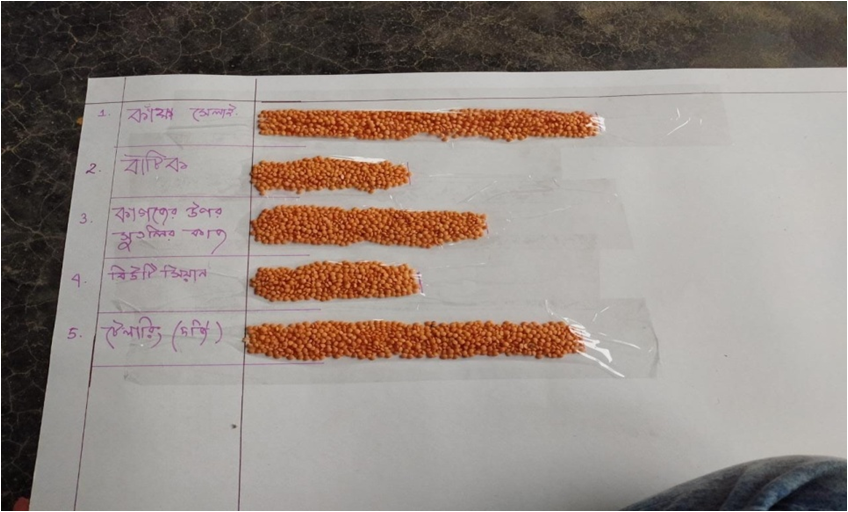
In this Covid-19 Pandemic situation, we had very limited options to have face-to-face interviews, focused group discussions or online interactions with such rural respondents to identify their actual needs. So, the only possible option is to survey through telephonic interactions. For this purpose, an appropriate questionnaire has been developed to suit the conditions and requirements. However, another method was adopted to survey representative respondents called participatory rural appraisal (PRA), taking all necessary precautions for Covid 19 viruses. This method is usually used for a group or community who are illiterate or semi-literate to understand their views against a set of questions. As the literacy level of the rural women in the study area is not as much, the PRA method has been used to identify the training need assessment for their skill development. This method is usually done on the ground, and their vernacular is used as a better communication method. Then it can be depicted on a chart paper for wide circulation and use. Local inputs like pulses (Dal), tree leaves etc., are used to carry out this method.
Only the women who are engaged in family-based entrepreneurial activities as artisans or as an entrepreneur or engaged in small business activities were considered for the study. For conducting the survey, we have covered ten villages randomly from two community blocks viz. Bolpur-Sriniketan and Illambazar. Altogether, a sample size comprised of 100 respondents were interviewed over telephone calls who fulfilled the criteria of our survey. A group of representative women for the PRA survey were selected to identify their appropriate training needs.
Table 1 explains the percentage of women involved in different crafts and small businesses. It is explicit that most of them are engaged in Kantha Stitching, followed by Applique and Copper Wirework. Similarly, in small business activities, they are mostly engaged in small dairy and grocery businesses. One of the most popular Santiniketan Gharana crafts is Kantha Stitching. Copper wire, Appliqué is also popular among the village women. Comparatively, lacquer, leatherwork, and traditional doll-making crafts are tedious, and women have less interest in these activities.
During the Covid -19 situation, mask-making as a small business became very popular, keeping in view the need and demand. Though tailoring shows a small percentage of interest, making masks is one of the major activities falling under tailoring. Small diary businesses are popular among women as they get financial support from Self – Help Groups (SHG) and Panchayats.
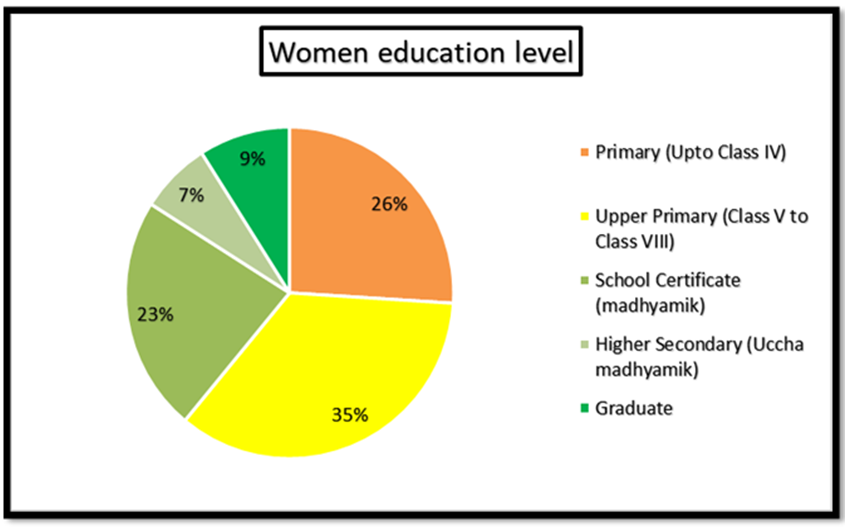
Figure 1 reveals the educational status of the respondents. The figures show that most entrepreneurs have very low educational qualifications (i.e., up to Class VIII standard). It is identified that only 9 per cent of women respondents are graduated. The caste-wise educational performance indicates that the accessibility of education is directly proportional to caste ranking (in the order of SC, ST, OBC and General). Therefore, the weaker sections are not only economically weak, but the situation also becomes more exacerbated with low levels of education. Because of their poor economic conditions, they cannot afford to continue their or their children’s education.

The most important way to track household income in India is to look at consumption expenditure, which is the only source of information without reliable income data.
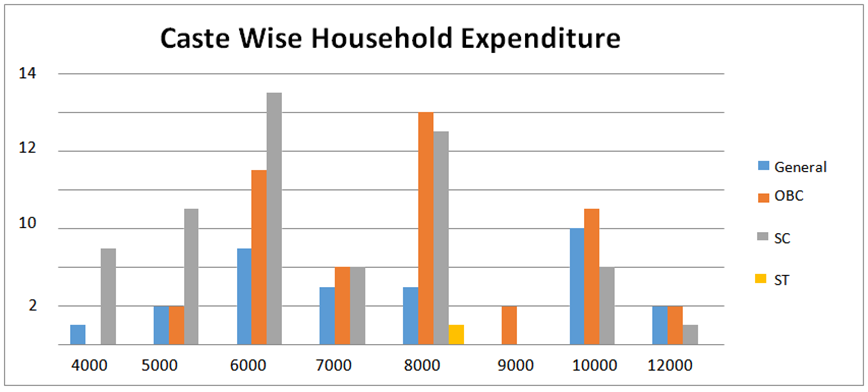
The average monthly consumption expenditure of rural Indian households-agricultural and non-agricultural was Rs. 6,646 in 2015-16 (agricultural year between July 1, 2015-June 30, 2016), compared to the average monthly income of Rs 8,059 [Business Standard, September 24, 2018]. Figure 2 reveals the consistency of the fact that the majority of the women entrepreneurs’ households spend between Rs. 5000 to Rs. 8000. It is elucidated that in this category, SC, ST, and OBC castes show their commendable presence. In contrast, the General caste spends between Rs. 8000 to Rs. 12000 per month.

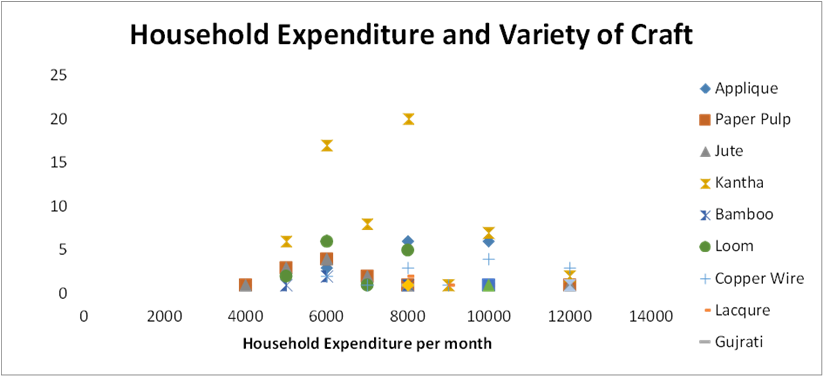
Entrepreneurs, including artisans who belong to the lower economic ladder, prefer enterprises with low capital, low investment, and fewer business operations. Not only that, they try to accommodate multifaceted enterprises to earn from these diversified enterprises in anticipation of probable failure of market demand. However, most of those in Kantha stitch enterprises are mere artisans and only replicate the design given to them by the big entrepreneurs. Here, the artisan’s creativity is much compromised or rather not promoted.
Again, it is understood that entrepreneurs with less education prefer crafts that are less complicated and have simple business operations. Also, low education hinders them from becoming self-reliant entrepreneurs by pushing them to remain artisans forever.
Table 2 shows the average contribution of the entrepreneur towards their monthly family expenses. Though the monthly expenditures are inconsistent with the numbers, the contribution shows an inverse relationship with the increase in family expenditure. It proves that the marginality of income from entrepreneurial activities is more important for the sustenance of marginal families. In contrast, those who can afford to spend more from other sources of income try to save a substantial amount out of their entrepreneurial income and contributes less towards family expenditure.

Let's consider Table 3 and Figure 3 in conjunction. It will be unconcealed that the middle-ranged economic groups are more comfortable with a variety of less capital-intensive crafts and incur low variable costs. However, with the progress of economic stability, the higher economic group went further with complicated varieties and differentiated products from the competition. With better economic conditions, they are more risk-taking even if they “niche down” further by developing blends of other provinces like Gujrat and Kashmir.
7.1. Discussion with the Respondents about Training NeedsIn this COVID-19 situation, many women are not willing to take training through direct methods (face-to-face). As most women are not literate enough, they cannot understand the proper mechanism of marketing, accounting procedures, tax, and innovation concepts. An Interesting finding is that a few of them are aware of online markets but do not know how to use online markets and digital platforms. So, they are interested in acquiring new types of training to improve their operations and increase their business sizes. Also, they are interested in taking training on Kantha Stitch, Medical Mask making, Jute work on smashed paper (pulp), Copper wire, etc.
Some other findings have also emerged grossly from the telephonic discussions that could depict the real situation of the local entrepreneurs, which may pose constraints to the development of entrepreneurship among women. The salient points of the discussion will give us some idea of the need for training in various areas like developing craft skills, business skills, social awareness, economic empowerment, and management of small businesses.
Most women cannot read, write, or understand English & Hindi languages. Child marriage is a common problem among rural households, ultimately affecting the business ecosystem by losing one’s good helping hand. Most women are unaware of using new technology gadgets or digital platforms like Smartphones, online businesses & social networking platforms. The women artisans have no other income except their handmade products. But all women artisans are eager to improve their present socio-economic conditions. They are not much interested in doing small businesses; rather, they rely much on their traditional crafts like- Katha stitch, Applique, Copper wire, Bamboo & wood crafts, etc. Some of them are still the victims of domestic violence (especially those belonging to the SC, ST & OBC families). They are required to perform their family’s responsibilities and household chores and take care of other family members, including in-laws and children, even when they produce crafts. Generally, they are very enthusiastic, participative, keen to improve their businesses and income level and want to learn new techniques of businesses. Many entrepreneurs are landless; they opted the handicrafts as the only source of income, and many women artisans wanted to standby by their husbands with financial support as they were the only source of income. The choice of crafts sometimes depends on the culture and religion of the entrepreneurs (for example, for Leather crafts, women belonging to the Hindu religion are reluctant to opt for this craft). Availability of raw materials at the right time and at the right rates is a major challenge. Over-dependency on money lenders (Mahajan) is observed, and the repayment terms are too discouraging due to exorbitant interest rates. Too much dependency on middlemen to sell their products to local or distant markets keeps them unaware of the actual sale price of their produce. The absence of warehouses to store finished and unfinished stocks is a major challenge for the entire supply chain.
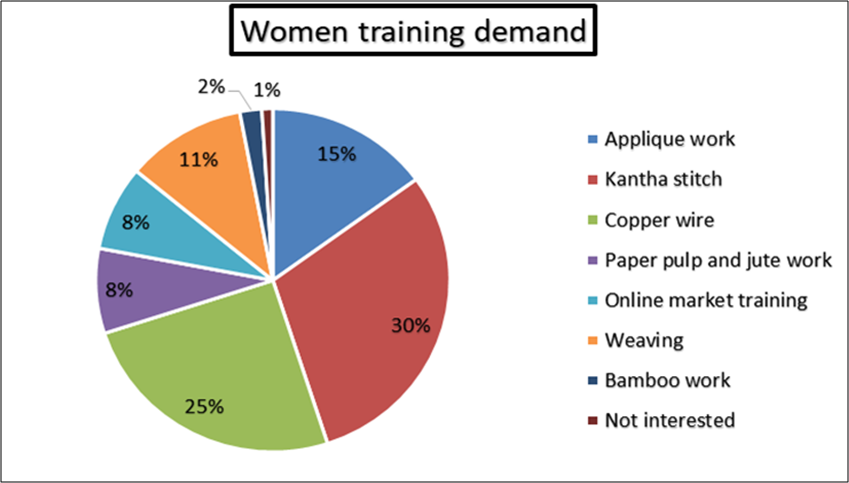
7.2. Training Need Assessment of the Family-Based Women EntrepreneursFigure 4 depicts the demand for training for various entrepreneurship businesses. The demand for Kantha Stitch is high in this area and consistent with Table 1 analysis, followed by the demand for tailoring to acquire the know-how to prepare masks as this is in high demand in the market during the Covid period.

Participatory Rural Appraisal (PRA) is used by non-governmental organizations (NGOs) and other agencies involved in international development. The approach aims to incorporate the knowledge and opinions of rural people in the planning and management of development projects and programmes. PRA recently renamed Participatory Learning for Action (PLA), is a methodological approach that enables communities or groups to analyse their situation and develop a common perspective on natural resource management and agriculture at the village level. PRA is an assessment and learning process that empowers a particular community to create the information base they need for participatory planning and collective action. Many different tools have been developed for use in PRA. In this study matrix and ranking procedure have been used to identify their training needs concerning different crafts they know as per their priorities. As the language they are habituated to, i.e. Bengali, the work is done using their vernacular.
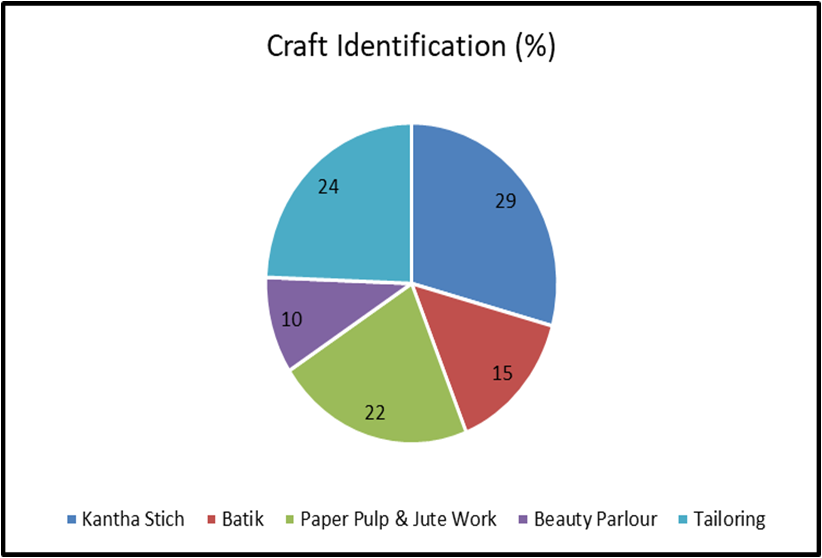
To conduct PRA, Supur village, under Raipur-Supur Gram Panchayat (GP), Bolpur- Sriniketan Block has been selected purposively. Fourteen (14) family-based women entrepreneurs attended the PRA exercise. Figure 5 shows a model PRA sheet generally exercised at the village level. In this document, we can find out the priority listing of the crafts for which the community intends to get training. They prioritised Kantha Stitching as the first and tailoring as the second most wanted training need. They used pulses (Dal) available in their homes for the ranking. This model sheet has been converted to a pie diagram in Figure 6 for better understanding. As discussed earlier, the identification of crafts for training is almost similar to their opinions given in the telephonic interview; it is found that 29% of the respondents preferred to undergo training on Katha Stitch, and the next 24% of respondents preferred Tailoring or Mask making. 22% of respondents opted for training in Paper Pulp & Jute work and 15% for Batik, and 10% for Beauty Parlour.


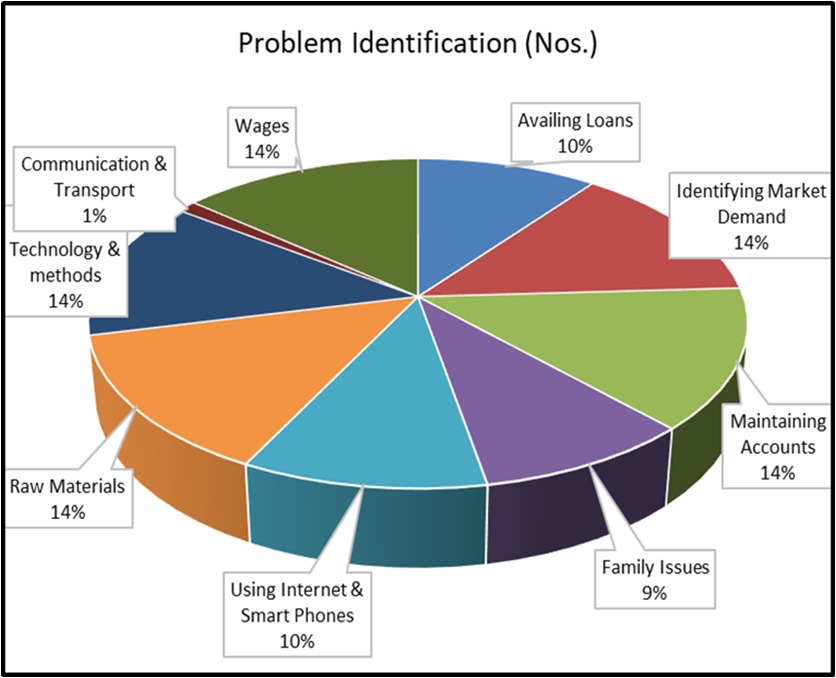
Now the question is what kind of constraints they face while operating their family-based businesses. In Figure 7, some major factors of hindrances are found through constraint analysis. The constraints entrepreneurs face in running their businesses have been identified using the same method, i.e., PRA. It is identified that 14% of the respondents feel that adopting new technology, low wages, lack of markets/ demands and maintaining accounts (book-keeping) procedures and non-availability of raw materials are some of the major problems they face. 10% of the respondents reported that availing loan for the business, unaware of the use of smartphone and internet facilities are their major constraints. Other 9% reported their family-related issues posed hindrances before them. Due to these constraints, they lag behind the competition.
There is a severe lack of education among business owners. They primarily come from low-income families. Marginal households rely more on the earnings of women entrepreneurs, who also make marginal incomes. The income contribution to the household expenditure is inversely proportionate (when the income of an entrepreneur rises, the contribution towards household expenditure decreases). Different family members may be involved in different small businesses and crafts. Most craft business owners still have poor incomes as artisans and depend on larger business owners to satisfy their needs for semi-finished goods. These powerful businesspeople serve as a buffer at the same time as serving as Mahajans (loan-givers in lieu of output at the time of distress). The level of exploitation is colossal. Most artisans (in craft) demand to undergo training on Kantha Stitch, Copper wire and Jute work on paper pulp (these products have consistent demand in the local hats and showrooms). Those who are in small businesses demanded training on tailoring, keeping the increasing market demand for hand-made three-layered cotton masks for the rural and semi-urban population. Most of them have no idea about the modern marketing mechanism, online business, or proper accounting procedures (like budgeting or book-keeping). They face the constraints like availing loans from financial institutions, depreciation and smart communication and the use of digital platforms & internet. Lastly, many are not comfortable taking hands-on training during this Covid-19 situation. They expressed that they would be happy if the training could be organised at the village level using the clustering method minimising physical movement, commuting and minimum exposure to unknown environments and situations.
The key advantage of family-based women’s entrepreneurship is that it has immense potential to provide employment (including self-employment) where the risk element is minimum. Statistics show that family-based entrepreneurship employs around 2.2 million people in West Bengal alone. Presently, 40% of the total industrial output in India is a contribution from small-scale and cottage industries. It offers economic independence and social upliftment of women and gives a matter of self-pride for women in developing and developed countries. Therefore, it could be one of the ways to build an ecosystem of businesses comprising funders, advisers, government, banking systems, non-government organisations and media to create pavement for the numerous women’s family-based entrepreneurship.
| [1] | Bhowmick, D. R. (2019). Motivational Forces and Challenges of Women Entrepreneurs: A Case Study of Tinsukia Town. Journal of Entrepreneurship and Management. 8(2), 2019, 41-46 | ||
| In article | |||
| [2] | Lathabahvan, R. S. (2020). A study on Women Entrepreneurship in India. Mukt Shabd Journal. Volume IX, Issue VI, JUNE/2020, 3422-3432. | ||
| In article | |||
| [3] | Rao, G. S. (2016). Status of Women Entrepreneurship in India. International Journal of Multidisciplinary Educational Research. | ||
| In article | |||
| [4] | Prachita Patil & Yogesh Deshpande (2019). Why Women Enter Into Entrepreneurship? An Exploratory Study. Journal of Organisational Studies and Innovation. Vol. 6, no. 2, Summer, 2019, 30-40. | ||
| In article | |||
| [5] | Shruthi. B.E. D. (2021). The Rise of Women Entrepreneurship in India: A Study. Journal of Emerging Technologies and Innovative Research (JETIR). | ||
| In article | |||
| [6] | Chatterjee, S. (2019). A Study on Training Need Assessment of Rural Crafts in West Bengal. Journal of Human Resource and Adult Learning, 15(1), 1-10. | ||
| In article | |||
| [7] | Das, A. (2018). A Study of the Training Needs of Rural Craftsmen in West Bengal. Indian Journal of Traditional Knowledge, 17(3), 432-439. | ||
| In article | |||
| [8] | Ghosh, D. (2015). Training Need Assessment of Rural Crafts in West Bengal: A Study of the Potter Community. Journal of Rural Studies, 31(2), 127-134. | ||
| In article | |||
Published with license by Science and Education Publishing, Copyright © 2023 Sudeshna Mitra, Amit Kumar Hazra and Harpal S. Grewal
 This work is licensed under a Creative Commons Attribution 4.0 International License. To view a copy of this license, visit
http://creativecommons.org/licenses/by/4.0/
This work is licensed under a Creative Commons Attribution 4.0 International License. To view a copy of this license, visit
http://creativecommons.org/licenses/by/4.0/
| [1] | Bhowmick, D. R. (2019). Motivational Forces and Challenges of Women Entrepreneurs: A Case Study of Tinsukia Town. Journal of Entrepreneurship and Management. 8(2), 2019, 41-46 | ||
| In article | |||
| [2] | Lathabahvan, R. S. (2020). A study on Women Entrepreneurship in India. Mukt Shabd Journal. Volume IX, Issue VI, JUNE/2020, 3422-3432. | ||
| In article | |||
| [3] | Rao, G. S. (2016). Status of Women Entrepreneurship in India. International Journal of Multidisciplinary Educational Research. | ||
| In article | |||
| [4] | Prachita Patil & Yogesh Deshpande (2019). Why Women Enter Into Entrepreneurship? An Exploratory Study. Journal of Organisational Studies and Innovation. Vol. 6, no. 2, Summer, 2019, 30-40. | ||
| In article | |||
| [5] | Shruthi. B.E. D. (2021). The Rise of Women Entrepreneurship in India: A Study. Journal of Emerging Technologies and Innovative Research (JETIR). | ||
| In article | |||
| [6] | Chatterjee, S. (2019). A Study on Training Need Assessment of Rural Crafts in West Bengal. Journal of Human Resource and Adult Learning, 15(1), 1-10. | ||
| In article | |||
| [7] | Das, A. (2018). A Study of the Training Needs of Rural Craftsmen in West Bengal. Indian Journal of Traditional Knowledge, 17(3), 432-439. | ||
| In article | |||
| [8] | Ghosh, D. (2015). Training Need Assessment of Rural Crafts in West Bengal: A Study of the Potter Community. Journal of Rural Studies, 31(2), 127-134. | ||
| In article | |||