Student Activity Program is one of the challenged areas when institutions have shifted from a fragmentary to flexible teaching and learning approach. Therefore, to ensure a smooth implementation of a more flexible, alternative, and equity-based learning approach, a thorough evaluation must be conducted alongside addressing the characteristics of learners, such as their interests, needs, experience, abilities, culture, and learning styles. Nonetheless, there is now much evidence to support the claim that students and parents face a range of unique difficulties in their involvement to activities which include technical issues, distractions and time management, motivation, understanding expectations, and lack of in-person interaction. Hence, this study employed Mixed Sequential Explanatory Research Design (quantitative and qualitative) with the goal to evaluate the student activities of the SPUP-BEU Grade School for Academic Year 2020-2021. Generally, the participants strongly agree on the student activities’ success indicators along program objectives, delivery of content, facilitation, and technical/digital quality. Moreover, pupils revealed that the effective line of communication, provision of personal space/own device, subscription and familiarity to learning platforms, family supervision, and assistance in troubleshooting are considered as enablers affecting their involvement. On the other hand, unstable internet connectivity, device limitations, household responsibilities, lack of access/subscription to digital applications, and schedule disruption by community quarantines are identified as constraints. Therefore, such findings on the evaluation, enablers, and constraints are deemed valuable for the Enhancement of the Flexible Student Activity Plan.
Since the outbreak of COVID-19, institutions have shifted from a fragmentary to flexible teaching and learning approach which signify a more systematic, agile, and inclusive intervention in response to the ever-changing needs and circumstances of stakeholders in the time of pandemic.
Student Activity Program is one of the challenged areas in the said transition as it needs to ensure holistic development by improving the skills of students in their fields of interest using alternative learning modalities. Through synchronous and asynchronous online delivery of student activities, students' potentials are deemed to be stimulated in religious, academic, socio-cultural and civic engagements.
As stipulated under DepEd Memorandum No. 055, series of 2021, the Department of Education (DepEd), through the Bureau of Learner Support Services- Youth Formation Division, issues recommended Programs, Projects, and Activities of the Student Government to support the efficient operationalization of the Basic Learning Continuity Plan (BE-LCP). Consistent with the BE-LCP priorities, the realignment aims to protect the health, safety, and well-being of learners through the establishment of learner support systems that shall facilitate the provision of psychosocial support, health and safety measures, and remediation and enhancement to all types of learners.
In particular, St. Paul University Philippines- Basic Education Unit (SPUP-BEU) Student Activity Program aims to provide leisure activities and collaborative learning experiences undertaken side by side with the curricular activities in response to the perceived challenges of studying from home. Through the official Facebook Page, SPUP-Grade School Coordinating Team, student activities are delivered online every 2nd and 4th Wednesdays of the month integrating the List of Activities and Celebrations/Observances Mandated by Law 1.
Therefore, to ensure a smooth implementation of a more flexible, alternative and equity-based learning approach, a thorough evaluation must be conducted alongside addressing the characteristics of learners, such as their interests, needs, experience, abilities, culture, and learning styles.
Nonetheless, there is now much evidence to support the claim that students and parents face a range of unique difficulties in their involvement to activities which include technical issues, distractions and time management, motivation, understanding expectations, and lack of in-person interaction.
Among the studies reviewed by the researcher, only few literature focused on the evaluation of student activities in the flexible learning landscape and how these can be improved in order to address the changing needs and interests of students while still in the pandemic.
This gap raises a number of questions including: (1) How do students understand and experience student activities in a flexible environment? (2) What are the enabling factors and constraints of students in their involvement in school activities? and (3) What modifications have to be done in response to the students’ evaluation? Hence, the researcher deemed it necessary to conduct a study on the evaluation of BEU Grade School virtual activities towards the enhancement of the flexible student activity plan; thereby contributing to the institution’s digital transformation experience.
Theoretical/ Conceptual Framework
Community of Inquiry (CoI) Garrison, Anderson, and Archer (2000)
An educational community of inquiry is a group of individuals who collaboratively engage in purposeful critical discourse and reflection to construct personal meaning and confirm mutual understanding.
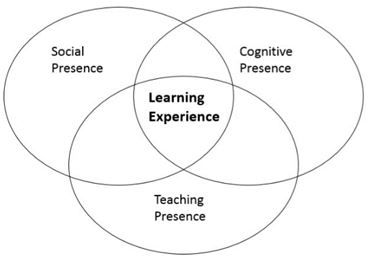
The Community of Inquiry theoretical framework represents a process of creating a deep and meaningful (collaborative-constructivist) learning experience through the development of three interdependent elements– social, cognitive, and teaching presence.
Social presence is “the ability of participants to identify with the community (e.g., course of study), communicate purposefully in a trusting environment, and develop inter-personal relationships by way of projecting their individual personalities” 5.
Teaching Presence is the design, facilitation, and direction of cognitive and social processes for the purpose of realizing personally meaningful and educationally worthwhile learning outcomes 6.
Cognitive Presence is the extent to which learners are able to construct and confirm meaning through sustained reflection and discourse 6.

Figure 1 shows the “Community of Inquiry” model for online learning environments developed by Garrison, Anderson, and Archer (2000) that is based on the concept of three distinct “presences”: cognitive, social, and teaching. Picciano, A. G. 7 posits that while recognizing the overlap and relationship among the three components, Anderson, Rourke, Garrison, and Archer (2001) advise further research on each component. Their model supports the design of online and blended courses as active learning environments or communities dependent on instructors and students sharing ideas, information, and opinions. Of particular note is that “presence” is a social phenomenon and manifests itself through interactions among students and instructors. The community of inquiry has become one of the more popular models for online and blended courses that are designed to be highly interactive among students and faculty using discussion boards, blogs, wikis, and videoconferencing.
Anderson’s Online Learning Model
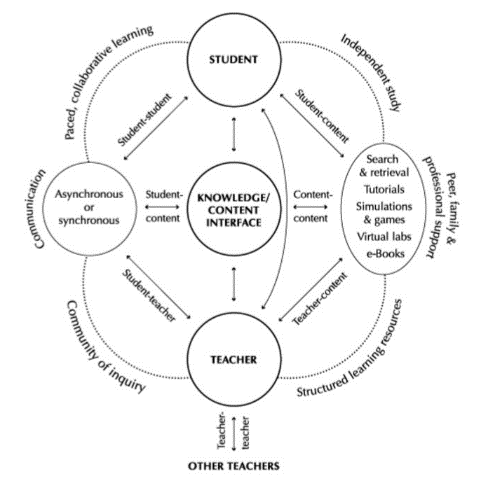
According to Picciano, A. G. 7, Anderson’s Online Learning Model illustrates the two major human actors- learners and teachers, and their interactions with each other and with content. Learners can, of course, interact directly with content that they find in multiple formats, and especially on the Web; however, many choose to have their learning sequenced, directed, and evaluated with the assistance of a teacher. This interaction can take place within a community of inquiry, using a variety of Net-based synchronous and asynchronous activities. These environments are particularly rich, and allow for the learning of social skills, the collaborative learning of content, and the development of personal relationships among participants.
However, the community binds learners in time, forcing regular sessions or at least group-paced learning. The second model of learning (on the right) illustrates the structured learning tools associated with independent learning. Common tools used in this mode include computer-assisted tutorials, drills, and simulations 2.

Figure 2 demonstrates the instructional flow within the two sides and represents the beginnings of a theory or model from the distance education perspective. Anderson concluded that his model “will help us to deepen our understanding of this complex educational context” 7, which he noted needs to measure more fully the direction and magnitude of each input variable on relevant outcome variables. Anderson also commented about the potential of the Internet for education delivery, and that an online learning-based theory or model could subsume all other modes with the exception of the “rich face-to-face interaction in formal classrooms” 7. This becomes a quandary for Anderson in trying to develop a common theory of online education in that it does not provide for in-person, face-to-face activity and is problematic for those who see online education as a subset of education in general.
Conceptual Framework

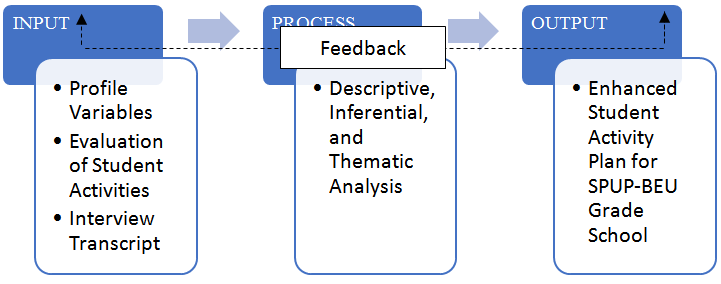
Figure 3 illustrates the paradigm of the study. The researcher considered the input-process-output (IPO) model to present the framework on which the study was anchored. He examined the participants’ profile variables, evaluation of student activities, and participants' interview transcripts (inputs) using descriptive, inferential, and thematic analysis (process) to come up with an Enhanced Student Activity Plan for SPUP-BEU Grade School (output).
Statement of the Problem
This study aimed to evaluate the student activities of the SPUP-BEU Grade School for Academic Year 2020-2021 with the goal of developing an Enhanced Student Activity Plan. Specifically, it sought answers to the following:
1. What is the profile of participants in terms of:
1.1. gender;
1.2. grade level; and
1.3. place of residence (province)?
2. What are the student activities of the SPUP-BEU Grade School for AY 2020-2021?
3. What is the participants’ extent of agreement on the specified student activities’ success indicators along the following components:
2.1. Program Objectives;
2.2. Delivery of Content;
2.3. Facilitation; and
2.4. Technical/Digital Quality?
4. Is there a significant difference in the participants' extent of agreement on the student activities’ success indicators when they are grouped according to profile variables?
5. What enablers and constraints affect participants’ involvement in student activities?
6. What enhancement on the Student Activity Plan can be made based on the evaluation?
Hypothesis
There is no significant difference in the extent to which the participants agreed on the student activities’ success indicators in the four components when grouped according to profile variables.
Research Design
The study employed Mixed Sequential Explanatory Research Design (quantitative and qualitative) with the goal to evaluate the student activities of the SPUP-BEU Grade School for Academic Year 2020-2021. Specifically, the descriptive and inferential methods were used to describe the participants’ profile, determine the extent to which the participants agreed on the student activities’ success indicators in the four components, and ascertain the significant difference in their evaluation when they are grouped according to profile variables. The thematic method of analysis, on the other hand, was used to cluster into themes the enablers and constraints that affect participants’ involvement in student activities.
Participants of the Study
Convenience sampling technique was used by the researcher to reach a total of 240 participants. The sample size was determined by using the Raosoft’s formula. In this light, the researcher involved students who:
1. are currently enrolled in the Basic Education Unit (BEU) Grade School for academic year 2020-2021;
2. have participated in student activities (synchronous and asynchronous);
3. gave informed consent; and
4. are capable of comprehending the questionnaire that is written in English.
Research Instruments
Survey questionnaire. This survey questionnaire on Student Activities Evaluation underwent content validation by an expert panel who evaluated individual items and the instrument in general with regards to item relevance and clarity using Content Validity Index (CVI). The obtained Kappa value was .310 indicating that it is under the range of “fair agreement”. The validated self-assessment tool is pilot-tested by the researcher to 50 students and utilized Cronbach's alpha to determine the internal consistency or average correlation of items in a survey instrument, together with its usability. The tool obtained a Cronbach’s alpha value of .702, indicating a high level of internal consistency. It included two parts, namely: 1) participants’ profile in terms of grade level, sex, and place of current residence; and 2) items measuring the extent to which they agreed on the student activities’ success indicators along the four components (Program Objectives, Delivery of Content, Facilitation, and Technical/Digital Quality)
Semi-structured one-on-one interview. The researcher utilized semi-structured one- on-one interview which allowed him and the participants to engage in a dialogue in real time. The interview guide underwent content validation by an expert panel which obtained a Kappa value of .334 indicating that it is under the range of “fair agreement”. Such data collection technique also gave sufficient space and flexibility for original and unexpected issues to arise, which the researcher may investigate in more detail with further questions.
Data Collection Procedure
1. Throughout the process of the study, the researcher strictly complied with the institutional research protocols and regulations. A letter asking permission for the conduct of the study was sought from the Vice President for Academics of St. Paul University Philippines; and from SPUP’s Institutional Ethics Review Board (IERB).
2. Once approved, permission to conduct the study was also requested from the Principal of the Basic Education Unit.
3. In particular, the researcher met the students who were qualified in the set criteria and asked if they can be participants of the study. The nature and objectives of the study vis a vis participants’ rights were discussed with them, and informed consent was also sought.
4. Those who agreed in the conditions thereof and signed the informed consent were asked to answer the questionnaire followed by the semi-structured one-on-one interview.
5. After collecting the accomplished questionnaires, the researchers collated the data using Excel and Word. The quantitative data were statistically treated using SPSS version 17, while the qualitative data were examined using thematic analysis. Finally, the results of the data treatment and analysis were summarized, interpreted, and reported in writing.
Data Analysis
In analyzing the data, the researcher used the following tools:
Frequency count and percentage. These were used to describe the profile of the participants.
Weighted mean. This was used to determine the extent to which the participants agreed on the student activities’ success indicators in the four components. The mean scores were interpreted using the four-point Likert scale below.
t-test. The researcher used this to determine the significant difference in the extent to which the participants agreed on the student activities’ success indicators in the four components when they are grouped according to gender.
Analysis of variance (ANOVA). This enabled the researcher to test for significant difference in the extent to which the participants agreed on the student activities’ success indicators in the four components when they are grouped according to grade level, and place of current residence.
Thematic analysis. This was used to cluster into themes the identified enablers and constraints that affect participants’ involvement in student activities.
I. Profile of the Participants
Results of the descriptive analysis of the participants’ profile (Table 2) show that majority of the students who participated in the survey are female. In terms of grade level, most of them belong to the intermediate grades consisting of 52, 48, and 42 participants from grade 6, 5, and 4, respectively. While for primary grades, 37, 33, and 28 pupils were involved from grade 3, 2, and 1, respectively.
Though all student activities are open to grades 1 to 6, maximum participation is manifested among the secondary grade levels (grades 4-6) as most of them are elected as officers who have the responsibility to organize, promote, and facilitate the conduct and evaluation of student activities year-round.
Relatively, most pupils in the primary grade levels (grades 1-3) are still under the supervision/guidance of their parents, specifically in receiving school advisories and reminders, accessing meeting links and sending outputs, as well as participating in feedbacking sessions.
In terms of current residence, 176 (73.33%) or majority of the pupils stay in Cagayan Province, while 48 (20%) stay in the neighboring province of Isabela. It is also noteworthy that among those who participated in the study, there are only 11 pupils outside region 2, 4 from Nueva Vizcaya, and 1 from Quirino. Generally, this is relative to the BEU enrolment data as Cagayan is considered to be the feeder province, considering that the university is also situated in the said province.
II. Student activities of the SPUP-BEU Grade School for AY 2020-2021
Table 3 shows the activities/ events undertaken by the Grade School pupils during the Academic Year 2020-2021. There are a total of 19 student activities, whereby 14 among which are delivered asynchronously, while 5 are conducted synchronously.
In response to the perceived challenges of studying from home, BEU Student Activity Program is aimed at providing leisure activities and collaborative learning experiences undertaken side by side with the curricular activities. Since there is no registration to specific clubs/organizations, student activities, through the official Facebook Page (Grade School Coordinating Team) are delivered online integrating the List of Activities and Celebrations/Observances Mandated by Law (Enclosure no. 3 to DepEd Order No. 007, s. 2020).
Every 2nd and 4th Wednesdays of the month, student activities are delivered online along the specified monthly themes: National Peace Consciousness Month (September); National Indigenous Peoples Month (October); Filipino Values Month (November); Paulinian Christmas Celebration (December); Zero-Waste Month (January); National Arts Month (February); Fire Prevention Month (March); National Intellectual Property Month (April); Health Workers Day (May); and WATCH: We Advocate Time Consciousness and Honesty Month (June).
As gleaned from the table, the Project BisiklAeta delivered on October 15, 2020 garnered the highest social media engagements at 1,268, with a total of 11,182 people reached. In celebration of the National Indigenous Month, the BisiklAeta Project: Bisikletang Handog sa Aeta was conducted to encourage students, parents and other stakeholders to buy the "Nito" baskets of the Aeta Community in Brgy. Balasi, Flora, Apayao. Proceeds of the project were used to purchase bicycles which the beneficiaries need in selling their products to nearby towns. Hence, the large number of participants involved in the said activity paved way for its wide social media engagement and reach.
On the other hand, Master-Peace: A Poster Making Contest obtained the least social media engagements at only 8, with a total of 155 people reached. It is worthy to note that when this activity was delivered asynchronously (September 9, 2020), pupils just started their academic classes which may have propelled them to focus more on their meetings and formative assessments in class.
Descriptive analysis was also conducted on the extent to which the Students Agree on the Activities’ Success Indicators along the Four Components. Results (Table 4) reveal that along Program Objectives, all three items were rated ‘Strongly Agree ‘having the second indicator (‘The objectives were relevant to me in this flexible learning environment.’) as the highest with a mean of 3.72.
Moreover, they strongly agree that objectives were clearly presented and discussed, as well as the activity achieved the set objectives students expected to attain which were rated as 3.65 and 3.57, respectively.
In general, the students strongly agree on the success indicators under program objectives which implies that the set objectives for the activities are made relevant and presented clearly in order to attain the expectation of the students. This is consonance to the advice of Peterson (1989) that to make optimum use of information technology and to aggressively support the organization, managers must set objectives to guide their department through the long term.
Along Delivery of Content (Table 5), the participants rated four indicators as ‘Strongly Agree’. Obtaining the highest mean of 3.82 is the indicator that the activities are aligned with the monthly theme. Moreover, other key indicators were also strongly agreed by the participants. That is, as planning was evidenced through a systematic presentation of activities, students are greatly involved in the activities since they fit their interests and needs. As a result of such, they gained new knowledge, skills, and values which they can apply in future endeavors.
In contrast to a relatively high rating (strongly agree) in the aforementioned indicators, participants had to only agree that the the activity started and ended as scheduled, and that the duration of the activity was adequate for the material covered. This is primarily brought by time constraints as student activities are supposed to be considered as “breathers”, allocating only few days in the schedule to give priority for academic classes.
This runs parallel to the study of Zacherman et al. 3 where the effects of time spent in cocurricular activities on academic performance was tested. Findings say that a curvilinear relationship between hours per week spent involved in cocurricular activities and grade point average was discovered such that a low amount of cocurricular involvement was beneficial to grades, while a high amount can potentially hurt academic performance in students.
Overall, the students strongly agree with the success indicators under delivery of content. This further indicates that because participants are greatly engaged on student activities, they can maximize their time to consider activities as effective “breathers” in their regular academic classes.
As regards Facilitation, data (Table 6) show that three out of four indicators were rated ‘strongly agree’. Instructions that were clear and understandable are a notable feature of the student activities stemming from the fact that the facilitator/ organizers (adviser/ student activity chair/ resource person) were knowledgeable about the content. Moreover, since the facilitator/ organizers were well-prepared, maximum engagement of students is tapped as evidenced by an effective delivery and retrieval of materials/outputs.
III. The Mean Extent to which the Students Agree on the Activities’ Success Indicators along the Four Components.
This finding runs in comparison with the discovery of Ahn et al. 4 that the three strategies: modeling, simple PPT, and comprehension check for instructions were effective in students’ comprehension of instructions. At SPUP, instructions for activities are uploaded using creative digital posters and these are followed up by the respective teachers during their synchronous homeroom sessions with students.
Nonetheless, the participants also agree that the facilitator/ organizers were accommodating as they encouraged questions and maximum participation. This approach is considered valuable to encourage wider reach as not only students but also parents ask questions throughout the conduct of the activities.
Generally, the students strongly agree with the success indicators under facilitation, indicating a high degree of recognition on the efforts of the facilitator/ organizers in facilitating activities both synchronously and asynchronously.
In terms of Technical/ Digital Quality, Table 7 reveals that two indicators were strongly agreed by the participants. Mainly, the students firmly believe that promotional materials (posters, photos, announcements, etc.) are creatively done to stimulate interest. Relatively, they strongly agree that the use of technology is effective as shown by the smooth flow of activities.
Sadik 5 also posits that although research emphasizes the importance of integrating technology into the curriculum, the use of technology can only be effective if teachers themselves possess the expertise to use technology in a meaningful way in the classroom. Along this line, the present study also shows that students agree that the platform (application/ software) used is user-friendly and has the features needed for the activity.
However, the lowest rating of 2.56 was given to the indicator that there is a consistent and reliable access to a gadget and internet. This problem on “digital divide” was also identified as one of the constraints affecting students’ involvement on the activities, citing the weak internet connection due to location and due to maintenance of telecommunications companies as major causes.
From the analysis of Siddika 8, the dataset shows that the participants have agreed that their quality of online education is being affected through the internet issues, and this pattern is valid for every single proxy of internet issues and quality of education.
As a whole, the participants strongly agree with the success indicators under technical/ digital quality, pointing out the importance of technical know-how in promoting and conducting activities while underscoring the need for a stable internet connectivity.
Table 8 presents the summary of the students’ evaluation on the extent to which they agree on the activities’ success indicators along the four components. As shown, Facilitation indicates the highest component which the students strongly agreed. This is followed by Program Objectives and Delivery of Content, while the lowest among the components is Technical/Digital Quality. This implies that a high degree of recognition is accorded to the facilitator/ organizers which are comprised of the advisers, student activity chair, and resource persons who spearhead the virtual student activities. Nevertheless, though students strongly agree with all the four components, there is still a need to leverage the effective use of technology and solve the problems on internet connectivity.
The overall mean (3.46, Strongly Agree) further suggests that the Grade School virtual student activities for academic year 2020-2021 are deemed successful, indicating maximum ratings from the objectives, content, facilitation, and down to technical quality.
IV. Significant difference between the participants' extent of agreement on the student activities’ success indicators when they are grouped according to profile variables
Table 9 shows that the probability values along gender, grade level, and place of residence are all greater than 0.05 level of significance. This indicates that the students don’t vary significantly in their extent of agreement on the student activities’ success indicators when they are grouped according to profile variables.
It further implies that no matter the gender or the grade level a student belongs to, he or she can still maximize participation in the virtual activities. Alongside this, regardless of place of residence, students can have optimum access as the online platforms used have a wider reach among stakeholders.
In relation to this, Tonks, et al., 9 asserts that a shared belief is that the flexibility of digital learning materials, when combined with appropriately designed online delivery systems and instruction, can address the variable learning needs of elementary students in ways difficult or impossible to otherwise achieve.
V. Enablers and Constraints Affecting Participants’ Involvement In Student Activities
Thematic analysis was conducted to cluster into themes the enablers and constraints of the pupils involved in the study. Table 1 shows a summary of the enablers affecting participants’ involvement in student activities which were categorized into five areas, namely: Effective Line of Communication, Provision of Personal Space/Own Device, Subscription and Familiarity to Learning Platforms, Family Supervision, and Assistance in Troubleshooting.
As regards effective line of communication, students mainly pointed out on information dissemination through Facebook, Messenger, and MS Teams. Apart from MS Teams, other platforms were used to establish wider reach to both the students and their parents/guardians who are visible on mainstream social media like Facebook and Messenger. Not only are announcements posted on the official Facebook page of the Grade School Coordinating Team, but they are also sent by the respective advisers to their class group chats. These include textual reminders as well as attached digital posters of advisories / announcements which students find creative. The class advisers also facilitate the submission of students’ outputs as they are forwarded directly to the Grade School Student Activity Chair for organizing, judging, editing, and uploading on social media. Thereafter, feedbacking sessions are deemed by participants as enablers because their insights, comments, and suggestions are considered in planning the succeeding activities.
Participants are also privileged to have the provision of personal space or own device. They are able to participate well in the activities because of their convenient online learning setup at home, and because of owning their personal gadget which would give them access anytime without worrying who is next to use the gadget.
In relation to this, subscription and familiarity to learning platforms like MS Teams were found to be beneficial for pupils as they have a firm grasp navigating through it with the help of series of orientation sessions. Alongside, family supervision was also noted to be advantageous because pupils, particularly those in grades 1 to 3, are aided by their parents/guardians in accessing information and creating/submitting outputs. Especially during community quarantines/ lockdowns when those below the age of 18 are advised to stay at home, parents and guardians are the ones purchasing materials sourced outside the home.
Relatively, the pupils also find the assistance provided by teachers/ staff in troubleshooting as valuable. Examples of this are when participants have to retrieve forgotten passwords or unlock unknown features on MS Teams. Through a quick response by their teachers/staff, they are able to join the synchronous and asynchronous activities.
While there are enablers mentioned earlier, Table 1 shows a summary of the constraints affecting participants’ involvement in student activities which were categorized into five areas namely, Unstable Internet Connectivity, Device Limitations, Household Responsibilities, Lack of Access/Subscription to Digital Applications, and Schedule Disruption by Community Quarantines.
Due to the phenomenon called “digital divide”, it is inevitable for some students to experience unstable internet connectivity and device limitations. Participants identified two reasons for weak internet connection- (1) due to location and (2) due to maintenance of telecommunications companies. Meanwhile, they also find it restricting to accomplish their activities if their gadgets are running low on storage. Considering the fact that they download and create a number of digital files day by day, there is a need for constant revisit of their storage allocation. Also, some devices need to be updated regularly not just for it to function well but also in order to have an access on new features provided by system and app developers.
Relatively, lack of access or subscription to digital applications may also cause pupils to shun away from accomplishing activities. Be it known that apps are evolving time to time, there are some of which that may not be compatible with a particular gadget. Also, some of them also need paid subscriptions which usually becomes a problem if it’s not part of the family’s financial priorities.
Since pupils are advised to learn from home, they are also expected to help in some household responsibilities like the daily chores and even minding their younger siblings. These were found out to be a challenge among the participants in balancing their time for school and home.
Lastly, during the academic year 2020-2021, there have been several changes in the community quarantine status of the provinces within and outside the region. As such, school calendar is disrupted causing some cancellation of previously slated activities. Along this line, social mobility is also restricted among pupils which prevent them from taking video shoots outside of their homes, purchasing materials needed for their activities, and even generating creative juices for their outputs.
VI. Enhanced Flexible Student Activity Plan
Based on the aforementioned findings on the participants’ evaluation of virtual student activities, an Enhanced Flexible Student Activity Plan was formulated. Such enhancement was a product of aligning the evaluation, enablers, and constraints that affect participants’ involvement in the student activities
The Enhanced Flexible Student Activity Plan was anchored on the SPUP Vision-Mission integrating the List of Activities and Celebrations/Observances Mandated by Law 1 Moreover, the plan is geared towards the attainment of the following objectives: participate consistently in various activities that will help them grow holistically; practice essential skills anchored on institutional advocacies; develop mutual respect and understanding through diverse yet inclusive activities; and establish heightened commitment in their fields of interest.
Generally, the grade school pupils of St. Paul University Philippines strongly agree on the student activities’ success indicators along program objectives, delivery of content, facilitation, and technical/digital quality. This implies that the virtual student activities for academic year 2020-2021 are delivered successfully in both asynchronous and synchronous modes. Moreover, pupils revealed that the effective line of communication, provision of personal space/own device, subscription and familiarity to learning platforms, family supervision, and assistance in troubleshooting are considered as enablers affecting their involvement. On the other hand, unstable internet connectivity, device limitations, household responsibilities, lack of access/subscription to digital applications, and schedule disruption by community quarantines are identified as constraints. Therefore, such findings on the evaluation, enablers, and constraints are deemed valuable for the Enhancement of the Flexible Student Activity Plan.
Based on the findings presented and the conclusions drawn, the researcher offers the following recommendations:
The University may reinforce the involvement of pupils, parents, and other stakeholders in the planning, implementation, and evaluation of virtual student activities.
The Grade School Student Activity Chair may craft activities that are more responsive to the identified enablers and constraints affecting students’ involvement on student activities.
School administrators may consider providing teachers/staff appropriate training sessions in handling student activities online.
Parents may establish regular and open communication with their children to monitor their progress in school.
Other researchers may conduct parallel or related studies involving students on other levels.
| [1] | Department of Education. (n.d.). Retrieved January 20, 2022, from https://www.deped.gov.ph/wp-content/uploads/2020/07/DepEd_LCP_July3.pdf. | ||
| In article | |||
| [2] | Figure 6. Anderson's online learning model. reprinted with ... (n.d.). Retrieved January 20, 2022, from https://www.researchgate.net/figure/Andersons-Online-Learning-Model-Reprinted-with-permission-by-Anderson-T-2011-The_fig2_319452611. | ||
| In article | |||
| [3] | Zacherman, Avi and Foubert, John. "The Relationship Between Engagement in Cocurricular Activities and Academic Performance: Exploring Gender Differences" Journal of Student Affairs Research and Practice, vol. 51, no. 2, 2014, pp. 157-169. | ||
| In article | View Article | ||
| [4] | Ahn, Y., Lee, E., & Hwang, D. (2017) How Can We Give Clear and Effective Instructions in a Speaking Class?. EFL, 87. | ||
| In article | |||
| [5] | Garrison, D. R., Anderson, T., & Archer, W. (2000). education model. The Internet and Higher Education, 2(2-3), 87-105. | ||
| In article | View Article | ||
| [6] | Anderson, T., L. Rourke, D.R. Garrison and W. Archer (2001). Assessing teaching presence in a computer conferencing context, Journal of Asynchronous Learning Networks 5 (2). | ||
| In article | View Article | ||
| [7] | Picciano, A. G. (2017). Theories and frameworks for online education: Seeking an integrated model. Online Learning, 21(3), 166-190. doi: 10.24059/olj.v21i3.1225 | ||
| In article | View Article | ||
| [8] | Siddika, Benozir and Islam, Md. Rafiqul and Zubayer, Abdullah Al and Sarker, Indrani and Sakib, Mojammel Haque (2021), Exploring Online Learning and Internet Connectivity in the Pandemic: Evidence From the University Student of Bangladesh. | ||
| In article | |||
| [9] | Tonks, D., Kimmons, R., & Mason, S.L. (2021). Motivations among special education students and their parents for switching to an online school: Survey responses and emergent themes. Online Learning, 25(2), 171-189. https://doi.org/10.24059/olj.v25i2.2141 | ||
| In article | |||
Published with license by Science and Education Publishing, Copyright © 2023 John Kit S. Masigan and Fe S. Masigan
 This work is licensed under a Creative Commons Attribution 4.0 International License. To view a copy of this license, visit
http://creativecommons.org/licenses/by/4.0/
This work is licensed under a Creative Commons Attribution 4.0 International License. To view a copy of this license, visit
http://creativecommons.org/licenses/by/4.0/
| [1] | Department of Education. (n.d.). Retrieved January 20, 2022, from https://www.deped.gov.ph/wp-content/uploads/2020/07/DepEd_LCP_July3.pdf. | ||
| In article | |||
| [2] | Figure 6. Anderson's online learning model. reprinted with ... (n.d.). Retrieved January 20, 2022, from https://www.researchgate.net/figure/Andersons-Online-Learning-Model-Reprinted-with-permission-by-Anderson-T-2011-The_fig2_319452611. | ||
| In article | |||
| [3] | Zacherman, Avi and Foubert, John. "The Relationship Between Engagement in Cocurricular Activities and Academic Performance: Exploring Gender Differences" Journal of Student Affairs Research and Practice, vol. 51, no. 2, 2014, pp. 157-169. | ||
| In article | View Article | ||
| [4] | Ahn, Y., Lee, E., & Hwang, D. (2017) How Can We Give Clear and Effective Instructions in a Speaking Class?. EFL, 87. | ||
| In article | |||
| [5] | Garrison, D. R., Anderson, T., & Archer, W. (2000). education model. The Internet and Higher Education, 2(2-3), 87-105. | ||
| In article | View Article | ||
| [6] | Anderson, T., L. Rourke, D.R. Garrison and W. Archer (2001). Assessing teaching presence in a computer conferencing context, Journal of Asynchronous Learning Networks 5 (2). | ||
| In article | View Article | ||
| [7] | Picciano, A. G. (2017). Theories and frameworks for online education: Seeking an integrated model. Online Learning, 21(3), 166-190. doi: 10.24059/olj.v21i3.1225 | ||
| In article | View Article | ||
| [8] | Siddika, Benozir and Islam, Md. Rafiqul and Zubayer, Abdullah Al and Sarker, Indrani and Sakib, Mojammel Haque (2021), Exploring Online Learning and Internet Connectivity in the Pandemic: Evidence From the University Student of Bangladesh. | ||
| In article | |||
| [9] | Tonks, D., Kimmons, R., & Mason, S.L. (2021). Motivations among special education students and their parents for switching to an online school: Survey responses and emergent themes. Online Learning, 25(2), 171-189. https://doi.org/10.24059/olj.v25i2.2141 | ||
| In article | |||