This study investigates the effect of mobile app on students’ Behavioral engagement, Confidence with technology, Mathematics confidence, Affective engagement, and Mathematics with technology. Grade 9 students were provided with mobile apps to support them in studying mathematics during distance learning. Post-test control group was utilized in the study to compare the mathematics and technology attitudes of the students in the control and treatment groups. This study used the Mathematics and Technology Attitudes Scale (MTAS) questionnaire adapted from Pierce et al. (2007). Majority of students have a favorable attitude about the use of mobile educational applications, ranging from neutral to positive. Although there were no statistically significant differences in several of the subscales, the experimental group showed greater optimism than the control group. Teachers should continue incorporating mobile educational applications into the classroom to help and enhance the learning process given the good experiences reported by students. To further enhance students' attitudes toward the topic, it should be considered to address the negative attitude toward mathematical confidence.
The landscape of education has undergone significant transformations in recent years, primarily fueled by advancements in computer and communication technologies. Traditional classroom settings, where direct engagement between students and teachers was pivotal, have been complemented by the widespread use of mobile technology for learning 1.
As the world has become increasingly mobile over the past few decades, mobile phones have evolved from communication devices to indispensable technological tools utilized by people of all ages worldwide 2.
Amidst the challenges brought about by the pandemic, mobile educational applications emerged as an alternative method, demonstrating favorable effects on students' mathematics achievement 9. Students generally viewed the use of mobile devices in learning as interesting, rewarding, and beneficial 6 10 11. To ensure active engagement during such circumstances, educators were encouraged to adopt blended learning approaches and other engaging pedagogical strategies 12. Integrating mobile apps into blended learning further enhances the modular approach, making the learning model more flexible and fostering a collaborative learning community 13.
Given the influence of students' attitudes toward mathematics and technology on their performance, evaluating these attitudes becomes essential. Gurat 14 highlighted that students' perspectives significantly influence their confidence, which, in turn, influences their mathematical ability. Thus, the purpose of this research is to investigate the effect of mobile apps on students' attitudes toward mathematics and technology. The domains to be explored include Behavioral engagement (BE), Confidence with technology (TC), Mathematics confidence (MC), Affective engagement (AE), and Mathematics with technology (MT).
This study utilizes the CK-12 Math app as the mathematical application under investigation. The CK-12 Math app offers access to a diverse range of math resources, such as tutorials, practice problems, simulations, and adaptive tests, catering to individual learning requirements and preferences. By providing dynamic and engaging materials, the platform aims to support both students and teachers in their pursuit of math education, increasing accessibility and effectiveness in learning mathematics for learners of all ages and proficiency levels.
This research investigated the effect of the CK-12 Math app on mathematics and technology attitudes. Specifically, it:
1. determined the students’ mathematics and technology attitude in each of the following domains after the use of the mobile educational application:
a. Behavioral engagement (BE)
b. Confidence with technology (TC)
c. Mathematics confidence (MC)
d. Affective engagement (AE)
e. Mathematics with technology (MT)
2. determined whether a significant difference exists between the mathematics and technology attitudes of the students of the control and experimental groups.
The study used a post-test control group and descriptive - comparative approach to analyze the data. The study explored and compared the mathematical and technological attitudes of students exposed to a mobile educational application with those of students who did not have access to such an app. The study was conducted on junior high school students particularly the Grade 9 students of Bintawan National High School, Bintawan Sur, Villaverde, Nueva Vizcaya.
The research instrument was the Mathematics and Technology Attitudes Scale (MTAS). The Mathematics and Technology Attitudes Scale (MTAS) was created by Pierce et al. 15 and consists of 20 items on a five-point Likert scale. Their study featured a model that discussed the conceptual framework's scale development investigations. Items 1 to 4 assess students' behavioral engagement (BE), whereas items 5 to 8 measure their confidence when using technology (TC). Moreover, items 9 to 12 measure the students’ mathematics confidence (MC), and items 13 to 16 measure their affective engagement (AE). Lastly, items 17 to 20 assess students' attitudes about studying mathematics using technology (MT). The reliability study shows good Cronbach's alpha values for each of the subscales (MC, 0.87; MT, 0.89; TC, 0.79; BE, 0.72 and AE, 0.65), showing a high degree of internal consistency.
The MTAS for the experimental group is different from the control group. For items 17 to 20 on assessing students’ attitudes about studying mathematics using technology (MT) for the control group, it is indicated that it is for mobile educational applications they used before the research was conducted while for the experimental group items 17 to 20 specified the use of the mobile app during the class.
Ethical considerations were observed by the researchers in the data-gathering process. Approval from the authorities was sought. Parent consent forms and informed consent forms were distributed to the target student respondents of the study. The students were grouped according to the list provided by the advisers in their preferred mode of learning. Students who have mobile phones and stable internet connections were grouped in the experimental group, otherwise, they were in the control group.
To determine the mathematics and technology attitudes of the students that belong to the experimental group, mean and standard deviation were computed. Table 1 presents the scale of the qualitative description specified on the Mathematics and Technology Attitudes Scale.
For the qualitative description “Hardly Ever / Strongly Disagree” the scale is from 1.00 to 1.79; “Occasionally / Disagree” has a scale of 1.80 to 2.59; “About Half of the time / Not sure” has a scale of 2.60 to 3.39; “Usually / Agree” has a scale of 3.40 to 4.19and lastly, “Nearly Always / Strongly Agree” has a scale of 4.20 to 5.00.
Moreover, the sum of the responses was also computed to interpret the classification of the attitude as positive, neutral, and negative. Table 2 presents the range of scores for every subscale of the Mathematics and Technology Attitudes Scale adapted from Pierce et al. (2007).
The simple addition of responses can calculate Mathematics and Technology Attitudes Scale (MTAS) subscale scores of mathematics confidence (MC), confidence with technology (TC), attitude to learning mathematics with technology (MT), affective engagement (AE), and behavioral engagement (BE). With a maximum possible score on any subscale of 20 and a minimum of 4, scores of 17 or above are high, indicating a very positive attitude, 13–16 be moderately high, and 4 – 12 to be a low score reflecting a neutral or negative attitude to that factor (Pierce et al., 2007). In this study, the overall attitude in each domain was determined using the model.
In comparing the attitude of the students in the control group and treatment group, assumptions of the tests for comparisons were assessed such as normality and equality of variances. The normality test used was Shapiro-Wilk, Table 3 presents the test of normality for each subscale on the Mathematics and Technology Attitudes Scale (MTAS).
T-test for independent samples was used to analyze the significant difference between their attitudes, particularly in behavioral engagement (BE), mathematics confidence (MC), and attitude to learning mathematics with technology (MT) of students from both the experimental and control groups. Additionally, Levene’s Test for equality of variances was also computed. Behavioral engagement (BE), and affective engagement (AE) of students turned out not to have “equal variances assumed”. Shapiro-Wilk reveals that students’ confidence with technology (TC) and affective engagement (AE) are not normally distributed; hence, the Mann-Whitney U-test was used.
Upon the approval of the persons in charge, consent from both the parents and students was sought before the students were considered as respondents. There were no conflicts of interest present throughout the study. The students' identities and the data collected were kept confidential. The respondents were well-informed about the study. As the study included minors, parents and students were required to sign a consent form, and students who wished to participate were asked to complete the questionnaires.
There was no known risk in students' participation in the study. The researcher sought parental consent followed by the administration of the research/survey form to the respondents. Brief descriptions of directions for answering the consent forms were explained.
Section 1. Students’ Attitude toward Mathematics after the use of the Mobile Application
Table 4 shows the mean, standard deviation, and verbal interpretation of the students’ mathematics and technology attitudes in the experimental group.
The table shows the students’ attitudes toward mathematics after the use of the mobile educational application for the experimental group. Based on the survey results, the obtained overall weighted mean is 3.61 with a verbal interpretation of “agree”. The statement, “Learning mathematics is enjoyable.” got the highest weighted mean of 4.26 (Strongly Agree). To facilitate the creation of mathematics learning activities, Bray and Tangney 16 showed how to integrate three crucial components: a transformative, mobile technology-mediated approach (RME), and a particular model of 21st-century learning. In terms of raising students' interest in and confidence in the topic, this integration produced encouraging outcomes. Emphasizing student-centered activities can make mathematics more engaging and exciting, leading to the improvement of the Philippine educational system's teaching and learning processes 17.
Items 1 to 4 measure the students' behavioral engagement (BE). The term "behavioral engagement" describes students' visible and engaged participation in academic work, classroom activities, and interactions with classmates and teachers. It includes taking part in educational activities and acting in an attentive and on-task manner. Students, on average, concentrate hard in mathematics about half of the time. Also, about half of the time, students try to answer the teacher's questions. Students also correct their mistakes and try different ideas to solve a problem about half of the time. Tang and Hew 18 also found more behavioral engagement, presenting more messages and words as well as higher participation, task completion, and interaction rates when they used mobile, particularly Mobile Instant Messaging (MIM) as part of the discussion in teaching.
Items 5 to 8 measure students' confidence with technology (TC). An individual's belief in their capacity to use technical tools and equipment successfully and competently is reflected in their level of technology confidence. It entails having a favorable opinion of one's technological aptitude and skills. Winter et al. 19 found that confidence is one factor that influences teachers’ skills in using technology. As shown in the table, students mostly agree on being good at using computers and things like VCRs, DVDs, MP3s, and mobile phones. They also agree that they can master any computer program needed for school. However, they are not sure if they can fix many computer problems.
Moreover, items 9 to 12 measure the students' mathematics confidence (MC). The term "mathematical confidence" relates to a person's faith in their capacity to comprehend, pick up on, and master mathematical concepts and problem-solving techniques. A person's self-assurance and positive attitude toward their mathematics talents and abilities are reflected in this psychological construct.
A learner is more likely to tackle mathematical tasks with a positive attitude, persevere through challenges, and feel capable of grasping new mathematical concepts if they have high mathematics confidence. On the other hand, a lack of confidence in mathematics can result in anxiety and a lack of interest in solving mathematical issues 20. As shown in the table, students mostly agree that they have a mathematical mind, can get good results in mathematics, can handle difficulties in mathematics, and are confident with mathematics.
Items 13 to 16 measure students' affective engagement (AE). The emotional or affective aspect of a student's involvement in the learning process is referred to as affective engagement. Students' attitudes, sentiments, and emotional reactions to the lessons, activities, and learning environment are included 21. On the table, students strongly agree that they are interested in learning new things in mathematics and that it is enjoyable. At the same time, students agree that students get rewards for their efforts in mathematics and that they have a sense of satisfaction when they solve mathematics problems.
Lastly, items 17 to 20 measure the students' mathematics with technology (MT). The term "mathematics with technology" describes the integration and use of technological resources and equipment to improve mathematical idea learning and comprehension. The exploration, visualization, and problem-solving parts of mathematics are made easier by using a variety of digital technologies, including computers, tablets, calculators, instructional software, and mobile applications. In the table, students agreed that they like using the mobile educational application for mathematics, and it is worth the extra effort. They also agreed that it is more interesting to learn mathematics and better when using the mobile educational application.
Math applications and online tools can assist students in developing the fundamental knowledge of mathematical processes that will serve as a basis for more complex math problems in the future. Math educators with open math tasks (problems that typically have more than one correct answer) help students develop a conceptual understanding of mathematics rather than becoming hung up on memorizing facts. They all mentioned three free websites for open math tasks as examples of this. Providing learners with personalized learning experiences may be accomplished in various ways. Users can, for example, take quizzes to determine which topics they have learned, and which concepts they need to experience more. Alternatively, students who prefer to study through written language can obtain transcripts that accompany the educational films on the web. Making it possible for students to plan and control their learning pathways is a compelling argument for using technology in our mathematics education.
Table 5 shows the frequency distribution of students’ attitudes in mathematics after the use of the mobile application. The score is divided into three with its classification for attitude, 17 – 20 (Positive), 13 – 16 (Neutral), and 4 – 12 (Negative). The MTAS is divided into 5 subscales, BE (Behavioral Engagement); TC (Confidence with technology); MC (Mathematics Confidence); AE (Affective Engagement), and MT (Mathematics with technology). The mean for every subscale is also included in the table.
Table 5 shows that 19 (54.3%) respondents have a negative classification of attitude in their mathematics confidence while 14 (40.0%) respondents have a neutral attitude and only 2 (5.7%) respondents have a positive attitude. Five (14.3%) respondents are positive in their attitude toward learning mathematics with technology, while 18 (51.4%) respondents were neutral and 12 (34.3%) respondents have a negative attitude. Seven (20.0%) respondents were also negative in their confidence with technology, 20 (57.1%) were neutral and eight (22.9%) respondents had positive feedback. Thirteen (37.1%) respondents were neutral while there are 21 (60.0%) who have a positive attitude and 1 (2.9%) who have a negative attitude concerning their behavioral engagement. Furthermore, 51.4 percent (18) of the respondents are positive in their affective engagement. Eleven (371.4%) respondents are neutral while six (17.1%) respondents have a negative attitude toward learning mathematics with technology. Table 5 shows the distribution of students’ attitudes toward mathematics after the use of the mobile application.
This is supported by the study of Fabian and Topping, 6, in that student's attitudes about mobile technology were overwhelmingly negative, while the impact of mobile technology on students' attitudes toward mathematics was mixed. Student interaction with other students, as well as their engagement with the learning activities, usually improved throughout the generations.
According to Houston et al. 22, using mobile technology is associated with positive student impressions of collaborative learning, but it also causes students to become less engaged in class.
Table 5 also presents the mean and standard deviation of the different subscales. For behavioral engagement (BE) the mean is 2.49 and a standard deviation of 0.61. For the subscale confidence with technology (TC), the mean is 2.20 and a standard deviation of 0.68. Moreover, the subscale for mathematics confidence (MC) has a 1.97 mean and a 0.66, standard deviation. The subscale for affective engagement (AE) has a mean of 1.42 and 0.56 standard deviation. Lastly, the attitude to learning mathematics with technology (MT) subscale has a mean of 1.66 and a standard deviation of 0.76.
Alhumaid 23 asserted that technology has four possible adverse effects on education. These include the potential deterioration of students' reading and writing skills, the dehumanization of educational settings, the distortion of social interactions between teachers and students, and the risk of isolating individuals who rely heavily on technology. Technology has served as a harbinger, allowing us to harness nature's unconquerable energies and challenge them. However, during the last 50 years or so, the influence of technology in our lives has become noticeably more prominent than it was previously. Technology has had an indelible impact on everything we do in recent years, and it continues to do so.
Section 2. Significant Difference between Attitudes of Students in Control and Experimental Groups
Table 6 shows the result of the Mann-Whitney U test on the comparative analysis of the mathematics and technology attitudes of the control and experimental groups as to behavioral engagement, confidence with technology, mathematics confidence, affective engagement, and mathematics with technology.
Accordingly, the result of the test reveals that there is no significant difference in the mathematics confidence of the students in the control (Mean=2.89, SD=0.71) and experimental groups (Mean=2.80 SD=0.96); also, there is no significant difference in the confidence of the students with technology in the control (Mean=33.15,) and experimental groups (Mean=27.10). Similarly, there is no significant difference in the affective engagement of the students in the control (Mean=28.87) and experimental groups (Mean=29.91). The results are all supported by the p-value that is greater than 0.05 level of significance. On the contrary, there is a significant difference in the attitude of the students toward the use of technology in mathematics in the control (Mean=3.00, SD=0.56) and experimental groups (Mean=3.48 SD=0.64). Finally, there is a significant difference in the behavioral engagement of the students in the control (Mean=3.68, SD=0.53) and experimental groups (Mean=4.17 SD=0.96). The significant results are supported by the p-values of 0.005 and 0.034, which are less than the 0.01, and 0.05 levels of significance, respectively. An independent sample t-test was used to analyze the significant difference between the mathematics and technology attitudes scale scores of experimental and control groups, particularly in behavioral engagement (BE), students’ mathematics confidence (MC), and attitude toward learning mathematics with technology (MT). Based on the results, there is no significant difference, p = 0.680, between the experimental and control group's mathematics confidence (MC) scores. This resulted in accepting the null hypothesis. This means that the scores of the students in the said subscale do not differ. Conversely, there is a significant difference in the student’s attitude to learning mathematics with technology (MT), and behavioral engagement (BE) scores between the experimental and control groups (MT: p = 0.005 and BE: p = 0.034), resulting in the rejection of the null hypothesis. This means that students’ score in each of the subscale mentioned was different and higher than the other group.
Shapiro-Wilk and Mann-Whitney U-test was used to determine if there is a significant difference between the scores of students’ confidence with technology (TC) and affective engagement (AE) in the control and experimental group. Based on the results, it shows that there is no significant difference between the scores of the students for each subscale (TC: p = 0.178 and AE: p = 0.816). The null hypothesis is thus accepted which shows that students’ scores on both groups for each subscale do not differ.

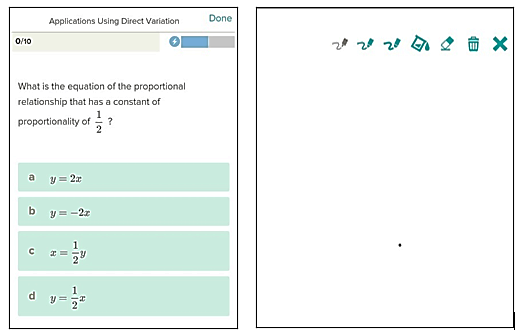
As presented in Figures 1 and 2 the mobile educational application includes a variety of elements, including games, lessons, tutorials, examples, and quizzes, that allow students to learn about the subject in several ways. Because the algebra material is interwoven in the game itself, each game requires a certain level of algebraic proficiency to complete. There are games for identifying factors, adding and subtracting directed numbers, factorization, and calculating equations all running at the same time on the internet.
Figure 1 shows a game included in every topic. The game proposes for you to start practicing questions related to the topic. You can answer it before or after reading or watching the videos included in the topics. There are also reminders before you start the game.

Figure 2 shows an example of multiple-choice questions under the topic “Applications Using Direct Variation”. In every single question, if there is a need to compute or draw something for the user to come up with the answers, a sketch pad is included for the user to use for computations.
The results agree with the results of the studies of Jaciw et al. 24, and Miller 25 that mathematics and mobile learning were found not to have significant improvements in students' attitudes. Similarly, Tang and Hew 18 found similar results. However, they emphasized that the strategy of using Mobile Instant Messaging (MIM) seemed to encourage better intimacy and interpersonal interactions, although there was no statistically significant difference between the two groups' affective evaluations of course interaction and satisfaction. More "creating" behaviors were also demonstrated by the MIM group, which also demonstrated stronger cognitive engagement, particularly in interactive idea sharing. The study concluded that MIM is a useful tool to increase student participation and engagement in online learning.
The result does not corroborate with Main and O'Rourke 26 and Riconscente 27 who found a positive change in students' attitudes to math.
Moreover, the study of Bray and Tangney 16 found different results for various scales of math attitudes: improved students' affective engagement and attitudes towards technology, but no significant difference in students' behavioral engagement, mathematical confidence, and confidence with technology.
Majority of the students' attitude in mathematics for every subscale after the intervention of the mobile educational application was as follows: neutral for attitude to learning mathematics with technology (MT) and confidence with technology (TC), positive attitude for behavioral engagement (BE) and affective engagement (AE), and negative attitude for mathematics confidence (MC). The results suggest that mobile learning might help students learn. The majority of students exhibit a favorable outlook, ranging from neutral to positive, regarding the incorporation of mobile educational applications.
The experimental group is more positive on each of the aforementioned subscales. However, there is no statistically significant difference between the two groups' values for confidence with technology (TC), mathematics confidence (MC), and affective engagement (AE). It indicates that the subscale scores of students in both groups are the same.
We thank the Department of Science and Technology - Science Education Institute (DOST-SEI) through the Capacity Building Program in Science and Mathematics Education (CBPSME).
| [1] | Alqahtani, M., & Mohammad, H. (2015). Mobile applications' impact on student performance and satisfaction. Turkish Online Journal of Educational Technology-TOJET, 14(4), 102-112. www.tojet.net/articles/v14i4/14410.pdf. | ||
| In article | |||
| [2] | Huet, J.-M., & Tcheng, H. (2010). What if telecoms - were the key to the third industrial revolution? In Google Books. Pearson Education France. https://books.google.com.ph /books?id= IZXg17nfYgAC. | ||
| In article | |||
| [3] | Macwan, Urvish. (2017, April 4). Mobile technology, its importance, present, and future trends. Finextra. https://www.finextra.com /blogposting/14000/mobile-technology-its-importance-present-and-future-trends. | ||
| In article | |||
| [4] | Harrison, R., Flood, D., & Duce, D. A. (2013). Usability of mobile applications: Literature review and rationale for a new usability model. Journal of Interaction Science, 1 (1) 1. | ||
| In article | View Article | ||
| [5] | Gurat, M. & de Gracia, R. (2016). Predictors of Students’ Competence in Applying Mathematics in Real World Problems. Journal of Studies in Social Sciences, 15 (2):49-62. http://infinitypress.info/ index.php/jsss/article/view/1328/607. | ||
| In article | |||
| [6] | Fabian, K., Topping, K., & Barron, J. (2018). Using mobile technologies for mathematics: Effects on student attitudes and achievement. Educational Technology Research and Development, 66(5), 1119–1139. | ||
| In article | View Article | ||
| [7] | Fast, L., Lewis, J. D., Bryant, M. D., Bocian, K. M., Cardullo, R. A., Rettig, M. P., & Hammond, K. A. (2010). Does math self-efficacy mediate the effect of the perceived classroom environment on standardized math test performance? Journal of Educational Psychology, 102(3), 729–740. | ||
| In article | View Article | ||
| [8] | Linnenbrink, E. A., & Pintrich, P. R. (2003). The role of self-efficacy beliefs in student engagement and learning in the classroom. Reading & Writing Quarterly, 19 (2), 119–137. | ||
| In article | View Article | ||
| [9] | Canilao, C.M. and Gurat, M.G.(2023). Comparing mathematics achievement: Control vs. experimental groups in the context of mobile educational applications. American Journal of Educational Research,11(6):348-358.pubs.sciepub.com/education/11/6/2/index.html. | ||
| In article | View Article | ||
| [10] | Baya’a, N. F., & Daher, W. M. (2009). Learning mathematics in an authentic mobile environment: The perceptions of students. International Journal of Interactive Mobile, 3(S1), 6–14. | ||
| In article | View Article | ||
| [11] | Lai, A-F, Lai, H-Y, Shen, V. R. L., Tsai, I. C. & Chou, A. (2012) "The Evaluation of Two-Stage Mobile Learning Guidance of Math in an Elementary School," 2012 IEEE Seventh International Conference on Wireless, Mobile and Ubiquitous Technology in Education, Takamatsu, Japan, 2012, pp. 282-286. | ||
| In article | View Article | ||
| [12] | Hufana, D.A.T & Gurat, M.G. (2023). Individual, motivational, and social support factors towards learning mathematics of university students in the blended learning approach. American Journal of Educational Research, 11(4):175-182.pubs.sciepub.com/education/11/4/1/index.html. | ||
| In article | View Article | ||
| [13] | Hamm, S., Saltsman, G., Jones, B., Baldridge, S., & Perkins, S. (2013). A mobile pedagogy approach for transforming learners and faculty. In Handbook of mobile learning (pp. 176-186). Routledge. | ||
| In article | |||
| [14] | Gurat, M. G. (2018). Structural equation model of students’ competence in mathematics among Filipino high school student. Journal of Interdisciplinary Studies in Education, 7(1), 67–77. | ||
| In article | View Article | ||
| [15] | Pierce, R., Stacey, K., & Barkatsas, A. N. (2007). A scale for monitoring students’ attitudes to learning mathematics with technology. Computers and Education, 48(2), 285–300. | ||
| In article | View Article | ||
| [16] | Bray, A., & Tangney, B. (2016). Enhancing student engagement through the affordances of mobile technology: A 21st century learning perspective on Realistic Mathematics Education. Mathematics Education Research Journal, 28(1), 173–197. https://eric.ed.gov/?id=EJ1092056. | ||
| In article | View Article | ||
| [17] | Aquino, E.T.M., & Gurat, M.G. (2023). Satisfaction of students in the methods used in Mathematics in the Modern World in a new normal. American Journal of Educational Research, 11(3):144-150. http://pubs .sciepub.com/education/11/3/7/. | ||
| In article | View Article | ||
| [18] | Tang, Y., Hew, K.F. Effects of using mobile instant messaging on student behavioral, emotional, and cognitive engagement: a quasi-experimental study. Int J Educ Technol High Educ 19(3) (2022). | ||
| In article | View Article PubMed | ||
| [19] | Winter, E. , Costello,A. O’Brien, M. & Hickey, G. (2021) Teachers’ use of technology and the impact of Covid-19. Irish Educational Studies, 40(2), 235-246. | ||
| In article | View Article | ||
| [20] | Nasir, N. S., & Hand, V. M. (2008). From the court to the classroom: Opportunities for engagement, learning, and identity in basketball and classroom mathematics. Journal of the Learning Sciences, 17(2), 143-179. | ||
| In article | View Article | ||
| [21] | Skinner, E. A., Kindermann, T. A., & Furrer, C. J. (2009). A motivational perspective on engagement and disaffection: Conceptualization and assessment of children's behavioral and emotional participation in academic activities in the classroom. Educational and Psychological Measurement, 69(3), 493–525. | ||
| In article | View Article | ||
| [22] | Houston, H., Heflin, J., Shewmaker, J., & Nguyen, J. (2017). Impact of mobile technology on student attitudes, engagement, and learning. Computers & Education, 107, 91-99. | ||
| In article | View Article | ||
| [23] | Alhumaid, K. (2019). Four ways technology has negatively changed education. Journal of Educational and Social Research, 9(4), 10-20. https://www.mcser.org/journal /index.php/jesr/article/view/10526. | ||
| In article | View Article | ||
| [24] | Jaciw, A. P., Toby, M., & Ma, B. (2012). Conditions for the effectiveness of a tablet-based algebra program. In Society for research on educational effectiveness. Retrieved from https://eric.ed. gov/?id=ED535506. | ||
| In article | |||
| [25] | Miller, D. J., & Robertson, D. P. (2010). Using a games console in the primary classroom: Effects of “Brain Training” programme on computation and self-esteem. British Journal of Educational Technology, 41(2), 242–255. | ||
| In article | View Article | ||
| [26] | Main, S., & O’Rourke, J. (2011). “New Directions for Traditional Lessons”: Can handheld game consoles enhance mental mathematics skills? Australian Journal of Teacher Education. | ||
| In article | View Article | ||
| [27] | Riconscente, M. M. (2013). Results from a controlled study of the iPad fractions game Motion Math. Games and Culture, 8(4), 186–214. | ||
| In article | View Article | ||
Published with license by Science and Education Publishing, Copyright © 2023 Charlotte M. Canilao and Melanie G. Gurat
 This work is licensed under a Creative Commons Attribution 4.0 International License. To view a copy of this license, visit
http://creativecommons.org/licenses/by/4.0/
This work is licensed under a Creative Commons Attribution 4.0 International License. To view a copy of this license, visit
http://creativecommons.org/licenses/by/4.0/
| [1] | Alqahtani, M., & Mohammad, H. (2015). Mobile applications' impact on student performance and satisfaction. Turkish Online Journal of Educational Technology-TOJET, 14(4), 102-112. www.tojet.net/articles/v14i4/14410.pdf. | ||
| In article | |||
| [2] | Huet, J.-M., & Tcheng, H. (2010). What if telecoms - were the key to the third industrial revolution? In Google Books. Pearson Education France. https://books.google.com.ph /books?id= IZXg17nfYgAC. | ||
| In article | |||
| [3] | Macwan, Urvish. (2017, April 4). Mobile technology, its importance, present, and future trends. Finextra. https://www.finextra.com /blogposting/14000/mobile-technology-its-importance-present-and-future-trends. | ||
| In article | |||
| [4] | Harrison, R., Flood, D., & Duce, D. A. (2013). Usability of mobile applications: Literature review and rationale for a new usability model. Journal of Interaction Science, 1 (1) 1. | ||
| In article | View Article | ||
| [5] | Gurat, M. & de Gracia, R. (2016). Predictors of Students’ Competence in Applying Mathematics in Real World Problems. Journal of Studies in Social Sciences, 15 (2):49-62. http://infinitypress.info/ index.php/jsss/article/view/1328/607. | ||
| In article | |||
| [6] | Fabian, K., Topping, K., & Barron, J. (2018). Using mobile technologies for mathematics: Effects on student attitudes and achievement. Educational Technology Research and Development, 66(5), 1119–1139. | ||
| In article | View Article | ||
| [7] | Fast, L., Lewis, J. D., Bryant, M. D., Bocian, K. M., Cardullo, R. A., Rettig, M. P., & Hammond, K. A. (2010). Does math self-efficacy mediate the effect of the perceived classroom environment on standardized math test performance? Journal of Educational Psychology, 102(3), 729–740. | ||
| In article | View Article | ||
| [8] | Linnenbrink, E. A., & Pintrich, P. R. (2003). The role of self-efficacy beliefs in student engagement and learning in the classroom. Reading & Writing Quarterly, 19 (2), 119–137. | ||
| In article | View Article | ||
| [9] | Canilao, C.M. and Gurat, M.G.(2023). Comparing mathematics achievement: Control vs. experimental groups in the context of mobile educational applications. American Journal of Educational Research,11(6):348-358.pubs.sciepub.com/education/11/6/2/index.html. | ||
| In article | View Article | ||
| [10] | Baya’a, N. F., & Daher, W. M. (2009). Learning mathematics in an authentic mobile environment: The perceptions of students. International Journal of Interactive Mobile, 3(S1), 6–14. | ||
| In article | View Article | ||
| [11] | Lai, A-F, Lai, H-Y, Shen, V. R. L., Tsai, I. C. & Chou, A. (2012) "The Evaluation of Two-Stage Mobile Learning Guidance of Math in an Elementary School," 2012 IEEE Seventh International Conference on Wireless, Mobile and Ubiquitous Technology in Education, Takamatsu, Japan, 2012, pp. 282-286. | ||
| In article | View Article | ||
| [12] | Hufana, D.A.T & Gurat, M.G. (2023). Individual, motivational, and social support factors towards learning mathematics of university students in the blended learning approach. American Journal of Educational Research, 11(4):175-182.pubs.sciepub.com/education/11/4/1/index.html. | ||
| In article | View Article | ||
| [13] | Hamm, S., Saltsman, G., Jones, B., Baldridge, S., & Perkins, S. (2013). A mobile pedagogy approach for transforming learners and faculty. In Handbook of mobile learning (pp. 176-186). Routledge. | ||
| In article | |||
| [14] | Gurat, M. G. (2018). Structural equation model of students’ competence in mathematics among Filipino high school student. Journal of Interdisciplinary Studies in Education, 7(1), 67–77. | ||
| In article | View Article | ||
| [15] | Pierce, R., Stacey, K., & Barkatsas, A. N. (2007). A scale for monitoring students’ attitudes to learning mathematics with technology. Computers and Education, 48(2), 285–300. | ||
| In article | View Article | ||
| [16] | Bray, A., & Tangney, B. (2016). Enhancing student engagement through the affordances of mobile technology: A 21st century learning perspective on Realistic Mathematics Education. Mathematics Education Research Journal, 28(1), 173–197. https://eric.ed.gov/?id=EJ1092056. | ||
| In article | View Article | ||
| [17] | Aquino, E.T.M., & Gurat, M.G. (2023). Satisfaction of students in the methods used in Mathematics in the Modern World in a new normal. American Journal of Educational Research, 11(3):144-150. http://pubs .sciepub.com/education/11/3/7/. | ||
| In article | View Article | ||
| [18] | Tang, Y., Hew, K.F. Effects of using mobile instant messaging on student behavioral, emotional, and cognitive engagement: a quasi-experimental study. Int J Educ Technol High Educ 19(3) (2022). | ||
| In article | View Article PubMed | ||
| [19] | Winter, E. , Costello,A. O’Brien, M. & Hickey, G. (2021) Teachers’ use of technology and the impact of Covid-19. Irish Educational Studies, 40(2), 235-246. | ||
| In article | View Article | ||
| [20] | Nasir, N. S., & Hand, V. M. (2008). From the court to the classroom: Opportunities for engagement, learning, and identity in basketball and classroom mathematics. Journal of the Learning Sciences, 17(2), 143-179. | ||
| In article | View Article | ||
| [21] | Skinner, E. A., Kindermann, T. A., & Furrer, C. J. (2009). A motivational perspective on engagement and disaffection: Conceptualization and assessment of children's behavioral and emotional participation in academic activities in the classroom. Educational and Psychological Measurement, 69(3), 493–525. | ||
| In article | View Article | ||
| [22] | Houston, H., Heflin, J., Shewmaker, J., & Nguyen, J. (2017). Impact of mobile technology on student attitudes, engagement, and learning. Computers & Education, 107, 91-99. | ||
| In article | View Article | ||
| [23] | Alhumaid, K. (2019). Four ways technology has negatively changed education. Journal of Educational and Social Research, 9(4), 10-20. https://www.mcser.org/journal /index.php/jesr/article/view/10526. | ||
| In article | View Article | ||
| [24] | Jaciw, A. P., Toby, M., & Ma, B. (2012). Conditions for the effectiveness of a tablet-based algebra program. In Society for research on educational effectiveness. Retrieved from https://eric.ed. gov/?id=ED535506. | ||
| In article | |||
| [25] | Miller, D. J., & Robertson, D. P. (2010). Using a games console in the primary classroom: Effects of “Brain Training” programme on computation and self-esteem. British Journal of Educational Technology, 41(2), 242–255. | ||
| In article | View Article | ||
| [26] | Main, S., & O’Rourke, J. (2011). “New Directions for Traditional Lessons”: Can handheld game consoles enhance mental mathematics skills? Australian Journal of Teacher Education. | ||
| In article | View Article | ||
| [27] | Riconscente, M. M. (2013). Results from a controlled study of the iPad fractions game Motion Math. Games and Culture, 8(4), 186–214. | ||
| In article | View Article | ||