Traditional Ethnoecological Knowledge (TEK) is changing and diminishing with continuous change in land use, changing demographics and migration patterns. This paper elucidates plant related TEK among populations of one of the Primitive Vulnerable Tribal Groups (PVTGs) of India- Paudi Bhuyans. Populations of this tribe are now migrating downhills from their original habitation over hill tops in Keonjhar district to northern parts in Angul district, Odisha. Migration and impact of several socio-economic factors have resulted in defining a new set of relationships of these populations with natural resources. Plant based traditional knowledge in eleven villages which are spread over 270 km2 and situated at altitudes varying between 180m to 613m were documented and three parameters proxied and presented as TEK. These include knowledge about edible species, their ethnomedicinal value, and prevalence of biocultural practices amongst Paudi Bhuyan populations. Nestedness between changing demographics caused due to intermixing of the tribes, and socioeconomic factors that influence the culture and TEK status in these eleven villages are presented. The study pitches for a strong need to adopt a ‘uniform prescribed category or criteria’ to prioritize and safeguard the ‘pool of TEK” in tribal populations.
Indigenous communities inherit and transfer ethnoecological knowledge and experiences to future generations (Roue and Nakashima 2002) 1. It is further postulated that indigenous people have knowledge about their surroundings and resources that is locale specific and unique (Berkes et al. 2000) 2. Various components comprising biocultural diversity like plants, animals, their phenophases, and cultural events related to them, interact in complex ways that exhibit evolutionary trends (Maffi 2005) 3. Usually this information is transmitted through memes. Similar to the role of a gene in genetic evolution, meme plays a role in evolution of biocultural diversity. Meme is actually a unit for carrying forward ideas in the cultural evolution and hence an analogy can be drawn between biocultural evolution and biological evolution (Loh and Harmon 2014) 4. In any set up an exchange of new genetic material needs a cultural integration because it brings with it a unique set of experiences and environmental adaptations (Jianchu and Yongping 2007) 5. Cultural ideas which are unable to withstand changes in the external world, are less likely of remaining viable and become rare, and in absence of any takers, fade, get forgotten and eventually go extinct over a period of time. Hence when an idea around an environmental adaptation is lost, so is the ecological knowledge which otherwise forms the core of nature based solutions (Cohen-Shacham et al. 2016) 6. It is further postulated that Traditional Ethnoecological Knowledge (TEK) is a key resource for enhancing the adaptive capacity (Boillat and Berkes 2013) 7. This knowledge (TK) adapts to newer environmental conditions due to its dynamic nature and has been repeatedly stated and reinforced that communities that will greatly benefit society’s resilience are forest communities, farmers, and indigenous populations (Ladio 2011; Hladik et al. 1993) 8, 9. TK has an immense benefit for humankind, and its universal acceptance is bound to create an understanding and adoption of traditional resource efficiency measures to achieve sustainability. Modernization, pressure related to food, medicine or cultural practices, are affecting both the well-being and degree of dependence of indigenous people on natural resources (Wyndham 2010) 10. It is therefore, important that in prevailing circumstances focus shifts to conceptualization of nature in accordance with knowledge rested within the local and indigenous people (Eyssartier et al. 2011) 11.
1.1. Reflecting on the Tribal Wealth in Odisha, IndiaThere are 62 tribes in Odisha and the population constitutes 22.1% of the total population of the state (Census data 2011) 12. Of these, there are 13 Particularly Vulnerable Tribal Groups (PVTGs) in Odisha. This paper presents the dynamics of plant based Traditional Ethnoecological Knowledge (TEK) in Paudi Bhuyans (PB), a particularly vulnerable tribal group (PVTG), one of the most economialy backward tribes found in Northern parts of Odisha, majorly in districts of Keonjhar, Sundargarh, Mayurbhanj, Sambalpur and Angul. Members of PB tribe are also found in Indian states of Bihar, West Bengal and Assam. Perusal of literature on PVTGs of Northern Odisha reveals negligible documentation of ethnoecological knowledge within and amongst members of this tribe. Paudi Bhuyan is an important, unique and sensitive tribe that shares genetic similarity with three other important tribes, namely the Jarawas, the Great Andamanese and the Onges (Acharya et al. 2015) 13. Primitive Paudi Bhuyans have migrated from Keonjhar to other parts of the state (Odisha), including district Angul. Most primitive populations of Paudi Bhuyans are still living on the hill tops (Roy 1935) 14, however, a sizable population has migrated to lower elevations. Due to geographic isolation populations of Paudi Bhuyans found on hill tops are perhaps the ‘original’ populations and most primitive. During their downhill movement they acquired a transitional way of living between the hill top and plain dwelling populations, and further constituted a population of the ‘Foot hill’ Paudi Bhuyans. The third category are the ‘Plain’ Paudi Bhuyans who have due its continuous exposure and interaction with other tribes and non-tribal populations undergone maximum acculturation resulting in maximum lifestyle modifications in comparison with more traditional and primitive populations.
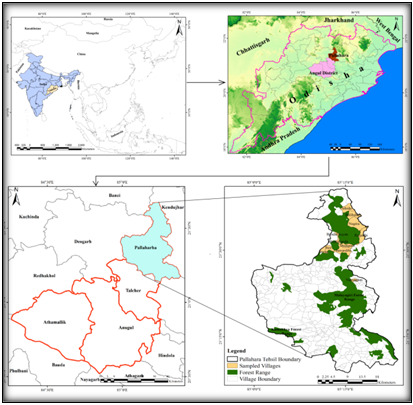
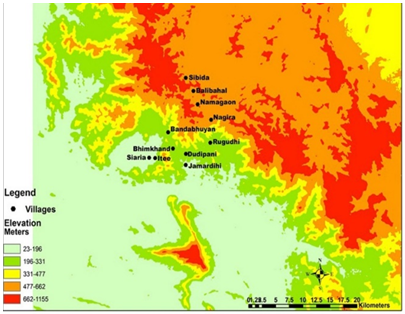
In this study we focussed on eleven villages in Pallahara tehsil (District Angul) spread over 270 km2 and situated at altitudes varying between 180m to 613m (msl) (Figure 1; and Figure 2). These villages are inhabited by both tribal and rural populations. They were either completely dominated by Paudi Bhuyan tribe or had mixed populations of Paudi Bhuyans and members of other tribes like Munda, Kolha, Gandia, and Ho. Non-tribal members practicing Hinduism and Christianity were also living in these villages. Names of the eleven villages covered in the study along with altitudes, distances from motorable roads, and number of Paudi Bhuyan households, are given in Table 1.
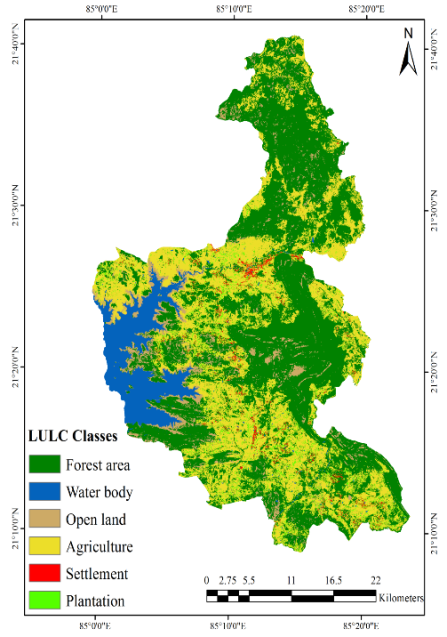
Distribution of villages as per altitude level brings forward two categories. Higher altitude category of villages include Sibida, Balibahal, Namagaon, and Nagira. Villages at a lower altitude include Jamardihi, Dudipani, Bhimkhand, Siaria, Itee, Rugudhi, and Bandabhuyan. LULC profile (Figure 3) reveals that though a majority of the land near these cillags is under forest cover, agriculture is the next major usage pattern in the area. Settlements are sparse in distribution.


To facilitate with the information from villages in the study area, communication was facilitated by village head men. Discussions with members of PBDA (Paudi Bhuyan Development Agency), Jamardihi were helpful in gaining entry in the study area. Questionnaires were structured around three trajectories- socio-economic, bio-ecological, and cultural. Focus group discussions and interviews with respondents from eleven villages selected for this study were conducted over a period of three years (2015-2018). Experimental designs were constructed to capture data related to three identified aspects of plant based TEK- edibility status of plants; medicinal value of species; and biocultural value of the floral species. Based on responses received from villages, lists of plant based knowledge and their uses were prepared and validated. A study of socio-economic and demographic profile of these villages were also undertaken. These were recorded in three sections- census reports of 2001 and 2011, and primary data collected in the field during the period of study (2015-2018).
Focus group discussions were attended by members of both gender, and representatives of all age groups in each village. Responses from women were difficult to record due to their shy nature. On several occasions separate discussions were held with the elderly to record their responses on questions that required intergenerational perspective. Village surveys on foot were conducted. Local markets (haats) were visited to assess products that have a commercial value and also to record inter-village variations.
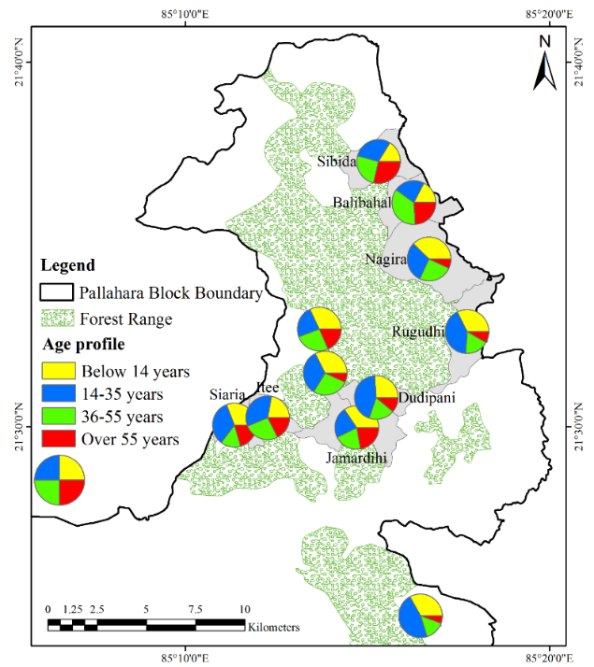
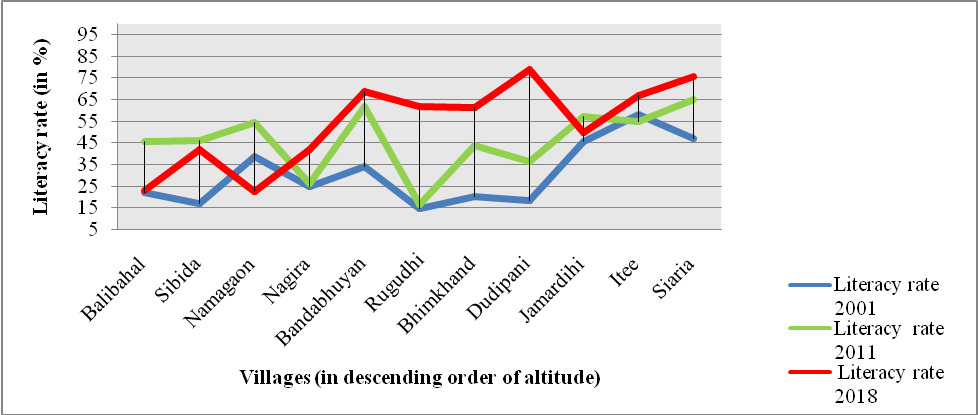
A range of factors influence plant based knowledge in research locations. Unique quantitative trends about edibility status of plants, knowledge about ethnomedicinal properties and biocultural practices prevalent in the study area were observed (Table 1). Each village had a unique knowledge about edible species, ethnomedicinal uses, and biocultural values. Detailed list of these species along with specimen samples and photographs are maintained as herbaria in Biosystematics lab, USEM, GGS Indraprastha University, Dwarka, New Delhi. General observations reveal that edible plant species recorded from the study area belonged to both wild and domesticated categories. Leafy and tuber based vegetables constitute a majority of traditionally consumed plants. Highest knowledge about edible plants was documented from villages Nagira and Namagaon at altitudes (msl) of 542 m and 583 m, respectively (Table 1). Literacy levels (Figure 6) also influenced the knowledge levels in the villages. Namagaon with one with the lowest literacy level (22%) but demonstrated highest value of knowledge about known number of edible plant species (Table 1). As the distance from motorable road decreased, the knowledge levels also decreased. This implies that least movement from and into habitation lead to losses of traditional knowledge (Siaria village was close to motorable road and one exhibiting lowest level of plant based knowledge). Another interesting observation was in the case of Balibahal, a village with a higher percentage of elderly generation (Figure 4), that also exhibited a higher knowledge about edible plants (Table 1).


Several plant species were known to have medicinal value. Nyctanthes arbortristis L. (Gutakhadika), Andrographis paniculata (Burm.f.) Nees, Terminalia chebula Retz. (Harida), Terminalia bellerica (Gaertn.) Roxb. (Bahada), and Rauvolfia serpentine (L.) Benth. ex Kurz (Patalgaruda) were leading this category. Families with highest number of plant species of medicinal value from the field were Fabaceae, followed by Apocynanceae and Malvaceae. Villagers used various plant parts such as bark, root, leaf, seed, flower, fruit or entire plant to cure different ailments.
3.3. Cultural ValueAlong with direct uses as food and medicine, Paudi Bhuyans also revere nature by worshiping it as supreme power in forms of Mother Earth, Sun, hills, forests, fields, and water bodies. Two types of cultural festivities were evident in the study area. Those which were endemic to tribal population and those that were celebrated in mixed population of villages.In former category: Gramshree, Badam, Bisiri, Mahula, Karam, Nuakhai, Dihabandha, Basana, Rajo parab, Nadi puja, Jatal Puja, Bhimbudha, Dhana Nua, and Sarapta puja were included. Akshay Tritiya, Pushpurnima, Kartik Purnima, Jagannath puja, and Makar Sankranti were included in the latter category. They have now also started worshipping various Hindu deities like Laxmi, Durga, Saraswati and Ganesha. Collective wisdom of mixed population groups has led to increase in observance of cultural practices. Villages Itee and Jamardihi, which were closer to motorable roads and more exposed to urbanisation practiced a larger number of cultural festivals. However, in the case of Bandabhuyan village (100% Paudi Bhuyan presence) only a few endemic festivals were practiced. This village was more secluded with minimal interference from other populations and had unique and undisturbed knowledge levels related to edibility, medicinal value and biocultural practices linked with plant species. The villagers worship Mahul (Madhuca longifolia var latifolia (Roxb.) A.Chev), Kendu (Diospyros melanoxylon Roxb.) and Sal (Shorea robusta Gaertn.), Mango (Mangifera indica), Rajkusumo (Schleichera oleosa), Genda (Tagetes erecta), Muchkundu (Pterospermum acerifolium), Barh (Ficus benghalensis), Hambu (Cryptolepis brazzaei), Limbo (Azadirachta indica), and Palasho (Butea monosperma). Commonly celebrated festivities include Karam, Bisiri, Gramshree, and Banadurga puja. Paudi Bhuyan tribe members in villages in study area are well versed in dance forms imitating different animals. These dance performances were done to welcome guests in their villages. Some villages have an active Van Sangrakshak Samiti (VSS) to guard and protect adjoining forests. This is an effort to protect and preserve the pool of indigenous knowledge being subjected to development and social influences.
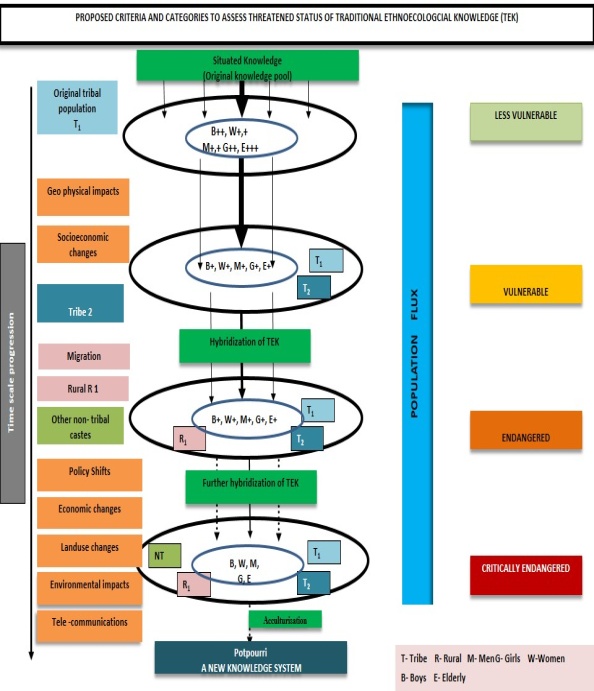
TEK is subjected to development dynamics in the current age of the Anthropocene epoch. An ongoing spasm of biological crisis, has led to an alarming depletion of species, languages, and traditions related to ecology. A rich diversity of languages is akin to species and their depletion would be a complete loss of its evolutionary process. Since ethnic knowledge, popular beliefs, and inherited practices are all ingrained in TEK, these are transmitted primarily through oral communication at a particular geographical area over a period of hundreds of years. All indigenous populations have their own set of TEK rules and doctrines to support their conservation practices (Steffen et al. 2004) 15 and thus by nature it is a situated knowledge system. Situated knowledge is critical as it may get eroded if intergenerational transmission links are severed. Globalisation, technology and market oriented development are considered as main factors that impact TEK (Godoy et al. 2005) 16. Migration impacts populations. Accessibility of urban areas to indigenous populations affects their well being and level of dependence on natural resources (Baggethun et al. 2013) 17. It is therefore postulated that to understand causes behind universal impacts on TEK, focus of research needs to shift to conceptualization of nature in local knowledge and hence a hybridization model of TEK is proposed,wherein a mixing of old and new schools of thoughts happen simultaneously. This is similar to the species categories defined by IUCN (IUCN 2018) 18.
We have found that Paudi Bhuyan populations residing in the eleven villages were influenced by several exogenic factors that are impacting their TEK. Observations have led to an understanding that each Paudi Bhuyan tribal population possess a unique ‘ethno-eco-cultural’ knowledge base. In a process of migration and adaptation to new conditions, these populations have slowly detached from many of their traditional practices and have evolved a new/ hybrid version of their TEK. This adaptation fits well with the survival strategies of the populations. But, from the TEK point of view, it exhibits weakening of ‘meme’ or the knowledge system of Paudi Bhuyans. This unique TEK was passed on to them as accumulated and time tested treasure in this particular geographical area. Thus like a gene pool this ‘meme pool’ is unfortunately threatened and is leading towards ‘endangered’ and ‘critically endangered categories’ akin to any biological species. Once lost it will be difficult to retrieve this body of knowledge as every sphere of the biosphere is changing fast. Variations in TEK of different Paudi Bhuyan populations reveal a new gradient in knowledge systems. It has emerged that a unique nesting exists between biodiversity and cultures. Since these two are inseparable, their evolution pathways also follow parallel trends. TEK is being further compared with the status of threatened species categories proposed by IUCN in Red Data Books and Red Lists (IUCN 2018) 18.
Building up on unique observations that have emerged from the study of Paudi Bhuyans, it is proposed that like species, TEK can also similarly be categorised into conservation status categories of IUCN, which are Vulnerable, Endangered and Critically Endangered. In the current study, populations of Paudi Bhuyans at hill tops are exposed to minimal disturbances and hence their knowledge pool falls in the category of ‘vulnerability’ but to a lesser extent. We have grouped them as ‘Less Vulnerable’. These represent the ‘original pool of knowledge’ which needs to be documented before it is diluted, or gone forever, since with passage of time, changes in population dynamics and structure may modify this situated pool of knowledge. Migration or movements of populations of Paudi Bhuyans from areas of origin have been recorded earlier though they were migrating from hill tops to hill top only. Of late their movement to new areas down the hills has led to intermixing with other tribal populations which has caused changes in the situated knowledge pool of the original indigenous populations of Paudi Bhuyans thus influencing changes in their knowledge pool. Further downhill, movement of Paudi Bhuyans and their subsequent intermixing with other tribes and rural populations have led to changes not only in the composition of original tribal populations but the hybridization of knowledge pools. As a result, the ‘original’ ecology based knowledge system has also been significantly changed. This hybridization of knowledge is leading to an evolution of a new knowledge regime which exhibits a fraction of the original knowledge pool and hence these new emerging regimes are categorised as ‘Endangered’ from a viewpoint of intergenerational transmission of the TEK among Paudi Bhuyans. Admixture of tribes and formation of new social setups lead to further losses and gains in TEK because populations are custodians of this knowledge. In new geographical locations and living with other populations, the original tribes are under a lot of pressure to adapt and adopt new living conditions leading to further changes in their TEK. Some members also migrate to sub urban or urban areas, under pressure to enhance their living conditions. Modernisation pressures further expose these populations to policy and economic changes in new locations. Adaptations to changes in land use pattern and conditions of surrounding environment also leads to a new knowledge regime. The new knowledge regime is categorised as ‘Critically Endangered”, and is significantly different from their original knowledge pool in hill top Paudi Bhuyans (Figure. 6).
Traditional Ethnoecological Knowledge (TEK) considers sustainability to be a new paradigm for thinking about a future in which environmental, societal, and economic considerations are balanced in the pursuit of development, and an improved quality of life. Knowledge about TEK will effectively feed into the growing interest of global community about nature based solutions (NbS), and hence help in policy decisions to address societal challenges effectively and adaptively, simultaneously providing human well-being and biodiversity benefits.
The authors are grateful to the informants and village residents for their help and sharing valuable information during the course of investigation. We are thankful to staff at Paudi Bhuyan Development Agency situated at Pallahara, for their help in selection of villages and facilitation of initial visits. We also acknowledge USEM, GGSIPU for providing academic support to carry out this research.
Detailed lists along with specimen samples and photographs of plant species collected and studied in this research are maintained as herbaria in Biosystematics lab, USEM, GGS Indraprastha University, Dwarka, New Delhi.
| [1] | Roué, M. & Nakashima, D, 2002. Knowledge and foresight: The predictive capacity of traditional knowledge applied to environmental assessment. Int. J. Soc. Sci. Res, 54 (173): 337-347. | ||
| In article | View Article | ||
| [2] | Berkes, F.; Colding, J. & Folke, C. 2000. Rediscovery of traditional ecological knowledge as adaptive management. Ecol Appl, 10 (5): 1251-1262. | ||
| In article | View Article | ||
| [3] | Maffi, L. 2005. Linguistic, Cultural, and Biological Diversity. Annu Rev Anthropol. 34(1): 599-617. | ||
| In article | View Article | ||
| [4] | Loh, J. & Harmon, D., 2014. Biocultural Diversity: threatened species, endangered languages. WWF Netherlands, Zeist, The Netherlands. Available at https://d2ouvy59p0dg6k.cloudfront.net/downloads/biocultural report. Last accessed March 2018. | ||
| In article | |||
| [5] | Jianchu, X. & Yongping, Y. 2007. Agrobiodiversity conservation and the role of rural women. Expert consultation report, FAO. | ||
| In article | |||
| [6] | Cohen-Shacham, E., Walters, G., Janzen, C. & Maginnis, S. (eds.) (2016). Nature-based Solutions to address global societal challenges. Gland, Switzerland: IUCN. xiii + 97pp. | ||
| In article | View Article | ||
| [7] | Boillat, S. & Berkes, F. 2013. Perception and interpretation of climate change among Quechua farmers of Bolivia: indigenous knowledge as a resource for adaptive capacity. Ecol. Soc. 18(4): Art.21. | ||
| In article | View Article | ||
| [8] | Ladio, A.H. 2011. Traditional knowledge of edible wild native and exotic plants in the context of cultural change in human populations of arid Patagonia. Biorem. Biodiv. Bioavail. 5(1):60-64. | ||
| In article | |||
| [9] | Hladik, C.M.; Hladik, A.; Linares, O.F.; Pagezy, H.; Semple, A. & Hadley, M. 1993. Tropical forests, people and food: Biocultural interactions and applications to development. UNESCO Man and Biosphere Series 13. Carnforth, UK: Parthenon Publishing. | ||
| In article | |||
| [10] | Wyndham, F.S. 2010. Environments of learning: Rarámuri children's plant knowledge and experience of schooling, family, and landscapes in the Sierra Tarahumara, Mexico. Hum Ecol 38(1): 87-99. | ||
| In article | View Article | ||
| [11] | Eyssartier, C.; Ladio, A.H. & Lozada, M. 2011. Traditional horticultural knowledge change in a rural population of the Patagonian steppe. J. Arid Environ. 75(1):78–86. | ||
| In article | View Article | ||
| [12] | Census, 2011. Available at https://censusindia.gov.in/Tables_Published/SCST/dh_st_orissa.pdf. | ||
| In article | |||
| [13] | Acharya, S.K.; Das, P.K. & Kshatriya, G.K. 2015. Love and marriage practices among the Pauri Bhuyan tribe in Keonjhar district of Odisha, India. East Anthropol, 68(1):26-43. | ||
| In article | |||
| [14] | Roy, S.C. 1935. The Hill Bhuiyas of Orissa. Ranchi: Man in India Office. | ||
| In article | |||
| [15] | Steffen, W.; Sanderson, R.A.;, Tyson, P.D.; Jäger, J.; Matson, P.A.; Moore, III. B.; Oldfield, F.; Richardson, K.; Schellnhuber, H.J.; Turner, B.L. & Wasson, R.J. 2004. Global Change and the Earth system: A planet under pressure. New York: Springer-Verlag. | ||
| In article | View Article | ||
| [16] | Godoy, R.; Reyes-García, V.; Byron, E.; Leonard, W.R. & Vadez, V. 2005. The effect of market economies on the well-being of indigenous people and on their use of renewable natural resources. Annu Rev Anthropol. 34:121-138. | ||
| In article | View Article | ||
| [17] | Baggethun, E.G.; Corbera, E. & García, V.R. 2013. Traditional ecological knowledge and global environmental change: research findings and policy implications. Ecol. Soc. 18(4):Art.72. | ||
| In article | View Article PubMed | ||
| [18] | IUCN Red List of Species Categories. Available at https://www.iucnredlist.org/. Last accessed April 2018. | ||
| In article | |||
Published with license by Science and Education Publishing, Copyright © 2023 Kahlon L.K. and Singh R
 This work is licensed under a Creative Commons Attribution 4.0 International License. To view a copy of this license, visit
http://creativecommons.org/licenses/by/4.0/
This work is licensed under a Creative Commons Attribution 4.0 International License. To view a copy of this license, visit
http://creativecommons.org/licenses/by/4.0/
| [1] | Roué, M. & Nakashima, D, 2002. Knowledge and foresight: The predictive capacity of traditional knowledge applied to environmental assessment. Int. J. Soc. Sci. Res, 54 (173): 337-347. | ||
| In article | View Article | ||
| [2] | Berkes, F.; Colding, J. & Folke, C. 2000. Rediscovery of traditional ecological knowledge as adaptive management. Ecol Appl, 10 (5): 1251-1262. | ||
| In article | View Article | ||
| [3] | Maffi, L. 2005. Linguistic, Cultural, and Biological Diversity. Annu Rev Anthropol. 34(1): 599-617. | ||
| In article | View Article | ||
| [4] | Loh, J. & Harmon, D., 2014. Biocultural Diversity: threatened species, endangered languages. WWF Netherlands, Zeist, The Netherlands. Available at https://d2ouvy59p0dg6k.cloudfront.net/downloads/biocultural report. Last accessed March 2018. | ||
| In article | |||
| [5] | Jianchu, X. & Yongping, Y. 2007. Agrobiodiversity conservation and the role of rural women. Expert consultation report, FAO. | ||
| In article | |||
| [6] | Cohen-Shacham, E., Walters, G., Janzen, C. & Maginnis, S. (eds.) (2016). Nature-based Solutions to address global societal challenges. Gland, Switzerland: IUCN. xiii + 97pp. | ||
| In article | View Article | ||
| [7] | Boillat, S. & Berkes, F. 2013. Perception and interpretation of climate change among Quechua farmers of Bolivia: indigenous knowledge as a resource for adaptive capacity. Ecol. Soc. 18(4): Art.21. | ||
| In article | View Article | ||
| [8] | Ladio, A.H. 2011. Traditional knowledge of edible wild native and exotic plants in the context of cultural change in human populations of arid Patagonia. Biorem. Biodiv. Bioavail. 5(1):60-64. | ||
| In article | |||
| [9] | Hladik, C.M.; Hladik, A.; Linares, O.F.; Pagezy, H.; Semple, A. & Hadley, M. 1993. Tropical forests, people and food: Biocultural interactions and applications to development. UNESCO Man and Biosphere Series 13. Carnforth, UK: Parthenon Publishing. | ||
| In article | |||
| [10] | Wyndham, F.S. 2010. Environments of learning: Rarámuri children's plant knowledge and experience of schooling, family, and landscapes in the Sierra Tarahumara, Mexico. Hum Ecol 38(1): 87-99. | ||
| In article | View Article | ||
| [11] | Eyssartier, C.; Ladio, A.H. & Lozada, M. 2011. Traditional horticultural knowledge change in a rural population of the Patagonian steppe. J. Arid Environ. 75(1):78–86. | ||
| In article | View Article | ||
| [12] | Census, 2011. Available at https://censusindia.gov.in/Tables_Published/SCST/dh_st_orissa.pdf. | ||
| In article | |||
| [13] | Acharya, S.K.; Das, P.K. & Kshatriya, G.K. 2015. Love and marriage practices among the Pauri Bhuyan tribe in Keonjhar district of Odisha, India. East Anthropol, 68(1):26-43. | ||
| In article | |||
| [14] | Roy, S.C. 1935. The Hill Bhuiyas of Orissa. Ranchi: Man in India Office. | ||
| In article | |||
| [15] | Steffen, W.; Sanderson, R.A.;, Tyson, P.D.; Jäger, J.; Matson, P.A.; Moore, III. B.; Oldfield, F.; Richardson, K.; Schellnhuber, H.J.; Turner, B.L. & Wasson, R.J. 2004. Global Change and the Earth system: A planet under pressure. New York: Springer-Verlag. | ||
| In article | View Article | ||
| [16] | Godoy, R.; Reyes-García, V.; Byron, E.; Leonard, W.R. & Vadez, V. 2005. The effect of market economies on the well-being of indigenous people and on their use of renewable natural resources. Annu Rev Anthropol. 34:121-138. | ||
| In article | View Article | ||
| [17] | Baggethun, E.G.; Corbera, E. & García, V.R. 2013. Traditional ecological knowledge and global environmental change: research findings and policy implications. Ecol. Soc. 18(4):Art.72. | ||
| In article | View Article PubMed | ||
| [18] | IUCN Red List of Species Categories. Available at https://www.iucnredlist.org/. Last accessed April 2018. | ||
| In article | |||