Based on theoretical and practical studies, we design and provide resources to teach Grade 1 Experiential Activities. At the same time, through experiments, we verify the possibility and efficiency of using the resource system. In some primary schools, we make recommendations on the coordination of resource use and the organization of Experiential Activities among the research team, schools, and teachers to improve the quality of educational activities.
Experiential activity is an educational activity that allows children to participate in a diverse learning environment, directly through creative activities. They require the detection and resolution of contradictions to create a unification between what was and what was not, between the known and the unknown, between what can be seen and the behavior change. Thereby, core competencies are formed and students' potential is developed.
It derives from David Kolb's experiential learning cycle, which is the inheritance and development of relevant learning theories of psychologists and educators such as John Dewey (1859-1952), Mary Parker Follett (1868-1933); Kurt Lewin (1890-1947); Jean Piaget (1896-1980); Lev Vygotsky (1896-1934); Carl Jung (1875-1961); Carl Rogers (1902-1987); Paulo Freire (1921-1997) and many other scientific researchers 1. The experiential learning cycle has been considered the educational philosophy of many countries, applied in at least 30 fields and widely used to develop and popularize school curricula.
Realizing the importance of teaching through experiential learning, Vietnamese education has made a change in its education curriculum when stipulating that experiential activities are compulsory educational ones in order to form and develop qualities and core competencies for students, especially first graders.
In fact, to ensure the effective implementation of Experiential Activities, Vietnam Ministry of Education and Training issued the Circular 25/2020 dated August 26, 2020 stipulating the selection of textbooks in general education institutions and Vietnam Department of Education and Training issued the Official Dispatch No. 2323/DoETs-GE on November 13, 2019 on the instructions for implementing the content of Primary School Experience Activities in the 2018 General Education Curriculum From the 2020-2021 school year. Therefore, the direction of implementing experiential activity content is carried out promptly and timely so that it can meet the requirements of experiential activities and promote the relationship between schools and other educational forces 2, 3.
Besides, according to a number of articles and scientific research topics such as the topic “Management of experiential activities for students at primary schools in Thuy Nguyen district, Hai Phong city in the direction of developing cooperation capacity” - Pham Thi Kim Nhung - Hanoi National University of Education - 2020, the topic "Developing the capacity to organize experiential activities for elementary school teachers in Hanoi city to meet the new general education curriculum" - Nguyen Thi Cam Chi - Hanoi National University of Education - 2020, the article "The reality of one year of teaching experiential activities under the 2018 General Education Curriculumat Primary level", several difficulties in the organization of teaching Experiential activities are: Firstly, teachers’ capacity to organize experiential activities is still limited; Secondly, the evaluation of products and students' participation in activities has not been provided criteria which are specific and suitable for students as well as meet the requirements of the curriculum; Thirdly, the training courses and fostering professional pedagogy are still short; Reference sources are limited 4, 5, 6.
Thereby, we realized that it is necessary to study the real situation and design teaching resources for first grade Experiential Activities to meet the requirements of the curriculum and the needs of teachers. It is a potential learning tool not only for teachers in teaching but also for students' self-study. Moreover, there has not been any specific research on solutions related to reference sources in teaching first grade Experiential Activities in schools. Hence, this study brings more significance and usability.
a) John Dewey’s model of Experiential Learning
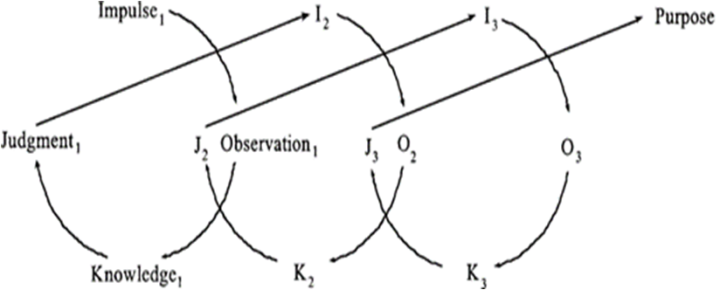
John Dewey makes it more explicit about the developmental nature of learning as a feedback process by describing how learning transforms the impulses, feelings, and desires of concrete experience into purposeful action at a higher level.
Dewey’s description of learning emphasizes learning as a dialectic process integrating experience and concepts, observations and action. The impulse of experience gives ideas their motive force, and ideas give directions to impulse. Postponing actions immediately is essential for observation and judgment to intervene, and action is necessary to achieve the goals. Thanks to the integration of these opposing but symbiotically related processes, sophisticated and mature purposes can develop from blind urge 1.
Dewey offers a four-step Experiential Learning Cycle as presented in Figure 1.

b) David Kolb’s Experiential Learning model
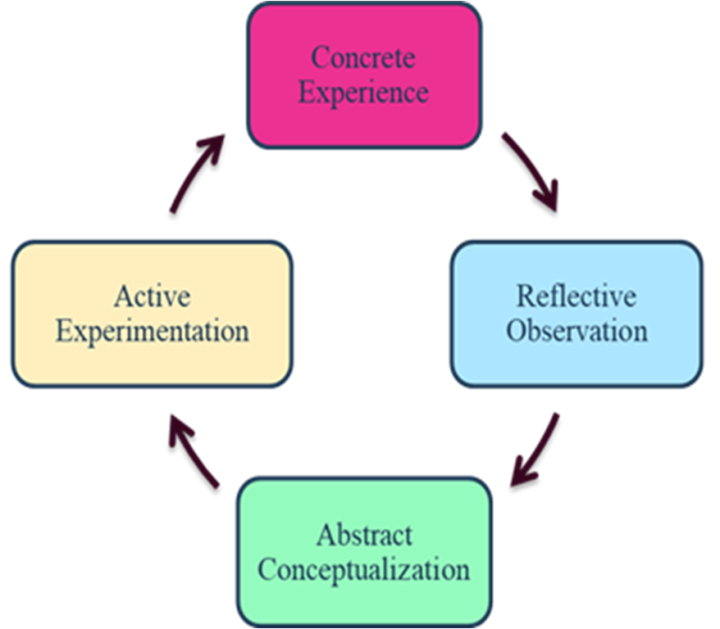
According to Kolb, this type of learning can be defined as "the process whereby knowledge is created through the transformation of experience. Knowledge results from the combinations of grasping and transforming experience" 1.

Kolb offers a four-step Experiential Learning Cycleas as showed in Figure 2.
These four learning methods are often described as a cycle. According to Kolb, concrete experience provides information that serves as a basis for reflection. From these reflections, we assimilate the information and form abstract concepts.
The core point of Kolb's experiential learning theory is that learners need to have reflection which is the back and forth of thought in consciousness, heading towards their experiences, analyzing, generalizing and formulating them into concepts; then these concepts are applied and tested in practice... Thereby, new experiences emerge and then become inputs for the next round of learning until learning goals are achieved.
In terms of needs, first graders still have the characteristic needs of the previous age and gradually form and develop strong cognitive demand. Their perceptions and thoughts are associated with vivid visualization, which is conducted mainly through direct activity with the object. The imagination of first graders has become richer than that of preschoolers, but it is still simple and unsustainable. With regard to language, it has developed markedly in both quantity and quality. Nevertheless their language is poor, simple and they are not proficient in using the written language 7.
Experiential Activity is a compulsory educational activity which plays an extremely important role in education, especially for first graders. Besides fostering 5 qualities, forming and developing 3 common competencies, 1st Grade Experiential Activities set out the requirements to be met in terms of specific competencies: The ability to adapt to life, the capacity to design and organize activities 8. Based on those requirements, the content of the experience activity is built around 3 content circuits: Self-directed activities, Social-oriented activities, and Nature-oriented activities 9. Activities are built in the form of: Activities under the flag, Themed experiential activities and Class meetings. In particular, the process of organizing activities includes 4 steps: Identification - Discovery; Learning – Expanding; Practicing - Application; Evaluation – Development 10.
2.2. PracticalWith the new features of Experiential Activities, as well as the outbreak of the Covid 19 epidemic - lots of primary school teachers run into difficulties in teaching Experiential Activities.
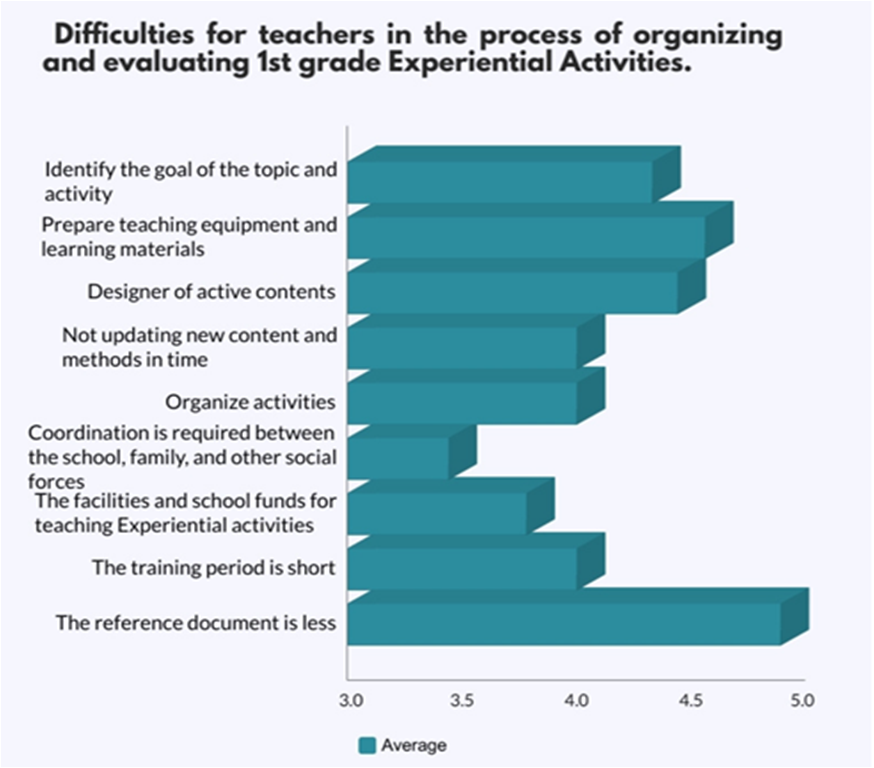
To learn about this situation accurately and objectively, we did a survey of the reality of the organization of 1st Grade Experiential Activities to determine teachers' awareness of the role of Experiential Activities in elementary school, the difficulties that teachers face in the teaching and learning process, teachers' capacity to organize 1st grade experiential activities and the need for reference resource support.
After 2 days of surveying at 3 elementary schools in three different provinces in Vietnam, we found that teachers' awareness of the role of experiential activities in the comprehensive development of primary school students is relatively high. However, the organization of experiential activities still faces many challenges, for example, the limitation of teachers' capacity to organize experiential activities, the lack of unity in coordination among schools, social organizations, and students' parents; the lack of facilities and funding for experiential activities in primary schools; the brevity of the training period; the limitation of references (Figure 3).

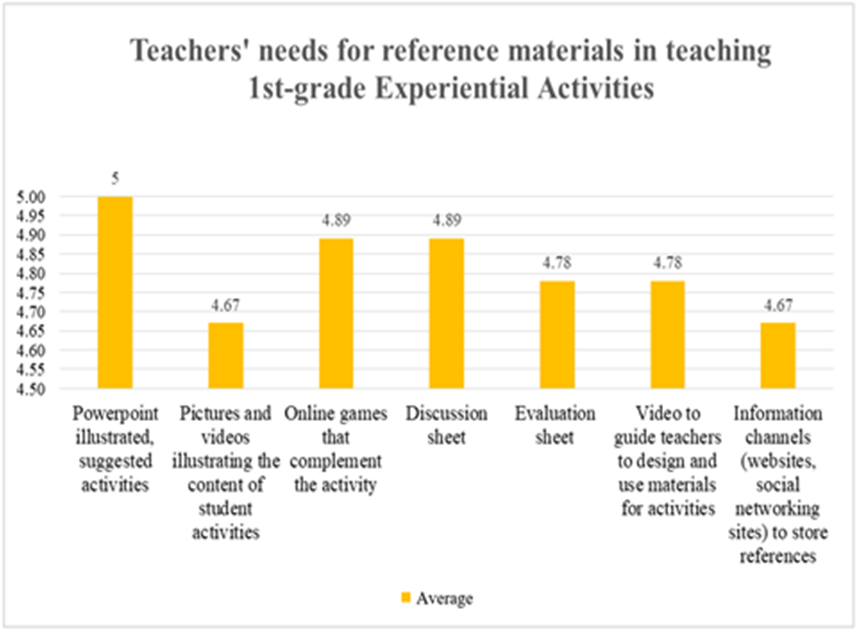
According to the survey results, it is necessary for a lot of teachers to use the Experiential Activities resource system. The types of references given are mostly within the needs of teachers in designing and organizing Grade 1 Experiential Activities (Figure 4).

In fact, creating a resource system for experiential activities is absolutely necessary for teachers, especially those who lack information technology capabilities. This support will contribute to reducing work pressure as well as increasing the quality of teaching Experiential activities. Therefore, it is necessary to build an Experiential Activity resource system.
2.3. Building a Resources System of First Grade Experiential ActivityBased on the requirements to be met in terms of quality, capacity, and content in the 2018 General Education Curriculum on Experiential Activities for Grade 1 and the results of the investigation of the actual organization of the Grade 1 Experiential Activities of teachers, we build a resource system of Grade 1 Experiential Activities to guide and support teachers in designing and organizing Experiential Activities; simultaneously, it contributes to enhancing the interest and cooperation between the family and the school to make the educational process more effective. The resource system is designed to be compatible with two types which are thematic educational activities and class meetings; and focuses on three content circuits that need to be met by grade 1 students, which are: self-directed activities, social-oriented activities and nature-oriented activities 11, 12, 13, 14, 15, 16.
For the most effective building and using a resource system, we offer some conditions for implementing teaching resources Experiential activities grade 1 as follows: Firstly, resources must ensure the realization of the educational goals of the 2018 General Education Curriculum Experiential Activities for Grade 1. Secondly, the content must be suitable to the psychological characteristics of 1st graders. Thirdly, the teaching aids included in the resource system need to be popular, easy to use, and safe for students. Fourthly, resources for assessment are required to base on student progress. Finally, for the maximum effective use of Experiential Activity resources, teachers need to meet certain competencies.
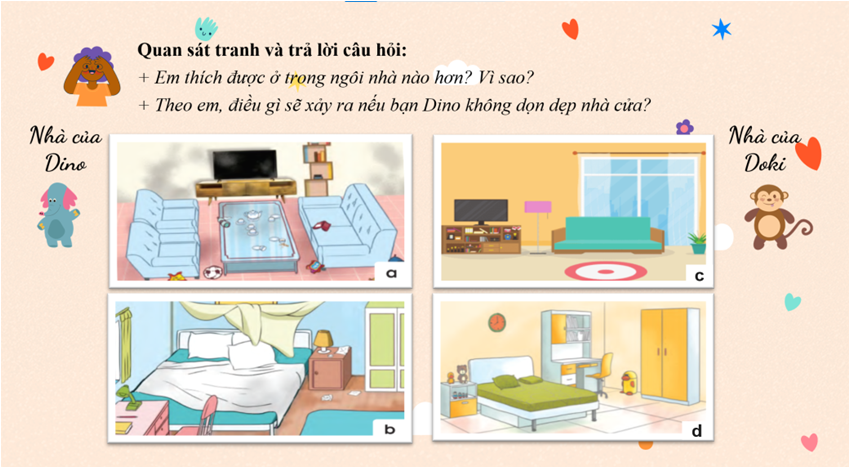
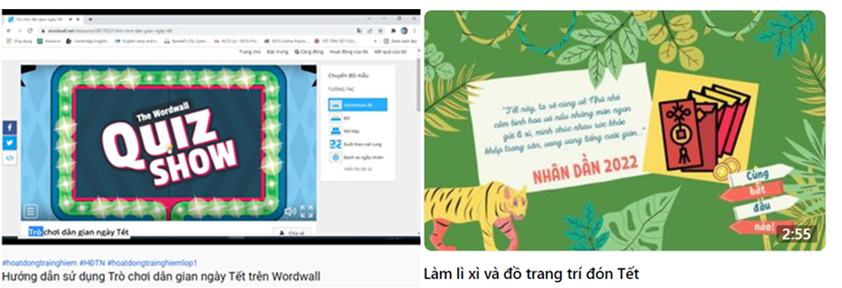
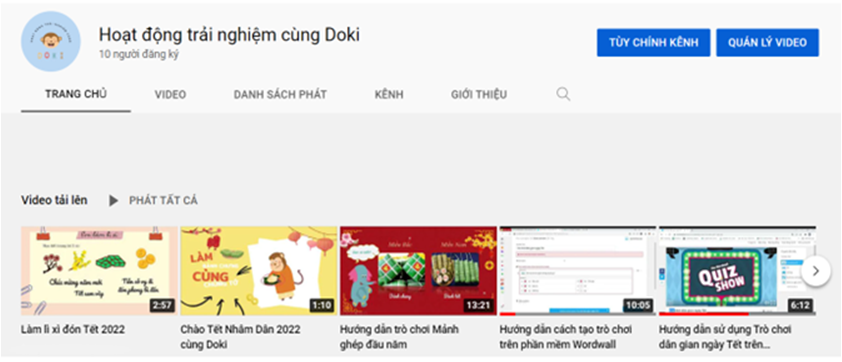
To increase the closeness and excitement for students, throughout the activities, we build a Doki monkey character with his friends: Tina bear, LiLy squirrel, and Dino elephant. Those characters accompany most teaching activities: Experiential activities in class and additional activities for self-study needs under the guidance of teachers and students' parents. Resources fall into two main categories: PowerPoint illustrating activities, teaching aids and learning materials (Figure 5); Additional videos for activities and instructions for using designing (Figure 6).


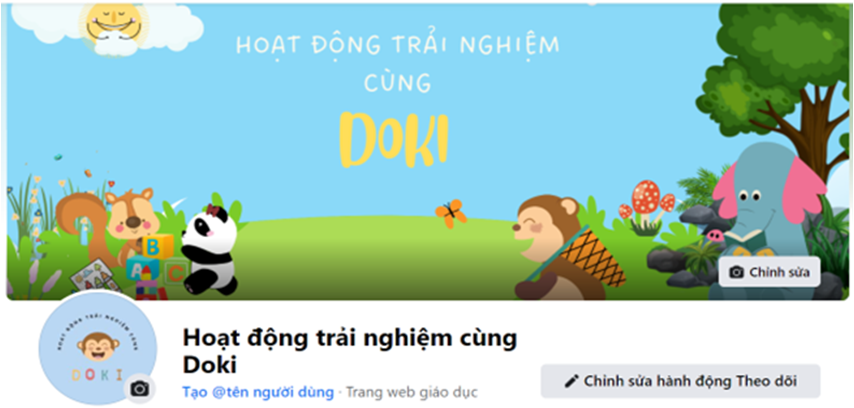
In order to store, update, and share various types of resources, we created a page of information on the social network Facebook "Experiential Activities with Doki". The content of posts on Fanpage includes PowerPoint illustrating activities, discussion sheets, evaluation sheets, videos of additional activities, etc. Those materials are creative, concretized, and guaranteed to meet the requirements of the Experiential Activities Curriculum for grade 1 (Figure 7).


To test the efficiency of the resource system Experiential Activities we organize experiments in 2 phases: exploratory experiment and impact experiment.
In the first phase, we conducted an exploratory experiment to evaluate the feasibility and effectiveness of using resources in the education of 1st grade Experiential Activities. Thereby, we offer appropriate adjustment measures in resource design.
In the second phase, we carried out an impact experiment to verify the feasibility and effectiveness of using resources in the education of grade 1 experiential activities. Thereby, we affirm the quality of resources and meet the research objective which is to improve the quality of teaching 1st Grade Experiential Activities.
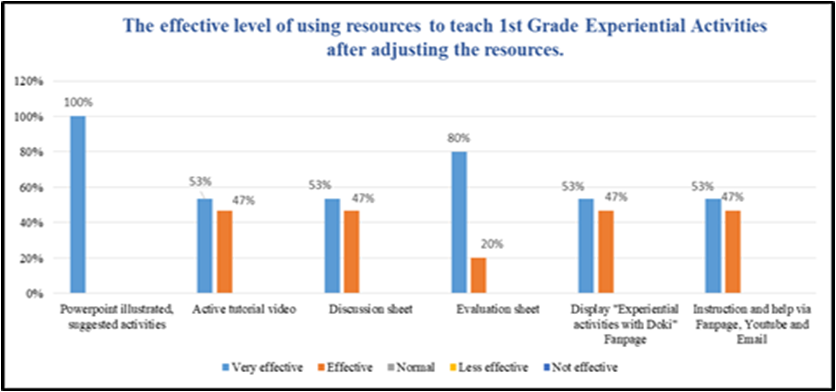
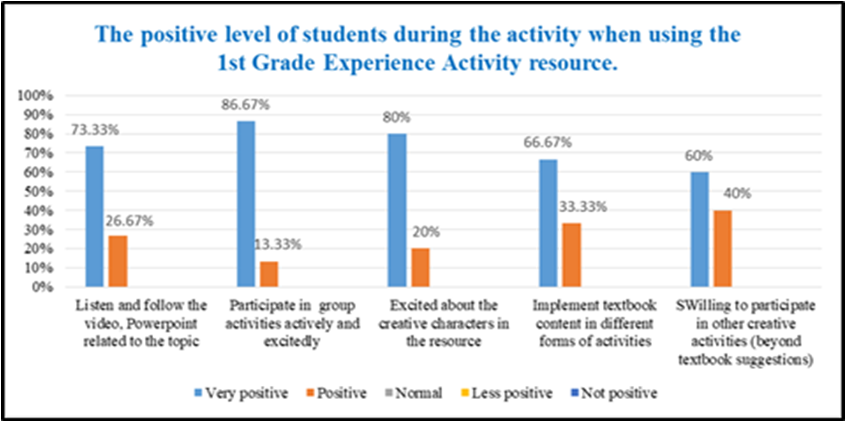
We get the result of the effective level of using resources to teach 1st Grade Experiential Activities and the positive levels of students after adjusting the resources (Figure 9 and Figure 10).


Based on the results of the above analysis, we concluded that the resources after being adjusted brought about positive changes for teachers and students when using them. Most teachers rate the resources at a very effective/very positive level. The most prominent feature is by combining the use of graphic design software (Adobe Illustrator, Photoshop, ...), Microsoft PowerPoint slideshow software and some other information channels that support image search in the design of companion characters and active content, resources in the form of PowerPoint illustrations, we suggest the content of the operation to achieve a maximum efficiency of 100%. This shows that our 1st Grade Experience Activity resource system is useful and feasible. Apart from proposing solutions to design the system of experiential activities in accordance with the requirements of the 2018 General Education Curriculum the psychological characteristics of students at the beginning of elementary school and meeting the needs of support for teachers' references, the resources also contributes to improving the quality of the organization of the 1st Grade Experiential Activities.
Through conducting research and experimentally evaluating the resources designed based on the requirements to be met in the program, it can be seen that the quality of experiential education in experimental schools has achieved certain results and achievements. Teachers can easily learn, create and organize activities suitable for their students by storing resources online in the form of soft copies on social networking sites Facebook and Youtube. Not only are students active and interested in participating in activities with PowerPoint illustrating the activities' content, videos, discussion sheets, evaluation sheets, and activity cards which are creative and attractive, but parents are willing to participate activities and evaluate with your child. In addition, students are self-directed learning under the guidance of teachers and parents. Furthermore, the use of resources helps promote investment in facilities and funds by local individuals and organizations to improve the quality of experiential education.
| [1] | D. A. Kolb. (1984). Experiential learning: Experience as the source of learning and development (2nd ed). Englewood Cliffs, New Jersey: Prentice - Hall. | ||
| In article | |||
| [2] | Vietnam Ministry of Education and Training. (2020). Circular 25/2020 dated August 26, 2020 stipulating the selection of textbooks in general education institutions (Thông tư 25/2020 ngày 26/8/2020 quy định việc lựa chọn sách giáo khoa trong cơ sở giáo dục phổ thông). | ||
| In article | |||
| [3] | Vietnam Department of Education and Training. (2019). Official Dispatch No.2323/DoETs-GE on Guidelines for the implementation of the content of Primary-level experiential activities in the 2018 General Education Program from the 2020-2021 school year (Công văn số 2323/SGDĐT-GDPT về Hướng dẫn thực hiện nội dung Hoạt động trải nghiệm cấp Tiểu học trong Chương trình giáo dục phổ thông 2018 từ năm học 2020 – 2021). | ||
| In article | |||
| [4] | Le Hoang Du. (August 2021). Actual situation of one year of teaching practice Experiential activities according to the 2018 General Education Program at Primary level (Thực trạng một năm thực hiện dạy học Hoạt động trải nghiệm theo Chương trình giáo dục phổ thông 2018 cấp Tiểu học). Retrieved from: http://thnguyendinhchieucm.edu.vn/4/30607/79262/360647/nghien-cuu-khoa-hoc/thuc-trang-mot-nam-thuc-hien-day-hoc-hoat-dong-trai-nghiem-theo-chuong-trinh-giao-duc-pho-thong-.aspx | ||
| In article | |||
| [5] | Nguyen Cam Chi. (2020). Developing capacity to organize experiential activities for elementary school teachers in Hanoi city to meet the new general education program (Phát triển năng lực tổ chức Hoạt động trải nghiệm cho giáo viên Tiểu học trên địa bàn thành phố Hà Nội đáp ứng chương trình giáo dục phổ thông mới), (pp.49-67). University of Education Publishing House. | ||
| In article | |||
| [6] | Pham Thi Kim Nhung. (2020). Managing experiential activities for students at primary schools in Thuy Nguyen district, Hai Phong city in the direction of developing collaborative capacity (Quản lý Hoạt động trải nghiệm cho học sinh tại các trường Tiểu học huyện Thủy Nguyên, thành phố Hải Phòng theo hướng phát triển năng lực hợp tác), (pp.43-63). University of Education Publishing House. | ||
| In article | |||
| [7] | Phan Thi Hanh Mai & Vu Thi Lan Anh. (2018). Psychology of elementary school students (Tâm lý học sinh tiểu học). University of Education Publishing House. | ||
| In article | |||
| [8] | Vietnam Ministry of Education and Training. (2018). General Education Curriculum Experiential Activities and Experiential activities, career guidance (Issued together with Circular No. 32/2018/Circular-MOET dated December 26, 2018 of the Vietnam Minister of Education and Training) (Chương trình Giáo dục phổ thông Hoạt động trải nghiệm và Hoạt động trải nghiệm, hướng nghiệp (Ban hành kèm theo Thông tư số 32/2018/TT-BGDĐT ngày 26 tháng 12 năm 2018 của Bộ trưởng Bộ Giáo dục và Đào tạo)). | ||
| In article | |||
| [9] | Communist Party of Vietnam Central Committee. (2013). Resolution No. 29/Resolution-Central dated November 4, 2013 on fundamental and comprehensive renovation of education and training, meeting the requirements of industrialization and modernization in the context of a market economy (Nghị quyết số 29/NQ-TW ngày 04/11/2013 về đổi mới căn bản, toàn diện giáo dục và đào tạo, đáp ứng yêu cầu công nghiệp hoá, hiện đại hoá trong điều kiện kinh tế thị trường). | ||
| In article | |||
| [10] | Pho Duc Hoa. (2020). Guidelines for organizing Grade 1 experiential activities according to the new general education program (Hướng dẫn tổ chức Hoạt động trải nghiệm lớp 1 theo Chương trình giáo dục phổ thông mới). University of Education Publishing House. | ||
| In article | |||
| [11] | Bui Ngoc Diep & Pho Duc Hoa. (2020). Experiential activities 1 (Hoạt động trải nghiệm 1) - B. Vietnam Education Publishing House. | ||
| In article | |||
| [12] | Bui Sy Tung. (2020). Experiential activities 1 (Hoạt động trải nghiệm 1). Vietnam Education Publishing House. | ||
| In article | |||
| [13] | Dang Vu Hoat, Pho Duc Hoa. (2011). Primary Education 1 (Giáo dục Tiểu học 1). Vietnam Education Publishing House. | ||
| In article | |||
| [14] | Dinh Thi Kim Thoa. (2020). Experiential activities 1 (Hoạt động trải nghiệm 1) - A. Vietnam Education Publishing House. | ||
| In article | |||
| [15] | Luu Thu Thuy. (2020). Experiential activities 1 (Hoạt động trải nghiệm 1). Vietnam Education Publishing House. | ||
| In article | |||
| [16] | Vu Quang Tuyen. (2020). Experiential activities 1 (Hoạt động trải nghiệm 1). Vietnam Education Publishing House. | ||
| In article | |||
Published with license by Science and Education Publishing, Copyright © 2022 Pho Duc Hoa, Nguyen Thi Hong Anh, Nguyen Ngoc Han, Nguyen Thi Thu Hien, Vu Thi Kim Lien and Bui Thi Kim Hue
 This work is licensed under a Creative Commons Attribution 4.0 International License. To view a copy of this license, visit
http://creativecommons.org/licenses/by/4.0/
This work is licensed under a Creative Commons Attribution 4.0 International License. To view a copy of this license, visit
http://creativecommons.org/licenses/by/4.0/
| [1] | D. A. Kolb. (1984). Experiential learning: Experience as the source of learning and development (2nd ed). Englewood Cliffs, New Jersey: Prentice - Hall. | ||
| In article | |||
| [2] | Vietnam Ministry of Education and Training. (2020). Circular 25/2020 dated August 26, 2020 stipulating the selection of textbooks in general education institutions (Thông tư 25/2020 ngày 26/8/2020 quy định việc lựa chọn sách giáo khoa trong cơ sở giáo dục phổ thông). | ||
| In article | |||
| [3] | Vietnam Department of Education and Training. (2019). Official Dispatch No.2323/DoETs-GE on Guidelines for the implementation of the content of Primary-level experiential activities in the 2018 General Education Program from the 2020-2021 school year (Công văn số 2323/SGDĐT-GDPT về Hướng dẫn thực hiện nội dung Hoạt động trải nghiệm cấp Tiểu học trong Chương trình giáo dục phổ thông 2018 từ năm học 2020 – 2021). | ||
| In article | |||
| [4] | Le Hoang Du. (August 2021). Actual situation of one year of teaching practice Experiential activities according to the 2018 General Education Program at Primary level (Thực trạng một năm thực hiện dạy học Hoạt động trải nghiệm theo Chương trình giáo dục phổ thông 2018 cấp Tiểu học). Retrieved from: http://thnguyendinhchieucm.edu.vn/4/30607/79262/360647/nghien-cuu-khoa-hoc/thuc-trang-mot-nam-thuc-hien-day-hoc-hoat-dong-trai-nghiem-theo-chuong-trinh-giao-duc-pho-thong-.aspx | ||
| In article | |||
| [5] | Nguyen Cam Chi. (2020). Developing capacity to organize experiential activities for elementary school teachers in Hanoi city to meet the new general education program (Phát triển năng lực tổ chức Hoạt động trải nghiệm cho giáo viên Tiểu học trên địa bàn thành phố Hà Nội đáp ứng chương trình giáo dục phổ thông mới), (pp.49-67). University of Education Publishing House. | ||
| In article | |||
| [6] | Pham Thi Kim Nhung. (2020). Managing experiential activities for students at primary schools in Thuy Nguyen district, Hai Phong city in the direction of developing collaborative capacity (Quản lý Hoạt động trải nghiệm cho học sinh tại các trường Tiểu học huyện Thủy Nguyên, thành phố Hải Phòng theo hướng phát triển năng lực hợp tác), (pp.43-63). University of Education Publishing House. | ||
| In article | |||
| [7] | Phan Thi Hanh Mai & Vu Thi Lan Anh. (2018). Psychology of elementary school students (Tâm lý học sinh tiểu học). University of Education Publishing House. | ||
| In article | |||
| [8] | Vietnam Ministry of Education and Training. (2018). General Education Curriculum Experiential Activities and Experiential activities, career guidance (Issued together with Circular No. 32/2018/Circular-MOET dated December 26, 2018 of the Vietnam Minister of Education and Training) (Chương trình Giáo dục phổ thông Hoạt động trải nghiệm và Hoạt động trải nghiệm, hướng nghiệp (Ban hành kèm theo Thông tư số 32/2018/TT-BGDĐT ngày 26 tháng 12 năm 2018 của Bộ trưởng Bộ Giáo dục và Đào tạo)). | ||
| In article | |||
| [9] | Communist Party of Vietnam Central Committee. (2013). Resolution No. 29/Resolution-Central dated November 4, 2013 on fundamental and comprehensive renovation of education and training, meeting the requirements of industrialization and modernization in the context of a market economy (Nghị quyết số 29/NQ-TW ngày 04/11/2013 về đổi mới căn bản, toàn diện giáo dục và đào tạo, đáp ứng yêu cầu công nghiệp hoá, hiện đại hoá trong điều kiện kinh tế thị trường). | ||
| In article | |||
| [10] | Pho Duc Hoa. (2020). Guidelines for organizing Grade 1 experiential activities according to the new general education program (Hướng dẫn tổ chức Hoạt động trải nghiệm lớp 1 theo Chương trình giáo dục phổ thông mới). University of Education Publishing House. | ||
| In article | |||
| [11] | Bui Ngoc Diep & Pho Duc Hoa. (2020). Experiential activities 1 (Hoạt động trải nghiệm 1) - B. Vietnam Education Publishing House. | ||
| In article | |||
| [12] | Bui Sy Tung. (2020). Experiential activities 1 (Hoạt động trải nghiệm 1). Vietnam Education Publishing House. | ||
| In article | |||
| [13] | Dang Vu Hoat, Pho Duc Hoa. (2011). Primary Education 1 (Giáo dục Tiểu học 1). Vietnam Education Publishing House. | ||
| In article | |||
| [14] | Dinh Thi Kim Thoa. (2020). Experiential activities 1 (Hoạt động trải nghiệm 1) - A. Vietnam Education Publishing House. | ||
| In article | |||
| [15] | Luu Thu Thuy. (2020). Experiential activities 1 (Hoạt động trải nghiệm 1). Vietnam Education Publishing House. | ||
| In article | |||
| [16] | Vu Quang Tuyen. (2020). Experiential activities 1 (Hoạt động trải nghiệm 1). Vietnam Education Publishing House. | ||
| In article | |||