The purpose of the paper is to achieve relative error changes of influence coefficients based on the number of Gaussian points and relative error changes of ux and uy according to x and y using boundary element method (BEM) and constant elements. In this case, the dominant equation is Laplace’s equation defined for a rectangular domain with the Dirichlet boundary condition. The boundaries of the domain will first be discretization with four constant element and four boundary conditions will be introduce in MATLAB and then four Neumann boundary conditions will be gain. Afterwards, four influence coefficients have been obtained regarding the source point within the domain and first element analytical and numerical and their relative error has been computed. Finally, ux and uy values in four points toward x and three points toward y within the domain have been computed analytical and numerical and the results have been Presented in schemes and tables.
In mathematics, PDE is a differential equations involving functions and their partial derivatives. PDEs are used to formulate problems involving functions of several variables, and are either solved by hand, or used to create a relevant computer model. PDEs can be used to describe a wide variety of phenomena such as sound, heat, electrostatics, electrodynamics, fluid flow, elasticity, or quantum mechanics. These seemingly distinct physical phenomena can be formalized similarly in terms of PDEs. Just as ordinary differential equations often model one-dimensional dynamical systems, partial differential equations often model multi-dimensional systems. PDEs find their generalization in stochastic partial differential equations 1. Laplace's equation is the simplest form of elliptic PDEs. Due to simplicity and appropriate accuracy of Laplace's equation, it is used in different physical and engineering problem such as fluid dynamic 2, elasto-static 3, controls and vibrations 4 and heat transfer 5. Potential theory is the general theory to solve of Laplace's equation. Moreover, solutions of Laplace's equation are harmonic functions. Many researches are addressed different method for solving Laplace’s equation under various boundary conditions 6, 7, 8, 9. For example, Laplace’s equation can be solved by separation of variables methods 10.
The Boundary Element Method (BEM) constitutes a technique for analyzing the behavior of mechanical systems and especially of engineering structures subjected to external loading. The term loading is used here in the general sense, referring to the external source which produces a non-zero field function that describes the response of the system (temperature field, displacement field, stress field, etc.), and it may be heat, surface tractions, body forces, or even non homogeneous boundary conditions, e. g. support settlement. Since its beginnings in the 1960s, the boundary element method (BEM) has become a well-established numerical technique which provides an efficient alternative to the finite difference and finite element method for solving a variety of engineering problems 11. The classical BEM considered in this work requires a fundamental solution to the governing differential equation (here the Laplace equation) in order to obtain an equivalent boundary integral equation. Regarding homogeneous potential problems, BEMs have the following advantages 12.
The integral equation may be regarded as an exact solution of the governing partial differential equation. The boundary element method attempts to use the given boundary conditions to fit boundary values into the integral equation, rather than values throughout the space defined by a partial differential equation. Once this is done, in the post-processing stage, the integral equation can then be used again to calculate numerically the solution directly at any desired point in the interior of the solution domain 13.
Types of element in BEM include variety of choices regarding order of the polynomial that defines them. Studying linear element is the first step in implementing higher order elements in BEM. It will be said that deriving the equations in linear element complies with the concept of constant element in many ways 14.
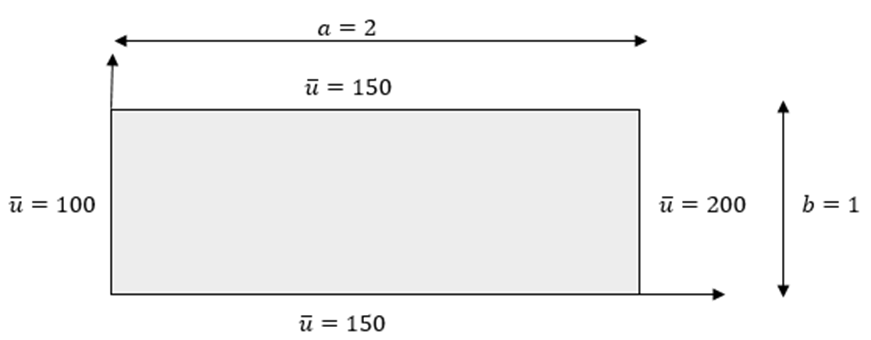
The Laplace equation and boundary conditions (Figure 1) are defined as follows:
 | (1) |
Boundary Condition:  .
.

The boundaries  until
until  is discretized into 4 constant elements, which are numbered in the counter-clockwise sense. The values of the boundary quantity u and its normal derivative
  (denoted also as
  ) are assumed constant over each element and equal to their value at the mid-point of the element. The values of
  are calculated in MATLAB program as follows:
 |
The discretized form of boundary integral equation is expressed for a given point  on Г as:
 | (2) |
Where  is the segment (straight line) on which the j-th node is located and over which integration is carried out, and
  is the nodal point of the i-th element. For constant elements, the boundary is smooth at the nodal points, hence ε(P)=½. Moreover, the values of u and
  are constant on each element, so they can be moved outside the integral.
With  and
and  that are the values of u and
  on j-th element, the boundary integral equation was written as follows:
 | (3) |
The integrals involved in the above equation relate the node  , where the fundamental solution is applied, to the node
  (j = 1, 2… N). their values express the contribution of the nodal values
  and
and  to the formation of the value
  . For this reason, they are often referred to as influence coefficients. These coefficients are denoted by
  and
and  which are defined as:
 | (4) |
The partial derivatives  and
and  (the quantity rate along x and y inside the domain) can be evaluated at points within
  by direct differentiation for ε (P) = 1. Since the fundamental solution and its derivatives are continuous functions of x and y, the differentiation passes under the integral sign giving:
 | (5) |
 | (6) |
Equations (5) and (6) are discretized in the same way as Eq. (1) and they yield the following expressions for the evaluation of the derivatives  and
and  at point P(x , y) as follows:
 | (7) |
 | (8) |
Where the influence coefficients are given by the integrals:
 | (9) |
 | (10) |
In this section, at first we calculate the values of influence coefficients in three points out of first element, along first element and on first element by two analytical and numerical methods for different Gaussian points then the values of relative error for any point was obtained.
For this purpose, the point  located in the domain, we transmit from the global coordinates (x, y) to local coordinates (
 ,
,  ). (-1 ≤
  ≤ 1).
≤ 1).
Then, the integrand values of equations (9) and (10) for all of source points were calculated. So with the help of following relationships, analytical solutions of 
 and
and  were extracted as follows:
 |
 |
 |
 |
As the same way, the values of influence coefficients were calculated for source points  and
and  . Then, the relative error was calculated for each source point by following relationship:
 | (11) |
Finally, relative errors of source points were extracted for different Gaussian points and the results are presented in Table 1, Table 2 and Table 3 as follows:
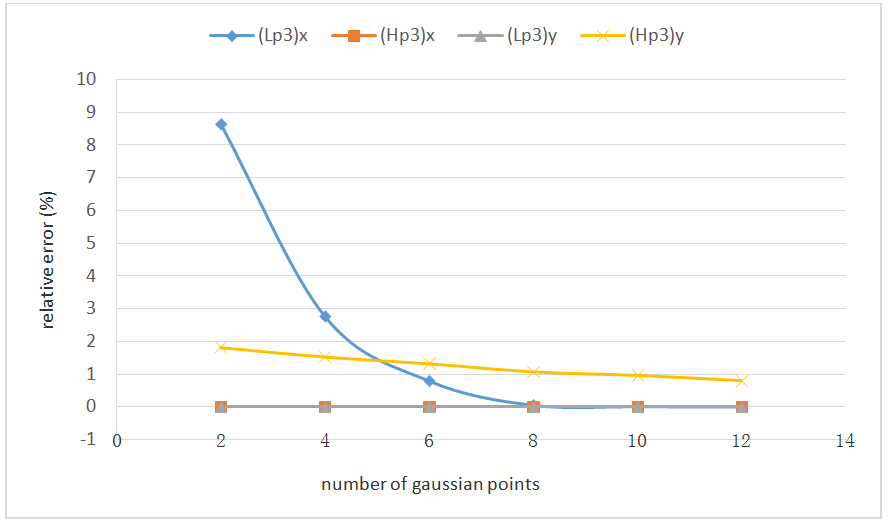
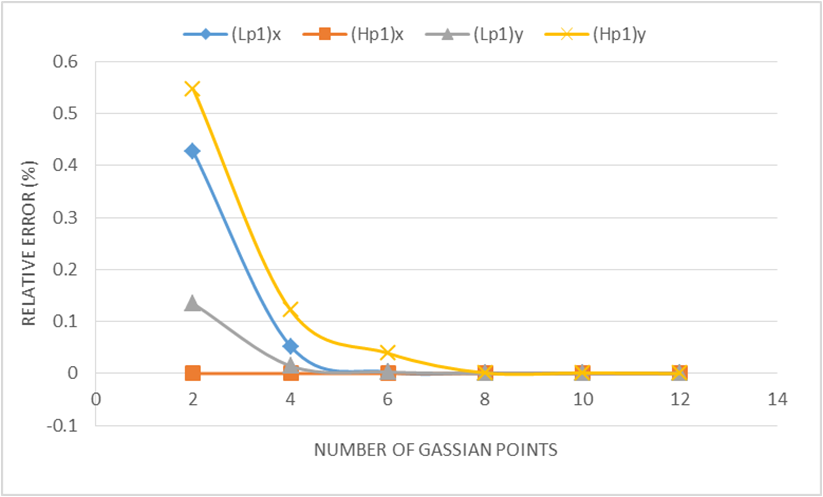
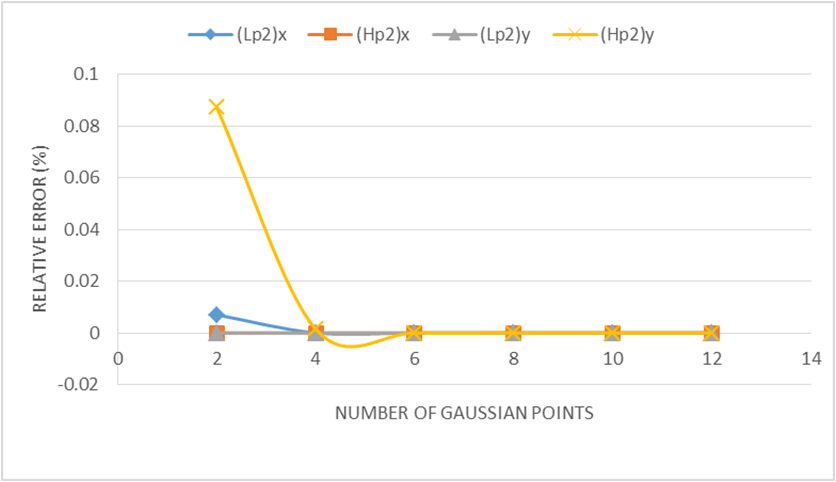
Thus, changes of the relative error of influence coefficients according to number of Gaussian points ( ) are shown in Figure 2, Figure 3 and Figure 4 at different field points as follows:


Figure 2, Figure 3 and Figure 4 are shown the relative errors for the integrals of the  ,
,  ,
,  and
and  for different Gaussian point numbers. With increasing the Gaussian point numbers, the error is diminished.
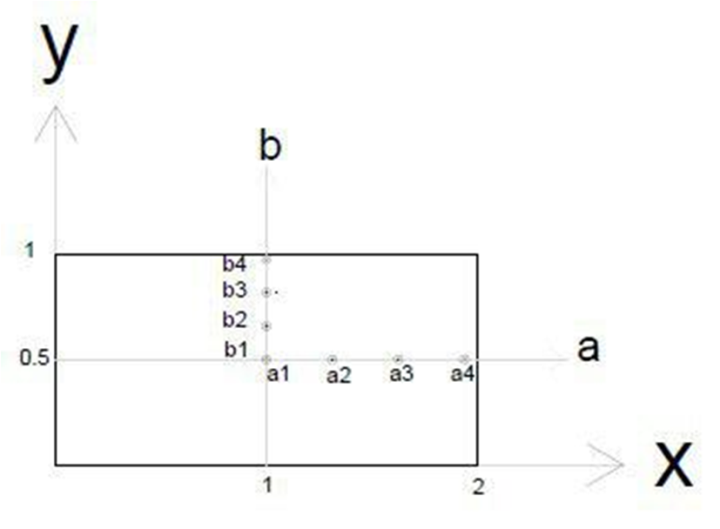
In this section, four points were considered along x-axis and three points along y-axis inside the rectangular domain as shown in Figure 5. Coordinates of the points are defined as follows:
Along x-axis:
 |
Along y-axis:
 |

The values of  and
and  for each point were calculated using the relationships of (7), (8), (9) and (10) and boundary conditions of the problem
  with two analytical and numerical methods. Then, at first the values of
  and
and  were calculated at any point in analytical method. This means that any point within the domain
  was considered as the source point for each element and influence coefficients are calculated separately for each of the 4 element. As a result, obtained 16 influence coefficients for each element. For example,
  and
and  at
at  are calculated as follows:
 |
 |
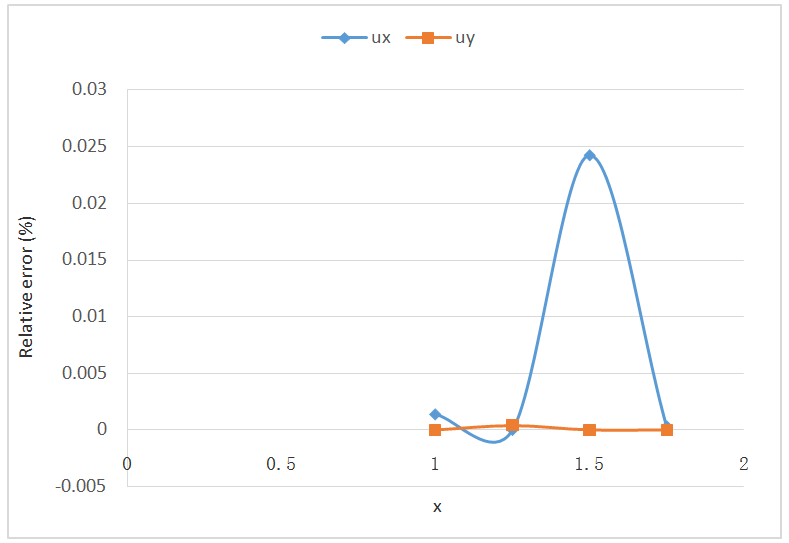
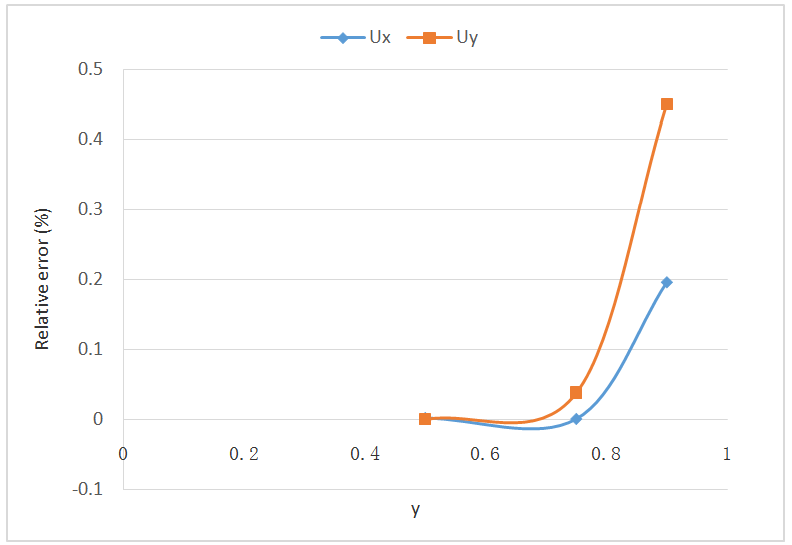
Then, other points are calculated in the same way. Finally, all the values obtained from both analytical and numerical methods as well as the relative error of these two methods are presented in Table 4 and Table 5. Also, corresponding these data are shown in Figure 6 and Figure 7.


Figure 6 and Figure 7 are shown the relative errors for the integrals of the  and
and  inside the domain when x and y is changed. With increasing x, the error at first is diminished then it’s increased and finally is decreased. With increasing y, the error is increased.
In this paper,we calculate relative error changes of influence coefficients based on the number of Gaussian points and relative error changes of  and
and  according to x and y for a rectangular domain with Dirichlet boundary conditions by BEM. The results described in the previous section in summery listed in Table 6 and Table 7 as follows:
| [1] | Myint-U T., Debnath L., Linear Partial Differential Equations for Scientists and Engineers, Fourth edition, 2007 Birkhauser Boston. | ||
| In article | PubMed | ||
| [2] | Blazek, Jiri. Computational fluid dynamics: principles and applications. Butterworth-Heinemann, 2015. | ||
| In article | View Article | ||
| [3] | Haitao, Wang, and Yao Zhenhan. “Application of a new fast multipole BEM for simulation of 2D elastic solid with large number of inclusions.” Acta Mechanica Sinica 20, no. 6 (2004): 613-622. | ||
| In article | View Article | ||
| [4] | Li, Guo-Qing, Xing-Yuan Miao, Yuan-Tai Hu, and Ji Wang. “Analysis of smart beams with Piezoelectric elements using impedance matrix and inverse Laplace transform.” Smart Materials and Structures 22, no. 11 (2013): 115001. | ||
| In article | View Article | ||
| [5] | Tarasov, Vasily E. “Heat transfer in fractal materials.” International Journal of Heat and Mass Transfer 93 (2016): 427-430. | ||
| In article | View Article | ||
| [6] | Smith, Gordon D. Numerical solution of partial differential equations: finite difference methods. Oxford university press, 1985. | ||
| In article | View Article | ||
| [7] | Chen, J. T., S. R. Lin, and K. H. Chen. “Degenerate scale problem when solving Laplace's equation by BEM and its treatment.” International Journal for Numerical Methods in Engineering 62, no. 2 (2005): 233-261. | ||
| In article | View Article | ||
| [8] | Peaceman, Donald W., and Henry H. Rachford, Jr. “The numerical solution of parabolic and elliptic differential equations.” Journal of the Society for industrial and Applied Mathematics 3, no. 1 (1955): 28-41. | ||
| In article | View Article | ||
| [9] | K. Gerdes and L. Demkowicz, “Solution of 3D-Laplace and Helmholtz equations in exterior domains using hp-infinite elements,” Computer Methods in Applied Mechanics and Engineering, Vol-137, Issue 3-4, November 1996. | ||
| In article | View Article | ||
| [10] | Kalnins, E. “On the Separation of Variables for the Laplace Equation Δψ+K^2ψ=0 in Two-and Three-Dimensional Minkowski Space.” SIAM Journal on Mathematical Analysis 6, no. 2 (1975): 340-374. | ||
| In article | View Article | ||
| [11] | Brebbia, C. (1982). Boundary element methods in engineering, Springer New York, NY, USA. | ||
| In article | View Article PubMed | ||
| [12] | Brebbia, C.A., Dominguez J.: (1989). Boundary Elements-An Introductory course, McGraw-Hill. | ||
| In article | View Article | ||
| [13] | Katsikadelis, J. T., The Boundery Element Method for Engineers and Scientists, Elsevier publication, 2016. | ||
| In article | |||
| [14] | Ghassemi, H. and A. Ahani, Solving the Quantity Element Using New Numerical Techniques on the Discontinues Boundary Element Method. American Journal of Applied Mathematics and Statistics, 2017. 5(1): p. 14-21. | ||
| In article | View Article | ||
 This work is licensed under a Creative Commons Attribution 4.0 International License. To view a copy of this license, visit
http://creativecommons.org/licenses/by/4.0/
This work is licensed under a Creative Commons Attribution 4.0 International License. To view a copy of this license, visit
http://creativecommons.org/licenses/by/4.0/
| [1] | Myint-U T., Debnath L., Linear Partial Differential Equations for Scientists and Engineers, Fourth edition, 2007 Birkhauser Boston. | ||
| In article | PubMed | ||
| [2] | Blazek, Jiri. Computational fluid dynamics: principles and applications. Butterworth-Heinemann, 2015. | ||
| In article | View Article | ||
| [3] | Haitao, Wang, and Yao Zhenhan. “Application of a new fast multipole BEM for simulation of 2D elastic solid with large number of inclusions.” Acta Mechanica Sinica 20, no. 6 (2004): 613-622. | ||
| In article | View Article | ||
| [4] | Li, Guo-Qing, Xing-Yuan Miao, Yuan-Tai Hu, and Ji Wang. “Analysis of smart beams with Piezoelectric elements using impedance matrix and inverse Laplace transform.” Smart Materials and Structures 22, no. 11 (2013): 115001. | ||
| In article | View Article | ||
| [5] | Tarasov, Vasily E. “Heat transfer in fractal materials.” International Journal of Heat and Mass Transfer 93 (2016): 427-430. | ||
| In article | View Article | ||
| [6] | Smith, Gordon D. Numerical solution of partial differential equations: finite difference methods. Oxford university press, 1985. | ||
| In article | View Article | ||
| [7] | Chen, J. T., S. R. Lin, and K. H. Chen. “Degenerate scale problem when solving Laplace's equation by BEM and its treatment.” International Journal for Numerical Methods in Engineering 62, no. 2 (2005): 233-261. | ||
| In article | View Article | ||
| [8] | Peaceman, Donald W., and Henry H. Rachford, Jr. “The numerical solution of parabolic and elliptic differential equations.” Journal of the Society for industrial and Applied Mathematics 3, no. 1 (1955): 28-41. | ||
| In article | View Article | ||
| [9] | K. Gerdes and L. Demkowicz, “Solution of 3D-Laplace and Helmholtz equations in exterior domains using hp-infinite elements,” Computer Methods in Applied Mechanics and Engineering, Vol-137, Issue 3-4, November 1996. | ||
| In article | View Article | ||
| [10] | Kalnins, E. “On the Separation of Variables for the Laplace Equation Δψ+K^2ψ=0 in Two-and Three-Dimensional Minkowski Space.” SIAM Journal on Mathematical Analysis 6, no. 2 (1975): 340-374. | ||
| In article | View Article | ||
| [11] | Brebbia, C. (1982). Boundary element methods in engineering, Springer New York, NY, USA. | ||
| In article | View Article PubMed | ||
| [12] | Brebbia, C.A., Dominguez J.: (1989). Boundary Elements-An Introductory course, McGraw-Hill. | ||
| In article | View Article | ||
| [13] | Katsikadelis, J. T., The Boundery Element Method for Engineers and Scientists, Elsevier publication, 2016. | ||
| In article | |||
| [14] | Ghassemi, H. and A. Ahani, Solving the Quantity Element Using New Numerical Techniques on the Discontinues Boundary Element Method. American Journal of Applied Mathematics and Statistics, 2017. 5(1): p. 14-21. | ||
| In article | View Article | ||


 with ng)
 with ng)
 with ng)
 with ng)
 with ng)
 with ng)