This study assessed cashew farmers’ perceptions of climate risks and their adaptation strategies in the municipality of Tchaourou. Data were collected through structured interviews with 163 farmers across seven districts (Alafiarou, Bétérou, Goro, Kika, Sanso, Tchaourou, and Tchatchou). The survey focused on identifying predominant climate risks, their perceived impacts on yields, and the adaptation measures employed. Correspondence Analysis (CA) was applied to explore the district-specific relationships between types of climate risks and their effects. Cashew farmers identified erratic rainfall, increasing temperatures, prolonged Harmattan seasons, and frequent drought events as the main climate risks. These were reported to cause soil degradation, the emergence of new diseases, a reduction in nut quality, and yield losses. The CA revealed a spatially heterogeneous distribution of these impacts across the districts. In response, cashew farmers have adopted various adaptation strategies. The most prevalent practices include post-rainy-season plowing and mowing, thinning, intercropping with food crops, and pruning. Plowing and mowing were highlighted as the primary strategies for mitigating soil evaporation and reducing competition for water and nutrients. Overall, this study provides a critical empirical foundation for developing targeted interventions aimed at optimizing water management and enhancing climate resilience within Benin’s vital cashew sector.
Africa is a continent with relatively low greenhouse gas emissions, yet it is among the regions in the world most vulnerable to the impacts of climate change 1. These disturbances lead to significant changes in key climatic parameters, including temperature, relative humidity, vapor pressure 2, and rainfall patterns 3.
Global data trends since 1970 indicate that anthropogenic warming has likely caused observable impacts on various biophysical systems. Observations across all continents and most oceans demonstrate that many natural systems are affected by regional climate change, notably rising temperatures 4. Knowledge of these impacts reveals that affected areas are diverse, and projections of future consequences are of serious concern. These include freshwater resources and their management, ecosystems, agriculture (including fibers and forest products), coastal systems and lowland regions, and the health sector 5.
Like most of Sub-Saharan countries, Benin remains vulnerable to the adverse effects of climate change 1. In the country, agriculture forms the backbone of the economy, contributing between 25% and 33% to Gross Domestic Product (GDP) and between 75% and 80% to export earnings depending on the year and data sources 6, 7, 8, 9. For this reason, the negative impacts of climate change on agricultural systems have been widely documented 10. These impacts are manifested as seasonal disruptions, crop failure, and crop flooding resulting in production losses, higher food prices, and food insecurity, highlighting the need to integrate these climatic hazards into agricultural development policies 11. Both staple crops and cash crops are vulnerable to these climate change impacts. 3, for example, reported that climate change affect cashew plantations, and contribute to the decline in cashew nut yields in Benin. It is therefore essential for stakeholders in the agricultural sector to be fully aware of the effects of climate change, both observed and projected 12.
Cashew (Anacardium occidentale) is an economically important crop for Benin, contributing significantly to both producers’ incomes and the national economy 13. The crop provides multiple opportunities at national and international levels 14. In Benin, cashew plantations are mainly concentrated in the departments of Donga, Collines, Borgou, and Atacora 15. It is the second largest agricultural export product after cotton 13, yet it remains highly exposed to the impacts of climate change 3. Owing to the expansion of the cashew sector, Benin is now among the top ten producers globally and ranks third in Africa in cashew nut production 16, 17. In 2023, national production was estimated at 203,844 tonnes, with an average yield of 4.75 kg per tree 18. The sector accounted for 8% of total export value, 7% of the agricultural GDP, 3% of the national GDP 13, 19, and 15% of national export revenues 16. According to the 2019 National Agricultural Census, Benin had approximately 168,318 producers managing 346,155 ha of cashew plantations 20. The municipality of Tchaourou, the leading producer nationally 15, actively contributed to this growth. In 2021, cashew plantations in Tchaourou covered approximately 26,106 ha, making cashew the most extensively cultivated crop in the municipality.
The cashew sector has experienced significant growth. However, climatic variability continues to undermine these benefits, resulting in reduced cashew yields, despite governmental efforts through the Government Action Program to support the sector 21, 22. Several factors contribute to this variability, particularly adverse weather conditions. Cashew farmers frequently report climate variability as a major challenge during workshops and meetings 23, emphasizing the need for in-depth investigations to improve sector management and sustainability 23. Previous studies have examined farmers’ perceptions of climate change impacts on agriculture 3, 24, 25, 26. However, identifying the specific climate risks affecting the cashew sector, in relation to farmers’ perceptions and the adaptation strategies they implement across different geographic locations, remains essential for guiding the Beninese Government in its sustainable development initiatives, both for the sector as a whole and specifically for the municipality of Tchaourou. Furthermore, the development of a sustainable water management program in cashew farming requires a socio-demographic profiling of farmers’ perceptions and the strategies they use to cope with climate risks. This study aims to examine the ethno-climatic perceptions of cashew farmers and the adaptation strategies they employ.
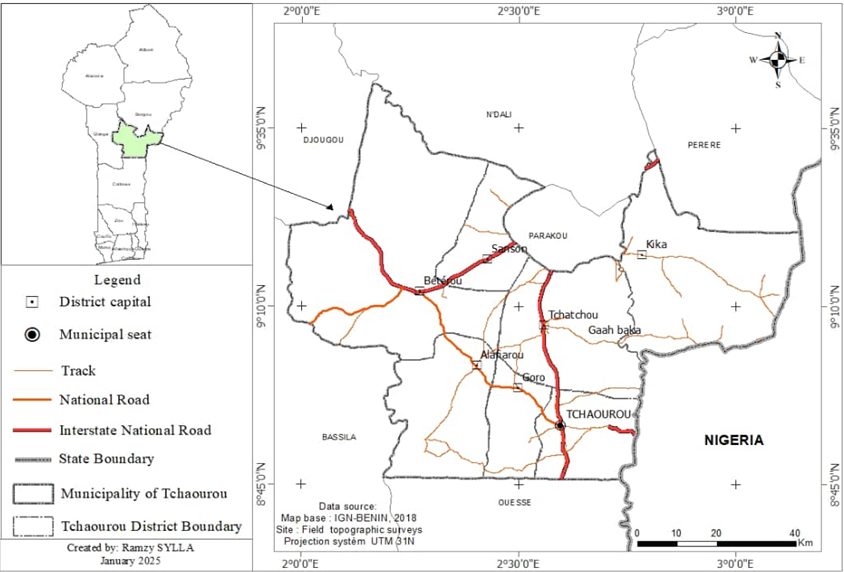
The municipality of Tchaourou, located in the Borgou Department (Figure 1), is the largest municipality in Benin, covering an area of 7,256 km², which represents approximately 6.5% of the national territory 27. It lies between 8°45' and 9°20' North latitude and 2°10' and 3°40' East longitude. Tchaourou is bordered to the north by the municipalities of Parakou, Pèrèrè, and N'Dali, to the south by Ouèssè, to the east by the Federal Republic of Nigeria, and to the west by Bassila and Djougou.
Administratively, the municipality is divided into seven districts: Alafiarou, Bétérou, Goro, Kika, Sanson, Tchaourou, and Tchatchou.
Economically, the municipality’s potential sources of income include quarrying, commercial, artisanal, and agricultural activities. It also hosts a cashew processing plant, AFOKANTAN Benin Cashew, with a capacity of 2,000 tons per year 22.
Climatically, the municipality experiences a Sudanese South climate characterized by two distinct seasons: a rainy season with an annual cumulative rainfall ranging from 1,100 to 1,200 mm, and a dry season lasting 5 to 6 months 28, 29, 30. Average monthly temperatures vary between 20 and 38°C.

From a pedological perspective, the municipality’s soils are predominantly tropical ferruginous with weak concretions. The hydrographic network is mainly composed of tributaries of the Ouémé River, which drain most of the municipality’s districts and support the development of fishing activities.
At the human level, the municipality of Tchaourou is home to a diverse range of ethnic groups 31, the most dominant being the Bariba (34.2%), the Fulani (18.9%), and the Nagot (15.8%). These major groups coexist with other minority groups, including the Otamari (12.9%), the Yom-Lokpa (10.9%), as well as the Fons and Adja (4%).
2.2. Survey DataThe data collected for this study pertain to ethno-climatic information, including cashew farmers’ perceptions of climate risks and their adaptation strategies. To this end, a survey based on structured interviews was carried out in the seven previously described districts of the study area. The sample size was determined using the formula proposed by 32:
 | (1) |
where: (i) n denotes the sample size; (ii) Z is the critical value for a 95% confidence interval (Z = 1.96, according to the normal distribution table); (iii) p represents the proportion of cashew farmers who perceived the effects of climate change on cashew farming; and (iv) d is the margin of estimation error, set at 5% in this study following the recommendations of 32 for agronomic research. In the exploratory phase, nearly 88% of surveyed farmers indicated perceiving an impact of climate change on cashew farming, from which the value of p was derived. Based on these results, a total of 163 cashew farmers were selected and distributed across the seven districts, as presented in Table 1.
The questionnaire, administered to respondents aged 18–60 years, covered four main themes: (i) sociocultural and demographic characteristics of cashew farmers; (ii) constraints in cashew farming; (iii) the perceived effects of climate change; and (iv) the adaptation strategies employed in response. The age range of 18–60 years was selected to ensure that respondents were both legally eligible and actively engaged in farming, and directly involved in cashew production, thereby providing reliable insights into farmers’ perceptions of climate risks and the strategies they implement to cope with them.
The dataset was primarily processed in Excel 2016 to generate tables and graphs. Statistical analyses were conducted in R version 4.4.2 33. Correspondence Analysis (CA) was applied to explore the relationships between the identified types of climate change and their effects on cashew farming.
The study results reveal that the average age of cashew farmers is 37 years, ranging from 22 to 58 years. The heads of cashew-producing households in Tchaourou municipality are men, which can be explained by local tradition, in which the management of cashew farms is passed down through the male lineage.
In terms of ethnicity, the Bariba constitute the majority group, representing approximately 61% of respondents, followed by the Nagot with roughly 23% (Table 2). Other ethnic groups represent only a small proportion, with Bariba and Nagot together accounting for 84% of the surveyed farmers. This distribution reflects the ethnic composition of Tchaourou municipality, which is predominantly Bariba and Nagot, as reported in the Fourth General Population and Housing Census of 2013 31.
Table 3 presents the distribution of respondents by religion. Analysis of the table shows that the surveyed heads of household belong to diverse religious congregations, with Muslims accounting for approximately 77%, Christians for 23%, and practitioners of traditional religions for 1%. These findings highlight the predominance of Islam in Tchaourou municipality.
Table 4 presents the distribution of respondents by educational attainment. The analysis highlights that educational attainment among respondents in Tchaourou municipality varies across cashew nut farmers. Approximately 45% of respondents have no formal education (i.e., are illiterate), while 35% have attained primary education, 14% secondary education, and 6% higher education. These results indicate that slightly over half of the respondents (55%) have received some level of education. This constitutes a valuable finding for understanding cashew farmers’ perceptions of climate risks.
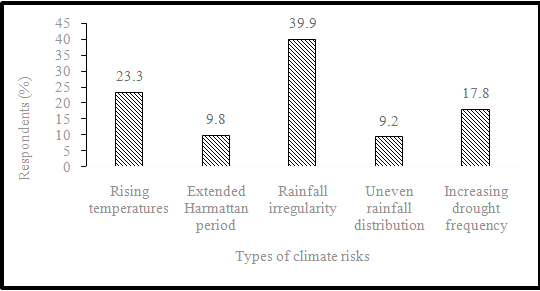
This fourth section of the results presents, first, cashew farmers’ perceptions of different types of climate risks, then the perceived effects of these risks on cashew farming, and finally the relationship between districts, types of climate risks, and their impacts on production. The perceived types of climate risks identified in the survey are illustrated in Figure 2.
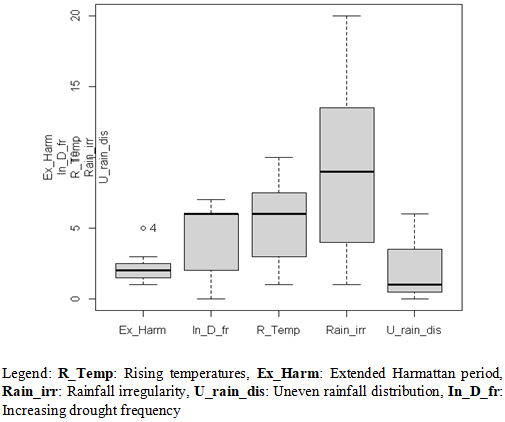
The box plot in Figure 3 confirms farmers’ perceptions of the identified climate risks and highlights their relative importance. Rainfall irregularity emerges as the most critical factor, with high variability indicating that farmers perceive this risk most strongly. Rising temperatures and increasing drought frequency display moderate dispersion, suggesting that these risks are perceived as moderately important. In contrast, uneven rainfall distribution and an extended Harmattan period show low variability, indicating that these risks are perceived as less important by cashew farmers.
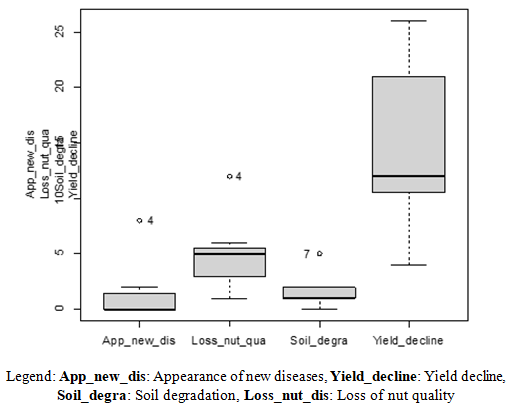
Figure 4 illustrates the perceived effects of climate risks identified by cashew farmers. Overall, 64% of respondents reported reduced yield as the most frequently perceived effect, followed by a decline in nut quality at harvest (35%). Other farmers (14%) reported that climate risks cause new diseases and soil degradation around cashew trees. Yield reduction remains the most frequently perceived effect. In contrast, new diseases and soil degradation show low variability, indicating that farmers perceive these effects as minor. Loss of nut quality shows moderate variability, suggesting that it is perceived as moderately important.


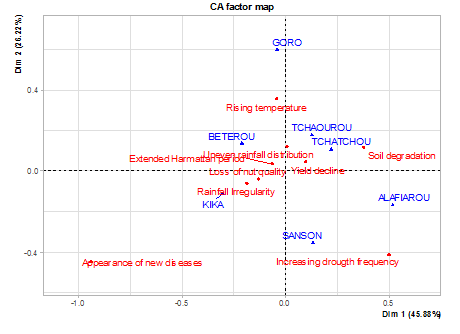
The Correspondence Analysis (CA) was performed to identify the relationships between types of climate risks and their effects on cashew farming across districts. Figure 5 shows the factor map depicting the relationships between districts (blue) and climate risks and their effects (red) in Tchaourou municipality.

The first two principal components (Dim 1 and Dim 2) explain 45.88% and 26.22% of the variance, respectively, accounting for a total of 72.1%, which ensures reliable interpretation. According to the CA map, Goro, Tchatchou, and Tchaourou are mainly associated with rising temperatures and uneven rainfall distribution, while Bétérou and Kika experience extended Harmattan periods, irregular rainfall, and a decline in cashew nut quality. Sanson and Alafiarou are characterized by frequent droughts. Moreover, the observed correlation between uneven rainfall distribution, prolonged Harmattan periods, and declining yields indicates a significant impact of these climatic risks on cashew farming.
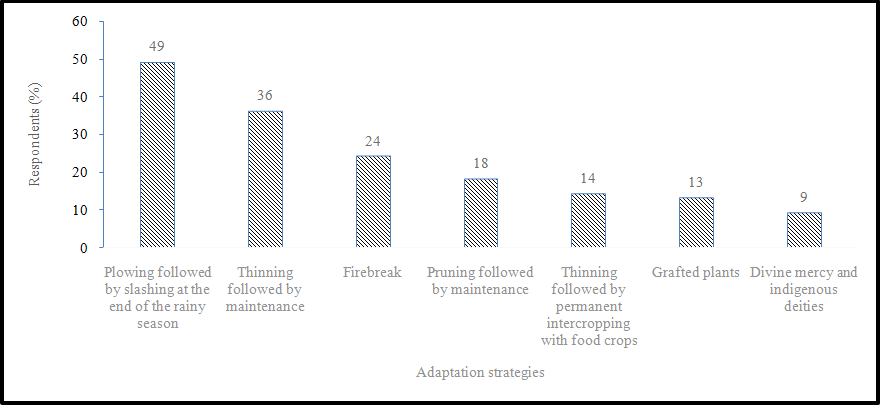
3.5. Adaptation StrategiesTo sustain their livelihoods despite the impacts of perceived climate risks, cashew farmers in Tchaourou have developed a range of adaptation strategies over time. These strategies mitigate the negative effects of local climate risks and are implemented at both individual and collective levels, guided by seasonal variations. Figure 6 illustrates the adoption levels of these strategies among cashew farmers in Tchaourou municipality.
The analysis of Figure 6 indicates that, according to surveyed cashew farmers, plowing followed by slashing at the end of the rainy season is the primary adaptation strategy in cashew plantations, adopted by 49% of respondents. This practice reduces evapotranspiration by minimizing competition for water and nutrients between weeds and cashew plants, promotes soil moisture conservation, enhances water infiltration and retention, reduces fire risks, and prepares the soil for the dry season. Thinning followed by maintenance is the second most adopted strategy, contributing to reduced competition for nutrients and light, which are essential for efficient photosynthesis. Collective adaptation strategies, implemented by a minority of surveyed farmers (9%), involve prayer sessions aimed at mitigating the impacts of delayed or excessive rainfall. Between these extremes, strategies adopted by 13–24% of cashew farmers mainly focus on optimizing space through agroecological practices and maximizing photosynthesis.
This study revealed that cashew farmers in Tchaourou municipality perceive climate change through multiple indicators, including irregular rainfall, rising temperatures, extended Harmattan periods, and frequent droughts. Similar findings have been reported by 34, 35, 36, who examined climate variability in various regions of Benin at different scales. Moreover, the majority of these farmers consider climate change to be the main constraint to cashew farming. This is supported by 25, who reported that climatic factors negatively affected the phenology and yield of cashew plants in 2013, according to farmers’ perceptions.

Cashew farmers perceive climate risks to cause declining yields, lower nut quality, soil degradation, and the emergence of new diseases. This aligns with previous findings, with 3 noting that cashew yields in Benin depend on ecological conditions and cultivation practices, and 25 demonstrating that climatic factors adversely affect cashew phenology and productivity
To cope with climate-related disruptions, cashew farmers in Tchaourou municipality have developed various adaptation practices over time. These include plowing followed by mowing at the end of the rainy season, thinning with maintenance, thinning combined with permanent association of food crops, pruning with maintenance, and reliance on divine intervention. Thinning and pruning reduce competition for nutrients and light, thereby enhancing photosynthesis, while plowing creates sunken spaces that retain water and humus, benefiting cashew tree development 23. In the case of thinning combined with permanent association of food crops, the associated crops are mainly cereals such as maize and millet. This intercropping enriches the soil with nutrients, protects against erosion, maintains soil moisture, and contributes to a more stable microclimate, thus mitigating the effects of climate risks 37, 38. These findings align with 39, who studied socio-economic determinants of adopting good cultural practices in cashew plantations in Benin.
Despite these strategies, some farmers do not implement any practices and rely solely on divine intervention, confirming observations by 40 regarding producer passivity in the face of climatic constraints. The combination of individual practices (maintenance and cultural interventions) and collective strategies (prayers, mutual aid) illustrates a community resilience well-established in local knowledge systems. To further strengthen ethno-climatic knowledge, it is essential to align Sudanese climatic characteristics with cashew phenology across different agroecological zones. This approach not only validates farmers’ perceptions but also supports the development of robust strategies for mitigating current and future climate risks.
This study complements previous research on farmers’ perceptions of local climate by providing specific insights into the climate risks affecting cashew farming in the municipality of Tchaourou, Benin. The main risks identified by cashew farmers include erratic rainfall, rising temperatures, extended Harmattan periods, and frequent droughts. These risks were reported to contribute to yield losses, a reduction in nut quality, soil degradation, and the emergence of new diseases. To cope with these challenges, farmers have adopted several adaptation strategies, primarily focusing on soil and water conservation and agroforestry practices, such as intercropping. To further validate these subjective perceptions and strengthen adaptation strategies, future research should prioritize integrating biophysical data. In particular, studies correlating local climatic variables with key phenological stages of the cashew farming cycle are essential. Such research is critical for optimizing water management and informing the development of evidence-based, sustainable policies aimed at enhancing the resilience of the cashew sector.
This research resulted from the collaborative efforts of the Territorial Agency for Agricultural Development of Tchaourou and the School of Rural Engineering at the National University of Agriculture, whose contributions are gratefully acknowledged.
The authors hereby declare that there are no financial, personal, or professional conflicts of interest that could have influenced the research, authorship, or publication of this study.
| [1] | Tinlot, M., Évaluation ex ante du bilan carbone de la filière anacarde au Burkina Faso. Institut Supérieur d’Agriculture de Lille, 90p., 2010. https://www.fao.org/fileadmin/ templates/ex_act/pdf/master_thesis/MFE_TINLOT_M_210610.pdf?utm_source=chatgpt.com [Accessed August 17, 2025]. | ||
| In article | |||
| [2] | Tefera, M.L., Seddaiu, G., Carletti, A., and Awada, H., Rainfall variability and drought in West Africa: challenges and implications for rainfed agriculture. Theoretical and Applied Climatology, 156, 41, 2025. | ||
| In article | View Article | ||
| [3] | Tchétangni, Y.A., Bello, D., Assogbadjo, A.E., and Houéhanou, T., Effets du changement climatique sur la production des noix d’anacardier. European Scientific Journal, 12(14), 220–239, 2016. | ||
| In article | View Article | ||
| [4] | IPCC, 2023: Climate Change 2023: Synthesis Report. Contribution of Working Groups I, II and III to the Sixth Assessment Report of the Intergovernmental Panel on Climate Change [Core Writing Team, H. Lee and J. Romero (eds.)]. IPCC, Geneva, Switzerland, 184p. | ||
| In article | |||
| [5] | Houssou-Goe, S.S.P., Agriculture et changement climatique au Bénin: risques climatiques, vulnérabilité et stratégies d’adaptation des populations rurales du département du Couffo. Thèse d’Ingénieur Agronome, UAC/ FSA/ DESAC, Abomey-Calavi, Bénin, 160p., 2008.http://hdl.handle.net/10625/44965 [Accessed August 18, 2025]. | ||
| In article | |||
| [6] | Atchadé, M.N, and Nougbodé, H., Statistical investigation on the relationship between climate change, food availability, agricultural productivity, and economic expansion. Heliyon, 10(12):e32520, 2024. | ||
| In article | View Article PubMed | ||
| [7] | FIDA, Le Bénin en quelques chiffres, 2022. https://www.ifad.org/ fr/w/pays/benin [Accessed August 18, 2025]. | ||
| In article | |||
| [8] | Moussa, A., Does Agricultural Sector Contribute to the Economic Growth in Case of Republic of Benin? Journal of Social Economics Research, Conscientia Beam, 5(2): 85-93, 2018. | ||
| In article | View Article | ||
| [9] | Gologo, H., Adaptation is … informing and involving farmers in Benin, IRDC-DFID, 4 p., 2007.http://hdl.handle.net/10625/52764 [Accessed August 17, 2025]. | ||
| In article | |||
| [10] | Dossa, K.F., Bissonnette, J.-F., Barrette, N., Bah, I., and Miassi, Y.E., Projecting Climate Change Impacts on Benin’s Cereal Production by 2050: A SARIMA and PLS-SEM Analysis of FAO Data. Climate, 13(1), 19, 2025. | ||
| In article | View Article | ||
| [11] | GDAA, Adapter l’agriculture grâce à la connaissance locale. Note d’information du Groupe de Discussion Africa Adapt. Secrétariat AfricaAdapt, ENDA Tiers-Monde, Dakar, Sénégal, 6 p., 2012. http://hdl.handle.net/10625/51975 [Accessed August 18, 2025]. | ||
| In article | |||
| [12] | RAC-F, Adaptation de l’agriculture aux changements climatiques: Recueil d’expériences territoriales. Réseau Action Climat-France, Montreuil, France, 60 p., 2014. https://temis.documentation. developpement-durable.gouv.fr/docs/Temis/0082/Temis-0082326/21974.pdf [Accessed August 18, 2025]. | ||
| In article | |||
| [13] | PADEFA-ENA, Benin-Cashew nuts sector and agricultural entrepreneurship development support project. African Development Fund Report, 32 p., 2019. https:// www.afdb.org/ en/documents/ document/ benin-cashew- nuts- sector-and-agricultural-entrepreneurship-development-support-project-padefa - ena-appraisal-report-108718 [Accessed August 17, 2025]. | ||
| In article | |||
| [14] | Oloukoi, L., and Adégbola, P.Y., Compétitivité de la filière anacarde au Bénin: une analyse des effets aux prix de référence. Conference Paper Presentation, pp.47-50, 2008. | ||
| In article | |||
| [15] | DSA, Indicateurs macroéconomiques 2020 sur le secteur agricole au Bénin, MAEP, Cotonou, Bénin, 8 p., 2021. https:// apidsa.agriculture.gouv.bj/public/storage/uploads/ZbBUPaGKyqD1SKFMDjfkd4qUBQnnkI3ACbkwNcGL.pdf [Accessed August 18, 2025]. | ||
| In article | |||
| [16] | Yin, L., Ghosh, R., Lin, C., Hale, D., Weigl, C., Obarowski, J., Zhou, J., Till, J., Jia X., You, N., Mao T., Kumar V., and Jin, Z., Mapping smallholder cashew plantations to inform sustainable tree crop expansion in Benin. Remote Sensing of Environment, 295, 2023. | ||
| In article | View Article | ||
| [17] | Duguma, L.A., Bah, A.; Minang, P.A., Woldeyohanes, T., Jaiteh, M., Sanneh, E., Muthee, K., and Badjie, M., Cashew: An emerging tree commodity in African drylands for livelihoods improvement and ecosystem restoration. In, Minang, P.A., Duguma, L.A., van Noordwijk, M., Tree Commodities and Resilient Green Economies in Africa., Nairobi, Kenya: World Agroforestry (ICRAF), 2021. https:// apps.worldagroforestry.org/ downloads/ Publications/PDFS/BC22001.pdf [Accessed August 18, 2025]. | ||
| In article | |||
| [18] | DSA, L’anacarde au Bénin: Une filière en pleine mutation. MAEP, Cotonou, Bénin, 11 p., 2024. https://apidsa.agriculture.gouv.bj/ public/storage/uploads/LRBCYsh2svNySfZe1ZAY3REntlnmXlMIfhy6ZgAE.pdf [Accessed August 18, 2025]. | ||
| In article | |||
| [19] | Tandjiékpon, A.M., Analyse de la Chaine de Valeur du Secteur Anacarde du Bénin - Initiative du Cajou Africain. GIZ, 64 p., 2010. https://star-www.giz.de/dokumente/bib-2011/giz2011-0329en-cashew-benin.pdf [Accessed August 18, 2025]. | ||
| In article | |||
| [20] | Alem A, E., and Yabi, J.A., Analyse de la rentabilité économique de la production des noix d’anacardier dans la commune de Tchaourou au Nord-Est du Bénin. International Journal of Accounting, Finance, Auditing, Management and Economics, 5(8), 403–420, 2024. https://ijafame.org/index.php/ijafame/ article/view/1533. | ||
| In article | |||
| [21] | PNIASAN (2022). Benin/Regulatory framework for public and private investments: development of PNIASAN 3rd generation launched, Cotonou, Bénin, 2022. https://www.jumelages-partenariats.com/en/actualites.php?n=16949 [Accessed August 18, 2025]. | ||
| In article | |||
| [22] | MAEP, Plan Stratégique de Développement du Secteur Agricole (PSDSA) 2025 et Plan National d’Investissements Agricoles et de Sécurité Alimentaire et Nutritionnelle PNIASAN 2017-2021, Cotonou, Bénin, 139 p., 2017. https://ecowap.ecowas.int/ media/ecowap/naip/files/BENIN_SlM6akD.pdf [Accessed August 18, 2025]. | ||
| In article | |||
| [23] | Tandjiékpon, A. M., Caractérisation du système agroforestier à base d’anacardier (Anacardium occidentale, Linnaeus) en zone de savane au Bénin. Mémoire de Diplôme d’Études Approfondies (DEA), Faculté des Lettres, Arts et Sciences Humaines (FLASH), Université d’Abomey-Calavi, Bénin, 104 p., 2005. | ||
| In article | |||
| [24] | Adifon, F., Atindogbé, G., Orou Bello, D., Balogoun, I., Yabi, I., Dossou, J., Ahoton, L.; and Saïdou, A., Effect of Climate Variability on Yams (Dioscorea spp.) Production in Central and Northern Benin. American Journal of Climate Change, 9, 423-440, 2020. | ||
| In article | View Article | ||
| [25] | Bello, D.O, Ahoton, L.E., Saidou, A., Akponikpè, I.P.B., Ezin, V.A., Balogoun, I., and Aho, N., Climate change and cashew (Anacardium occidentale L.) productivity in Benin (West Africa): perceptions and endogenous measures of adaptation. International Journal of Biological Chemical Sciences, 11(3): 924-946, 2016. | ||
| In article | View Article | ||
| [26] | Yabi, I., and Afouda, F., Extreme Rainfall Years in Benin (West Africa). Quaternary International, 262, 39-43, 2012. | ||
| In article | View Article | ||
| [27] | Bah-Agba, R., Gouvernance locale et approvisionnement en eau potable dans les milieux ruraux au Bénin: cas de la commune de Tchaourou. Mémoire de maître ès arts, Université du Québec à Rimouski, Canada, 193 p., 2014. https://semaphore.uqar.ca/ id/eprint/1027/ [Accessed August 17, 2025]. | ||
| In article | |||
| [28] | Djohy, G.L., Alladatin, J., Sounon Bouko, B., Déterminants de la mobilité pastorale et de ses dynamiques spatio-temporelles dans un contexte de changements socio-économiques et environnementaux en Afrique. Revue Marocaine des Sciences Agronomiques et Vétérinaires, 12(4), 2024. | ||
| In article | |||
| [29] | Hounkpè, J., Diekkrüger, B., Badou, D.F., Afouda, A.A., Change in Heavy Rainfall Characteristics over the Ouémé River Basin, Benin Republic, West Africa. Climate, 4(1), 15, 2016. | ||
| In article | View Article | ||
| [30] | Kora, O., Monographie de la Commune de Tchaourou. Mission de décentralisation, Bénin, Afrique Conseil, 45 p., 2006. SCRIBD [Accessed September, 3, 2025]. | ||
| In article | |||
| [31] | INSAE, Effectifs de la population des villages et quartiers de ville du Bénin (RGPH-4, 2013). Cotonou, Bénin, 85p., 2016. INSTaD [Accessed August 18, 2025]. | ||
| In article | |||
| [32] | Dagnelie, P., Théorie et méthodes statistiques. Applications Agronomiques, Vol. 2: Les méthodes de l'inférence statistique. Les presses agronomiques de Gembloux. A.S.B.L. (Belgium), 463p., 1986. | ||
| In article | |||
| [33] | R Core Team, R: A Language and Environment for Statistical Computing (Version 4.4.2) [Software]. R Foundation for Statistical Computing, Vienna, Austria., 2025. https://www.R-project.org/ [Accessed August 18, 2025]. | ||
| In article | |||
| [34] | Sounouke, H.V., Houngnibo, C. M.M., Bessou, J., Yabi, I., Perceptions des risques climatiques dans la zone soudanienne du Bénin: Cas des producteurs de maïs du Département de Borgou. European Scientific Journal, ESJ, 18(14), 212, 2022. | ||
| In article | View Article | ||
| [35] | Idrissou Y., Assani, A.S., Baco, M.N., Yabi, A.J., Traoré A.I., Adaptation strategies of cattle farmers in the dry and sub-humid tropical zones of Benin in the context of climate change. Heliyon, 20; 6(7): e04373. PMID: 32715118; PMCID: PMC7378546, 2020. | ||
| In article | View Article PubMed | ||
| [36] | Diendéré, A.A., Farmers’ perceptions of climate change and farm-level adaptation strategies: Evidence from Bassila in Benin. African Journal of Agricultural and Resource Economics, 14(1), pp.42-55, 2019. | ||
| In article | |||
| [37] | Assogba, P., Afouda, A.S., Afouda, H.W., and Yabi, I., Caractérisation de l’agro-diversité des exploitations agricoles familiales dans les communes de Savè et de Ouêssè (Centre du Benin). African Scientific Journal, 03(18), 778-800, 2023. | ||
| In article | |||
| [38] | Koffi, S.Y., and Oura, K.R., Les facteurs de l’adoption de l’anacarde dans le bassin cotonnier de Côte d’Ivoire. Cahiers Agricultures, 28, 24, 8 p., 2019. | ||
| In article | View Article | ||
| [39] | Hinnou, L.C., Agbotridja, V.D., Coco, K., and Sossou, R., Déterminants de la rentabilité de la production de plants greffés d’anacardier au Bénin. African Journal of Food, Agriculture, Nutrition and Development, 22(9), 21568–21595, 2022. | ||
| In article | View Article | ||
| [40] | Moutouama, F.T., Tepa-Yotto, G.T., Agboton, C., Gbaguidi, B., Sekabira, H., Tamò, M., Farmers’ Perception of Climate Change and Climate-Smart Agriculture in Northern Benin, West Africa. Agronomy, 12(6), 1348, 2022. | ||
| In article | View Article | ||
Published with license by Science and Education Publishing, Copyright © 2025 Chaim Vivien DOTO, Ramzy Iko Allah Sylla SYLLA EL HADJ BONI, Djigbo Félicien BADOU and Hyppolite AGADJIHOUEDE
 This work is licensed under a Creative Commons Attribution 4.0 International License. To view a copy of this license, visit
http://creativecommons.org/licenses/by/4.0/
This work is licensed under a Creative Commons Attribution 4.0 International License. To view a copy of this license, visit
http://creativecommons.org/licenses/by/4.0/
| [1] | Tinlot, M., Évaluation ex ante du bilan carbone de la filière anacarde au Burkina Faso. Institut Supérieur d’Agriculture de Lille, 90p., 2010. https://www.fao.org/fileadmin/ templates/ex_act/pdf/master_thesis/MFE_TINLOT_M_210610.pdf?utm_source=chatgpt.com [Accessed August 17, 2025]. | ||
| In article | |||
| [2] | Tefera, M.L., Seddaiu, G., Carletti, A., and Awada, H., Rainfall variability and drought in West Africa: challenges and implications for rainfed agriculture. Theoretical and Applied Climatology, 156, 41, 2025. | ||
| In article | View Article | ||
| [3] | Tchétangni, Y.A., Bello, D., Assogbadjo, A.E., and Houéhanou, T., Effets du changement climatique sur la production des noix d’anacardier. European Scientific Journal, 12(14), 220–239, 2016. | ||
| In article | View Article | ||
| [4] | IPCC, 2023: Climate Change 2023: Synthesis Report. Contribution of Working Groups I, II and III to the Sixth Assessment Report of the Intergovernmental Panel on Climate Change [Core Writing Team, H. Lee and J. Romero (eds.)]. IPCC, Geneva, Switzerland, 184p. | ||
| In article | |||
| [5] | Houssou-Goe, S.S.P., Agriculture et changement climatique au Bénin: risques climatiques, vulnérabilité et stratégies d’adaptation des populations rurales du département du Couffo. Thèse d’Ingénieur Agronome, UAC/ FSA/ DESAC, Abomey-Calavi, Bénin, 160p., 2008.http://hdl.handle.net/10625/44965 [Accessed August 18, 2025]. | ||
| In article | |||
| [6] | Atchadé, M.N, and Nougbodé, H., Statistical investigation on the relationship between climate change, food availability, agricultural productivity, and economic expansion. Heliyon, 10(12):e32520, 2024. | ||
| In article | View Article PubMed | ||
| [7] | FIDA, Le Bénin en quelques chiffres, 2022. https://www.ifad.org/ fr/w/pays/benin [Accessed August 18, 2025]. | ||
| In article | |||
| [8] | Moussa, A., Does Agricultural Sector Contribute to the Economic Growth in Case of Republic of Benin? Journal of Social Economics Research, Conscientia Beam, 5(2): 85-93, 2018. | ||
| In article | View Article | ||
| [9] | Gologo, H., Adaptation is … informing and involving farmers in Benin, IRDC-DFID, 4 p., 2007.http://hdl.handle.net/10625/52764 [Accessed August 17, 2025]. | ||
| In article | |||
| [10] | Dossa, K.F., Bissonnette, J.-F., Barrette, N., Bah, I., and Miassi, Y.E., Projecting Climate Change Impacts on Benin’s Cereal Production by 2050: A SARIMA and PLS-SEM Analysis of FAO Data. Climate, 13(1), 19, 2025. | ||
| In article | View Article | ||
| [11] | GDAA, Adapter l’agriculture grâce à la connaissance locale. Note d’information du Groupe de Discussion Africa Adapt. Secrétariat AfricaAdapt, ENDA Tiers-Monde, Dakar, Sénégal, 6 p., 2012. http://hdl.handle.net/10625/51975 [Accessed August 18, 2025]. | ||
| In article | |||
| [12] | RAC-F, Adaptation de l’agriculture aux changements climatiques: Recueil d’expériences territoriales. Réseau Action Climat-France, Montreuil, France, 60 p., 2014. https://temis.documentation. developpement-durable.gouv.fr/docs/Temis/0082/Temis-0082326/21974.pdf [Accessed August 18, 2025]. | ||
| In article | |||
| [13] | PADEFA-ENA, Benin-Cashew nuts sector and agricultural entrepreneurship development support project. African Development Fund Report, 32 p., 2019. https:// www.afdb.org/ en/documents/ document/ benin-cashew- nuts- sector-and-agricultural-entrepreneurship-development-support-project-padefa - ena-appraisal-report-108718 [Accessed August 17, 2025]. | ||
| In article | |||
| [14] | Oloukoi, L., and Adégbola, P.Y., Compétitivité de la filière anacarde au Bénin: une analyse des effets aux prix de référence. Conference Paper Presentation, pp.47-50, 2008. | ||
| In article | |||
| [15] | DSA, Indicateurs macroéconomiques 2020 sur le secteur agricole au Bénin, MAEP, Cotonou, Bénin, 8 p., 2021. https:// apidsa.agriculture.gouv.bj/public/storage/uploads/ZbBUPaGKyqD1SKFMDjfkd4qUBQnnkI3ACbkwNcGL.pdf [Accessed August 18, 2025]. | ||
| In article | |||
| [16] | Yin, L., Ghosh, R., Lin, C., Hale, D., Weigl, C., Obarowski, J., Zhou, J., Till, J., Jia X., You, N., Mao T., Kumar V., and Jin, Z., Mapping smallholder cashew plantations to inform sustainable tree crop expansion in Benin. Remote Sensing of Environment, 295, 2023. | ||
| In article | View Article | ||
| [17] | Duguma, L.A., Bah, A.; Minang, P.A., Woldeyohanes, T., Jaiteh, M., Sanneh, E., Muthee, K., and Badjie, M., Cashew: An emerging tree commodity in African drylands for livelihoods improvement and ecosystem restoration. In, Minang, P.A., Duguma, L.A., van Noordwijk, M., Tree Commodities and Resilient Green Economies in Africa., Nairobi, Kenya: World Agroforestry (ICRAF), 2021. https:// apps.worldagroforestry.org/ downloads/ Publications/PDFS/BC22001.pdf [Accessed August 18, 2025]. | ||
| In article | |||
| [18] | DSA, L’anacarde au Bénin: Une filière en pleine mutation. MAEP, Cotonou, Bénin, 11 p., 2024. https://apidsa.agriculture.gouv.bj/ public/storage/uploads/LRBCYsh2svNySfZe1ZAY3REntlnmXlMIfhy6ZgAE.pdf [Accessed August 18, 2025]. | ||
| In article | |||
| [19] | Tandjiékpon, A.M., Analyse de la Chaine de Valeur du Secteur Anacarde du Bénin - Initiative du Cajou Africain. GIZ, 64 p., 2010. https://star-www.giz.de/dokumente/bib-2011/giz2011-0329en-cashew-benin.pdf [Accessed August 18, 2025]. | ||
| In article | |||
| [20] | Alem A, E., and Yabi, J.A., Analyse de la rentabilité économique de la production des noix d’anacardier dans la commune de Tchaourou au Nord-Est du Bénin. International Journal of Accounting, Finance, Auditing, Management and Economics, 5(8), 403–420, 2024. https://ijafame.org/index.php/ijafame/ article/view/1533. | ||
| In article | |||
| [21] | PNIASAN (2022). Benin/Regulatory framework for public and private investments: development of PNIASAN 3rd generation launched, Cotonou, Bénin, 2022. https://www.jumelages-partenariats.com/en/actualites.php?n=16949 [Accessed August 18, 2025]. | ||
| In article | |||
| [22] | MAEP, Plan Stratégique de Développement du Secteur Agricole (PSDSA) 2025 et Plan National d’Investissements Agricoles et de Sécurité Alimentaire et Nutritionnelle PNIASAN 2017-2021, Cotonou, Bénin, 139 p., 2017. https://ecowap.ecowas.int/ media/ecowap/naip/files/BENIN_SlM6akD.pdf [Accessed August 18, 2025]. | ||
| In article | |||
| [23] | Tandjiékpon, A. M., Caractérisation du système agroforestier à base d’anacardier (Anacardium occidentale, Linnaeus) en zone de savane au Bénin. Mémoire de Diplôme d’Études Approfondies (DEA), Faculté des Lettres, Arts et Sciences Humaines (FLASH), Université d’Abomey-Calavi, Bénin, 104 p., 2005. | ||
| In article | |||
| [24] | Adifon, F., Atindogbé, G., Orou Bello, D., Balogoun, I., Yabi, I., Dossou, J., Ahoton, L.; and Saïdou, A., Effect of Climate Variability on Yams (Dioscorea spp.) Production in Central and Northern Benin. American Journal of Climate Change, 9, 423-440, 2020. | ||
| In article | View Article | ||
| [25] | Bello, D.O, Ahoton, L.E., Saidou, A., Akponikpè, I.P.B., Ezin, V.A., Balogoun, I., and Aho, N., Climate change and cashew (Anacardium occidentale L.) productivity in Benin (West Africa): perceptions and endogenous measures of adaptation. International Journal of Biological Chemical Sciences, 11(3): 924-946, 2016. | ||
| In article | View Article | ||
| [26] | Yabi, I., and Afouda, F., Extreme Rainfall Years in Benin (West Africa). Quaternary International, 262, 39-43, 2012. | ||
| In article | View Article | ||
| [27] | Bah-Agba, R., Gouvernance locale et approvisionnement en eau potable dans les milieux ruraux au Bénin: cas de la commune de Tchaourou. Mémoire de maître ès arts, Université du Québec à Rimouski, Canada, 193 p., 2014. https://semaphore.uqar.ca/ id/eprint/1027/ [Accessed August 17, 2025]. | ||
| In article | |||
| [28] | Djohy, G.L., Alladatin, J., Sounon Bouko, B., Déterminants de la mobilité pastorale et de ses dynamiques spatio-temporelles dans un contexte de changements socio-économiques et environnementaux en Afrique. Revue Marocaine des Sciences Agronomiques et Vétérinaires, 12(4), 2024. | ||
| In article | |||
| [29] | Hounkpè, J., Diekkrüger, B., Badou, D.F., Afouda, A.A., Change in Heavy Rainfall Characteristics over the Ouémé River Basin, Benin Republic, West Africa. Climate, 4(1), 15, 2016. | ||
| In article | View Article | ||
| [30] | Kora, O., Monographie de la Commune de Tchaourou. Mission de décentralisation, Bénin, Afrique Conseil, 45 p., 2006. SCRIBD [Accessed September, 3, 2025]. | ||
| In article | |||
| [31] | INSAE, Effectifs de la population des villages et quartiers de ville du Bénin (RGPH-4, 2013). Cotonou, Bénin, 85p., 2016. INSTaD [Accessed August 18, 2025]. | ||
| In article | |||
| [32] | Dagnelie, P., Théorie et méthodes statistiques. Applications Agronomiques, Vol. 2: Les méthodes de l'inférence statistique. Les presses agronomiques de Gembloux. A.S.B.L. (Belgium), 463p., 1986. | ||
| In article | |||
| [33] | R Core Team, R: A Language and Environment for Statistical Computing (Version 4.4.2) [Software]. R Foundation for Statistical Computing, Vienna, Austria., 2025. https://www.R-project.org/ [Accessed August 18, 2025]. | ||
| In article | |||
| [34] | Sounouke, H.V., Houngnibo, C. M.M., Bessou, J., Yabi, I., Perceptions des risques climatiques dans la zone soudanienne du Bénin: Cas des producteurs de maïs du Département de Borgou. European Scientific Journal, ESJ, 18(14), 212, 2022. | ||
| In article | View Article | ||
| [35] | Idrissou Y., Assani, A.S., Baco, M.N., Yabi, A.J., Traoré A.I., Adaptation strategies of cattle farmers in the dry and sub-humid tropical zones of Benin in the context of climate change. Heliyon, 20; 6(7): e04373. PMID: 32715118; PMCID: PMC7378546, 2020. | ||
| In article | View Article PubMed | ||
| [36] | Diendéré, A.A., Farmers’ perceptions of climate change and farm-level adaptation strategies: Evidence from Bassila in Benin. African Journal of Agricultural and Resource Economics, 14(1), pp.42-55, 2019. | ||
| In article | |||
| [37] | Assogba, P., Afouda, A.S., Afouda, H.W., and Yabi, I., Caractérisation de l’agro-diversité des exploitations agricoles familiales dans les communes de Savè et de Ouêssè (Centre du Benin). African Scientific Journal, 03(18), 778-800, 2023. | ||
| In article | |||
| [38] | Koffi, S.Y., and Oura, K.R., Les facteurs de l’adoption de l’anacarde dans le bassin cotonnier de Côte d’Ivoire. Cahiers Agricultures, 28, 24, 8 p., 2019. | ||
| In article | View Article | ||
| [39] | Hinnou, L.C., Agbotridja, V.D., Coco, K., and Sossou, R., Déterminants de la rentabilité de la production de plants greffés d’anacardier au Bénin. African Journal of Food, Agriculture, Nutrition and Development, 22(9), 21568–21595, 2022. | ||
| In article | View Article | ||
| [40] | Moutouama, F.T., Tepa-Yotto, G.T., Agboton, C., Gbaguidi, B., Sekabira, H., Tamò, M., Farmers’ Perception of Climate Change and Climate-Smart Agriculture in Northern Benin, West Africa. Agronomy, 12(6), 1348, 2022. | ||
| In article | View Article | ||