Groundwater is the most important source of water supply in Tchamba prefecture. Groundwater quality contaminations have emerged in many geographical areas due to natural environmental processes and human intervention in the geosystems. Hydrochemical evolution of groundwater quality in the study area was investigated. The physicochemical parameters such as major ions were determined. Factor analysis was used to identify key parameters that described groundwater quality in the study area. The first two factors were considered: Factor 1 explained 53.43% of the total variance and translates the natural rainwater recharge and water-soil/rock interaction process. The second factor (F2) explained 22.05% of the total variance and expresses the anthropogenic pressure such as domestic sewage, uncontrolled landfill waste, fertilizers, and wastewater. The results showed that silicate mineral dissolution and cation exchange in aquifers play an important role in groundwater chemistry evolution.
Access to safe drinking water is a prerequisite for health, an essential human right, and a key component of effective health protection policies. Water is necessary for life, and all people must have access to a satisfactory water supply. Improved access to safe drinking water can result in tangible health benefits. Every human action should made to obtain drinking water that is as safe as possible 1, 2. Water resources in Togo are diverse, but groundwater is the primary source of drinking water for people in rural areas 3. Groundwater is much less vulnerable than surface water 4, 5. Given the population growth and the socio-economic pressures in prefectures of Togo', particularly in Tchamba area, the water demand is increasingly high. The urban and peri-urban areas of Tchamba are not supplied with the water of the Togolese Society of Water, except a few urban areas. To meet this demand for drinking water, the authorities of water management carried out some boreholes..
Togo is committed to achieving the Sustainable Development Goals (SDGs)) including SDG6, which aims to ensure people at access to safe drinking water and sanitation by 2030 1. Safe drinking water is necessary for domestic uses including drinking, food preparation, and personal hygiene. However, the most of populations at risk from water-borne diseases are infants, young children, the weak, and the elderly, mainly when they live in unsanitary conditions 6. Therefore, the assessment of the quality and hydrochemical study of water resources in urban, peri-urban, and rural areas play a significant role in the socio-economic development 2. In the upstream of Mono River basin such as Tchamba, the intensification of agriculture with uncontrolled use of fertilizers, the poor management of household waste and untreated domestic wastewater released into the environment lead to the pollution of aquifers 7.
This study evaluated groundwater hydrochemistry and quality in Tchamba prefecture. The physicochemical parameters were determined and factor analysis, and classic graphs are used to identify the most important factors contributing to the drinking water quality. This paper may contribute to improved water resource management in the Tchamba prefecture. The findings may be applied to future planning and implementation measures to control groundwater quality.
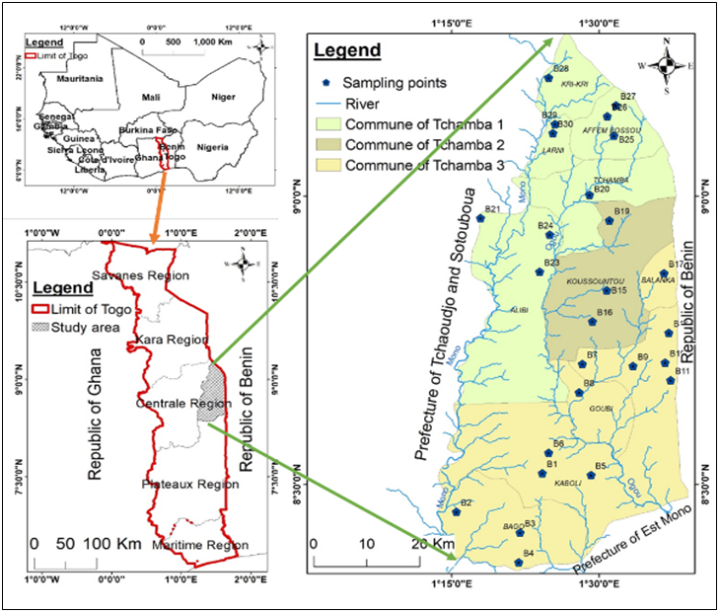
The study area is located between latitudes 8°15'0" to 9°15'0" N and longitudes 1°15'0" to 2°0'0" E, (Figure 1). The study area covers the urban and preurban areas of Tchamba The study area is in a tropical climate with one rainy season (from March to October) and one dry season (from April to September). However, the average of annual precipitation in the region is 1,208 mm per year. Winter is hot and dry with maximum temperatures above 30 °C. The average temperature in the region is about 26.4°C, with the high temperature recorded at 36.7°C and the lowest at 18,8°C 8. Most of the area is a flat plain, with surface elevations ranging from 219 to 433 m a.s.l.(from DEM) 9.
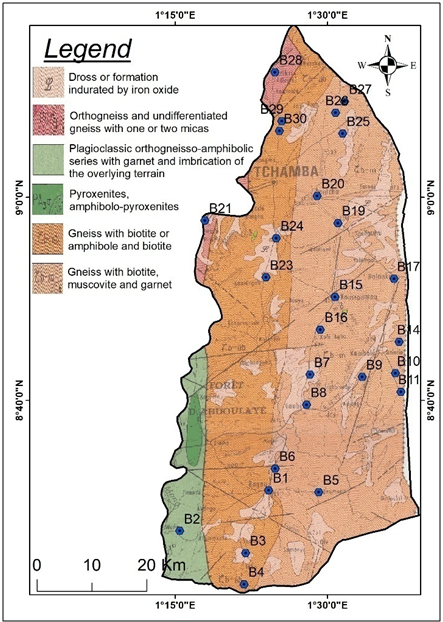
The study area is in the structural unit of the Benino-Togolese plain, formed essentially by crystalline rocks. The geology is predominantly basic, with metamorphic rocks such as amphibole gneisses, massive metadiorites, and amphibolites.(Figure 2). These metamorphic rocks are spatially associated with mafic to ultramafic massifs that have retained mainly their magmatic texture. The mineralogical composition is generally as follows: green hornblende, epidote, plagioclase andesine or oligoclase, biotite, chlorite, interlocking quartz, muscovite and incidentally apatite, sphene and scapolite, interstitial brown hornblende, orthopyroxene, clinopyroxene, quartz, feldspars, zoïsite and garnets 10, 11.
There are two main types of aquifers: Fissure and alteration aquifers. The frequency of fracturing varies according to the nature of the rock, its structural position, and bedding. The hardest rocks are generally the most fractured; schistose rocks, which are more deformable, are less fractured. The products of weathering are unevenly distributed and form porous media containing aquifers of limited volume. The permeability of alterites is generally low, around  m/s. The average thickness of the weathering varies from 3 to 15 m. The storage capacity of a fissured massif is low due to the low useful porosity of 1 to 5% 12.

Groundwater samples from 25 monitoring boreholes were collected to provide a uniform distribution over most of the drinking water supply area. The geographic coordinates of the wells were obtained using a GPS and used to create a distribution map using ArcGIS 10.7 software 13. Water samples were collected in October 2021 in polyethylene bottles. The temperature, electrical conductivity, pH, and total dissolved solids (TDS) values were measured in situ. The concentration of ions, such as  ,
,  ,
,  was measured in the laboratory within seven days after sampling. Samples were stored in a dark and cold place at 4°C. Volumetric analysis was used fo
 and
and  ;
;  were analyzed using a Molecular Adsorption Spectrophotometer METASH, 5200 and a flame spectrophotometer for
  14.
14.
The results were analyzed using a Piper diagram created by origin software 15, also used to perform multivariate statistical analysis. Nine standardized chemical parameters (Table 3) have been used in factor analysis. Before analysis, the data were normalized to a distribution with a mean of zero and a standard deviation of one. Factor extraction was performed using principal component analysis 16, 17.
Table 1 shows descriptive statistics: minimum (Min), mean, maximum (Max), and standard deviation (SD) of groundwater quality parameters from 25 samples collected in October 2021.
The temperature varied by 1°C among the samples, and the minimum and maximum temperatures were 26.40°C and 26.66°C, respectively. Approximately 96% of samples were slightly acidic (pH<7.0), and 100% of samples were nearly neutral (pH 6.5 to 7.5). The acidity of the water in the study area is mainly related to CO2 in surface soil layers, which is produced by biological activity or infiltration of precipitation 18.
The EC ranged from 140 to 680 μS.  and then compliant with the World Health Organization (WHO) standard for drinking water (500 -1500 μs.
 ) However, only 76 % of the samples had EC < 500 μS.
 , and 24% could be classed as moderately mineralized (EC=500–1000 μS.
  ). The EC values range from 140 to 680 μS.
  and translate the interference of numerous natural processes 6.
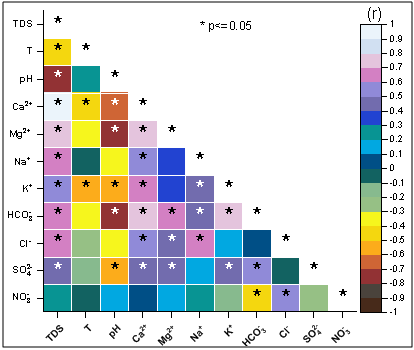
Figure 3 shows the correlation between parameters. The correlation of EC and each of the ions was calculated using data from all the wells as follows (ion, r) :  , 0.71;
  , 0.39;
  , 0.58;
  , 0.65;
  , 0.72;
  , 0.92;
  , 0.76; and
  , 0.26. These correlation coefficients show that the EC is strongly influenced by
  ,
,  ,
,  ,
,  , and
, and  (Figure 3) 19.
The most abundant cation in the groundwater was  with values ranging from 4.80 to 51.20 mg/L. This was followed by Na (6,13 to 38.72mg/L),
  (3,16 to 19.93 mg/L), and
  (1,6 to 8.10 mg/L). The dominant anion in the groundwater was
  (34,16 to 240.34mg/L). The groundwater concentration of
  ,
,  , and
, and  ranges from 7.10 to 62.13, 0.01 to 3.97, and 0.21 to 43.08 mg/L, respectively. The
  concentrations at some locations show a pollution. Nitrate in groundwater reflects the anthropogenic impact of domestic sewage, uncontrolled landfill waste, fertilizers, and manure on the study area 20.

The correlation coefficients among various groundwater quality parameters were obtained to investigate their interdependence. This shows that nitrate has a negative relationship with sulfate, bicarbonate alkalinity, and potassium, whereas the relationship with calcium, magnesium, sodium, chloride, and EC is positive (Figure 3).
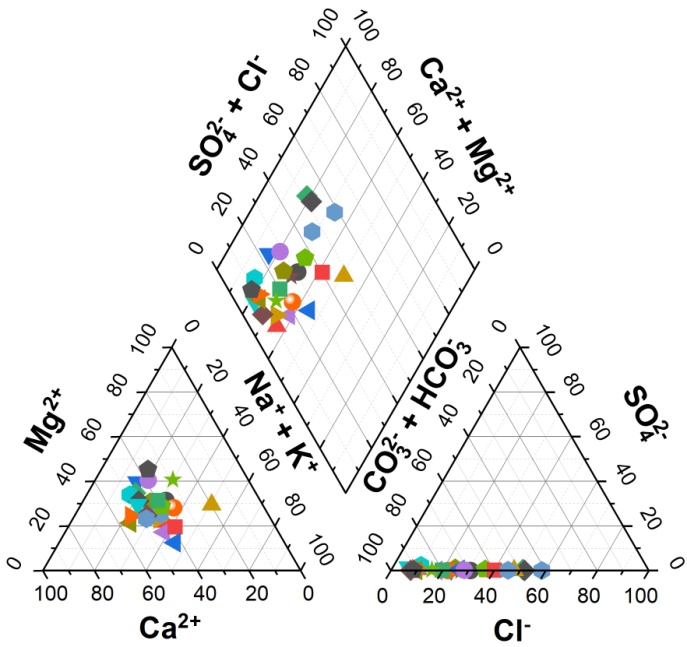
5.2. Water TypeThe major ions in groundwater from monitoring boreholes are plotted on a Trilinear diagram 21 shown in Figure 4. The trilinear plot of groundwater samples shows that the dominant water type in the area is mixed cation-
 type.
type.
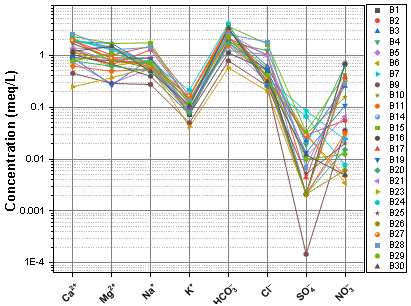
A Schoeller diagram (Figure 5) was used to compare the different boreholes and highlight the dominant anions and cations in each borehole 22. Figure 5 showed that the groundwater in the study area was characterized by abundant of  ,
,  ,
, . The Schoeller diagram also illustrated the impact of boreholes location on water quality, and samples from different boreholes had different dominant chemical species. The graphs show that most of these boreholes contained moderate nitrate levels. The peaks in a Schoeller diagram indicate the water type. In this case, the groundwater samples mainly contained
  and
and  (Ca-
(Ca- type).


The factor loadings of the variables (Table 3) reflect their correlation with the extracted factors. The first factor (F1) is a component built by  ,
, 
 and explained 53.43% of the total variance. Factor 1 is strongly determined by the
  concentration, which could originate from the presence of dissolved
  . This factor reflects the dissolution of minerals (Table 3) and concentrations of major ions in the groundwater [23]. The second factor (F2) is a component built by
  and
and  , and explained 22.05% of the total variance.
  is naturally present in groundwater at very low concentrations, and its source is human activities such as domestic or industrial waste or agriculture. Therefore, F2 also reflects the anthropogenic impact of domestic sewage 24, uncontrolled landfill waste, fertilizers, and wastewater on the study area. Indeed, some groundwater samples show a well-defined relationship between
  and cation (
 and
and  ) (Figure 3), highlighting that both elements are mostly originated from the excessive use of fertilizers 25.
These two factors express 75.48% of the variability of groundwater quality. The related parameters include  ,
,  ,
,  ,
,  ,
,  ,
,  for F1;
  and
and  for F2. However, the measurement of only two parameters (
 and
and  ) is sufficient for regular monitoring of the quality of groundwater. The other parameters can be determined by simple linear regression because of their correlation to these two parameters (Figure 3).
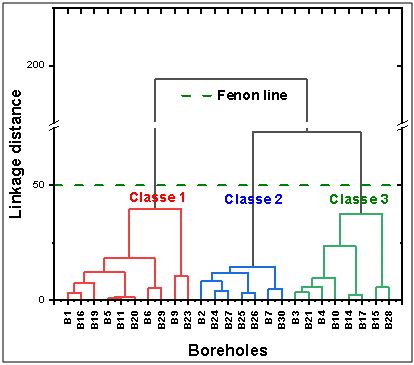
According to cluster analysis, the boreholes can be grouped into three clusters (C1, C2 and C3) with similar parameters using hierarchical cluster analysis (Figure 6) 15, 16. C1 included boreholes B1, B5, B6, B9, B11, B16, B19, B20, B23 and B29. C2 included boreholes B2, B7, B24, B25, B26, B27 and B30 and C3 contained boreholes B3, B4, B10, B14, B15, B17 and B28. It is showed that all boreholes within each group have very similar pH, TDS, EC, and major and minor element content. Clustering reduces the number of sampling sites that would be required in any future studies. For example, during the exploration of a new field campaign for reconfiguring the water supply network and assessing the proposed network's reliability, it will be essential to map the changes in groundwater quality chemistry.
5.5. Minerals DissolutionPrevious studies 17 [26-32] 26 had shown that c( )/c(
)/c(
 ) linear distribution of water samples denotes carbonate dissolution, and c(
 )/c(
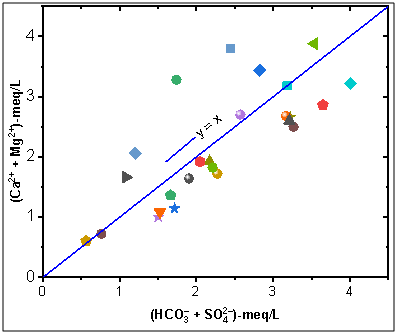
)/c( ) nonlinear water sample distribution refers to silicate dissolution. The monitoring data from October 2021 shows that their plot in c(
 )/c(
)/c( ) are linear with axe y = x of most of the observation points in the study area. The scatter diagram (Figure 7) of c(
 )/c(
)/c( ) shows that the source of
  and
and  originates from silicate mineral dissolution. Therefore,
  can indicate the water-rock interaction region. The high concentrations of
  ,
,  , and
, and  reflect mineral dissolution and rock weathering processes in the study area. The origin of
  in the study area should be the dissolution of
  and other processes.


 ) vs. c(
 )
)As previously mentioned, the main sources of  and
and  in the study area is related to a silicate mineral dissolution process. This process demonstrates that an increase in the concentration of
  should increase the concentration of
  . However, if Na/Ca exchange takes place, the concentration of
  will be lower, while the concentration of
  will be higher 2 [33-36] 36. A common feature/process of Ca/Na exchange is that when the concentration of
  increases,
  will decrease, and
  will increase. This type of region is the typical region of Ca/Na exchange. In the study area,
  and
and  increased while the concentration of
  decreased. This shows that the Ca/Na ion exchange occurred in this area.
Hydrochemical assessment were performed using different techniques. The main water-rock interactions in the study area include mineral dissolution processes and cation exchange. The ranks of the abundance of the ions are as follows:  >
>  >
>  >
>  for anions and
  >
>  >
>  >
>  for cations. Two factors, F1 and F2 extracted from the dataset represent the dissolution of minerals and the anthropogenic impact of domestic sewage, uncontrolled landfill waste, fertilizers, and wastewater on the study area. However, measuring only two parameters (
 and
and  ) is sufficient for regular monitoring of borehole water quality. The other parameters can be determined by simple linear regression because of their correlation to these two parameters. Hierarchical cluster analysis shows that the boreholes water were grouped into three clusters. All boreholes within each group have very similar pH, TDS, EC, major and minor elements content. Clustering of samples reduces the number of sampling sites that would be required in any future studies.
| [1] | WHO, « Guidelines for drinking-water quality, 4th edition, incorporating the 1st addendum », 2017. https://www.who.int/publications-detail-redirect/9789241549950 (consulté le 28 avril 2021). | ||
| In article | |||
| [2] | F. Obiri-Nyarko et al., « Hydrogeochemical Studies to Assess the Suitability of Groundwater for Drinking and Irrigation Purposes: The Upper East Region of Ghana Case Study », Agriculture, vol. 12, no 12, p. 1973, 2022. | ||
| In article | View Article | ||
| [3] | S. Zoulgami, M. D. T. Gnazou, T. Kodom, G. Djaneye-Boundjou, et L. M. Bawa, « Physico-chemical study of groundwater in the Northeast of Kara region (Togo) », International Journal of Biological and Chemical Sciences, vol. 9, no 3, p. 1711‑1724, 2015. | ||
| In article | View Article | ||
| [4] | A. J. Adewumi, A. Y. B. Anifowose, F. O. Olabode, et T. A. Laniyan, « Hydrogeochemical Characterization and Vulnerability Assessment of Shallow Groundwater in Basement Complex Area, Southwest Nigeria », Contemporary Trends in Geoscience, vol. 7, no 1, p. 72‑103, juin 2018. | ||
| In article | View Article | ||
| [5] | J. Andrzej, Witkowski, J.-K. Sabina, C. Joanna, et G. Dorota, Groundwater Vulnerability and Pollution Risk Assessment. 2022. Consulté le: 24 novembre 2022. [En ligne]. Disponible sur: https://www.routledge.com/Groundwater-Vulnerability-and-Pollution-Risk-Assessment/Witkowski-Jakobczyk-Karpierz-Czekaj-Grabala/p/book/9781032400723. | ||
| In article | |||
| [6] | WHO, « Guidelines for drinking-water quality, 4th edition », 2011. https://www.who.int/publications-detail-redirect/9789241548151 (consulté le 8 novembre 2022). | ||
| In article | |||
| [7] | R. Bos, « WHO Guidelines for the safe use of wastewater, excreta and greywater in agriculture and aquaculture: policy aspects », in Regional workshop on health aspects of wastewater reuse in agriculture, OMS/CEHA, 2006. | ||
| In article | |||
| [8] | A. Badameli et V. Dubreuil, « diagnostic du changement climatique au togo à travers l’évolution de la température entre 1961 ET ». | ||
| In article | |||
| [9] | J. L. Faundeen, R. L. Kanengieter, et M. D. Buswell, « US geological survey spatial data access », Journal of Geospatial Engineering, vol. 4, no 2, p. 145‑145, 2002. | ||
| In article | |||
| [10] | K. S. Godonou, A. Aregba, et P. Assih-Edeou, Notice explicative de la carte géologique à 1:200.000. Feuille Sokodé. Lomé: Direction générale mines géologie, 1986. | ||
| In article | |||
| [11] | J. P. Sylvain, A. Aregba, J. Collart, et K. S. Godonou, « Carte Géologique du Togo à 1/500.000 et Notice Explicative », République Togolaise, Direction Générale des Mines, de la Géologie et du Bureau National de Recherches Minières. Memoire, vol. 6, p. 120, 1986. | ||
| In article | |||
| [12] | F. Fabio, A. Fredrik, et K. Gnandi, « Etude de faisabilité des forages manuels au Togo Identification des zones potentiellement Favorables », 2009. | ||
| In article | |||
| [13] | ESRI, « À propos d’ArcGIS | Logiciel et services de cartographie et d’analyse », 2023. https://www.esri.com/fr-fr/arcgis/about-arcgis/overview (consulté le 14 septembre 2023). | ||
| In article | |||
| [14] | J. Rodier, B. Legube, et N. Merlet, « L’Analyse de l’eau 9e édition », Entièrement Mise À Jour Dunod Paris, 2009. | ||
| In article | |||
| [15] | B. Banoeng-Yakubo, S. M. Yidana, et E. Nti, « Hydrochemical analysis of groundwater using multivariate statistical methods—the Volta region, Ghana », KSCE Journal of Civil Engineering, vol. 13, no 1, p. 55‑63, 2009. | ||
| In article | View Article | ||
| [16] | V. Cloutier, R. Lefebvre, R. Therrien, et M. M. Savard, « Multivariate statistical analysis of geochemical data as indicative of the hydrogeochemical evolution of groundwater in a sedimentary rock aquifer system », Journal of Hydrology, vol. 353, no 3, p. 294‑313, mai 2008. | ||
| In article | View Article | ||
| [17] | K. Akpataku et al., « Hydrochemical and isotopic characterization of groundwater in the southeastern part of the Plateaux Region, Togo », Hydrological Sciences Journal, vol. 64, mai 2019. | ||
| In article | View Article | ||
| [18] | K. E. Ahoussi, Y. M. S. Oga, Y. B. Koffi, A. M. Kouassi, N. Soro, et J. Biemi, « Caractérisation hydrogéochimique et microbiologique des ressources en eau du site d’un Centre d’Enfouissement Technique (CET) de Côte d’Ivoire: cas du CET de Kossihouen dans le District d’Abidjan (Côte d’Ivoire) », International Journal of Biological and Chemical Sciences, vol. 5, no 6, p. 2524‑2542, 2011. | ||
| In article | View Article | ||
| [19] | E. K. Ahoussi, N. Soro, A. M. Kouassi, G. Soro, Y. B. Koffi, et S. P. Zade, « Application des méthodes d’analyses statistiques multivariées à l’étude de l’origine des métaux lourds (Cu 2+, Mn 2+, Zn 2+ et Pb 2+) dans les eaux des nappes phréatiques de la ville d’Abidjan », International Journal of Biological and Chemical Sciences, vol. 4, no 5, 2010. | ||
| In article | View Article | ||
| [20] | M. Lasagna et D. A. De Luca, « Evaluation of sources and fate of nitrates in the western Po plain groundwater (Italy) using nitrogen and boron isotopes », Environmental Science and Pollution Research, vol. 26, no 3, p. 2089‑2104, 2019. | ||
| In article | View Article PubMed | ||
| [21] | A. M. Piper, « A graphic procedure in the geochemical interpretation of water-analyses », Eos, Transactions American Geophysical Union, vol. 25, no 6, p. 914‑928, 1944. | ||
| In article | View Article | ||
| [22] | H. Schoeller, « Geochemistry of groundwater », Groundwater studies, an international guide for research and practice, UNESCO, Paris, p. 1‑18, 1977. | ||
| In article | |||
| [23] | N. Adimalla, « Controlling factors and mechanism of groundwater quality variation in semiarid region of South India: an approach of water quality index (WQI) and health risk assessment (HRA) », Environmental Geochemistry and Health, vol. 42, no 6, p. 1725‑1752, 2020. | ||
| In article | View Article PubMed | ||
| [24] | S.-L. A.-S. Mande, M. Liu, F. Liu, H. Chen, G. Djaneye-Boundjou, et M. L. Bawa, « Geochemical Investigation of Groundwater’s of Shallow Coastal Aquifer in and around Lomé », Energy Procedia, no 11, p. 2600‑2605, 2011. | ||
| In article | |||
| [25] | S. Peña-Haro, C. Llopis-Albert, M. Pulido-Velazquez, et D. Pulido-Velazquez, « Fertilizer standards for controlling groundwater nitrate pollution from agriculture: El Salobral-Los Llanos case study, Spain », Journal of Hydrology, vol. 392, no 3‑4, p. 174‑187, 2010. | ||
| In article | View Article | ||
| [26] | F. Barbecot, C. Marlin, E. Gibert, et L. Dever, « Hydrochemical and isotopic characterisation of the Bathonian and Bajocian coastal aquifer of the Caen area (northern France) », Applied Geochemistry, vol. 15, no 6, p. 791‑805, juill. 2000. | ||
| In article | View Article | ||
| [27] | A. Khettouch, M. Hssaisoune, M. Maaziz, A. A. Taleb, et L. Bouchaou, « Characterization of groundwater in the arid Zenaga plain: Hydrochemical and environmental isotopes approaches », Groundwater for Sustainable Development, vol. 19, p. 100816, nov. 2022. | ||
| In article | View Article | ||
| [28] | N. Aghazadeh et A. A. Mogaddam, « Investigation of hydrochemical characteristics of groundwater in the Harzandat aquifer, Northwest of Iran », Environmental monitoring and assessment, vol. 176, p. 183‑195, 2011. | ||
| In article | View Article PubMed | ||
| [29] | F. Heine, K. Zosseder, et F. Einsiedl, « Hydrochemical Zoning and Chemical Evolution of the Deep Upper Jurassic Thermal Groundwater Reservoir Using Water Chemical and Environmental Isotope Data », Water, vol. 13, no 9, Art. no 9, janv. 2021. | ||
| In article | View Article | ||
| [30] | J. Liu, H. Wang, D. Jin, F. Xu, et C. Zhao, « Hydrochemical characteristics and evolution processes of karst groundwater in Carboniferous Taiyuan formation in the Pingdingshan coalfield », Environ Earth Sci, vol. 79, no 6, p. 151, mars 2020. | ||
| In article | View Article | ||
| [31] | T. Iwatsuki, R. Furue, H. Mie, S. Ioka, et T. Mizuno, « Hydrochemical baseline condition of groundwater at the Mizunami underground research laboratory (MIU) », Applied Geochemistry, vol. 20, no 12, p. 2283‑2302, déc. 2005. | ||
| In article | View Article | ||
| [32] | A. K. Sodomon, S.-L. Alfa-Sika Mande, A. A. Dougna, et M. Afoda, « Wells and boreholes physicochemical water quality evaluation in the Atakpamé commune under agriculture and municipal wastewater impact », International Journal of Natural and Engineering Sciences, vol. 10(5), p. 62‑72, nov. 2021. | ||
| In article | View Article | ||
| [33] | Z. Zhou et al., « Hydrogeochemical and isotopic characteristics of groundwater in Xinchang preselected site and their implications », Environ Sci Pollut Res, vol. 27, no 28, p. 34734‑34745, oct. 2020. | ||
| In article | View Article PubMed | ||
| [34] | S.-W. Jeen, J.-M. Kim, K.-S. Ko, B. Yum, et H.-W. Chang, « Hydrogeochemical characteristics of groundwater in a mid-western coastal aquifer system, Korea », Geosciences Journal, vol. 5, p. 339‑348, 2001. | ||
| In article | View Article | ||
| [35] | M. Kurdi, S. Tabasi, T. Eslamkish, et A. Hezarkhani, « Hydrogeochemical study to evaluate the suitability of water for irrigation purpose at Qareh sou catchment, North of Iran », Elixir Geosci, vol. 62, p. 17536‑17541, 2013. | ||
| In article | |||
| [36] | J.-H. Kim et al., « Hydrogeochemical evolution of formation waters responsible for sandstone bleaching and ore mineralization in the Paradox Basin, Colorado Plateau, USA », GSA Bulletin, vol. 134, no 9‑10, p. 2589‑2610, févr. | ||
| In article | View Article | ||
Published with license by Science and Education Publishing, Copyright © 2023 Agbessi Koffi Sodomon, Seyf-Laye Alfa-Sika Mande, Lallébila Tampo, Kossitse Venyo Akpataku, Moudassirou Sedou and Kossi Jorge Komlan
 This work is licensed under a Creative Commons Attribution 4.0 International License. To view a copy of this license, visit
http://creativecommons.org/licenses/by/4.0/
This work is licensed under a Creative Commons Attribution 4.0 International License. To view a copy of this license, visit
http://creativecommons.org/licenses/by/4.0/
| [1] | WHO, « Guidelines for drinking-water quality, 4th edition, incorporating the 1st addendum », 2017. https://www.who.int/publications-detail-redirect/9789241549950 (consulté le 28 avril 2021). | ||
| In article | |||
| [2] | F. Obiri-Nyarko et al., « Hydrogeochemical Studies to Assess the Suitability of Groundwater for Drinking and Irrigation Purposes: The Upper East Region of Ghana Case Study », Agriculture, vol. 12, no 12, p. 1973, 2022. | ||
| In article | View Article | ||
| [3] | S. Zoulgami, M. D. T. Gnazou, T. Kodom, G. Djaneye-Boundjou, et L. M. Bawa, « Physico-chemical study of groundwater in the Northeast of Kara region (Togo) », International Journal of Biological and Chemical Sciences, vol. 9, no 3, p. 1711‑1724, 2015. | ||
| In article | View Article | ||
| [4] | A. J. Adewumi, A. Y. B. Anifowose, F. O. Olabode, et T. A. Laniyan, « Hydrogeochemical Characterization and Vulnerability Assessment of Shallow Groundwater in Basement Complex Area, Southwest Nigeria », Contemporary Trends in Geoscience, vol. 7, no 1, p. 72‑103, juin 2018. | ||
| In article | View Article | ||
| [5] | J. Andrzej, Witkowski, J.-K. Sabina, C. Joanna, et G. Dorota, Groundwater Vulnerability and Pollution Risk Assessment. 2022. Consulté le: 24 novembre 2022. [En ligne]. Disponible sur: https://www.routledge.com/Groundwater-Vulnerability-and-Pollution-Risk-Assessment/Witkowski-Jakobczyk-Karpierz-Czekaj-Grabala/p/book/9781032400723. | ||
| In article | |||
| [6] | WHO, « Guidelines for drinking-water quality, 4th edition », 2011. https://www.who.int/publications-detail-redirect/9789241548151 (consulté le 8 novembre 2022). | ||
| In article | |||
| [7] | R. Bos, « WHO Guidelines for the safe use of wastewater, excreta and greywater in agriculture and aquaculture: policy aspects », in Regional workshop on health aspects of wastewater reuse in agriculture, OMS/CEHA, 2006. | ||
| In article | |||
| [8] | A. Badameli et V. Dubreuil, « diagnostic du changement climatique au togo à travers l’évolution de la température entre 1961 ET ». | ||
| In article | |||
| [9] | J. L. Faundeen, R. L. Kanengieter, et M. D. Buswell, « US geological survey spatial data access », Journal of Geospatial Engineering, vol. 4, no 2, p. 145‑145, 2002. | ||
| In article | |||
| [10] | K. S. Godonou, A. Aregba, et P. Assih-Edeou, Notice explicative de la carte géologique à 1:200.000. Feuille Sokodé. Lomé: Direction générale mines géologie, 1986. | ||
| In article | |||
| [11] | J. P. Sylvain, A. Aregba, J. Collart, et K. S. Godonou, « Carte Géologique du Togo à 1/500.000 et Notice Explicative », République Togolaise, Direction Générale des Mines, de la Géologie et du Bureau National de Recherches Minières. Memoire, vol. 6, p. 120, 1986. | ||
| In article | |||
| [12] | F. Fabio, A. Fredrik, et K. Gnandi, « Etude de faisabilité des forages manuels au Togo Identification des zones potentiellement Favorables », 2009. | ||
| In article | |||
| [13] | ESRI, « À propos d’ArcGIS | Logiciel et services de cartographie et d’analyse », 2023. https://www.esri.com/fr-fr/arcgis/about-arcgis/overview (consulté le 14 septembre 2023). | ||
| In article | |||
| [14] | J. Rodier, B. Legube, et N. Merlet, « L’Analyse de l’eau 9e édition », Entièrement Mise À Jour Dunod Paris, 2009. | ||
| In article | |||
| [15] | B. Banoeng-Yakubo, S. M. Yidana, et E. Nti, « Hydrochemical analysis of groundwater using multivariate statistical methods—the Volta region, Ghana », KSCE Journal of Civil Engineering, vol. 13, no 1, p. 55‑63, 2009. | ||
| In article | View Article | ||
| [16] | V. Cloutier, R. Lefebvre, R. Therrien, et M. M. Savard, « Multivariate statistical analysis of geochemical data as indicative of the hydrogeochemical evolution of groundwater in a sedimentary rock aquifer system », Journal of Hydrology, vol. 353, no 3, p. 294‑313, mai 2008. | ||
| In article | View Article | ||
| [17] | K. Akpataku et al., « Hydrochemical and isotopic characterization of groundwater in the southeastern part of the Plateaux Region, Togo », Hydrological Sciences Journal, vol. 64, mai 2019. | ||
| In article | View Article | ||
| [18] | K. E. Ahoussi, Y. M. S. Oga, Y. B. Koffi, A. M. Kouassi, N. Soro, et J. Biemi, « Caractérisation hydrogéochimique et microbiologique des ressources en eau du site d’un Centre d’Enfouissement Technique (CET) de Côte d’Ivoire: cas du CET de Kossihouen dans le District d’Abidjan (Côte d’Ivoire) », International Journal of Biological and Chemical Sciences, vol. 5, no 6, p. 2524‑2542, 2011. | ||
| In article | View Article | ||
| [19] | E. K. Ahoussi, N. Soro, A. M. Kouassi, G. Soro, Y. B. Koffi, et S. P. Zade, « Application des méthodes d’analyses statistiques multivariées à l’étude de l’origine des métaux lourds (Cu 2+, Mn 2+, Zn 2+ et Pb 2+) dans les eaux des nappes phréatiques de la ville d’Abidjan », International Journal of Biological and Chemical Sciences, vol. 4, no 5, 2010. | ||
| In article | View Article | ||
| [20] | M. Lasagna et D. A. De Luca, « Evaluation of sources and fate of nitrates in the western Po plain groundwater (Italy) using nitrogen and boron isotopes », Environmental Science and Pollution Research, vol. 26, no 3, p. 2089‑2104, 2019. | ||
| In article | View Article PubMed | ||
| [21] | A. M. Piper, « A graphic procedure in the geochemical interpretation of water-analyses », Eos, Transactions American Geophysical Union, vol. 25, no 6, p. 914‑928, 1944. | ||
| In article | View Article | ||
| [22] | H. Schoeller, « Geochemistry of groundwater », Groundwater studies, an international guide for research and practice, UNESCO, Paris, p. 1‑18, 1977. | ||
| In article | |||
| [23] | N. Adimalla, « Controlling factors and mechanism of groundwater quality variation in semiarid region of South India: an approach of water quality index (WQI) and health risk assessment (HRA) », Environmental Geochemistry and Health, vol. 42, no 6, p. 1725‑1752, 2020. | ||
| In article | View Article PubMed | ||
| [24] | S.-L. A.-S. Mande, M. Liu, F. Liu, H. Chen, G. Djaneye-Boundjou, et M. L. Bawa, « Geochemical Investigation of Groundwater’s of Shallow Coastal Aquifer in and around Lomé », Energy Procedia, no 11, p. 2600‑2605, 2011. | ||
| In article | |||
| [25] | S. Peña-Haro, C. Llopis-Albert, M. Pulido-Velazquez, et D. Pulido-Velazquez, « Fertilizer standards for controlling groundwater nitrate pollution from agriculture: El Salobral-Los Llanos case study, Spain », Journal of Hydrology, vol. 392, no 3‑4, p. 174‑187, 2010. | ||
| In article | View Article | ||
| [26] | F. Barbecot, C. Marlin, E. Gibert, et L. Dever, « Hydrochemical and isotopic characterisation of the Bathonian and Bajocian coastal aquifer of the Caen area (northern France) », Applied Geochemistry, vol. 15, no 6, p. 791‑805, juill. 2000. | ||
| In article | View Article | ||
| [27] | A. Khettouch, M. Hssaisoune, M. Maaziz, A. A. Taleb, et L. Bouchaou, « Characterization of groundwater in the arid Zenaga plain: Hydrochemical and environmental isotopes approaches », Groundwater for Sustainable Development, vol. 19, p. 100816, nov. 2022. | ||
| In article | View Article | ||
| [28] | N. Aghazadeh et A. A. Mogaddam, « Investigation of hydrochemical characteristics of groundwater in the Harzandat aquifer, Northwest of Iran », Environmental monitoring and assessment, vol. 176, p. 183‑195, 2011. | ||
| In article | View Article PubMed | ||
| [29] | F. Heine, K. Zosseder, et F. Einsiedl, « Hydrochemical Zoning and Chemical Evolution of the Deep Upper Jurassic Thermal Groundwater Reservoir Using Water Chemical and Environmental Isotope Data », Water, vol. 13, no 9, Art. no 9, janv. 2021. | ||
| In article | View Article | ||
| [30] | J. Liu, H. Wang, D. Jin, F. Xu, et C. Zhao, « Hydrochemical characteristics and evolution processes of karst groundwater in Carboniferous Taiyuan formation in the Pingdingshan coalfield », Environ Earth Sci, vol. 79, no 6, p. 151, mars 2020. | ||
| In article | View Article | ||
| [31] | T. Iwatsuki, R. Furue, H. Mie, S. Ioka, et T. Mizuno, « Hydrochemical baseline condition of groundwater at the Mizunami underground research laboratory (MIU) », Applied Geochemistry, vol. 20, no 12, p. 2283‑2302, déc. 2005. | ||
| In article | View Article | ||
| [32] | A. K. Sodomon, S.-L. Alfa-Sika Mande, A. A. Dougna, et M. Afoda, « Wells and boreholes physicochemical water quality evaluation in the Atakpamé commune under agriculture and municipal wastewater impact », International Journal of Natural and Engineering Sciences, vol. 10(5), p. 62‑72, nov. 2021. | ||
| In article | View Article | ||
| [33] | Z. Zhou et al., « Hydrogeochemical and isotopic characteristics of groundwater in Xinchang preselected site and their implications », Environ Sci Pollut Res, vol. 27, no 28, p. 34734‑34745, oct. 2020. | ||
| In article | View Article PubMed | ||
| [34] | S.-W. Jeen, J.-M. Kim, K.-S. Ko, B. Yum, et H.-W. Chang, « Hydrogeochemical characteristics of groundwater in a mid-western coastal aquifer system, Korea », Geosciences Journal, vol. 5, p. 339‑348, 2001. | ||
| In article | View Article | ||
| [35] | M. Kurdi, S. Tabasi, T. Eslamkish, et A. Hezarkhani, « Hydrogeochemical study to evaluate the suitability of water for irrigation purpose at Qareh sou catchment, North of Iran », Elixir Geosci, vol. 62, p. 17536‑17541, 2013. | ||
| In article | |||
| [36] | J.-H. Kim et al., « Hydrogeochemical evolution of formation waters responsible for sandstone bleaching and ore mineralization in the Paradox Basin, Colorado Plateau, USA », GSA Bulletin, vol. 134, no 9‑10, p. 2589‑2610, févr. | ||
| In article | View Article | ||