Public health is facing significant challenges due to the increasing pollution of global water sources, which makes the rapid detection and treatment of a wide range of contaminants difficult. This issue is particularly critical in rural areas where centralized water treatment systems and pipe infrastructure are not always feasible. Point-of-use (POU) water supply systems represent a cost-effective and energy-efficient solution to store, treat, and monitor the quality of water. However, currently available POU systems have limited success in dealing with the emerging portfolio of contaminants, especially those present at trace concentrations. Additionally, the site-to-site variation in contaminant species and concentrations requires versatile POU systems capable of detecting and treating contaminants and providing on-demand clean water. Silica nanoparticles offer one of the potential solutions for developing rapid and sensitive water purification processes and sensors due to their strong activity and selectivity toward chemical substrates. Recently, many enzyme-nanomaterial composites have been developed that enhance enzyme stability and activity and expand their functionality. This development facilitates the application of Silica nanoparticles in advanced POU systems.
Silica nanoparticles have shown great potential for water purification and monitoring in point-of-use water supply systems due to their unique properties such as high surface area, high adsorption capacity, and excellent stability 1. Access to clean drinking water is a fundamental human right, as recognized by the United Nations. However, in many remote areas around the world, access to clean drinking water is a luxury that is not easily obtainable. These remote areas are often deprived of logistical support, which makes it challenging to implement the United Nations sustainable development plans. In such areas, it is crucial to prioritize the purification of drinking water to ensure that residents have access to safe and clean water 2.
The lack of clean drinking water in remote areas has several negative consequences. One of the most significant impacts is on public health. Drinking contaminated water can cause a range of illnesses, including diarrhea, cholera, typhoid, dysentery, and hepatitis A 3. These illnesses can lead to severe dehydration, malnutrition, and, in some cases, even death. Children and the elderly are particularly vulnerable to these illnesses, and the lack of access to clean drinking water can significantly impact their health and well-being. In addition to the negative impacts on public health, the lack of access to clean drinking water can also impact economic development. In many remote areas, residents spend a significant amount of time collecting water from distant sources. This time could be better spent on education, income-generating activities, and other productive pursuits. Furthermore, the costs associated with treating waterborne illnesses can be crippling for families and communities, further hindering economic development 4.
The United Nations has recognized the importance of access to clean drinking water and has included it as one of the Sustainable Development Goals (SDGs). SDG 6 aims to ensure availability and sustainable management of water and sanitation for all. However, implementing this goal in remote areas can be challenging due to logistical constraints such as lack of infrastructure, limited resources, and political instability 5.
In such situations, point-of-use (POU) water treatment systems can be an effective solution. POU water treatment systems are designed to treat water at the point of consumption, such as in homes and schools. These systems are cost-effective, easy to install, and require minimal maintenance. They can be designed to remove specific contaminants, including bacteria, viruses, and chemicals, making them ideal for use in areas where there are water quality challenges. There are several different types of POU water treatment systems available, including filtration systems, disinfection systems, and adsorption systems. Filtration systems use physical barriers to remove contaminants from water, while disinfection systems use chemicals or UV light to kill bacteria and viruses. Adsorption systems use activated carbon or other materials to absorb pollutants from water 6.
One of the most promising POU water treatment systems is the use of nanotechnology-based systems. Nanotechnology involves the use of materials and processes at the nanoscale, typically between 1 and 100 nanometers. These materials have unique properties that make them effective at removing contaminants from water, including high surface area and reactivity. Nanotechnology-based POU water treatment systems have several advantages over traditional systems. They are highly efficient, require less energy, and can be designed to remove specific contaminants. Additionally, they are scalable and can be customized to meet the specific needs of different communities 7. One example of a nanotechnology based POU water treatment system is the use of graphene oxide membranes. Graphene oxide is a two-dimensional material that has high mechanical strength, high water permeability, and high selectivity for certain contaminants 8. Researchers have developed a graphene oxide membrane that can effectively remove heavy metals, organic pollutants, and bacteria from water. This membrane is highly efficient, requires minimal maintenance, and can be easily scaled up for use in larger communities. Another example of a nanotechnology based POU water treatment system is the use of silver nanoparticles. Silver nanoparticles have strong antimicrobial properties and can effectively kill bacteria and viruses in water. Researchers have developed a silver nanoparticle-based water treatment system that can be used in households to provide safe drinking water. This system is cost-effective, easy to use, and requires minimal maintenance 9.
As we become increasingly aware of the harmful effects of chemicals on human health, the importance of non-toxic water purification methods is growing. In this context, a recent research paper presents a novel approach to purifying drinking water in deprived and underserved areas. The method involves adding nanosilica to the water source, which effectively removes harmful bacteria. The following paper provides a more detailed analysis of this innovative technique for water purification.
Certainly! The use of nano silica in water purification is a promising and innovative approach to providing clean and safe drinking water, particularly in areas where access to traditional water treatment methods is limited. Nano silica is a type of nanoparticle composed of silicon dioxide, with a high surface area and reactivity, which makes it an effective adsorbent material for removing contaminants from water. The aim of this study is to discuss the potential of using silica nanoparticles for water purification and monitoring, particularly in point-of-use (POU) water supply systems. The authors highlight the challenges of providing clean drinking water in remote areas and the limitations of current POU systems in dealing with emerging contaminants. The manuscript reviews the properties of silica nanoparticles, their potential applications in water purification and monitoring, and their advantages over traditional POU systems. The authors also discuss the importance of access to clean drinking water and the role of POU systems in achieving the United Nations Sustainable Development Goals.
Silica nanoparticles have emerged as a promising technology for water purification and monitoring in point-of-use water supply systems. These nanoparticles possess unique properties, such as high surface area, high adsorption capacity, and excellent stability, which make them ideal for removing contaminants from water. In this literature review, we will explore the current research on the use of silica nanoparticles for water purification and monitoring in point-of-use water supply systems 10.
Adsorption of Contaminants
Silica nanoparticles are highly effective at removing contaminants from water through adsorption. These nanoparticles can be functionalized with specific molecules that selectively bind to target contaminants, such as heavy metals, organic pollutants, and bacteria. The high surface area of the nanoparticles allows for a large number of binding sites, increasing the efficiency of adsorption. The adsorption process can be enhanced by modifying the surface chemistry of the nanoparticles, such as adjusting the pH, ionic strength, or functional groups 11.
In a study by Chen et al. 10, silica nanoparticles were modified with amino propyl trimethoxy silane (APTS) and used to remove lead (Pb) from water. The results showed that the modified nanoparticles had a high adsorption capacity for Pb, with a removal efficiency of over 98% in just 30 minutes. Similarly, in another study by Liu et al. silica nanoparticles functionalized with aminopropyltriethoxysilane (APTES) were used to remove bisphenol A (BPA) from water. The results showed that the modified nanoparticles had a high adsorption capacity for BPA, with a removal efficiency of over 90% in just 60 minutes.
Membrane Filtration
Silica nanoparticles can also be used to improve the performance of membrane filtration systems. The nanoparticles can be added to the membrane material, resulting in improved permeability and selectivity. The high surface area of the nanoparticles can also enhance the adsorption of contaminants on the membrane surface, further improving the filtration efficiency 12.
In a study by Huang et al. 15, silica nanoparticles were incorporated into polyvinylidene fluoride (PVDF) membranes to improve their filtration performance. The results showed that the modified membranes had a higher permeability and selectivity for heavy metal ions compared to unmodified membranes. Similarly, in another study by Wang et al. 13, silica nanoparticles were added to polyamide (PA) membranes to improve their antifouling properties. The results showed that the modified membranes had a higher flux and lower fouling rate compared to unmodified membranes.
Disinfection
Silica nanoparticles can also be functionalized with antimicrobial agents to create a disinfectant that can be added to water. The nanoparticles can also be used to enhance the performance of UV disinfection systems by increasing the absorption of UV light. The combination of silica nanoparticles with other disinfection methods can result in a more effective and efficient water treatment process 14.
In a study by Huang et al. 15, silica nanoparticles were functionalized with silver nanoparticles (AgNPs) to create a disinfectant that could be added to water. The results showed that the modified nanoparticles had a high antimicrobial activity against both Gram-positive and Gram-negative bacteria. Similarly, in another study by Li et al. 16, silica nanoparticles were used to enhance the performance of a UV disinfection system. The results showed that the addition of silica nanoparticles significantly increased the absorption of UV light and improved the disinfection efficiency.
Monitoring
Silica nanoparticles can also be used to detect and monitor contaminants in water. The nanoparticles can be functionalized with specific molecules that bind to target contaminants, resulting in a color change or fluorescence signal that indicates the presence of the contaminant. This approach can be used for real-time monitoring of water quality and can help identify potential contamination sources 17.
In a study by Zhang et al. 18, silica nanoparticles were functionalized with a fluorescent probe and used to detect mercury (Hg) in water. The results showed that the modified nanoparticles had a high sensitivity and selectivity for Hg, with a detection limit of 0.1 ng/mL. Similarly, in another study by Li et al. 16, silica nanoparticles were functionalized with a colorimetric probe and used to detect nitrite (NO2-) in water. The results showed that the modified nanoparticles had a high sensitivity and selectivity for NO2-, with a detection limit of 0.1 μM.
Silica nanoparticles have shown great potential for water purification and monitoring in point-of-use water supply systems. These nanoparticles possess unique properties, such as high surface area, high adsorption capacity, and excellent stability, which make them ideal for removing contaminants from water. The use of silica nanoparticles in water treatment can improve the efficiency and effectiveness of point-of-use water supply systems, particularly in rural areas where access to clean water is limited. However, more research is needed to fully understand the potential risks and benefits of using these nanoparticles for water purification and monitoring.
Sodium silicate is a chemical substance that is commonly used in commercial sodium silicate solutions. Its chemical formula is Na2SiO3 and it is composed of sodium cations (Na+) and polymeric metasilicate anions ([–SiO2–3–]). Sodium silicate is an ionic compound and is soluble in water, which makes it a versatile substance for a variety of applications. One of the applications of sodium silicate is as a sterilizing agent for surfaces. A test box was designed to measure the maximum physical field that the substance reaches in order to eliminate bacteria within a specific time frame. The test box had specific geometric dimensions that allowed for the substance to be evenly distributed and tested under controlled conditions. Figure 1 shows the test box used to measure the effectiveness of sodium silicate as a sterilizing agent. The box consists of a rectangular chamber with a lid that can be opened and closed to access the interior of the box. The interior of the box is lined with a material that can be contaminated with bacteria and other microorganisms. To test the effectiveness of sodium silicate, a solution of the substance is sprayed onto the contaminated surface inside the box. The lid is closed, and the box is left to stand for a specific time period to allow the sodium silicate to eliminate the bacteria. The maximum physical field that the substance reaches is measured using specific instruments and techniques, such as spectrophotometry and fluorescence microscopy.
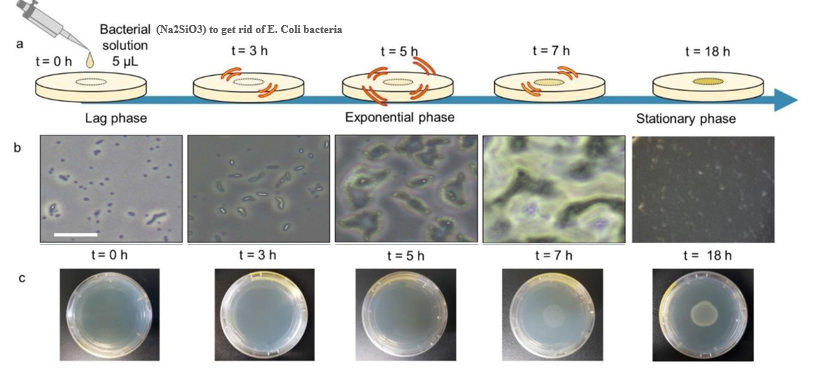
The thermal fusion method is a process that uses high temperatures to fuse or melt substances together. In the case of using sodium silicate (Na2SiO3) to get rid of E. Coli bacteria, the thermal fusion method can be used to create a solid surface that is hostile to the growth of the bacteria as presented in Figure 2.


Real-time monitoring of bacterial growth and rapid antimicrobial susceptibility testing are two important techniques for quickly assessing the effectiveness of antibiotics against bacterial infections. Real-time monitoring involves the use of advanced technologies that allow for the continuous measurement of bacterial growth and the detection of changes in bacterial behavior over time. Rapid antimicrobial susceptibility testing involves the use of innovative methods to quickly determine the susceptibility of bacterial strains to different antibiotics, which can help clinicians to choose the most effective treatment regimen for their patients. Together, these techniques offer powerful tools for the timely diagnosis and treatment of bacterial infections, helping to improve patient outcomes and reduce the spread of antibiotic-resistant bacteria. The results of the final stage that we can observe the thermal fusion method using sodium silicate is a promising approach to getting rid of E. Coli bacteria. The high temperature used in the process creates a solid surface that is hostile to the growth of bacteria, which can be an effective way to prevent contamination in various settings. However, further research is needed to optimize the process and evaluate its efficiency under different conditions.
The proposed method for determining bacterial susceptibility is significantly faster than standard antimicrobial susceptibility testing (AST) methods and commercialized automated systems. While standard AST methods and automated systems take around 16-20 hours and 8 hours respectively, the proposed method can determine bacterial susceptibility in just 2-4.5 hours. This rapidity is attributed to several factors. Firstly, the proposed method utilizes speckles which are sensitive to both amplitude and phase changes induced by bacteria. Bacterial colonies have been reported to exert phase modulation, which makes speckle patterns more sensitive to changes in optical path length in bacterial samples compared to amplitude-dependent detection methods such as camera-vision based AST which takes around 3.5 hours. Secondly, the proposed method averages the response over a large population of bacteria, making it unaffected by individual variations in microorganisms. This approach helps to increase the accuracy and reliability of the results, while also reducing the overall testing time 19. Overall, the proposed method offers a faster and more accurate way to determine bacterial susceptibility, which can help to improve patient outcomes and reduce the spread of antibiotic-resistant bacteria. Further research is needed to optimize and validate the proposed method for routine clinical use.
The increasing pollution of global water sources presents significant challenges for public health, particularly in rural areas where centralized water treatment systems and pipe infrastructure may not be feasible. Detecting and treating a wide range of contaminants in a timely manner is difficult, especially as currently available point-of-use (POU) water supply systems have limited success in dealing with emerging contaminants present at trace concentrations. To address this issue, versatile POU systems capable of detecting and treating contaminants and providing on-demand clean water are needed. Silica nanoparticles offer a potential solution for developing rapid and sensitive water purification processes and sensors due to their strong selectivity and activity toward chemical substrates. After the incubation period, the efficiency of the thermal fusion method can be evaluated by comparing the growth of E. Coli on the treated surface to that of an untreated surface. This can be done by counting the number of colonies on each surface and comparing the results using statistical analysis. Overall, the use of silica nanoparticles in POU systems holds promise for overcoming the challenges of water contamination and improving access to safe and clean drinking water, particularly in rural areas. Further research and development are needed to optimize and validate these systems for practical use in various settings.
| [1] | Qu, X., Brame, J., Li, Q., & Alvarez, P. J. (2013). Nanotechnology for a safe and sustainable water supply: enabling integrated water treatment and reuse. Accounts of chemical research, 46(3), 834-843. | ||
| In article | View Article PubMed | ||
| [2] | Wang, M., Mohanty, S. K., & Mahendra, S. (2019). Nanomaterial-supported enzymes for water purification and monitoring in point-of-use water supply systems. Accounts of chemical research, 52(4), 876-885. | ||
| In article | View Article PubMed | ||
| [3] | Bae, J., & Lynch, M. J. (2023). Ethnicity, poverty, race, and the unequal distribution of US Safe Drinking Water Act violations, 2016-2018. The Sociological Quarterly, 64(2), 274-295. | ||
| In article | View Article | ||
| [4] | Talema, A. (2023). Causes, negative effects, and preventive methods of water pollution in Ethiopia. Quality Assurance and Safety of Crops & Foods, 15(2), 129-139. | ||
| In article | View Article | ||
| [5] | Yadav, M., & Baral, S. K. (2023). Can Asia Accomplish the Sustainable Development Goal for Water and Sanitation by 2030?. In Handbook of Research on Sustainable Consumption and Production for Greener Economies (pp. 198-212). IGI Global. | ||
| In article | View Article | ||
| [6] | Gunipe, P. K., & Das, A. K. (2023). Point of use drinking water filtration: A microfluidic solution providing safe drinking water during flood situation. Journal of Water Process Engineering, 52, 103545. | ||
| In article | View Article | ||
| [7] | Nair, S. S., Marasini, R., Buck, L., Dhodapkar, R., Marugan, J., Lakshmi, K. V., & McGuigan, K. G. (2023). Life cycle assessment comparison of point-of-use water treatment technologies: Solar water disinfection (SODIS), boiling water, and chlorination. Journal of Environmental Chemical Engineering, 11(3), 110015. | ||
| In article | View Article | ||
| [8] | Ying, Y., Wang, D., & Zhao, D. (2023). Two-dimensional material-based membranes for gas separation: current status and future direction. Current Opinion in Chemical Engineering, 40, 100918. | ||
| In article | View Article | ||
| [9] | Kospa, D. A., Gebreil, A., El-Hakam, S. A., Ahmed, A. I., & Ibrahim, A. A. (2023). Multifunctional plasmonic Ag–Cu alloy nanoparticles immobilized on reduced graphene oxide for simultaneous solar-driven steam, wastewater purification, and electricity generation. Journal of Materials Research and Technology, 23, 2924-2939. | ||
| In article | View Article | ||
| [10] | Chen, L., Liu, J., Zhang, Y., Zhang, G., Kang, Y., Chen, A., ... & Shao, L. (2018). The toxicity of silica nanoparticles to the immune system. Nanomedicine, 13(15), 1939-1962. | ||
| In article | View Article PubMed | ||
| [11] | Malafatti, J. O. D., Tavares, F. A., Neves, T. R., Mascarenhas, B. C., Quaranta, S., & Paris, E. C. (2023). Modified Silica Nanoparticles from Rice Husk Supported on Polylactic Acid as Adsorptive Membranes for Dye Removal. Materials, 16(6), 2429. | ||
| In article | View Article PubMed | ||
| [12] | Zargar, M., Hartanto, Y., Jin, B., & Dai, S. (2016). Hollow mesoporous silica nanoparticles: A peculiar structure for thin film nanocomposite membranes. Journal of Membrane Science, 519, 1-10. | ||
| In article | View Article | ||
| [13] | Wang, W., Li, Y., Wang, W., Gao, B., & Wang, Z. (2019). Palygorskite/silver nanoparticles incorporated polyamide thin film nanocomposite membranes with enhanced water permeating, antifouling and antimicrobial performance. Chemosphere, 236, 124396. | ||
| In article | View Article PubMed | ||
| [14] | Song, J., Kong, H., & Jang, J. (2011). Bacterial adhesion inhibition of the quaternary ammonium functionalized silica nanoparticles. Colloids and Surfaces B: Biointerfaces, 82(2), 651-656. | ||
| In article | View Article PubMed | ||
| [15] | Huang, X., Zhou, H., Huang, Y., Jiang, H., Yang, N., Shahzad, S. A., ... & Yu, C. (2018). Silver nanoparticles decorated and tetraphenylethene probe doped silica nanoparticles: A colorimetric and fluorometric sensor for sensitive and selective detection and intracellular imaging of hydrogen peroxide. Biosensors And Bioelectronics, 121, 236-242. | ||
| In article | View Article PubMed | ||
| [16] | Li, H., Huang, X. B., Sun, J. S., Lv, K. H., Meng, X., & Zhang, Z. (2022). Improving the anti-collapse performance of water-based drilling fluids of Xinjiang Oilfield using hydrophobically modified silica nanoparticles with cationic surfactants. Petroleum Science. | ||
| In article | View Article | ||
| [17] | Wu, Z., Sun, D. W., Pu, H., & Wei, Q. (2023). A dual signal-on biosensor based on dual-gated locked mesoporous silica nanoparticles for the detection of Aflatoxin B1. Talanta, 253, 124027. | ||
| In article | View Article | ||
| [18] | Zhang, H., Tong, C., Sha, J., Liu, B., & Lü, C. (2015). Fluorescent mesoporous silica nanoparticles functionalized graphene oxide: a facile FRET-based ratiometric probe for Hg2+. Sensors and Actuators B: Chemical, 206, 181-189. | ||
| In article | View Article | ||
| [19] | Yehia, H. M., & Said, S. M. (2021). Effects of the addition of titanium dioxide; sodium silicate and silica nanoparticles on the elimination of bacteria and viruses in a physical field. Am J Biomed Res, 9(2), 24-29. | ||
| In article | View Article | ||
Published with license by Science and Education Publishing, Copyright © 2023 Hesham Mohamed Abdal-Salam Yehia and Said Mahmoud Said
 This work is licensed under a Creative Commons Attribution 4.0 International License. To view a copy of this license, visit
http://creativecommons.org/licenses/by/4.0/
This work is licensed under a Creative Commons Attribution 4.0 International License. To view a copy of this license, visit
http://creativecommons.org/licenses/by/4.0/
| [1] | Qu, X., Brame, J., Li, Q., & Alvarez, P. J. (2013). Nanotechnology for a safe and sustainable water supply: enabling integrated water treatment and reuse. Accounts of chemical research, 46(3), 834-843. | ||
| In article | View Article PubMed | ||
| [2] | Wang, M., Mohanty, S. K., & Mahendra, S. (2019). Nanomaterial-supported enzymes for water purification and monitoring in point-of-use water supply systems. Accounts of chemical research, 52(4), 876-885. | ||
| In article | View Article PubMed | ||
| [3] | Bae, J., & Lynch, M. J. (2023). Ethnicity, poverty, race, and the unequal distribution of US Safe Drinking Water Act violations, 2016-2018. The Sociological Quarterly, 64(2), 274-295. | ||
| In article | View Article | ||
| [4] | Talema, A. (2023). Causes, negative effects, and preventive methods of water pollution in Ethiopia. Quality Assurance and Safety of Crops & Foods, 15(2), 129-139. | ||
| In article | View Article | ||
| [5] | Yadav, M., & Baral, S. K. (2023). Can Asia Accomplish the Sustainable Development Goal for Water and Sanitation by 2030?. In Handbook of Research on Sustainable Consumption and Production for Greener Economies (pp. 198-212). IGI Global. | ||
| In article | View Article | ||
| [6] | Gunipe, P. K., & Das, A. K. (2023). Point of use drinking water filtration: A microfluidic solution providing safe drinking water during flood situation. Journal of Water Process Engineering, 52, 103545. | ||
| In article | View Article | ||
| [7] | Nair, S. S., Marasini, R., Buck, L., Dhodapkar, R., Marugan, J., Lakshmi, K. V., & McGuigan, K. G. (2023). Life cycle assessment comparison of point-of-use water treatment technologies: Solar water disinfection (SODIS), boiling water, and chlorination. Journal of Environmental Chemical Engineering, 11(3), 110015. | ||
| In article | View Article | ||
| [8] | Ying, Y., Wang, D., & Zhao, D. (2023). Two-dimensional material-based membranes for gas separation: current status and future direction. Current Opinion in Chemical Engineering, 40, 100918. | ||
| In article | View Article | ||
| [9] | Kospa, D. A., Gebreil, A., El-Hakam, S. A., Ahmed, A. I., & Ibrahim, A. A. (2023). Multifunctional plasmonic Ag–Cu alloy nanoparticles immobilized on reduced graphene oxide for simultaneous solar-driven steam, wastewater purification, and electricity generation. Journal of Materials Research and Technology, 23, 2924-2939. | ||
| In article | View Article | ||
| [10] | Chen, L., Liu, J., Zhang, Y., Zhang, G., Kang, Y., Chen, A., ... & Shao, L. (2018). The toxicity of silica nanoparticles to the immune system. Nanomedicine, 13(15), 1939-1962. | ||
| In article | View Article PubMed | ||
| [11] | Malafatti, J. O. D., Tavares, F. A., Neves, T. R., Mascarenhas, B. C., Quaranta, S., & Paris, E. C. (2023). Modified Silica Nanoparticles from Rice Husk Supported on Polylactic Acid as Adsorptive Membranes for Dye Removal. Materials, 16(6), 2429. | ||
| In article | View Article PubMed | ||
| [12] | Zargar, M., Hartanto, Y., Jin, B., & Dai, S. (2016). Hollow mesoporous silica nanoparticles: A peculiar structure for thin film nanocomposite membranes. Journal of Membrane Science, 519, 1-10. | ||
| In article | View Article | ||
| [13] | Wang, W., Li, Y., Wang, W., Gao, B., & Wang, Z. (2019). Palygorskite/silver nanoparticles incorporated polyamide thin film nanocomposite membranes with enhanced water permeating, antifouling and antimicrobial performance. Chemosphere, 236, 124396. | ||
| In article | View Article PubMed | ||
| [14] | Song, J., Kong, H., & Jang, J. (2011). Bacterial adhesion inhibition of the quaternary ammonium functionalized silica nanoparticles. Colloids and Surfaces B: Biointerfaces, 82(2), 651-656. | ||
| In article | View Article PubMed | ||
| [15] | Huang, X., Zhou, H., Huang, Y., Jiang, H., Yang, N., Shahzad, S. A., ... & Yu, C. (2018). Silver nanoparticles decorated and tetraphenylethene probe doped silica nanoparticles: A colorimetric and fluorometric sensor for sensitive and selective detection and intracellular imaging of hydrogen peroxide. Biosensors And Bioelectronics, 121, 236-242. | ||
| In article | View Article PubMed | ||
| [16] | Li, H., Huang, X. B., Sun, J. S., Lv, K. H., Meng, X., & Zhang, Z. (2022). Improving the anti-collapse performance of water-based drilling fluids of Xinjiang Oilfield using hydrophobically modified silica nanoparticles with cationic surfactants. Petroleum Science. | ||
| In article | View Article | ||
| [17] | Wu, Z., Sun, D. W., Pu, H., & Wei, Q. (2023). A dual signal-on biosensor based on dual-gated locked mesoporous silica nanoparticles for the detection of Aflatoxin B1. Talanta, 253, 124027. | ||
| In article | View Article | ||
| [18] | Zhang, H., Tong, C., Sha, J., Liu, B., & Lü, C. (2015). Fluorescent mesoporous silica nanoparticles functionalized graphene oxide: a facile FRET-based ratiometric probe for Hg2+. Sensors and Actuators B: Chemical, 206, 181-189. | ||
| In article | View Article | ||
| [19] | Yehia, H. M., & Said, S. M. (2021). Effects of the addition of titanium dioxide; sodium silicate and silica nanoparticles on the elimination of bacteria and viruses in a physical field. Am J Biomed Res, 9(2), 24-29. | ||
| In article | View Article | ||