This study investigated the quality of three main sources of water used in Nteingue community- a village in Santchou municipality of the Menoua division, West Region of Cameroon, in order to determine its suitability for domestic use following World Health Organisation (WHO) guidelines. Inhabitants of this locality consume water from these sources without any prior treatment, which can result in health problems if the water sources are contaminated. Three water sources: a spring in Plantain market, a tap (harnessed spring) in Nteingue market, and an open well in Nteingue-Mbouteuc quarter were sampled in the dry and rainy seasons of 2022 and examined for organoleptic, physicochemical and bacteriological parameters using standard methods recommended by WHO. Water samples had acceptable organoleptic characteristics except for the spring in the rainy season which was clear with tiny dark debris. Results of physical parameters revealed moderately acidic to neutral waters (5.6-7.2) with low mineral content, dissolved solids and turbidity. All major ions were within the WHO guideline values. There were significant seasonal differences observed in the variations of the concentrations of HCO3- and K+ (p <0.05). The water sources were type in both seasons, which are typical of ground water resources. Sampled waters were also acceptable based on water quality indices, exception being the open well which had a poor quality index in the rainy season. Faecal coliforms and specific bacteria (Escherichia coli, Enterobacter, Streptococcus, Vibrio, Salmonella, Staphylococcus, Streptococcus, and Shigella spp) were identified in all sampled waters, suggesting recent contamination of the sources by human or animal faeces. The sources were unfit for domestic use and thus, exposed the population to water-borne diseases such as typhoid, diarrhoea and dysentery. Hence, home treatment methods such as chlorination, filtration, and boiling should be implemented prior to consumption.
Water is the second most important need for life to exist after air 1. It covers about 80% of the Earth’s surface, but availability of freshwater supply has increasingly become a major problem 2. Access to fresh water remains a major challenge for millions of households on the African continent, and more particularly, those located in its sub-Saharan part; meanwhile, it stands as one of the main objectives for sustainable development 3.
Deficiency in drinking water supply is related to several factors, which include poverty, rural exodus, population growth, current climate change and variability, and lack of investment in the water sector (production, treatment and distribution) 4, 5. Although Africa has abundant sources of fresh water, millions of rural households across the continent do not have access to clean drinking water. This has caused the population to rely on unhealthy water sources which when consumed, causes waterborne diseases such as cholera and diarrhoea, which kills over 2000 under-five children across the globe, every day. Majority of deaths resulting from diarrhoea are said to occur in sub-Saharan Africa 6. Drinking water quality has an impact on health and therefore, the effective monitoring, assessment, and treatment of drinking water sources are important for the wellbeing of the public and to allow the implementation of a preventive approach to manage drinking water quality 7.
National drinking water standards often stipulate the maximum permissible concentration of contaminants in drinking water, and at a global scale, the World Health Organization (WHO) guidelines provide recommendations for managing the risk of hazards that may compromise the safety of drinking water 8.
Today, the major difficulty confronted by Cameroonians is not access to water but more precisely, access to potable water for domestic use. Water-related diseases represent about two-thirds of all diseases in this country; responsible for approximately 50% of death cases recorded annually 9, 10. The level of improved drinking water sources and sanitation facilities in semi-urban and rural communities of the country was placed at 49% (WHO, 2015). In rural areas where conventional water network is absent, the population rely on community taps, surface, and groundwater sources for domestic use. The quality of these sources is largely determined by both natural processes (dissolution and precipitation of minerals, groundwater velocity, quality of recharge waters, and interaction with other types of water aquifers) and anthropogenic activities 2.
Nteingue community is not adequately supplied with good quality water by the national water supply to meet the ever-increasing clean water demand, which is indispensable to the local population's continued existence. The inhabitants are therefore forced to use the available sources which are hand-dug wells, flowing springs, and community taps for domestic purposes. The main spring is surrounded by agricultural farm land and forest. The available taps distributing constructed well water are found in very few quarters, and water from it is sometimes coloured. Most of the wells are shallow, not properly covered, very close to buildings and pit toilets. These sources have the possibility of being contaminated by natural and anthropogenic pollutants. Domestic use of these doubtful water sources may pose a serious health concerns since they may lead to water-borne diseases. Information on the organoleptic, physicochemical, and bacteriological properties of these water sources has not been documented. Therefore, there is the need for proper assessment and monitoring of water from these sources. This study was therefore aimed to examine the physicochemical and bacteriological characteristics of water from three main sources in Nteingue in order to ascertain their suitability for domestic use based on WHO guidelines for drinking water quality.
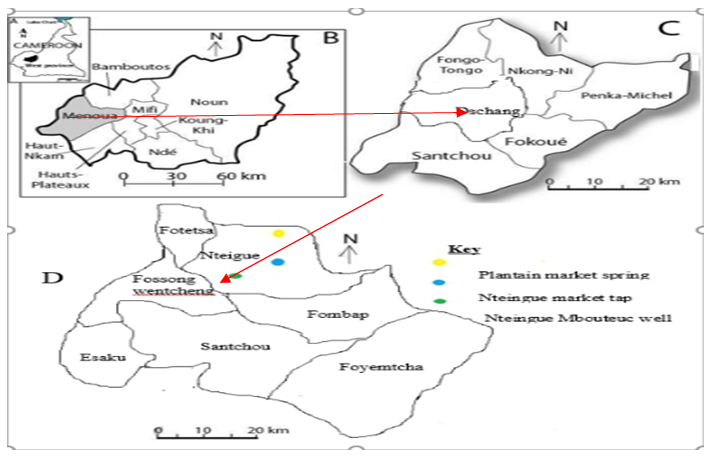
Nteingue is a village in Santchou subdivision of the Menoua division in the West Region of Cameroon. It is situated along the Dschang-Douala highway, some 20 km from Dschang, 9 km from Santchou town, and 182 km from Douala. The land stretches over 12 km2 and culminates at about 1450 m altitude, between the coordinates longitude 10°30'00'' -10°95'00 E and latitude 5°21'00''-5°83'00'' N. It has a population of about 5000 inhabitants. It is bounded by neighboring villages of Santchou sub division; to the North by Fotetsa, to the South by Fomella, to the south West by Fombap, and to the West by Fotochi. 11.
Nteingue is endowed with a rich climate marked by two distinct seasons; the rainy and dry seasons. The rainy season starts from mid-March to mid-November with peaks in August and September. The dry season is from mid-November to mid-March with its peak from December to February, which is common over the southern part of the national territory. Nteingue has the subequatorial climate. The main economic activity of the population is farming. Nteingue village has three natural water resources such as groundwater (springs, wells), surface water (streams and rivers), and rainfall.
2.2. Sample Collection and PreservationWater samples were collected from three main sources (well, natural spring, and harnessed spring(tap)) in Nteingue village (Figure 1). Each water source was sampled twice (dry season and rainy season) in order to investigate the effect of season on the water quality. Sampling points were chosen in relation to their use by the population. The samples were collected using clean and sterilized 0.5 L polyethylene containers which were all labelled as A (spring), B (tap), and C (well). The containers were rinsed with water to be sampled from each source several times before collecting the required sample volume. The collections were done in the morning and the samples were packaged in a cooler containing ice in order to maintain the temperature around 4°C to minimize physicochemical and bacteriological changes. Finally, the samples were transported to the Research Unit of Animal Physiology and Microbiology and Research Unit of Soil Analysis and Environmental Chemistry, in the University of Dschang, Cameroon on that same day for preservation and analyses. A Global Positioning System (GPS) was used to locate the study sites geographically. The coordinates are presented in Table 1.

pH, electrical conductivity (EC), and total dissolved solids (TDS) were determined in situ with a calibrated multimeter, HANNAH198128. Turbidity was measured using a turbidimeter (Model DRT 100B, MF scientific, Inc). Chloride content was determined by the argentometric method. Nitrate and ammonium were determined by Kjeldahl’s distillation method. Phosphate was determined by UV-visible spectrophotometric analysis. Bicarbonate was determined by acid-base titration and sulphate by gravimetric analysis. Ca and Mg ions were determined by complexometric titration, while Na and K were determined by flame photometry. All analyses were done following the methods described by 8 and 12. Total permanent water hardness (TH) expressed as equivalent of  was calculated following formula 1 13.
 | (1) |
Where
TH = Total permanent hardness as  in mg/L.
[Ca2+] = Ca2+ concentration in mg/L.
[Mg2+] = Mg2+ concentration in mg/L.
The interpretation of water type with respect to TH was done by using Table 2.
Water Quality Index (WQI) is one of the most effective tools to monitor surface water as well as ground water pollution and can be used efficiently in the implementation of water quality upgrading programmes 14. The WQI model simplifies the presentation of the results of an analysis related to a water body as it summarises in one value a series of parameters analysed 14. WQI also eases the comparison between different sampling sites and events. WQI was calculated using the weighted Arithmetic Index Method 14, 15. In this study, the parameters used for the calculation of WQI include pH, EC, Turbidity, Na+, K+, Ca2+, Mg2+,


 and
and  . Calculation was done using the WHO standards and the following steps below.
In the first step, the unit weight (𝑊𝑖) for each water quality parameter was determined using the following formula:
 | (2) |
Where
S𝑖 = standard value of 𝑖th parameter recommended by WHO,
𝐾 = proportionality constant which is calculated by using equation 3:
 | (3) |
The inverse of the sum of inverses of standard parameters was used in order to make the parameters expressed by large numbers to weigh less in equation 5. In the second step, a quality rating or sub-index (𝑞𝑖) was computed for each of the parameters using equation 4:
 | (4) |
Where
V𝑖 = estimated value of 𝑖th parameter in the analysed water sample,
𝑉0 = ideal value of this parameter in pure water (it is zero for all parameters except pH = 7.0 and DO = 14.6 mg/L),
S𝑖 = recommended standard value of 𝑖th parameter given by WHO.
In the final step, the overall WQI was calculated by using equation 5:
 | (5) |
A reference WQI table (Table 3) was used to deduce the sampled water status.
Piper trilinear diagrams were drawn using chemical properties to classify the analysed water sources into various hydro-chemical facies 16.
Paired sample T-test was performed at 95% confidence interval to verify if there exist any significant differences in the mean parameters due to seasonal changes or spatial variation, and Pearson correlation was used to verify the relations between parameters. Statistical Package for Social Sciences (SPSS) version 20.0 was used for statistical analysis.
Results of organoleptic parameters showed that all water samples were clean, clear, and colourless for both seasons except sample C that had tiny dark debris in the wet season (Table 4).
The presence of debris in the well is a sign of other contaminants 8 and could be due to atmospheric deposition since it was exposed to the surroundings. This is justified by the high value of turbidity (10.8 NTU) that is above the WHO standard (5 NTU). The good organoleptic properties of most of these sources could be justified by the fact that these are ground waters are naturally filtered as they are recharged by precipitation. All the samples met the WHO requirement for safe drinking water except sample C in the rainy season that will require proper filtration before use. However, at this level, there was no assurance as good domestic water must not only be clean, clear, and odourless according to WHO, but should possess good physical, chemical, and bacteriological qualities 7, 15.
3.2. Physical ParametersPhysical parameters are presented in Table 5.
Water pH varied between 6.8 and 7.2 with a maximum mean of 7.05± 0.21 obtained from the spring source in the dry season (Table 5). The pH of the samples in both seasons were not significantly different (p>0.05). The strong positive correlation observed between pH and E. coli (r = 0.999; p < 0.01) and between pH, Enterobacteria, Streptococcus spp, Salmonella spp and Shigella spp (r = 1, p < 0.01) suggested that bacteria growth in the water sources is highly dependent on pH variations. All pH values were within WHO permissible limits (6.5-8.5). Regarding the health aspect, no extreme pH values which may result in health risk was recorded. Hence, the water sources were acceptable for drinking. The pH values obtained in this study are in disagreement with 6.1-6.6 recorded by 17 in Santchou, a neighbouring town. The study attributed the pH variation in the area to the lithology of the aquifer system as well as hydrogeochemical processes operating in the aquifer.
Electrical conductivity ranged from 30 to 90 μS/cm in the dry season, and 50 to 160 μS/cm in the wet season with a maximum mean value of 125 μS/cm recorded in the well, while TDS ranged between 20.10 and 60.30 mg/L in the dry season and between 33.5 and 107.2 mg/L in the wet season, with a maximum mean value of 83.75±33.16 mg/L in the well (Table 5). No significant differences in mean EC and TDS values were observed between seasons (p>0.05). Low EC and TDS values compared to the WHO guideline values of 1000 μS/cm and 500 mg/L, respectively, suggest low mineralized water with little dissolved solids 18. A strong positive correlation observed between EC and TDS (r1= 1.00, p<0.01) is due to the direct proportional relationship between both parameters, given that TDS arises mainly from inorganic salts in solution 15. Similar low EC and TDS values have been recorded in this area by 17 and 19 and elsewhere in Cameroon by 15 and 20.
Turbidity ranged from 1.1 to 6.5 NTU in the dry season and 0.1 to 10.8 NTU in the wet season with a maximum mean value of 6.05 NTU recorded in the well (Table 5). There were no significant differences in turbidity between seasons (p>0.05). The spring and well had turbidity values of 6.5 NTU and 10.8 NTU in the dry and wet seasons, respectively, that were above the WHO guideline value (5 NTU). High turbidity recorded in the spring during the dry season may be due to reduced or no precipitation, low flow velocity, high temperatures and high evapotranspiration. On the other hand, the increase in turbidity of the well during the wet season could be attributed to the presence of clay and other particulate matter transported by water. Water from these sources were thus of doubtful quality and consequently unfit for human consumption with respect to turbidity, given that the presence of particulate materials contributes to bacteria and viruses’ growth and protects them against disinfection 8, 15. The contribution of turbidity to microbial growth was evident through the strong positive correlation between turbidity, Enterobacteria, Salmonella spp, and Shigella spp (r = 0.99, p<0.01). Maximum turbidity values recorded in this study were low compared to the maximum values of 13.1 NTU and 65.2 NTU reported in this area in the dry and wet seasons, respectively 17.
3.3. Chemical ParametersChemical parameters analysed included major cations (Na+, K+, Ca2+ and Mg2+), major anions (
 ) and nutrients (
 ). A summary of chemical parameters is presented in Table 6.
Sodium ranged from 0.32 to 90 0.80 mg/L in the dry season, and 0.44 to 1.49 mg/L in the wet season with a maximum mean value of 1.15± 0.49 mg/L recorded in the well, though there was no significant difference (p>0.05) in the seasonal variation. The strong negative correlation between sodium and pH (r= -1.00, p<0.01), suggests that acidic water favours the dissolution of this ion from rocks 17. Potassium ranged between 2.19 and 3.15 mg/L in the dry season and between 0.86 and 2.36 mg/L with a maximum mean value of 2.76± 0.56 mg/L also recorded in the well (Table 6), with a significant decrease in mean concentration in the wet season (p<0.05), attributable to the effects of rain 17. All water sources had very low Na+ and K+ concentrations compared to the WHO set standards of 200 mg/L for both ions. Low sodium ions in the sampled waters could be as a result of low sodium in the geological formations of the study area, as it generally originates from the weathering of rock salt like sodium silicate ( ) 8, 15, 20, its common source being the dissolution of Albite (
 ).
).
Low Sodium concentrations could also be attributed to the absence of industrial activity in the study area 8. Similar low sodium has been recorded in the neighbouring Santchou town 17 and elsewhere in Cameroon 24, 25. Although sodium is a necessary dietary component, its low concentration has no health implications as high sodium consumption is a long-term factor responsible for the genesis of arterial hypertension 26. Potassium is one of the most important minerals in the body that helps in regulating fluid’s balance, muscle contractions, and nerve signals. Its low concentration in the studied waters may be due to its low geochemical mobility in the soils 10, 27. The low potassium is in contrast to that recorded by 17 in the neighbouring Santchou town; its possible origin being the disintegration of silicate minerals like orthoclase, microcline, albite and muscovite and improper application of potassium fertilizers and sewage disposal 17. 28 reported potassium concentrations between 5.54 mg/L and 12.82 mg/L in peri urban areas around Mount Cameroon which was attributed to the geology of the area. Relatively low potassium concentrations compared to 17 have equally been recorded in other African countries 21, 29.
Calcium and magnesium are the primary ions responsible for water hardness. Calcium ion concentrations ranged from 18.80 to 21.20 mg/L in the dry season and 23.00 to 31.80 mg/L in the wet season with a maximum mean value of 25.70± 8.63 mg/L recorded in the spring, while  ranged from 4.93 to 18.54 mg/L in the dry season and 7.30 to 22.54 mg/L in the wet season with a maximum mean value of 20.54±2.83 mg/L recorded in the well.
  and
and  did not vary significantly with season (p > 0.05).
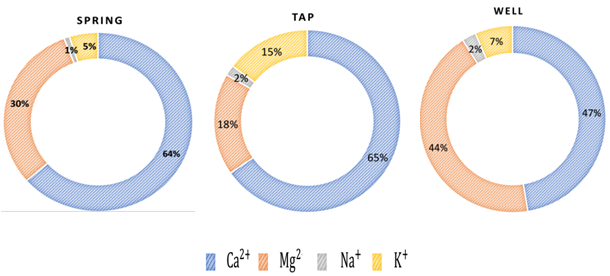
The relative abundance of the major cations was as follows:  >
>  >
>  >
>  (Figure 2). The presence of
  and
and  as dominant cations suggests the occurrence of limestone and chalk sediments in the study area 26. Both ions may also originate from igneous rocks, particularly basalts 30, their main source being the weathering of calco-sodic feldspar, olivine, pyroxene, and hornblende in the basic rock 31, 32, 33.
Based on the WHO guideline values of 75 mg/L and 30 mg/L for calcium and magnesium ions, respectively, the sampled waters were all fit for human consumption. However, the total hardness (TH) in mg/L as  showed that the well in both seasons and the spring in the wet season were hard (120 mg/L ≤TH<180 mg/L), while the spring in the dry season and tap in the wet season were moderately hard (60 mg/L≤TH < 120 mg/L) (Table 7).
Calcium concentrations have been recorded within the same range in ground water in the neighbouring Santchou town by 17. However, the study recorded very high concentrations of magnesium ranging between 68.9 and 262.5 mg/L in the dry season. Though some consumers may tolerate total hardness in excess of 500 mg/L, it should be noted that excess intakes of calcium have been associated with increased risk of nephrolithiasis (kidney stones) 20. Moreover, drinking water with high magnesium content will have a laxative effect 26. In addition, water with hardness above 200 mg/L will lead to lathering impairment in laundry and bathing and 26, 34.
Ammonium ions ranged from 2.70 to 9.24 mg/L in the dry season and 0.25 to 0.61 mg/L in the wet season with a maximum mean of 4.98± 6.06 mg/L recorded in the tap, without any significant differences between mean values of seasons (p>0.05). Ammonium ions in the waters could be from biological breakdown of domestic and agricultural wastes; thus, indicating bacterial, sewage, and animal waste contamination from nearby farms and homes 26. However, the concentrations were far below the permissible limit of 30 mg/L set by the WHO. Ammonium concentrations recorded are in accordance with values recorded by 35 in the ground waters of Bamenda, and 21 in Treichville municipality (Abidjan, Côte d’Ivoire). Contrarily, 36 reported very high ammonium concentrations in groundwater in Lomé, Togo, attributed to contamination from sources such as pit latrines, dumpsites, septic tanks, sewer leakage, sewage effluent, and sewage sludge.

The concentration of  ranged from 48.80 to 91.50 mg/L in the dry season and 122.0 to 128.10 mg/L in the rainy season with a maximum mean of 109.0± 25.88 mg/L and recorded in the spring. Mean
  concentrations significantly increased in the wet season (p<0.05).
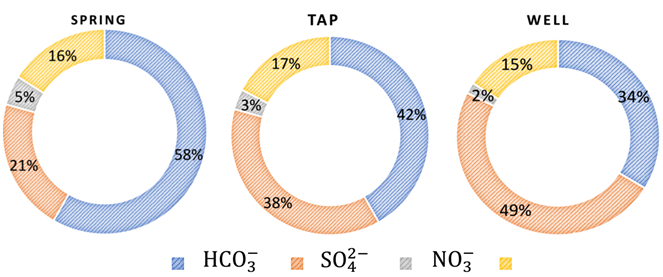
The relative abundance of the major anions in the water sources were as follows:  >
>  >
>  in the spring and tap and
  >
>  >
>  in the well (Figure 3). Bicarbonate was the most abundant anion in the waters. Its presence in the water sources could be as the result of the partitioning of CO2 from the atmosphere in the wet season 37 and the weathering of iron rich minerals such as olivine 38. However, the concentrations were very low compared to the WHO guideline value of 1000 mg/L, indicating that the water sources are of good quality with respect to bicarbonate concentration. The low content of these sources is possibly due to the process of auto-purification of water. 18 Also recorded HCO3- values between 2.5 and 91.1 mg/L in some bore holes and wells, which were associated with its possible igneous origin. 11 made a similar observation but with the exception of one point (well) with bicarbonate content as high as 1200 mg/L in the Dschang municipality. HCO3- is necessary as it constitutes an important buffer system which helps in lowering the acidity of water 39.
Sulphate ranged from 30.5 to 100.5 mg/L in the dry season and 48.5 to 164.0 mg/L in the wet season with a maximum mean concentration of 132.25± 44.90 mg/L recorded in the well. Mean sulphate did not vary significantly with season (p>0.05). The presence of sulphate in water can be as a result of acid rain, the dissolution of evaporitic sedimentary rocks such as gypsum (CaSO4.2H2O) and pyrite(FeS), and the use of artificial fertilizer and detergents 11. All samples had sulphate concentrations below the permissible limit (250 mg/L) and therefore posed no health risk to consumers.
The nitrate concentration ranged from 4.96 to 12.40 mg/L in the dry season and 4.98 to 5.21 mg/L in the rainy season with a maximum average value of 8.81± 5.08mg/L. There was no significant difference in nitrate concentration between seasons (p>0.05). The main sources of nitrate in groundwater could be attributed to agricultural practices such as the application of nitrogenous fertilizers and manures, wastewater disposal, leaching from natural vegetation and seepage from latrines, pit toilets or septic tanks. Interest is centred on nitrate mostly because high nitrate levels in waters have been reported to be responsible for the "blue baby" syndrome (methaemoglobinaemia) and typhoid effects 26. Similar low nitrates have been recorded in this area by 17. The nitrate concentrations were below the WHO permissible limit (50 mg/L). Therefore, with respect to nitrate, all sources in both seasons pose no health hazards.
Chloride concentrations ranged from 24.85 to 53.25 mg/L in the dry season and from 31.95 to 35.5 mg/L in the wet season with a maximum mean value of 42.66± 15.06 mg/L recorded in the well. Chloride concentrations did not vary significantly with season. The concentrations were far below the WHO guideline value of 250 mg/L, indicating no  pollution. Low
 suggest low minerals such as sodalite, apatite, feldspathoids, and halite in the study area, as
  is naturally leached from these minerals into soil and water by weathering 23, 40. Low
  had been recorded elsewhere in Cameroon 30, 33, 39, 41. However, 17 recorded relatively high chloride values in this area with some values above the WHO guideline value.
Phosphate ranged from 0.01 to 0.04 mg/L in the dry season and was non-detectable in the wet season. The concentrations were below the WHO limits of 5 mg/L. The presence of phosphate in water could result from natural decomposition of rocks and minerals, erosion, and sedimentation 42. Its low concentration in the dry season and its absence in the wet season could be due to its sorption to organic colloids. Phosphate’s concentrations recorded in this study are in agreement with the findings of 17 in this area.

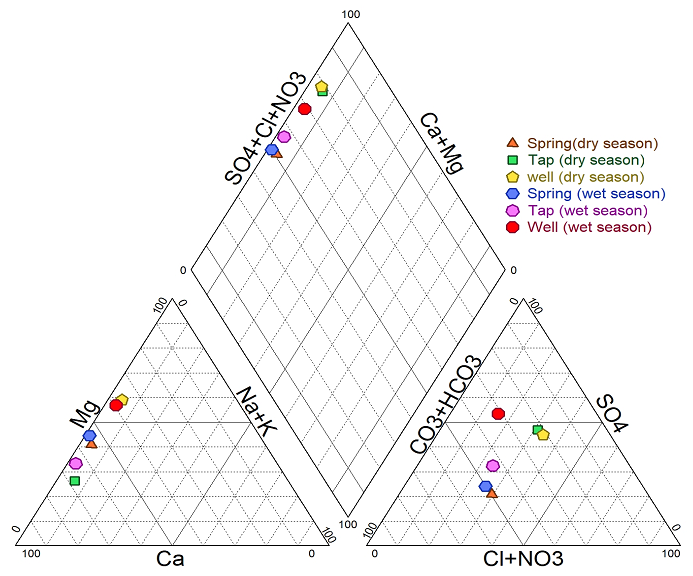
The concentrations (mg/L) of the major cationic and anionic constituents of the water samples were plotted on a Piper trilinear diagram to determine the water types (Figure 4). The ternary diagram in the lower left section representing cations showed that alkaline earth metal ions,  exceeded alkali metal ions,
  . Meanwhile, the ternary diagram in the lower right representing anions showed no dominant anions in the waters in both seasons. The dominance of calcium and magnesium in groundwater samples suggested an inverse ion exchange process during which Ca from the aquifer matrix was exchanged by Na from the groundwater 43. The plot of physicochemical data on the diamond-shaped trilinear diagram, which is a matrix transformation of the two ternary diagrams, revealed that the waters were
  type in both seasons, which are typical of ground waters.

The Water Quality Index (WQI) values and the status of water quality for the water samples are presented in Table 8. Based on the computed WQI, the tap in both seasons, spring in the wet season and well in the dry season were excellent (grade A, WQI<50), while the spring was good in the dry season (grade B) and well graded as poor in the rainy season (grade C). It is important to note that WQI may not convey sufficient information about the real quality situation of water since the covering or overstressing of a single bad parameter value can give deceptive information about the water quality. Moreover, the bacteriological quality, which is not included in the calculations, limits the applicability of WQI. This is because water with excellent WQI grade but having poor bacteriological quality will still be unsuitable for consumption.
Bacteriological analysis revealed the presence of faecal coliforms in all water sources, with the most probable numbers ranging from 03 to 40/100 mL in the dry season and 10 to 35/100 mL in the rainy season (Table 9). Specific analyses led to the isolation of specific bacteria such as Enteroibacteria, E. coli, Streptococcus spp, Salmonella spp, Shigella spp, and Staphylococcus spp, with colony counts in the following ranges: Enterobacteria (05 – 88 CFU/mL in the dry season and 15 – 60 CFU/mL in the rainy season), E. coli (03 – 40 CFU/mL in the dry season and 10 – 35 CFU/mL in rainy season), Streptococcus (02 – 10 CFU/mL in the dry season and 05 – 20 CFU/mL in rainy season), Salmonella (00 – 20 CFU/mL in the dry season and 00 – 10CFU/mL in rainy season), Shigella (00– 01 CFU/mL in the dry season and 00-05 CFU/mL in rainy season) and Staphylococcus (03–15 CFU/mL in the dry season and 05 – 10 CFU/mL in rainy season) as shown in Table 10. There were no significant differences in the mean colony counts of bacteria between the two seasons (p>0.05).
Based on classifications 44, the spring showed a high risk during both seasons and was thus unacceptable (category C), the tap was acceptable as the risk was minimal (Category B) in both seasons while the well which showed low risk in the dry season, was unacceptable in the rainy season.
The presence of faecal coliforms and E. coli - indicators of faecal pollution, and other specific pathogenic bacteria suggest recent contamination of water sources by human or animal faeces. Given that faecal coliforms such as E. coli are prevalent in the digestive tracts of warm-blooded animals, their presence in water is definite evidence of faecal contamination 40. A similar observation was made by 45 in some selected communities in South-western Nigeria.
World Health Organisation (WHO) guidelines recommend no bacteria of faecal origin in drinking water. Thus, all sources were unfit for domestic uses such as drinking and bathing and may have little or no effect on cooking if the water is boiled above 70°C for more than 30 minutes. However, looking at the level of contamination, some sources were acceptable for consumption (category B). Comparable faecal coliform counts have equally been recorded in this area 17 and 19, in other parts of Cameroon by 15, 20, 25, 33, 39, 46, 47 and elsewhere in Africa by 36, 48. 49 also reported high faecal coliforms in 83% of untreated water sources in Brazil, which was associated with leachate from animal manure.
The water samples had acceptable organoleptic characteristics except for the spring in the rainy season which was clear with tiny dark debris. The waters ranged from moderately acidic to weakly basic, having low mineral content and little dissolved solids. All major ions were within the WHO acceptable limits, thus suggesting no health risk to consumers. However, the spring source in the dry season and well in both seasons were hard, The waters were  type in both seasons, which are typical of ground water. The waters were also acceptable based on water quality indices, the exception being the well which had poor quality in the wet season. Concerning the bacteriological quality, all samples had very high contents of faecal coliforms and pathogenic bacteria that justified the bad quality of these sources. This could be associated to poor hygiene and sanitation as well as poor source management and farming activities. The population is thus, exposed to water-borne diseases such as typhoid, diarrhoea and dysentery. On a general view, the water samples presented little or no health risk as far as organoleptic and physicochemical parameters were concerned. The great worry came from bad bacteriological quality with values above the WHO recommended limit (00 CFU/mL) for drinking water. Thus, home treatment of water such as chlorination, filtration, or boiling is required before consumption.
Relevant data are available for consultation if needed.
The authors declare that there are no conflicts of interest regarding the publication of this article.
Enormous thanks to the local authorities and inhabitants of Nteingue community for permitting us to carry out this research on their water sources and for the information they provided. All technicians of the Research Unit of Animal Physiology and Microbiology and Research Unit of Soil Analysis and Environmental Chemistry (RUSAEC), University of Dschang, Cameroon, are acknowledged for helping in the laboratory analysis.
| [1] | Spellman, F. R, “Handbook of water and wastewater treatment plant operations,” CRC press, 2013. | ||
| In article | View Article | ||
| [2] | Shigut, D. A., Liknew, G., Irge D. D. & Ahmad, T. “Assessment of physico-chemical quality of borehole and spring water sources supplied to Robe Town, Oromia region, Ethiopia,” Applied Water Science, 7(1). 155-164. 2017. | ||
| In article | View Article | ||
| [3] | Mfonka, Z., Ndam, J. R. N., Kpoumie, A., Ndjigui, P. D., Zammouri, M., Ngouh, A. N. and Rakotondrabe, F, “Hydrodynamic and groundwater vulnerability assessment of the shallow aquifer of the Foumban locality (Bamoun plateau, Western-Cameroon),” Arabian Journal of Geosciences, 12(5). 1-23. 2019. | ||
| In article | View Article | ||
| [4] | Njoyim, E.B.T., Nchofua, F.B., Mofor, N.A. and Djoko, Y.T, ‘‘Contrôle de la qualité des eaux domestiques dans le village Babessi au Nord-Ouest Cameroon,’’ International Journal of Biological and Chemical Science, 10(3). 1382-1402. 2016. | ||
| In article | View Article | ||
| [5] | Ndam, N. J. R., Dzana, J. G., Kpoumie, A., Ghogomu, R. T., Fouepe, T. A., Braun, J. J. and Ekodeck, G. E, “Present-day sediment dynamics of the Sanaga catchment (Cameroon): from the total suspended sediment (TSS) to erosion balance,” Hydrological Sciences Journal, 61(6). 1080-1093. 2016. | ||
| In article | View Article | ||
| [6] | Speak Up Africa, ‘‘As Africa battles COVID-19, over 300 million Africans beg for clean water,’’ African Journal of Science and Technology, 12(5). 18-19. April 2020. | ||
| In article | |||
| [7] | Durmishi, B.H., Ismaili, M., Shabani, A. and Abduli, S. “Drinking Water Quality Assessment in Tetova Region,” American Journal of Environmental Sciences, 8(2). 162-169. 2012. | ||
| In article | View Article | ||
| [8] | World Health Organization, “Guidelines for drinkingwater quality: incorporating the first and second addenda,” WHO Library Cataloguing-in-Publication Data, Geneva, Switzerland, 2022. | ||
| In article | |||
| [9] | Katte, V. Y., Fonteh, M. F. and Guemuh, G. N, “Domestic water quality in urban centres in Cameroon: a case study of Dschang in the West Province”, African Water Journal, 1. 43-51. 2003. | ||
| In article | |||
| [10] | Wirmvem, M. J., Fantong, W. Y., Wotany, E. R., Takeshi O. and Ayonghe, S. N, “Sources of bacteriological contamination of shallow groundwater and health effects in Ndop plain, Northwest Cameroon,” Journal of Environmental Science and Water Resources, 2. 127-132. 2013. | ||
| In article | |||
| [11] | Tsanga, R., Mvondo, S. A., Lescuyer, G., Aty, R. E. and Béligné, V, “ Gestion décentralisée des ressources forestières : revue des initiatives de foresterie communale dans les pays membres de la COMIFAC ”, Les politiques de décentralisation au Cameroun, Fondation paul Ango Eh, L’Harmattan, Yaoundé, Cameroun, 2013. | ||
| In article | |||
| [12] | Rodier, J., Legube, B., Merlet, N., Mialocq, J. C., Leroy, P., Lavison, G., Bechemin, C. and Vincent, M, “L'analyse de l'eau” 9e édition. Dunod, Hachette Livre, Paris, France, 2009. 1579 pages. | ||
| In article | |||
| [13] | Todd, D. K., “Groundwater hydrology,” 2nd edition, Wiley-Interscience, Wiley and sons, New York, USA, 1980. 552 pages. | ||
| In article | |||
| [14] | Brown, R. K., McClelland, N. I., Deininger R. A., and Tozer, R. G, “Water quality Index-do we care?” Water Sewage Works, 117. 339-343. 1970. | ||
| In article | |||
| [15] | Mofor, N. A., Njoyim, E. B. T. and Mvondo-Zé, A. D., “Quality assessment of some springs in the Awing community, Northwest Cameroon, and their health implications,” Journal of Chemistry, 2017, 1-11. 2017. | ||
| In article | View Article | ||
| [16] | Piper, A. M., “Groundwater Notes 12: A graphic procedure in the geochemical interpretation of water analyses,” Transactions American Geophysicists Union, 25. 914-928. 1944. | ||
| In article | View Article | ||
| [17] | Magha, A. M., Tita, M. A., Tamfuh, P.A., Nyangang, A.J., Njei, A.G. and Kamgang, K. V. B, “Physico-chemical and Bacteriological Characterization of Groundwater for Domestic and Irrigation Purposes in Santchou (Cameroon Western Highlands),” American Journal of Environmental Protection, 11(3). 62-73. 2022. | ||
| In article | View Article | ||
| [18] | Wirmvem, M. J., Ohba, T., Fantong, W. Y., Ayonghe, S. N., Suila, J. Y., Asaah, A. N. E. and Hell, J. V, “Hydrochemistry of shallow groundwater and surface water in the Ndop plain, North West Cameroon” African Journal of Environmental Science and Technology,” 7(6). 518-530. 2013. | ||
| In article | |||
| [19] | Temgoua, E., “Chemical and bacteriological analysis of drinking water from alternative sources in the Dschang municipality, Cameroon” Journal of Environmental Protection, 2. 620-628. 2011. | ||
| In article | View Article | ||
| [20] | Biosengazeh, N. F., Mofor, N. A., Tamungang, N. E. B. and Mvondo-Ze, A. D, “Assessment of Ground Water Quality in Baba I Village, North-West Cameroon,” Journal of Geoscience and Environment Protection, 8. 87-104. 2020. | ||
| In article | View Article | ||
| [21] | Kouassi, D. K., Kouame, I. K., Kof, K., Douagui, A. G., Sandu. A. V. and Sandu, I, “Assessment of the quality of quaternary groundwater under the influence of anthropogenic activities in the low‑income neighbourhoods of the Treichville municipality (Abidjan, Côte d’Ivoire),” SN Applied Sciences, 2. 19 pages, 2020. | ||
| In article | View Article | ||
| [22] | Anazawa, K. and Ohmori, H, “The hydrochemistry of surface waters in andesitic volcanic area, Norikura volcano, central Japan” Chemosphere, 59. 605-615. 2005. | ||
| In article | View Article PubMed | ||
| [23] | Njoyim, I. K., Kengni, L., Tamen, J., Awah, T. M. and Njoyim, E. B. T, “Spring quality assessment and effects on the health of inhabitants of Santa Sub-Division, North West Region. Cameroon,” International Journal of Biological and Chemical Sciences, 13. 2894-2913. 2019. | ||
| In article | View Article | ||
| [24] | Niba, M. L. F., T. Fonkou and C. M. Lambi, “Spatio-Temporal Assessment of Water Quality in Douala IV Municipality, Cameroon,” Journal of Water Resource and Protection, vol. 11, pp. 1441-1461, 2019. | ||
| In article | View Article | ||
| [25] | F.B. Nchofua, E.B.T, Njoyim., N.A. Mofor., A.D. Mvondo-ze, ‘‘Analysis and Water Quality Control of Alternative Sources in Bangolan, Northwest Cameroon,’’ Journal of chemistry, Vol. 2020, Article ID 5480762,13 pages, 2020. | ||
| In article | View Article | ||
| [26] | World Health Organization, “Guidelines for drinking-water quality, 4th edition incorporating the first Addendum,” WHO Library Cataloguing-in-Publication Data. 20 Avenue Appia, 1211 Geneva 27, Switzerland, 2017. | ||
| In article | |||
| [27] | Hem, H. D., “Study and interpretation of the chemical characteristics of natural waters,” 3rd edition, Water-Supply Paper, U.S. Geological Survey, Washington D.C, USA, 263 pages. 1989. | ||
| In article | |||
| [28] | Ajonina, U. P., Ediamam, G. E., Ajonina, G. N. and Atiekum, E. Z., “Evaluating Drinking Water Quality from Various Sources in a Peri Urban Area on the North Eastern flank of Mount Cameroon” American Journal of Water Resources, 8(5). 211-217. 2020. | ||
| In article | |||
| [29] | Ogbeifun, D. E., Archibong, U. D., Chiedu, I. E. and Ikpe, E. E, “Assessment of the water quality of boreholes in selected areas in Benin city, Edo State, Nigeria,” Chemical Science International Journal, 28(2). 13 pages. 2019. | ||
| In article | View Article | ||
| [30] | Lumnwi, M., Fantong, W. Y. and Ayonghe, S. N., “Challenges of potable water supply management in Bafut Sub-Division, North West region of Cameroon,” International Journal of Research - Granthaalayah, 6. 256-273. 2018. | ||
| In article | View Article | ||
| [31] | Marzoli, A., Piccirillo, E.M., Renne, P.R., Bellien, G., Facumin, G.M., Nyobe, J. and Tongwa, A.T, “The CVL Revisited: petrogenesis of continental basaltic mangmas form lithospheric and asthenospheric mantle sources”, Journal of petrology, 41. 87-109. 2000. | ||
| In article | View Article | ||
| [32] | Snorri, G., “Experimental weathering rates of aluminium-silicates. Geochemistry ”. Ph.D thesis, Université Paul Sabatier - Toulouse III, Toulouse, France, 221 pages. 2013. | ||
| In article | |||
| [33] | Magha, A., Awah, M. T., Kouankap, G. D., Wotchoko, N. P., Tabot, A. M. and Kabeyene, V. K., “Physico-chemical and bacteriological characterization of spring and well water in Bamenda III (NW Region, Cameroon),” American Journal of Environmental Protection, 4. 163-173. 2015. | ||
| In article | View Article | ||
| [34] | Kuhn, A., Lesufi, W.N. and Oelofse, A . P. M, “Quality of domestic water supply,” Assessment guide, Water Research Commission, 104 pages. 2001. | ||
| In article | |||
| [35] | Akoanung, A. A., Endene, E., Enoh, J. F. and Akoachere, R. A, “Assessment of groundwater quality in Bamenda–Cameroon for suitable applications,” SN Applied Sciences, 1. 1-20. 2019. | ||
| In article | View Article | ||
| [36] | Akpataku, K. V., Gnazou, M. D. T., Nomesi, T. Y. A, Nambo, P., Doni, K., Bawa, L. M. and Boundjou G. D, “Physicochemical and microbiological quality of shallow groundwater in Lomé, Togo,” Journal of Geoscience and Environment Protection, 8. 162-179. 2020. | ||
| In article | View Article | ||
| [37] | Karanth, K.R., “Groundwater assessment: Development and management,” Tatamc Grawl Hill publishing company limited, 7 west patel Nagar, New Delhi, India. 488 pages. 1987. | ||
| In article | |||
| [38] | Earle, S., “Physical geology,” BCcampus OpenEd, Vancouver, Canada, 630 pages. 2015. | ||
| In article | |||
| [39] | Njoyim, E. B. T., Menga, T. R., Mofor, N. A., Nchofua, F. B. and Njoyim, I. K., “Evaluation of surface and ground water quality in the Bangangte Municipality-West Cameroon,” International Journal of Research and Review in Applied Sciences, 28(2). 53-64. 2016. | ||
| In article | |||
| [40] | World Health Organization, “Guidelines for drinking-water quality,” 2nd edition, WHO Library Cataloguing-in-Publication Data, 20 Avenue Appia, 1211 Geneva 27, Switzerland, 990 pages. 1996. | ||
| In article | |||
| [41] | Nzeket, A. B., Moyo, K. B., Aboubakar, A., Youdom, Y. A. S., Moussima, Y. D. A., Zing Zing, B., Sulem, Y. N. N., Mama, A. C. and Mfopou, M. Y. C., “Assessment of Physicochemical and Heavy Metal Properties of Groundwater in Edéa (Cameroon),” American Journal of Water Resources, 7. 1-10. 2019. | ||
| In article | View Article | ||
| [42] | Singh, M. R. and Gupta, A, “Water pollution-sources, effects and control,” Centre for Biodiversity, Department of Botany, Nagaland University, 2016. | ||
| In article | |||
| [43] | Kumar, P. J. S, “Interpretation of groundwater chemistry using piper and chadha´s diagrams: a comparative study from perambalur taluk,” Elixir Geoscience, 54. 12208-12211. 2013. | ||
| In article | |||
| [44] | Cheesbrough, M, “Medical laboratory manual for tropical countries: Microbiology, tropical health technology,” Cambridge University Press, Cambridge, UK, 479 pages. 1984. | ||
| In article | |||
| [45] | Bisi-Johnson, M. A., Adediran, K. O., Akinola, S. A., Popoola, E. O. and Okoh, A. I, “Comparative Physicochemical and microbiological qualities of source and stored household waters in some selected communities in Southwestern Nigeria,” Sustainability, 9. 1-11. 2017. | ||
| In article | View Article | ||
| [46] | Njoyim, E. B. T., Mofor, N. A., Niba, M. L. F and Sunjo, J., “Physicochemical and bacteriological quality assessment of the Bambui community drinking water in the North West Region of Cameroon” African Journal of Environmental Science and Technology, 10. 181-191. 2016. | ||
| In article | |||
| [47] | Djaouda, M., Lecké, A., Maïné, M. K., Wadoubé, Z., Liang, S., Nola, M. and Njiné, T, “Assessment of bacteriological quality of groundwater from boreholes in Maroua (Far North Cameroon),” International Journal of Biological and Chemical Sciences, 12(2). 958-974. 2018. | ||
| In article | View Article | ||
| [48] | Loko, S., Ahoussi, K. E., Koffi, B. Y., Kakou, N. F., Kouassi, A. M. and Biemi, J, “Microbiological and physico-chemical quality of groundwater from artisanal sites of mining exploitation in the South-West of Côte d’Ivoire: case of the area of Hiré,” International Journal of Scientific & Engineering Research, 4. 567-574. 2013. | ||
| In article | |||
| [49] | Nogueira, G., Nakamura, C. V., Tognim, M. C. B., Filho, B. A. A. and Filho, B. P. D., “Microbiological quality of drinking water of urban and rural communities, Brazil,” Revista de Saúde Pública, 37. 232-236. 2003. | ||
| In article | View Article PubMed | ||
Published with license by Science and Education Publishing, Copyright © 2023 Mofor Nelson Alakeh, Mbene Kenneth, Njoyim Estella Buleng Tamungang, Nchofua Festus Biosengazeh and Nkemajen Eugene Asongafac
 This work is licensed under a Creative Commons Attribution 4.0 International License. To view a copy of this license, visit
http://creativecommons.org/licenses/by/4.0/
This work is licensed under a Creative Commons Attribution 4.0 International License. To view a copy of this license, visit
http://creativecommons.org/licenses/by/4.0/
| [1] | Spellman, F. R, “Handbook of water and wastewater treatment plant operations,” CRC press, 2013. | ||
| In article | View Article | ||
| [2] | Shigut, D. A., Liknew, G., Irge D. D. & Ahmad, T. “Assessment of physico-chemical quality of borehole and spring water sources supplied to Robe Town, Oromia region, Ethiopia,” Applied Water Science, 7(1). 155-164. 2017. | ||
| In article | View Article | ||
| [3] | Mfonka, Z., Ndam, J. R. N., Kpoumie, A., Ndjigui, P. D., Zammouri, M., Ngouh, A. N. and Rakotondrabe, F, “Hydrodynamic and groundwater vulnerability assessment of the shallow aquifer of the Foumban locality (Bamoun plateau, Western-Cameroon),” Arabian Journal of Geosciences, 12(5). 1-23. 2019. | ||
| In article | View Article | ||
| [4] | Njoyim, E.B.T., Nchofua, F.B., Mofor, N.A. and Djoko, Y.T, ‘‘Contrôle de la qualité des eaux domestiques dans le village Babessi au Nord-Ouest Cameroon,’’ International Journal of Biological and Chemical Science, 10(3). 1382-1402. 2016. | ||
| In article | View Article | ||
| [5] | Ndam, N. J. R., Dzana, J. G., Kpoumie, A., Ghogomu, R. T., Fouepe, T. A., Braun, J. J. and Ekodeck, G. E, “Present-day sediment dynamics of the Sanaga catchment (Cameroon): from the total suspended sediment (TSS) to erosion balance,” Hydrological Sciences Journal, 61(6). 1080-1093. 2016. | ||
| In article | View Article | ||
| [6] | Speak Up Africa, ‘‘As Africa battles COVID-19, over 300 million Africans beg for clean water,’’ African Journal of Science and Technology, 12(5). 18-19. April 2020. | ||
| In article | |||
| [7] | Durmishi, B.H., Ismaili, M., Shabani, A. and Abduli, S. “Drinking Water Quality Assessment in Tetova Region,” American Journal of Environmental Sciences, 8(2). 162-169. 2012. | ||
| In article | View Article | ||
| [8] | World Health Organization, “Guidelines for drinkingwater quality: incorporating the first and second addenda,” WHO Library Cataloguing-in-Publication Data, Geneva, Switzerland, 2022. | ||
| In article | |||
| [9] | Katte, V. Y., Fonteh, M. F. and Guemuh, G. N, “Domestic water quality in urban centres in Cameroon: a case study of Dschang in the West Province”, African Water Journal, 1. 43-51. 2003. | ||
| In article | |||
| [10] | Wirmvem, M. J., Fantong, W. Y., Wotany, E. R., Takeshi O. and Ayonghe, S. N, “Sources of bacteriological contamination of shallow groundwater and health effects in Ndop plain, Northwest Cameroon,” Journal of Environmental Science and Water Resources, 2. 127-132. 2013. | ||
| In article | |||
| [11] | Tsanga, R., Mvondo, S. A., Lescuyer, G., Aty, R. E. and Béligné, V, “ Gestion décentralisée des ressources forestières : revue des initiatives de foresterie communale dans les pays membres de la COMIFAC ”, Les politiques de décentralisation au Cameroun, Fondation paul Ango Eh, L’Harmattan, Yaoundé, Cameroun, 2013. | ||
| In article | |||
| [12] | Rodier, J., Legube, B., Merlet, N., Mialocq, J. C., Leroy, P., Lavison, G., Bechemin, C. and Vincent, M, “L'analyse de l'eau” 9e édition. Dunod, Hachette Livre, Paris, France, 2009. 1579 pages. | ||
| In article | |||
| [13] | Todd, D. K., “Groundwater hydrology,” 2nd edition, Wiley-Interscience, Wiley and sons, New York, USA, 1980. 552 pages. | ||
| In article | |||
| [14] | Brown, R. K., McClelland, N. I., Deininger R. A., and Tozer, R. G, “Water quality Index-do we care?” Water Sewage Works, 117. 339-343. 1970. | ||
| In article | |||
| [15] | Mofor, N. A., Njoyim, E. B. T. and Mvondo-Zé, A. D., “Quality assessment of some springs in the Awing community, Northwest Cameroon, and their health implications,” Journal of Chemistry, 2017, 1-11. 2017. | ||
| In article | View Article | ||
| [16] | Piper, A. M., “Groundwater Notes 12: A graphic procedure in the geochemical interpretation of water analyses,” Transactions American Geophysicists Union, 25. 914-928. 1944. | ||
| In article | View Article | ||
| [17] | Magha, A. M., Tita, M. A., Tamfuh, P.A., Nyangang, A.J., Njei, A.G. and Kamgang, K. V. B, “Physico-chemical and Bacteriological Characterization of Groundwater for Domestic and Irrigation Purposes in Santchou (Cameroon Western Highlands),” American Journal of Environmental Protection, 11(3). 62-73. 2022. | ||
| In article | View Article | ||
| [18] | Wirmvem, M. J., Ohba, T., Fantong, W. Y., Ayonghe, S. N., Suila, J. Y., Asaah, A. N. E. and Hell, J. V, “Hydrochemistry of shallow groundwater and surface water in the Ndop plain, North West Cameroon” African Journal of Environmental Science and Technology,” 7(6). 518-530. 2013. | ||
| In article | |||
| [19] | Temgoua, E., “Chemical and bacteriological analysis of drinking water from alternative sources in the Dschang municipality, Cameroon” Journal of Environmental Protection, 2. 620-628. 2011. | ||
| In article | View Article | ||
| [20] | Biosengazeh, N. F., Mofor, N. A., Tamungang, N. E. B. and Mvondo-Ze, A. D, “Assessment of Ground Water Quality in Baba I Village, North-West Cameroon,” Journal of Geoscience and Environment Protection, 8. 87-104. 2020. | ||
| In article | View Article | ||
| [21] | Kouassi, D. K., Kouame, I. K., Kof, K., Douagui, A. G., Sandu. A. V. and Sandu, I, “Assessment of the quality of quaternary groundwater under the influence of anthropogenic activities in the low‑income neighbourhoods of the Treichville municipality (Abidjan, Côte d’Ivoire),” SN Applied Sciences, 2. 19 pages, 2020. | ||
| In article | View Article | ||
| [22] | Anazawa, K. and Ohmori, H, “The hydrochemistry of surface waters in andesitic volcanic area, Norikura volcano, central Japan” Chemosphere, 59. 605-615. 2005. | ||
| In article | View Article PubMed | ||
| [23] | Njoyim, I. K., Kengni, L., Tamen, J., Awah, T. M. and Njoyim, E. B. T, “Spring quality assessment and effects on the health of inhabitants of Santa Sub-Division, North West Region. Cameroon,” International Journal of Biological and Chemical Sciences, 13. 2894-2913. 2019. | ||
| In article | View Article | ||
| [24] | Niba, M. L. F., T. Fonkou and C. M. Lambi, “Spatio-Temporal Assessment of Water Quality in Douala IV Municipality, Cameroon,” Journal of Water Resource and Protection, vol. 11, pp. 1441-1461, 2019. | ||
| In article | View Article | ||
| [25] | F.B. Nchofua, E.B.T, Njoyim., N.A. Mofor., A.D. Mvondo-ze, ‘‘Analysis and Water Quality Control of Alternative Sources in Bangolan, Northwest Cameroon,’’ Journal of chemistry, Vol. 2020, Article ID 5480762,13 pages, 2020. | ||
| In article | View Article | ||
| [26] | World Health Organization, “Guidelines for drinking-water quality, 4th edition incorporating the first Addendum,” WHO Library Cataloguing-in-Publication Data. 20 Avenue Appia, 1211 Geneva 27, Switzerland, 2017. | ||
| In article | |||
| [27] | Hem, H. D., “Study and interpretation of the chemical characteristics of natural waters,” 3rd edition, Water-Supply Paper, U.S. Geological Survey, Washington D.C, USA, 263 pages. 1989. | ||
| In article | |||
| [28] | Ajonina, U. P., Ediamam, G. E., Ajonina, G. N. and Atiekum, E. Z., “Evaluating Drinking Water Quality from Various Sources in a Peri Urban Area on the North Eastern flank of Mount Cameroon” American Journal of Water Resources, 8(5). 211-217. 2020. | ||
| In article | |||
| [29] | Ogbeifun, D. E., Archibong, U. D., Chiedu, I. E. and Ikpe, E. E, “Assessment of the water quality of boreholes in selected areas in Benin city, Edo State, Nigeria,” Chemical Science International Journal, 28(2). 13 pages. 2019. | ||
| In article | View Article | ||
| [30] | Lumnwi, M., Fantong, W. Y. and Ayonghe, S. N., “Challenges of potable water supply management in Bafut Sub-Division, North West region of Cameroon,” International Journal of Research - Granthaalayah, 6. 256-273. 2018. | ||
| In article | View Article | ||
| [31] | Marzoli, A., Piccirillo, E.M., Renne, P.R., Bellien, G., Facumin, G.M., Nyobe, J. and Tongwa, A.T, “The CVL Revisited: petrogenesis of continental basaltic mangmas form lithospheric and asthenospheric mantle sources”, Journal of petrology, 41. 87-109. 2000. | ||
| In article | View Article | ||
| [32] | Snorri, G., “Experimental weathering rates of aluminium-silicates. Geochemistry ”. Ph.D thesis, Université Paul Sabatier - Toulouse III, Toulouse, France, 221 pages. 2013. | ||
| In article | |||
| [33] | Magha, A., Awah, M. T., Kouankap, G. D., Wotchoko, N. P., Tabot, A. M. and Kabeyene, V. K., “Physico-chemical and bacteriological characterization of spring and well water in Bamenda III (NW Region, Cameroon),” American Journal of Environmental Protection, 4. 163-173. 2015. | ||
| In article | View Article | ||
| [34] | Kuhn, A., Lesufi, W.N. and Oelofse, A . P. M, “Quality of domestic water supply,” Assessment guide, Water Research Commission, 104 pages. 2001. | ||
| In article | |||
| [35] | Akoanung, A. A., Endene, E., Enoh, J. F. and Akoachere, R. A, “Assessment of groundwater quality in Bamenda–Cameroon for suitable applications,” SN Applied Sciences, 1. 1-20. 2019. | ||
| In article | View Article | ||
| [36] | Akpataku, K. V., Gnazou, M. D. T., Nomesi, T. Y. A, Nambo, P., Doni, K., Bawa, L. M. and Boundjou G. D, “Physicochemical and microbiological quality of shallow groundwater in Lomé, Togo,” Journal of Geoscience and Environment Protection, 8. 162-179. 2020. | ||
| In article | View Article | ||
| [37] | Karanth, K.R., “Groundwater assessment: Development and management,” Tatamc Grawl Hill publishing company limited, 7 west patel Nagar, New Delhi, India. 488 pages. 1987. | ||
| In article | |||
| [38] | Earle, S., “Physical geology,” BCcampus OpenEd, Vancouver, Canada, 630 pages. 2015. | ||
| In article | |||
| [39] | Njoyim, E. B. T., Menga, T. R., Mofor, N. A., Nchofua, F. B. and Njoyim, I. K., “Evaluation of surface and ground water quality in the Bangangte Municipality-West Cameroon,” International Journal of Research and Review in Applied Sciences, 28(2). 53-64. 2016. | ||
| In article | |||
| [40] | World Health Organization, “Guidelines for drinking-water quality,” 2nd edition, WHO Library Cataloguing-in-Publication Data, 20 Avenue Appia, 1211 Geneva 27, Switzerland, 990 pages. 1996. | ||
| In article | |||
| [41] | Nzeket, A. B., Moyo, K. B., Aboubakar, A., Youdom, Y. A. S., Moussima, Y. D. A., Zing Zing, B., Sulem, Y. N. N., Mama, A. C. and Mfopou, M. Y. C., “Assessment of Physicochemical and Heavy Metal Properties of Groundwater in Edéa (Cameroon),” American Journal of Water Resources, 7. 1-10. 2019. | ||
| In article | View Article | ||
| [42] | Singh, M. R. and Gupta, A, “Water pollution-sources, effects and control,” Centre for Biodiversity, Department of Botany, Nagaland University, 2016. | ||
| In article | |||
| [43] | Kumar, P. J. S, “Interpretation of groundwater chemistry using piper and chadha´s diagrams: a comparative study from perambalur taluk,” Elixir Geoscience, 54. 12208-12211. 2013. | ||
| In article | |||
| [44] | Cheesbrough, M, “Medical laboratory manual for tropical countries: Microbiology, tropical health technology,” Cambridge University Press, Cambridge, UK, 479 pages. 1984. | ||
| In article | |||
| [45] | Bisi-Johnson, M. A., Adediran, K. O., Akinola, S. A., Popoola, E. O. and Okoh, A. I, “Comparative Physicochemical and microbiological qualities of source and stored household waters in some selected communities in Southwestern Nigeria,” Sustainability, 9. 1-11. 2017. | ||
| In article | View Article | ||
| [46] | Njoyim, E. B. T., Mofor, N. A., Niba, M. L. F and Sunjo, J., “Physicochemical and bacteriological quality assessment of the Bambui community drinking water in the North West Region of Cameroon” African Journal of Environmental Science and Technology, 10. 181-191. 2016. | ||
| In article | |||
| [47] | Djaouda, M., Lecké, A., Maïné, M. K., Wadoubé, Z., Liang, S., Nola, M. and Njiné, T, “Assessment of bacteriological quality of groundwater from boreholes in Maroua (Far North Cameroon),” International Journal of Biological and Chemical Sciences, 12(2). 958-974. 2018. | ||
| In article | View Article | ||
| [48] | Loko, S., Ahoussi, K. E., Koffi, B. Y., Kakou, N. F., Kouassi, A. M. and Biemi, J, “Microbiological and physico-chemical quality of groundwater from artisanal sites of mining exploitation in the South-West of Côte d’Ivoire: case of the area of Hiré,” International Journal of Scientific & Engineering Research, 4. 567-574. 2013. | ||
| In article | |||
| [49] | Nogueira, G., Nakamura, C. V., Tognim, M. C. B., Filho, B. A. A. and Filho, B. P. D., “Microbiological quality of drinking water of urban and rural communities, Brazil,” Revista de Saúde Pública, 37. 232-236. 2003. | ||
| In article | View Article PubMed | ||