This study assesses the impact of future climate change on three water related ecosystem services (WRES) in the Dano catchment. The conceptual rainfall-runoff model HBV light was successfully calibrated (NSE = 0.945, R² = 0.945, and KGE= 0.948) and validated (NSE = 0.648, R² = 0.798, and KGE= 0.551) and demonstrated a good agreement between observed and simulated variables. The projected climate change signal in the catchment was analyzed using the WASCAL high-resolution regional climate simulations (HadGEM2-ES and GFDL-ESM2M under RCP 4.5) between a refence period (1985-2005) and two future periods (2020-2049 & 2070-2099). Compared to the reference period, both climate models show an increase in temperature of +1.9 to +2.8 °C by 2020-2049, and at the end of the century 3.2 to 5.4 °C. Precipitation trends of + 10 to +30 % in the middle of the century and between +37 to +51.4% towards 2100 are projected. The projected annual discharges change signals show an increase of +25 % to +68 % by 2049, while at the end of the century this increase exceeds +80.65. The simulated hydrological changes were translated into changes in WRES provision (hydropower, domestic water consumption, and ecological flow). The projected discharge increase will translate in an increase of hydropower generation potential but this increase in discharge will not be enough to meet future additional domestic water demand. Domestic water supply will decrease because of population growth. Therefore, the projected increase in future discharge will not be sufficient to counterbalance the additional water demand associated to population development.
The concept of ecosystem services, understood as the contribution of the benefits derived passively or actively from ecosystems towards current and future human well-being 1, has increasing gained recognition in the recent decades. Indeed, the availability of water, in terms of both quantity and quality, is heavily dependent on ecosystem functioning, while water underpins all major ecosystem cycles [2–3]. However, due to their ambiguous nature, global hydro-climatic projections by affecting hydrological conditions 4 pose a challenge to water resources management 5.
Water related ecosystem services-WRES are projected to change in the coming decades because of changes in the spatial and temporal distribution of precipitation and the form of precipitation on the earth 6. Indeed, while the development of countries and their needs for WRES are increasing, the provision of water related ecosystem services is threatened by climate change. The impact of climate change on water resources is specifically a major concern in West Africa, as the region is projected to be hardest hit by global warming 7. Knowing how climate change will affect key water related services can potentially create awareness about the need to protect ecosystems; moreover, such a knowledge can provide new insights for sustainable water resources management.
The current study aims at assessing the impacts of climate change on three WRES in the Dano catchment. Thus, besides the usual assessment of climate change impacts on water resources, it also seeks to evaluate the benefits generated by freshwater to humans and environment, i.e., water related ecosystem services. It pursued two specific objectives: (i) simulate the hydrological behavior of the Dano catchment following a modeling approach; and (ii) assess the impact of climate change on WRES in the catchment.
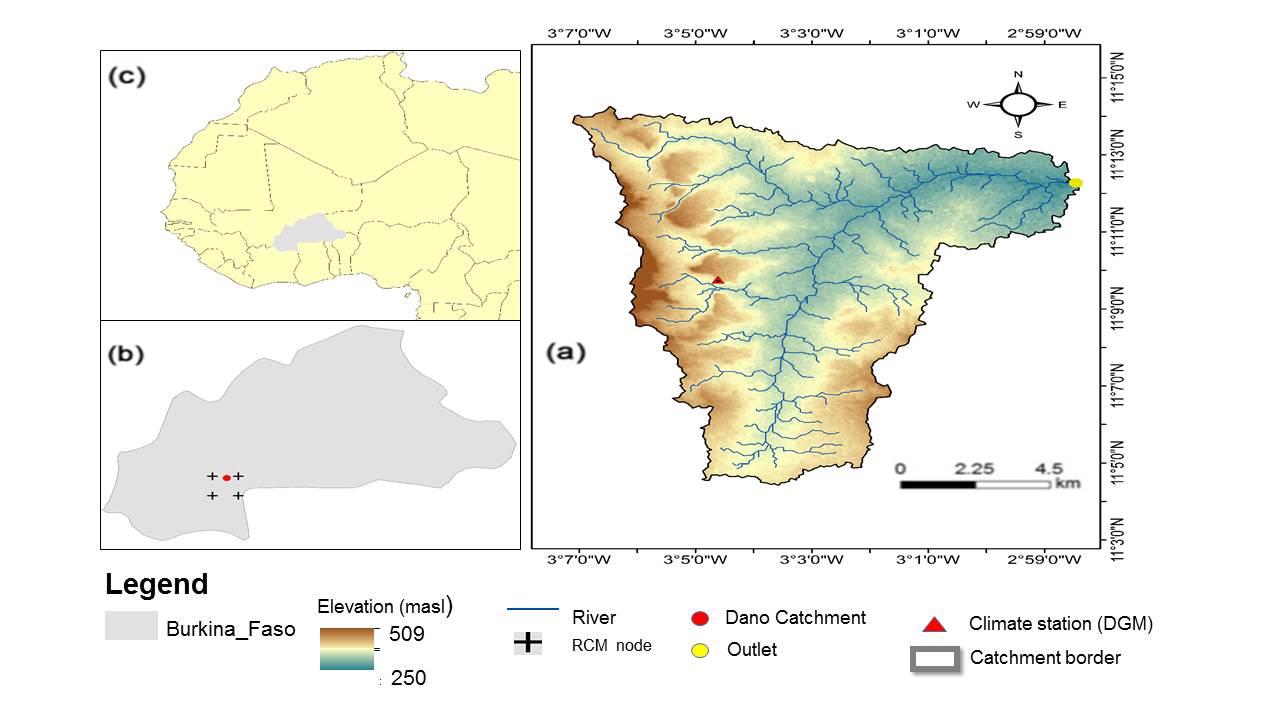
The Dano catchment covers about 196 Km² in area and is between 11 ° and 12 ° north latitude and 3 ° and 4 ° west longitude (). Dano is characterized by a South-Sudanian climate regime with two seasons: a dry season that lasts 7 months (from October to April) and a wet season of 5 months (from May to September). The average annual rainfall is of the order of 1000 mm. From 2002 to 2016, the average annual rainfall recorded was 939.98 mm 8. The vegetation of the catchment is mainly of the savanna type, dominated by species like Gardenia sp, Combretum micranthum, Parkia biglobosa, Butyrospermum parkii and Bombax costatum. Dominant grasses are Loudetia togoensis, Pennicetum sp and Andropogon sp. Plinthosols soil type covers 73% of the catchment area, followed by Cambisols and Gleysols each accounting for about 10% 9.

The applied GCMs-RCM data were retrieved at the WASCAL Competence Center (also available at https://doi.pangaea.de/10.1594/PANGAEA.880512). This regional dataset is produced at 12 km resolution using the Weather Research and Forecasting Model 10. The current study used the output of the GFDL-ESM2M and HadGEM2-ES global models, downscaled by WRF under the RCP4.5 scenario. Detail of the different datasets used in the study is presented in Table 1. After a comparison of historical climatic variables simulated by each GCM-RCM with observed climate data, it turned out that the GCMs-RCM exhibited an overestimation of annual precipitation as well as a misrepresentation of the timing of the rainy season. Therefore, bias correction was applied to the GCMs–RCM following Gudmundsson et al. (2012). The outcome showed that for all variables, biases were in general reduced by the applied empirical quantiles method. Additionally, wind speed, relative humidity, solar radiation, and temperature (both observed and simulated) were used to calculate the potential evapotranspiration following the Penman–Monteith using the version 3.2 of the FAO ETo-Calculator.
HBV-light model 12 was applied in the study. It is a conceptual rainfall-runoff model requiring evapotranspiration, discharge, precipitation, and air temperature for a run. The model has 15 parameters that need to be parameterized for calibration. An automatic calibration approach, using the built-in Genetic Algorithm and Powell optimization, was followed in the study. As the catchment is a data scarce environment, observed discharge data was only available form 01/01/2011 to 31/12/2014. Therefore, records from 31/10/2012 to 31/10/2013 were used as input for model calibration and records from 31/10/2013 to 31/12/2014 were used for model validation. The warming-up period spanned from 01/01/2011 to 31/10/2012. Three coefficients were used to evaluate the performances of the model i.e., the Nash-Sutcliffe efficiency-NSE, the coefficient of determination-R2 and the Kling Gupta efficiency-KGE 13. Visual inspections complemented these coefficients.
2.4. Projected climate and discharge changes analysisThe above mentioned two WASCAL high-resolution regional climate simulations were used to assess future climate changes in the Dano catchment. Change in the streamflow was also assessed by applying GFDL-ESM2M and HadGEM2-ES based simulations as inputs to HBV-Light. For both climate datasets, hydrological variables and WRES (see following paragraph), projected (2020-2049 and 2070-2099) and historical (1980-2005) averages were compared on monthly and annual bases.
2.5. Evaluation of water related ecosystem servicesThree WRES were assessed in this study: 1- domestic water supply-DWS (demand and met demand), 2-ecological water supply, 3-run-off river hydropower potential. Household water supply was quantified based on the population and a 60l/day per capita water demand (Eq. 1) following Togbévi et al. (2020). An annual population growth rate (3%) was used to determine the catchment population for near (2020-2049) and far (2070-2099) future periods. Ecological water supply-EWS was set as the Q95 of the simulated historical discharges at the catchment outlet (Eq. 2). Hydropower generation potential-HPP was calculated from the simulated discharges using the hydropower equations (Eq. 3). Consistently with climate and discharge changes, WRES changes are expressed for each water related ecosystem service as annual and monthly difference between projected (2020-2049 and 2070-2099) and historical (1980-2005) values.
 | (1) |
 | (2) |
 | (3) |
Where  is the efficiency of the turbine (set to 80%),
  is the density of water (kg/m3),
  is simulated discharge (m3/s),
  is the gravitational force (m/s2), and H set to 5 m is the water level above the turbine (m).
The achieved water balance and statistical quality measures over the calibration and validation periods are shown . The calculated model statistical measures range from satisfactory over the validation phase to very good for the calibration phase. presents the corresponding simulated and observed discharges for the same periods. It can be noted a good accordance between simulated and observed discharges except for few peaks. Overbank flow is reported to explain such misrepresentations. The Calculation of the Standard Precipitation Index-SPI indicated that the calibration phase (2013) was very humid (SPI=2) while the validation year (2014) was normal to slightly dry (SPI=-0.8). This difference in the climatology of the calibration and validation periods might explained the drop in the model efficiency during the validation.
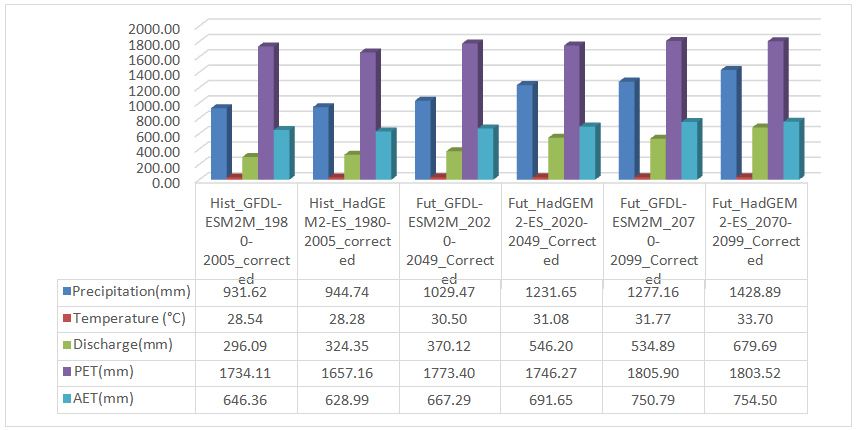
Figure 3 compares the historical (1980-2005) and projected (2020-2049 and 2070-2099) precipitation, temperature, and discharges for the GFDL-ESM2M climate dataset. HadGEM2-ES shows very similar trends (see ). One notes for bias corrected data that the average monthly precipitation shows an increase compared to the historical period (1980-2005). A projected annual precipitation increases for GFDL-ESM2M equals 97.85 mm (10.5 %) is expected the for the period 2020-2049, while this increase reaches 345.5 mm (37%) in the 2070-2099 period. Compared to the bias corrected data, the precipitation changes with non-bias corrected climate data show a similar trend (with however a lower magnitude). As for temperature, also shows a positive trend for both bias corrected and non-bias corrected irrespective the considered future period.
The simulated discharges using the hydrological HBV light model show changes in annual discharge for the 2020– 2049 and 2070 -099 periods compared to the historical period. The average annual discharges show an increase of 74 mm (25 %) and 238.8 mm (80.65 %) by 2049 and the end of the century, respectively.


Hydropower generation potential
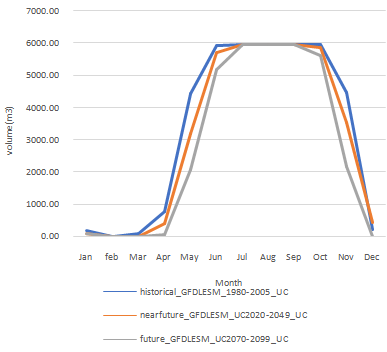
Compared to the historical period, an increase of energy generation potential is projected (Figure 5 Historical and projected hydropower potential with GFDL-ESM2M dataset. UC refers to non-bias corrected, BC to bias corrected) by 2049 and the end of the century. Applying the same hydropower equation for the historical and future periods implies that hydropower potential solely depends on discharge. Therefore, the projected discharge increase (section 3.2) leads to an increase of the hydropower potential of the catchment. The potential increase reaches 25% and 80% the period (2020-2049) and (2070-2099), respectively.

Domestic water supply
Following the GFDL-ESM2M dataset, by 2049, the additional domestic water demand, induced by population growth, will reach 14 000 m3 per month, while this demand will be met (using solely surface flow) only from Jun to October (Figure 6 Projected additional domestic water demand and water available for domestic use (domestic water used) for 2020-2049 and 2070-2099 (GFDL-ESM2M). By the end of the century this additional demand will exceed 120 000 m3 per month and will be met by surface flow only from Jully to September. The projected discharge increase due to climate change will therefore be insufficient to provide the additional water demand resulting from population growth. According to HadGEM2-ES the unmet demand is even higher.

Ecological flow
shows the evolution of ecological flow in the future. A negative ecological flow trend over both future periods is projected. The increase of domestic water demand is likely to lead to a decrease of ecological flow despite an overall increase of discharge. Discharge downstream the catchment is therefore expected to decrease in the future.
The results for the calibration and validation of the HBV model indicated overall good performances for the Dano Catchment. The achieved coefficients (NSE, R2 and KGE) ranged from 0.55 to 0.78 during the validation phase, while they are all above 0.9 over the calibration period. These results indicate a certain ability of the model to reproduce the hydrology of the Dano catchment. It should however be noted a poor representation of peaks, as simulated discharges often underestimated observations. Several studies using the same dataset have also reported a challenge related to peaks simulation in the Dano catchment, although different hydrological models have been applied (e.g., Op de Hipt et al., 2017 with SHETRAN ; Yira et al., 2016 with WaSIM). These authors attributed the discrepancies between observed and simulated peaks to overbank flow that is observed at the gauging station during high discharges.
Looking at SPI values, one notes that the calibration phase (SPI = 2) is a wet period while the validation phase (SPI = - 0.8) corresponds to a normal-to-dry period. This difference in the climate of the calibration and validation periods fairly explains the drop in the model efficiency during the validation. A performant model under contrasted calibration and validation climate conditions, illustrates model parameters that are reliable under changing climate conditions. The HBV model, as parameterized, gives satisfactory results, simulated the hydrology of the catchment in an acceptable way and its outputs are suitable for WRES assessment.
4.2. Projected climate and discharge changes analysisUsing GFDL-ESM2M and HadGEM2-ES dataset as input to the HBV model showed that, compared to the historical period of 1980-2005, projections (2020-2049 and 2070-2099) indicated a clear increase signal for the different climate variables (Temperature, Precipitation, Potential evapotranspiration, and Actual evapotranspiration for both climates simulation product GFDL-ESM2M and HadGEM2-ES under RCP4.5) as well as future discharges in the Dano catchment. These results are common to several studies carried out in the catchment, as well as in the region [7–17–19], although negative future discharge change signals (consistently with the future precipitation change signals) are also projected for the basin [4–9].
4.3. Water related ecosystem servicesThe results indicated a projected increase of hydropower potential in the catchment. The impact of climate change is therefore expected to be positive on this WRES. This is mainly due to an increase in discharge in the future and the non-consumptive nature of hydropower generation service. An increase in hydropower potential following a discharge increase is commonly reported by studies in the region [7–20]. However few studies highlighted a potential decrease in hydropower generation potential despite an increase in future discharge. Due to the timing of the discharge increase, usually during high flows, the additional discharge does not pass through the turbines and is therefore note converted to energy [21–22]. As for the future domestic water supply, projections show an increase of water demand, but this additional water demand will only be satisfied over few months in a year ( Jun to October). Domestic water supply will therefore get worst in the Dano catchment due not to climate change that increases discharge but due to population growth and related demand.
The study assessed the impact of future climate change on water-related ecosystem services (WRES) in the Dano catchment. It intended to provide information on future impact of climate change on WRES to support rational water resources management. From the initial specific objectives, the following conclusion can be derived:
This study revealed challenges in terms future domestic water supply, with projected additional stress on water resources. Exploring ways to store high discharges may help adapting to the projected impact of climate change on the investigated WRES.
| [1] | B. Fisher, R. K. Turner, and P. Morling, “Defining and classifying ecosystem services for decision making,” Ecol. Econ., vol. 68, no. 3, pp. 643–653, Jan. 2009, doi: 10.1016/j.ecolecon.2008.09.014. | ||
| In article | View Article | ||
| [2] | S. M. Díaz et al., The global assessment report on biodiversity and ecosystem services: Summary for policy makers. Intergovernmental Science-Policy Platform on Biodiversity and Ecosystem Services, 2019. Accessed: May 23, 2023. [Online]. Available: https://ri.conicet.gov.ar/handle/11336/116171 | ||
| In article | |||
| [3] | D. Russi et al., The Economics of Ecosystems and Biodiversity for Water and Wetlands. 2013. | ||
| In article | |||
| [4] | Y. Yira, B. Diekkrüger, G. Steup, and A. Y. Bossa, “Impact of climate change on hydrological conditions in a tropical West African catchment using an ensemble of climate simulations,” Hydrol Earth Syst Sci, vol. 21, no. 4, pp. 2143–2161, Apr. 2017, doi: 10.5194/hess-21-2143-2017. | ||
| In article | View Article | ||
| [5] | G. I. Yangouliba et al., “Impacts of hydro-climatic trends and upstream water management on hydropower generation at the Bagré dam,” J. Water Clim. Change, vol. 13, no. 6, pp. 2399–2413, May 2022, doi: 10.2166/wcc.2022.452. | ||
| In article | View Article | ||
| [6] | H. Chang and M. R. Bonnette, “Climate change and water‐related ecosystem services: impacts of drought in california, usa,” Ecosyst. Health Sustain., vol. 2, no. 12, p. e01254, Dec. 2016, doi: 10.1002/ehs2.1254. | ||
| In article | View Article | ||
| [7] | M. Dembélé et al., “Contrasting changes in hydrological processes of the Volta River basin under global warming,” Hydrol. Earth Syst. Sci., vol. 26, no. 5, pp. 1481–1506, Mar. 2022, doi: 10.5194/hess-26-1481-2022. | ||
| In article | View Article | ||
| [8] | L. A. L. C. A. G. Ngom, “An Assessment of Climate Change Impact on Water Related Ecosystem Services (WRES) including Hydropower Potential in the Dano Catchment (Volta Basin),” Master Thesis, PAUWES, 2019. Accessed: May 23, 2023. [Online]. Available: http://repository.pauwes-cop.net/handle/1/339 | ||
| In article | |||
| [9] | M. Idrissou et al., “Modeling the Impact of Climate and Land Use/Land Cover Change on Water Availability in an Inland Valley Catchment in Burkina Faso,” Hydrology, vol. 9, no. 1, Art. no. 1, Jan. 2022, doi: 10.3390/hydrology9010012. | ||
| In article | View Article | ||
| [10] | D. Heinzeller et al., “The WASCAL high-resolution regional climate simulation ensemble for West Africa: Concept, dissemination and assessment,” Earth Syst. Sci. Data, vol. 10, no. 2, Art. no. 2, 2018, doi: 10.5194/essd-10-815-2018. | ||
| In article | View Article | ||
| [11] | L. Gudmundsson, J. B. Bremnes, J. E. Haugen, and T. Engen-Skaugen, “Technical Note: Downscaling RCM precipitation to the station scale using statistical transformations - a comparison of methods,” Hydrol. Earth Syst. Sci., vol. 16, no. 9, pp. 3383–3390, Sep. 2012, doi: 10.5194/hess-16-3383-2012. | ||
| In article | View Article | ||
| [12] | J. Seibert and M. J. P. Vis, “Teaching hydrological modeling with a user-friendly catchment-runoff-model software package,” Hydrol Earth Syst Sci, vol. 16, no. 9, pp. 3315–3325, Sep. 2012, doi: 10.5194/hess-16-3315-2012. | ||
| In article | View Article | ||
| [13] | H. V. Gupta, H. Kling, K. K. Yilmaz, and G. F. Martinez, “Decomposition of the mean squared error and NSE performance criteria: Implications for improving hydrological modelling,” J. Hydrol., vol. 377, no. 1–2, pp. 80–91, Oct. 2009, doi: 10.1016/j.jhydrol.2009.08.003. | ||
| In article | View Article | ||
| [14] | Q. F. Togbévi, A. Y. Bossa, Y. Yira, K. Preko, L. O. Sintondji, and M. van der Ploeg, “A multi-model approach for analysing water balance and water-related ecosystem services in the Ouriyori catchment (Benin),” Hydrol. Sci. J., vol. 65, no. 14, pp. 2453–2465, Oct. 2020, doi: 10.1080/02626667.2020.1811286. | ||
| In article | View Article | ||
| [15] | F. Op de Hipt, B. Diekkrüger, G. Steup, Y. Yira, T. Hoffmann, and M. Rode, “Applying SHETRAN in a Tropical West African Catchment (Dano, Burkina Faso)—Calibration, Validation, Uncertainty Assessment,” Water, vol. 9, no. 2, p. 101, Feb. 2017, doi: 10.3390/w9020101. | ||
| In article | View Article | ||
| [16] | Y. Yira, B. Diekkrüger, G. Steup, and A. Y. Bossa, “Modeling land use change impacts on water resources in a tropical West African catchment (Dano, Burkina Faso),” J. Hydrol., vol. 537, pp. 187–199, Jun. 2016, doi: 10.1016/j.jhydrol.2016.03.052. | ||
| In article | View Article | ||
| [17] | V. Aich et al., “Comparing impacts of climate change on streamflow in four large African river basins,” Hydrol Earth Syst Sci, vol. 18, no. 4, pp. 1305–1321, Apr. 2014, doi: 10.5194/hess-18-1305-2014. | ||
| In article | View Article | ||
| [18] | F. Op de Hipt et al., “Modeling the effect of land use and climate change on water resources and soil erosion in a tropical West African catch-ment (Dano, Burkina Faso) using SHETRAN,” Sci. Total Environ., vol. 653, pp. 431–445, Feb. 2019, doi: 10.1016/j.scitotenv.2018.10.351. | ||
| In article | View Article PubMed | ||
| [19] | R. Yonaba et al., “Future climate or land use? Attribution of changes in surface runoff in a typical Sahelian landscape,” Comptes Rendus Géoscience, vol. 355, no. S1, pp. 1–28, 2023, doi: 10.5802/crgeos.179. | ||
| In article | View Article | ||
| [20] | G. T. Oyerinde et al., “Quantifying Uncertainties in Modeling Climate Change Impacts on Hydropower Production,” Climate, vol. 4, no. 3, p. 34, Jun. 2016, doi: 10.3390/cli4030034. | ||
| In article | View Article | ||
| [21] | T. C. Mutsindikwa et al., “Modeling climate change impact on the hydropower potential of the Bamboi catchment,” Model. Earth Syst. Environ., vol. 7, no. 4, pp. 2709–2717, Nov. 2021, doi: 10.1007/s40808-020-01052-w. | ||
| In article | View Article | ||
| [22] | Y. Yira, T. C. Mutsindikwa, A. Y. Bossa, J. Hounkpè, and S. Salack, “Assessing climate change impact on the hydropower potential of the Bamboi catchment (Black Volta, West Africa),” in Proceedings of IAHS, Copernicus GmbH, Nov. 2021, pp. 349–354. doi: 10.5194/piahs-384-349-2021. | ||
| In article | View Article | ||
Published with license by Science and Education Publishing, Copyright © 2023 Yira Yacouba, Bossa Yaovi Aymar, Ngom L. A. L. C. A. Guedji, Hounkpè Jean, Hounkpatin L. Ozias, Mouhamed Idrissou and Sintondji O. Luc
 This work is licensed under a Creative Commons Attribution 4.0 International License. To view a copy of this license, visit
http://creativecommons.org/licenses/by/4.0/
This work is licensed under a Creative Commons Attribution 4.0 International License. To view a copy of this license, visit
http://creativecommons.org/licenses/by/4.0/
| [1] | B. Fisher, R. K. Turner, and P. Morling, “Defining and classifying ecosystem services for decision making,” Ecol. Econ., vol. 68, no. 3, pp. 643–653, Jan. 2009, doi: 10.1016/j.ecolecon.2008.09.014. | ||
| In article | View Article | ||
| [2] | S. M. Díaz et al., The global assessment report on biodiversity and ecosystem services: Summary for policy makers. Intergovernmental Science-Policy Platform on Biodiversity and Ecosystem Services, 2019. Accessed: May 23, 2023. [Online]. Available: https://ri.conicet.gov.ar/handle/11336/116171 | ||
| In article | |||
| [3] | D. Russi et al., The Economics of Ecosystems and Biodiversity for Water and Wetlands. 2013. | ||
| In article | |||
| [4] | Y. Yira, B. Diekkrüger, G. Steup, and A. Y. Bossa, “Impact of climate change on hydrological conditions in a tropical West African catchment using an ensemble of climate simulations,” Hydrol Earth Syst Sci, vol. 21, no. 4, pp. 2143–2161, Apr. 2017, doi: 10.5194/hess-21-2143-2017. | ||
| In article | View Article | ||
| [5] | G. I. Yangouliba et al., “Impacts of hydro-climatic trends and upstream water management on hydropower generation at the Bagré dam,” J. Water Clim. Change, vol. 13, no. 6, pp. 2399–2413, May 2022, doi: 10.2166/wcc.2022.452. | ||
| In article | View Article | ||
| [6] | H. Chang and M. R. Bonnette, “Climate change and water‐related ecosystem services: impacts of drought in california, usa,” Ecosyst. Health Sustain., vol. 2, no. 12, p. e01254, Dec. 2016, doi: 10.1002/ehs2.1254. | ||
| In article | View Article | ||
| [7] | M. Dembélé et al., “Contrasting changes in hydrological processes of the Volta River basin under global warming,” Hydrol. Earth Syst. Sci., vol. 26, no. 5, pp. 1481–1506, Mar. 2022, doi: 10.5194/hess-26-1481-2022. | ||
| In article | View Article | ||
| [8] | L. A. L. C. A. G. Ngom, “An Assessment of Climate Change Impact on Water Related Ecosystem Services (WRES) including Hydropower Potential in the Dano Catchment (Volta Basin),” Master Thesis, PAUWES, 2019. Accessed: May 23, 2023. [Online]. Available: http://repository.pauwes-cop.net/handle/1/339 | ||
| In article | |||
| [9] | M. Idrissou et al., “Modeling the Impact of Climate and Land Use/Land Cover Change on Water Availability in an Inland Valley Catchment in Burkina Faso,” Hydrology, vol. 9, no. 1, Art. no. 1, Jan. 2022, doi: 10.3390/hydrology9010012. | ||
| In article | View Article | ||
| [10] | D. Heinzeller et al., “The WASCAL high-resolution regional climate simulation ensemble for West Africa: Concept, dissemination and assessment,” Earth Syst. Sci. Data, vol. 10, no. 2, Art. no. 2, 2018, doi: 10.5194/essd-10-815-2018. | ||
| In article | View Article | ||
| [11] | L. Gudmundsson, J. B. Bremnes, J. E. Haugen, and T. Engen-Skaugen, “Technical Note: Downscaling RCM precipitation to the station scale using statistical transformations - a comparison of methods,” Hydrol. Earth Syst. Sci., vol. 16, no. 9, pp. 3383–3390, Sep. 2012, doi: 10.5194/hess-16-3383-2012. | ||
| In article | View Article | ||
| [12] | J. Seibert and M. J. P. Vis, “Teaching hydrological modeling with a user-friendly catchment-runoff-model software package,” Hydrol Earth Syst Sci, vol. 16, no. 9, pp. 3315–3325, Sep. 2012, doi: 10.5194/hess-16-3315-2012. | ||
| In article | View Article | ||
| [13] | H. V. Gupta, H. Kling, K. K. Yilmaz, and G. F. Martinez, “Decomposition of the mean squared error and NSE performance criteria: Implications for improving hydrological modelling,” J. Hydrol., vol. 377, no. 1–2, pp. 80–91, Oct. 2009, doi: 10.1016/j.jhydrol.2009.08.003. | ||
| In article | View Article | ||
| [14] | Q. F. Togbévi, A. Y. Bossa, Y. Yira, K. Preko, L. O. Sintondji, and M. van der Ploeg, “A multi-model approach for analysing water balance and water-related ecosystem services in the Ouriyori catchment (Benin),” Hydrol. Sci. J., vol. 65, no. 14, pp. 2453–2465, Oct. 2020, doi: 10.1080/02626667.2020.1811286. | ||
| In article | View Article | ||
| [15] | F. Op de Hipt, B. Diekkrüger, G. Steup, Y. Yira, T. Hoffmann, and M. Rode, “Applying SHETRAN in a Tropical West African Catchment (Dano, Burkina Faso)—Calibration, Validation, Uncertainty Assessment,” Water, vol. 9, no. 2, p. 101, Feb. 2017, doi: 10.3390/w9020101. | ||
| In article | View Article | ||
| [16] | Y. Yira, B. Diekkrüger, G. Steup, and A. Y. Bossa, “Modeling land use change impacts on water resources in a tropical West African catchment (Dano, Burkina Faso),” J. Hydrol., vol. 537, pp. 187–199, Jun. 2016, doi: 10.1016/j.jhydrol.2016.03.052. | ||
| In article | View Article | ||
| [17] | V. Aich et al., “Comparing impacts of climate change on streamflow in four large African river basins,” Hydrol Earth Syst Sci, vol. 18, no. 4, pp. 1305–1321, Apr. 2014, doi: 10.5194/hess-18-1305-2014. | ||
| In article | View Article | ||
| [18] | F. Op de Hipt et al., “Modeling the effect of land use and climate change on water resources and soil erosion in a tropical West African catch-ment (Dano, Burkina Faso) using SHETRAN,” Sci. Total Environ., vol. 653, pp. 431–445, Feb. 2019, doi: 10.1016/j.scitotenv.2018.10.351. | ||
| In article | View Article PubMed | ||
| [19] | R. Yonaba et al., “Future climate or land use? Attribution of changes in surface runoff in a typical Sahelian landscape,” Comptes Rendus Géoscience, vol. 355, no. S1, pp. 1–28, 2023, doi: 10.5802/crgeos.179. | ||
| In article | View Article | ||
| [20] | G. T. Oyerinde et al., “Quantifying Uncertainties in Modeling Climate Change Impacts on Hydropower Production,” Climate, vol. 4, no. 3, p. 34, Jun. 2016, doi: 10.3390/cli4030034. | ||
| In article | View Article | ||
| [21] | T. C. Mutsindikwa et al., “Modeling climate change impact on the hydropower potential of the Bamboi catchment,” Model. Earth Syst. Environ., vol. 7, no. 4, pp. 2709–2717, Nov. 2021, doi: 10.1007/s40808-020-01052-w. | ||
| In article | View Article | ||
| [22] | Y. Yira, T. C. Mutsindikwa, A. Y. Bossa, J. Hounkpè, and S. Salack, “Assessing climate change impact on the hydropower potential of the Bamboi catchment (Black Volta, West Africa),” in Proceedings of IAHS, Copernicus GmbH, Nov. 2021, pp. 349–354. doi: 10.5194/piahs-384-349-2021. | ||
| In article | View Article | ||