This article aims to propose a method of draining rainwater in order to reduce the risk of flooding in the municipality of Taïba Niassène located in the Kaolack region, more precisely in the department of Nioro. To achieve this objective, it was necessary to carry out topographical, geotechnical and hydrological studies to know the nature of the relief, the typology of the soils and the hydrographic network of the area. In addition, the design of the axes to be coated was made taking into account the nature of the terrain to reduce the earthworks. Thus, the coating is designed in such a way that the water will drain along the curbs of the sidewalks to the gully grids positioned near the retention basins. The latter are two in number and are sized with flow rates of 1.318m3/s for basin 1 and 1.1 m3/s for basin 2 for a rainfall duration of five hours.
Floods are one of the main natural hazards in the world. They affect all regions of the world, particularly African countries. The vulnerability of cities in these countries can be explained by a combination of factors. The main one being the increase in the population by the conjunction of the birth rate 1. In Africa, more particularly in Senegal, flooding phenomena are recurrent during the rainy season. They affect urban centers but also rural areas. In this context, it would be wrong to think that sanitation needs are more urgent in urban areas than in rural areas. However, sanitation problems take on particular importance in rural areas 2.
New challenges are imposed on the elected representatives of small municipalities: rapid development of areas, the need to integrate agro-environmental measures into development policies and the growing concern of citizens for their living environment, etc. Erected jointly with the arrival of Act III of decentralization in 2013, Taïba Niassene is booming economically and is experiencing remarkable demographic growth like Senegal. Consequently the need for habitable land increases. This situation has led to an extension of buildings in flood-prone areas, which promotes stagnation of rainwater. From the legislative point of view, the question of sanitation seems to occupy a priority place in the policy of the State of Senegal, and is dealt with until 2009 in various codes (water code, hygiene code, environment, town planning code, construction code). On June 17, 2009, Law No. 2009-24 on the Sanitation Code was adopted by the National Assembly 3.
Therefore, a careful approach will be suitable to achieve the overall objectives.
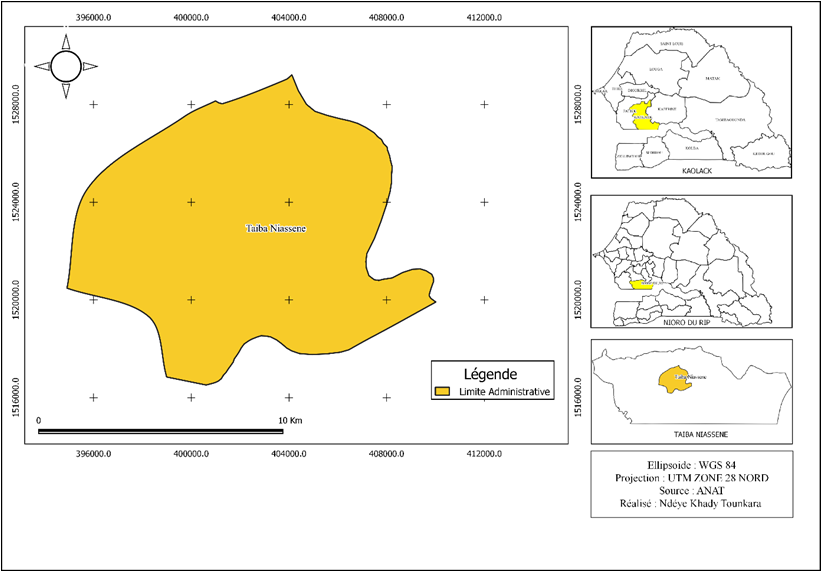
The commune of Taïba Niassene is located in the central zone of Senegal in the district of Paoskoto, department of Nioro du Rip, Kaolack region between latitudes 13°45'00''N and 13°48'45''N and longitudes 15°56'15''W and 15°52'30''W (Figure 1). It is connected to National Road No. 4 by an 11 km ramp leading to Dinguiraye in the North-West and is located about 250 km from the capital, Dakar. Covering 108 km², it thus brings together the 22 registered villages of the former local authority for a total population of 34,000 inhabitants, i.e. a density of 315 inhabitants/km2. It is bounded to the north by the commune of NGainth Kaye, to the south by the district of Prokhane, to the east by the commune of Paoskoto and to the west by the commune of Wack Ngouna.

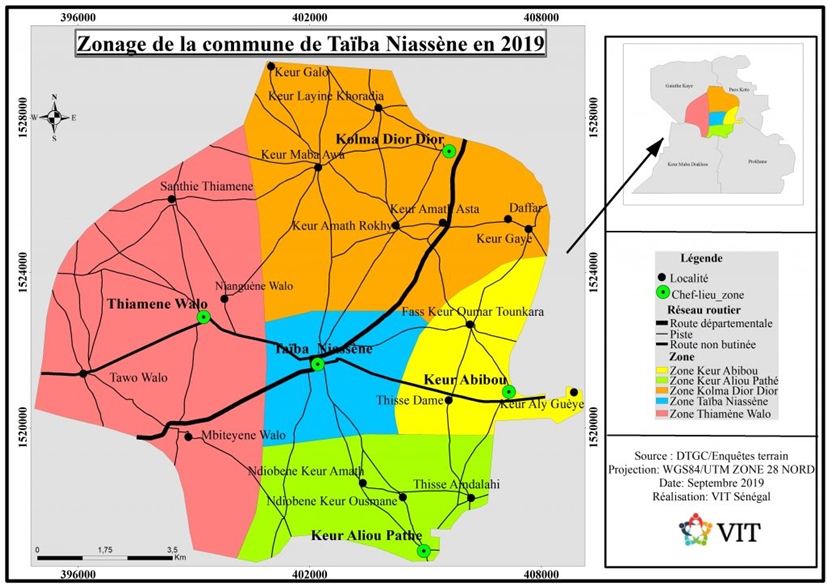
With the advent of decentralization in 2013, the municipality of Taïba Niassene is built on the remains of the former rural community. It is divided into four zones (Figure 2).

The population is made up of 52% women and 48% men and is essentially young; those under15 represent nearly 70%, while those over 70 constitute only 1.3% of the total.
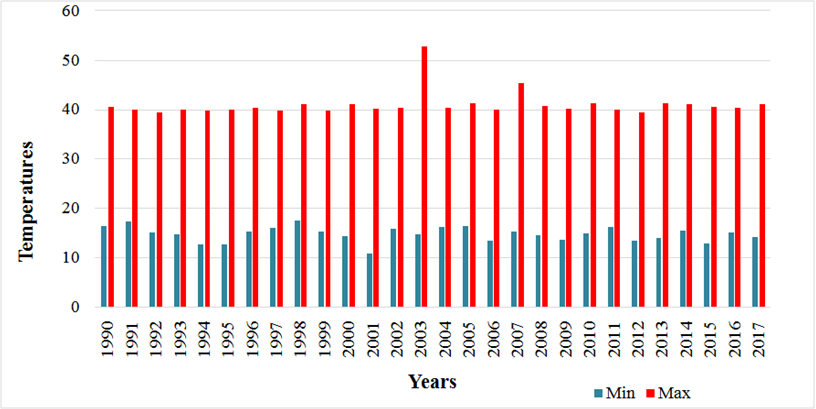
The area studied is well located between isohyets 900 mm in the North and 1,000 mm in the South 5, which frame the Sudano-Sahelian climate with Nioro du Rip as a reference station. The average temperature is around 28°C. Maximum temperatures reach 40°C during the months of April to June and drop to 33° during December and January. (Figure 3).

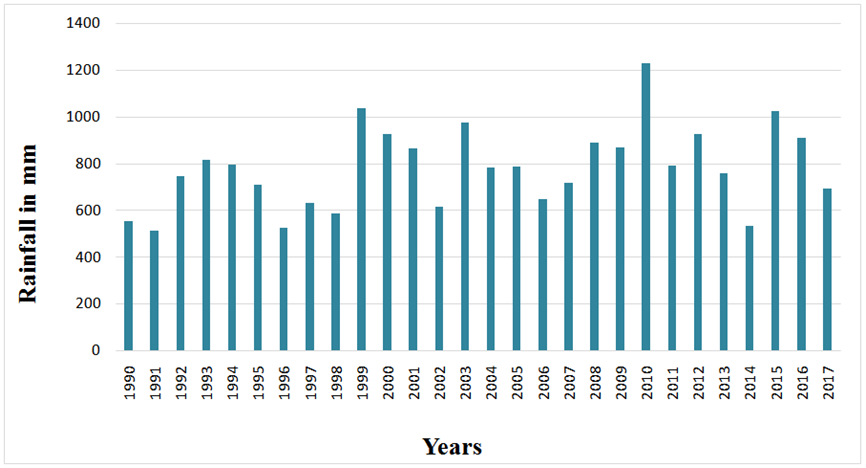
The rainfall data collected at ANACIM will make it possible to analyze the rainfall trend in Taïba Niassene. It is a series of 27 years (1990-2017) with monthly and annual time steps (Figure 4).

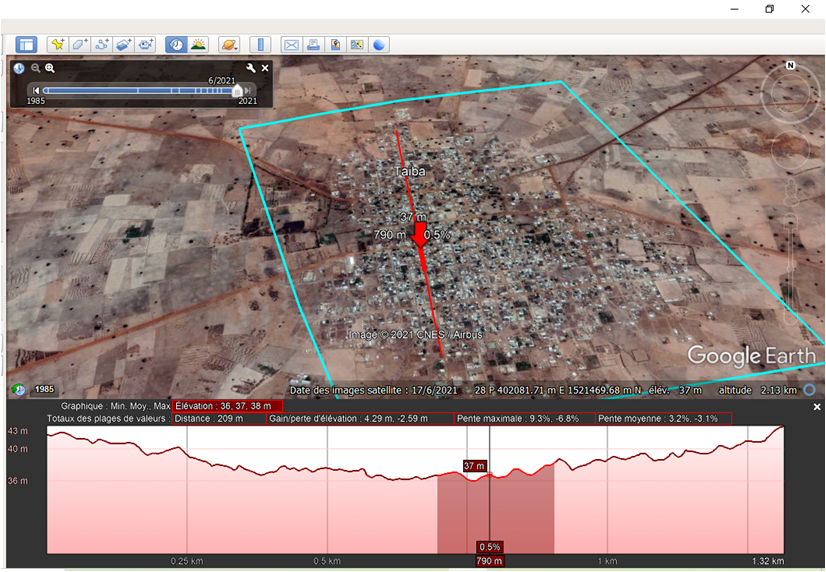
It is important to do a pre-reconnaissance study in order to have an overview of the study area. This pre-reconnaissance study is done with Google Earth and Global Mapper software. The objective is to see how the relief and the hydrographic network are. (Figure 5).

The pre-reconnaissance study provided an idea of the nature of the relief of the area concerned. And this made it possible to better plan the acquisition phase in the field.
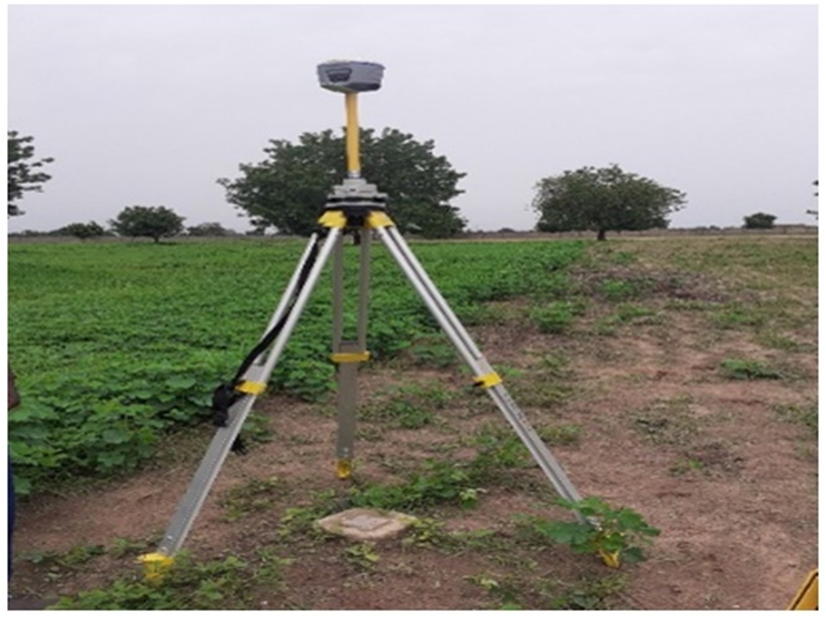
2.2. Data Processing and AnalysisAfter the pre-reconnaissance study, topographic and geotechnical data were collected in the field. The i50 GNSS Receiver integrates a GNSS engine, GNSS antenna, internal radio (410 MHz - 470 MHz), 4G cellular modem, Bluetooth, Wi-Fi, and dual batteries into a rugged, miniature unit that's easy to configure for you a rover All-in-one RTK or mobile base station. Bluetooth and Wi-Fi technology enables cable-free communication between receiver and controller. (Figure 6)

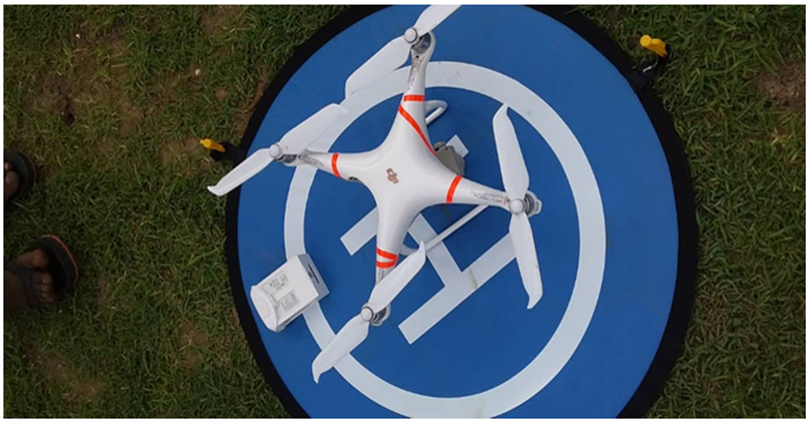
Aerial photogrammetry (topographic survey by drone) allows the production of a georeferenced 3D model from captured photographic files. For this project, the shots were taken by the Phantom 4 drone (Figure 7).

The objective is to materialize the support points to later georeference the images taken by the drone of the village. To carry out this work, we used the second order point of RRS04 B118 which is located in the Wack Ngouna high school located 15 km west of Taïba Niassene (Table 1).
From B118, observations in static mode for 20 minutes on three points located in the village were made to then complete the post-processing with Leica Infinity software to calculate the coordinates of these three points (Table 2).
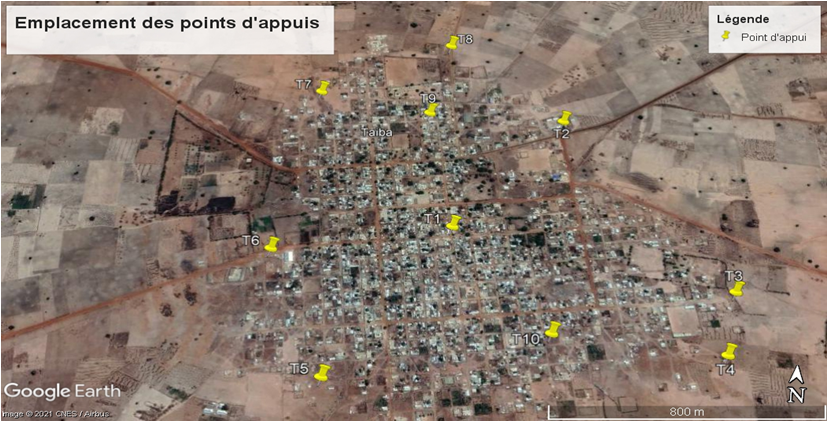
Using these three points, one of which served as a base and the other two as control points, surveys are carried out on seven other points well distributed in the village in RTK mode (Table 3 and Figure 8).
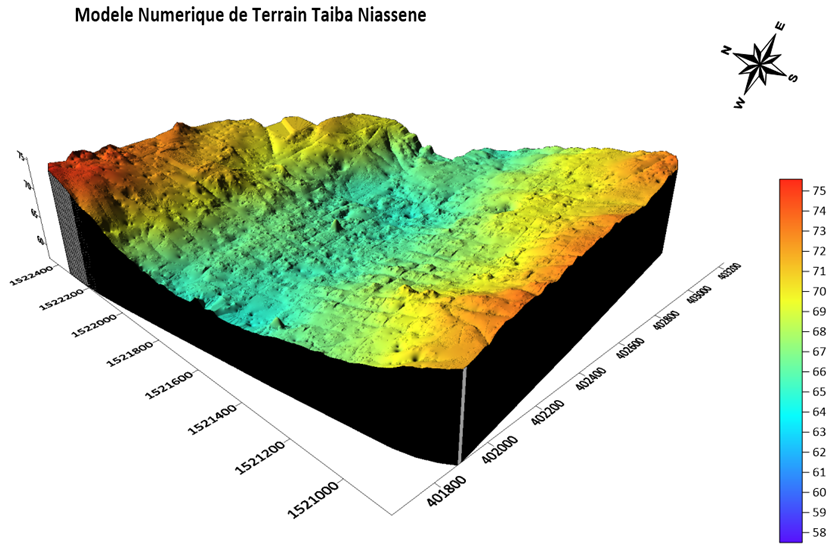
The DTM is a digital representation of the terrain. It allows to know the nature of the terrain and to derive the shapes of the topographic surface of a given area. In this article, the DEM is directly generated by the PIX4D software and is obtained in raster format (Figure 9).

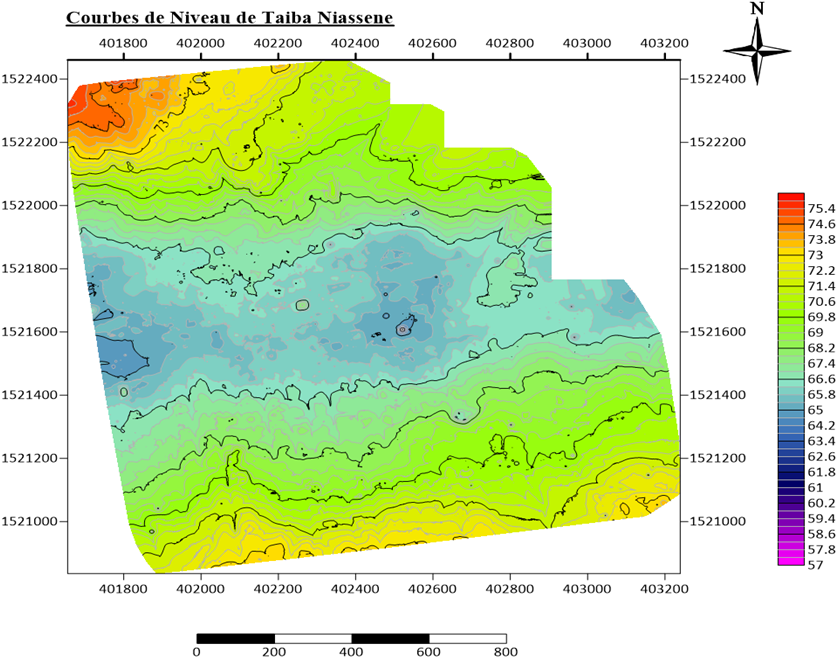
With the legend of the elevations, ranging from 58m to 75m, we can clearly see the deformations of the relief. Thus, it can be confirmed that the lowest area is in the center of the area, to the east and west with the lowest elevations. And the further you go from the center, going north or south, the terrain becomes higher and higher. And these deformations are even more explicit on the map of the level curves (Figure 10).

Contour lines are lines representing points of the same altitude or elevation. They allow to have a plan view of the relief and thus identify the high lines compared to the low lines. This will allow you to know, for example, the direction of the flow of water.
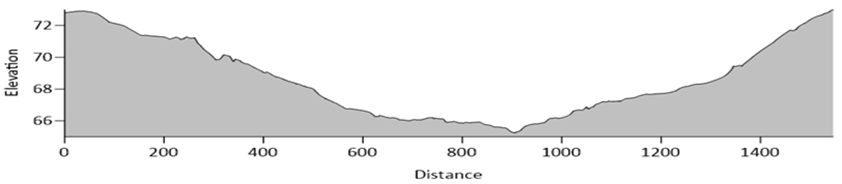
Thus, the lines are higher in the North and in the South. The figure presents the topographic profile of a section on the North-South axis (Figure 11). You can clearly see the natural ditch that is located in the center.
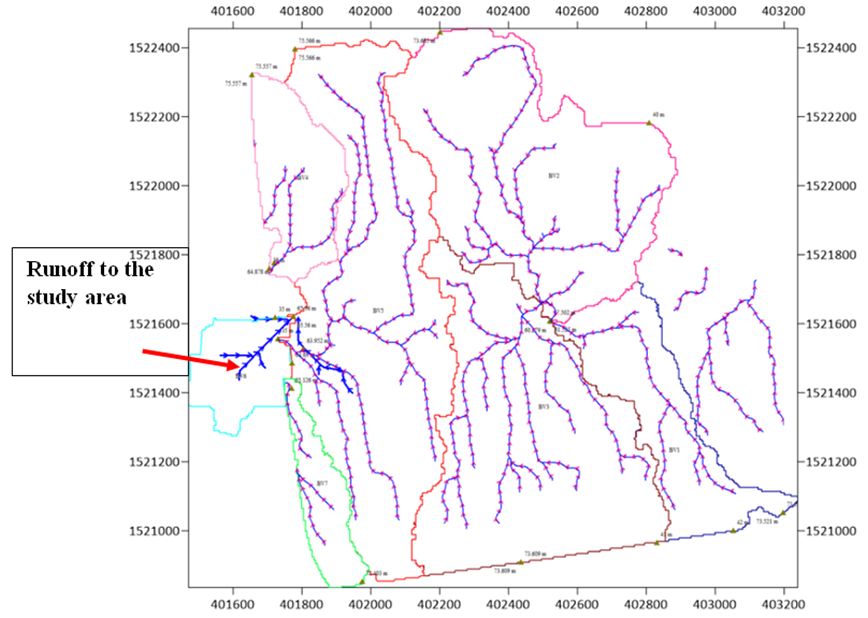
The delimitation of the watersheds is done starting from the outlet and following the line of greatest slope and then the lines of ridges which join one summit to the other.

After generating the sub-watersheds, we noticed that there are two outlets to which they flow (Figure 11).
According to the hydrographic network, rainwater mainly follows two directions. Indeed, part of the network drains to the east and another part goes to the west.
The delimitation gave seven watersheds that impact the study area (Figure 12) and the calculations of their characteristics and flows are given in Table 4 to Table 6.

The rational method is used to calculate flows because the surface areas of the catchment areas are less than 4 km2 7.
The runoff coefficients of the basins are estimated at 0.75 for all the catchment areas, except catchment 6 whose runoff coefficient is estimated at 0.5 because the surface it covers remains the natural ground and it is assumed that the soil is semi- permeable 8.
To meet the expectations of this work, it is necessary to limit the flow of rainwater downstream of the watersheds, in particular by buffering runoff water. To do this, it is imperative to build retention basins that must be sized and designed according to the specific needs of the project. Whatever their size, they will always harbor an aquatic “ecosystem” whose balance will depend on variations in volume and quality due to rainfall. Retention basin 1 is impacted by three watersheds including BV1, BV2, BV3 and retention basin 2 is impacted by the remaining four.
The runoff volume is calculated by the relationship
 |
V entering = Volume of runoff entering the retention structure during the duration t and for the return period considered in the analysis (m³);
C = runoff coefficient;
Atotal = Total project area (ha);
i = Intensity of precipitation associated with duration t for the desired return period (mm/h).
MCC = Add-on to take into account the effects of climate change;
6 = Conversion factor for units;
t = Duration of the precipitation considered (min);
Vinf = Volume of water intercepted by infiltration structures located in the watershed of the retention structure (m³)
Part of the hydrographic network drains to the west at the exit of the village, but by expanding the hydrological study, we see that there is runoff towards the study area coming from the west. Consequently, a retention basin is also planned at the exit of the village to the west.
The surface of the basin bottom having a rectangular shape, is calculated by the following formula:
 |
For the pools, the depth is fixed at 2m.
The hydrographic study is a very important step in this article. Indeed, it completed the topographical study and made it possible to identify the outlets in the study area. Thus, two retention basins are planned and sized to contain runoff water.
This article made it possible to detect two low points, one inside the village and the other at the exit to the west, it also made it possible to size two retention basins in these places.
However, the design has some limitations, in particular the non-leveling of the points during topographic surveys and the non-dimensioning of the buried pipes.
| [1] | NDAO, Ch.A.; YADE, A., “Etudes du drainage des eaux pluviales de l'ile à Saint Louis,” p. 102, 2020. | ||
| In article | |||
| [2] | KANE, F.; NDIAYE, A.Kh., “Etude de l’assainissement en eaux pluviales du Site abritant l’Université de Thiès,” p. 85, 2018. | ||
| In article | |||
| [3] | DTG, “Enquetes terrain proection WGS84/UTM ZONE 28 NORD,” VIT Sénégal, Septembre 2019. | ||
| In article | |||
| [4] | BPS, 1993. | ||
| In article | |||
| [5] | ANACIM, 2020. | ||
| In article | |||
| [6] | A. A. M. M. O. Z. e. O. P. BRUCKMANN L, “Analyse géohistorique de lévolution spation-temporelle du risque dinnondation et de sa gestion,” 2019. | ||
| In article | |||
| [7] | M. DIONGUE, Périphérie urbaine et risques d'innondation au Sénégal, 2014. | ||
| In article | |||
| [8] | ARMP, “Commne de Taiba Niassène: Revue indépendante de la conformité de la passation des marchés au titre au titre de a gestion 2016.,” 2018. | ||
| In article | |||
| [9] | BPS, “ÉTUDE SEMI DÉTAILLÉE DES SOLS DE NIORO,” 1993. | ||
| In article | |||
| [10] | B. FALL and I. SEYE, CONCEPTION D’UN RÉSEAU D’ASSAINISSEMENT DES EAUX PLUVIALES INTÉGRÉ DANS UN SYSTÈME D’INFORMATION GÉOGRAPHIQUE (SIG) AU QUARTIER DE SAMPATHÉ (THIÈS-EST, 2019. | ||
| In article | |||
Published with license by Science and Education Publishing, Copyright © 2023 Ndiouga Camara, Mouhamadou Moustapha Mbacké Ndour, Ndèye Khady Tounkara and Séni Tamba
 This work is licensed under a Creative Commons Attribution 4.0 International License. To view a copy of this license, visit
http://creativecommons.org/licenses/by/4.0/
This work is licensed under a Creative Commons Attribution 4.0 International License. To view a copy of this license, visit
http://creativecommons.org/licenses/by/4.0/
| [1] | NDAO, Ch.A.; YADE, A., “Etudes du drainage des eaux pluviales de l'ile à Saint Louis,” p. 102, 2020. | ||
| In article | |||
| [2] | KANE, F.; NDIAYE, A.Kh., “Etude de l’assainissement en eaux pluviales du Site abritant l’Université de Thiès,” p. 85, 2018. | ||
| In article | |||
| [3] | DTG, “Enquetes terrain proection WGS84/UTM ZONE 28 NORD,” VIT Sénégal, Septembre 2019. | ||
| In article | |||
| [4] | BPS, 1993. | ||
| In article | |||
| [5] | ANACIM, 2020. | ||
| In article | |||
| [6] | A. A. M. M. O. Z. e. O. P. BRUCKMANN L, “Analyse géohistorique de lévolution spation-temporelle du risque dinnondation et de sa gestion,” 2019. | ||
| In article | |||
| [7] | M. DIONGUE, Périphérie urbaine et risques d'innondation au Sénégal, 2014. | ||
| In article | |||
| [8] | ARMP, “Commne de Taiba Niassène: Revue indépendante de la conformité de la passation des marchés au titre au titre de a gestion 2016.,” 2018. | ||
| In article | |||
| [9] | BPS, “ÉTUDE SEMI DÉTAILLÉE DES SOLS DE NIORO,” 1993. | ||
| In article | |||
| [10] | B. FALL and I. SEYE, CONCEPTION D’UN RÉSEAU D’ASSAINISSEMENT DES EAUX PLUVIALES INTÉGRÉ DANS UN SYSTÈME D’INFORMATION GÉOGRAPHIQUE (SIG) AU QUARTIER DE SAMPATHÉ (THIÈS-EST, 2019. | ||
| In article | |||