The purpose of this study was to investigate the impact of wrist-lagging angle on both distance and accuracy in golf downswing among NCAA Division I female golfers. Seven female golfers from a university of the East Coast of the United States volunteered to participate in the study. While performing a full swing with 7-iron, a standardized Golf Simulator was used to obtain swing related data and Dartfish was utilized to measure the wrist angles in the downswing. Multivariate General Linear Regression (MGLR) analysis was conducted to determine predictor variables for hitting distance and accuracy. The results have shown that for irons wrist-lagging angle is a significant predictor for the accuracy, but not for the distance. Other variables such as club head speed, smash effect, sidespin and backspin were also found significant in MGLR model (p < .01). Future studies should gain a comprehensive understand of how wrist-lagging angle impact on male golfers.
Golf made a comeback to the 2016 Rio Olympic Games because it has become more popular and attracts people at different ages across 206 countries 1. According to Business Report 2, it is estimated that there are 34, 000 golf clubs in the globe containing 60 million golf members. The growing number of golf members consisting of amateur golfers for health benefits (e.g., balance, flexibility, aerobic capability, and leg strength) and professional golfers for external reward (e.g., money, endorsement, and trophy) 3, 4. Despite their aims of participating golf game, both amateur and professional golfers have always been looking for the best ways to optimize their athletic performance in golf so that they are more likely to win their opponents during the golf game.
One of the primary aims for the majority of golfers is to optimize driving performance during the golf swing 5. Driving distance and driving accuracy are typically thought of as the most influential variables for evaluating golf performance, which has been extensively examined 6, 7, 8, 9, 10. The driving distance is measured by the length of displacement of a golf ball between where a golfer was hit the ball and where the ball landed. To obtain a maximum displacement of the golf ball, golfers are required to have the capability to effectively utilize their body and club so that they are able to carry out the transfer of maximum force from their physical body into the golf ball 11, 12. For better golf performance, golfers are not simply required to perform a full golf swing to displace the golf ball a maximum distance, but also the golfers need to ensure that the location of where the golf ball lands are as close as possible to the optimal area to lay a solid foundation for each hole.
Hume, Keogh, and Reid 6 stated that a great number of studies have been done to examine the influence of biomechanical parameters on driving performance among golfers. In particular, researchers utilized mathematical models to explore the relationships between driving performance and biomechanical variables at specific golf technique such as golf swing 13, 14, 15. For example, a double pendulum model was often employed to determine whether swing-related variables (e.g., delayed the release of uncocking wrist, increased torque applied in the hubs of arms, and torso-pelvic separation) were associated with an increased angular velocity of golf club head, leading to better driving distance 16, 17. An alternative way was also used to determine the critical variables of enhancing the driving performance, involving in comparing professional golfers with amateur counterparts 18, 19, 20, 21. Despite the heterogeneity of research methodology application, researchers unanimously agree that wrist-lagging angle plays a dominant role in optimizing the club head velocity and ball velocity for obtaining a maximum driving distance. It is mainly attributed to that the delayed release of wrist lagging angle at the stage of downswing can help a golfer apply centrifugal force and maintain angular momentum to achieve maximum club speed at impact 22, 23, 24, 25, 26. Additionally, Milburn 27 utilized three-dimensional digital technique to explore the influence of joint-related variables (shoulders, wrist, spin, and hips) on the golf swing performance, suggesting that of the joints, the wrist manipulative skill is thought of as the critical factor and accounted for a variance of 70% of the golf swing. In particular, Zhang, Zou, Thornton, and Du 10 recently reported that wrist-lagging angle had direct influence on hitting distance and driving accuracy in NCAA Division I female golfers 10.
The delayed release of wrist lagging angle during the golf downswing has been commonly recognized as one of the performance-determining variables, which provides insightful instruction on how to help golfers perform optimal golf swings for maximizing ball distance. However, researchers emphasize that determining an optimal golf swing performance should not only be individually reflected by a maximum distance, but also accuracy should also be thought of as an equivalently important variable 9, 28, 29. In addition, a recent study conducted by Wiseman and Chatterjee 30 has shown a negative relationship between hitting distance and driving accuracy among professional golfers. In other words, if golfers achieved a maximum driving distance resulting from the greatest amount of club-head velocity through the delayed release of wrist lagging angle during golf downswing, driving accuracy would be negatively affected.
Up till now, the relationship between the delayed release of wrist lagging angle and golf driving performance (hitting distance and driving accuracy) during the golf downswing has rarely been investigated. In addition, previous literature has focused on professional golfers, but few studied on female amateur golfers 22. Although Zhang et al 10 concluded wrist-lagging angle has impact on both female golfers’ driving distance and accuracy, they urged to conduct similar research on irons due to drastic length difference of irons and driver. Therefore, the purpose of this study was to examine whether wrist-lagging angle had impact on both iron swing distance and accuracy for female amateur golfers. The null hypothesis of this research was that the wrist-lagging angle in down swing had no impact on iron swing distance nor accuracy.
Seven female golfers from a university of the east coast of the United States were recruited and volunteered to participate in the research. They were all freshmen competing in NCAA Division I. All seven golfers were right-handed without any injury and significant history of joint injury during the present study period. After obtaining a permission from their head coach, a written consent form approved by the University’s Institutional Review Board was sent to each college golfer for their signature prior to the beginning of the test. Demographics of the golfers is presented in Table 1.
A Full Swing Golf Simulator (About-Golf Ltd., Maymee, OH.) placed in an indoor 15 ft x 15 ft x 30 ft booth on the campus practicing facility was used. Golfers were allowed to play on a photographically simulated driving range or golf course. A big screen of the Full Swing Golf Simulator was located 5 m away from the left shoulder of all right-handed golfers while performing a full swing. The big screen showed a virtual golf environment consisting of a golf hole in the tee box, fairway, and green with a pin and flag. The simulator allows researchers to obtain hitting performance variables (club head speed, smash effect, sidespin, height of flying ball, and backspin) through tracking and analyzing projection and contact information of ball and club head. The total distance consists both ball fly and carry distance. Hitting accuracy illustrated as off distance to the left or right of the centerline for each shot. A high-speed camera capable of 60 frames per second was synchronized with the Simulator to film the movement of each swing, especially for the wrist-lagging angle. The films were downloaded to a computer for Dartfish software analysis (www.dartfish.com). Dartfish is a popular golf swing analyzing software, which can capture detailed angles and movements created in the golf swing. Dartfish was used to measure two wrist angles, one at the begging of the down swing when hands traveled at shoulder level, and the other one when the hands traveled to the waist level before releasing the wrists should be released.
2.3. ProceduresEach female golfer was instructed by her head coach to carry out a stretching-dominant exercise prior to data collection. Subsequently, each golfer used her own 7-iron to hit golf balls at the simulator three to five times as practice to warm up. Then each golfer hit 10 shots off an artificial turf tee box into a projected practice range image on the screen while golf performance variables were collected. The researchers limited the number of swings by each golfer to ten because they wanted to control the influence from each individual golfer to the group data. Among the variables generated by the simulator, hitting accuracy was a combination of off distance to the left (draw or hook) and off distance to the right (slice) captured by the system. The researchers inputted the off distance to the left as positive numbers and off distance to the right as negative numbers as one dependent variable: Accuracy.
2.4. Statistical AnalysisGolf down swing wrist lagging angle or delayed wrist release has been studied and analyzed by both professionals and researchers. However, there is no study so far to examine the relationship among down swing wrist lagging angles and hitting accuracy and distance. In the world of golf, no one can argue the importance of both golf drive distance and accuracy. Since they are both pivotal to the success of the game of golf, it is necessary to analyze both as covariates instead of as individual dependent variables 10, 31, 32, 33, 34. First step of data analysis, a Pearson Product-moment Correlation Coefficient (PPMCC) was conducted to determine whether a relationship existed between lagging angles with driving accuracy and distance. Zhang et al 10 utilized a Multivariate General Linear Regression (MGLR) model to explore the possible cause and effect relationship and to identify a correlation matrix among golf driving distance, accuracy and the independent variables. Similar to Zhang et al 10, hitting distance and accuracy are the co-dependent variables. Other variables such as club head speed, back spin velocity, side spin velocity, ball height and smash factor found to have relationships with driving distance and accuracy were also included in this study as independent variables 25, 35. Finally, in order to better validate the term wrist lagging, a new variable was created by subtracting the waist level wrist angle from shoulder level wrist angle. The ideal situation should be zero that means the golfer did not lose any wrist angle in down swing before release his or her wrist. This variable is named Angle Difference.
Mean and standard deviation for independent and dependent variables is presented in Table 2. Particularly, wrist angles as the primary independent ranged from 69.0 to 147.5 degrees. The angle difference ranged from -19.4 to 54.2 degrees. The results of PPMCC indicated that ball distance was significantly positively correlated with club head speed (r = .595, p < .01), smash effect (r = .315, p < .01) and height (r = .385, p = .01) but was significantly negatively correlated with angle difference (r = -.607, p < .01) and wrist lagging angle (r = -.393, p < .01). Accuracy was only significantly correlated with sidespin (r = .619, p < .01). Table 3.
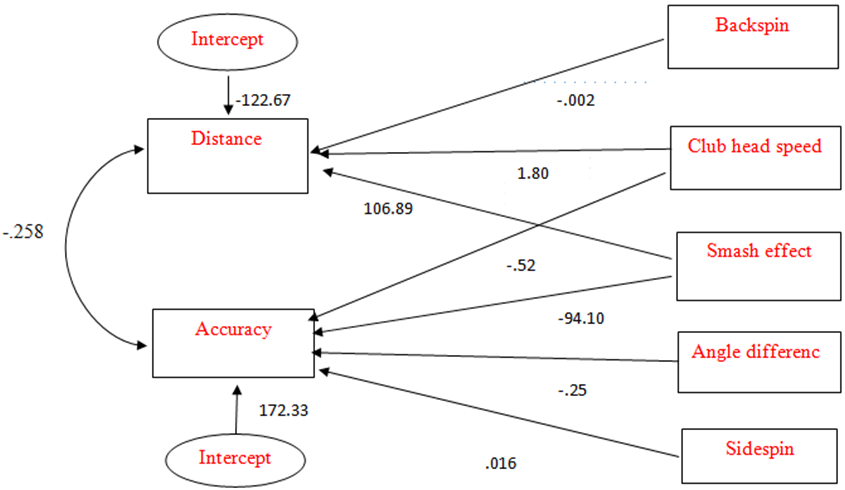
The multivariate generalized linear regression (MGLR) analysis indicated in Residual SSCP Matrix that driving distance was significantly negatively correlated with driving accuracy (r = - .258, p < .05). Only when the correlation coefficient of the two dependent variables is zero, the MGLR is equivalent to the separate multiple linear regression model 36. This result coincides with findings from Wiseman and Chatterjee 30 and Zhang et al 10. The both study concluded that there is a negative relationship between golf driving distance and driving accuracy for both professional and amateur golfers. The results of the MGLR analysis indicated that five (club head speed, smash effect, sidespin, backspin and angle difference) were significant in predicting both hitting distance and accuracy. Variable height of ball fly had no significance was dropped from the model. The final model with five remaining independent variables showed a. R Squared = .932, Adjusted R Squared = .927 and b. R Squared = .535, Adjusted R Squared = .499 (p < .01).
Results from MGLR identified that club head speed (F = 497.55, p < .01), smash effect (F = 178.43, p < .01) and backspin (F = 11.35, p < .01) were significant for hitting distance. For accuracy, club head speed (F = 4.39, p < .05), sidespin (F = 54.53, p < .01) and angle difference (F = 11.46, p < .01) were significant predictors. Table 4 reported the fitted MGLR equations for distance and accuracy. Finally, Figure 1 demonstrated the correlation matrix among hitting distance, accuracy and independent variables.

The study results from MGLR rejected the Null hypothesis, suggesting that wrist-lagging angle in the downswing for female golfers has a significant influence on accuracy for the iron club, but hitting distance. This is different from the study by Zhang et al 10 who concluded that wrist-lagging angle had the significant impact on both distance and accuracy for the driver. The direct result from the smaller wrist-lagging angle at releasing point was longer club head travel distance to the impact point at the ball. The trigonometric formula (a/sinA = b/sinB = c/sinC) can calculate the length of any side of a triangle given the length of two sides and the opposite angle. Since the length of a 7-iron club is 92.7 cm and the participants lose average 23-degree wrist angle from shoulder level (mean = 91.26, SD = 11.37) to waist level (mean = 114.26, SD = 17.79) in downswing could result in a loss of 36.9cm club head travel distance to the ball. Surprisingly, the lagging angle does not have a significant impact on distance. This result could attribute to the lofty of the head and shorter length of a 7-iron compare to a driver hence, to contribute less in ball displacement. However, the lagging angle has significant impact on hitting accuracy. The authors and golf coaches believe it is because retaining the lag in your swing helps keep club face on its swing path longer and better place it on the target line. The significant negative correlation (r = -.607, p <.01) between wrist angle difference and hitting distance supports the role of retaining wrist angle to maximize distance 21, 27, 37 in downswing. However, angle difference is not a significant predictor to distance. This relationship needs to be further examined in future research.
Nevertheless, golfer psychology plays an important role in every single swing, which could affect body coordination and biomechanics. As complex as it can be, no single element alone could explain the results of every golf swing. Especially this study employed amateur golfers whose skill or performance can vary in a wide range from swing to swing 6. This presented a huge challenge for golf teaching professionals who want to improve performance or skills for their players. Swing by swing related statistics such a club head speed, back spin, side spin, ball height, and smash effect were results from tracking ball fly after each swing but do not offer any clue how to change or improve swings. The results of this research offer a direction on analyzing and improving each swing patterns. By focusing on retaining wrist angle in the downswing, amateur golfers can practice control distance and accuracy through delayed release of the wrist, which could keep club face on its swing path longer and better place it on the target line at contact. The results of descriptive statistics showed that female golfers generally loose wrist angles in down swing from shoulder to waist level. This is due to the gravity of the club head pulls it away from the body in the downswing. The lack of wrist strength for female golfers could make them more vulnerable than male counterparts. The researcher and golf coach all agree the need for targeted wrist strength training help them to retain smaller wrist angle as long as possible hence to achieve the greater club head velocity and better contact with the ball.
The MGLR matrix indicated retaining wrist angle has a significant impact on accuracy but not on distance. This is different from the results from Zhang et al 10, which discovered it has an impact on both driving distance and accuracy. As the author indicated previously, this phenomenon could be explained by the lofty clubface design of a 7-iorn since its intention is distance control and accuracy. Results from this research provide insight to golfers and golf coaches that an individual should focus on retaining wrist angle to achieve better accuracy. Distance could be a by-product given the significant negative correlation between wrist angle and distance. This result indirectly supports the negative relationship between driving distance and accuracy 30. In other words, smaller wrist lagging angle can maximize club head velocity hence contributing to the greater displacement of a golf ball. This is so-call the speed-accuracy trade-off phenomenon in golf 38, 39, 40. The authors believe this might be an issue for driving but should not be a factor for amateur golfer and coaches to consider for irons because one can always switch to a different club for distance. Accuracy should be the only focus in their mind with iron clubs. Another source of error in quick movements such as golf swing includes inconsistency of muscle contraction force increases due to noise at the connection (nerve impulse) 41. In other words, more force generates more variability and thus causes more errors in movement direction to translate into golf is the accuracy. Furthermore, player’s mental capacity and breath could have profound affection on nerve impulse.
Finally, this study only analyzed one type of golfers the female varsity golf players. Results cannot be generalized to other groups. In future studies, the researchers would like to reveal how retaining wrist angle impact on male golfers given male presumably have more strength than female hence to hypothesize they can retain smaller wrist angle in the downswing. A comparison study can be interesting. Also, to develop targeted strength training program as intervention can be meaningful. The authors hope a series of related study could provide golfers and golf coaches at all level better scientific guidance to improve golf swing to generate better distance and accuracy.
| [1] | World Golf Foundation. (2015). Golf 20/20 industry report for 2015. Boca Rotan, FL: World Golf Foundation. | ||
| In article | |||
| [2] | Business Report. 2009. Sports marketing surveys. Retrieved from the Business Report and Independent Online (Pty) Ltd. Available at http://www.busrep.co.za.ezproxy.springfield.edu/index.php?fArticleId=244889. | ||
| In article | View Article | ||
| [3] | Farahmand, B., Broman, G., De Faire, U., Vågerö, D., & Ahlbom, A. (2009). Golf: a game of life and death–reduced mortality in Swedish golf players. Scandinavian journal of medicine & science in sports, 19(3), 419-424. | ||
| In article | View Article PubMed | ||
| [4] | Zhang, M. (2007). An analysis of recreational golfer motivation, constraints, and satisfaction on the mastery and frequency of play in the Gulf Coast region of Mississippi (Doctoral dissertation, UNITED STATES SPORTS ACADEMY). | ||
| In article | |||
| [5] | Wiseman, F., & Chatterjee, S. (2006). Comprehensive analysis of golf performance on the PGA Tour: 1990–2004. Perceptual and motor skills,102(1), 109-117. | ||
| In article | View Article PubMed | ||
| [6] | Hume, P. A., Keogh, J., & Reid, D. (2005). The role of biomechanics in maximising distance and accuracy of golf shots. Sports Medicine, 35(5), 429-449. | ||
| In article | View Article PubMed | ||
| [7] | Libkuman, T. M., Otani, H., & Steger, N. (2002). Training in timing improves accuracy in golf. The Journal of general psychology, 129(1), 77-96. | ||
| In article | View Article PubMed | ||
| [8] | Pearce, B. (2013). The effect of gluteus medius Kinesio (R) taping on torso-pelvic separation during the golf swing, ball flight distance and accuracy (Doctoral dissertation). | ||
| In article | View Article | ||
| [9] | Wiseman, F., Habibullah, M., & Friar, J. (2011). The importance of driving distance and driving accuracy on the PGA and champions Tours. The Sport Journal, 14(1), 1-4. | ||
| In article | View Article | ||
| [10] | Zhang, M., Zou, L., Thornton, S. and Du, G. (2016). Wrist lagging angle impact on both golf driving distance and accuracy. International Journal of Sports Science 6(6). | ||
| In article | View Article | ||
| [11] | Adlington, G. S. (1996). Proper swing technique and biomechanics of golf.Clinics in sports medicine, 15(1), 9-26. | ||
| In article | PubMed | ||
| [12] | Farrally, M. R., Cochran, A. J., Crews, D. J., Hurdzan, M. J., Price, R. J., Snow, J. T., & Thomas, P. R. (2003). Golf science research at the beginning of the twenty-first century. Journal of sports sciences, 21(9), 753-765. | ||
| In article | View Article PubMed | ||
| [13] | Milburn, P. D. (1981). Summation of segmental velocities in the golf swing. Medicine and science in sports and exercise, 14(1), 60-64. | ||
| In article | View Article | ||
| [14] | Miura, K. (2001). Parametric acceleration–the effect of inward pull of the golf club at impact stage. Sports Engineering, 4(2), 75-86. | ||
| In article | View Article | ||
| [15] | Penner, A. R. (2002). The physics of golf. Reports on Progress in Physics, 66(2), 131. | ||
| In article | View Article | ||
| [16] | Cochran, A. J., & Stobbs, J. (2005). Search for the perfect swing. Triumph. | ||
| In article | |||
| [17] | Shamus, E., & Shamus, J. (2001). Sports injury: prevention and rehabilitation. McGraw-Hill Medical. | ||
| In article | PubMed | ||
| [18] | Jorgensen, T. P. (1994). The physics of Golf. New York: AIP Press. | ||
| In article | |||
| [19] | McLaughlin, P. A., & Best, R. J. (1994, July). Three-dimensional kinematic analysis of the golf swing. In Science and Golf II: Proceedings of the World Scientific Congress of Golf (pp. 91-96). | ||
| In article | |||
| [20] | Robinson, R. L. (1994, July). A study of the correlation between swing characteristics and club head velocity. In Science and golf II: Proceedings of the 1994 World Scientific Congress of Golf (pp. 84-90). London: E & FN Spon. | ||
| In article | PubMed PubMed | ||
| [21] | Sprigings, E. J., & Neal, R. J. (2000). An insight into the importance of wrist torque in driving the golfball: a simulation study. Journal of Applied Biomechanics, 16(4), 356-366. | ||
| In article | View Article | ||
| [22] | Chu, Y., Sell, T. C., & Lephart,S. M. (2010). The relationship between biomechanical variables and driving performance during the golf swing. Journal of Sports Sciences, 28(11), 1251-1259. | ||
| In article | View Article PubMed | ||
| [23] | Myers, J., Lephart, S., Tsai, Y. S., Sell, T., Smoliga, J., & Jolly, J. (2008). The role of upper torso and pelvis rotation in driving performance during the golf swing. Journal of sports sciences, 26(2), 181-188. | ||
| In article | View Article PubMed | ||
| [24] | Neal, R. J., & Wilson, B. D. (1985). 3D Kinematics and Kinetics of the Golf Swing. International Journal of Sport Biomechanics, 1(3), 221-232. | ||
| In article | View Article | ||
| [25] | Tang, W. T. (2002). Relationships among arm strength, wrist release, and joint torques during the golf downswing. | ||
| In article | View Article | ||
| [26] | White, R. (2006). On the efficiency of the golf swing. American journal of physics, 74(12), 1088-1094. | ||
| In article | View Article | ||
| [27] | Milburn, P. D. (1981). Summation of segmental velocities in the golf swing. Medicine and science in sports and exercise, 14(1), 60-64. | ||
| In article | View Article | ||
| [28] | Engelhardt, G. M. (1995). “It's Not How You Drive; it's How You Arrive”: The Myth. Perceptual and Motor Skills, 80(3), 1135-1138. | ||
| In article | View Article | ||
| [29] | Engelhardt, G. M. (2002). Driving distance and driving accuracy equals total driving: Reply to Dorsel and Rotunda. Perceptual and motor skills, 95(2), 423-424. | ||
| In article | View Article PubMed | ||
| [30] | Wiseman, F., & Chatterjee, S. (2006). Comprehensive analysis of golf performance on the PGA Tour: 1990–2004. Perceptual and motor skills,102(1), 109-117. | ||
| In article | View Article PubMed | ||
| [31] | Alonso, A. A., Rodriguez, O., Tibaldi, F., & Cortinas, A. J. (2002). Use of multivariate extensions of generalized linear models in the analysis of data from clinical trials. | ||
| In article | |||
| [32] | Bruin, J. 2006. newest: command to compute new test. UCLA. | ||
| In article | |||
| [33] | Morrison, D. F. (1990). Multivariate statistical methods. 3. New York, NY. Mc. | ||
| In article | |||
| [34] | Fox, J., & Weisberg, S. (2011). Multivariate linear models in R. | ||
| In article | View Article | ||
| [35] | Shamus, E., & Shamus, J. (2001). Sports injury: prevention and rehabilitation. McGraw-Hill Medical. | ||
| In article | PubMed | ||
| [36] | Fahrmeir, L., & Tutz, G. (2001). Models for multicategorical responses: Multivariate extensions of generalized linear models. In Multivariate Statistical Modelling Based on Generalized Linear Models (pp. 69-137). Springer New York. | ||
| In article | View Article | ||
| [37] | Costis, P., & Midland, G. (2006). The secret of the new X-factor. Golf Mag, 2, 106-113. | ||
| In article | |||
| [38] | Plamondon, R., & Alimi, A. M. (1997). Speed/accuracy trade-offs in target-directed movements. Behavioral and Brain Sciences, 20(02), 279-303. | ||
| In article | View Article PubMed | ||
| [39] | van den Tillaar, R., & Ettema, G. (2006). A comparison between novices and experts of the velocity-accuracy trade-off in overarm throwing. Perceptual and Motor Skills, 103(2), 503-514. | ||
| In article | View Article PubMed | ||
| [40] | Wickelgren, W. A. (1977). Speed-accuracy tradeoff and information processing dynamics. Acta psychologica, 41(1), 67-85. | ||
| In article | View Article | ||
| [41] | Schmidt, R. A., Sherwood, D. E., Zelaznik, H. N., & Leikind, B. J. (1985). Speed-accuracy trade-offs in motor behavior: Theories of impulse variability. InMotor Behavior (pp. 79-123). Springer Berlin Heidelberg. | ||
| In article | View Article | ||
 This work is licensed under a Creative Commons Attribution 4.0 International License. To view a copy of this license, visit
http://creativecommons.org/licenses/by/4.0/
This work is licensed under a Creative Commons Attribution 4.0 International License. To view a copy of this license, visit
http://creativecommons.org/licenses/by/4.0/
| [1] | World Golf Foundation. (2015). Golf 20/20 industry report for 2015. Boca Rotan, FL: World Golf Foundation. | ||
| In article | |||
| [2] | Business Report. 2009. Sports marketing surveys. Retrieved from the Business Report and Independent Online (Pty) Ltd. Available at http://www.busrep.co.za.ezproxy.springfield.edu/index.php?fArticleId=244889. | ||
| In article | View Article | ||
| [3] | Farahmand, B., Broman, G., De Faire, U., Vågerö, D., & Ahlbom, A. (2009). Golf: a game of life and death–reduced mortality in Swedish golf players. Scandinavian journal of medicine & science in sports, 19(3), 419-424. | ||
| In article | View Article PubMed | ||
| [4] | Zhang, M. (2007). An analysis of recreational golfer motivation, constraints, and satisfaction on the mastery and frequency of play in the Gulf Coast region of Mississippi (Doctoral dissertation, UNITED STATES SPORTS ACADEMY). | ||
| In article | |||
| [5] | Wiseman, F., & Chatterjee, S. (2006). Comprehensive analysis of golf performance on the PGA Tour: 1990–2004. Perceptual and motor skills,102(1), 109-117. | ||
| In article | View Article PubMed | ||
| [6] | Hume, P. A., Keogh, J., & Reid, D. (2005). The role of biomechanics in maximising distance and accuracy of golf shots. Sports Medicine, 35(5), 429-449. | ||
| In article | View Article PubMed | ||
| [7] | Libkuman, T. M., Otani, H., & Steger, N. (2002). Training in timing improves accuracy in golf. The Journal of general psychology, 129(1), 77-96. | ||
| In article | View Article PubMed | ||
| [8] | Pearce, B. (2013). The effect of gluteus medius Kinesio (R) taping on torso-pelvic separation during the golf swing, ball flight distance and accuracy (Doctoral dissertation). | ||
| In article | View Article | ||
| [9] | Wiseman, F., Habibullah, M., & Friar, J. (2011). The importance of driving distance and driving accuracy on the PGA and champions Tours. The Sport Journal, 14(1), 1-4. | ||
| In article | View Article | ||
| [10] | Zhang, M., Zou, L., Thornton, S. and Du, G. (2016). Wrist lagging angle impact on both golf driving distance and accuracy. International Journal of Sports Science 6(6). | ||
| In article | View Article | ||
| [11] | Adlington, G. S. (1996). Proper swing technique and biomechanics of golf.Clinics in sports medicine, 15(1), 9-26. | ||
| In article | PubMed | ||
| [12] | Farrally, M. R., Cochran, A. J., Crews, D. J., Hurdzan, M. J., Price, R. J., Snow, J. T., & Thomas, P. R. (2003). Golf science research at the beginning of the twenty-first century. Journal of sports sciences, 21(9), 753-765. | ||
| In article | View Article PubMed | ||
| [13] | Milburn, P. D. (1981). Summation of segmental velocities in the golf swing. Medicine and science in sports and exercise, 14(1), 60-64. | ||
| In article | View Article | ||
| [14] | Miura, K. (2001). Parametric acceleration–the effect of inward pull of the golf club at impact stage. Sports Engineering, 4(2), 75-86. | ||
| In article | View Article | ||
| [15] | Penner, A. R. (2002). The physics of golf. Reports on Progress in Physics, 66(2), 131. | ||
| In article | View Article | ||
| [16] | Cochran, A. J., & Stobbs, J. (2005). Search for the perfect swing. Triumph. | ||
| In article | |||
| [17] | Shamus, E., & Shamus, J. (2001). Sports injury: prevention and rehabilitation. McGraw-Hill Medical. | ||
| In article | PubMed | ||
| [18] | Jorgensen, T. P. (1994). The physics of Golf. New York: AIP Press. | ||
| In article | |||
| [19] | McLaughlin, P. A., & Best, R. J. (1994, July). Three-dimensional kinematic analysis of the golf swing. In Science and Golf II: Proceedings of the World Scientific Congress of Golf (pp. 91-96). | ||
| In article | |||
| [20] | Robinson, R. L. (1994, July). A study of the correlation between swing characteristics and club head velocity. In Science and golf II: Proceedings of the 1994 World Scientific Congress of Golf (pp. 84-90). London: E & FN Spon. | ||
| In article | PubMed PubMed | ||
| [21] | Sprigings, E. J., & Neal, R. J. (2000). An insight into the importance of wrist torque in driving the golfball: a simulation study. Journal of Applied Biomechanics, 16(4), 356-366. | ||
| In article | View Article | ||
| [22] | Chu, Y., Sell, T. C., & Lephart,S. M. (2010). The relationship between biomechanical variables and driving performance during the golf swing. Journal of Sports Sciences, 28(11), 1251-1259. | ||
| In article | View Article PubMed | ||
| [23] | Myers, J., Lephart, S., Tsai, Y. S., Sell, T., Smoliga, J., & Jolly, J. (2008). The role of upper torso and pelvis rotation in driving performance during the golf swing. Journal of sports sciences, 26(2), 181-188. | ||
| In article | View Article PubMed | ||
| [24] | Neal, R. J., & Wilson, B. D. (1985). 3D Kinematics and Kinetics of the Golf Swing. International Journal of Sport Biomechanics, 1(3), 221-232. | ||
| In article | View Article | ||
| [25] | Tang, W. T. (2002). Relationships among arm strength, wrist release, and joint torques during the golf downswing. | ||
| In article | View Article | ||
| [26] | White, R. (2006). On the efficiency of the golf swing. American journal of physics, 74(12), 1088-1094. | ||
| In article | View Article | ||
| [27] | Milburn, P. D. (1981). Summation of segmental velocities in the golf swing. Medicine and science in sports and exercise, 14(1), 60-64. | ||
| In article | View Article | ||
| [28] | Engelhardt, G. M. (1995). “It's Not How You Drive; it's How You Arrive”: The Myth. Perceptual and Motor Skills, 80(3), 1135-1138. | ||
| In article | View Article | ||
| [29] | Engelhardt, G. M. (2002). Driving distance and driving accuracy equals total driving: Reply to Dorsel and Rotunda. Perceptual and motor skills, 95(2), 423-424. | ||
| In article | View Article PubMed | ||
| [30] | Wiseman, F., & Chatterjee, S. (2006). Comprehensive analysis of golf performance on the PGA Tour: 1990–2004. Perceptual and motor skills,102(1), 109-117. | ||
| In article | View Article PubMed | ||
| [31] | Alonso, A. A., Rodriguez, O., Tibaldi, F., & Cortinas, A. J. (2002). Use of multivariate extensions of generalized linear models in the analysis of data from clinical trials. | ||
| In article | |||
| [32] | Bruin, J. 2006. newest: command to compute new test. UCLA. | ||
| In article | |||
| [33] | Morrison, D. F. (1990). Multivariate statistical methods. 3. New York, NY. Mc. | ||
| In article | |||
| [34] | Fox, J., & Weisberg, S. (2011). Multivariate linear models in R. | ||
| In article | View Article | ||
| [35] | Shamus, E., & Shamus, J. (2001). Sports injury: prevention and rehabilitation. McGraw-Hill Medical. | ||
| In article | PubMed | ||
| [36] | Fahrmeir, L., & Tutz, G. (2001). Models for multicategorical responses: Multivariate extensions of generalized linear models. In Multivariate Statistical Modelling Based on Generalized Linear Models (pp. 69-137). Springer New York. | ||
| In article | View Article | ||
| [37] | Costis, P., & Midland, G. (2006). The secret of the new X-factor. Golf Mag, 2, 106-113. | ||
| In article | |||
| [38] | Plamondon, R., & Alimi, A. M. (1997). Speed/accuracy trade-offs in target-directed movements. Behavioral and Brain Sciences, 20(02), 279-303. | ||
| In article | View Article PubMed | ||
| [39] | van den Tillaar, R., & Ettema, G. (2006). A comparison between novices and experts of the velocity-accuracy trade-off in overarm throwing. Perceptual and Motor Skills, 103(2), 503-514. | ||
| In article | View Article PubMed | ||
| [40] | Wickelgren, W. A. (1977). Speed-accuracy tradeoff and information processing dynamics. Acta psychologica, 41(1), 67-85. | ||
| In article | View Article | ||
| [41] | Schmidt, R. A., Sherwood, D. E., Zelaznik, H. N., & Leikind, B. J. (1985). Speed-accuracy trade-offs in motor behavior: Theories of impulse variability. InMotor Behavior (pp. 79-123). Springer Berlin Heidelberg. | ||
| In article | View Article | ||


)
)
)