Combat sports pose a discrete thesis in terms of biomechanics among the majority of the sport activities. This research aims to identify and study the position of Centre of Mass (CoM) in ancient Greek Athletes who participated in combat sports, especially in Pankration. This project was carried out by analyzing figures drawn on ancient pottery. The study calculated the CoM using innovative software and programming: OpenPose, Sublime text, Python programming language, and Matplotlib library. According to the results, the study succeeded (for the first time globally) in calculating the CoM of ancient Pankratiasts during the contests.
The Olympic Games were the most remarkable games of the ancient Greek world among the events included in the sports program. The Games cultivated the body and the mind. In the gymnasiums apart from physical exercise, coaching, training, and fighting, teaching including writing, mathematics, painting, and music was performed 1. At the end of the Homeric period (1100-750 BC) and especially during the Archaic (750-480 BC), when the institution of the city-state appears, Greek sports are organized with the establishment of the Panhellenic or sacred games, as they used to be called during the antiquity 2. The Olympia was founded in Olympia and held next to the sanctuary of Zeus, Pythia in 582 BC. in Delphi near the sanctuary of Apollo, Isthmia in Corinth in 582 BC. near the temple of Poseidon and Nemea in Nemea in 573 BC. near the temple of Zeus 1.
1.1. The Combat Sports of AntiquityAt the same time in the city-states were established palestrae and gymnasiums, where young people used to train as the sport became part of their education, while the most capable of them were preparing for their participation in the local, but mainly in the Panhellenic games. The competitions that were included in them were plenty and Philostratus in Gymnasticus after listing them and dividing them into light (koufa) and heavy (barea), tells us about the reasons for their establishment 3. Heavy sports were always a pole of attraction and of significant interest for the spectators 4. The heavy sports were pankration, wrestling, boxing, and discus 5.
1.2. PankrationPankration was a mixture of wrestling and boxing. The term comes from the Greek word “παγκράτιον” [paŋkrátion], literally meaning “all powers” from παν (pan-) “all” + κράτος (kratos) “strength, power” 6. It involved boxing grips and free blows with the hands and legs 7. It is imperfect wrestling and imperfect boxing according to the expression of Philostratus 8, for this reason, it becomes necessary to see it as a combination of these two sports in order to make clear both the character of Pankration and its relation to them. Because it combined two fighting types, it was the most spectacular and the most popular of all games. All types of grips and blows were allowed except for biting, eye ripping, and blows at the genitals. Plato says Pankratiasts are omniscient (in fighting) 9. There was continuous movement of the athletes; the falls were spectacular and frequent 10. The winners of the Pankration were praised with incomparable odes by the poets of the time, some of them were heroized, while others were honored with offerings worthy of those of the gods 11. Pankration was the last sporting event to appear in the Olympic Games with the men's category that began the 23rd Olympiad, 648 BC, and the children's during the 145th Olympics (200 BC) 11. Pankration does not appear in Homer and in any other literary work before the 5th century, however, it was a sport of the Greek and Roman world.
1.3. Gravity and the Centre of Mass (CoM)Gravity is a purely decisive force that governs the evolution of living things and engineering gravity, is the universal force of attraction acting between all matter 12. It shapes and determines a person's perception of the environment and lays the groundwork for how we interact with it. In sports, there have been various correlations between an athlete's ability to balance and the possibility of injury due to a loss of balance, but according to Hrysomallis C. 13 the information provided on athletic performance and balance is limited. Center of gravity (or mass) analysis is a tactic used in the study of human movement. CoM is one of the most crucial parameters in terms of technique, anatomy, and biomechanics.
Every existence with some mass will have a Centre of Mass, a point where all the mass of the body can be assumed to act 14. The position of the Centre of Mass will depend on how the mass is distributed in the body 15. By analyzing the Centre of Mass (CoM) scientists can observe basic elements of the technique used by an athlete in order to perform a movement. Research which was conducted on fencers showed a shift in the center of gravity of the fencing athletes while performing a strike 16. An interesting finding is that the CoM was following a different path when top athletes were compared to beginners 16. The top athletes had the ability to achieve longer strikes by shifting their center of mass forward and upward when hitting while at the same time they were stretching their back leg 16. Another observation that is interesting is the fact that the blows of the elite athletes were slower than those of the young ones 13. This fact demonstrates the importance of studying the CoM during the performance of a sports movement to understand and possibly improve the technique.
The research project that underpins this manuscript was carried out by the University of Dundee. This project was conducted by the usage of innovative computer software and programming: OpenPose, Sublime text, and Python programming language. The study investigated the position of CoΜ in ancient Greek athletes who participated in combat sports. Ancient athletes used their bodies in a special way that allowed them to maximize the effectiveness of their attacks while keeping their position as secure as possible when preparing for an attack. To achieve the best results, we conducted a systematic examination of the scenes, which are preserved in the creations of antiquity. We analyzed the figures drawn on ancient pottery, (Amphorae, Hydria, Krater, Dinos etc). The archive (photos) which was used as a sample for the present research was collected from the bibliography.
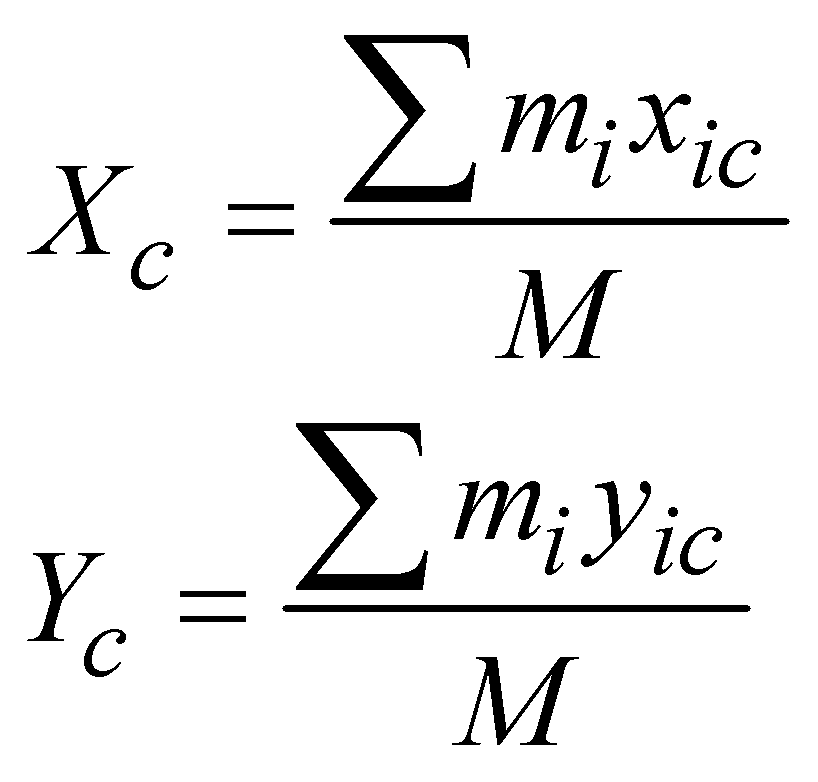
2.1. Centre of Mass EstimationTo calculate the CoM of each image from kinematic data, the necessary equations that the literature gives were taken. The selected equations as well as the methodology are provided by the University of Dundee 17 and disrobed by the following:

Xc and Yc are the coordinates that express the coordinates of the CoM of the whole system, while mi is the mass for each segment, and xic yic represent the position of CoM for each segment. The sum of them is then divided by the total mass of the body 18. The mass was estimated as a total of 100kg for each athlete, a hypothetical value that was used for the calculations. The equations were imported in Excel and the calculations were made by it.
2.2. InstrumentsOpenPose is a real-time multi-person system to jointly detect human body, hand, facial, and foot key-points (in total 135 key-points) on single images 19. OpenPose with a minor implementation in python, the authors have created many builds for different operating systems and languages. For this research OpenPose build for Windows was used. The version used is 1.70 while both the GPU and CPU builds were used. OpenPose works using Deep Learning 20.
2.3. Sublime TextThis application is a text editor for code and prose that automates repetitive tasks. It is supported on macOS, Windows and Linux. Its versatility comes from a wide range of community-developed third-party packages that provide syntax highlighting, snippets, or other automation backed by Python plugins 21. Sublime was the main program used to construct the necessary scripts that allowed the fulfillment of this study.
2.4. PythonPython is an interpreted high-level general-purpose programming language. Because code is automatically compiled to byte code and executed, Python is suitable for use as a scripting language, Web application implementation language, etc. 22. The created script makes use of libraries that work with python. The most important library that was utilized was Matplotlib 23. The addition of this library allows us to display the recorded coordinates of the program, creating a ribbed shape through the display process 23.
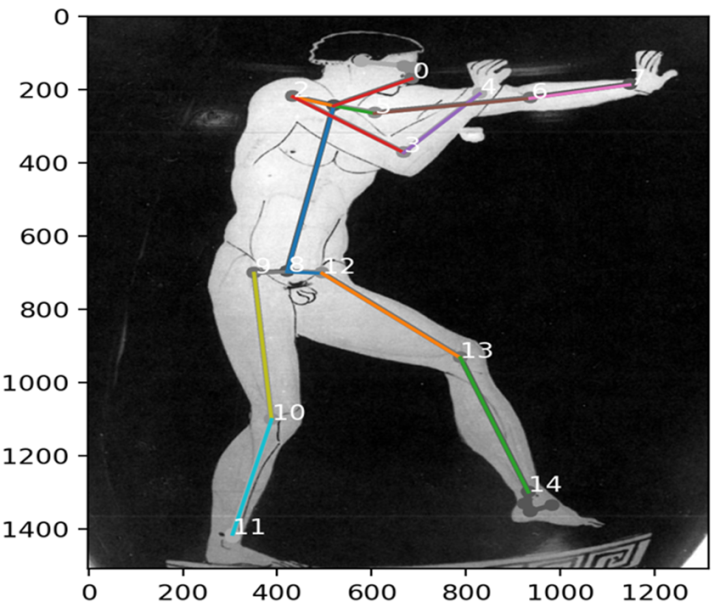
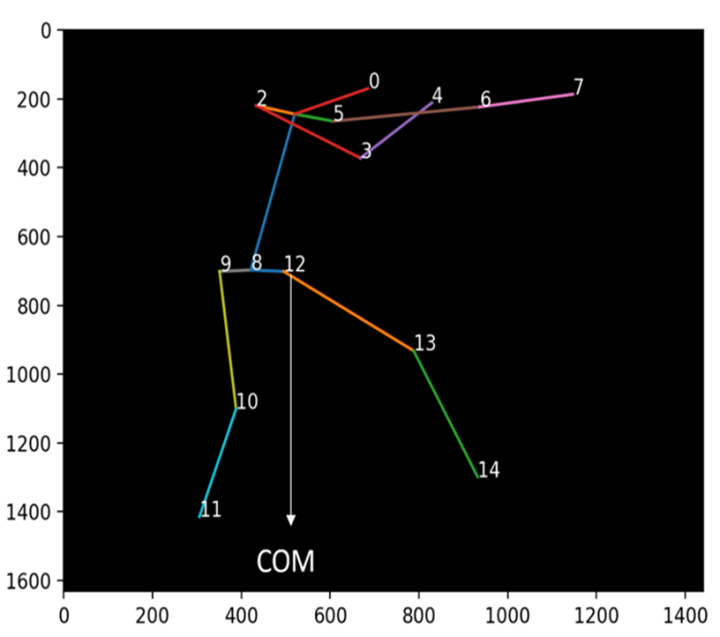
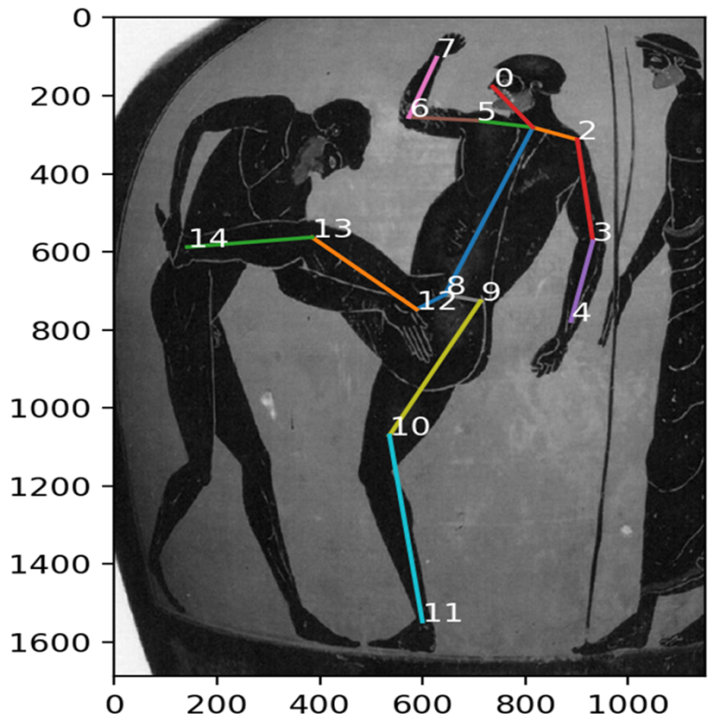
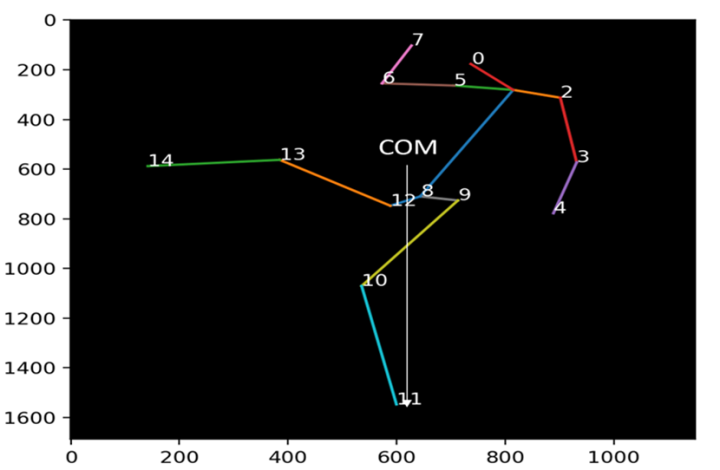
For this study, two indicative images (Figure 2, Figure 4, depicting ancient Greek Athletes) were analyzed in order to find the coordinates of the bodies’ Center of Mass. The representations of CoM may be found drawn on the respective images, (Figure 3, Figure 5). The center of mass coordinates as well as the corresponding center of gravity coordinates of each segment are also presented here. The multi-segment schema has been drawn using Matplotlib. Plots have been constructed by connecting joint coordinates with line segments. Then a graphic representation of the results is presented, (Figure 3, Figure 5) demonstrating the point at which the center of gravity acts, may be found as below:


For this research, pottery depictions were examined to find the center of mass (CoM). Illustrated points were presented as well as the coordinates of each body segment. Furthermore, starting from the first image (Figure 2), we observe that the CoM of the athlete is very close to the back foot and is at about 30% of the distance defined by the straight section which is the support base of the individual, thus allowing the athlete to maintain a safe position of his CoM. By placing the CoM at this point the athlete is able to start the match, having a starting position that provides him with safety for the first actions of the match 19.
The kinematic analysis of Figure 2 shows that the athlete lowers the CoM to have better balance. The hands are at the eyes’ level and the athlete is ready for the next strike, while protecting his body by maintaining a lateral position to protect the abdomen and his genitals 19.
From the kinematic analysis of Figure 4, it appears that the left leg supports the athlete’s weight. He is bringing the other leg forward to deliver a blow to his opponent. For better balance, he has the arms widely open allowing him to deliver the maximum force while he has the rest of the body behind to protect the head, abdomen, and genitals 19.
The above Figure 4, Figure 5 show the execution of a kick with the foot which is called pternizein and is a strike with the heel and was aiming to hit with the heel to the opponent's stomach. “… A special feature of Pankration is kicking 24, the kicks that contributed to the creation of the techniques that are a characteristic of Pankration, the pternizein, (the kicking with the heel) …” 25. As presented on Figure 4 this strike involved the danger of being exposed, as it enabled the defender by repelling it to drive his opponent into a state of imbalance. The phase depicted shows us after the analysis that the center of mass of the athlete who kicks acts perpendicularly in a straight line which leads exactly to the middle of the foot which is the support base of the athlete 19.
More specifically we see that his CoM is at 45% of the foot distance. This fact shows us that the athlete has made the best possible choice which allows him to be exposed as little as possible during the strike while achieving the maximum possible result during the kick.
This study aimed to find the CoM of the athletes as it is presented by the ancient pottery depictions. Estimating the CoM is of major importance as it allows to study elements of an athlete’s technique. Another important fact is that by finding the CoM it becomes possible to proceed to further analysis such as static analysis and analysis of the muscle function. Therefore, it becomes possible to approach for the first-time biomechanical characteristics, like the Ground Reaction Force (GRF) of the ancient Greek athletes. The development of neural networks and artificial intelligence in general as well as the simplification of the procedures required to create a script thanks to the programming language Python, allowed us to study images that have been taken from the relevant bibliography.
In our study, we applied modern sciences, i.e., modern biomechanics and computer science to analyze the postures depicted in various sculptures, vases, etc., and present scenes of Pankration. Ancient Greek athletes during various postures such as those presented to us from the archaeological archive, applied techniques that for their execution required a high level of knowledge of body-mechanics. The investigation of this case followed the modern experimental process. A two-dimensional analysis of the images took place, where the coordinates which are necessary to be able to locate the CoM were obtained.
The process of finding the CoM as presented by the modern literature was followed. The equations provided were imported to the program to automate the process but also to avoid some errors that could arise from the human factor. Through the analysis, we were able to think of some interpretations of the reasons why the athletes used to take these postures during the sports events, but also to give the perspective of engaging in the sport through modern sciences. It is an issue that still needs more studies in order to be fully analyzed.
The authors declare that they have no founding sources.
Andreas Bourantanis: Data curation, Formal analysis, Methodology, Software, Visualization, Writing – review. Nikitas Nomikos: Data curation, Conceptualization, Methodology, Writing – review & editing. Constantinos Trompoukis: Review & editing. Weijie Wang: Supervision, Project administration.
The authors declare that they have no known competing financial interests or personal relationships that could have appeared to influence the work reported in this paper.
| [1] | Gardiner N. (1930). Athletics of the Ancient World, The Clarendon Press, Oxford, p 48. | ||
| In article | |||
| [2] | Nomikos N. “Sport Injuries during the Athletic Games in Antiquity.” PhD thesis. Athens: Medical School of Athens; 2009. p. 43. | ||
| In article | |||
| [3] | Philostratus, Gymnasticus 3 | ||
| In article | |||
| [4] | Swaddling J. (1980). The Ancient Olympic Games. London. British Museum Press, p.57. | ||
| In article | |||
| [5] | Nomikos, N. N., Nomikos, G. N., Nikolopoulos, K. S., & Kores, D. S. (2009). Athletic injuries in ancient games. Opšta medicina, 15(3-4), 142-146. | ||
| In article | |||
| [6] | Liddell H.G., Scott R., A Greek-English Lexicon, on Perseus project. | ||
| In article | |||
| [7] | PBritannica, T. Editors of Encyclopaedia (2019, January 22). pankration. Encyclopedia Britannica. https://www.britannica.com/sports/pankration. | ||
| In article | |||
| [8] | Philostratus, Gymnasticus 11. https://www.loebclassics.com/view/philostratus_athens-gymnasticus/2014/pb_LCL521.415.xml. | ||
| In article | |||
| [9] | Plato, Euthydemus 271c. https://www.perseus.tufts.edu/hopper/text?doc=Perseus%3Atext%3A1999.01.0178%3Atext%3DEuthyd.%3Asection%3D271c. | ||
| In article | |||
| [10] | Kariotakis I. The History of the Heavy Events. Athens. Edition: Publishing Company of Athens, 1974; p. 118. | ||
| In article | |||
| [11] | Poliakoff, M., 1975. Combat sports in the ancient world. Yale University Press. 54-55. | ||
| In article | |||
| [12] | Cook, A. H, Nordtvedt. Kenneth L. and Faller. James E. (2021, November 17). gravity. Encyclopedia Britannica. https://www.britannica.com/science/gravity-physics. | ||
| In article | |||
| [13] | Hrysomallis C. Relationship between balance ability, training, and sports injury risk. Sports Med. 2007; 37(6): 547-56. | ||
| In article | View Article PubMed | ||
| [14] | Gialouris N. The Olympic Games in Ancient Greece. Edition: Publishing Company of Athens, 1976; p. 228. | ||
| In article | |||
| [15] | Dolan, M., Drew, T., Frank, T., Rami Abboud, R., Gibbs, S., Wang, W. and Christie, I., 2007. ESSENTIAL PHYSICS. 1st ed. Dundee, Scotland: University of Dundee, p.29. | ||
| In article | |||
| [16] | Gholipour, M., Tabrizi, A., & Farahmand, F. (2008). Kinematics Analysis of Lunge Fencing Using Stereophotogrametry. | ||
| In article | |||
| [17] | Wang, W., Arnold, G., Drew, T., Gibbs, S. and Christie, I., 2012. Modelling Techniques. Dundee, Scotland: University of Dundee. p 8. | ||
| In article | |||
| [18] | Wang, W., Abboud, R., Drew, T., Gibbs, S. and Chrisite, I., 2009. Properties of Joints and Limbs. Dundee, Scotland: University of Dundee. p 11. | ||
| In article | |||
| [19] | Bourantanis A. “A Static Analysis of Emblazonments Depicting Ancient Greek Pankration” MSc thesis. University of Dundee, 2021. | ||
| In article | |||
| [20] | Cao, Z., Hidalgo, G., Simon, T., Wei, S. E., & Sheikh, Y. (2021). OpenPose: Realtime Multi-Person 2D Pose Estimation Using Part Affinity Fields. IEEE Transactions on Pattern Analysis and Machine Intelligence, 43(1), 172-186. | ||
| In article | View Article PubMed | ||
| [21] | Peleg, Dan. 2013 Mastering Sublime Text. Packt Publishing Ltd pp 1 | ||
| In article | |||
| [22] | Summerfield, M. (2010). Programming in Python 3: a complete introduction to the Python language. Addison-Wesley Professional. | ||
| In article | |||
| [23] | Hunter J. D., “Matplotlib: A 2D Graphics Environment”, Computing in Science & Engineering, vol. 9, no. 3, pp. 90-95, 2007. | ||
| In article | View Article | ||
| [24] | Nomikos, N. N. (2015). The First Fatal Incident of Pangration/Pankration. American Journal of Sports Science and Medicine, 3(4), 82-84. | ||
| In article | |||
| [25] | Lucian Anacharsis 9 -14 http://www.perseus.tufts.edu/hopper/text?doc=Perseus%3Atext%3A2008.01.0453%3Asection%3D9. | ||
| In article | |||
Published with license by Science and Education Publishing, Copyright © 2022 Andreas G. Bourantanis, Nikitas N. Nomikos, Constantinos C. Trompoukis and Weijie W. Wang
 This work is licensed under a Creative Commons Attribution 4.0 International License. To view a copy of this license, visit
http://creativecommons.org/licenses/by/4.0/
This work is licensed under a Creative Commons Attribution 4.0 International License. To view a copy of this license, visit
http://creativecommons.org/licenses/by/4.0/
| [1] | Gardiner N. (1930). Athletics of the Ancient World, The Clarendon Press, Oxford, p 48. | ||
| In article | |||
| [2] | Nomikos N. “Sport Injuries during the Athletic Games in Antiquity.” PhD thesis. Athens: Medical School of Athens; 2009. p. 43. | ||
| In article | |||
| [3] | Philostratus, Gymnasticus 3 | ||
| In article | |||
| [4] | Swaddling J. (1980). The Ancient Olympic Games. London. British Museum Press, p.57. | ||
| In article | |||
| [5] | Nomikos, N. N., Nomikos, G. N., Nikolopoulos, K. S., & Kores, D. S. (2009). Athletic injuries in ancient games. Opšta medicina, 15(3-4), 142-146. | ||
| In article | |||
| [6] | Liddell H.G., Scott R., A Greek-English Lexicon, on Perseus project. | ||
| In article | |||
| [7] | PBritannica, T. Editors of Encyclopaedia (2019, January 22). pankration. Encyclopedia Britannica. https://www.britannica.com/sports/pankration. | ||
| In article | |||
| [8] | Philostratus, Gymnasticus 11. https://www.loebclassics.com/view/philostratus_athens-gymnasticus/2014/pb_LCL521.415.xml. | ||
| In article | |||
| [9] | Plato, Euthydemus 271c. https://www.perseus.tufts.edu/hopper/text?doc=Perseus%3Atext%3A1999.01.0178%3Atext%3DEuthyd.%3Asection%3D271c. | ||
| In article | |||
| [10] | Kariotakis I. The History of the Heavy Events. Athens. Edition: Publishing Company of Athens, 1974; p. 118. | ||
| In article | |||
| [11] | Poliakoff, M., 1975. Combat sports in the ancient world. Yale University Press. 54-55. | ||
| In article | |||
| [12] | Cook, A. H, Nordtvedt. Kenneth L. and Faller. James E. (2021, November 17). gravity. Encyclopedia Britannica. https://www.britannica.com/science/gravity-physics. | ||
| In article | |||
| [13] | Hrysomallis C. Relationship between balance ability, training, and sports injury risk. Sports Med. 2007; 37(6): 547-56. | ||
| In article | View Article PubMed | ||
| [14] | Gialouris N. The Olympic Games in Ancient Greece. Edition: Publishing Company of Athens, 1976; p. 228. | ||
| In article | |||
| [15] | Dolan, M., Drew, T., Frank, T., Rami Abboud, R., Gibbs, S., Wang, W. and Christie, I., 2007. ESSENTIAL PHYSICS. 1st ed. Dundee, Scotland: University of Dundee, p.29. | ||
| In article | |||
| [16] | Gholipour, M., Tabrizi, A., & Farahmand, F. (2008). Kinematics Analysis of Lunge Fencing Using Stereophotogrametry. | ||
| In article | |||
| [17] | Wang, W., Arnold, G., Drew, T., Gibbs, S. and Christie, I., 2012. Modelling Techniques. Dundee, Scotland: University of Dundee. p 8. | ||
| In article | |||
| [18] | Wang, W., Abboud, R., Drew, T., Gibbs, S. and Chrisite, I., 2009. Properties of Joints and Limbs. Dundee, Scotland: University of Dundee. p 11. | ||
| In article | |||
| [19] | Bourantanis A. “A Static Analysis of Emblazonments Depicting Ancient Greek Pankration” MSc thesis. University of Dundee, 2021. | ||
| In article | |||
| [20] | Cao, Z., Hidalgo, G., Simon, T., Wei, S. E., & Sheikh, Y. (2021). OpenPose: Realtime Multi-Person 2D Pose Estimation Using Part Affinity Fields. IEEE Transactions on Pattern Analysis and Machine Intelligence, 43(1), 172-186. | ||
| In article | View Article PubMed | ||
| [21] | Peleg, Dan. 2013 Mastering Sublime Text. Packt Publishing Ltd pp 1 | ||
| In article | |||
| [22] | Summerfield, M. (2010). Programming in Python 3: a complete introduction to the Python language. Addison-Wesley Professional. | ||
| In article | |||
| [23] | Hunter J. D., “Matplotlib: A 2D Graphics Environment”, Computing in Science & Engineering, vol. 9, no. 3, pp. 90-95, 2007. | ||
| In article | View Article | ||
| [24] | Nomikos, N. N. (2015). The First Fatal Incident of Pangration/Pankration. American Journal of Sports Science and Medicine, 3(4), 82-84. | ||
| In article | |||
| [25] | Lucian Anacharsis 9 -14 http://www.perseus.tufts.edu/hopper/text?doc=Perseus%3Atext%3A2008.01.0453%3Asection%3D9. | ||
| In article | |||