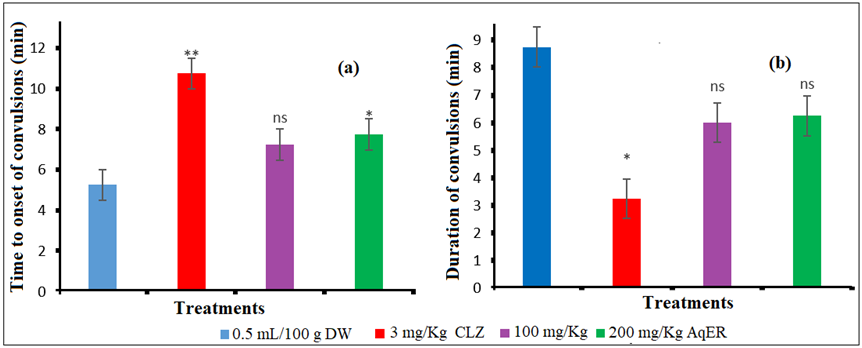
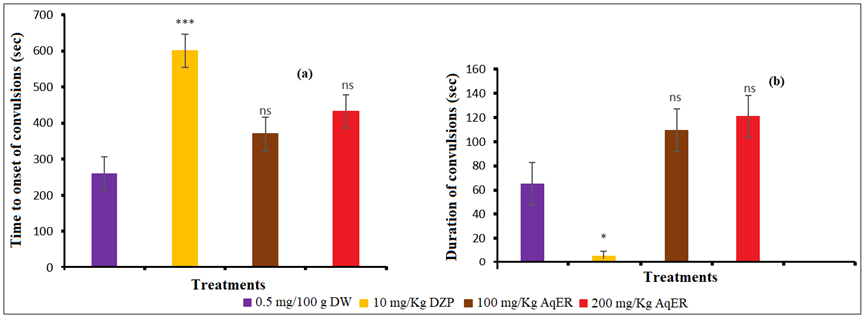
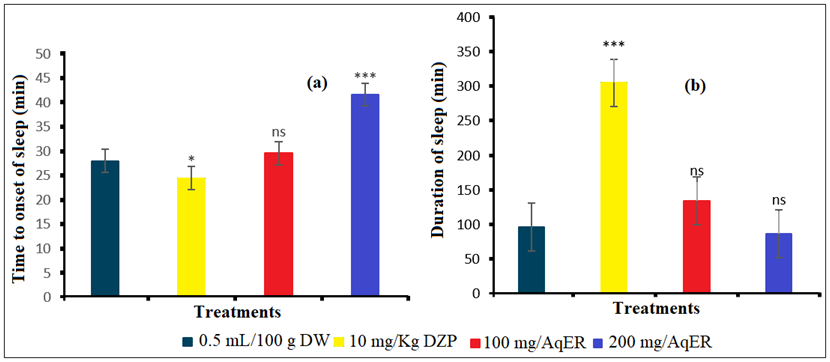
The present study aimed to evaluate the anticonvulsant and sedative effects of the aqueous extract of Crossopteryx febrifuga. Two pharmacological tests such induction of convulsions by Picrotoxin and Strychnine were carried out to evaluate the anticonvulsant effect of C. febrifuga roots. The two other tests performed for the sedative effect involved the motor activity test and the barbiturate sleep potentiation test in mice. The aqueous extract of Crossopteryx febrifuga roots at a dose of 200 mg/kg showed a significant increase (**p < 0.01 and *p < 0.05) in the time to onset of seizures induced by Picrotoxin and a non-significant increase in the time to onset of strychnine-induced seizures in mice. The extract caused a non-significant decrease in the duration of convulsions in mice at doses of 100 and 200 mg/kg. Crossopteryx febrifuga extract had no effect on motor activity. However, at a dose of 200 mg/kg the extract caused a significant increase (**p < 0.01 and *** p < 0.001) in the time to onset of sleep.
Epilepsy is a continuing brain disorder categorised by repeated instability of the nervous system because of unexpected extreme disorderly discharge from the cerebral neurons 1. Seizures are measured in closely 70% of patients with epilepsy, frequently over drugs effect on membrane ion channels or on gamma amino butyric acidergic (GABA) or glutamatergic transmission 2, 3. World Health Organization (WHO) projected that about 80% persons with epilepsy live in emerging countries and most of them do not get satisfactory therapeutic cure 4. All the presently accessible antiepileptic drugs are manmade molecules 5. In various patients, the currently offered antiepileptic drugs (AED) for example phenobarbital, phenytoin, benzodiazepines, sodium valproate, carbamazepine, ethosuximide, trimethadione etc., are incapable to resist seizures competently. Moreover, the dose-associated neurotoxicity and other side effects related to well-known AED limit their medical usage. The fresher AED like oxcarbazepine, vigabatrin, lamotrigine, gabapentin, felbamate etc., determine an actual advancement in the treatment of no responders or recalcitrant patients. Though, the problematic of antagonistic effects has also not been avoided absolutely and about 30% of the patients endure to have seizures with therapy of recent antiepileptic remedies. Therefore, exploration should remain to develop innovative, more active, and harmless neuroprotective agents for epilepsy treatment 6.
Medicinal plants recycled in traditional medicine for the epilepsy treatment have been systematically revealed to own hopeful anticonvulsant activities in animal simulations for transmission of anticonvulsant activity 7. Herbal medicine is motionless the support of approximately 75-80% of the world population, mostly in the emerging countries, for main health care due to well cultural satisfactoriness, enhanced compatibility through the human body and minor side effects. Nevertheless, the past few years have realised a foremost increase in their usage in the advanced world. Universal estimations show that 80% of approximately 4 billion of people cannot pay for the products of the Western Pharmaceutical Manufacturing and have to trust on the usage of traditional medicines which are largely resulting from plant material 8. Seeing the excessive dependence on traditional medicinal plants for diseases treatment and the impending for drug finding; it becomes pertinent to seek out effective, current and fairly safe plant medicines.
A quantity of investigations has been performed on medicinal plants founded on products and discovered worthy results when selected for anticonvulsant activity and various such plants are however to be scientifically discovered 9, 10, 11. Lately, Crossopteryx febrifuga (C.febrifuga) is a recurrent plant belonging to the Rubiaceae family 12, 13, 14, 15. The plant is accessible in many tropical countries. In traditional medicinal system, different parts of the plant have been stated to be suitable in a diversity of diseases. The leaves and roots are used in convulsions and central nervous system stimulation 16. Different extracts of Crossopteryx febrifuga also own antioxidative activities 14.
Various extracts of Crossopteryx febrifuga have also shown interesting anticonvulsive effects on certain pathogenic germs of clinical origin, responsible for infections of the nervous system. It protects against histamine-induced, useful in the treatment of epilepsy. The protective activity as anticonvulsive might be due to its flavonoid content. In the light of all this information, the therapeutic indications could be extended to other pathologies such as respiratory system, including diseases of bacterial origin 17, 18. However, only restricted data are accessible regarding the anticonvulsant activity of this plant species therefore, the present work was assumed to assess the anticonvulsant activity of aqueous extracts of Crossopteryx febrifuga roots.
Crossopteryx febrifuga, was collected from Kinkala, in the pool’s Department, Congo Republic, in March 2021. The plant was identified and authenticated by Dr. Mountsambote from National Institute of Forestery, Marien Ngouabi University, Congo Republic. The specimen was preserved in Laboratory of Pharmacodynamics and Experimental Physiopathology (L2PE), Faculty of Sciences and Techniques, Marien Ngouabi University, Brazzaville-Congo for future experimental tests.
2.2. Animal MaterialHealthy Swiss albino mice of either sex (18-20 g) were procured from the Institute of Research in health Sciences (IRSSA), Congo Republic. Animals were housed at house facilities of the Laboratory of Pharmacodynamics and Experimental Physiopathology (L2PE) until they gained significant weight (20 - 35 g) suitable for the present research work. They were housed in hygienic cages and preserved under normal laboratory conditions for one week before the experiments started and were preserved in groups of four (4) per cage at controlled temperature (22±2°C) with 12 h light/dark cycle and humidity (50%). They received standard diet, with free access to food and drinking water. The animals were kept in accordance with CPCSEA (Committee for the Purpose of Control and Supervision of Experimental Animals) guidelines for the care and usage of laboratory animals.
2.3. Extracts PreparationThe roots of Crossopteryx febrifuga collected were dried under shade for a period of four weeks. The dried plant material was crushed to a fine powder using the commercial laboratory mixer. Dried powder (50 g) was extracted in 500 mL of distilled water. The aqueous extract was stored in well closed glass container at 5°C in refrigerator for further study. The extracts obtained were subjected to various pharmacological tests to detect the anticonvulsive effects of the Aqueous Extracts of the Roots of Crossopteryx febrifuga in mice.
2.4. Study of the Anticonvulsant Activity of the Roots of C febrifugaAnimals were divided into 4 groups, (n=4 mice in one group). All treatment and standard groups were statistically compared with control groups. Destilled water was administered orally and standard drugs were administered by intra-peritoneal (i.p.) way. After treatments administration, mice were observed for elapsed time from intraperitoneal injection of picrotoxin until convulsions occurred and a number of mice showing convulsions (Basoueka, 2019).
2.5. Evaluation of the Effect of C. febrifuga Roots on Picrotoxin-induced Seizures (PIC)Groups of four mice each were formed: The negative control group received distilled water 0.5 mL/100 g per os; the positive control group was treated with Clonazepam 3 mg/kg per os and the test groups received the aqueous extract of the roots of Crossopteryx febrifuga at doses of 100 and 200 mg/kg per os respectively. One hour after all treatments, the convulsions were induced by intraperitoneal injection of picrotoxin 7.5 mg/kg. Animals were observed for 15 minutes. Those presenting or not convulsions without dying during this period, were declared protected. The onset time as well as the duration of convulsions in each group were determined 13, 19.
2.6. Evaluation of the Effect of C. febrifuga Roots on Strychnine-induced Seizures (STR)Groups of four mice each were formed: Group 1 negative control received distilled water 0.5 mL/100 g, per os; positive control groupo 2 was treated with diazepam 10 mg/kg per os and the test groups received the aqueous extract of Crossopteryx febrifuga roots at doses of 100 and 200 mg/kg per os respectively. One hour after all treatments, convulsions were induced by intraperitoneal injection of strychnine 2.5 mg/kg. Animals were observed for 10 minutes. Those presenting or not convulsions without dying during this period, were declared protected. The onset time as well as the duration of convulsions in each group were determined 16, 18.
2.7. Evaluation of the Effects of Aqueous Extracts from the Roots of C. febrifuga on Motor Activity and Barbiturate SleepGroups of four mice each were formed and treated orally as follows: Negative control group 1 received distilled water 0.5 mL/100 g; the positive control group was treated with the reference molecule such diazepam 10 mg/kg and the test groups received the aqueous extract of the roots of Crossopteryx febrifuga respectively at doses of 100 and 200 mg/kg. One hour after administration of products, animals were placed in turn in a squared cage, and the number of squares crossed by them after five (5) minutes was noted.
Intraperitoneal injection of phenobarbital induced sleep in mice. Groups of four mice each were formed. Negative control group 1 received distilled water 0.5 mL/100 g, per-os; the positive control group was treated with diazepam 10 mg/kg, per os; the test groups were treated with the aqueous extract of the roots of Crossopteryx febrifuga at doses of 100 and 200 mg/kg per os respectively. One hour after administration of different products, sleep was induced by intraperitoneal injection of phenobarbital 50 mg/kg at a dose of 50 mg/kg, the time to onset and the duration of sleep for each mouse was determined 15, 20.
2.8. Statistical AnalysesStatistical analysis was performed from experimental results including observations which were expressed as mean ± standard deviation (SD). The significance of difference among groups was carried out by using one-way analysis of variance (ANOVA) measured by at any level one of the Dunnett’s multiple comparison tests (p < 0.05, p < 0.01, p < 0.001) where rate of significance was determined for each test. The results were presented as mean ± S.D.
Figure 1 (a and b) represents the effect of the aqueous extract of the roots of C. febrifuga on the time to onset and duration of seizures in mice, respectively. These results suggest that the aqueous extract of the roots of C. febrifuga at a dose of 200 mg/kg leads to a significant increase (**p < 0.01 and *p < 0.05) in the time to onset of seizures in mice (Figure 1). Regarding the duration of convulsions, Figure 3 shows that the aqueous extract of the roots of C. febrifuga at doses of 100 and 200 mg/kg caused a non-significant decrease in the duration of convulsions in mice.

Figure 2 (a and b) represents the effect of aqueous extracts of roots of C. febrifuga on the time to onset and duration of convulsions in mice respectively. These results show a non-significant increase of the aqueous extracts of roots of C.febrifuga in the time to onset of convulsions compared to the control group (Figure 2 a and b).

Table 1 shows the effect of aqueous extracts of roots of C.febrifuga on motor activity in mice. It appears that the aqueous extracts of roots of C.febrifuga did not cause a significant decrease in motor activity in mice at the respective doses of 100 and 200 mg/kg compared to the control group.
Figure 3 represents the effect of the aqueous extract of the roots of C. febrifuga respectively on the time to onset and the duration of sleep in mice. These results suggest that the aqueous extract of the roots of C. febrifuga at a dose of 200 mg/kg led to a significant increase (**p < 0.01 and *** p < 0.001) in the time to onset of sleep in mice (Figure 3). However, unlike the reference molecule, the extract at a dose of 200 mg/kg increased the duration of sleep (Figure 3).

The present study aimed to evaluate the anticonvulsant and sedative effects of the aqueous extract of the roots of C. febrifuga. The results obtained showed that the aqueous extract of the roots of C. febrifuga at a dose of 200 mg/kg led to a significant increase in the time to onset of convulsions. On the other hand, at doses of 100 and 200 mg/kg the extract caused a non-significant reduction in the duration of convulsions compared to the control groups. This suggests that the aqueous extract from the roots of C. febrifuga would have an anticonvulsant effect against STR-induced seizures. Thus, the antagonism by C. febifuga of STR-induced seizures in mice could be explained by the existence of molecules in the aqueous extracts that would have anticonvulsant properties 13, 15, 20. Considering the strychnine-induced (STR), the results obtained show that the aqueous extract of the roots of C. febrifuga at doses of 100 and 200 mg/kg resulted in an increase and a non-significant decrease respectively in the time to onset and the duration of convulsions like the reference molecule such as diazepam. C. febrifuga roots showed no effect on the duration of convulsions. These results suggest that the extract would have an anticonvulsant effect at high doses, since all the substances that oppose the effect of STR are anticonvulsants. flavonoids present in the extract would be responsible for the pharmacological effect observed. The aqueous extract from the roots of C. febrifuga had no effect on barbiturate sleep, increasing and decreasing the time to onset and duration of sleep respectively in mice, unlike the reference molecule (diazepam).
In conclusion, the results of the present study demonstrated that the aqueous extract obtained from Crossopteryx febrifuga roots possess anticonvulsant properties in treated mice. Such pharmacological effects confirm and justify, at least in part, the popular traditional use of this plant to treat convulsions. However, the mechanism by which the plant extract exerts its anticonvulsant effect can be always studied for additional information.
The aqueous roots extract of Crossopteryx febrifuga roots demonstrated potential anticonvulsant properties in the experimental animals at the doses used. Therefore, these plant parts deserve to be investigated to isolate the phytoconstituent responsible for anticonvulsant effects as well as its mechanism.
| [1] | Maiha B.B., Magaji M.G., Yaro A.H., Hamza A.H., Ahmed S.J., Magaj A.R. (2009). Anticonvulsant studies on cochlospermum tinctorium and Paullinia pinnata extracts in laboratory animals. Nigerian Journal of Pharmaceutical Sciences 8: 102-108. | ||
| In article | |||
| [2] | Vyawahare N.S., Khandelwal A.R., Batra V.R., Nikam A.P. (2007). Herbal anticonvulsants. Journal of Herbal Medicine and Toxicology 1: 9-14. | ||
| In article | |||
| [3] | Marjan N.A., Zamansoltani F., Torabinejad B. (2009). Antiepileptic effects of quinine in the pentylenetetrazole model of seizure. Seizure 8: 129-132. | ||
| In article | View Article PubMed | ||
| [4] | Reddy D.S. (2005). Pharmacotherapy of catamenial epilepsy. Indian Journal of Pharmacology 37: 288-293. | ||
| In article | View Article | ||
| [5] | Hema B., Bhupendra S., Mohamed Saleem T.S., Gauthaman K. (2009). Anticonvulsant effect of Drosera burmannii Vahl. International Journal of Applied Research in Natural Products 2: 1-4. | ||
| In article | |||
| [6] | Ezekiel I., Mabrouk M.A., Ayo J.O., Goji A.D., Okpanachi A.O., Mohammed A., Tanko Y. (2010). Study of the effect of hydro-ethanolic extract of Commiphora africana (stem-bark) on sleeping time and convulsion in mice. Asian Journal of Medical Sciences 2: 85-88. | ||
| In article | |||
| [7] | Wannang N.N., Anuka J.A., Kwanashie H.O., Gyang S.S., Auta A. (2008). Anti-seizure activity of the aqueous leaf extract of Solanum nigrum L. (Solanaceae) in experimental animal. African Health Sciences 8: 74-79. | ||
| In article | |||
| [8] | Joy P.P., Thomas J., Mathew S., Skaria B.P. (2001); Medicinal Plants Tropical Horticulture. Vol-2, Calcutta: Naya Prokashan. | ||
| In article | |||
| [9] | Hosseinzadeh H., Khosravan V. (2002). Anticonvulsant effects of aqueous and ethanolic extracts of Crocus sativus L. stigmas in mice. Archives of Internal Medicine 5: 44-47. | ||
| In article | |||
| [10] | Hosseinzadeh H., Parvardeh S. (2004). Anticonvulsant effects of thymoquinone, the major constituent of Nigella sativa seeds in mice. Phytomedicine 11: 56-64. | ||
| In article | View Article PubMed | ||
| [11] | Quintans-Júnior L.J., Almeida J.R., Lima J.T., Nunes X.P., Siqueira J.S., Gomes de Oliveira L.E., Almeida R.N., Athayde-Filho P., Barbosa-Filho J.M. (2008a). Plants with anticonvulsant properties-a review. Revista Brasileira de Farmacognosis 18: 798-819. | ||
| In article | View Article | ||
| [12] | Quintans-Júnior L.J., Souza T.T., Leite B.S., Lessa N.M.N., Bonjardim L.R., Santos M.R.V., Alves P.B., Blank A.F., Antoniolli A.R. (2008b). Phythochemical screening and anticonvulsant activity of Cymbopogon winterianus Jowitt (Poaceae) leaf essential oil in rodents. Phytomedicine 15: 619-624. | ||
| In article | View Article PubMed | ||
| [13] | Bassoueka D.J., Taiwe Sotoing G., Nsonde Ntandou G.F. et Ngo Bum E. (2016). Anticonvulsant activity of the decoction of Crossopteryx febrifuga in mice. International Journal of Science and Research 5(3): 112-116. | ||
| In article | View Article | ||
| [14] | Bassoueka D.J., Loufoua B.A.E., Abena A.A., (2019). Assessment of anxiolytic abd antidepressant effects of Crossopteryx febrifuga in mice. International journal of science and research 7: 2319-7064. | ||
| In article | |||
| [15] | Bassoueka D. J., Loembet E.C., Mavethy A.B.E., Loufoua O.B., Abena1 A.A. (2022). Anticonvulsant and sedative effects assessment of aqueous extract of Crossopteryx febrifuga seeds in mice. IOSR Journal of Pharmacy and Biological Sciences (IOSR-JPBS) 1: 27-31. | ||
| In article | |||
| [16] | Adesina S.K. (1982). Studies on some plants used as anticonvulsants in Amerindian and African traditional medicine. Fitoterapia 53: 147-162. | ||
| In article | |||
| [17] | Mao S.C., Li Z.Y., Li G. (2007). Studies on antioxidation activity of three plants of Desmodium. Yunnan Daxue Xue Bao 29: 393-397. | ||
| In article | |||
| [18] | Poole K., Moran N., Bell G., Solomon J., Kendall S., McCarthy M., McCormick D., Nashef L., Johnson A., Sander J., Shorvon S. (2000). Patients' perspectives on services for epilepsy: a survey of patient satisfaction, preferences and information provision in 2394 people with epilepsy. Seizure 9: 551-558. | ||
| In article | View Article PubMed | ||
| [19] | Ngo Bum I., Temkou Ngoupaye G., Dimo T. (2008). The anticonvulsant and sedative properties of stems of Cissus quadrangularis in mice. African Journal of Pharmacy and Pharmacology 2(3): 42-47. | ||
| In article | |||
| [20] | Ngo Bum E., Taiwe G.S., Nkaissa L.A., Moto F.C.O., Seke Etet P.F., Hiana I.R., T., Rouyatou, Papa Seyni, Rakotonirina A., Rakotonirina S.V. (2009). Validation of anticonvulsant and sedative activity of six medicinal plants. Epilepsy and Behavior 14: 454-458. | ||
| In article | View Article PubMed | ||
Published with license by Science and Education Publishing, Copyright © 2022 Bassoueka D’Avila Judicaël, Peneme Bonaventure Max Lazare and Abena Ange Antoine
 This work is licensed under a Creative Commons Attribution 4.0 International License. To view a copy of this license, visit
http://creativecommons.org/licenses/by/4.0/
This work is licensed under a Creative Commons Attribution 4.0 International License. To view a copy of this license, visit
http://creativecommons.org/licenses/by/4.0/
| [1] | Maiha B.B., Magaji M.G., Yaro A.H., Hamza A.H., Ahmed S.J., Magaj A.R. (2009). Anticonvulsant studies on cochlospermum tinctorium and Paullinia pinnata extracts in laboratory animals. Nigerian Journal of Pharmaceutical Sciences 8: 102-108. | ||
| In article | |||
| [2] | Vyawahare N.S., Khandelwal A.R., Batra V.R., Nikam A.P. (2007). Herbal anticonvulsants. Journal of Herbal Medicine and Toxicology 1: 9-14. | ||
| In article | |||
| [3] | Marjan N.A., Zamansoltani F., Torabinejad B. (2009). Antiepileptic effects of quinine in the pentylenetetrazole model of seizure. Seizure 8: 129-132. | ||
| In article | View Article PubMed | ||
| [4] | Reddy D.S. (2005). Pharmacotherapy of catamenial epilepsy. Indian Journal of Pharmacology 37: 288-293. | ||
| In article | View Article | ||
| [5] | Hema B., Bhupendra S., Mohamed Saleem T.S., Gauthaman K. (2009). Anticonvulsant effect of Drosera burmannii Vahl. International Journal of Applied Research in Natural Products 2: 1-4. | ||
| In article | |||
| [6] | Ezekiel I., Mabrouk M.A., Ayo J.O., Goji A.D., Okpanachi A.O., Mohammed A., Tanko Y. (2010). Study of the effect of hydro-ethanolic extract of Commiphora africana (stem-bark) on sleeping time and convulsion in mice. Asian Journal of Medical Sciences 2: 85-88. | ||
| In article | |||
| [7] | Wannang N.N., Anuka J.A., Kwanashie H.O., Gyang S.S., Auta A. (2008). Anti-seizure activity of the aqueous leaf extract of Solanum nigrum L. (Solanaceae) in experimental animal. African Health Sciences 8: 74-79. | ||
| In article | |||
| [8] | Joy P.P., Thomas J., Mathew S., Skaria B.P. (2001); Medicinal Plants Tropical Horticulture. Vol-2, Calcutta: Naya Prokashan. | ||
| In article | |||
| [9] | Hosseinzadeh H., Khosravan V. (2002). Anticonvulsant effects of aqueous and ethanolic extracts of Crocus sativus L. stigmas in mice. Archives of Internal Medicine 5: 44-47. | ||
| In article | |||
| [10] | Hosseinzadeh H., Parvardeh S. (2004). Anticonvulsant effects of thymoquinone, the major constituent of Nigella sativa seeds in mice. Phytomedicine 11: 56-64. | ||
| In article | View Article PubMed | ||
| [11] | Quintans-Júnior L.J., Almeida J.R., Lima J.T., Nunes X.P., Siqueira J.S., Gomes de Oliveira L.E., Almeida R.N., Athayde-Filho P., Barbosa-Filho J.M. (2008a). Plants with anticonvulsant properties-a review. Revista Brasileira de Farmacognosis 18: 798-819. | ||
| In article | View Article | ||
| [12] | Quintans-Júnior L.J., Souza T.T., Leite B.S., Lessa N.M.N., Bonjardim L.R., Santos M.R.V., Alves P.B., Blank A.F., Antoniolli A.R. (2008b). Phythochemical screening and anticonvulsant activity of Cymbopogon winterianus Jowitt (Poaceae) leaf essential oil in rodents. Phytomedicine 15: 619-624. | ||
| In article | View Article PubMed | ||
| [13] | Bassoueka D.J., Taiwe Sotoing G., Nsonde Ntandou G.F. et Ngo Bum E. (2016). Anticonvulsant activity of the decoction of Crossopteryx febrifuga in mice. International Journal of Science and Research 5(3): 112-116. | ||
| In article | View Article | ||
| [14] | Bassoueka D.J., Loufoua B.A.E., Abena A.A., (2019). Assessment of anxiolytic abd antidepressant effects of Crossopteryx febrifuga in mice. International journal of science and research 7: 2319-7064. | ||
| In article | |||
| [15] | Bassoueka D. J., Loembet E.C., Mavethy A.B.E., Loufoua O.B., Abena1 A.A. (2022). Anticonvulsant and sedative effects assessment of aqueous extract of Crossopteryx febrifuga seeds in mice. IOSR Journal of Pharmacy and Biological Sciences (IOSR-JPBS) 1: 27-31. | ||
| In article | |||
| [16] | Adesina S.K. (1982). Studies on some plants used as anticonvulsants in Amerindian and African traditional medicine. Fitoterapia 53: 147-162. | ||
| In article | |||
| [17] | Mao S.C., Li Z.Y., Li G. (2007). Studies on antioxidation activity of three plants of Desmodium. Yunnan Daxue Xue Bao 29: 393-397. | ||
| In article | |||
| [18] | Poole K., Moran N., Bell G., Solomon J., Kendall S., McCarthy M., McCormick D., Nashef L., Johnson A., Sander J., Shorvon S. (2000). Patients' perspectives on services for epilepsy: a survey of patient satisfaction, preferences and information provision in 2394 people with epilepsy. Seizure 9: 551-558. | ||
| In article | View Article PubMed | ||
| [19] | Ngo Bum I., Temkou Ngoupaye G., Dimo T. (2008). The anticonvulsant and sedative properties of stems of Cissus quadrangularis in mice. African Journal of Pharmacy and Pharmacology 2(3): 42-47. | ||
| In article | |||
| [20] | Ngo Bum E., Taiwe G.S., Nkaissa L.A., Moto F.C.O., Seke Etet P.F., Hiana I.R., T., Rouyatou, Papa Seyni, Rakotonirina A., Rakotonirina S.V. (2009). Validation of anticonvulsant and sedative activity of six medicinal plants. Epilepsy and Behavior 14: 454-458. | ||
| In article | View Article PubMed | ||