As part of a larger study this study reviewed the current state of knowledge of female garment workers’ (FGWs) experiences and their personal understandings of their human immunodeficiency virus (HIV) experiences in Bangladesh. Relevant literature on FGWs health on sexually transmitted infections (STIs) and HIV within Bangladesh published between 1990 and 2020 was carried out through a critical review. Relevant information from the selected articles was extracted and presented to contribute to the existing literature in the form of new findings and also critically interpret existing findings. The themes and keywords were examined in the abstract and title of literature extracted using the aforementioned search engines. Major causes of HIV vulnerability of FGWs are gender inequality, multiple sex partners, drug abuse and rape violence. These poor FGWs are not informed about contraceptive methods, safe sex, menstruation and hygiene and HIV infection due to low literacy rate. Empowering FGWs through formal health education on HIV is essential, including prevention of work place violence (WPV) and intimate partner violence (IPV) related training. Community leaders, private sector involvement and business in HIV needs to be encouraged. Current, surveillance has been conducted on key population, therefore outcome of this study recommend a large-scale study on FGWs in urban areas of Bangladesh to guide policymakers and researchers on how to prevent HIV and improve FGW health.
According to the World Bank (2013) report, Bangladesh is a low- to middle-income country (LMIC), with a gross national income (GNI) per capita of US$829. The Director for General Family Planning, Government of Bangladesh( GOB) reported in 2013 that young people aged 10-24 years represent 31% of the total population, with a substantial ‘(24.3%) percentage’ 1 living in poverty. 55% of adolescent girls and 48% of boys are enrolled in secondary schools. 85% majority of garment workers are female, of which 50% are adolescent girls. The adolescent population of Bangladesh covers more than one-fifth (1/5) of the total population, which consists of 36 million 2, which is more than total population of Australia, which consists of over 25 million 3.
Bangladesh continues to have a low percentage of the epidemic prominence of the human immunodeficiency virus (HIV) among developing countries in Asia, where as the adult prevalence of HIV infection is assessed less than 0.1% 4, 5. However, the number of undetected cases is much higher 6, 7, 8. Despite its enormous health problems in Bangladesh, Bangladesh acknowledges HIV as one of the emerging health and social problems 9. Bangladesh does have a very high prevalence of (sexually transmitted infection) STIs, ‘indicating the country's increased susceptibility to HIV’ 10. In other words, infections with STIs increase the chance of spreading HIV. Effective treatment of STIs is one of the proven methods of preventing HIV 7, 11, 12, 13, 14, 15. Finally, the drug powerfully contributes to the spread of HIV disease 16.
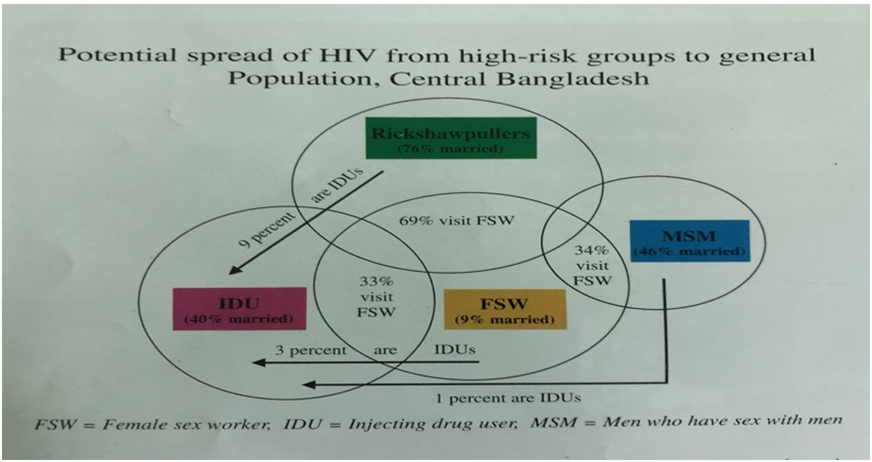
Current surveillance has discovered the occurrence of close sexual networks of injecting drug users (IDUs) with other risk groups, particularly female sex workers (FSWs). On the other hand, FSWs were shown to have close sexual links with multiple male client groups, not restricted to IDUs 17. HIV has started to move an upper trend 5, 18, 19 among people who inject drugs (PWID) 7, 8, 20. In Bangladesh, female IDUs are at risk of foremost HIV epidemic from sexual risk behaviours, injection sharing and sex workers. IDUs are especially vulnerable, once HIV enter this KP community (female sex workers, IDUs and men who have sex with men (MSM)), and these female IDUs are potential to bridge the HIV epidemic to the general population 21, 22. The results from the 2016 serological surveillance was conducted among IDUs in the Dhaka city and found that 22% male IDUs and 5% female IUDs were HIV positive 23. According to Ministry of Health and Family Welfare, Government of Bangladesh, 2017 report, the HIV epidemic was predominantly cantered in one particular neighbourhood in Dhaka city, where 27% of the sample were male IUDs HIV positive. According to UNICEF, there is a risk of HIV infection may infect to the general population 23.
Female garments workers (FGWs), who had sex with numerous partners were more likely to inject drugs and these FGWs, who had numerous sex partners as well as inject drugs were significantly less likely to use condoms. Furthermore, these FGWs, who inject drugs were also significantly more likely to have sex with multiple partners. This connotation of one risk behaviour with further risk behaviours may imply that garment workers could fall into a vicious cycle of risk behaviour, if one of the risk behaviours is present and eventually this may lead to this FGWs to be extremely vulnerable to HIV 24. In other words, the HIV-related risk behaviours’ of the FGWs may have a substantial impact on the future course of the HIV epidemic in Bangladesh.
The future direction of this virus depends on the level of knowledge of how the STIs/HIV is spread and changes in sexual knowledge, attitudes and practice/behaviour. The aim of the research is to critically examine female garment factory workers’ experiences and their personal understandings of sexually transmitted infections, particularly Human Immunodeficiency Virus (HIV) in Bangladesh. This understanding is key to future program development and effective policies directed towards STIs and HIV prevention for this population of women.
A critical review was carried out of the literature published in English and available in databases of PubMed, Google Scholar, WHO, Medline, Ebsco, Embase, Proquest, Scopus, and the United Nations and World Health Organization. Google Scholar is a non-academic search engine however, it was included here to ensure that can be captured all available evidence on STIs/ HIV on FGWs, which may have been published in journals not indexed on the included databases 25. In addition, manual searching was conducted to identify and review relevant articles in academic database and library of University of Newcastle, Australia. Articles covered a wide-ranging range that included philosophical debates, social science, public health ethics, and descriptive reports, in addition to quantitative and qualitative studies. The key words used were: ‘sexually transmitted disease’, ‘human immune deficiency virus’, ‘syphilis’, ‘gonorrhoea’, ‘chlamydia’, ‘violence’, ‘women and health’, ‘female’, ‘garment’ or ‘clothing’ or ‘fabric’ or ‘ sweatshop’ or ‘textile’, and ‘Bangladesh’. Key themes of the research were STIs/HIV, gender, exploitation, garment industries and occupational vulnerabilities of these FGWs placed them in a context of increased risk of acquiring STIs and HIV. Interventions to reduce the risk of HIV infection for FGWs should address these themes. The corresponding author also obtained only those articles that were more likely to meet the objective of the study. Besides, the corresponding gone through the reference arrangements of the selected articles, which were further screened for important papers.
The critical literature search was conducted between October 2017 and June, 2020; during this period collected literature were reviewed and synthesized for analysis. Overall 10,079 documents were retrieved from the databases of national and international peer reviewed journals and websites from 1990-2020. Online sources of social and public health and STIs/HIV related journals were searched for relevant publications. The review involved two stages: The corresponding author first conducted an extensive search of the existing literatures, and then the corresponding author screened the collected literatures in terms of their relevance to issues of women’s health, particularly FGWs on STIs and HIV. Most of the articles were excluded after screening the title and abstracts. The corresponding author also screened out a good number of articles due to duplication and irrelevant to the issues. The Corresponding author have cited 106 documents to this paper. During the review process efforts were made to synthesize the relevant materials to gain a comprehensive understanding. Relevant conference presentations related to STIs in women of Bangladesh together with findings of historical observations and a cross sectional prevalence study of STIs and HIV in Bangladesh were included. Study design included in this critical review were descriptive cross-sectional studies. All studies addressed health outcomes, including STIs and HIV. Participants included FGWs dedicated to cutting, weaving, sewing stitching, finishing, dyeing, and ironing. This extensive critical review attempted to contribute to existing literature in the form of new findings and critically evaluate existing findings aimed at reducing women’s HIV/STIs risk, particularly FGWs in Bangladesh. Corresponding author executed a content analysis of all data and concise it under certain themes, and then compared and contrasted the outcomes as they related to FGWS and their vulnerability and susceptibility to STIs/HIV 26. Corresponding author completed a content analysis of all data and succinct it under certain themes, and then compared and contrasted the results as they related to FGWs and their vulnerability and susceptibility to STIs/HIV 26.
The corresponding author debated most of the society’s grand challenges, as defined by the United Nation (UN) Sustainable Development Goals (SDGs) from social scientific outlooks and the SDGs goals are:
GOAL 1: No Poverty; GOAL 3: Good Health and Well-being; GOAL 4: Quality Education: GOAL 5; Gender Equality: GOAL 8: Decent Work and Economic Growth; GOAL 9: Industry, Innovation and Infrastructure: GOAL 10: Reduced Inequality; GOAL 11: Sustainable Cities and Communities; GOAL 12: Responsible Consumption and Production; GOAL 16: Peace and Justice Strong Institutions; GOAL 17: Partnerships to achieve the Goal 27.
The industry hires primarily women workers 4 million, 90% of them are women 28, 29, 30, 31, and 90% of the FGWs are the migrants from rural areas and mainstream of them migrated from landless families 32, 33. The FGWs have a key role for strengthening the Ready Made Garment (RMG) industry by the fact that the poor unskilled women have few choices or/and no better work opportunities. Employers prefer female workers not only because they are inexpensive (mainly low wage and salary) and abundantly available, but also because they are more docile, vulnerable and manageable than male workers as well as disenfranchised population of Bangladesh 34. Whenever the country is criticized for its high level of corruption and confrontational politics, it is the garment industry is held up as a success story 35.
The themes of the literature review are provided in overview format, below:
• FGWs and their vulnerability to STIs and HIV.
• Awareness levels on HIV among FGWs.
• FGWs prone to sex work.
• Violence and its impact on FGWs.
3.1. FGWs and Their Vulnerability to STIs and HIVThe adolescent characteristics with “formation of one’s individuality, expressions of intimacy, and the defining of experiences within a sexual and romantic framework” 7, 36 make these FGWs particularly vulnerable to social magnitudes, including potential risk of contracting STIs. In one study it was revealed that around 60 % of the respondents were unmarried at the interview time, indicating that FGWs have chosen to remain unmarried for longer than traditional young women in Bangladesh 37. This brings the issue of unprotected premarital sex among FGWs. In previous research it was reported that feelings of pressure for sexual activity and unprotected pre-marital sex were prevalent in FGWs. In the community, unmarried adolescents do not have much access to information about ways to protect them from contracting STIs/HIV 38. The situation places these FGWs at risk of not only contracting STIs and HIV, but also increases the risk of spreading the diseases in the community 39.
Risk of contracting STIs, that is lack of knowledge about safe sex practice, multiple sex partners, and having STIs without the knowledge of having it, have been known in Bangladeshi garment workers 7, 22, 39, 40. Research suggest that the respondents are not adequately aware about contraceptive use, but contraceptive usage was establish to be an important aspect for STIs, plus HIV/AIDS awareness 7, 41. According to one study reported that among people aged 15-24; the rate of knowledge about HIV prevention was lower among women (36%) compared to men (40%) 42. Another study discloses that regarding knowledge on non-contraceptive use of condoms such as protection from STIs like HIV, syphilis, gonorrhoea etc. literature demonstrated that around 87% workers had no knowledge about it and only 30% were anxious of uses of condoms 7, 43. In light of the above findings and according to Yaya et.al it proves that women’s level of HIV knowledge in Bangladesh is noticeably low 42.
Limited access to information and social condemnation of sexual activity on safe sex in unmarried women in Bangladesh make it harder for FGWs to talk about sexuality related health complications 44. Another study made an attempt to assess the risk behaviours for HIV/AIDS among FGWs aged 15-24 years. The knowledge of HIV and AIDS was moderate with high rates of misperception regarding modes of transmission. Furthermore, symptoms of STIs, such as genital ulcer disease and vaginal discharge were predominant, and risk behaviours, such as drug abuse, multiple sex partners, and low use of condoms were also prevalent 7, 24, 40. According to Paul and others (1999), many illnesses and diseases are more predominant among the FGWs than among their male colleagues 45. About 40% of women’s illnesses and diseases as opposed to 33% for male garment workers do not receive any treatment 46, 106. One study revealed that FGWs exposure to changing social dynamics and environments may increase their engagement in intimate relationships and sexual exploitation 47, 48, thereby increasing their likelihood of STIs infection 49. According to Webber et al, in Cambodia, the study maintain when the FGWs leave the support and control of their parents and their communities, they left with a large social support networks. While other female colleagues fill this gap, for some FGWs their newfound friends may encourage them to pursue sexual relationships with local men according to this study. This social vulnerability amplified by loneliness and absence of family restrictions 50. The example is similar to Bangladesh social context as most of the FGWs are migrating from rural to urban city. FGWs are mostly alone and single and often develop a social group by themselves as FGWs families are living far away from them 51, 52.
3.2. Awareness Levels on HIV/AIDS among FGWsThe respondents’ contraceptive usage, education level, mass media and HIV workshops significant effects on HIV/AIDS knowledge and the awareness of FGWs 53. It is crucial to understand how much of female adolescents know about fatality and AIDS and how to prevent the disease 5. Till date little is identified about awareness of HIV/AIDS among adolescent FGWs in Bangladesh 54.
As 54, the study, the awareness of majority of the FGWs, 76.9% was poor, whereas 12.5% had average awareness. Only 10.6% had good awareness. The study demonstrated that, out of 136 male respondents, 18 had good awareness, whereas among 167 female, 14 had good awareness. That is to say, male were slightly more aware than the female, though their relationship is not statistically significant 54, 55. Mass media exposure, such as TV and Radio were positively connected with having knowledge on HIV/AIDS among the adolescent 54. In addition to this, 21% of the respondents in Hasan and others study, referred that the respondents first came to know about HIV/AIDS from the health personnel. Nevertheless, UNICEF indicated that only 14.4% of male and 11.9% of female have complete knowledge about prevention of HIV/AIDS among individuals aged 15–24 years 56. On this observation, majority considered that HIV/AIDS as a serious social health problem for Bangladesh. 54.
3.3. FGWs Prone to Sex WorkAccording to behavioural surveillances, control and practices, FGWs in Dhaka city are among the client groups of street, who use brothels and brothel based Female Sex Workers (FSW), who are quite neglected section of the society with regards to access to information and services 43.
Approximately half a million men meet every day with sex workers throughout the country. FGWs, rickshaw pullers and truck drivers are three risk groups, who are regularly engaged in illegal and unsafe sex 40, 55, 57. Hossain and Chatterjee estimated that there are 100,000 female sex workers across Bangladesh 58, 59, 60.
With insufficient or low salaries and short term work and due to the gap between salary and living costs, there has been increasing numbers of women reportedly involved in sex work 61. The other reasons is the cultural forces exist that add pressure to such decisions these poor FGWs engage in sex work so that they can increase the amount of money sent to their family members 62. ‘Action Aid Bangladesh, a British non-government organization (NGO) stated that 20% of the women they interviewed from the garment factories in Bangladesh were engaged with sex at the workplace 62, 63.
Furthermore, the recent Rana Plaza factory disaster also made them more prone to sex work 62, ‘in which more than 1134 garment workers were killed and injured over 2500’ 64. The FGWs, who were injured and wounded from the Rana Plaza collapse have become a burden on other family members and are fighting extreme poverty, experience significant disability as well as health issues and turn to risky work, including sex work, begging to survive ‘as a way of meeting basic food and housing needs’. Such work leaves women at risk of isolation and/or exclusion from family networks, unwanted pregnancy, and STIs 62.
One of the FGWs narrated “…Therefore, I now work as a floating sex worker to survive along with my parents. I am not worried to be infected by diseases. I cannot force the clients for using the condom because they do not want to use the contraceptive” 62.
Reproduce below the paragraph of an essay on FGWs of Bangladesh:
There's a saying among girls in the slum areas of Bangladesh: “If you're lucky, you'll be a prostitute-if you're unlucky, you'll be a garment worker”. 30.
This FGWs narrative provides profound insight into the lack of power she has in her workplace. Now she is forced to start to survive. She is unable to enforce safe sex with clients, while knowing that she is vulnerable to unwanted pregnancy and STIs as this would result in no work. As she is a floating sex worker, most of her clients are likely to be low class, such as rickshaw pullers and hawkers. The FGWs also reported that knowing many FGWs, who survived the Rana Plaza collapse are now engaged in sex work 62.
The threats and emotional abuse women experienced from male managers/supervisors illustrated clearly on the dominant representations of FGWs in Bangladesh as either actual sex workers, or else sexually promiscuous, because of their misbehaviours of gendered social customs 65.
In some cases, women may consent to engage in sex work, nevertheless, usually this is not the case. Women are also testified as being sexually assaulted by male co-workers within the workplace 66). As a consequence of sex work, whether voluntary or not, women become susceptible and vulnerable to life-threatening diseases, such as HIV and sexually transmitted infection (STIs), in addition to the health vulnerabilities the FGWs experience from their employment activities in the garment factories 62, 63, 67. In addition, Due to low literacy rate, the array FGWs are not informed of contraceptive methods, safe sex, menstruation, and HIV infection 40, 43.
3.4. Violence and Its Impact on FGWs in BangladeshAccording to United Nation Population Fund UNFPA, in Global chart Bangladesh stands second, when it comes to violence against women by men 7, 68, 69. A review of health and safety regulations in the garment industry establish that sexual harassment is the most leading source of psychological stress for garment workers 70. The garment industry is the most leading and prominent employer of women in the private sector 28, 71, 72. FGWs in Bangladesh are under immense pressure to engage in sexual activity, predominantly as an outcome of the long hours that men and women spend together unsupervised by parents or guardians 37.
The initial social sciences research on FGWs had also documented narratives of sexual exploitation. Like the development oriented accounts of national and international NGOs, these early social sciences research talked about FGWs’ low wages, poor working conditions, lack of job security, lack of benefits and paid leave, delayed payment of arrears, sexual abuse and harassment etc 73.
A few literature states that female workers are likely to experience violence in the factories, although the positive impact of formal employment in the garment sector on women’s social and economic empowerment,. Fair Wear Foundation establish that 75% of workers had experienced verbal violence at work, 20% experienced physical violence, and 30% had experienced psychological violence. 60% of FGWs had experienced sexual harassment in the factories 74. Sexual violence in factories, which includes sexualized verbal abuse, patting, touching, slapping, pinching, rape and coerced sex by management or by hired criminals/mastans 12, 30, 75, 76 and even death or secret killing by criminals/mastans or in police firing 76. In 1998, 161 rape cases were registered in Dhaka with the Department of Metropolitan Police. Among them in 17 cases (about 11 % total rape cases), the victims were FGWs and only in five cases (3% of total rape cases), the victims were non -garment workers. FGWs account for only 2-to 3 percent of the total population of women in the Dhaka metropolitan area, whereas they account for 11% of rape cases. However these sorts of sexual harassment are highly under reported because FGWs are reluctant to disclose information on this topic. So, FGWS were asked about the natures of sexual harassment and mishaps faced by their supervisor or colleagues 77.
Tahmima Anam’s short story “Garments” revolves around three garment workers, who are forced to become sexual objects to a man by marrying him together in order to rent a room. These women are ready to divide time, responsibilities and even sex amongst themselves to make the marriage run smoothly in the face of a desperate need of finding a place to live, which was made inaccessible to them because of their unmarried status 73, 78.
Most common offenders of workplace violence are middle and low level factory management workforce, and majority of them are male 69, 79. Other offenders of sexual violence includes: the owners’, male relatives of owner’s, and buyers, with alluring young FGWs most vulnerable 7, 30, 69. In Nepal, instances of sexual exploitation by supervisors and factory owners were also documented 7, 80. The literature shows, 43% garment owners believes that sexual harassment does not influence factories production and development 7, 81. FGWs experience high levels of intimate partner violence (IPV), and (work place violence) WPV, which was indicated in previous studies conducted amongst garment workers in Bangladesh.
Another aspects is that regulation, jointly with minimum wages are a substantial building block of effective violence prevention. Nonetheless, existing regulations are enforced very poorly, moreover these approaches may be rather ineffective, without also ‘reinforcing trade unions as a way to enforce laws and regulations’ 65, 69. Another view was these FGWs were didn’t show any interest to join trade unions 82. In Bangladesh IPV is banned through the ‘Domestic Violence Act 2010’. However, there remain main encounters in implementation, in addition to the continuing opinion that ‘domestic violence is a private concern’ 7, 65, 69.
FGWs positioning as sexually promiscuous and/or sex workers increased their vulnerability to violence 83, which can lead to HIV 69. Thus, the adolescent garments workers are considered as vulnerable group for HIV infection 7, 69, 84.
HIV is spreading along “the gradients of power” continuously constructed and reconstructed by broad political, economic and social forces 7, 85.
Gender and youth complement to the susceptibility of female migrants, who are anticipated to earn an income for their family with inadequate social education and skills 85, 86, 87.Women are typically targeted both as commercial sex workers and as married women of reproductive age in the mainstream AIDS policy discourses. These overlook the situations of the mainstream of the young female individuals 88. It is clearly illustrated that FGWs in Bangladesh as either actual sex workers, or else sexually promiscuous 69. FGWs are thus subjected to risk, structured along gradients of power.
From one study two very significant explanations have been explored and that is the awareness is directly comparative to the age and level of literacy. Therefore, it could be suggested that to raise awareness against HIV/AIDS, importance should be given on escalating the literacy rate and strengthening and arranging the campaign program against HIV/AIDS among these illiterate FGWs. Considering the sociological characteristics of AIDS pandemic in Asia, it is vital that youth be given correct and appropriate information and education on reproductive health topics, including HIV/AIDS. It is essential for developing and implementing working group based programme on HIV/AIDS prevention to decrease HIV related risk behaviours, mainly the unprotected sex. Mass education by a series of events and interventions at industry level, sponsored by effective interpersonal communication as peer education, community action and factory based teaching should be more broadly considered in this circumstance 54. Another study suggested that various initiative of comprehensive training and education regarding risky behaviour among this group should be taken with help of government sectors, NGOs and civil society 12. A study stated that the cost-effectiveness of a health education program positively improved the knowledge and awareness of STIs/HIV among FGWs in Dhaka, Bangladesh. Yet, no information is available on any formal health education program on STIs in FGWs in Bangladesh 39.
According to Halli, 2009, suggests that a workplace-based intervention can efficiently promote gender-equitable attitudes, decrease the acceptability of IPV and escalate knowledge of IPV. This intervention also improves employee satisfaction, productivity and retention. Research supported repetition and scale-up of this intervention in workplaces all over India offers a promising method to improving gender equity and health 89. Saraswathi urged that the proper counselling and awareness may reduce the risk behaviours and help these young garment workers to have a healthy wellbeing 90. According to Webber et al., they suggested that male partners’ should be included in HIV prevention programs. Interventions focussing on education about HIV transmission and condom negotiation skills are insufficient for many of these migrant women, since implementation entails male cooperation 91. One study suggested to promote condom use among these people, who continue to be sexually active regardless of being made aware of their risky behaviour are also warranted. The traditional unprotected sexual activity, which placed these people at risk of HIV infection 92. Bangladesh Garment Manufacturers and Exporters Association (BGMEA) is promoting garment factories (more than 1/3) to move out of the cities and other RMG industries and migrants working women will be moving into rural areas 93.
According to National AIDS/STD Program Ministry of Health & Family Welfare NASP and save the children (2011), the joint report maintained BGMEA & Factory owners agreed to implement life skills education (LSE) for FGWS. Further the joint report mentioned that HIV/AIDS will reduce productivity, affects markets, impact on Bangladesh investment climate, invisible cost if not taken effective measures like LSE as workplace intervention. LSE empowered the employee providing information, increasing knowledge level 22. Bangladesh Export Processing Zones Authority (BEZPA) undertook a similar kind of training, which was sponsored by World Bank, called ‘NARI’ provided training, transitional housing, counselling and job placement services in garment factories 94. However, the Bangladesh Independent Garments Union Federation (BIGUF) and/or BEPZA has no clear programmes on sexual harassment, nor WPV and IPV training 95.
The findings indicate that HIV prevention programs have a lot to improve in creating general awareness and clarifying misconceptions regarding mode of transmission of the disease. Education and sex of the household head were significantly correlated with the knowledge of HIV and reaffirms the findings from previous studies as well as indicates the import of their incorporation in the HIV prevention strategies. In the same vein, reducing gender inequality through education can be a viable option for increasing HIV knowledge status 42. Bangladesh ranked 116th in the Gender Inequality Index of the UNDP’s Human Development Index in 2010, nonetheless, it is not obvious that Bangladesh has much to celebrate in terms of the levels of gender equality 96.
In terms of concrete actions, first step should be for the GOB in collaboration with women’s and labour rights to draw up a code of conduct that would be applicable and appropriate for the industrial sector. The majority of members should be female. Workers must be assured of full confidentiality throughout the process. All personnel in positions of authority should have mandatory gender sensitivity training, especially on the topic of sexual harassment in the workplace. Gender sensitivity training for police personnel is essential. Women need to have the self-confidence to be able to distinguish and report without fear between casual, friendly comments and sexual intimidation and blackmail. Counselling services for those, who have been subjected to harassment should also be made available 30. As per NASP 2007, strengthening counselling services, to be delivered by health care workers and NGOs is an important priority 19.
UNAIDS and WHO recommend that there should be a clearly defined national STIs programme management structure within the general health services and with a specific budget allocation. The national programme should ensure that necessary operational research is carried out 97. icddr, b- an international centre for health and population research based in Bangladesh warned that despite the percent low prevalence of HIV, the high prevalence of syphilis and risk behaviours should set alarm bells ringing for Bangladesh. Thus, low prevalence of HIV/AIDS in Bangladesh cannot be reason for a wait and see approach as adopted by many countries expecting that the “storm would go in different direction”. Strong political leadership and quick and sustained action will help Bangladesh take advantage of an opportunity to become one of the world’s few success stories in STIs/HIV prevention 98.
Since, the majority of the research to date has used a quantitative approach, this critical review suggests conducting ethnographic qualitative research in Bangladesh context in future, given the propagation of this sector in that country over the last two decades and to provide more logical insights into their sexual behavior and the contexts in which high-risk behaviors occur.
As we honour Dr. Martin Luther King’s influence on American society, and his enduring impact on social justice. Dr. King once said that "injustice anywhere is a threat to justice everywhere" 7, 101 and now more than ever we must turn to righting one of the greatest social injustices of our time: empowering women 7. The dynamics and politics of STIs and HIV infection among women in Bangladesh and the corresponding policy responses to these reveal much about the complex relationships between those in power, those who are powerless and the concept of sexuality 102.
Accordingly, alternative planning paradigms which challenge power and bring diversity and the possibility of empowerment into the debate are required for those understood to be ‘powerless’ 102. As has been indicated by 103 as well, what needs to be developed are strategies that improve access to prevention options, with 90% of people by 2020, especially young women in high-prevalence countries, the eliminating of gender inequalities and the continuing decrease of all forms of violence and discrimination against women, as well as people living with HIV 103.
Moving urban factories into rural areas is a good step. The chances of susceptibility to STIs/HIV may decrease as the migrant women does not need to migrate. The future direction of this pandemic depends on the level of knowledge of how the virus is spread and changes in sexual behaviour and attitudes 42, 104. According to Rianon and others (2009) also stressed on health education and authors maintained that lack of information on STIs and HIV education programs among FGWs also prevents determination of cost-effectiveness in Bangladesh 39. Both GOB and NGOs should work together to introduce female condoms and to raise health education level of sex workers so that HIV epidemic can be controlled 104. Thus, HIV related risk behaviours of FGWs demonstrate a potentially substantial impact on the future course of HIV epidemic in Bangladesh. This research contributes to broader disciplinary knowledge and/or policy practice on STIs prevention within FGWs of Dhaka City. Empowering FGWs through formal health education on STIs is essential, including prevention of sexual harassment, WPV and IPV related training. In Lesotho, the ‘2000 Labour Code Amendment Act’, which established provisions on HIV/AIDS and moved jurisdiction for explicit types of employment disputes from Labour Appeals Court to the Labour Court, 105. Accordingly, Bangladesh should also initiate the Labour Code Amendment, which can streamline employment disputes. HIV prevention programme should also involve the FGWs, owner of the factories, including the male partners’. It is also crucial to push for improved implementation of the ‘Domestic Violence Act 2000’. BGMEA along with government should take-up an improved accommodation facility for FGWs so that women worker’s life can be healthy and secured. Another significant step would be strengthening trade unions as a way to impose laws and regulations. All FGWs should be member of this union and can voice their rights and needs. BGMEA can assist in this regard and can help a lot to solve the problem and continue the success story. Female representative is to be ensured in the leadership of the union. As a partnership commitment community leaders, private sector involvement and NGOs focusing on STIs need to be encouraged to aware the FGWs regarding safe sex. Counselling and additional information are critical components to support women in making sexual intercourse decisions and carrying them out both voluntarily and safely at the same time. To this point in time, national surveillance has only been conducted in key population. However, FGWs need to be included in the national surveillance as they are no less vulnerable than those of key population group. Therefore, the outcomes of the qualitative study are aimed at undertaking further large-scale ethnographical studies exploring the direct and remotely connected risk on FGWs awareness regarding the causes and consequences of the epidemic in urban areas of Bangladesh and to intend to contribute to guide policymakers and researchers in reference to the HIV and STIs incidents of FGWs and improve their health over time in Bangladesh.
SM designed and conducted the literature review, methodology and contributed to the manuscript structure as well as drafting and overall editing of the manuscript. Author read and approved the final manuscript.
The author express sincere gratitude to A/Prof Daniela Heil, and Dr. Chris Krogh, School of Humanities and Social Science, Faculty of Education and Arts, University of Newcastle for encouraging in writing this manuscript and also the support received from the Australian Government Research Training Program Scholarship.
The research received no specific grant from any funding agency in the public, commercial or not-for-profit sectors. The author declare no conflicts of interest
| [1] | Daily Star. Poverty reduction rate slows down. 2017; Available from: https://www.thedailystar.net/frontpage/poverty-reduction-rate-slows-down-1477468. | ||
| In article | |||
| [2] | Tamanna, A., The challenge of adolescent SRH services in Bangladesh, in Daily Star. 2019, The Daily Star: Dhaka, Bangladesh. | ||
| In article | |||
| [3] | Australia, P., Australia Population 2020. 2020. | ||
| In article | |||
| [4] | UNAIDS, On the Fast-Track to end AIDS. UNAIDS Strategy 2017-2021. 2016. | ||
| In article | |||
| [5] | Azim, T., et al., Prevalence of Infections, HIV Risk Behaviors and Factors Associated with HIV Infection Among Male Injecting Drug Users Attending a Needle/Syringe Exchange Program in Dhaka, Bangladesh. Substance Use & Misuse, 2008. 43(14): p. 2124-2144. | ||
| In article | View Article PubMed | ||
| [6] | UNICEF, HIV and AIDS in Bangladesh. 2010. | ||
| In article | |||
| [7] | Mahmood, S., The Status of Female Garment Workers’ Health on STIs/HIV and the Role of Garment Factory Owners in Bangladesh. European Scientific Journal, ESJ, 2020. 16(23). | ||
| In article | View Article | ||
| [8] | Mahmood, S., Climate change may increase deaths from HIV/AIDS, in Daily Star. 2010. | ||
| In article | |||
| [9] | Al Wazni, A.B., Muslim Women in America and Hijab: A Study of Empowerment, Feminist Identity, and Body Image. Social Work, 2015. 60(4): p. 325-33. | ||
| In article | View Article PubMed | ||
| [10] | Mahmood, S., Education; Women in Bangladesh at Increasing Risk for HIV Infection. Women's Health Weekly, 2001: p. 12-13. . | ||
| In article | |||
| [11] | Hossain, M., et al., Knowledge and awareness about STDs among women in Bangladesh. BMC Public Health, 2014. 14: p. 775. | ||
| In article | View Article PubMed | ||
| [12] | Mondal, N.I., M. Hossain, and M. Rahman, Knowledge and awareness about HIV/AIDS among garments workers in Gazipur District Bangladesh. Soc Sci, 2008. 3. | ||
| In article | |||
| [13] | Islam, M.M., et al., HIV Awareness of Outgoing Female Migrant Workers of Bangladesh: A Pilot Study. Journal of Immigrant and Minority Health, 2010. 12(6): p. 940-6. | ||
| In article | View Article PubMed | ||
| [14] | Jonathan Mann, Daniel J. M. Tarantola, and T.W. Netter., AIDS in the World 1992, . Bulletin of Science, Technology & Society, 1993. 13(3): p. 176. | ||
| In article | |||
| [15] | Nusbaum, M.R., et al., Sexually transmitted infections and increased risk of co-infection with human immunodeficiency virus. The Journal of the American Osteopathic Association, 2004. 104(12): p. 527-535. | ||
| In article | |||
| [16] | Moss, A.R., Epidemiology and the politics of needle exchange. American journal of public health, 2000. 90(9): p. 1385. | ||
| In article | View Article PubMed | ||
| [17] | NASP, National HIV Serological Surveillance, Bangladesh: Sixth Round Technical Report., NASP, Editor. 2004, Government of People's Republic of Bangladesh: Dhaka. | ||
| In article | |||
| [18] | Azim, T., et al., HIV and AIDS in Bangladesh. Journal of Health, Population & Nutrition, 2008. 26(3): p. 311-324. | ||
| In article | View Article PubMed | ||
| [19] | Bangladesh AIDS Prevention And Control Programme, Strategic Plan of the National AIDS Programme of Bangladesh. 2000: Bangladesh, Ministry of Health and Family Welfare. | ||
| In article | |||
| [20] | Mahmood, S., HIV/AIDS in Bangladesh: The role of government in health and human services administration. Journal of Health and Human Services Administration, 2007(2): p. 129. | ||
| In article | |||
| [21] | Azim, T., et al., Vulnerability to HIV infection among sex worker and non-sex worker female injecting drug users in Dhaka, Bangladesh: evidence from the baseline survey of a cohort study. Harm Reduction Journal, 2006. 3: p. 33-10. | ||
| In article | View Article PubMed | ||
| [22] | NASP, Progress Assessment of workplace intervention at Garment Factory. 2012. | ||
| In article | |||
| [23] | Gourab, G., et al., The willingness to receive sexually transmitted infection services from public healthcare facilities among key populations at risk for human immunodeficiency virus infection in Bangladesh: A qualitative study. PloS one, 2019. 14(9): p. e0221637. | ||
| In article | View Article PubMed | ||
| [24] | Sayem, A., An assessment of risk behaviours to HIV/AIDS vulnerability among young female garment workers in Bangladesh.[Erratum appears in Int J STD AIDS. 2010 Mar;21(3):227 Note: Popsci, M [removed]]. International Journal of STD & AIDS, 2010. 21(2): p. 133-7. | ||
| In article | View Article PubMed | ||
| [25] | Haque, M.A., H.A. Begum, and H. Fahmida, Supply-side effect of health care facilities on productivity amongst the female workers in the readymade garment sector. Ibrahim Medical College Journal, 2008. 2(1): p. 4-8. | ||
| In article | View Article | ||
| [26] | Gale, N.K., et al., Using the framework method for the analysis of qualitative data in multi-disciplinary health research. BMC medical research methodology, 2013. 13(1): p. 1-8. | ||
| In article | View Article PubMed | ||
| [27] | UN, The 17 sustainable development goals (SDGs) to transform our world. 2020, United Nations: Geneva. | ||
| In article | |||
| [28] | Kabeer&Mahmud, Rags, Riches and Women Workers: Export-oriented Garment Manufacturing in Bangladesh. Commonwealth Secretariat., 2004: p. 33-164. | ||
| In article | |||
| [29] | Campaign, C.C., Hazardous workplaces: Making the Bangladesh Garment industry safe. 2012. | ||
| In article | |||
| [30] | Siddiqi, D.M., The Sexual Harassment of Industrial Workers: Strategies for Intervention in the Workplace and Beyond. 2003. 26(Centre for Policy Dialogue). | ||
| In article | |||
| [31] | Islam, M.S., M.A. Rakib, and A. Adnan, Ready-made garments sector of Bangladesh: Its contribution and challenges towards development. Stud, 2016. 5(2). | ||
| In article | |||
| [32] | Chowdhury, N.J. and M.H. Ullah, Socio-Economic Conditions of Female Garment Workers in Chittagong Metropolitan Area An Empirical Study. Journal of Business and Technology (Dhaka), 2010. 5(2): p. 53-70. | ||
| In article | View Article | ||
| [33] | Afsar, R., Female Labor Migration and Urban Adaptation. 2000: BIDS. | ||
| In article | |||
| [34] | Sikhdar, M., S.K. Sarkar, and S. Sadeka, Socio-Economic Conditions of the Female Garment Workers in the Capital City of Bangladesh. 2014. | ||
| In article | |||
| [35] | Rajjohin Raja, A Term paper On Dynamics of industrial unrest in Bangladesh A case study of a Garments industry in Bangladesh Course Name: Conflict Management in Faculty of School of business 2011, University of Information Technology & Sciences: Dhaka, Bangladesh. | ||
| In article | |||
| [36] | O'Sullivan, L.F. and J. Brooks-Gunn, The timing of changes in girls' sexual cognitions and behaviors in early adolescence: a prospective, cohort study. J Adolesc Health, 2005. 37(3): p. 211-9. | ||
| In article | View Article PubMed | ||
| [37] | Amin, S., et al., Transition to adulthood of female garment-factory workers in Bangladesh. Studies in family planning, 1998: p. 185-200. | ||
| In article | View Article PubMed | ||
| [38] | Caldwell, J.C., et al., The construction of adolescence in a changing world: implications for sexuality, reproduction, and marriage. Studies in family planning, 1998: p. 137-153. | ||
| In article | View Article PubMed | ||
| [39] | Rianon, N., et al., Cost of health education to increase STD awareness in female garment workers in Bangladesh. International Electronic Journal of Health Education, 2009. 12: p. 134-149. | ||
| In article | |||
| [40] | Mahmood, S. FEMALE GARMENT WORKERS' UNDERSTANDINGS OF HIV/AIDS IN BANGLADESH. in AMER SOC TROP MED & HYGIENE 8000 WESTPARK DR, STE 130, MCLEAN, VA 22101 USA. 2019. National Harbor, MD USA AMER SOC TROP MED & HYGIENE 8000 WESTPARK DR, STE 130, MCLEAN, VA 22101 USA. | ||
| In article | |||
| [41] | Mondal, N.I., et al., Determinants of HIV/AIDS awareness among garments workers in Dhaka City, Bangladesh. World J AIDS, 2012. 2. | ||
| In article | |||
| [42] | Yaya, S., et al., Trends and determinants of HIV/AIDS knowledge among women in Bangladesh. Bmc Public Health, 2016. 16: p. 9. | ||
| In article | View Article PubMed | ||
| [43] | Sharmin, S., M. MohdIsa, and W.A. Manan, The awareness levels on HIV/AIDS among garment women workers in Bangladesh. IOSR Journal of Humanities and Social Science, 2014. 19(5): p. 75-78. | ||
| In article | View Article | ||
| [44] | Caldwell, J.C., et al., The construction of adolescence in a changing world: implications for sexuality, reproduction, and marriage. Stud Fam Plann, 1998. 29(2): p. 137-53. | ||
| In article | View Article PubMed | ||
| [45] | Paul-Majumder, P., et al., The Gender Imbalances in the Export-Oriented Industries: A Case of the Ready Made Garment Industry in Bangladesh. 1999, Working Paper, World Bank-BIDS, Dhaka, Bangladesh. | ||
| In article | |||
| [46] | Paul-Majumder, P., Health Status of the Garment Workers in Bangladesh: findings from a survey of employers and employees. 1998: Bangladesh Institute of Strategic Studies. | ||
| In article | |||
| [47] | Kibria, N., Culture, social class, and income control in the lives of women garment workers in Bangladesh. Gender & Society, 1995. 9(3): p. 289-309. | ||
| In article | View Article | ||
| [48] | Ahmed, F.E., The rise of the Bangladesh garment industry: Globalization, women workers, and voice. NWSA journal, 2004: p. 34-45. | ||
| In article | View Article | ||
| [49] | Nahar, Q., et al., Genital human papillomavirus infection among women in Bangladesh: findings from a population-based survey. PLoS One, 2014. 9(10): p. e107675. | ||
| In article | View Article PubMed | ||
| [50] | Webber, G., et al., Life in the big city: The multiple vulnerabilities of migrant Cambodian garment factory workers to HIV. Women's Studies International Forum, 2010. 33(3): p. 159-169. | ||
| In article | View Article | ||
| [51] | Huq, N., et al., Strategies to Improve Reproductive Health Services for Adolescents in Bangladesh: A Worksite Study. 2018. | ||
| In article | |||
| [52] | Sajeda, A., et al., Transition to Adulthood of Female Garment-Factory Workers in Bangladesh. Studies in Family Planning, 1998(2): p. 185. | ||
| In article | View Article PubMed | ||
| [53] | Islam Mondal, M.N., et al., Determinants of HIV/AIDS Awareness among Garments Workers in Dhaka City, Bangladesh. Conference Papers -- American Sociological Association, 2013: p. 1-13. | ||
| In article | |||
| [54] | Hasan, A.H., et al., Influence of socio-demographic factors on awareness of HIV/AIDS among Bangladeshi garment workers. Springerplus, 2013. 2(1): p. 174. | ||
| In article | View Article PubMed | ||
| [55] | Joydeb, G., Gender and HIV/AIDS in Bangladesh: A review. Journal of Health and Social Sciences, Vol 1, Iss 3, Pp 181-198 (2016), 2016(3): p. 181. | ||
| In article | |||
| [56] | UNICEF, Bangladesh statistics. 2013. | ||
| In article | |||
| [57] | Hasan, A.T.M.H., et al., Influence of socio-demographic factors on awareness of HIV/AIDS among Bangladeshi garment workers. SpringerPlus, 2013. 2(1). | ||
| In article | View Article PubMed | ||
| [58] | Hosain, G.M.M. and N. Chatterjee, Beliefs, sexual behaviours and preventive practices with respect to HIV/AIDS among commercial sex workers in Daulatdia, Bangladesh. Public Health, 2005. 119: p. 371-381. | ||
| In article | View Article PubMed | ||
| [59] | Islam, M.M., et al., HIV and sexual risk behaviors among recognized high-risk groups in Bangladesh: need for a comprehensive prevention program. 2008. | ||
| In article | View Article PubMed | ||
| [60] | Choudhury MR, Chowdhury AQMB, and L. S., Responding to HIV-AIDS in Bangladesh, N.A. Committee, Editor. 1995, National AIDS Committee: NAC, Dhaka, Bangladesh. | ||
| In article | |||
| [61] | Khosla, N., The ready-made garments industry in Bangladesh: A means to reducing gender-based social exclusion of women? Journal of International Women's Studies, 2009. 11(1): p. 289-303. | ||
| In article | |||
| [62] | Kabir, H., M. Maple, and S.R. Fatema, Vulnerabilities of Women Workers in the Readymade Garment Sector of Bangladesh: A Case Study of Rana Plaza. Journal of International Women's Studies, 2018. 19(6): p. 224-235. | ||
| In article | |||
| [63] | Islam, T., LABOUR-BANGLADESH: Women Suffer Most in Garment Sweatshops, in IPS. 1998, IPS – Inter Press Service Rome, Italy. | ||
| In article | |||
| [64] | Barua, U. and M.A. Ansary, Workplace safety in Bangladesh ready-made garment sector: 3 years after the Rana Plaza collapse. International Journal of Occupational Safety and Ergonomics, 2017. 23(4): p. 578-583. | ||
| In article | View Article PubMed | ||
| [65] | Naved, R., et al., Female garment workers' experiences of violence in their homes and workplaces in Bangladesh: A qualitative study. Social Science & Medicine (1982), 2018. 196: p. 150-157. | ||
| In article | View Article PubMed | ||
| [66] | Ahmed, S. and M.Z. Raihan, Health status of the female workers in the garment sector of Bangladesh. J Faculty Econom Administr Sci, 2014. 4(1): p. 43-58. | ||
| In article | |||
| [67] | IFC, Fostering women’s economic empowerment the case of Bangladesh. Washington, DC: The World Bank Group. 2011, The World Bank Group: Washington, DC. | ||
| In article | |||
| [68] | Mahmood, S., The Socio-Economic Impact of HIV/AIDS in Bangladesh: The Role of Public Administration in Response to HIV/AIDS. Southern Business Review, 2004. 30(1): p. 25-32. | ||
| In article | |||
| [69] | Mahmood, S., Female Garment Workers’ in Bangladesh: Violence, Gender and HIV/AIDS Journal of Social and Political Sciences, 2020. Vol.3 (No.2): p. 550-563. | ||
| In article | View Article | ||
| [70] | Begum, A. and P. Paul-Majumdar, The Gender imbalances in the export oriented garment inductry in Bangladesh. World Bank, 2000(Washington DC). | ||
| In article | |||
| [71] | Siddiqi, D.M., Harassment and the Public Woman in Bangladesh. HIMAL South Asian, 2002. 15/5(Kathmandu). | ||
| In article | |||
| [72] | Aenishaenslin, C., et al., Factors associated with preventive behaviors regarding Lyme disease in Canada and Switzerland: a comparative study. BMC Public Health, 2015. 15: p. 185. | ||
| In article | View Article PubMed | ||
| [73] | Raisa Mizan, Narratives of Disjuncture: Women Garment Workers of Bangladesh and Sexuality in Literature and Social Sciences, in Department of English and Humanities. 2018, Brac University: Dhaka, Bangladesh. | ||
| In article | |||
| [74] | FWF, Standing Firm against Factory Floor Harassment. Fair Wear Foundation. 2013. | ||
| In article | |||
| [75] | Alam, K., L. Blanch, and A. Smith, Stitched up: Women workers in the Bangladeshi garment sector. 2011: War on Want. | ||
| In article | |||
| [76] | Muhammad, A., Wealth and deprivation: Ready-made garments industry in Bangladesh. Economic and Political weekly, 2011: p. 23-27. | ||
| In article | |||
| [77] | Paul-Majumder, P. and A. Begum, The gender imbalances in the export oriented garment industry in Bangladesh. 2000: World Bank, Development Research Group/Poverty Reduction and Economic …. | ||
| In article | |||
| [78] | Anam, T., Garments. No. fall 2015, London. 2015. Freeman's. | ||
| In article | |||
| [79] | Gazi Salah Uddin, M., Wage Productivity and Wage Income Differential in Labor Market: Evidence from RMG Sector in Bangladesh. Vol. 4. 2008, Asian Social Science 92-101. | ||
| In article | View Article | ||
| [80] | Puri, M. and J. Cleland, Sexual behavior and perceived risk of HIV/AIDS among young migrant factory workers in Nepal. Journal of Adolescent Health, 2006. 38(3): p. 237-46. | ||
| In article | View Article PubMed | ||
| [81] | Hasan, M.M., et al., Trends and impacts of different barriers on Bangladeshi RMG industry’s sustainable development. International Research Journal of Business Studies, 2018. 11(3): p. 245-260. | ||
| In article | View Article | ||
| [82] | Das, M.B., Whispers to voices: Gender and social transformation in Bangladesh. 2008, The World Bank. | ||
| In article | |||
| [83] | Naved, R., et al., Female garment workers’ experiences of violence in their homes and workplaces in Bangladesh: A qualitative study. Social Science & Medicine, 2018. 196: p. 150-157. | ||
| In article | View Article PubMed | ||
| [84] | Jahan, M., Women workers in Bangladesh garments industry: a study of the work environment. Int J Soc Sci Tomorrow, 2012. 1. | ||
| In article | |||
| [85] | Farmer, P., Infections and inequalities: The modern plagues. 2001: Univ of California Press. | ||
| In article | |||
| [86] | Bryman, A., Social research methods. 2016: Oxford university press. | ||
| In article | |||
| [87] | Schoepf, B.G., Gender relations and development: Political economy and culture. 1992. | ||
| In article | |||
| [88] | Carovano, K., More than mothers and whores: redefining the AIDS prevention needs of women. Int J Health Serv, 1991. 21(1): p. 131-42. | ||
| In article | View Article PubMed | ||
| [89] | Halli, S.S., et al., Assessing HIV risk in workplaces for prioritizing HIV preventive interventions in Karnataka State, India. Sexually Transmitted Diseases, 2009. 36(9): p. 556-63. | ||
| In article | View Article PubMed | ||
| [90] | Saraswathi, S., et al., Awareness and High Risk Behaviour Related to HIV/AIDS among Garment Workers in Bangalore, India. Indian Journal of Public Health Research & Development, 2013. 4(2). | ||
| In article | View Article | ||
| [91] | Bjelland, M.J., et al., Age and disability employment discrimination: occupational rehabilitation implications. Journal of Occupational Rehabilitation, 2010. 20(4): p. 456-71. | ||
| In article | View Article PubMed | ||
| [92] | Ryder, R.W., et al., Heterosexual transmission of HIV-1 among employees and their spouses at two large businesses in Zaire. AIDS, 1990. 4(8): p. 725-32. | ||
| In article | View Article PubMed | ||
| [93] | Schoen, R.F. Women and rural industrialization: Garment production reaches old land and new labor in Bangladesh. in Women's Studies International Forum. 2019. Elsevier. | ||
| In article | View Article | ||
| [94] | World Bank, In Bangladesh, Empowering and Employing Women in the Garments Sector. 2017, World Bank: Dhaka, Bangladesh. | ||
| In article | |||
| [95] | ILO, Inclusive Labour Markets, Labour Relations and Working Conditions Branch (INWORK). 2019. | ||
| In article | |||
| [96] | Hossain, N., Exports, Equity, and Empowerment: The Effects Of Readymade Garments Manufacturing Employment On Gender Equality In Bangladesh Bangladesh. 2012, WORLD DEVELOPMENT REPORT New York, USA. | ||
| In article | |||
| [97] | WHO/UNAIDS, Sexually transmitted diseases: policies and principles for prevention and care. 1997. | ||
| In article | |||
| [98] | icddrb, Glimpse, in HIV/AIDS in Bangladesh, j.B. Henry, Editor. 2001, icddr,b: icddr,b, Dhaka, Bangladesh. p. 3-4. | ||
| In article | |||
| [99] | Population Council, Key Population are at risk of HIV. 2018. | ||
| In article | |||
| [100] | Urmi, A.Z., et al., Profile of an HIV testing and counseling unit in Bangladesh: majority of new diagnoses among returning migrant workers and spouses. PLoS One, 2015. 10(10): p. e0141483. | ||
| In article | View Article PubMed | ||
| [101] | Christina Quint, Injustice Anywhere is a Threat to Justice Everywhere, in salud sin dano. 2020, Salud Ssn dano: USA. | ||
| In article | |||
| [102] | Farmer, P., M. Connors, and J. Simmons, Women, poverty, and AIDS: sex, drugs, and structural violence. 1996: Common Courage Press. | ||
| In article | |||
| [103] | UNAIDS, 90-90-90: An ambitious treatment target to help end the AIDS epidemic. 2020. | ||
| In article | |||
| [104] | Mondal, M.N.I. and I.M.R. Khan M.A.R., Mamun A.A, Commercial sex workers in brothels are hallmark of HIV epidemic in Bangladesh. Pakistan Journal of Social Sciences, 2005. 3(9): p. 1152-8. | ||
| In article | |||
| [105] | Irene, P.K., Made in Lesotho: Examining variation in workers' perceptions of compliance with labour standards in Lesotho's clothing industry. Vol. 3579143. 2014, Ann Arbor: Cornell University. 253. | ||
| In article | |||
| [106] | Mahmood, S. (2021). Female garment workers’ understandings of sexually transmitted infections in selected low to middle-income countries: A systematic review. Public Health of Indonesia, 7(1), 5-22. | ||
| In article | View Article | ||
Published with license by Science and Education Publishing, Copyright © 2021 Shakeel Mahmood
 This work is licensed under a Creative Commons Attribution 4.0 International License. To view a copy of this license, visit
http://creativecommons.org/licenses/by/4.0/
This work is licensed under a Creative Commons Attribution 4.0 International License. To view a copy of this license, visit
http://creativecommons.org/licenses/by/4.0/
| [1] | Daily Star. Poverty reduction rate slows down. 2017; Available from: https://www.thedailystar.net/frontpage/poverty-reduction-rate-slows-down-1477468. | ||
| In article | |||
| [2] | Tamanna, A., The challenge of adolescent SRH services in Bangladesh, in Daily Star. 2019, The Daily Star: Dhaka, Bangladesh. | ||
| In article | |||
| [3] | Australia, P., Australia Population 2020. 2020. | ||
| In article | |||
| [4] | UNAIDS, On the Fast-Track to end AIDS. UNAIDS Strategy 2017-2021. 2016. | ||
| In article | |||
| [5] | Azim, T., et al., Prevalence of Infections, HIV Risk Behaviors and Factors Associated with HIV Infection Among Male Injecting Drug Users Attending a Needle/Syringe Exchange Program in Dhaka, Bangladesh. Substance Use & Misuse, 2008. 43(14): p. 2124-2144. | ||
| In article | View Article PubMed | ||
| [6] | UNICEF, HIV and AIDS in Bangladesh. 2010. | ||
| In article | |||
| [7] | Mahmood, S., The Status of Female Garment Workers’ Health on STIs/HIV and the Role of Garment Factory Owners in Bangladesh. European Scientific Journal, ESJ, 2020. 16(23). | ||
| In article | View Article | ||
| [8] | Mahmood, S., Climate change may increase deaths from HIV/AIDS, in Daily Star. 2010. | ||
| In article | |||
| [9] | Al Wazni, A.B., Muslim Women in America and Hijab: A Study of Empowerment, Feminist Identity, and Body Image. Social Work, 2015. 60(4): p. 325-33. | ||
| In article | View Article PubMed | ||
| [10] | Mahmood, S., Education; Women in Bangladesh at Increasing Risk for HIV Infection. Women's Health Weekly, 2001: p. 12-13. . | ||
| In article | |||
| [11] | Hossain, M., et al., Knowledge and awareness about STDs among women in Bangladesh. BMC Public Health, 2014. 14: p. 775. | ||
| In article | View Article PubMed | ||
| [12] | Mondal, N.I., M. Hossain, and M. Rahman, Knowledge and awareness about HIV/AIDS among garments workers in Gazipur District Bangladesh. Soc Sci, 2008. 3. | ||
| In article | |||
| [13] | Islam, M.M., et al., HIV Awareness of Outgoing Female Migrant Workers of Bangladesh: A Pilot Study. Journal of Immigrant and Minority Health, 2010. 12(6): p. 940-6. | ||
| In article | View Article PubMed | ||
| [14] | Jonathan Mann, Daniel J. M. Tarantola, and T.W. Netter., AIDS in the World 1992, . Bulletin of Science, Technology & Society, 1993. 13(3): p. 176. | ||
| In article | |||
| [15] | Nusbaum, M.R., et al., Sexually transmitted infections and increased risk of co-infection with human immunodeficiency virus. The Journal of the American Osteopathic Association, 2004. 104(12): p. 527-535. | ||
| In article | |||
| [16] | Moss, A.R., Epidemiology and the politics of needle exchange. American journal of public health, 2000. 90(9): p. 1385. | ||
| In article | View Article PubMed | ||
| [17] | NASP, National HIV Serological Surveillance, Bangladesh: Sixth Round Technical Report., NASP, Editor. 2004, Government of People's Republic of Bangladesh: Dhaka. | ||
| In article | |||
| [18] | Azim, T., et al., HIV and AIDS in Bangladesh. Journal of Health, Population & Nutrition, 2008. 26(3): p. 311-324. | ||
| In article | View Article PubMed | ||
| [19] | Bangladesh AIDS Prevention And Control Programme, Strategic Plan of the National AIDS Programme of Bangladesh. 2000: Bangladesh, Ministry of Health and Family Welfare. | ||
| In article | |||
| [20] | Mahmood, S., HIV/AIDS in Bangladesh: The role of government in health and human services administration. Journal of Health and Human Services Administration, 2007(2): p. 129. | ||
| In article | |||
| [21] | Azim, T., et al., Vulnerability to HIV infection among sex worker and non-sex worker female injecting drug users in Dhaka, Bangladesh: evidence from the baseline survey of a cohort study. Harm Reduction Journal, 2006. 3: p. 33-10. | ||
| In article | View Article PubMed | ||
| [22] | NASP, Progress Assessment of workplace intervention at Garment Factory. 2012. | ||
| In article | |||
| [23] | Gourab, G., et al., The willingness to receive sexually transmitted infection services from public healthcare facilities among key populations at risk for human immunodeficiency virus infection in Bangladesh: A qualitative study. PloS one, 2019. 14(9): p. e0221637. | ||
| In article | View Article PubMed | ||
| [24] | Sayem, A., An assessment of risk behaviours to HIV/AIDS vulnerability among young female garment workers in Bangladesh.[Erratum appears in Int J STD AIDS. 2010 Mar;21(3):227 Note: Popsci, M [removed]]. International Journal of STD & AIDS, 2010. 21(2): p. 133-7. | ||
| In article | View Article PubMed | ||
| [25] | Haque, M.A., H.A. Begum, and H. Fahmida, Supply-side effect of health care facilities on productivity amongst the female workers in the readymade garment sector. Ibrahim Medical College Journal, 2008. 2(1): p. 4-8. | ||
| In article | View Article | ||
| [26] | Gale, N.K., et al., Using the framework method for the analysis of qualitative data in multi-disciplinary health research. BMC medical research methodology, 2013. 13(1): p. 1-8. | ||
| In article | View Article PubMed | ||
| [27] | UN, The 17 sustainable development goals (SDGs) to transform our world. 2020, United Nations: Geneva. | ||
| In article | |||
| [28] | Kabeer&Mahmud, Rags, Riches and Women Workers: Export-oriented Garment Manufacturing in Bangladesh. Commonwealth Secretariat., 2004: p. 33-164. | ||
| In article | |||
| [29] | Campaign, C.C., Hazardous workplaces: Making the Bangladesh Garment industry safe. 2012. | ||
| In article | |||
| [30] | Siddiqi, D.M., The Sexual Harassment of Industrial Workers: Strategies for Intervention in the Workplace and Beyond. 2003. 26(Centre for Policy Dialogue). | ||
| In article | |||
| [31] | Islam, M.S., M.A. Rakib, and A. Adnan, Ready-made garments sector of Bangladesh: Its contribution and challenges towards development. Stud, 2016. 5(2). | ||
| In article | |||
| [32] | Chowdhury, N.J. and M.H. Ullah, Socio-Economic Conditions of Female Garment Workers in Chittagong Metropolitan Area An Empirical Study. Journal of Business and Technology (Dhaka), 2010. 5(2): p. 53-70. | ||
| In article | View Article | ||
| [33] | Afsar, R., Female Labor Migration and Urban Adaptation. 2000: BIDS. | ||
| In article | |||
| [34] | Sikhdar, M., S.K. Sarkar, and S. Sadeka, Socio-Economic Conditions of the Female Garment Workers in the Capital City of Bangladesh. 2014. | ||
| In article | |||
| [35] | Rajjohin Raja, A Term paper On Dynamics of industrial unrest in Bangladesh A case study of a Garments industry in Bangladesh Course Name: Conflict Management in Faculty of School of business 2011, University of Information Technology & Sciences: Dhaka, Bangladesh. | ||
| In article | |||
| [36] | O'Sullivan, L.F. and J. Brooks-Gunn, The timing of changes in girls' sexual cognitions and behaviors in early adolescence: a prospective, cohort study. J Adolesc Health, 2005. 37(3): p. 211-9. | ||
| In article | View Article PubMed | ||
| [37] | Amin, S., et al., Transition to adulthood of female garment-factory workers in Bangladesh. Studies in family planning, 1998: p. 185-200. | ||
| In article | View Article PubMed | ||
| [38] | Caldwell, J.C., et al., The construction of adolescence in a changing world: implications for sexuality, reproduction, and marriage. Studies in family planning, 1998: p. 137-153. | ||
| In article | View Article PubMed | ||
| [39] | Rianon, N., et al., Cost of health education to increase STD awareness in female garment workers in Bangladesh. International Electronic Journal of Health Education, 2009. 12: p. 134-149. | ||
| In article | |||
| [40] | Mahmood, S. FEMALE GARMENT WORKERS' UNDERSTANDINGS OF HIV/AIDS IN BANGLADESH. in AMER SOC TROP MED & HYGIENE 8000 WESTPARK DR, STE 130, MCLEAN, VA 22101 USA. 2019. National Harbor, MD USA AMER SOC TROP MED & HYGIENE 8000 WESTPARK DR, STE 130, MCLEAN, VA 22101 USA. | ||
| In article | |||
| [41] | Mondal, N.I., et al., Determinants of HIV/AIDS awareness among garments workers in Dhaka City, Bangladesh. World J AIDS, 2012. 2. | ||
| In article | |||
| [42] | Yaya, S., et al., Trends and determinants of HIV/AIDS knowledge among women in Bangladesh. Bmc Public Health, 2016. 16: p. 9. | ||
| In article | View Article PubMed | ||
| [43] | Sharmin, S., M. MohdIsa, and W.A. Manan, The awareness levels on HIV/AIDS among garment women workers in Bangladesh. IOSR Journal of Humanities and Social Science, 2014. 19(5): p. 75-78. | ||
| In article | View Article | ||
| [44] | Caldwell, J.C., et al., The construction of adolescence in a changing world: implications for sexuality, reproduction, and marriage. Stud Fam Plann, 1998. 29(2): p. 137-53. | ||
| In article | View Article PubMed | ||
| [45] | Paul-Majumder, P., et al., The Gender Imbalances in the Export-Oriented Industries: A Case of the Ready Made Garment Industry in Bangladesh. 1999, Working Paper, World Bank-BIDS, Dhaka, Bangladesh. | ||
| In article | |||
| [46] | Paul-Majumder, P., Health Status of the Garment Workers in Bangladesh: findings from a survey of employers and employees. 1998: Bangladesh Institute of Strategic Studies. | ||
| In article | |||
| [47] | Kibria, N., Culture, social class, and income control in the lives of women garment workers in Bangladesh. Gender & Society, 1995. 9(3): p. 289-309. | ||
| In article | View Article | ||
| [48] | Ahmed, F.E., The rise of the Bangladesh garment industry: Globalization, women workers, and voice. NWSA journal, 2004: p. 34-45. | ||
| In article | View Article | ||
| [49] | Nahar, Q., et al., Genital human papillomavirus infection among women in Bangladesh: findings from a population-based survey. PLoS One, 2014. 9(10): p. e107675. | ||
| In article | View Article PubMed | ||
| [50] | Webber, G., et al., Life in the big city: The multiple vulnerabilities of migrant Cambodian garment factory workers to HIV. Women's Studies International Forum, 2010. 33(3): p. 159-169. | ||
| In article | View Article | ||
| [51] | Huq, N., et al., Strategies to Improve Reproductive Health Services for Adolescents in Bangladesh: A Worksite Study. 2018. | ||
| In article | |||
| [52] | Sajeda, A., et al., Transition to Adulthood of Female Garment-Factory Workers in Bangladesh. Studies in Family Planning, 1998(2): p. 185. | ||
| In article | View Article PubMed | ||
| [53] | Islam Mondal, M.N., et al., Determinants of HIV/AIDS Awareness among Garments Workers in Dhaka City, Bangladesh. Conference Papers -- American Sociological Association, 2013: p. 1-13. | ||
| In article | |||
| [54] | Hasan, A.H., et al., Influence of socio-demographic factors on awareness of HIV/AIDS among Bangladeshi garment workers. Springerplus, 2013. 2(1): p. 174. | ||
| In article | View Article PubMed | ||
| [55] | Joydeb, G., Gender and HIV/AIDS in Bangladesh: A review. Journal of Health and Social Sciences, Vol 1, Iss 3, Pp 181-198 (2016), 2016(3): p. 181. | ||
| In article | |||
| [56] | UNICEF, Bangladesh statistics. 2013. | ||
| In article | |||
| [57] | Hasan, A.T.M.H., et al., Influence of socio-demographic factors on awareness of HIV/AIDS among Bangladeshi garment workers. SpringerPlus, 2013. 2(1). | ||
| In article | View Article PubMed | ||
| [58] | Hosain, G.M.M. and N. Chatterjee, Beliefs, sexual behaviours and preventive practices with respect to HIV/AIDS among commercial sex workers in Daulatdia, Bangladesh. Public Health, 2005. 119: p. 371-381. | ||
| In article | View Article PubMed | ||
| [59] | Islam, M.M., et al., HIV and sexual risk behaviors among recognized high-risk groups in Bangladesh: need for a comprehensive prevention program. 2008. | ||
| In article | View Article PubMed | ||
| [60] | Choudhury MR, Chowdhury AQMB, and L. S., Responding to HIV-AIDS in Bangladesh, N.A. Committee, Editor. 1995, National AIDS Committee: NAC, Dhaka, Bangladesh. | ||
| In article | |||
| [61] | Khosla, N., The ready-made garments industry in Bangladesh: A means to reducing gender-based social exclusion of women? Journal of International Women's Studies, 2009. 11(1): p. 289-303. | ||
| In article | |||
| [62] | Kabir, H., M. Maple, and S.R. Fatema, Vulnerabilities of Women Workers in the Readymade Garment Sector of Bangladesh: A Case Study of Rana Plaza. Journal of International Women's Studies, 2018. 19(6): p. 224-235. | ||
| In article | |||
| [63] | Islam, T., LABOUR-BANGLADESH: Women Suffer Most in Garment Sweatshops, in IPS. 1998, IPS – Inter Press Service Rome, Italy. | ||
| In article | |||
| [64] | Barua, U. and M.A. Ansary, Workplace safety in Bangladesh ready-made garment sector: 3 years after the Rana Plaza collapse. International Journal of Occupational Safety and Ergonomics, 2017. 23(4): p. 578-583. | ||
| In article | View Article PubMed | ||
| [65] | Naved, R., et al., Female garment workers' experiences of violence in their homes and workplaces in Bangladesh: A qualitative study. Social Science & Medicine (1982), 2018. 196: p. 150-157. | ||
| In article | View Article PubMed | ||
| [66] | Ahmed, S. and M.Z. Raihan, Health status of the female workers in the garment sector of Bangladesh. J Faculty Econom Administr Sci, 2014. 4(1): p. 43-58. | ||
| In article | |||
| [67] | IFC, Fostering women’s economic empowerment the case of Bangladesh. Washington, DC: The World Bank Group. 2011, The World Bank Group: Washington, DC. | ||
| In article | |||
| [68] | Mahmood, S., The Socio-Economic Impact of HIV/AIDS in Bangladesh: The Role of Public Administration in Response to HIV/AIDS. Southern Business Review, 2004. 30(1): p. 25-32. | ||
| In article | |||
| [69] | Mahmood, S., Female Garment Workers’ in Bangladesh: Violence, Gender and HIV/AIDS Journal of Social and Political Sciences, 2020. Vol.3 (No.2): p. 550-563. | ||
| In article | View Article | ||
| [70] | Begum, A. and P. Paul-Majumdar, The Gender imbalances in the export oriented garment inductry in Bangladesh. World Bank, 2000(Washington DC). | ||
| In article | |||
| [71] | Siddiqi, D.M., Harassment and the Public Woman in Bangladesh. HIMAL South Asian, 2002. 15/5(Kathmandu). | ||
| In article | |||
| [72] | Aenishaenslin, C., et al., Factors associated with preventive behaviors regarding Lyme disease in Canada and Switzerland: a comparative study. BMC Public Health, 2015. 15: p. 185. | ||
| In article | View Article PubMed | ||
| [73] | Raisa Mizan, Narratives of Disjuncture: Women Garment Workers of Bangladesh and Sexuality in Literature and Social Sciences, in Department of English and Humanities. 2018, Brac University: Dhaka, Bangladesh. | ||
| In article | |||
| [74] | FWF, Standing Firm against Factory Floor Harassment. Fair Wear Foundation. 2013. | ||
| In article | |||
| [75] | Alam, K., L. Blanch, and A. Smith, Stitched up: Women workers in the Bangladeshi garment sector. 2011: War on Want. | ||
| In article | |||
| [76] | Muhammad, A., Wealth and deprivation: Ready-made garments industry in Bangladesh. Economic and Political weekly, 2011: p. 23-27. | ||
| In article | |||
| [77] | Paul-Majumder, P. and A. Begum, The gender imbalances in the export oriented garment industry in Bangladesh. 2000: World Bank, Development Research Group/Poverty Reduction and Economic …. | ||
| In article | |||
| [78] | Anam, T., Garments. No. fall 2015, London. 2015. Freeman's. | ||
| In article | |||
| [79] | Gazi Salah Uddin, M., Wage Productivity and Wage Income Differential in Labor Market: Evidence from RMG Sector in Bangladesh. Vol. 4. 2008, Asian Social Science 92-101. | ||
| In article | View Article | ||
| [80] | Puri, M. and J. Cleland, Sexual behavior and perceived risk of HIV/AIDS among young migrant factory workers in Nepal. Journal of Adolescent Health, 2006. 38(3): p. 237-46. | ||
| In article | View Article PubMed | ||
| [81] | Hasan, M.M., et al., Trends and impacts of different barriers on Bangladeshi RMG industry’s sustainable development. International Research Journal of Business Studies, 2018. 11(3): p. 245-260. | ||
| In article | View Article | ||
| [82] | Das, M.B., Whispers to voices: Gender and social transformation in Bangladesh. 2008, The World Bank. | ||
| In article | |||
| [83] | Naved, R., et al., Female garment workers’ experiences of violence in their homes and workplaces in Bangladesh: A qualitative study. Social Science & Medicine, 2018. 196: p. 150-157. | ||
| In article | View Article PubMed | ||
| [84] | Jahan, M., Women workers in Bangladesh garments industry: a study of the work environment. Int J Soc Sci Tomorrow, 2012. 1. | ||
| In article | |||
| [85] | Farmer, P., Infections and inequalities: The modern plagues. 2001: Univ of California Press. | ||
| In article | |||
| [86] | Bryman, A., Social research methods. 2016: Oxford university press. | ||
| In article | |||
| [87] | Schoepf, B.G., Gender relations and development: Political economy and culture. 1992. | ||
| In article | |||
| [88] | Carovano, K., More than mothers and whores: redefining the AIDS prevention needs of women. Int J Health Serv, 1991. 21(1): p. 131-42. | ||
| In article | View Article PubMed | ||
| [89] | Halli, S.S., et al., Assessing HIV risk in workplaces for prioritizing HIV preventive interventions in Karnataka State, India. Sexually Transmitted Diseases, 2009. 36(9): p. 556-63. | ||
| In article | View Article PubMed | ||
| [90] | Saraswathi, S., et al., Awareness and High Risk Behaviour Related to HIV/AIDS among Garment Workers in Bangalore, India. Indian Journal of Public Health Research & Development, 2013. 4(2). | ||
| In article | View Article | ||
| [91] | Bjelland, M.J., et al., Age and disability employment discrimination: occupational rehabilitation implications. Journal of Occupational Rehabilitation, 2010. 20(4): p. 456-71. | ||
| In article | View Article PubMed | ||
| [92] | Ryder, R.W., et al., Heterosexual transmission of HIV-1 among employees and their spouses at two large businesses in Zaire. AIDS, 1990. 4(8): p. 725-32. | ||
| In article | View Article PubMed | ||
| [93] | Schoen, R.F. Women and rural industrialization: Garment production reaches old land and new labor in Bangladesh. in Women's Studies International Forum. 2019. Elsevier. | ||
| In article | View Article | ||
| [94] | World Bank, In Bangladesh, Empowering and Employing Women in the Garments Sector. 2017, World Bank: Dhaka, Bangladesh. | ||
| In article | |||
| [95] | ILO, Inclusive Labour Markets, Labour Relations and Working Conditions Branch (INWORK). 2019. | ||
| In article | |||
| [96] | Hossain, N., Exports, Equity, and Empowerment: The Effects Of Readymade Garments Manufacturing Employment On Gender Equality In Bangladesh Bangladesh. 2012, WORLD DEVELOPMENT REPORT New York, USA. | ||
| In article | |||
| [97] | WHO/UNAIDS, Sexually transmitted diseases: policies and principles for prevention and care. 1997. | ||
| In article | |||
| [98] | icddrb, Glimpse, in HIV/AIDS in Bangladesh, j.B. Henry, Editor. 2001, icddr,b: icddr,b, Dhaka, Bangladesh. p. 3-4. | ||
| In article | |||
| [99] | Population Council, Key Population are at risk of HIV. 2018. | ||
| In article | |||
| [100] | Urmi, A.Z., et al., Profile of an HIV testing and counseling unit in Bangladesh: majority of new diagnoses among returning migrant workers and spouses. PLoS One, 2015. 10(10): p. e0141483. | ||
| In article | View Article PubMed | ||
| [101] | Christina Quint, Injustice Anywhere is a Threat to Justice Everywhere, in salud sin dano. 2020, Salud Ssn dano: USA. | ||
| In article | |||
| [102] | Farmer, P., M. Connors, and J. Simmons, Women, poverty, and AIDS: sex, drugs, and structural violence. 1996: Common Courage Press. | ||
| In article | |||
| [103] | UNAIDS, 90-90-90: An ambitious treatment target to help end the AIDS epidemic. 2020. | ||
| In article | |||
| [104] | Mondal, M.N.I. and I.M.R. Khan M.A.R., Mamun A.A, Commercial sex workers in brothels are hallmark of HIV epidemic in Bangladesh. Pakistan Journal of Social Sciences, 2005. 3(9): p. 1152-8. | ||
| In article | |||
| [105] | Irene, P.K., Made in Lesotho: Examining variation in workers' perceptions of compliance with labour standards in Lesotho's clothing industry. Vol. 3579143. 2014, Ann Arbor: Cornell University. 253. | ||
| In article | |||
| [106] | Mahmood, S. (2021). Female garment workers’ understandings of sexually transmitted infections in selected low to middle-income countries: A systematic review. Public Health of Indonesia, 7(1), 5-22. | ||
| In article | View Article | ||