Antibiotic resistance (AMR) is one of the major public health threats, with 700,000 annual deaths worldwide and an estimated 10 million per year by 2050. Efforts are made to establish antibiotic stewardship to minimize un-reversible AMR disasters. Yet, nowadays, when all medical and financial efforts are zoomed towards the COVID-19 pandemic, fundamental antibiotic and antiseptic stewardships are overlooked in favor of reducing the spread of the severe acute respiratory syndrome coronavirus (SAR-CoV-2), illness and death. On the other hand, public health measures, including social distance, reduction in international traveling, increased hygiene, and wearing facial masks are all means that may contribute to the prevention of the spreading of AMR bacteria. Hence, the COVID-19 pandemic maybe a worldwide turning point regarding AMR, for better or worse.
Toward the end of 2019, an outbreak of severe pneumonia occurred in Wuhan, Hubei Province, China 1. A week later the causative agent was determined to be a novel coronavirus, SARS-CoV-2 2. The virus spread broadly within the Wuhan region and within no time reached over 210 countries around the world causing almost 40 million infections and over 1,124,000 deaths (details obtained on October 20, 2020) 3. Due to the high infection rate, the WHO declared on the 30 of January 2020 on a global health emergency of international concern which was followed on March 11, 2020, by a declaration of COVID-19 as a global pandemic 4.
1.2. Clinical Presentation and TreatmentSymptomatic COVID-19 patients usually present respiratory syndrome, most commonly with fever and cough. Patients may also suffer from dyspnea, fatigue, anorexia, anosmia, myalgia, and sometimes also confusion and diarrhea. Less frequent symptoms include sore throat, rhinorrhea, headache, chest pain, dizziness, abdominal pain, and nausea 5, 6. No targeted treatment for COVID-19 is yet available. The effects of various antimalarial drugs and antiviral agents have been evaluated showing no benefit compared with standard clinical care. Clinical studies with antiviral drugs are still on-going 7. The use of convalescent patient plasma has also been explored 8. Moreover, the use of human monoclonal antibodies that abrogate the binding of the virus to the angiotensin-converting enzyme 2 (ACE2) receptor may offer a promising tool as therapy 9. To date, over 3,300 clinical trials are ongoing all aimed at finding a potent therapeutic mean for combating COVID-19 10. Notably, as a consequence of the absence of efficient antiviral treatment, together with the anxiety and the concern over symptoms of cough, fever and lung infiltrate, physicians prescribed during the first wave of the pandemic antibiotic treatment to the majority of the COVID-19 patients.
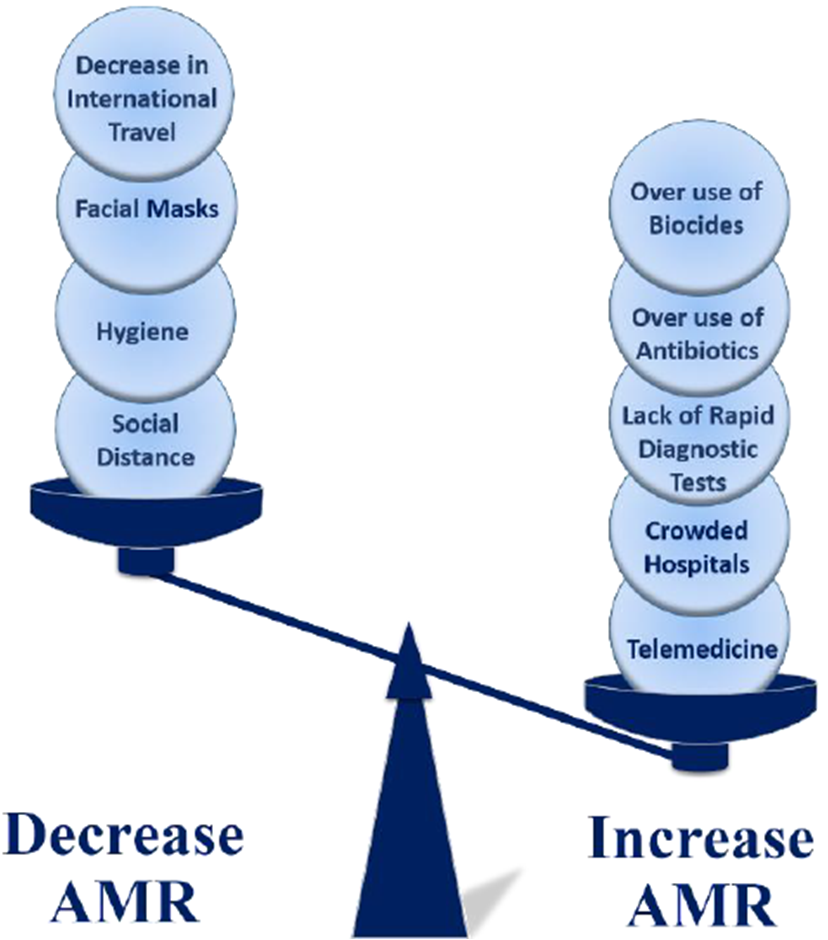
The lack of decision support means for clinical management of the pandemic such as rapid diagnostic of COVID-19, rapid diagnostic of bacterial pathogens, and rapid antibiotic susceptibility tests (ASTs), together with previous experience of high rates of bacterial co-infections with influenza 11 and high levels of anxiety led, during the first wave of the COVID-19 pandemic, to increased excessive empiric antimicrobial use. Concerns for antimicrobial resistance (AMR) following the flood of antibiotics and antiseptics use should be raised and lessons for antibiotic and antiseptic stewardships for the second wave should be taken. Alongside, alterations in various normal life settings may also contribute to the increase or the decrease in AMR and should not be ignored (Figure 1).

Retrospective data retrieved with time shows that while most patients (71%) were given antibiotic treatment, for a median duration of 5 days, only 1% exhibited bacterial co-infection 6. Similarly, data collected from 38 hospitals in Michigan USA, shows that 56.6% (27-84%) of the randomly sampled COVID-19 patients were prescribed, within 2 days of hospitalization, empiric antibacterial treatment, yet, only 3.5% of them had a confirmed bacterial infection 12. The rate of bacteremia in COVID-19 patients in New York, USA hospitals was significantly lower (3.8%) than in non-COVID-19 patients (8%). Moreover, most of the organisms in the COVID-19 patients reflected commensal skin microbiota, thus when excluded, reduced the bacteremia rate to 1.6% 13 A meta-analysis indicated that largely 7% (3-12%) of hospitalized COVID-19 patients had a bacterial co-infection. In ICU settings an increase to 14% (5-26%) was marked 14. Another meta-analysis showed similar results. Bacterial co-infection was identified in 3.5% (0.4-6.7%) of the patients and secondary infection was recorded in 14.3% (9.6-18.9%) of the patients 15. The overall proportion of bacterial infection was 6.9% (4.3-9.5%) with a slight increase to 8.1% (2.3-13.8%) in critically ill patients 15. Others have shown that among 16,654 deceased Italian COVID-19 patients only 11% had superinfections during the most severe stage of the disease 16. Zhou et al., have reported on 191 patients, of which 95% of them received antibiotics. Fifty-four of these patients did not survive and suffered prior to death from sepsis and respiratory failure which was followed in 50% of them with secondary infection. Of the 137 patients that did survive 42% suffered from sepsis and 36% from respiratory failure but only 1% had experienced secondary infection 17. It seems, therefore, that bacterial co-infections are not likely to be common in most patients with mild COVID-19 or with those with more serious disease upon admission to the hospital. However, high-risk patients, such as ones suffering from a chronic obstructive pulmonary disease (COPD), may have underlying chronic bacterial infections prior to the infection with SARS-CoV-2 18. It is conceivable to assume that bacterial co-infections will arise in a minority of critically ill patients due to their advanced age, underlying systemic diseases, mechanical ventilation, and an extended stay in crowded hospitals and intensive care units. The use of corticosteroids and immunomodulatory agents, as supportive therapeutic agents for COVID-19 patients, may also increase the risk for bacterial co-infections 19. Taken together, the extensive use of broad-spectrum antibiotics among hospitalized COVID-19 patients, in excess of identified bacterial co-infection rates, may lead to the emerging of AMR. Moreover, the overlap between COVID-19 epicenters and AMR epicenters 20 is of great concern.
The WHO interim guidance on the clinical management of COVID-19 21 does not recommend antibiotic therapy or prophylaxis for suspected or confirmed patients with mild COVID-19. For suspected or confirmed moderate COVID-19 patients, antibiotics should not be prescribed unless there is clinical suspicion of a bacterial infection. Moreover, a remark is added stating the concern of the excess use of antibiotics "widespread use of antibiotics should be discouraged, as their use may lead to higher bacterial resistance rates, which will impact the burden of disease and death in a population during the COVID-19 pandemic and beyond". However, for confirmed sever COVID-19 patients they recommend “the use of empiric antimicrobials to treat all likely pathogens, based on clinical judgment, patient host factors and local epidemiology, and this should be done as soon as possible, ideally with blood cultures obtained first".
2.2. Antiseptic Stewardship: Overflow of Antiseptic Use and the Fear of Cross-resistanceThe call by the CDC 22 and other agencies to practice high hygiene and disinfect households, public spaces, workplaces, and schools, largely increased the use of antimicrobial soaps and disinfectant cleaners leading to a new era of cleanliness. As reported by one manufacturer, the extreme use of disinfectants raised the level of production in May 2020 to the levels equivalent to the entire year of 2019. Others reported an increase of 146% in U.S sales of disinfectant wipes compared to the same period the previous year 23. The disinfectant list approved by the United States Environmental Protection Agency (EPA) for coronavirus 24 consists of hundreds of products, mainly based on the active biocides quaternary ammonium, isopropanol/ethanol, sodium hypochlorite, chlorhexidine, hydrogen peroxide, and acid-based. Antiseptic soaps consumed around the world may contain chlorhexidine gluconate or triclosan. While the direct benefits of hygiene and disinfection are obvious, one should not neglect coming apprehensions regarding their overuse, especially the emergence of AMR. The efflux pumps developed by bacteria to overcome biocides may also serve to overcome antibiotics, thus offering cross-resistance both to biocides and to antibiotics. Cross-resistance may also occur through changes in cell permeability or changes associated with the biosynthetic and metabolic machinery of the bacteria 25.
2.3. The Potential Impact of the Alterations of Normal Lifestyle Settings on AMRThe COVID-19 pandemic has forced new lifestyle settings. Mitigation means, including social distance, stay at home policies, reduced public transport crowding, increased hand hygiene and antiseptics in hospitals and in the community, and wearing facial masks in public, are all expected means to reduce person-to-person transmission vectors, that are expected eventually to result in a decrease in AMR. Moreover, the mark reduction in international travel is expected to decrease the movement of key AMR genes 26, 27. Health-system changes, comprising postponement of elective surgeries and pre-emptive discharge of patients may also reduce rates of AMR, however, these steps were undertaken in order to enhance bed capacity for COVID-19 patients due to the burden of the increasing numbers of COVID-19 patients 28. Thus, the overuse of antibiotics in COVID-19 patients may override the benefits regarding the decrease in AMR. Disruption of health services may also interrupt treatments for tuberculosis, human immunodeficiency virus, vaccination services, and more, leading to increased risk of infection and excessive antibiotic use 29. On top, increased use of telemedicine may too lead to increase subscriptions of antibiotic prescriptions 28.
The COVID-19 pandemic is a wake-up call for the need of antibiotic and antiseptic stewardship programs. Antibiotics and antiseptic stewardships should be integrated into all levels of pandemic response, both in health care settings as well as in community and private facilities. As suggested by WHO, antibiotics should be empirically used only for severely ill COVID-19 patients and targeted antibiotic treatment should be given as soon as possible. Thus, cutting edge, rapid and adequate diagnostic tools should provide on-line diagnostics of COVID-19. Alongside, to reduce the urge to initiate antibiotic treatment, rapid on-line tests that differentiate between bacterial and viral infections, should be developed and embedded in clinical settings. Two of the leading companies addressing this issue are MeMed Diagnostic that has developed and validated an immune-based protein signature for distinguishing between bacterial and viral infections and Predigen Diagnostic which is developing a gene expression platform to differentiate bacterial from viral infections. Upon identification of a bacterial infection, a rapid AST should be performed that provides the clinician with a targeted antimicrobial treatment. A favorable test should have the ability to determine AST directly from low bacterial concentration blood samples, omitting the need for blood cultures that are grown for several days. Notable, the marked increase in blood cultures of COVID-19 patients, received in New-York hospitals during March 20, which overwhelmed the capacity of the automated blood culture instruments 13. Thus, a direct AST from blood samples will shorten the time to answer and will reduce the capacity of equipment and the number of lab workers.
Furthermore, an implementation of strict infection prevention and control means together with experts' evaluation of the need for medical devices that are known to increase the chances of health-associated infection is mandatory. Telemedicine, which is becoming more common during COVID-19 curfews, should be backed up by digital technologies to assure the need for antibiotic prescription.
Moreover, one should balance the risks and benefits of the excessive use of biocides and chose the ones with minimal hazards regarding AMR. Differential use of different disinfectants in the community versus clinical settings could balance the discharged biocide load to the environment. Wastewater treatment techniques should offer complete elimination of derivatives of antibiotics and biocides in order to avoid sub-MIC concentrations released into the environments which may allow the emerging of AMR.
The COVID-19 pandemic maybe a worldwide turning point regarding AMR, for better or worse. With the right leadership, we can tilt the balance in favor of decreased AMR. Ignoring the warning signs may tilt the balance to an irreversible increase in AMR rates leading to an AMR pandemic.
RAG and SR wrote the paper. Both authors have read and agree to the published version of the manuscript.
This study was supported by the Israeli Institute of Biology Research, Ness-Ziona, Israel.
The authors declare no conflict of interest.
| [1] | WHO. Pneumonia of unknown cause-China. 2020; Available from: who.int/csr/don/05-january-2020-pneumonia-of-unkown-cause-china/en/. | ||
| In article | |||
| [2] | Coronaviridae Study Group of the International Committee on Taxonomy of, V., The species Severe acute respiratory syndrome-related coronavirus: classifying 2019-nCoV and naming it SARS-CoV-2. Nat Microbiol, 2020. 5(4): p. 536-544. | ||
| In article | View Article PubMed | ||
| [3] | 2020; Available from: worldometers.info/coronavirus/. | ||
| In article | |||
| [4] | Dhama, K., et al., Coronavirus disease 2019-COVID-19. Clinical Microbiology Reviews, 2020. 33(4): p. e00028-20. | ||
| In article | View Article PubMed | ||
| [5] | Wang, D., et al., Clinical characteristics of 138 hospitalized patients with 2019 novel Coronavirus-infected pneumonia in Wuhan, China. JAMA, 2020. 323(11): p. 1061-1069. | ||
| In article | View Article PubMed | ||
| [6] | Chen, N., et al., Epidemiological and clinical characteristics of 99 cases of 2019 novel coronaavirus pneumonia in Wuhan, China: a descriptive study. The Lancet, 2020. 395(10223): p. 507-513. | ||
| In article | View Article | ||
| [7] | Keni, R., et al., COVID-19: Emergence, Spread, Possible Treatments and Global Burden. Front. Public Health, 2020. | ||
| In article | View Article PubMed | ||
| [8] | Shen, C., et al., Treatment of 5 critically ill patients with COVID-19 with convalescent plasma. JAMA, 2020. 323: p. 1582-1589. | ||
| In article | View Article PubMed | ||
| [9] | Noy-Portat, T., et al., A panel of human neutralizing mAbs targeting SARS-CoV-2 spike at multiple epitopes. Nature Communications, 2020. 11: p. 4303. | ||
| In article | View Article PubMed | ||
| [10] | COVID-19-List results-ClinicalTrials.gov.; Available from: https://www.clinicaltrials.gov/ct2/results?cond=COVID- 19&term=&state=&city=7dist. | ||
| In article | |||
| [11] | Maclntyre, C.R., et al., The role of pneumonia and secondary bacterial infection in fatal and serious outcomes of pandemic influenza a (H1N1)pdmo9. BMC Infect Dis., 2018. 18(1): p. 637. | ||
| In article | View Article PubMed | ||
| [12] | Vaughn, V.M., et al., Empiric antibacterial therapy and community-onset bacterial co-infection in patients hospitalized with COVID-19: A multi-hospital cohort study. Clin Infect Dis, 2020: p. ciaa1239. | ||
| In article | View Article PubMed | ||
| [13] | Sepulveda, J., et al., Bacteremia and blood culture utilization during COVID-19 surge in New York city. Journal of Clinical Microbiology, 2020: p. 58e00875-20. | ||
| In article | View Article | ||
| [14] | Lansbury, L., et al., Co-infection in people with COVID-19: a systemic review and meta-analysis. Journal of Infection and Chemotherapy., 2020. | ||
| In article | View Article PubMed | ||
| [15] | Langford, B.J., et al., Bacterial co-infection and secondary infection in patients with COVID-19: a living rapid review and meta-analysis. Clinical Microbiology and Infection, 2020. | ||
| In article | View Article PubMed | ||
| [16] | Hutter, B.D., et al., COVID-19: don't neglect antimicrobial stewardship principles! Clinical Microbiology and Infection, 2020. | ||
| In article | View Article PubMed | ||
| [17] | Zhou, F., et al., Clinical course and risk facors for mortality of adult inpatients with COVID-19 in Wuhan, China: a retrospective cohort study. The Lancet, 2020. 395(10229): p. 1054-1062. | ||
| In article | View Article | ||
| [18] | Cox, M., et al., Co-infection: potentiallly lethal and unexplored in COVID-19. The Lancet, 2020. 1. | ||
| In article | View Article | ||
| [19] | Clancy, C.J. and M.H. Nguyen, Coronavirus disease 2019, Superinfections and antimicrobial development: What can we expect? Clin Infect Dis, 2020. | ||
| In article | View Article PubMed | ||
| [20] | Clancy, C.J., D.J. Buehrle, and M.H. Nguyen, Pro: The COVID-19 pandemic will result in increase in animicrobial resistance rates. JAC Antimicrob Resist, 2020. | ||
| In article | View Article PubMed | ||
| [21] | WHO, Clinical management of COVID-19 Interim guidance. 2020. | ||
| In article | |||
| [22] | CDC. Community, Work and Schools: Cleaning and Disinfecting 2020; Available from: cdc.gov/coronavirus/2019-ncov/community/clean-disinfect/index/html. | ||
| In article | |||
| [23] | Hora, P.I., et al., Increase use of quaternary ammonium compounds during the SARS-CoV-2 pandemic and beyond: considereation of environmetal implications. 2020. | ||
| In article | View Article PubMed | ||
| [24] | EPA. List N tools: COVID-19 Disinfectants. 2020; Available from: cfpub.epa.gov/giwiz/disinfectants/index/cfm. | ||
| In article | |||
| [25] | Wales, A.D. and R.H. Davis, Co-selection of resistance to antibiotics, biocides and heavy metals, and its relevance to foodborne pathogens. Antibiotics, 2015. 4: p. 567-604. | ||
| In article | View Article PubMed | ||
| [26] | Nordmann, P., et al., The emerging NDM carbapenemases. Trends in Microbiology, 2011. 19(12): p. 588-595. | ||
| In article | View Article PubMed | ||
| [27] | Castanheira, M., et al., Detection of mcr-1 among Escherichia coli clinical isolates collected worldwide as part of the sentry antimicrobial surveillance program in 2014 and 2015. Antimicrob Agents Chemother., 2016. 60(22): p. 5623-4. | ||
| In article | View Article PubMed | ||
| [28] | Rawson, T.M., et al., COVID-19 and the potential long-term impact on antimicrobial resistance. Journal of Antimicrobial Chemotherapy, 2020. | ||
| In article | View Article PubMed | ||
| [29] | Getahun, H., et al., Tackling antimicrobial resistance in the COVID-19 pandemic. Bulletin of the World Health Organization, 2020. 98: p. 442-442A. | ||
| In article | View Article PubMed | ||
Published with license by Science and Education Publishing, Copyright © 2021 Ronit Aloni-Grinstein and Shahar Rotem
 This work is licensed under a Creative Commons Attribution 4.0 International License. To view a copy of this license, visit
http://creativecommons.org/licenses/by/4.0/
This work is licensed under a Creative Commons Attribution 4.0 International License. To view a copy of this license, visit
http://creativecommons.org/licenses/by/4.0/
| [1] | WHO. Pneumonia of unknown cause-China. 2020; Available from: who.int/csr/don/05-january-2020-pneumonia-of-unkown-cause-china/en/. | ||
| In article | |||
| [2] | Coronaviridae Study Group of the International Committee on Taxonomy of, V., The species Severe acute respiratory syndrome-related coronavirus: classifying 2019-nCoV and naming it SARS-CoV-2. Nat Microbiol, 2020. 5(4): p. 536-544. | ||
| In article | View Article PubMed | ||
| [3] | 2020; Available from: worldometers.info/coronavirus/. | ||
| In article | |||
| [4] | Dhama, K., et al., Coronavirus disease 2019-COVID-19. Clinical Microbiology Reviews, 2020. 33(4): p. e00028-20. | ||
| In article | View Article PubMed | ||
| [5] | Wang, D., et al., Clinical characteristics of 138 hospitalized patients with 2019 novel Coronavirus-infected pneumonia in Wuhan, China. JAMA, 2020. 323(11): p. 1061-1069. | ||
| In article | View Article PubMed | ||
| [6] | Chen, N., et al., Epidemiological and clinical characteristics of 99 cases of 2019 novel coronaavirus pneumonia in Wuhan, China: a descriptive study. The Lancet, 2020. 395(10223): p. 507-513. | ||
| In article | View Article | ||
| [7] | Keni, R., et al., COVID-19: Emergence, Spread, Possible Treatments and Global Burden. Front. Public Health, 2020. | ||
| In article | View Article PubMed | ||
| [8] | Shen, C., et al., Treatment of 5 critically ill patients with COVID-19 with convalescent plasma. JAMA, 2020. 323: p. 1582-1589. | ||
| In article | View Article PubMed | ||
| [9] | Noy-Portat, T., et al., A panel of human neutralizing mAbs targeting SARS-CoV-2 spike at multiple epitopes. Nature Communications, 2020. 11: p. 4303. | ||
| In article | View Article PubMed | ||
| [10] | COVID-19-List results-ClinicalTrials.gov.; Available from: https://www.clinicaltrials.gov/ct2/results?cond=COVID- 19&term=&state=&city=7dist. | ||
| In article | |||
| [11] | Maclntyre, C.R., et al., The role of pneumonia and secondary bacterial infection in fatal and serious outcomes of pandemic influenza a (H1N1)pdmo9. BMC Infect Dis., 2018. 18(1): p. 637. | ||
| In article | View Article PubMed | ||
| [12] | Vaughn, V.M., et al., Empiric antibacterial therapy and community-onset bacterial co-infection in patients hospitalized with COVID-19: A multi-hospital cohort study. Clin Infect Dis, 2020: p. ciaa1239. | ||
| In article | View Article PubMed | ||
| [13] | Sepulveda, J., et al., Bacteremia and blood culture utilization during COVID-19 surge in New York city. Journal of Clinical Microbiology, 2020: p. 58e00875-20. | ||
| In article | View Article | ||
| [14] | Lansbury, L., et al., Co-infection in people with COVID-19: a systemic review and meta-analysis. Journal of Infection and Chemotherapy., 2020. | ||
| In article | View Article PubMed | ||
| [15] | Langford, B.J., et al., Bacterial co-infection and secondary infection in patients with COVID-19: a living rapid review and meta-analysis. Clinical Microbiology and Infection, 2020. | ||
| In article | View Article PubMed | ||
| [16] | Hutter, B.D., et al., COVID-19: don't neglect antimicrobial stewardship principles! Clinical Microbiology and Infection, 2020. | ||
| In article | View Article PubMed | ||
| [17] | Zhou, F., et al., Clinical course and risk facors for mortality of adult inpatients with COVID-19 in Wuhan, China: a retrospective cohort study. The Lancet, 2020. 395(10229): p. 1054-1062. | ||
| In article | View Article | ||
| [18] | Cox, M., et al., Co-infection: potentiallly lethal and unexplored in COVID-19. The Lancet, 2020. 1. | ||
| In article | View Article | ||
| [19] | Clancy, C.J. and M.H. Nguyen, Coronavirus disease 2019, Superinfections and antimicrobial development: What can we expect? Clin Infect Dis, 2020. | ||
| In article | View Article PubMed | ||
| [20] | Clancy, C.J., D.J. Buehrle, and M.H. Nguyen, Pro: The COVID-19 pandemic will result in increase in animicrobial resistance rates. JAC Antimicrob Resist, 2020. | ||
| In article | View Article PubMed | ||
| [21] | WHO, Clinical management of COVID-19 Interim guidance. 2020. | ||
| In article | |||
| [22] | CDC. Community, Work and Schools: Cleaning and Disinfecting 2020; Available from: cdc.gov/coronavirus/2019-ncov/community/clean-disinfect/index/html. | ||
| In article | |||
| [23] | Hora, P.I., et al., Increase use of quaternary ammonium compounds during the SARS-CoV-2 pandemic and beyond: considereation of environmetal implications. 2020. | ||
| In article | View Article PubMed | ||
| [24] | EPA. List N tools: COVID-19 Disinfectants. 2020; Available from: cfpub.epa.gov/giwiz/disinfectants/index/cfm. | ||
| In article | |||
| [25] | Wales, A.D. and R.H. Davis, Co-selection of resistance to antibiotics, biocides and heavy metals, and its relevance to foodborne pathogens. Antibiotics, 2015. 4: p. 567-604. | ||
| In article | View Article PubMed | ||
| [26] | Nordmann, P., et al., The emerging NDM carbapenemases. Trends in Microbiology, 2011. 19(12): p. 588-595. | ||
| In article | View Article PubMed | ||
| [27] | Castanheira, M., et al., Detection of mcr-1 among Escherichia coli clinical isolates collected worldwide as part of the sentry antimicrobial surveillance program in 2014 and 2015. Antimicrob Agents Chemother., 2016. 60(22): p. 5623-4. | ||
| In article | View Article PubMed | ||
| [28] | Rawson, T.M., et al., COVID-19 and the potential long-term impact on antimicrobial resistance. Journal of Antimicrobial Chemotherapy, 2020. | ||
| In article | View Article PubMed | ||
| [29] | Getahun, H., et al., Tackling antimicrobial resistance in the COVID-19 pandemic. Bulletin of the World Health Organization, 2020. 98: p. 442-442A. | ||
| In article | View Article PubMed | ||