Background: Medicalization is defined by the World Health Organization (WHO) as the circumstance in which FGM/C is performed by any health care practitioner, whether in a public or private health facility, at home, or anywhere else. Aim: Assess Relationship between Personal Characteristics and the Person Performing Female Genital Mutilation at Beni-Suef. Subject & Methods: A descriptive cross-sectional study was used. The study population consisted of 2837 females in family health centers (FHCs) in different sitting at Beni-Suef. Α Structured Interviewing Questionnaire sheet was used to collect data. Results: The most (70.4%) of studied participants were rural residents, 90.2% were highly educated, 57.5% were single. There is a significant association between residence and the person performing FGM/C. (p≤0.001). Circumcision performed by Barber or Dayah were more prevalent (100.0% & 98.8%, respectively) among rural dwellers than urban ones (0.0% & 1.2%, respectively). There is a significant association between mothers' & fathers' education and the person performing FGM/C (p≤0.001). Conclusion & Recommendations: The most of studied participants were rural residents. A significant association between residence, parent's education and the person performing FGM/C was found. Motivations and behavior change of rural residences toward practices of FGM/C by educational programs should be performed.
The procedure of FGM/C is typically applied by knives, scissors, scalpels, glass, or razor blades. Additional damage occurs as a result of poor lighting, non-sterile equipment, and aseptic conditions. The procedure is typically administered by traditional healers, traditional birth attendants, barbers, or health care providers like midwives, nurses, and physicians. Members of the family help the performer by holding the girls to stop their movements and also the procedure usually takes from 15 to 20 minutes betting on the experience of the performer and the resistance of the girls. The age at which FGM/C is completed varies but it's usually done between the age of 4 and 14 years 1, 2, 3, 4, 5.
FGM is most commonly performed by health care providers in Egypt and Sudan, with doctors doing the procedure in Egypt and midwives performing the procedure in Sudan. In Egypt alone, 1.5 million girls and women have had their hair cut by health care providers, 1.2 million of whom have had their hair trimmed by doctors 6, 7, 8.
Egypt legalized the medicalization of FGM/C in 1994, citing the possibility of reducing the danger of health repercussions 9. Medicines Sans Frontières (MSF) provided surgical equipment for FGM/C in 1999, claiming that it was a first-aid response to avoid complications that could arise from using non-sterile equipment. MSF did not support the practice but claimed that it was a first-aid response to avoid complications that could arise from using non-sterile equipment. Following the abandonment of FGM/C, the MSF issued a policy paper criticizing the practice 10, 11, 12, 13, 14, 15.
The WHO originally prohibited the medicalization of FGM/C in 1979, at the first international conference on the subject. This prohibition was reaffirmed in 1982 in a formal statement to the United Nations Commission on Human Rights. In 1993, the World Medical Association decided to stop medicalizing FGM/C. Other medical organizations, including the International Federation of Gynecology and Obstetrics, as well as governmental and non-governmental groups, as well as international organizations, later outlawed the operation. In a joint statement issued by WHO, UNICEF, and UNFPA in 1997, as well as an interagency statement on the elimination of FGM/C in 2008, this desertion was highlighted once more 16, 17, 18, 19.
Medicalized cutting is largely carried out by doctors in Egypt, rather than other health workers, and has its origins in a 1994 Ministry of Health edict requiring state hospitals to set aside one day per week for trained physicians to perform FGM/C 20, 21, 22, 23, 24, 25.
In the most recent EHIS, the rate of medicalized FGM/C was more than doubled between mothers and daughters (38 percent and 84 percent, respectively) 9. The Egyptian government has made many changes to the medicalization of FGM/C. It was approved in 1994, but after a girl died during the FGM/C operation, the approval was changed in 1995. The FGM/C operation was outlawed in government hospitals, followed by private institutions, unless it was medically required. Until 2006, the medical necessity was approved. In 2007, all licensed medical care practitioners, whether public or private, were prohibited from conducting FGM/C in any hospital 16.
The present study was carried find out about FGM in Beni-Suef Governorate through: Assess Relationship between Personal Characteristics and the Person Performing Female Genital Mutilation at Beni-Suef.
2.1. Research Questions1. Is there Relationship between Personal Characteristics and the Person Performing Female Genital Mutilation at Beni-Suef?
A Descriptive Cross-sectional study was used to achieve the aim of the current study.
3.2. Subjects & SettingThe study was conducted in family health centers (FHCs) in different sitting at Beni-Suef Governorate.
A Convenient sample was used. The study sample was selected according to the following Inclusion criteria: 18-60 years old women. Can read and writes.
The study population consisted of all circumcised females (2021) who were accepted to participate in the study at the time of data collection (A period of six months from the start of data collection) and will be included in the study.
A pre-designed structured questionnaire was used to collect data. Data were collected through personal interviews. The questionnaire is divided into two sections:
Section I: А Structured Interviewing Questionnaire sheet which includes the following parts: age, residence, level of education, marital status, occupation and experience with mutilation, etc……
Section II: Relationship between Personal Characteristics and the Person Performing Female Genital Mutilation among studied participants at Beni-Suef.
Content validity will be done through five experts from Faculty Members of the Maternal Health Nursing department and obstetrics medicine Specialty to ascertain relevance and completeness.
The study tools were tested for their internal consistency by calculating Cronbach's Alpha.
Approval was taken from centers directors before starting the research and data were collected after explaining the aim of the study to all participants in the study. Written letters, including the aim of the study were issued from the Dean of the Faculty of Nursing, Beni-Suef University, to the Directorate of these centers in Beni-Suef. Confidentiality of the study was assured clearly for every woman participating in the study. Consent from every woman before the beginning of the interview was taken. Explanation of the aim of the study was done to women to obtain their permission to participate.
A pilot study, which was carried out on 10% from the study subjects. The main purposes of the pilot study were to test the clarity, feasibility of the tools and whether it was understandable, and to determine the time needed to fill the tool.
Data were gathered over six months beginning in November 2021 and ending in April 2022. The researcher was present at the previously mentioned location until the entire sample size was gathered. Before data collection, the researcher introduced herself to the women and explained the purpose of the study.
All data were collected, tabulated and statistically analyzed using IBM SPSS 25. Data was supplied, and appropriate analysis was performed for each parameter based on the type of data obtained.
Descriptive Statistics data were expressed as:
Count and percentage: Used for describing and summarizing categorical data.
Arithmetic mean (X-), Standard deviation (SD): Used for normally distributed quantitative data, these are used as measurements of central tendency and dispersion.
Cronbach alpha and Spearman-Brown coefficients: The internal consistency of the generated tools was measured to assess their reliability.
Chi-square (χ2): used to see if there's a link between two category variables or to see if two or more proportions differ. For Race tables, Monte Carlo exact probability was used wherever 2 was present.
Data visualization was done with Colum chart.
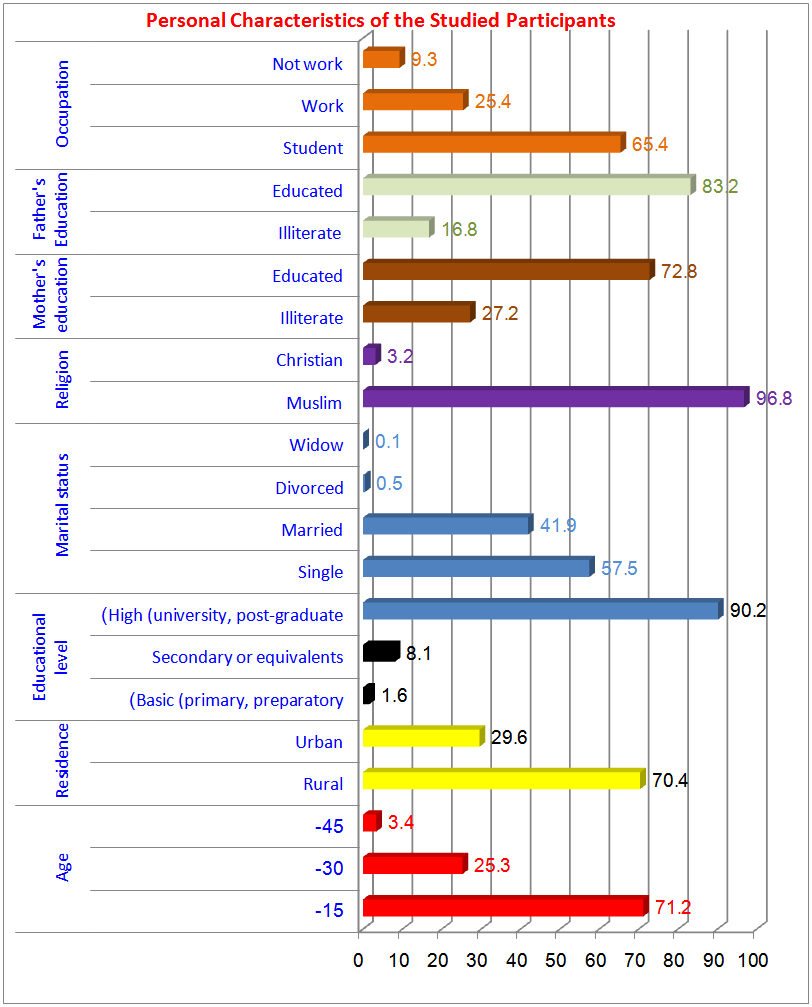
Figure 1 showed that the most of studied participants were rural residents (70.4%), 90.2% were highly educated, 57.5% were single, 96.8% were Muslims, and most of their mothers were educated (72.8%), and most of their fathers were educated (83.2%). About two-thirds of the participants were a student (65.4%).

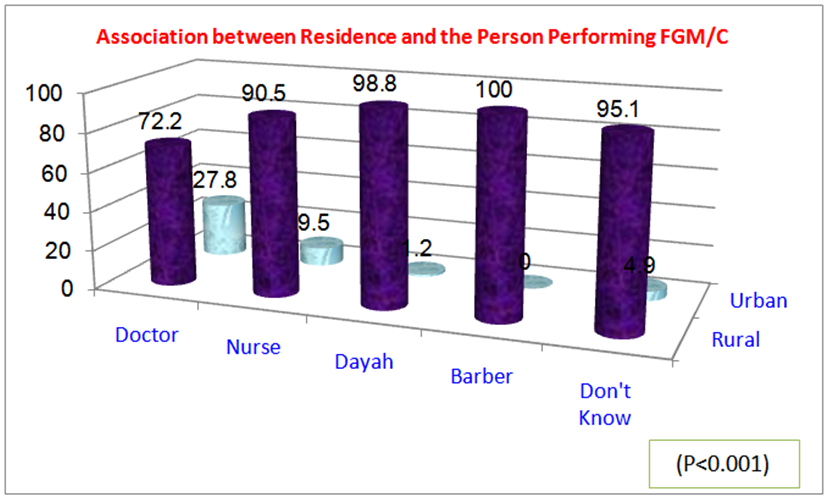
Figure 2 presented the Association between residence and the person performing FGM/C. It showed that there was a significant association between residence and the person performing FGM/C. (p≤0.001). Circumcision performed by Barber or Dayah were more prevalent (100.0% & 98.8%, respectively) among rural dwellers than urban ones (0.0% & 1.2%, respectively).

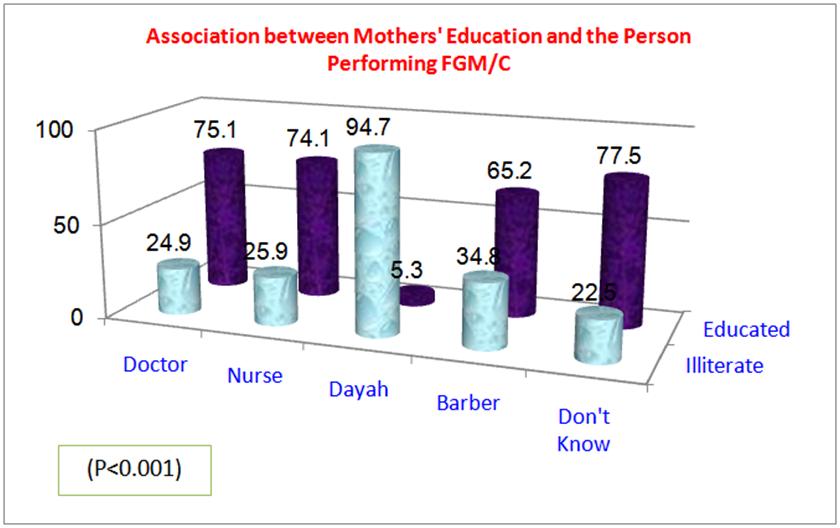
Figure 3 presented the relationship between mothers' education and the person performing FGM/C. It showed that there was a significant association between mothers' education and the person performing FGM/C (p≤0.001). Circumcision performed by doctors or nurses were more prevalent (75.1 & 74.1%, respectively) among participants whose mothers were educated than illiterate ones.

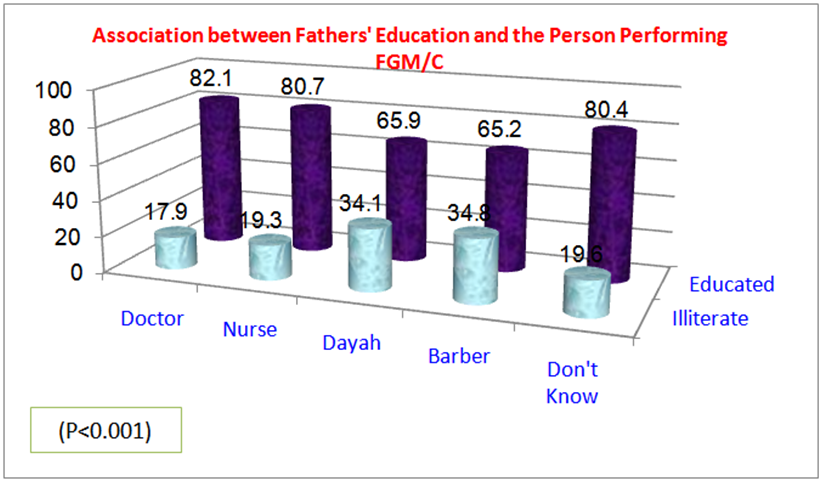
Figure 4 presented the relationship between fathers' education and the person performing FGM/C. It showed that there was a significant association between fathers' education and the person performing FGM/C (p≤0.001). Circumcision performed by doctors or nurses were more prevalent (82.1 & 80.7%, respectively) among participants whose mothers were educated than illiterate ones.
Medicalization is defined by the World Health Organization (WHO) as "the circumstance in which FGM/C is performed by any health care practitioner, whether in a public or private health facility, at home, or anywhere else." It encompasses all forms of FGM/C that include re- infibulation at any point in a woman's life (United Nations Population Fund) 6, 26.
In the current study, medical professionals carried out majority of the FGM/C procedures (physicians and nurses). However, the rate was comparable to the study conducted in Upper Egypt, which showed that girls were mutilated by medical professionals of nurses, young physicians, and senior physicians, respectively 27.
This was in line with UNICEF, 2018. These are the nations with the highest frequency of medicalized FGM/C. Egypt (78 percent), Sudan (77 percent), Guinea (31 percent), Djibouti (21 percent), Kenya (20 percent), Iraq (14 percent), Yemen (13 percent), and Nigeria (12 percent) 26. Moreover, UNICEF reported that FGM is most commonly performed by health care providers in Egypt and Sudan, with doctors doing the procedure in Egypt and midwives performing the procedure in Sudan. In Egypt alone, 1.5 million girls and women have had their hair cut by health care providers, 1.2 million of whom have had their hair trimmed by doctors 6.
Physicians, nurses, midwives, trained birth attendants, obstetricians, plastic surgeons, and others involved in delivering medical services to patients are among those participating in medicalized FGM/C 28. Shell-Duncan and colleagues calculated that 26% of women in the age cohort 15-49, or nearly 16 million women, have had their hair trimmed by a medical practitioner based on self-reported Demographic and Health Survey (DHS) data from 25 countries 20.
According to a recent study in Qalyubia that looked at the medicalization of FGM/C from the perspective of mothers, more than 30% of moms were unsure about cutting their children. These mothers intended to consult a doctor to decide whether or not their daughters "needed" FGM/C. The majority of mothers showed a high level of trust in doctors' advice. Furthermore, almost 90% of the mothers who were certain about cutting their daughters planned to have it done by a professional. Physicians, compared to DAYAS, are better educated to cope with any problems, such as hemorrhage, according to mothers 29.
The results of the current study revealed significant statistical relationship between residence of the studied subjects and the person performing FGM/C. It is not surprise to find that Circumcision performed by Barber or Dayah were more prevalent among rural dwellers than urban ones. This may attributed that rural areas almost depend on Barber or Dayah for health issues as health counselors.
There was a significant association between Mothers' and fathers' education and the person performing FGM/C. Circumcision performed by doctors or nurses were more prevalent among participants whose mothers & fathers were educated than illiterate ones. The findings of the current study agreed with those of a study carried out in Alexandria, which revealed that mutilated females were more likely to be illiterate or have limited reading and writing skills than non-mutilated females 30, 31, 32, 33. The present study shows that there was a significant association between lower mother and father education, and the person who performed FGM.
The most of studied participants were rural residents. A significant association between residence and the person performing FGM/C was found. Circumcision performed by Barber or Dayah were more prevalent among rural dwellers than urban ones. Significant association between mothers' & fathers' education and the person performing FGM/C was revealed. Circumcision performed by doctors or nurses were more prevalent among participants whose mothers were educated than illiterate ones. Motivations and behavior change of rural residences toward practices of FGM/C by educational programs should be performed.
| [1] | Odukogbe, A. T. A., Afolabi, B. B., Bello, O. O., & Adeyanju, A. S. Female genital mutilation/cutting in Africa. Translational andrology and urology, 2017; 6(2): 138. | ||
| In article | View Article PubMed | ||
| [2] | Hassan H., Abd-ELhakam F., Ebrahim R., Mohammed M. Prevalence of Female Genital Mutilation in Northern Upper Egypt. American Journal of Nursing Research, 2023, 11(1): 12-20. | ||
| In article | View Article | ||
| [3] | Abd-ELhakam F., Ebrahim R., Mohammed M., Hassan H. Relationship between Socio Demographic Data and Female Genital Mutilation. Archives of Medical Case Reports and Case Study, 2022; 6(5); 1-7. | ||
| In article | |||
| [4] | Mohammed M., Abd-ELhakam F., Hassan H., Ebrahim R. Study Females' Intention to practice Female Genital Mutilation for their Daughters at Beni-Suef. Public Health Open Access, 2022; 6(2): 1-8. | ||
| In article | View Article | ||
| [5] | Ebrahim R., Abd-ELhakam F., Hassan H., Mohammed M. Relationship between Females' Knowledge and Attitude and Intention of Female Genital Mutilation. Research in Psychology and Behavioral Sciences, 2023; 11(1): 1-6. | ||
| In article | View Article | ||
| [6] | UNICEF, 2018. At least 200 million girls and women alive today living in 30 countries have undergone FGM. https://data.unicef.org/topic/child-protection/female-genital-mutilation. | ||
| In article | |||
| [7] | Abd-ELhakam F. Prevalence of Female Genital Mutilation at Beni-Suef Governorate, Egypt. [Master's Disseration, Beni-Suef University]. Beni-Suef, Egypt. 2022. | ||
| In article | |||
| [8] | Hassan H., Abd-ELhakam F., Ebrahim R., Mohammed M. Female Genital Mutilation: Females' Intention in Northern Upper Egypt. Journal of Obstetrics Gynecology and Reproductive Sciences, 2023; 7(1): 1-11. | ||
| In article | View Article | ||
| [9] | Shell-Duncan, B., Njue, C., & Moore, Z. Trends in the medicalization of female genital mutilation/cutting: What do the data reveal? 2018; 1-24. | ||
| In article | View Article | ||
| [10] | Hassan H., Ebrahim R., Mohammed M., Abd-ELhakam F. Female Genital Mutilation: Impact on Knowledge, Attitude, Sexual Score Domains and Intention of Females in Northern Upper Egypt. Archives of Medical Case Reports and Case Study, 2022; 6(5): 1-8. | ||
| In article | |||
| [11] | Abd-ELhakam F., Hassan H., Ebrahim R., Mohammed M. Relationship between Females' Intention of Mutilating Their Daughters and Demographic Characteristics, Journal of Psychology and Neuroscience, 2023; 5(1): 1-6. | ||
| In article | |||
| [12] | Hassan H., Abd-ELhakam F., Ebrahim R., Mohammed M. Call for Change Enhancement Upper Egyptian Females' Knowledge Regarding Effect of Female Genital Mutilation. American Journal of Public Health Research, 2023; 11(1): 5-12. | ||
| In article | View Article | ||
| [13] | Abdou, M. S., Wahdan, I. M., & El-Nimr, N. A. Prevalence of Female Genital Mutilation, and Women’s Knowledge, Attitude, and Intention to Practice in Egypt: A Nationwide Survey. Journal of High Institute of Public Health, 2020; 50(3): 139-145. | ||
| In article | View Article | ||
| [14] | Hassan H. Evidence-Based Practice in Midwifery and Maternity Nursing for Excellent Quality of Care Outcomes. American Journal of Nursing Research, 2020; 8(6): 606-607. | ||
| In article | View Article | ||
| [15] | Abd- Elhakam F., Ibrahim R., Mohamed M., Hassan H. Prevalence of Female Genital Mutilation at Beni-Suef Governorate, Egypt. Egyptian Journal of Health Care, (EJHC), 2023; 14 (1): 564-577. | ||
| In article | View Article | ||
| [16] | Leye, E., Van Eekert, N., Shamu, S., Esho, T., & Barrett, H. Debating medicalization of Female Genital Mutilation/Cutting (FGM/C): learning from (policy) experiences across countries. Reproductive health, 2019; 16(1): 1-10. | ||
| In article | View Article PubMed | ||
| [17] | Hassan H. The Impact of Evidence-Based Nursing as The Foundation for Professional Maternity Nursing Practices. Open Access Journal of Reproductive System and Sexual Disorder, 2019; 2(2): 195-197. | ||
| In article | |||
| [18] | Abd-ELhakam F., Ebrahim R., Mohammed M., Hassan H. Female Genital Mutilation: Females' Related Knowledge. EC Nursing and Healthcare, 2023, 5(2). | ||
| In article | |||
| [19] | Hassan H., Abd-ELhakam F., Zakria M., El-sayed R. Female Genital Mutilation in Northern Upper Egypt: Prospects of Reasons for Performing and Refusing. Nursing and Care Open Access Journal, 2023; 9(1): 6-10. | ||
| In article | View Article | ||
| [20] | Kimani, S., & Shell-Duncan, B. Medicalized female genital mutilation/cutting: contentious practices and persistent debates. Current sexual health reports, 2018; 10(1): 25-34. | ||
| In article | View Article PubMed | ||
| [21] | Hassan H., Abd-ELhakam F., Ebrahim R., Mohammed M. Study Females' Attitude toward Female Genital Mutilation. Journal of Gynecology and Women’s Health, 2022, 24(3): 1-9. | ||
| In article | |||
| [22] | Hassan H., Ebrahim R., Mohammed M., Abd-ELhakam F. Prevalence and Determinants of Female Genital Mutilation at Beni-Suef. Journal of Gynecology and Women’s Health, 2022, 24(3): 1-10. | ||
| In article | |||
| [23] | Hassan H., Saber N., Sheha E. Comprehension of Dyspareunia and Related Anxiety among Northern Upper Egyptian women: Impact of Nursing Consultation Context Using PLISSIT Model. Nursing & Care Open Access Journal. 2019; 6(1): 1-19. | ||
| In article | View Article | ||
| [24] | Said S., Hassan H., Sarhan A. Effect of an Educational Intervention on Women's Knowledge and Attitude Regarding Cervical Cancer. American Journal of Nursing Research. 2018; 6(2): 59-66. | ||
| In article | |||
| [25] | Abd El Salam S., Hassan H., Kamal K., Ali R. Sexual Dysfunction of Women’s Associated with Cervical Cancer. Journal of Applied Health Sciences and Medicine, 2021; 1(2): 12-27. | ||
| In article | |||
| [26] | United Nations Population Fund [UNFPA]. (2018). UNFPA-UNICEF joint program to eliminate female genital mutilation. UNFPA https://www.unfpa.org/unfpa-unicef-joint-programme-eliminate-female-genitalmutilation. | ||
| In article | |||
| [27] | Rasheed, S. M., Abd-Ellah, A. H., & Yousef, F. M. Female genital mutilation in Upper Egypt in the new millennium. International Journal of Gynecology & Obstetrics, 2011; 114(1): 47-50. | ||
| In article | View Article PubMed | ||
| [28] | El-Gibaly, O., Aziz, M., & Abou Hussein, S. (2019). Health care providers’ and mothers’ perceptions about the medicalization of female genital mutilation or cutting in Egypt: a cross-sectional qualitative study. BMC international health and human rights, 19(1): 1-12. | ||
| In article | View Article PubMed | ||
| [29] | Modrek, S., & Sieverding, M. Mother, daughter, doctor: medical professionals and mothers' decision making about female genital cutting in Egypt. International Perspectives on Sexual and Reproductive Health, 2016; 42(2): 81-92. | ||
| In article | View Article PubMed | ||
| [30] | Mady, A. A. M. Assessment of knowledge, attitude and practices among females in the reproductive age (15-49 years) regarding females genital mutilation in rural and urban areas in Alexandria. [Master's Disseration, Alexandria University]. Alexandria, Egypt. 2017; 134: 79-85. | ||
| In article | |||
| [31] | Abd-ELhakam F., Ebrahim R., Mohammed M., Hassan H. Relationship between Women's Intention for Female Genital Mutilation and their Exposure to Complication and Pressure. Journal of Community Medicine and Public Health Reports 2022; 3(10). | ||
| In article | |||
| [32] | Hassan H., Mohammed M., Abd-ELhakam F., Ebrahim R. Female Genital Mutilation: Study Sexual Issues Journal of Gynecology and Women’s Health, 2023, 25(1): 1-8. | ||
| In article | |||
| [33] | Abd-ELhakam F., Ebrahim R., Mohammed M., Hassan H. Female Genital Mutilation: Relationship Association between Upper Egyptian Females' Knowledge and Attitude. Nursing and Health Care Researchers, 2023; 3(1): 1-7. | ||
| In article | |||
Published with license by Science and Education Publishing, Copyright © 2023 Rasha El-Syed Ebrahim, Momen Zakria Mohammed, Hanan Elzeblawy Hassan and Fatima Hosny Abd-ELhakam
 This work is licensed under a Creative Commons Attribution 4.0 International License. To view a copy of this license, visit
http://creativecommons.org/licenses/by/4.0/
This work is licensed under a Creative Commons Attribution 4.0 International License. To view a copy of this license, visit
http://creativecommons.org/licenses/by/4.0/
| [1] | Odukogbe, A. T. A., Afolabi, B. B., Bello, O. O., & Adeyanju, A. S. Female genital mutilation/cutting in Africa. Translational andrology and urology, 2017; 6(2): 138. | ||
| In article | View Article PubMed | ||
| [2] | Hassan H., Abd-ELhakam F., Ebrahim R., Mohammed M. Prevalence of Female Genital Mutilation in Northern Upper Egypt. American Journal of Nursing Research, 2023, 11(1): 12-20. | ||
| In article | View Article | ||
| [3] | Abd-ELhakam F., Ebrahim R., Mohammed M., Hassan H. Relationship between Socio Demographic Data and Female Genital Mutilation. Archives of Medical Case Reports and Case Study, 2022; 6(5); 1-7. | ||
| In article | |||
| [4] | Mohammed M., Abd-ELhakam F., Hassan H., Ebrahim R. Study Females' Intention to practice Female Genital Mutilation for their Daughters at Beni-Suef. Public Health Open Access, 2022; 6(2): 1-8. | ||
| In article | View Article | ||
| [5] | Ebrahim R., Abd-ELhakam F., Hassan H., Mohammed M. Relationship between Females' Knowledge and Attitude and Intention of Female Genital Mutilation. Research in Psychology and Behavioral Sciences, 2023; 11(1): 1-6. | ||
| In article | View Article | ||
| [6] | UNICEF, 2018. At least 200 million girls and women alive today living in 30 countries have undergone FGM. https://data.unicef.org/topic/child-protection/female-genital-mutilation. | ||
| In article | |||
| [7] | Abd-ELhakam F. Prevalence of Female Genital Mutilation at Beni-Suef Governorate, Egypt. [Master's Disseration, Beni-Suef University]. Beni-Suef, Egypt. 2022. | ||
| In article | |||
| [8] | Hassan H., Abd-ELhakam F., Ebrahim R., Mohammed M. Female Genital Mutilation: Females' Intention in Northern Upper Egypt. Journal of Obstetrics Gynecology and Reproductive Sciences, 2023; 7(1): 1-11. | ||
| In article | View Article | ||
| [9] | Shell-Duncan, B., Njue, C., & Moore, Z. Trends in the medicalization of female genital mutilation/cutting: What do the data reveal? 2018; 1-24. | ||
| In article | View Article | ||
| [10] | Hassan H., Ebrahim R., Mohammed M., Abd-ELhakam F. Female Genital Mutilation: Impact on Knowledge, Attitude, Sexual Score Domains and Intention of Females in Northern Upper Egypt. Archives of Medical Case Reports and Case Study, 2022; 6(5): 1-8. | ||
| In article | |||
| [11] | Abd-ELhakam F., Hassan H., Ebrahim R., Mohammed M. Relationship between Females' Intention of Mutilating Their Daughters and Demographic Characteristics, Journal of Psychology and Neuroscience, 2023; 5(1): 1-6. | ||
| In article | |||
| [12] | Hassan H., Abd-ELhakam F., Ebrahim R., Mohammed M. Call for Change Enhancement Upper Egyptian Females' Knowledge Regarding Effect of Female Genital Mutilation. American Journal of Public Health Research, 2023; 11(1): 5-12. | ||
| In article | View Article | ||
| [13] | Abdou, M. S., Wahdan, I. M., & El-Nimr, N. A. Prevalence of Female Genital Mutilation, and Women’s Knowledge, Attitude, and Intention to Practice in Egypt: A Nationwide Survey. Journal of High Institute of Public Health, 2020; 50(3): 139-145. | ||
| In article | View Article | ||
| [14] | Hassan H. Evidence-Based Practice in Midwifery and Maternity Nursing for Excellent Quality of Care Outcomes. American Journal of Nursing Research, 2020; 8(6): 606-607. | ||
| In article | View Article | ||
| [15] | Abd- Elhakam F., Ibrahim R., Mohamed M., Hassan H. Prevalence of Female Genital Mutilation at Beni-Suef Governorate, Egypt. Egyptian Journal of Health Care, (EJHC), 2023; 14 (1): 564-577. | ||
| In article | View Article | ||
| [16] | Leye, E., Van Eekert, N., Shamu, S., Esho, T., & Barrett, H. Debating medicalization of Female Genital Mutilation/Cutting (FGM/C): learning from (policy) experiences across countries. Reproductive health, 2019; 16(1): 1-10. | ||
| In article | View Article PubMed | ||
| [17] | Hassan H. The Impact of Evidence-Based Nursing as The Foundation for Professional Maternity Nursing Practices. Open Access Journal of Reproductive System and Sexual Disorder, 2019; 2(2): 195-197. | ||
| In article | |||
| [18] | Abd-ELhakam F., Ebrahim R., Mohammed M., Hassan H. Female Genital Mutilation: Females' Related Knowledge. EC Nursing and Healthcare, 2023, 5(2). | ||
| In article | |||
| [19] | Hassan H., Abd-ELhakam F., Zakria M., El-sayed R. Female Genital Mutilation in Northern Upper Egypt: Prospects of Reasons for Performing and Refusing. Nursing and Care Open Access Journal, 2023; 9(1): 6-10. | ||
| In article | View Article | ||
| [20] | Kimani, S., & Shell-Duncan, B. Medicalized female genital mutilation/cutting: contentious practices and persistent debates. Current sexual health reports, 2018; 10(1): 25-34. | ||
| In article | View Article PubMed | ||
| [21] | Hassan H., Abd-ELhakam F., Ebrahim R., Mohammed M. Study Females' Attitude toward Female Genital Mutilation. Journal of Gynecology and Women’s Health, 2022, 24(3): 1-9. | ||
| In article | |||
| [22] | Hassan H., Ebrahim R., Mohammed M., Abd-ELhakam F. Prevalence and Determinants of Female Genital Mutilation at Beni-Suef. Journal of Gynecology and Women’s Health, 2022, 24(3): 1-10. | ||
| In article | |||
| [23] | Hassan H., Saber N., Sheha E. Comprehension of Dyspareunia and Related Anxiety among Northern Upper Egyptian women: Impact of Nursing Consultation Context Using PLISSIT Model. Nursing & Care Open Access Journal. 2019; 6(1): 1-19. | ||
| In article | View Article | ||
| [24] | Said S., Hassan H., Sarhan A. Effect of an Educational Intervention on Women's Knowledge and Attitude Regarding Cervical Cancer. American Journal of Nursing Research. 2018; 6(2): 59-66. | ||
| In article | |||
| [25] | Abd El Salam S., Hassan H., Kamal K., Ali R. Sexual Dysfunction of Women’s Associated with Cervical Cancer. Journal of Applied Health Sciences and Medicine, 2021; 1(2): 12-27. | ||
| In article | |||
| [26] | United Nations Population Fund [UNFPA]. (2018). UNFPA-UNICEF joint program to eliminate female genital mutilation. UNFPA https://www.unfpa.org/unfpa-unicef-joint-programme-eliminate-female-genitalmutilation. | ||
| In article | |||
| [27] | Rasheed, S. M., Abd-Ellah, A. H., & Yousef, F. M. Female genital mutilation in Upper Egypt in the new millennium. International Journal of Gynecology & Obstetrics, 2011; 114(1): 47-50. | ||
| In article | View Article PubMed | ||
| [28] | El-Gibaly, O., Aziz, M., & Abou Hussein, S. (2019). Health care providers’ and mothers’ perceptions about the medicalization of female genital mutilation or cutting in Egypt: a cross-sectional qualitative study. BMC international health and human rights, 19(1): 1-12. | ||
| In article | View Article PubMed | ||
| [29] | Modrek, S., & Sieverding, M. Mother, daughter, doctor: medical professionals and mothers' decision making about female genital cutting in Egypt. International Perspectives on Sexual and Reproductive Health, 2016; 42(2): 81-92. | ||
| In article | View Article PubMed | ||
| [30] | Mady, A. A. M. Assessment of knowledge, attitude and practices among females in the reproductive age (15-49 years) regarding females genital mutilation in rural and urban areas in Alexandria. [Master's Disseration, Alexandria University]. Alexandria, Egypt. 2017; 134: 79-85. | ||
| In article | |||
| [31] | Abd-ELhakam F., Ebrahim R., Mohammed M., Hassan H. Relationship between Women's Intention for Female Genital Mutilation and their Exposure to Complication and Pressure. Journal of Community Medicine and Public Health Reports 2022; 3(10). | ||
| In article | |||
| [32] | Hassan H., Mohammed M., Abd-ELhakam F., Ebrahim R. Female Genital Mutilation: Study Sexual Issues Journal of Gynecology and Women’s Health, 2023, 25(1): 1-8. | ||
| In article | |||
| [33] | Abd-ELhakam F., Ebrahim R., Mohammed M., Hassan H. Female Genital Mutilation: Relationship Association between Upper Egyptian Females' Knowledge and Attitude. Nursing and Health Care Researchers, 2023; 3(1): 1-7. | ||
| In article | |||