The objective of this study is to evaluate the impact of diet on the evolution of pregnancy in pregnant women seen in antenatal consultations in a health facility in southern Benin. This is a descriptive and analytical study by means of a questionnaire which focused on pregnant women aged 15 to 43, received in prenatal consultation, at the Godomey health center in the period from July 1 to October 15, 2020 In total, 164 pregnant women were the subject of three series of visits. At the end of the visits, respectively, 77.4%, 61% and 26.8% of the women had inadequate weight gain. The factors implicated are the BMI before gestation, age, pregnancy-related complications, and high blood pressure. In short, prenatal visits revealed insufficient weight gain in the majority of pregnant women. The factors implicated are BMI before gestation, age, pregnancy-related complications, and high blood pressure. And, the frequency of prenatal consultations allows adequate weight gain, resulting from nutritional advice and monitoring of pregnant women during their visit. Thus, adequate weight gain during pregnancy is a condition for the delivery of a healthy baby and the future well-being of both child and mother. Therefore, adequate nutritional monitoring is necessary for a normal evolution of pregnancy.
Pregnancy is a state likely to increase the metabolic needs linked to the physiological changes of the pregnant woman and the needs of the fetus 1. It is the only period during which dietary habits have a direct impact on the health of the fetus. During and after pregnancy, food plays an essential role in the health and development of the child, it determines the nutritional health and the birth weight of the child 2. Nutritional requirements during pregnancy are higher than usual to support the rapid growth and development of the fetus. Supplements are also necessary to replenish the nutritional reserves of the mother-to-be 3. The proportion of women who suffer from undernutrition (BMI < 18.5) is over 20% for many low- and medium-resource countries and even goes up to 40% for some 4. Deficiencies in calorie intake in pregnant women are already reflected in children in utero, often victims of hypotrophy at birth, sometimes weighing less than 2500g. In addition, the birth weight of the baby is related to the body mass index (BMI) of the mother before pregnancy. Maternal overweight, particularly obesity, but also underweight increases the risk of complications during pregnancy and childbirth. In 2010, Germany, France and Japan had respectively maternal mortality ratios of 7, 8 and 5 maternal deaths per 100000 live births. In Africa, the rates are still high. Thus, Egypt, Angola and South Africa respectively obtained ratios of 66, 450 and 300 maternal deaths per 100,000 live births. In Benin in 2010, out of 100,000 live births, 350 women died of childbirth complications and postpartum complications 5. Thus, it is necessary to assess the nutritional and health status of pregnant women and its impact on the evolution of gestation, on the complications of childbirth and the birth weight of newborns. In-depth knowledge of the causes of maternal malnutrition proves useful in carrying out the fight. What about the nutritional status of pregnant women coming for prenatal consultations at the Godomey Health Center and its impact on the evolution of pregnancy?
This study is carried out in the maternity department of the district health center of Godomey in southern Benin. Created in 1966, it is the largest center of the said arrondissement. It is a descriptive and analytical study by means of a questionnaire which concerned 164 pregnant women received in consultations at the maternity department of the hospital center from July 1 to December 15, 2020.
Were taken into account in this study, pregnant women having:
• started their antenatal consultations in the first and or second trimester of pregnancy at the Godomey health center or having proof of subsequent consultations of their pregnancy in another health center (if the consultations were done elsewhere).
• agreed to be monitored until term in the said centre.
• given their consent to participate in the study
Are not taken into account in the study, pregnant women:
• having an anomaly that does not allow them to monitor the pregnancy until delivery in this type of center.
• having no fixed address.
The pregnant women received in the health center and meeting the criteria listed above were submitted to a questionnaire designed for this purpose. The topics that were addressed in the questionnaire are: age, weight, number of children, level of education, marital status, food preference during gestation, the diversification and frequency of these foods during the day and finally medical history.
4.2. Anthropometric MeasurementsThe weight of the pregnant women was taken in accordance with WHO standards, using a SECA model ENGLAND scale with an accuracy of 100 g. For height measurement a vertical measuring rod (stadiometer) with an accuracy of 1 cm was used. Age was recorded using different cards (lepi, national), birth certificates of pregnant women. Anthropometric measurements such as weight, height were collected in order to calculate the BMI (Body Mass Index).
4.3. Classification of Pregnant WomenBMI = P / T2, makes it possible to classify pregnant women according to their nutritional status before gestation in order to better follow the evolution of gestation (weight gain) according to their diet. Also, it should be noted that the weight of pregnant women before pregnancy was determined from their care book.
- Thinness (BMI < 18.5)
- Normal nutritional status (18.5 < BMI < 25)
- Overweight (25 < BMI < 30)
- Moderate obesity (30 < BMI < 35)
- Severe obesity (35 < BMI < 40)
- Massive obesity (40 < BMI).
4.4. Classification According to Weight GainTo assess the weight gain in pregnant women we used the following table
Data were recorded and processed using Excel version 2013 and SPSS software. This software allowed us to establish the value of each parameter but also to build the different histograms of the distribution of each parameter of the population studied but also to establish the relationship between weight gain and certain factors.
4.6. Ethical ConsiderationsThe survey was carried out following the authorization of the officials of the said centre. The respondents (pregnant) gave their free oral consent to participate in this study.
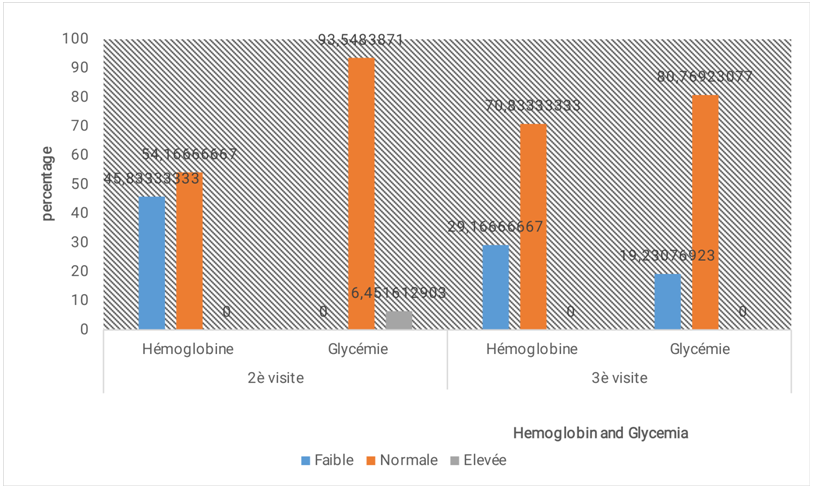
A total of 164 pregnant women aged 15 to 43 were the subject of our study. Almost ¾ have at least the primary level. The distribution of pregnant women according to their nutritional status before pregnancy shows that 32% are overweight against 20% who are undernourished. The evaluation of weight gain during the three (03) prenatal consultations revealed that during the first visit, 32% of pregnant women had insufficient weight gain and 45% excessive weight gain. At the second visit, 22.6% had insufficient weight gain and 32% excessive gain. The third visit allowed us to observe that 12% of pregnant women have insufficient weight gain and 14% excessive weight gain. During her visits, the determination of the hemoglobin level and the blood sugar level allowed us to observe that 62% have their normal hemoglobin level and almost all the pregnant women have a normal blood sugar level. The distribution of pregnant women according to the number of meals per day reveals that 71% of pregnant women have at least 3 meals against 24% who take 2 meals a day. The statistical cross (chi-square test) carried out between weight gain and certain factors shows that there is a significant relationship between the latter and BMI before pregnancy (p=0.000), the age of the pregnant woman (p= 0.001), pregnancy-related complications (p=0.024), and arterial hypertension (p=0.04) confer Table 3.
Pregnancy is a physiological state that requires a balanced diet made up of adequate nutrients for the harmonious development of the future baby. It was a question of closely monitoring the weight gain of pregnant women received in prenatal consultation in a health structure in southern Benin. Our results show that more than half of the pregnant women (66%) are between 20 and 30 years old with an average of 25 ± 5 years. This average is higher than that of 7 i.e. 24.9 years. A statistical comparison between age and gestational weight gain showed the existence of a significant relationship between the two (p=0.001). This result is consistent with those obtained by several authors in their various studies 8, 9, 10, 11. On the other hand, this result is in disagreement with that obtained by 12. In addition, the result relating to the level of education of pregnant women showed that the majority (73 %) have at least the primary level. This rate is higher than that obtained by 13. Isn't it easy to see the non-existence of a significant link between level of education and gestational weight gain (p = 0.21). Our result is contrary to that of 14 who showed that women with low levels of education were more likely to have poor weight gain. The evaluation of the nutritional state of pregnant women before pregnancy showed that 11% of pregnant women are obese. This prevalence is lower than that obtained by 15. These results support the observation that the rate of obese pregnant women is constantly increasing nowadays, and this could be explained by changes in eating habits and extensive sedentarization as a way of life 16, 17, 18.
The evaluation of weight gain during the three (03) prenatal consultations revealed that, respectively, 77.4%, 61% and 26.8% of the women had inadequate weight gain. Our results are close to those found by 19 in an American study. Biological analyzes showed that 29% of pregnant women are anemic. This rate is much lower than that obtained nationally during the Demographic Health Survey in Benin, i.e. 68.4% 20. This difference could be explained by the educational and socioeconomic level of our study population. In addition, taking the blood pressure of pregnant women shows that all pregnant women have normal blood pressure. This result is contrary to that obtained by 21 for whom 98.1% of pregnant women followed were hypertensive. This difference could be explained by the nutritional advice and monitoring that the pregnant women received at the Godomey health center received.
In short, prenatal visits revealed insufficient weight gain in the majority of pregnant women. The factors implicated are BMI before gestation, age, pregnancy-related complications, and high blood pressure. The frequency of prenatal consultations allows adequate weight gain, resulting from nutritional advice and monitoring of pregnant women during their visit. Thus, adequate weight gain during pregnancy is a condition for the delivery of a healthy baby and the future well-being of both child and mother. Therefore, adequate nutritional monitoring is necessary for a normal evolution of pregnancy.
| [1] | Oumarou , Biosci JA (2019); Nutritional status of pregnant women and impact on the birth weight of newborns: case of CSI Madina -Niamey p 13998-13999. | ||
| In article | |||
| [2] | Lambert H. Lumey , MD, Mph , Ph.D., Ezra S. Susser, MD, Drph, (2003), Long-Term Impacts of Prenatal and Early Postnatal Nutrition on Psychosocial Outcomes in Adults. Columbia University,USA Encyclopedia on Early Childhood Development. pp7-11. | ||
| In article | |||
| [3] | FAO, (2001); Nutrition in Developing Countries, Informatics Division, Chapter 5. | ||
| In article | |||
| [4] | lantonirina Ravaoarisoa, Julio Rakotonirina, Daniel Andriamiandrisoa, Perrine Humblet, Jean de Dieu Marie Rakotomanga, (2018); Dietary habits of mothers during pregnancy and lactation, Amoron'i Mania Madagascar region: qualitative study, Pan African Medical Journal. 29: 194. | ||
| In article | View Article | ||
| [5] | WHO, (2013); World Health Statistics, 66p. http://www.who.int/iris/handle/10665/82056. | ||
| In article | |||
| [6] | Kathleen M. Rasmussen and Ann L. Yaktine, Editors; Committee to Reexamine IOM Pregnancy Weight Guidelines; Institute of Medicine; National Research Council (2009). Weight Gain During Pregnancy: Reexamining the Guidelines, ISBN 978-0-309-13113-1, 869 p. | ||
| In article | |||
| [7] | Deruelle P, Vambergue A. (2012); Obesity and pregnancy. Endocrinology in Gynecology and Obstetrics; p209-213 | ||
| In article | View Article | ||
| [8] | Drehmer M, Camey S, Schmidt MI, Olinto MT, Giacomello A, Buss C, et al. (2010); Socioeconomic, demographic and nutritional factors associated with maternal weight gain in general practices in Southern Brazil . CAD Saude Publica ; p24-34. | ||
| In article | View Article | ||
| [9] | Lowelle H, Miller DC. (2010); Weight gain during pregnancy: compliance with Health Canada guidelines. Health Report; p:37-42. | ||
| In article | |||
| [10] | Rodrigues PL, Oliveira LC, Teens SB, Kac G. (2010); Determining factors of insufficient and excessive gestational weight gain and maternal-child adverse outcomes ; p:617-623. | ||
| In article | View Article | ||
| [11] | Goldoni J (2009); The obstetrical and neonatal consequences of excessive weight gain during pregnancy, Henri Poincaré University, Nancy I Albert Fruhinsholz School of Midwifery; p22-25. | ||
| In article | |||
| [12] | Podevin E (2009); Maternal-fetal complications related to excessive weight gain during pregnancy in women with a normal body mass index before pregnancy. End of study dissertation ESF Caen; p: 174-178. | ||
| In article | |||
| [13] | Doubogan CA et al (2016); Community dynamics around the management of maternal and neonatal health in weme environment in Benin : controversies, logics and strategies of the actors p:29-31. | ||
| In article | |||
| [14] | Tingyuan W, Yanwei L. (2015); inadequate gestational weight gain and adverse pregnancy outcomes among normal weight women in China. Int J Clin Exp Med; p:2881-2886. | ||
| In article | |||
| [15] | Djossinou , D. et al (2019); Diet and nutrition of women before and during pregnancy in southern Benin: quality and influencing factors P85-91. | ||
| In article | |||
| [16] | Djelantik AA, Kunst AE, Van Der Wal MF, Smit HA, Vrijkotte TG. (2012); Contribution of overweight and obesity to the occurrence of adverse pregnancy outcomes in a multi-ethnic cohort: attributive population fractions for Amsterdam. BJOG; p283-290. | ||
| In article | View Article | ||
| [17] | Cresswell J, Campbell OM, De Silva MJ, Filippi V (2012); Effect of maternal obesity on neonatal mortality in sub-Saharan Africa: a multivariate analysis of 27 national data sets. Lancets; p1325-1330. | ||
| In article | View Article | ||
| [18] | Poston L, Harthoorn LF, Van Der Beek EM. (2011); Obesity in pregnancy : implications for the mother and lifelong health of the child. A consensus statement . pediatrician Res ; p:175-180. | ||
| In article | View Article | ||
| [19] | Sridhar SB, Xu F, Hedderson MM. (2016); Quarter-Specific Gestational Weight Gain and Infant Size for Gestational Age. PLoS ONE; 159p. | ||
| In article | View Article | ||
| [20] | National Institute of Statistics and Economic Analysis (INSAE) and ICF, 2018. Demographic and Health Survey in Benin, 2017-2018: Key Indicators. Cotonou, Benin and Rockville, Maryland, USA, 74p. | ||
| In article | |||
| [21] | Tchaou BA, Tshabu-aguemon TC, Hounkponou NFM, Adisso S., Aguemon AR, Chobli M. (2013); severity and prognosis of patients treated for severe preeclampsia at the Departmental and University Hospital of Parakou (Benin), Médecine d'Afrique Noire 6011 Novembre, 489-495. | ||
| In article | |||
Published with license by Science and Education Publishing, Copyright © 2022 Béhanzin Gbessohèlè Justin, Bio Bouko Boni Orou Marius, Adebo Amirath Adégnika, Dotou A. Edwige, Yessoufou Abdou Ganiou and Sezan Alphonse
 This work is licensed under a Creative Commons Attribution 4.0 International License. To view a copy of this license, visit
http://creativecommons.org/licenses/by/4.0/
This work is licensed under a Creative Commons Attribution 4.0 International License. To view a copy of this license, visit
http://creativecommons.org/licenses/by/4.0/
| [1] | Oumarou , Biosci JA (2019); Nutritional status of pregnant women and impact on the birth weight of newborns: case of CSI Madina -Niamey p 13998-13999. | ||
| In article | |||
| [2] | Lambert H. Lumey , MD, Mph , Ph.D., Ezra S. Susser, MD, Drph, (2003), Long-Term Impacts of Prenatal and Early Postnatal Nutrition on Psychosocial Outcomes in Adults. Columbia University,USA Encyclopedia on Early Childhood Development. pp7-11. | ||
| In article | |||
| [3] | FAO, (2001); Nutrition in Developing Countries, Informatics Division, Chapter 5. | ||
| In article | |||
| [4] | lantonirina Ravaoarisoa, Julio Rakotonirina, Daniel Andriamiandrisoa, Perrine Humblet, Jean de Dieu Marie Rakotomanga, (2018); Dietary habits of mothers during pregnancy and lactation, Amoron'i Mania Madagascar region: qualitative study, Pan African Medical Journal. 29: 194. | ||
| In article | View Article | ||
| [5] | WHO, (2013); World Health Statistics, 66p. http://www.who.int/iris/handle/10665/82056. | ||
| In article | |||
| [6] | Kathleen M. Rasmussen and Ann L. Yaktine, Editors; Committee to Reexamine IOM Pregnancy Weight Guidelines; Institute of Medicine; National Research Council (2009). Weight Gain During Pregnancy: Reexamining the Guidelines, ISBN 978-0-309-13113-1, 869 p. | ||
| In article | |||
| [7] | Deruelle P, Vambergue A. (2012); Obesity and pregnancy. Endocrinology in Gynecology and Obstetrics; p209-213 | ||
| In article | View Article | ||
| [8] | Drehmer M, Camey S, Schmidt MI, Olinto MT, Giacomello A, Buss C, et al. (2010); Socioeconomic, demographic and nutritional factors associated with maternal weight gain in general practices in Southern Brazil . CAD Saude Publica ; p24-34. | ||
| In article | View Article | ||
| [9] | Lowelle H, Miller DC. (2010); Weight gain during pregnancy: compliance with Health Canada guidelines. Health Report; p:37-42. | ||
| In article | |||
| [10] | Rodrigues PL, Oliveira LC, Teens SB, Kac G. (2010); Determining factors of insufficient and excessive gestational weight gain and maternal-child adverse outcomes ; p:617-623. | ||
| In article | View Article | ||
| [11] | Goldoni J (2009); The obstetrical and neonatal consequences of excessive weight gain during pregnancy, Henri Poincaré University, Nancy I Albert Fruhinsholz School of Midwifery; p22-25. | ||
| In article | |||
| [12] | Podevin E (2009); Maternal-fetal complications related to excessive weight gain during pregnancy in women with a normal body mass index before pregnancy. End of study dissertation ESF Caen; p: 174-178. | ||
| In article | |||
| [13] | Doubogan CA et al (2016); Community dynamics around the management of maternal and neonatal health in weme environment in Benin : controversies, logics and strategies of the actors p:29-31. | ||
| In article | |||
| [14] | Tingyuan W, Yanwei L. (2015); inadequate gestational weight gain and adverse pregnancy outcomes among normal weight women in China. Int J Clin Exp Med; p:2881-2886. | ||
| In article | |||
| [15] | Djossinou , D. et al (2019); Diet and nutrition of women before and during pregnancy in southern Benin: quality and influencing factors P85-91. | ||
| In article | |||
| [16] | Djelantik AA, Kunst AE, Van Der Wal MF, Smit HA, Vrijkotte TG. (2012); Contribution of overweight and obesity to the occurrence of adverse pregnancy outcomes in a multi-ethnic cohort: attributive population fractions for Amsterdam. BJOG; p283-290. | ||
| In article | View Article | ||
| [17] | Cresswell J, Campbell OM, De Silva MJ, Filippi V (2012); Effect of maternal obesity on neonatal mortality in sub-Saharan Africa: a multivariate analysis of 27 national data sets. Lancets; p1325-1330. | ||
| In article | View Article | ||
| [18] | Poston L, Harthoorn LF, Van Der Beek EM. (2011); Obesity in pregnancy : implications for the mother and lifelong health of the child. A consensus statement . pediatrician Res ; p:175-180. | ||
| In article | View Article | ||
| [19] | Sridhar SB, Xu F, Hedderson MM. (2016); Quarter-Specific Gestational Weight Gain and Infant Size for Gestational Age. PLoS ONE; 159p. | ||
| In article | View Article | ||
| [20] | National Institute of Statistics and Economic Analysis (INSAE) and ICF, 2018. Demographic and Health Survey in Benin, 2017-2018: Key Indicators. Cotonou, Benin and Rockville, Maryland, USA, 74p. | ||
| In article | |||
| [21] | Tchaou BA, Tshabu-aguemon TC, Hounkponou NFM, Adisso S., Aguemon AR, Chobli M. (2013); severity and prognosis of patients treated for severe preeclampsia at the Departmental and University Hospital of Parakou (Benin), Médecine d'Afrique Noire 6011 Novembre, 489-495. | ||
| In article | |||